
2 Chronicles 20:7

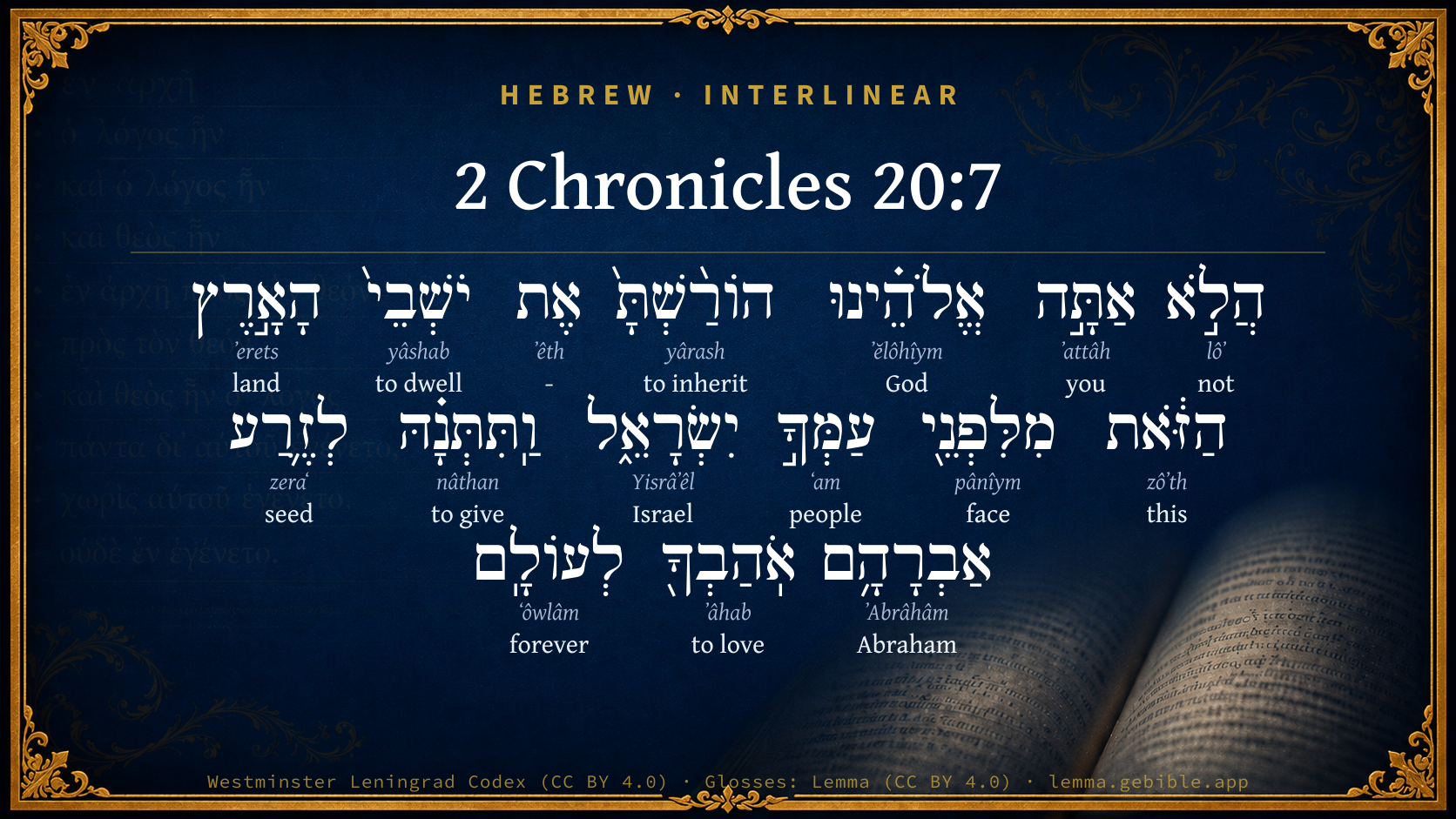
Hebrew (Westminster Leningrad Codex) 2 Chronicles 20:7 appears in the Hebrew Old Testament. The text above is from the Westminster Leningrad Codex. Each word links to its Strong’s number, a concise gloss, and parsing drawn from the Open Scriptures Hebrew Bible morphology. Click any word for its full Brown-Driver-Briggs (BDB) entry.
Download image
Cite this verse

2 Chronicles 20:7 (World English Bible). Public Domain. Lemma interlinear Bible study tool, https://lemma.gebible.app/v/2-chronicles/20/7.

Show BibTeX & RIS
BibTeX
RIS
English Translation
Did not you, our God, drive out the inhabitants of this land before your people Israel, and give it to the seed of Abraham your friend forever?
World English Bible · Public Domain
Download a study sheet

One document with this verse’s original text, its word-by-word gloss line, the meaning frame, cross-references with their text, attributed commentary, and full source and license credits — printable, and it pastes into notes with its structure intact.

This verse Autodidact and up

Study sheet (.html) Plain text (.txt)

A passage Seminary Student

Up to 50 verses in one chapter. A passage sheet keeps up to 6 commentary sources and 12 cross-references per verse, in the order this page ranks them, and says so on the sheet whenever that leaves anything out. Ask for a single verse and you get the Autodidact verse sheet above.

Everything on this page stays free to read, with no account — the sheet is a download of what is already on screen, not access to it.

Want to remove ads? Support Godless Engineer
Compare translations 3

The same verse in 3 English versions, stacked beneath the original-language interlinear above. Click any original word for its lexicon entry.

Each is an independent rendering of the whole verse — the interlinear is not word-aligned to these translations.

Highlighted words mark where these versions differ — a whole-verse word diff, not a word-by-word alignment.

  • World English Bible Public Domain
    Did not you, our God, drive out the inhabitants of this land before your people Israel, and give it to the seed of Abraham your friend forever?
  • King James Version Public Domain
    Art not thou our God, who didst drive out the inhabitants of this land before thy people Israel, and gavest it to the seed of Abraham thy friend for ever?
  • unfoldingWord Literal Text CC BY-SA 4.0
    Did you yourself our God not drive out the inhabitants of this land from before your people Israel, and give it to the seed of Abraham, the one who loved you, forever?

unfoldingWord Literal Text — © unfoldingWord, licensed CC BY-SA 4.0. Word-aligned USFM3 via Door43 (git.door43.org/unfoldingWord/en_ult).

Versions to compare (up to 4)

3 of 4 selected

Show all 18 translations

Every available English version of this verse, each an independent rendering of the whole verse.

  • World English Bible Public Domain
    Did not you, our God, drive out the inhabitants of this land before your people Israel, and give it to the seed of Abraham your friend forever?
  • Berean Standard Bible Public Domain
    Our God, did You not drive out the inhabitants of this land before Your people Israel and give it forever to the descendants of Abraham Your friend?
  • Majority Standard Bible Public Domain
    Our God, did You not drive out the inhabitants of this land before Your people Israel and give it forever to the descendants of Abraham Your friend?
  • King James Version Public Domain
    Art not thou our God, who didst drive out the inhabitants of this land before thy people Israel, and gavest it to the seed of Abraham thy friend for ever?
  • American Standard Version (1901) Public Domain
    Didst not thou, O our God, drive out the inhabitants of this land before thy people Israel, and give it to the seed of Abraham thy friend for ever?
  • Revised Version (1885) Public Domain
    Didst not thou, O our God, drive out the inhabitants of this land before thy people Israel, and gavest it to the seed of Abraham thy friend for ever?
  • Geneva Bible (1599) Public Domain
    Diddest not thou our God cast out ye inhabitants of this lande before thy people Israel, and gauest it to the seede of Abraham thy friende for euer?
  • Douay-Rheims (1899) Public Domain
    Didst not thou our God kill all the inhabitants of this land before thy people Israel, and gavest it to the seed of Abraham thy friend for ever?
  • Young's Literal Translation Public Domain
    `Art not Thou our God? Thou hast dispossessed the inhabitants of this land from before Thy people Israel, and dost give it to the seed of Abraham Thy friend to the age,
  • Literal Standard Version CC BY-SA 4.0
    Are You not our God? You have dispossessed the inhabitants of this land from before Your people Israel, and give it to the seed of Your friend Abraham for all time,
  • Unlocked Literal Bible CC BY-SA 4.0
    Our God, did you not drive out the inhabitants of this land before your people Israel, and give it forever to the descendants of Abraham?
  • unfoldingWord Literal Text CC BY-SA 4.0
    Did you yourself our God not drive out the inhabitants of this land from before your people Israel, and give it to the seed of Abraham, the one who loved you, forever?
  • Darby Bible Public Domain
    Hast not thou, our God, dispossessed the inhabitants of this land before thy people Israel, and given it for ever to the seed of Abraham, thy friend?
  • World Messianic Bible Public Domain
    Didn’t you, our God, drive out the inhabitants of this land before your people Israel, and give it to the offspring of Abraham your friend forever?
  • Webster's Bible Public Domain
    Art not thou our God, who didst drive out the inhabitants of this land before thy people Israel, and give it to the seed of Abraham thy friend for ever?
  • Free Bible Version CC BY-SA 4.0
    Our God, didn't you drive out before your people Israel those who were living in this land? Didn't you give this land to the descendants of your friend Abraham forever?
  • Bible in Basic English Public Domain
    Did you not, O Lord our God, after driving out the people of this land before your people Israel, give it to the seed of Abraham, your friend, for ever?
  • JPS Tanakh (1917) Public Domain
    Didst not Thou, O our God, drive out the inhabitants of this land before Thy people Israel, and gavest it to the seed of Abraham Thy friend for ever?

Literal Standard Version (2020), Covenant Press — licensed CC BY-SA 4.0. Text via the HelloAO Bible API (eBible.org). Unlocked Literal Bible (unfoldingWord) — licensed CC BY-SA 4.0. Text via the HelloAO Bible API (eBible.org). unfoldingWord Literal Text — © unfoldingWord, licensed CC BY-SA 4.0. Word-aligned USFM3 via Door43 (git.door43.org/unfoldingWord/en_ult). Free Bible Version, Dr. Jonathan Gallagher — licensed CC BY-SA 4.0. Text via the HelloAO Bible API (eBible.org).

Word by word

More ways to search: Search by grammar → Find every occurrence → Compare this word →

Practice this passage: Drill this verse → Learn its vocabulary →

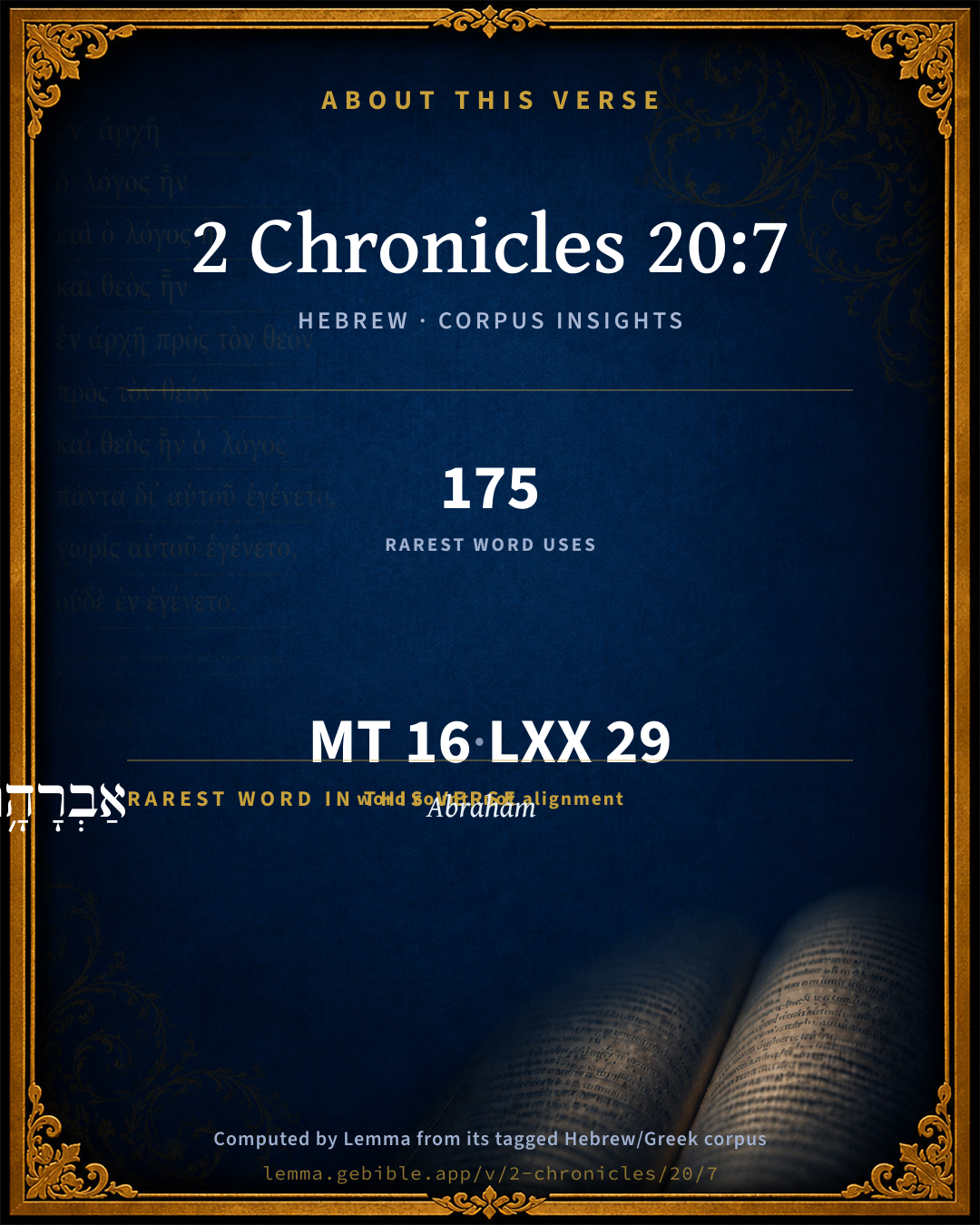
אַבְרָהָ֥ם
ʼAbrâhâm
H85
“Abraham”
Noun, Proper
Part of Speech
Noun
Type
Proper
Full BDB Definition

Origin: contracted from H1 and an unused root (probably meaning to be populous)

TWOT: 4b

Abraham = "father of a multitude" or " chief of multitude" - friend of God and founder of Hebrew nation via God's elective covenant
  1. הֲלֹ֣א lôʼ H3808 “not” Particle, Interrogative + Particle, Negative
  2. אַתָּ֣ה ʼattâh H859 “you” Pronoun, Personal, 2nd Person, Masculine, Singular
  3. אֱלֹהֵ֗ינוּ ʼĕlôhîym H430 “God(s) · our” Noun, Common, Masculine, Plural, Construct + Suffix, Personal, 1st Person, Common, Plural
  4. הוֹרַ֨שְׁתָּ֙ yârash H3423 “to inherit” Verb, Hiphil, Perfect, 2nd Person, Masculine, Singular
  5. אֶת ʼêth H853 “-” Particle, Direct Object
  6. יֹשְׁבֵי֙ yâshab H3427 “dwelling” Verb, Qal, Participle Active, Masculine, Plural, Construct
  7. הָאָ֣רֶץ ʼerets H776 “the · land” Particle, Definite Article + Noun, Common, Both, Singular, Absolute
  8. הַזֹּ֔את zôʼth H2063 “the · this” Particle, Definite Article + Pronoun, Demonstrative, Feminine, Singular
  9. מִלִּפְנֵ֖י pânîym H6440 “from · to/for · face(s) of” Preposition + Preposition + Noun, Common, Both, Plural, Construct
  10. עַמְּךָ֣ ʻam H5971 “people · your” Noun, Common, Masculine, Singular, Construct + Suffix, Personal, 2nd Person, Masculine, Singular
  11. יִשְׂרָאֵ֑ל Yisrâʼêl H3478 “Israel” Noun, Proper
  12. וַֽתִּתְּנָ֗הּ nâthan H5414 “and · to give · her” Conjunction + Verb, Qal, Sequential Imperfect, 2nd Person, Masculine, Singular + Suffix, Personal, 3rd Person, Feminine, Singular
  13. לְזֶ֛רַע zeraʻ H2233 “to/for · seed of” Preposition + Noun, Common, Masculine, Singular, Construct
  14. אֹֽהַבְךָ֖ ʼâhab H157 “loving · you” Verb, Qal, Participle Active, Masculine, Singular, Construct + Suffix, Personal, 2nd Person, Masculine, Singular
  15. לְעוֹלָֽם ʻôwlâm H5769 “to/for · forever” Preposition + Noun, Common, Masculine, Singular, Absolute

About this verse

These counts appear in no published source. They are computed here, from the morphology-tagged text and Lemma’s own curated glosses. What Lemma adds →

16
words
16
distinct lemmas
Historical
section

Grammatical profile

  • 4 verbs
  • 8 nouns
  • 2 pronouns
  • 2 particles

Verb forms

  • הוֹרַ֨שְׁתָּ֙ Hiphil · Perfect
  • יֹשְׁבֵי֙ Qal · Participle Active
  • וַֽתִּתְּנָ֗הּ Qal · Sequential Imperfect
  • אֹֽהַבְךָ֖ Qal · Participle Active

Hebrew & Septuagint length

In English translation the verse runs 27 words from the Hebrew and 32 from the Septuagint (LXX English) — closely comparable.

A rough comparison of the two English renderings, which tokenize alike — not a word-level alignment.

Word counts can differ between the Hebrew and the Greek without any difference in meaning — e.g. the Hebrew direct-object marker אֵת has no separate Greek word, and Greek often adds the article ὁ.

In the original languages it is 16 Hebrew tokens and 29 Greek tokens — but the two are counted differently (Hebrew bundles its prefixes and suffixes into one token; the Greek is in lemma form), so that isn’t a like-for-like length.

Cross-references

17

Topical passages linked to 2 Chronicles 20:7 in the Treasury of Scripture Knowledge — connected by theme and wording, ordered by reader-vote popularity; previews shown in the World English Bible.

  • Isaiah 41:8 But you, Israel, my servant, Jacob whom I have chosen, the seed of Abraham my friend,
  • James 2:23 and the Scripture was fulfilled which says, "Abraham believed God, and it was accounted to him as righteousness;" and he was called the friend of God.
  • Genesis 12:7 Yahweh appeared to Abram, and said, "I will give this land to your seed." He built an altar there to Yahweh, who appeared to him.
  • Psalms 44:2 You drove out the nations with your hand, But you planted them. You afflicted the peoples, But you spread them abroad.
  • Genesis 13:15 for all the land which you see, I will give to you, and to your offspring forever.
  • Joshua 24:3 I took your father Abraham from beyond the River, and led him throughout all the land of Canaan, and multiplied his seed, and gave him Isaac.
  • Nehemiah 9:8 and found his heart faithful before you, and made a covenant with him to give the land of the Canaanite, the Hittite, the Amorite, and the Perizzite, and the Jebusite, and the Girgashite, to give it to his seed, and have performed your words; for you are righteous.
  • Exodus 6:7 and I will take you to me for a people, and I will be to you a God; and you shall know that I am Yahweh your God, who brings you out from under the burdens of the Egyptians.
  • Exodus 33:2 I will send an angel before you; and I will drive out the Canaanite, the Amorite, and the Hittite, and the Perizzite, the Hivite, and the Jebusite:
  • 1 Chronicles 17:21–24 What one nation in the earth is like your people Israel, whom God went to redeem to himself for a people, to make you a name by great and awesome things, in driving out nations from before your people, whom you redeem out of Egypt?
  • 2 Chronicles 14:11 Asa cried to Yahweh his God, and said, Yahweh, there is none besides you to help, between the mighty and him who has no strength: help us, Yahweh our God; for we rely on you, and in your name are we come against this multitude. Yahweh, you are our God; don't let man prevail against you.
  • Genesis 17:7 I will establish my covenant between me and you and your seed after you throughout their generations for an everlasting covenant, to be a God to you and to your seed after you.
  • Exodus 19:5–7 Now therefore, if you will indeed obey my voice, and keep my covenant, then you shall be my own possession from among all peoples; for all the earth is mine;
  • Exodus 20:2 "I am Yahweh your God, who brought you out of the land of Egypt, out of the house of bondage.
  • John 11:11 He said these things, and after that, he said to them, "Our friend, Lazarus, has fallen asleep, but I am going so that I may awake him out of sleep."
  • Joshua 24:13 I gave you a land whereon you had not labored, and cities which you didn't build, and you dwell therein; of vineyards and olive groves which you didn't plant do you eat.
  • John 15:15 No longer do I call you servants, for the servant doesn't know what his lord does. But I have called you friends, for everything that I heard from my Father, I have made known to you.

Cross-references courtesy of OpenBible.info (CC BY 4.0).

Hebrew and Greek witnesses Masoretic Hebrew ↔ Greek Septuagint

The same verse in the two great witnesses to the Old Testament, shown verse-for-verse.

These are two independent witnesses, not word-aligned to each other, and the Septuagint is shown in lemma (dictionary) form.

Hebrew 2 Chronicles 20:7 Masoretic · Westminster Leningrad Codex

הֲלֹ֣א אַתָּ֣ה אֱלֹהֵ֗ינוּ הוֹרַ֨שְׁתָּ֙ אֶת יֹשְׁבֵי֙ הָאָ֣רֶץ הַזֹּ֔את מִלִּפְנֵ֖י עַמְּךָ֣ יִשְׂרָאֵ֑ל וַֽתִּתְּנָ֗הּ לְזֶ֛רַע אַבְרָהָ֥ם אֹֽהַבְךָ֖ לְעוֹלָֽם

Did not you, our God, drive out the inhabitants of this land before your people Israel, and give it to the seed of Abraham your friend forever?

World English Bible · Public Domain

Greek LXX 2 Chronicles 20:7 Septuagint · lemma form

οὐ σύ εἰμί ὁ κύριος ὁ ἐκὀλεθρεύω ὁ καταοἰκέω ὁ γῆ οὗτος ἀπό πρόσωπον ὁ λαός σύ ἰσραήλ καί δίδωμι αὐτός σπέρμα ἀβραάμ ὁ ἀγαπάω σύ εἰς ὁ αἰών

Are not you the Lord that did destroy the inhabitants of this land before the face of your people Israel, and did give it to your beloved seed of Abraham for ever?

LXX2012 (modern English Septuagint) · Public Domain

Hebrew: Westminster Leningrad Codex (CC BY 4.0). Greek: Septuagint (public domain); English from LXX2012 (modern English Septuagint) (Public Domain). How the Septuagint differs from the Hebrew →

Commentary

Notes on 2 Chronicles 20:7 from classic Christian and Jewish commentators (each source and its license shown beneath its notes). The classic Christian expositions comment on the surrounding passage and are grouped to its opening verse, so a note may address several verses; the Jewish commentaries on the Tanakh (Rashi and others) are per-verse, so they appear only where the commentator wrote on this verse.

Lemma curates 59 commentaries, every one of them public domain or Creative Commons licensed, each selected and text-cleaned for this edition rather than reprinted as found. About our sources →

Trapp's Complete Commentary

John Trapp

2Ch 20:7 [Art] not thou our God, [who] didst drive out the inhabitants of this land before thy people Israel, and gavest it to the seed of Abraham thy friend for ever?

Ver. 7. Art not thou our God?] God’s might and his mercy are faith’s Jachin and Boaz, whereon it resteth.

And gavest it to the seed of Abraham.] So that we are thy tenants, thy vassals; and wilt not thou see to us? Sure thou wilt.

John Trapp, A Commentary or Exposition upon All the Books of the Old and New Testament (1647–1656) — public domain. Text from a community e-Sword module.

Geneva Bible (1599)

Geneva Bible translators

He groundeth his prayer upon God’s power, whereby he is able to help, and also on his mercy, which he will continue toward his, forasmuch as he hath once chosen them and began to show his graces toward them.

Geneva Bible (1599) marginal notes — public domain. Text via Bolls.life.

Adam Clarke's Commentary

Verse 7. Art not thou our God] "Hast not thou, by thy WORD, driven out." - Targum.

Adam Clarke's Commentary on the Bible (1810–1826) — public domain. Text from a community e-Sword/MySword module.

Ellicott's Commentary for English Readers

(7) Art not thou our God?—Didst not Thou, our God, drive out, &c. (Comp. Jos_23:5; Jos_23:9; Deu_4:38; Deu_11:23; and for the form of appeal, Isa. Ii. 9, 10. Comp. also Psa_47:3-4.)

And gavest it to the seed of Abraham.—According to the Promise, Gen_13:15-16; Gen_15:18.

For ever.—Gen_17:8, “for an everlasting possession.”

Thy friend.—Or, lover. So Isa_41:8, “seed of Abraham, my friend.” This title of Abraham is mentioned again by St. James (Jas_2:23). Hebron, the patriarch’s burial-place, is at this day known to the Muslim world as el-Khalil, “the Friend.”

A Bible Commentary for English Readers, edited by Charles John Ellicott (1878–1897) — public domain. Text from a community e-Sword module.

The Cambridge Bible for Schools and Colleges

gen. ed. J. J. S. Perowne

7. Art not thou our God, who didst drive out] R.V. Didst not thou, O our God, drive out. Cp. Deu_9:5.

thy friend] Cp. Isa_41:8.

The Cambridge Bible for Schools and Colleges (gen. ed. J. J. S. Perowne; Cambridge University Press, 1878–1918) — public domain. Text from a community e-Sword module.

John Gill's Exposition

Art not thou our God,.... In a peculiar sense, not merely as the Creator and Governor of men, but in a covenant relation their covenant God and Father:

who didst drive out the inhabitants of the land before thy people Israel; the seven nations of Canaan, to make way and room for Israel:

and gavest it to the seed of Abraham thy friend for ever? made a deed of gift of it to them, and settled it on them till the coming of the Messiah, and that as an instance of love and friendship to Abraham; and wilt thou therefore suffer it to be taken from his seed?

John Gill's Exposition of the Whole Bible (1746–1763) — public domain (CC PDM 1.0). Text via the HelloAO Bible API.

Haydock's Catholic Bible Commentary

All, or the greatest part. Heb. "drive out the inhabitants." H.

George Leo Haydock (1774–1849), Haydock's Catholic Family Bible and Commentary, 1859 edition — public domain. Excludes Psalms (Douay-Rheims chapter numbering differs from Protestant) and Deuterocanonical books (Catholic canon only).

Matthew Poole's English Annotations

i.e. To whom thou hast engaged thyself by covenant to be his friend, and the friend of his seed for ever, and therefore we trust thou wilt not forsake us his posterity.

Matthew Poole's English Annotations on the Holy Bible (1683–1685) — public domain. Text from a community e-Sword/MySword module.

The Pulpit Commentary

Friendship with God.

"Abraham thy friend.

1. Before Jesus came to reveal God to our race as he did reveal him, theEternal One was known and worshipped chiefly as the Almighty One, or as the Creator of all things, or as the Divine Sovereign, whose rule we are bound to obey. Not exclusively; for he was known as the Father of men (Deu_32:6; 1Ch_29:10; Isa_63:16 Isa_64:8; Psa_103:13) Here also he is spoken of as a Friend (and see (Isa_41:8; Jam_2:23) But it is evident that it was only in a restricted sense, and by a very limited number, that God was thus apprehended.

2. It was Jesus Christ that revealed the Father as the Father of souls; it washe who taught us to address him as such, to think and speak of him as such, to approach him and to live before him as such.

3. It is Jesus Christ also who has enabled us to think and to feel towardGod as our Friend. "I have called you friends," he said to his disciples. (Joh_15:15) And he has so related himself to us that in him we can recognize God as our Divine Friend; as One of whom we may rightly speak, and toward whom we may venture to feel and to act as our Friend indeed. But on what ground and in what respects? On the ground of

I RECIPROCATED LOVE; including, what all true love must include, both affection and trust. God loves us. He loves us with parental affection, as his children who were once indeed estranged from him, but are now reconciled unto him; as those who have become endeared to him, both by his great sacrifice for their sake, and by their seeking after him and surrender of themselves to him. And God trusts us. He does not treat us as slaves, but as sons; he does not lay down a strict and severe code of rules by which our daily conduct is to be regulated; he gives us a few broad principles, and he trusts us to apply them to our own circumstances. We, in return, love and trust him. Not having seen him, but having understood his character and his disposition toward us in Jesus Christ, having realized how great and all-surpassing was his kindness toward us in him, (Tit_3:4) we love him in response. (1Jn_4:19) And in him, in his faithfulness and in his wisdom and in his goodness, we have an unfaltering trust. Thus we have the reciprocal love of friendship.

II CLOSE RESEMBLANCE OF CHARACTER AND SYMPATHY. There cannot be friendship worthy of the name where there is not this. Our character and our sympathies must be essentially alike, must be substantially the same. And so it is with the Divine Lord and those who worthily bear his Name. His character is theirs; his principles are theirs; his sympathies are theirs. What he loves and what he hates, they love and they hate. Towards all that to which (and towards all those to whom) he is drawn, they are drawn; that which repels him repels them. Here is the true basis of friendship, and even that distance of nature that separates the Divine from the human is no barrier in the way. Being so essentially like Christ as his true followers are, they are his friends and he is theirs.

III ONENESS OF AIM AND ACTION. Friendship is established and nourished by a common aim and by fellow-labouring. They who join heart and hand in any noble enterprise become united together in strong bonds of true companionship. It is so with our Master and ourselves. He is engaged in the sublime task of recovering a lost world to the knowledge, the love, the likeness of God; so are we. He has laboured and suffered to achieve that most glorious end; so do we. We are "workers together with him." His cause is ours; he and we are bent on the fulfilment of the same great purpose; and while he works through us and in us, he also works with us in this greatest and noblest of all earthly aims. "We are labourers together with God"; (1Co_3:9) "We then, as workers together with. (2Co_6:1) We are his friends. Let us:

1. Realize how high is the honour he has thus conferred upon us.

2. See that we walk worthily of such a lofty estate.

3. Take care that we never do that or become that which will make usforfeit so great a heritage. Let us be found faithful as the friends of God. C.

The Pulpit Commentary (1880–1919), ed. H.D.M. Spence-Jones & Joseph S. Exell — public domain. Text from a community e-Sword module.

John Wesley's Explanatory Notes

Abraham - To whom thou hast engaged thyself by covenant to be his friend, and the friend of his seed forever. 9. The sword - Or rather, the sword of judgement or of vengeance, that is, war, whereby thou punisheth thy people for their sins.

John Wesley, Explanatory Notes Upon the Whole Bible (1754–1765) — public domain. Text via the GEBible commentary corpus.

Rashi

Rabbi Shlomo Yitzchaki (Rashi)

and given it to the seed of Abraham Therefore, it is incumbent upon You to preserve it in their hands and to drive these peoples out. Even a flesh and blood king, and even an ordinary man, when he gives a present to his friend and someone comes to rob him of it, he exerts himself to preserve it in his hand. How much more so [should] You [do so]! Perhaps You will say, “I gave it to them only temporarily.” Therefore, it says, “forever.” You gave it to us for an eternal inheritance.

Rashi on the Tanakh — English translations: “The Judaica Press complete Tanach with Rashi, translated by A. J. Rosenberg” (CC BY 4.0); “Pentateuch with Rashi's commentary by M. Rosenbaum and A.M. Silbermann, 1929-1934” (public domain); “The Metsudah Tanach series, Lakewood, N.J” (CC BY 4.0); and “The Book of Joshua, Metsudah Publications, 1997” (CC BY 4.0). Text via Sefaria.

Lesson kit

Teaching starters — assembled from the data on this page, not authored interpretation. Every prompt links to the verse data it draws on. Edit before teaching.

2 Chronicles, in the Historical, opens this verse with 16 words (16 distinct Hebrew lemmas). Its most distinctive word is ʼAbrâhâm (“Abraham”). A historical commentator’s framing appears above. Read the whole chapter for the surrounding context.

Discussion questions

  1. What does “Abraham” (ʼAbrâhâm) contribute to the verse as a whole?
  2. How does Isaiah 41:8, which shares this passage’s theme, read alongside this verse?
  3. These translations render this verse differently; the difference is in the English rendering, not the original. What questions does that raise?
  4. «הוֹרַ֨שְׁתָּ֙» is a Hiphil Perfect verb. How does that grammatical form shape the action described?
  5. Compare how Trapp's Complete Commentary and Geneva Bible (1599) read this verse. Where do they agree or differ?

Things to notice

Reading settings

Reading text

Shown beneath each verse's original-language words.

Old Testament
Old Testament edition

Read the OT as the Masoretic Hebrew (MT) or the Greek Septuagint (LXX).

English shown for the Greek Septuagint (in the Hebrew ↔ Greek comparison).

Comparing translations? Open the Compare panel on any verse page to stack up to four side by side.