Proverbs 1:22

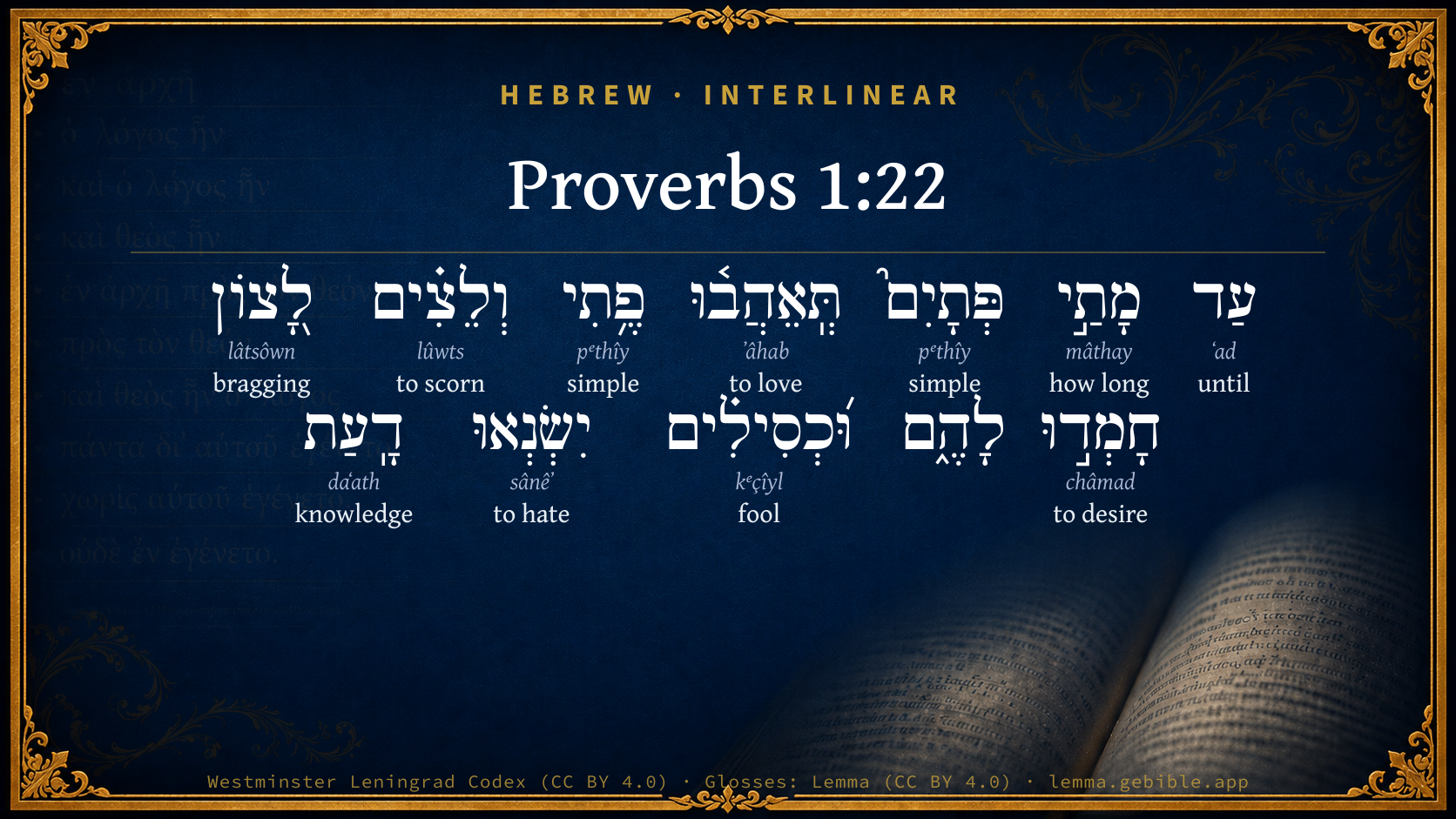
Hebrew (Westminster Leningrad Codex) Proverbs 1:22 appears in the Hebrew Old Testament. The text above is from the Westminster Leningrad Codex. Each word links to its Strong’s number, a concise gloss, and parsing drawn from the Open Scriptures Hebrew Bible morphology. Click any word for its full Brown-Driver-Briggs (BDB) entry.
Download image
Cite this verse

Proverbs 1:22 (World English Bible). Public Domain. Lemma interlinear Bible study tool, https://lemma.gebible.app/v/proverbs/1/22.

Show BibTeX & RIS
BibTeX
RIS
English Translation
"How long, you simple ones, will you love simplicity? How long will mockers delight themselves in mockery, And fools hate knowledge?
World English Bible · Public Domain
Highlights Full analysis ↓
Download a study sheet

One document with this verse’s original text, its word-by-word gloss line, the meaning frame, cross-references with their text, attributed commentary, and full source and license credits — printable, and it pastes into notes with its structure intact.

This verse Autodidact and up

Study sheet (.html) Plain text (.txt)

A passage Seminary Student

Up to 50 verses in one chapter. A passage sheet keeps up to 6 commentary sources and 12 cross-references per verse, in the order this page ranks them, and says so on the sheet whenever that leaves anything out. Ask for a single verse and you get the Autodidact verse sheet above.

Everything on this page stays free to read, with no account — the sheet is a download of what is already on screen, not access to it.

Want to remove ads? Support Godless Engineer
Compare translations 3

The same verse in 3 English versions, stacked beneath the original-language interlinear above. Click any original word for its lexicon entry.

Each is an independent rendering of the whole verse — the interlinear is not word-aligned to these translations.

Highlighted words mark where these versions differ — a whole-verse word diff, not a word-by-word alignment.

  • World English Bible Public Domain
    "How long, you simple ones, will you love simplicity? How long will mockers delight themselves in mockery, And fools hate knowledge?
  • King James Version Public Domain
    How long, ye simple ones, will ye love simplicity? and the scorners delight in their scorning, and fools hate knowledge?
  • unfoldingWord Literal Text CC BY-SA 4.0
    “Until when will naive ones love naiveté and mockers delight mockery for themselves and stupid ones hate knowledge?

unfoldingWord Literal Text — © unfoldingWord, licensed CC BY-SA 4.0. Word-aligned USFM3 via Door43 (git.door43.org/unfoldingWord/en_ult).

Versions to compare (up to 4)

3 of 4 selected

Show all 18 translations

Every available English version of this verse, each an independent rendering of the whole verse.

  • World English Bible Public Domain
    "How long, you simple ones, will you love simplicity? How long will mockers delight themselves in mockery, And fools hate knowledge?
  • Berean Standard Bible Public Domain
    “How long, O simple ones, will you love your simple ways? How long will scoffers delight in their scorn and fools hate knowledge?
  • Majority Standard Bible Public Domain
    “How long, O simple ones, will you love your simple ways? How long will scoffers delight in their scorn and fools hate knowledge?
  • King James Version Public Domain
    How long, ye simple ones, will ye love simplicity? and the scorners delight in their scorning, and fools hate knowledge?
  • American Standard Version (1901) Public Domain
    How long, ye simple ones, will ye love simplicity? And scoffers delight them in scoffing, And fools hate knowledge?
  • Revised Version (1885) Public Domain
    How long, ye simple ones, will ye love simplicity? and scorners delight them in scorning, and fools hate knowledge?
  • Geneva Bible (1599) Public Domain
    O ye foolish, howe long will ye loue foolishnes? and the scornefull take their pleasure in scorning, and the fooles hate knowledge?
  • Douay-Rheims (1899) Public Domain
    O children, how long will you love childishness, and fools covet those things which are hurtful to themselves, and the unwise hate knowledge?
  • Young's Literal Translation Public Domain
    `Till when, ye simple, do ye love simplicity? And have scorners their scorning desired? And do fools hate knowledge?
  • Literal Standard Version CC BY-SA 4.0
    “Until when, you simple, do you love simplicity? And have scorners desired their scorning? And do fools hate knowledge?
  • Unlocked Literal Bible CC BY-SA 4.0
    “How long, you naive people, will you love being naive? How long, you mockers, will you delight in mockery, and how long, you fools, will you hate knowledge?
  • unfoldingWord Literal Text CC BY-SA 4.0
    “Until when will naive ones love naiveté and mockers delight mockery for themselves and stupid ones hate knowledge?
  • Darby Bible Public Domain
    How long, simple ones, will ye love simpleness, and scorners take pleasure in their scorning, and the foolish hate knowledge?
  • World Messianic Bible Public Domain
    “How long, you simple ones, will you love simplicity? How long will mockers delight themselves in mockery, and fools hate knowledge?
  • Webster's Bible Public Domain
    How long, ye simple ones, will ye love simplicity? and the scorners delight in their scorning, and fools hate knowledge?
  • Free Bible Version CC BY-SA 4.0
    “How long will you stupid people love stupidity? How long will scornful people enjoy their mocking? How long will fools hate knowledge?
  • Bible in Basic English Public Domain
    How long, you simple ones, will foolish things be dear to you? and pride a delight to the haters of authority? how long will the foolish go on hating knowledge?
  • JPS Tanakh (1917) Public Domain
    'How long, ye thoughtless, will ye love thoughtlessness? And how long will scorners delight them in scorning, and fools hate knowledge?

Literal Standard Version (2020), Covenant Press — licensed CC BY-SA 4.0. Text via the HelloAO Bible API (eBible.org). Unlocked Literal Bible (unfoldingWord) — licensed CC BY-SA 4.0. Text via the HelloAO Bible API (eBible.org). unfoldingWord Literal Text — © unfoldingWord, licensed CC BY-SA 4.0. Word-aligned USFM3 via Door43 (git.door43.org/unfoldingWord/en_ult). Free Bible Version, Dr. Jonathan Gallagher — licensed CC BY-SA 4.0. Text via the HelloAO Bible API (eBible.org).

Word by word

More ways to search: Search by grammar → Find every occurrence → Compare this word →

Practice this passage: Drill this verse → Learn its vocabulary →

לָ֭צוֹן
lâtsôwn
H3944
“bragging”
Noun, Common, Masculine, Singular, Absolute
Part of Speech
Noun
Type
Common
Gender
Masculine
Number
Singular
State
Absolute
Full BDB Definition

Origin: from H3887

TWOT: 1113a

scorning, bragging
  1. עַד ʻad H5704 “until” Preposition
  2. מָתַ֣י mâthay H4970 “how long” Particle, Interrogative
  3. פְּתָיִם֮ pᵉthîy H6612 “simple ones” Noun, Common, Masculine, Plural, Absolute
  4. תְּֽאֵהֲב֫וּ ʼâhab H157 “to love” Verb, Qal, Imperfect, 2nd Person, Masculine, Plural
  5. פֶ֥תִי pᵉthîy H6612 “simple” Noun, Common, Masculine, Singular, Absolute
  6. וְלֵצִ֗ים lûwts H3887 “and · scoffer” Conjunction + Adjective, Adjective, Masculine, Plural, Absolute
  7. חָמְד֣וּ châmad H2530 “to desire” Verb, Qal, Perfect, 3rd Person, Common, Plural
  8. וּ֝כְסִילִ֗ים kᵉçîyl H3684 “and · fool” Conjunction + Adjective, Adjective, Masculine, Plural, Absolute
  9. יִשְׂנְאוּ sânêʼ H8130 “to hate” Verb, Qal, Imperfect, 3rd Person, Masculine, Plural
  10. דָֽעַת daʻath H1847 “knowledge” Noun, Common, Feminine, Singular, Absolute

About this verse

These counts appear in no published source. They are computed here, from the morphology-tagged text and Lemma’s own curated glosses. What Lemma adds →

12
words
10
distinct lemmas
Wisdom
section

Notable vocabulary

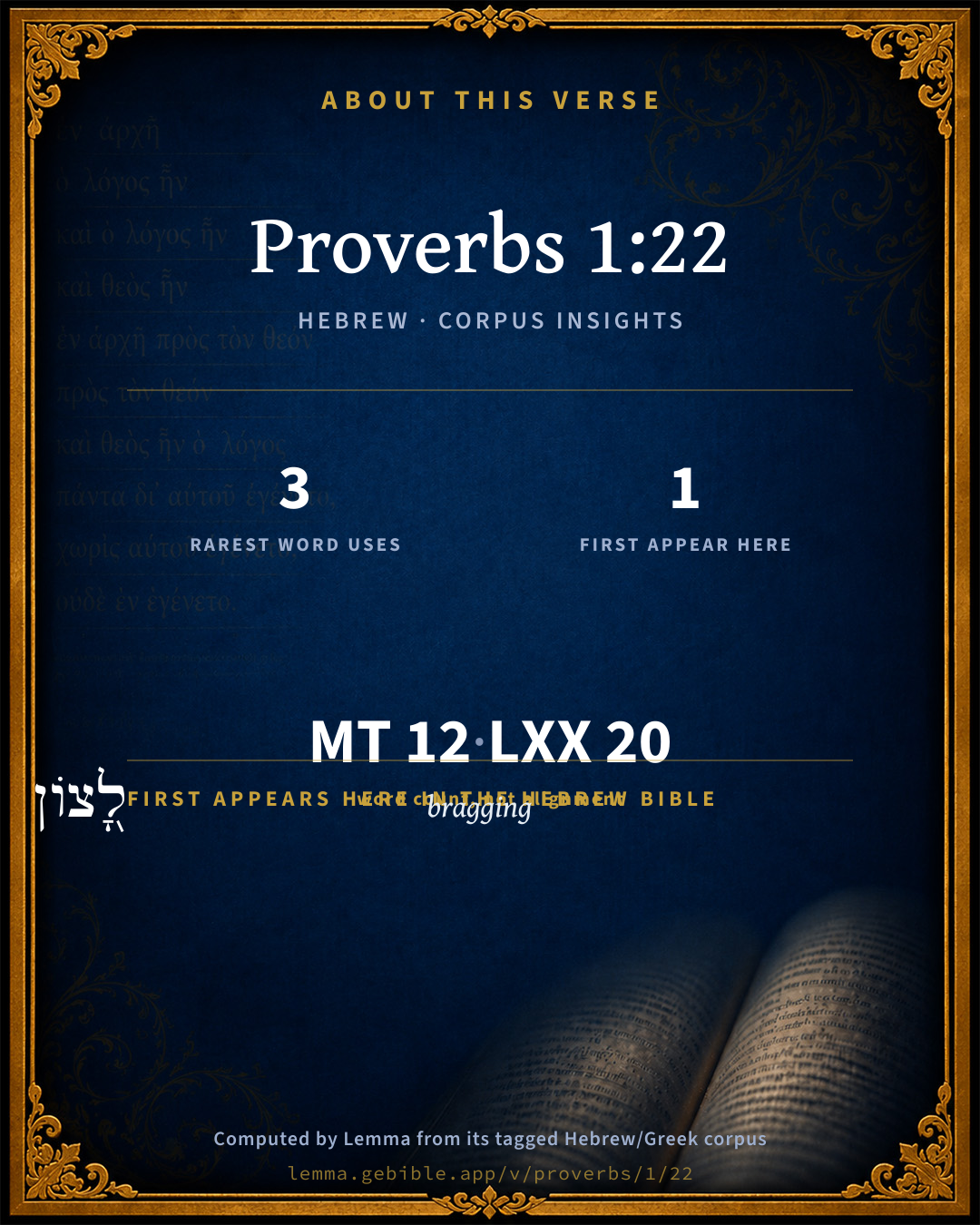
The rarest word here is לָ֭צוֹן bragging H3944 — appearing just 3 times in the whole Hebrew Bible.

First appearance in Scripture

This word makes its first canonical appearance in the Hebrew Bible here:

  • לָ֭צוֹן bragging H3944

Shared distinctive vocabulary

לָ֭צוֹן bragging H3944 occurs in 3 verses of the Hebrew Bible. Also found in:

Grammatical profile

  • 3 verbs
  • 4 nouns
  • 2 adjectives
  • 2 prepositions
  • 1 particle

Verb forms

  • תְּֽאֵהֲב֫וּ Qal · Imperfect
  • חָמְד֣וּ Qal · Perfect
  • יִשְׂנְאוּ Qal · Imperfect

Repetition

A word recurs within this verse — often emphatic in Hebrew:

  • פְּתָיִם֮ simple H6612 ×2

Hebrew & Septuagint length

In English translation the verse runs 21 words from the Hebrew and 32 from the Septuagint (LXX English) — the Septuagint runs noticeably longer here. See the side-by-side →

A rough comparison of the two English renderings, which tokenize alike — not a word-level alignment.

Word counts can differ between the Hebrew and the Greek without any difference in meaning — e.g. the Hebrew direct-object marker אֵת has no separate Greek word, and Greek often adds the article ὁ.

In the original languages it is 12 Hebrew tokens and 20 Greek tokens — but the two are counted differently (Hebrew bundles its prefixes and suffixes into one token; the Greek is in lemma form), so that isn’t a like-for-like length.

Cross-references

28

Topical passages linked to Proverbs 1:22 in the Treasury of Scripture Knowledge — connected by theme and wording, ordered by reader-vote popularity; previews shown in the World English Bible.

  • Psalms 1:1 Blessed is the man who doesn't walk in the counsel of the wicked, Nor stand in the way of sinners, Nor sit in the seat of scoffers;
  • Proverbs 1:29 Because they hated knowledge, And didn't choose the fear of Yahweh.
  • Proverbs 5:12 And say, "How I have hated instruction, And my heart despised reproof;
  • John 3:20 For everyone who does evil hates the light, and doesn't come to the light, lest his works would be exposed.
  • 2 Peter 3:3 knowing this first, that in the last days mockers will come, walking after their own lusts,
  • Matthew 9:13 But you go and learn what this means: 'I desire mercy, and not sacrifice,' for I came not to call the righteous, but sinners to repentance."
  • Matthew 11:29–30 Take my yoke upon you, and learn from me, for I am gentle and lowly in heart; and you will find rest for your souls.
  • Luke 19:42 saying, "If you, even you, had known today the things which belong to your peace! But now, they are hidden from your eyes.
  • Revelation 22:17 The Spirit and the bride say, "Come!" He who hears, let him say, "Come!" He who is thirsty, let him come. He who desires, let him take the water of life freely.
  • Proverbs 6:9 How long will you sleep, sluggard? When will you arise out of your sleep?
  • Proverbs 19:29 Penalties are prepared for scoffers, And beatings for the backs of fools.
  • Proverbs 21:11 When the mocker is punished, the simple gains wisdom; When the wise is instructed, he receives knowledge.
  • Exodus 10:3 Moses and Aaron went in to Pharaoh, and said to him, "This is what Yahweh, the God of the Hebrews, says: 'How long will you refuse to humble yourself before me? Let my people go, that they may serve me.
  • Exodus 16:28 Yahweh said to Moses, "How long do you refuse to keep my commandments and my laws?
  • Numbers 14:27 How long [shall I bear] with this evil congregation, that murmur against me? I have heard the murmurings of the children of Israel, which they murmur against me.
  • Job 34:7 What man is like Job, Who drinks scorn like water,
  • Psalms 94:8 Consider, you senseless among the people; You fools, when will you be wise?
  • Proverbs 1:4 To give prudence to the simple, Knowledge and discretion to the young man:
  • Proverbs 1:7 The fear of Yahweh is the beginning of knowledge; But the foolish despise wisdom and instruction.
  • Proverbs 3:34 Surely he mocks the mockers, But he gives grace to the humble.
  • Proverbs 7:7 I saw among the simple ones. I discerned among the youths a young man void of understanding,
  • Proverbs 8:5 You simple, understand prudence. You fools, be of an understanding heart.
  • Proverbs 9:4–6 "Whoever is simple, let him turn in here!" As for him who is void of understanding, she says to him,
  • Proverbs 9:16–18 "Whoever is simple, let him turn in here." As for him who is void of understanding, she says to him,
  • Proverbs 14:6 A scoffer seeks wisdom, and doesn't find it, But knowledge comes easily to a discerning person.
  • Proverbs 15:12 A scoffer doesn't love to be reproved; He will not go to the wise.
  • Matthew 17:17 Jesus answered, "Faithless and perverse generation! How long will I be with you? How long will I bear with you? Bring him here to me."
  • Matthew 23:37 "Jerusalem, Jerusalem, who kills the prophets, and stones those who are sent to her! How often would I have gathered your children together, even as a hen gathers her chickens under her wings, and you would not!

Cross-references courtesy of OpenBible.info (CC BY 4.0).

Hebrew and Greek witnesses Masoretic Hebrew ↔ Greek Septuagint

The same verse in the two great witnesses to the Old Testament, shown verse-for-verse.

Here the Septuagint runs noticeably longer than the Hebrew — LXX2012 (modern English Septuagint) 32 words vs World English Bible 21. A rough length comparison of the two English translations, not a word-level alignment — read both below.

These are two independent witnesses, not word-aligned to each other, and the Septuagint is shown in lemma (dictionary) form.

Hebrew Proverbs 1:22 Masoretic · Westminster Leningrad Codex

עַד מָתַ֣י פְּתָיִם֮ תְּֽאֵהֲב֫וּ פֶ֥תִי וְלֵצִ֗ים לָ֭צוֹן חָמְד֣וּ לָהֶ֑ם וּ֝כְסִילִ֗ים יִשְׂנְאוּ דָֽעַת

"How long, you simple ones, will you love simplicity? How long will mockers delight themselves in mockery, And fools hate knowledge?

World English Bible · Public Domain

Greek LXX Proverbs 1:22 Septuagint · lemma form

ὅσος ἄν χρόνος ἄκακος ἔχω ὁ δικαιοσύνη οὐ αἰσχύνω ὁ δέ ἄφρων ὁ ὕβρις εἰμί ἐπιθυμητής ἀσεβής γίγνομαι μισέω αἴσθησις

So long as the simple cleave to justice, they shall not be ashamed: but the foolish being lovers of haughtiness, having become ungodly have hated knowledge, and are become subject to reproofs.

LXX2012 (modern English Septuagint) · Public Domain

Hebrew: Westminster Leningrad Codex (CC BY 4.0). Greek: Septuagint (public domain); English from LXX2012 (modern English Septuagint) (Public Domain). How the Septuagint differs from the Hebrew →

Commentary

Notes on Proverbs 1:22 from classic Christian and Jewish commentators (each source and its license shown beneath its notes). The classic Christian expositions comment on the surrounding passage and are grouped to its opening verse, so a note may address several verses; the Jewish commentaries on the Tanakh (Rashi and others) are per-verse, so they appear only where the commentator wrote on this verse.

Lemma curates 59 commentaries, every one of them public domain or Creative Commons licensed, each selected and text-cleaned for this edition rather than reprinted as found. About our sources →

Trapp's Complete Commentary

John Trapp

Pro 1:22 How long, ye simple ones, will ye love simplicity? and the scorners delight in their scorning, and fools hate knowledge?

Ver. 22. How long, ye simple ones.] The fatuelli that are easily persuaded into a fool’s paradise. These are the best sort of bad men; the apostle calls them Aκακοι. {Rom 16:18} Optimi putantur Pontifices (saith Papirius Massonius, a Popish writer) {a} si vel leniter mali sint; vel minus boni quam coeteri mortales esse solent. Those are thought to be very good popes that are not stark naught, or that have any good at all in them. These simplicians are much better than scorners that delight in their scorning, but far beyond those fools that hate knowledge. See a like gradation in Psa 1:1, {See Trapp on "Psa 1:1"} Peccata non sunt paria; Nemo repente fit turpissimus. All sins are not alike sinful, and wicked men grow worse and worse.

{a} In Vita Pauli, iii.

John Trapp, A Commentary or Exposition upon All the Books of the Old and New Testament (1647–1656) — public domain. Text from a community e-Sword module.

Joseph Benson's Commentary

Pro 1:22-23. How long, ye simple ones — Ye ignorant, careless, and credulous persons, who are so easily deceived by sin and sinners, and cheated and deluded by the world, and the god of it, and do not understand or consider your own interest; will ye love simplicity? — Being unwilling to part with it, or to be made wise. And the scorners — That scoff at all religion, and despise the word and faithful ministers of God; delight in their scorning — Take pleasure, and glory in deriding and reviling the truths and precepts of the gospel, and the people and ways of God. And fools — That is, the wicked, for the Scriptures, with the utmost propriety, denominate all such, fools; hate knowledge — Which surely none but fools would hate. They hate it, because it lays open and reproves their errors, sins, and corrupt ways, which they cannot bear to have detected and rebuked. Hence they hate the knowledge of the divine laws, and also all those who are acquainted with them, and set a value upon them. Turn you at my reproof — Upon this admonition here given you, turn from your evil ways unto me. Behold — If you do so; I will pour out my spirit unto you — The gifts and graces of my Spirit, which God, whose wisdom here speaks, has promised to those that turn to him, and sincerely and earnestly ask them, Luk 11:13; Joh 4:14; and Joh 7:39. I will make known my words unto you — By my Spirit I will enable you truly and savingly to understand my word, which is hid from others, 2Co 4:3. The Hebrew, תשׁבו לתוכחתי, may be rendered, ye shall turn at my instruction, or correction; behold, אביעה לכם רוחי, ebulliam vobis Spiritum meum, I will cause my Spirit to ebulliate, or spring up within you, or, “I will make my Spirit flow upon you as a fountain, which produces its water.” The special and saving grace of God shall never be denied to any that honestly seek it and submit to it.

Joseph Benson's Commentary on the Old and New Testaments (1811–1818) — public domain. Text from a community e-Sword module.

Tyndale Open Study Notes

Tyndale Open Resources

1:22 Three main words in Proverbs describe those who lack God’s wisdom. Simpletons (Hebrew pethim) have not hardened themselves against God’s wisdom and are most open to correction (see 1:4). Fools (Hebrew kesilim) have heard God’s wisdom but resist it. Mockers (Hebrew latsonim) not only resist wisdom but even ridicule it.

Tyndale Open Study Notes — © Tyndale Open Resources, licensed CC BY-SA 4.0. Text via the HelloAO Bible API.

Geneva Bible (1599)

Geneva Bible translators

Wisdom reproveth three kinds of men: the foolish or simple which err of ignorance, and the mockers that cannot suffer to be taught, and the fools which are drowned in worldly lusts and hate the knowledge of godliness.

Geneva Bible (1599) marginal notes — public domain. Text via Bolls.life.

Jamieson, Fausset & Brown

Robert Jamieson, A. R. Fausset & David Brown

simple ones--(Compare Pro 1:4).

simplicity--implying ignorance.

scorners-- (Psa 1:1) --who despise, as well as reject, truth.

fools--Though a different word is used from that of Pro 1:7, yet it is of the same meaning.

Jamieson, Fausset & Brown — Commentary Critical and Explanatory on the Whole Bible (1871) — public domain (CC PDM 1.0). Text via the HelloAO Bible API.

Adam Clarke's Commentary

Verse 22. Ye simple ones] פתים pethayim, ye who have been seduced and deceived. See on Pr 1:4.

Adam Clarke's Commentary on the Bible (1810–1826) — public domain. Text from a community e-Sword/MySword module.

Ellicott's Commentary for English Readers

(22) How long . . .—Three classes of persons are here addressed: (1) simple ones, open to good influences, but also to evil (Pro_1:4); (2) scorners (lçtsîm), men who despised what was holy, priding themselves on their cleverness in so doing (Pro_14:6), who avoided the wise, and held themselves above their advice (Pro_15:12), proud, arrogant men (Pro_21:24). The name first appears at the time of Solomon, when the prosperity of the nation was favourable to the growth of religious indifference and scepticism. Isaiah had to deal with them in his day, too (Isa_28:14). (3) Fools (khesîlîm), dull, stupid persons, stolidly confident in their own wisdom.

A Bible Commentary for English Readers, edited by Charles John Ellicott (1878–1897) — public domain. Text from a community e-Sword module.

The Cambridge Bible for Schools and Colleges

gen. ed. J. J. S. Perowne

22. simple] unwary, see Pro_1:4 above, note.

love simplicity] when you stand in need of that subtilty, which wisdom offers you (Pro_1:4). When war is at the gates, you are not safe without armour. “Parvuli, diligitis infantiam,” Vulg.

scorners] The word is, with few exceptions, peculiar to this Book, in which “ ‘the scorners’ appear as a class of defiant and cynical freethinkers in contrast and antagonism to ‘the wise.’ The root-principle of their character is a spirit of proud self-sufficiency, a contemptuous disregard for God and man (Pro_21:24). It is impossible to reform them, for they hate reproof and will not seek instruction (Pro_13:1, Pro_15:12). If they seek for wisdom they will not find it (Pro_14:6). It is folly to argue with them (Pro_9:7-8). They are generally detested (Pro_24:9), and in the interests of peace must be banished from society (Pro_22:10). Divine judgements are in store for them, and their fate is a warning to the simple (Pro_3:34, Pro_19:25; Pro_19:29, Pro_21:11).” Kirkpatrick on Psa_1:1, in this Series.

fools] The Heb. word here used for “fool” signifies, heavy, dull, gross. See Pro_17:21, note.

simple, scorners, fools] The enumeration covers the field: the simple, from whom recruits are too easily drawn to the army of evil; scorners, the proud leaders of the host; fools, the rank and file of the host.

The Cambridge Bible for Schools and Colleges (gen. ed. J. J. S. Perowne; Cambridge University Press, 1878–1918) — public domain. Text from a community e-Sword module.

John Gill's Exposition

How long, ye simple ones, will ye love simplicity?.... Simple foolish things, agreeably to their character, being weak simple men, men of weak capacities and shallow understandings; and such were the first persons that were called by Christ through the ministry of the word, even effectually; they were babes and sucklings in comparison of others, by whom they were despised as illiterate and ignorant of the law; see Mat 11:25; though it may respect the Jews in general, who were externally called by Christ, and were a simple and foolish people, addicted to silly customs and usages, to the traditions of the elders, and loved the folly and darkness of them, and to continue in them, rather than the light of the Gospel, Joh 3:19;

and the scorners delight in their scorning; at Christ, because of the meanness of his parentage and education; at his disciples and followers, at his doctrines and miracles, sufferings and death;

and fools hate knowledge? the knowledge of Christ, and of God in Christ; the knowledge of the Gospel, and the truths of it; they hated the light of it, and did not care to come to it, but rather loved the darkness of the law, and even of error and infidelity; they hated Christ, the teacher of true and useful knowledge; they hated his person, though without a cause; they hated him in his offices, as a Prophet to instruct them, as a Priest to be the propitiation for them, and as a King to rule over them; such "fools" were they, and who are therefore expostulated with by Wisdom or Christ; which expostulations show their continuance in these things, and the danger they were in by them, the pity and compassion of Christ as man and a minister of the word, and the fervour and importunity of his ministrations.

John Gill's Exposition of the Whole Bible (1746–1763) — public domain (CC PDM 1.0). Text via the HelloAO Bible API.

Albert Barnes' Notes on the Bible

Compare the Psa 1:1 note.

(1) The “simple,” literally, “open,” i. e. fatally open to evil;

(2) the “scorners,” mocking at all good;

(3) lastly, the “fools” in the sense of being hardened, obstinate, perverse, hating the knowledge they have rejected.

Albert Barnes' Notes on the Bible (1834–1885) — public domain. Text from a community e-Sword/MySword module.

Haydock's Catholic Bible Commentary

Fools. Hebrew, "and scorners delight in their scorning." (Protestants) --- Such are the pests of society. (Haydock) --- They turn piety to ridicule, and will talk about things which they do not understand, like our esprits forts, (Calmet) or pretended philosophers. (Haydock)

George Leo Haydock (1774–1849), Haydock's Catholic Family Bible and Commentary, 1859 edition — public domain. Excludes Psalms (Douay-Rheims chapter numbering differs from Protestant) and Deuterocanonical books (Catholic canon only).

Matthew Poole's English Annotations

Ye simple ones; ye ignorant, and easy, and credulous persons, who are so soon cheated by the world and the devil, and do not understand your own interest.

Love simplicity; being unwilling to part with it, or to be made wiser. Scorners; that scoff at all religion, and contemn the word and faithful ministers of God.

Fools; wilful and wicked fools, as Pro 17:10; 26:4.

Matthew Poole's English Annotations on the Holy Bible (1683–1685) — public domain. Text from a community e-Sword/MySword module.

Whedon's Commentary on the Bible

Daniel D. Whedon

22. There is a gradation here, as in Psa_1:1. Simple ones — See Pro_1:2. Scorners — Or, scoffers at that which is good.

Fools — כסילים, (kesilim,) a different word from that in Pro_1:7, but etymologically of nearly the same signification; dull, carnal, stupid, hardened ones. The change of person here (from the second to the third) is common in the Hebrew. The interrogatory how long? carries its force to each of the clauses.

Daniel D. Whedon (gen. ed.), Commentary on the Old and New Testaments (1874–1909) — public domain. Text from a community e-Sword module.

The Pulpit Commentary

How long, ye simple ones, will ye love simplicity? etc. From this verse to the end of the chapter the sacred writer puts before us the words of Wisdom herself. The discourse begins in the same way as in Psa_4:2 (Zockler), and the classification of the persons addressed the simple, the scorners, and the sinners closely resembles that of Psa_1:1. In the order there is a progression from the least to the most culpable. The simple ( pthayim) , as in ver. 4, those who are indifferent through thoughtlessness and inconsiderateness, and are thereby open to evil. The scorners ( letsim); or, mockers, the same as the (wOxl, latson) "scornful men" of Pro_29:8, derived from the root xWL (luts), "to deride, mock," probably by imitating the voice in derision. The mockers are those who hold all things in derision, both human and Divine, who contemn God"s admonitions, and treat with ridicule both threatenings and promises alike. Fools; (chsilim), a different word from the evilim of ver. 7, but signifying much the same, i.e. the obdurate, the hardened, stolidi, those who walk after the sight of their eyes and the imagination of their hearts a class not ignorant of knowledge, but hating it because of the restraint it puts them under. The word occurs in Pro_17:10, in the sense of the incorrigible; in Pro_26:3, 4 as a term of the greatest contempt. The enallage, or interchange of tenses in the original the verbs "love" and "hate" being future, and "delight" being perfect is not reproducible in English. The perfect is used interchangeably with the future where the action or state is represented as first coming to pass or in progress, and, as Zockler remarks, may be inchoative, and so be rendered "become fond of," instead of "be fond of." But it appears to represent not so much a state or action first coming to pass as in progress (see Geseuius, "Gram.," 3). Bottcher ( 2) translates it by concupiverint, i.e. "How long shall ye have delighted in scorning?" The futures express "love" and "hate" as habitual sentiments (Delitzsch). It is to be noted that the language of Wisdom, in vers. 22 and 23, is expressive of the most tender and earnest solicitude.

The Pulpit Commentary (1880–1919), ed. H.D.M. Spence-Jones & Joseph S. Exell — public domain. Text from a community e-Sword module.

John Wesley's Explanatory Notes

Scoffers - That scoff at religion and contemn the word and faithful ministers of God.

John Wesley, Explanatory Notes Upon the Whole Bible (1754–1765) — public domain. Text via the GEBible commentary corpus.

Keil & Delitzsch

C. F. Keil & F. Delitzsch

The poet has now reached that part of his introduction where he makes use of the very words uttered by Wisdom:

How long, ye simple, will ye love simplicity,

And scorners delight in scorning,

And fools hate knowledge?

Three classes of men are here addressed: the פּתים, the simple, who, being accessible to seduction, are only too susceptible of evil; the לצים, mockers, i.e., free-thinkers (from לוּץ, Arab. luṣ, flectere, torquere, properly qui verbis obliquis utitur); and the כּסילים, fools, i.e., the mentally imbecile and stupid (from כּסל, Arab. kasal, to be thick, coarse, indolent). The address to these passes immediately over into a declaration regarding them; cf. the same enallage, Pro 1:27. עד־מתי has the accent Mahpach, on account of the Pasek following; vid., Torath Emeth, p. 26. Intentionally, Wisdom addresses only the פתים, to whom she expects to find soonest access. Between the futt., which express the continuing love and hatred, stands the perf. חמדוּ, which expresses that in which the mockers found pleasure, that which was the object of their love. להם is the so-called dat. ethicus, which reflexively refers to that which is said to be the will and pleasure of the subject; as we say, "I am fond of this and that." The form תּאהבוּ, Abulwald, Parchon, and Kimchi regard as Piel; but תּאהבוּ instead of תּאהבוּ would be a recompensatio of the virtual doubling, defacing the character of the Piel. Schultens regards it as a defectively written Pail (in Syr.), but it is not proved that this conjugation exists in Hebr.; much rather תּאהבוּ is the only possible Kal form with תּאהבוּן without the pause, regularly formed from תּאהבוּ (vid., Ewald, 193, a). The division by the accent Mercha-Mahpach of the two words תאהבו פתי is equal in value to the connecting of them by Makkeph; vid., Baer's Psalterium, p. x. In codd., and also in correct texts, תאהבו is written with the accent Galgal on the first syllable, as the servant of the Mercha-Mahpach. The Gaja is incorrectly here and there placed under the תּ.

Keil & Delitzsch — Biblical Commentary on the Old Testament (1861–1891) — public domain (CC PDM 1.0). Text via the HelloAO Bible API. (Old Testament only.)

Rashi

Rabbi Shlomo Yitzchaki (Rashi)

you naive ones Heb. פתים. Those who are enticed by enticers and sectarians.

naivete Heb. פתי, enticement, the noun for simplicity; like כלי, a vessel, קרי, a happening, שפי, silence.

Rashi on the Tanakh — English translations: “The Judaica Press complete Tanach with Rashi, translated by A. J. Rosenberg” (CC BY 4.0); “Pentateuch with Rashi's commentary by M. Rosenbaum and A.M. Silbermann, 1929-1934” (public domain); “The Metsudah Tanach series, Lakewood, N.J” (CC BY 4.0); and “The Book of Joshua, Metsudah Publications, 1997” (CC BY 4.0). Text via Sefaria.

Lesson kit

Teaching starters — assembled from the data on this page, not authored interpretation. Every prompt links to the verse data it draws on. Edit before teaching.

Proverbs, in the Wisdom, opens this verse with 12 words (10 distinct Hebrew lemmas). Its most distinctive word is lâtsôwn (“bragging”). The Greek Septuagint runs longer here. A historical commentator’s framing appears above. Read the whole chapter for the surrounding context.

Discussion questions

  1. What does “bragging” (lâtsôwn) contribute to the verse as a whole?
  2. The word “bragging” first appears here in Scripture. What is being introduced at this debut?
  3. Proverbs 29:8 shares the word «bragging» with this verse. How do the two illuminate each other?
  4. “simple” occurs 2× in this one verse. What is the effect of the repetition?
  5. Compared with the Hebrew, the Septuagint runs longer here. What questions does that raise?
  6. These translations render this verse differently; the difference is in the English rendering, not the original. What questions does that raise?
  7. The verb «תְּֽאֵהֲב֫וּ» is Qal Imperfect. How does its form color the action?
  8. Reading how Trapp's Complete Commentary and Joseph Benson's Commentary read this verse, where do the two commentators agree and where do they part?

Things to notice

Reading settings

Reading text

Shown beneath each verse's original-language words.

Old Testament
Old Testament edition

Read the OT as the Masoretic Hebrew (MT) or the Greek Septuagint (LXX).

English shown for the Greek Septuagint (in the Hebrew ↔ Greek comparison).

Comparing translations? Open the Compare panel on any verse page to stack up to four side by side.