
Proverbs 9:8

Hebrew (Westminster Leningrad Codex) Proverbs 9:8 appears in the Hebrew Old Testament. The text above is from the Westminster Leningrad Codex. Each word links to its Strong’s number, a concise gloss, and parsing drawn from the Open Scriptures Hebrew Bible morphology. Click any word for its full Brown-Driver-Briggs (BDB) entry.
Download image
Cite this verse

Proverbs 9:8 (World English Bible). Public Domain. Lemma interlinear Bible study tool, https://lemma.gebible.app/v/proverbs/9/8.

Show BibTeX & RIS
BibTeX
RIS
English Translation
Don't reprove a scoffer, lest he hate you. Reprove a wise man, and he will love you.
World English Bible · Public Domain
Download a study sheet

One document with this verse’s original text, its word-by-word gloss line, the meaning frame, cross-references with their text, attributed commentary, and full source and license credits — printable, and it pastes into notes with its structure intact.

This verse Autodidact and up

Study sheet (.html) Plain text (.txt)

A passage Seminary Student

Up to 50 verses in one chapter. A passage sheet keeps up to 6 commentary sources and 12 cross-references per verse, in the order this page ranks them, and says so on the sheet whenever that leaves anything out. Ask for a single verse and you get the Autodidact verse sheet above.

Everything on this page stays free to read, with no account — the sheet is a download of what is already on screen, not access to it.

Want to remove ads? Support Godless Engineer
Compare translations 3

The same verse in 3 English versions, stacked beneath the original-language interlinear above. Click any original word for its lexicon entry.

Each is an independent rendering of the whole verse — the interlinear is not word-aligned to these translations.

Highlighted words mark where these versions differ — a whole-verse word diff, not a word-by-word alignment.

  • World English Bible Public Domain
    Don't reprove a scoffer, lest he hate you. Reprove a wise man, and he will love you.
  • King James Version Public Domain
    Reprove not a scorner, lest he hate thee: rebuke a wise man, and he will love thee.
  • unfoldingWord Literal Text CC BY-SA 4.0
    Do not rebuke a mocker, lest he hate you; rebuke a wise one, and he will love you.

unfoldingWord Literal Text — © unfoldingWord, licensed CC BY-SA 4.0. Word-aligned USFM3 via Door43 (git.door43.org/unfoldingWord/en_ult).

Versions to compare (up to 4)

3 of 4 selected

Show all 18 translations

Every available English version of this verse, each an independent rendering of the whole verse.

  • World English Bible Public Domain
    Don't reprove a scoffer, lest he hate you. Reprove a wise man, and he will love you.
  • Berean Standard Bible Public Domain
    Do not rebuke a mocker, or he will hate you; rebuke a wise man, and he will love you.
  • Majority Standard Bible Public Domain
    Do not rebuke a mocker, or he will hate you; rebuke a wise man, and he will love you.
  • King James Version Public Domain
    Reprove not a scorner, lest he hate thee: rebuke a wise man, and he will love thee.
  • American Standard Version (1901) Public Domain
    Reprove not a scoffer, lest he hate thee: Reprove a wise man, and he will love thee.
  • Revised Version (1885) Public Domain
    Reprove not a scorner, lest he hate thee: reprove a wise man, and he will love thee.
  • Geneva Bible (1599) Public Domain
    Rebuke not a scorner, least he hate thee: but rebuke a wise man, and he will loue thee.
  • Douay-Rheims (1899) Public Domain
    Rebuke not a scorner lest he hate thee. Rebuke a wise man, and he will love thee.
  • Young's Literal Translation Public Domain
    Reprove not a scorner, lest he hate thee, Give reproof to the wise, and he loveth thee.
  • Literal Standard Version CC BY-SA 4.0
    Do not reprove a scorner, lest he hate you, || Give reproof to the wise, and he loves you.
  • Unlocked Literal Bible CC BY-SA 4.0
    Do not reprove a mocker, or he will hate you; reprove a wise man, and he will love you.
  • unfoldingWord Literal Text CC BY-SA 4.0
    Do not rebuke a mocker, lest he hate you; rebuke a wise one, and he will love you.
  • Darby Bible Public Domain
    Reprove not a scorner, lest he hate thee; reprove a wise [man], and he will love thee.
  • World Messianic Bible Public Domain
    Don’t reprove a scoffer, lest he hate you. Reprove a wise person, and he will love you.
  • Webster's Bible Public Domain
    Reprove not a scorner, lest he shall hate thee: rebuke a wise man, and he will love thee.
  • Free Bible Version CC BY-SA 4.0
    So don't argue with mockers or they'll only hate you; argue with the wise and they'll love you.
  • Bible in Basic English Public Domain
    Do not say sharp words to a man of pride, or he will have hate for you; make them clear to a wise man, and you will be dear to him.
  • JPS Tanakh (1917) Public Domain
    Reprove not a scorner, lest he hate thee; reprove a wise man, and he will love thee.

Literal Standard Version (2020), Covenant Press — licensed CC BY-SA 4.0. Text via the HelloAO Bible API (eBible.org). Unlocked Literal Bible (unfoldingWord) — licensed CC BY-SA 4.0. Text via the HelloAO Bible API (eBible.org). unfoldingWord Literal Text — © unfoldingWord, licensed CC BY-SA 4.0. Word-aligned USFM3 via Door43 (git.door43.org/unfoldingWord/en_ult). Free Bible Version, Dr. Jonathan Gallagher — licensed CC BY-SA 4.0. Text via the HelloAO Bible API (eBible.org).

Word by word

More ways to search: Search by grammar → Find every occurrence → Compare this word →

Practice this passage: Drill this verse → Learn its vocabulary →

לֵ֭ץ
lûwts
H3887
“scoffer”
Adjective, Adjective, Masculine, Singular, Absolute
Part of Speech
Adjective
Type
Adjective
Gender
Masculine
Number
Singular
State
Absolute
Full BDB Definition

Origin: a primitive root

TWOT: 1113

to scorn, make mouths at, talk arrogantly - (Qal) - to boast - to scorn - (Hiphil) - to mock, deride - to interpret (language) - interpreter (participle) - ambassador (figuratively) - (Hithpalpel) to be inflated, scoff, act as a scorner, show oneself a mocker
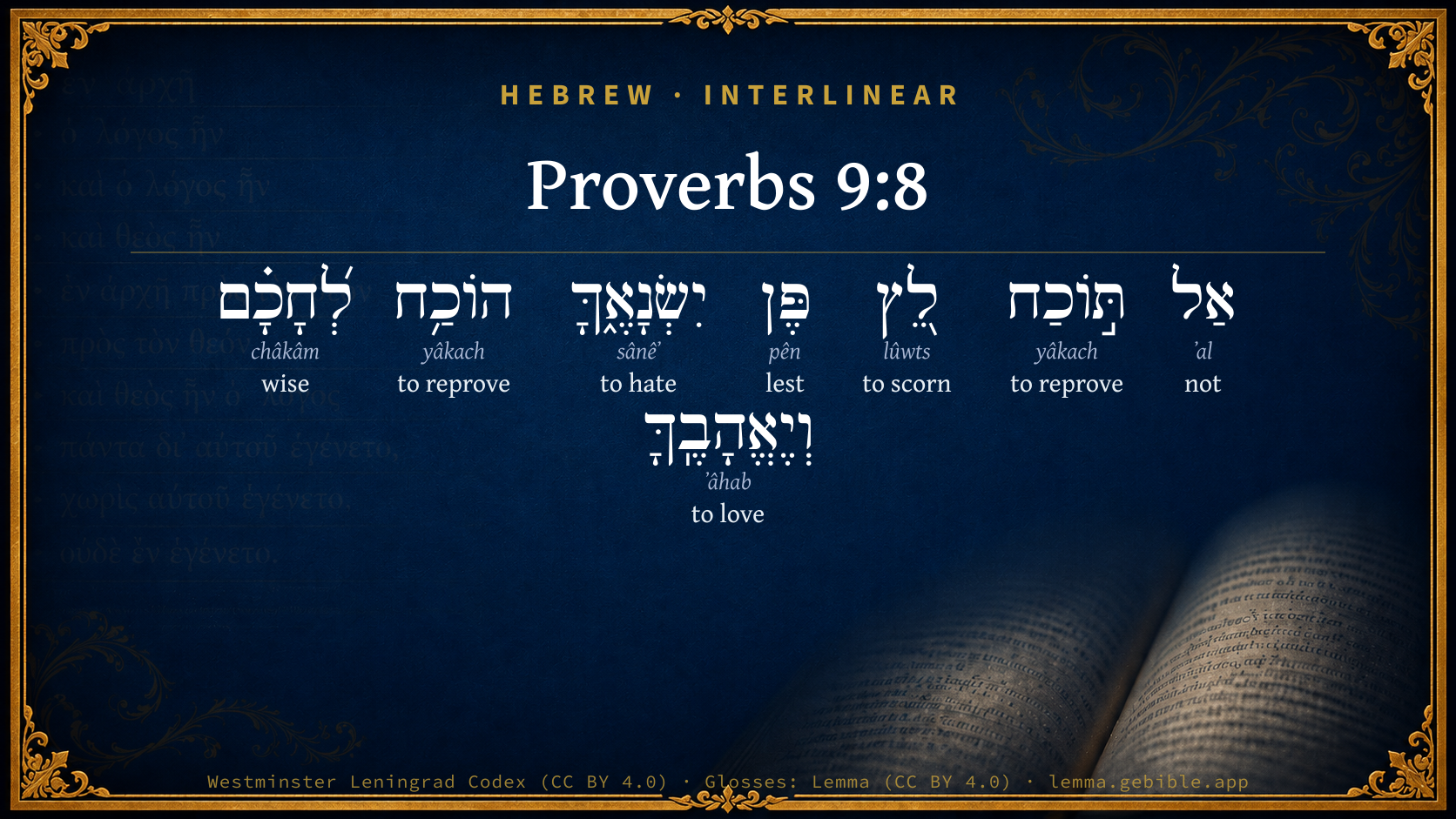
  1. אַל ʼal H408 “not” Particle, Negative
  2. תּ֣וֹכַח yâkach H3198 “to reprove” Verb, Hiphil, Jussive, 2nd Person, Masculine, Singular
  3. פֶּן pên H6435 “lest” Conjunction
  4. יִשְׂנָאֶ֑ךָּ sânêʼ H8130 “to hate · you” Verb, Qal, Imperfect, 3rd Person, Masculine, Singular + Suffix, Personal, 2nd Person, Masculine, Singular
  5. הוֹכַ֥ח yâkach H3198 “reprove” Verb, Hiphil, Imperative, 2nd Person, Masculine, Singular
  6. לְ֝חָכָ֗ם châkâm H2450 “to/for · wise” Preposition + Adjective, Adjective, Masculine, Singular, Absolute
  7. וְיֶאֱהָבֶֽךָּ ʼâhab H157 “and · to love · you” Conjunction + Verb, Qal, Imperfect, 3rd Person, Masculine, Singular + Suffix, Personal, 2nd Person, Masculine, Singular

About this verse

These counts appear in no published source. They are computed here, from the morphology-tagged text and Lemma’s own curated glosses. What Lemma adds →

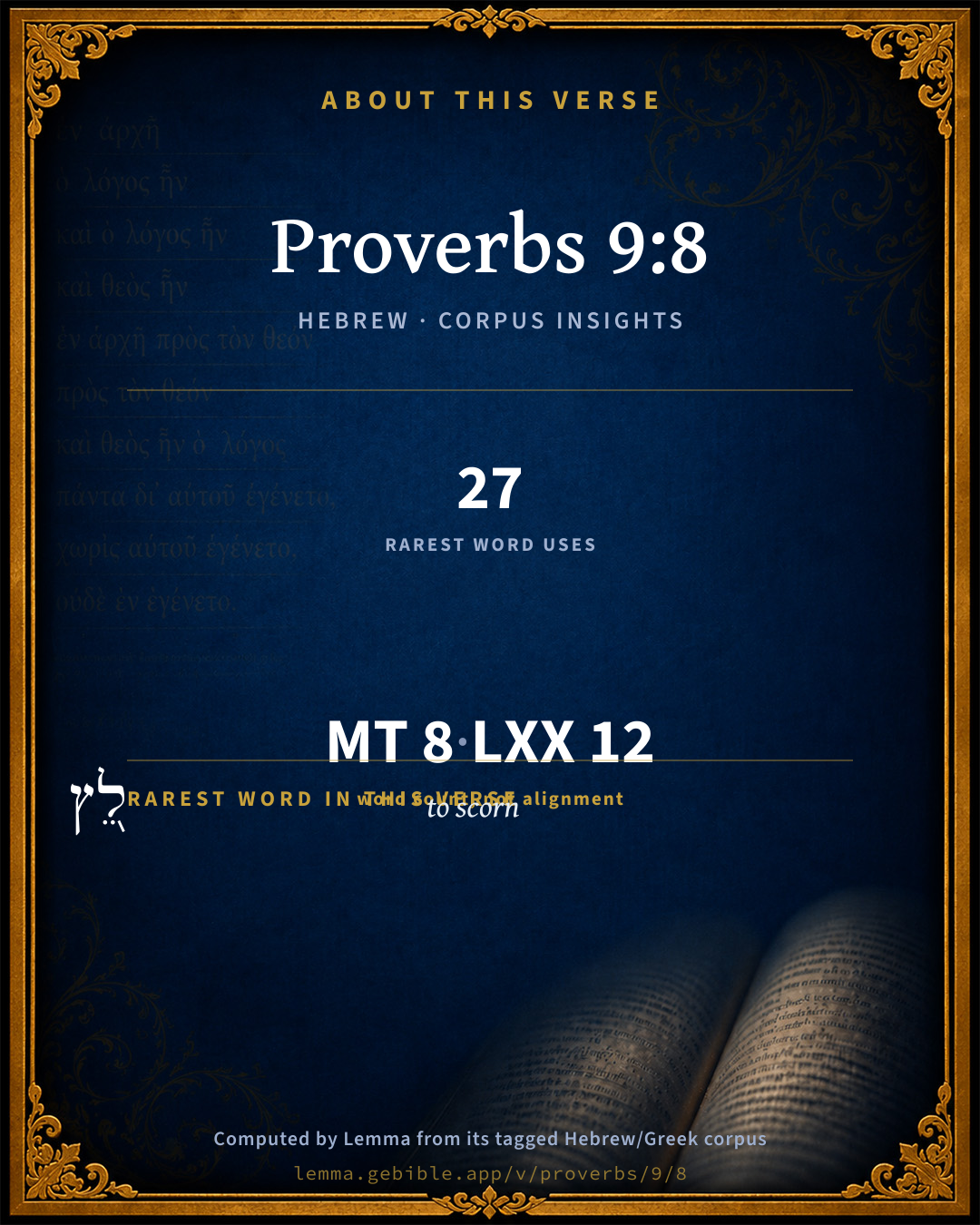
8
words
7
distinct lemmas
Wisdom
section

Shared distinctive vocabulary

לֵ֭ץ to scorn H3887 occurs in 26 verses of the Hebrew Bible. Also found in:

Grammatical profile

  • 4 verbs
  • 2 adjectives
  • 1 conjunction
  • 1 particle

Verb forms

  • תּ֣וֹכַח Hiphil · Jussive
  • יִשְׂנָאֶ֑ךָּ Qal · Imperfect
  • הוֹכַ֥ח Hiphil · Imperative
  • וְיֶאֱהָבֶֽךָּ Qal · Imperfect

Repetition

A word recurs within this verse — often emphatic in Hebrew:

  • תּ֣וֹכַח to reprove H3198 ×2

Hebrew & Septuagint length

In English translation the verse runs 17 words from the Hebrew and 18 from the Septuagint (LXX English) — closely comparable.

A rough comparison of the two English renderings, which tokenize alike — not a word-level alignment.

Word counts can differ between the Hebrew and the Greek without any difference in meaning — e.g. the Hebrew direct-object marker אֵת has no separate Greek word, and Greek often adds the article ὁ.

In the original languages it is 8 Hebrew tokens and 12 Greek tokens — but the two are counted differently (Hebrew bundles its prefixes and suffixes into one token; the Greek is in lemma form), so that isn’t a like-for-like length.

Cross-references

14

Topical passages linked to Proverbs 9:8 in the Treasury of Scripture Knowledge — connected by theme and wording, ordered by reader-vote popularity; previews shown in the World English Bible.

  • Psalms 141:5 Let the righteous strike me, it is kindness; Let him reprove me, it is like oil on the head; Don't let my head refuse it; Yet my prayer is always against evil deeds.
  • Proverbs 13:18 Poverty and shame come to him who refuses discipline, But he who heeds correction shall be honored.
  • Proverbs 23:9 Don't speak in the ears of a fool, For he will despise the wisdom of your words.
  • Proverbs 15:12 A scoffer doesn't love to be reproved; He will not go to the wise.
  • Proverbs 29:1 He who is often rebuked and stiffens his neck Will be destroyed suddenly, with no remedy.
  • Matthew 7:6 "Don't give that which is holy to the dogs, neither throw your pearls before the pigs, lest perhaps they trample them under their feet, and turn and tear you to pieces.
  • Proverbs 28:23 One who rebukes a man will afterward find more favor Than one who flatters with the tongue.
  • Leviticus 19:17 "'You shall not hate your brother in your heart. You shall surely rebuke your neighbor, and not bear sin because of him.
  • Matthew 15:14 Leave them alone. They are blind guides of the blind. If the blind guide the blind, both will fall into a pit."
  • Hebrews 6:4–8 For concerning those who were once enlightened and tasted of the heavenly gift, and were made partakers of the Holy Spirit,
  • 2 Samuel 12:7–14 Nathan said to David, "You are the man. This is what Yahweh, the God of Israel, says: 'I anointed you king over Israel, and I delivered you out of the hand of Saul.
  • 2 Peter 3:15–16 Regard the patience of our Lord as salvation; even as our beloved brother Paul also, according to the wisdom given to him, wrote to you;
  • Numbers 14:6–10 Joshua the son of Nun and Caleb the son of Jephunneh, who were of those who spied out the land, tore their clothes:
  • 1 Kings 1:23 They told the king, saying, Behold, Nathan the prophet. When he was come in before the king, he bowed himself before the king with his face to the ground.

Cross-references courtesy of OpenBible.info (CC BY 4.0).

Hebrew and Greek witnesses Masoretic Hebrew ↔ Greek Septuagint

The same verse in the two great witnesses to the Old Testament, shown verse-for-verse.

These are two independent witnesses, not word-aligned to each other, and the Septuagint is shown in lemma (dictionary) form.

Hebrew Proverbs 9:8 Masoretic · Westminster Leningrad Codex

אַל תּ֣וֹכַח לֵ֭ץ פֶּן יִשְׂנָאֶ֑ךָּ הוֹכַ֥ח לְ֝חָכָ֗ם וְיֶאֱהָבֶֽךָּ

Don't reprove a scoffer, lest he hate you. Reprove a wise man, and he will love you.

World English Bible · Public Domain

Greek LXX Proverbs 9:8 Septuagint · lemma form

μή ἐλέγχω κακός ἵνα μή μισέω σύ ἐλέγχω σοφός καί ἀγαπάω σύ

Rebuke not evil men, lest they should hate you: rebuke a wise man, and he will love you.

LXX2012 (modern English Septuagint) · Public Domain

Hebrew: Westminster Leningrad Codex (CC BY 4.0). Greek: Septuagint (public domain); English from LXX2012 (modern English Septuagint) (Public Domain). How the Septuagint differs from the Hebrew →

Commentary

Notes on Proverbs 9:8 from classic Christian and Jewish commentators (each source and its license shown beneath its notes). The classic Christian expositions comment on the surrounding passage and are grouped to its opening verse, so a note may address several verses; the Jewish commentaries on the Tanakh (Rashi and others) are per-verse, so they appear only where the commentator wrote on this verse.

Lemma curates 59 commentaries, every one of them public domain or Creative Commons licensed, each selected and text-cleaned for this edition rather than reprinted as found. About our sources →

Trapp's Complete Commentary

John Trapp

Pro 9:8 Reprove not a scorner, lest he hate thee: rebuke a wise man, and he will love thee.

Ver. 8. Reprove not a scorner.] See my "Commonplace of Admonition." Look how dogs prefer loathsome carrion before the sweetest odours, and would fly in the faces of such as would drive them from it: so is it here.

And he will love thee.] When he hath well considered he will, though, for present, he may seem to do otherwise; as Ass swaggered with the prophet, and put him in prison. We read in the ecclesiastical history that Agapetus, bishop of Rome, being sent by Theodatus, king of Goths, to Constantinople on an embassy to Justinian, and having obtained a peace, he was earnestly entreated by the emperor to subscribe and confirm the heresy of Eutyches. This when he utterly refused to do, the emperor threatened him in case he did not. Agapetus thereto boldly replied - I had a desire to wait upon Justinian, whom I took to be a most pious prince; but now I perceive him to be a most violent persecutor, a second Dioclesian. With this free reproof, and God’s blessing with it, Justinian was so wrought upon, that he presently embraced the true faith, and banishing bishop Anthemius, a great propagator of the Eutychian heresy, he set up Menna, an orthodox divine, in his room, whom Agapetus consecrated, if Platina may be believed. {a} David loved Nathan the better while he lived for dealing so plainly with him, and named him a commissioner for the declaring of his successor. {1Ki 1:32-35} So Alipius loved Augustine for reproving him.

{a} Funcius.

John Trapp, A Commentary or Exposition upon All the Books of the Old and New Testament (1647–1656) — public domain. Text from a community e-Sword module.

Joseph Benson's Commentary

Pro 9:8-9. Reprove not a scorner — An incorrigible sinner, who despises and scornfully rejects the means of amendment. Thus physicians deny physic to persons in a desperate condition; lest he hate thee — Whereby thou wilt not only expose thyself, without necessity, to his malice and rage, but also make thyself utterly incapable of doing that good, which, possibly, thou mightest do by other more prudent and proper means. Rebuke a wise man — Who is opposed to the scorner, to intimate that scorners, however they are thought by themselves or others to be witty or wise, yet, in God’s account, and in truth, are fools; and he will love thee — Both for that faithfulness and charity which he perceives in thee, and for that benefit which he receives from thee. Give instruction to a wise man — In the Hebrew it is only give; for, as receiving is put for learning, (Pro 1:3,) so giving is put for teaching. And he will be yet wiser — This is an undoubted maxim, that a man disposed to learn, who and has already hearkened to the instructions of wisdom, will grow wiser by reprehension; and the advice given to a just, or righteous man, one truly desirous of knowing and practising his duty, will make him yet better, and much improve him in every branch of piety and virtue.

Joseph Benson's Commentary on the Old and New Testaments (1811–1818) — public domain. Text from a community e-Sword module.

Geneva Bible (1599)

Geneva Bible translators

Meaning them that are incorrigible, which Christ calleth dogs and swine: or he speaketh this in comparison, not that the wicked should not be rebuked, but he showeth their malice, and the small hope of profit.

Geneva Bible (1599) marginal notes — public domain. Text via Bolls.life.

John Gill's Exposition

Reprove not a scorner, lest he hate thee,.... For wicked men are apt to hate those that publicly rebuke them, Amo 5:10. Hence minister's of the word are of all men most hated; though this also should be bore with, could it be thought, or there was any reason to believe, that the reproof would be of any service. The scorner here, and in the preceding verses, may not only design profane sinners, sensualists, and atheists, that despise all religion, and scoff at all that is good; but also proud scornful Pharisees, such who derided Christ himself, and trusted in themselves, and despised others, Christ and his apostles, and their ministrations, Luk 16:14; and such, as Christ came not to call them himself, so he bid his disciples let them alone, Mat 9:13;

rebuke a wise man, and he will love thee; as David did Nathan; and who was determined to take kindly the reproof of any righteous man, Psa 141:5. Such who are spiritually wise will be thankful for the reproof of Gospel ministers, and even of private Christians, and will love and esteem them for their faithfulness and uprightness, and for the good which they themselves receive hereby.

John Gill's Exposition of the Whole Bible (1746–1763) — public domain (CC PDM 1.0). Text via the HelloAO Bible API.

Matthew Poole's English Annotations

Reprove not a scorner; an obstinate and incorrigible sinner, who scornfully rejects and despiseth the means of amendment. Thus physicians deny physic to persons in desperate condition.

Lest he hate thee; whereby thou wilt not only expose thyself without necessity to his malice and rage, but also make thyself utterly uncapable of doing him that good which possibly thou mightest do by other more prudent and proper means.

Rebuke a wise man; who is opposed to the scorner, to intimate that scorners, howsoever they are thought by themselves or others to be witty or wise, yet in God’s account, and in truth, are fools.

He will love thee; both for that faithfulness and charity which he perceiveth in thee, and for that benefit which he receiveth from thee.

Matthew Poole's English Annotations on the Holy Bible (1683–1685) — public domain. Text from a community e-Sword/MySword module.

Whedon's Commentary on the Bible

Daniel D. Whedon

8. Reprove not a scorner — This is not to be understood as an imperative prohibition, to be observed in all cases; but as a strong way of stating the effects of reproof upon a scoffer: if thou reprove, etc. So the next clause, also.

Rebuke — If thou admonish or advise a wise man, he will love thee, will appreciate thy fidelity, even though at first it may wound him.

Compare Psa_141:5. Zockler’s interpretation of the drift of thought here is, that it is an invitation to abandon intercourse with such persons, for you will gain nothing but contempt and insult by their association. Comp. Mat_7:6.

Daniel D. Whedon (gen. ed.), Commentary on the Old and New Testaments (1874–1909) — public domain. Text from a community e-Sword module.

The Pulpit Commentary

Reprove not a scorner, lest he hate thee. (see the last note, and comp. Pro_15:12, and note there) There are times when reproof only hardens and exasperates. "It is not proper," says St. Gregory, "for the good man to fear lest the scorner should utter abuse at him when he is chidden, but lest, being drawn into hatred, he should be made worse" ("Moral.," 8:67). "Bad men sometimes we spare, and not ourselves, if from the love of those we cease from the rebuking of them. Whence it is needful that we sometimes endure keeping to ourselves what they are, in order that they may learn in us by our good living what they are not". (ibid., 20:47, Oxford transl.) Rebuke a wise man, and he will love thee. So Psa_141:5, "Let the righteous smite me, it shall be a kindness: and let him reprove me, it shall be as oil upon the head; let not my head refuse it". (comp. Pro_19:25 Pro_25:12 Pro_27:6)

Reproof.

I HOW TO GIVE REPROOF. The duty of reproving is one of the most difficult and delicate ever attempted. The people who are most rash in adventuring upon it too often fall into the greatest blunders, while those who are really fitted to undertake it shrink from the attempt. The mere utterance of a protest is generally worse than useless. It only raises anger and provokes to greater obstinacy. Unless there is some probability of convincing a man of the wrongness of his conduct, there is little good in administering rebukes to him. It is not the duty of any man to raise up enemies without cause. We should all seek, as far as in us lies, to live peaceably with all men. Of course, it may he incumbent upon us sometimes so to act that we shall provoke opposition. Jesus Christ could have avoided the enmity of the Jews, but only by unfaithfulness to his mission. Where we are in the way of our mission, or when any duty will be accomplished or any good done, we must not shrink from rousing antagonism. To do so is cowardice, not peaceableness. But if no good is done, we may only bring a nest of hornets about our heads by our indiscretion. Let us understand that while we are never to sanction evil doing, we are only called to rebuke it when the rebuke will not be certainly rejected; then we must risk insult for the sake of righteousness. The practical point, then. is that we consider the character of a man before attempting to rebuke him, and that we be not so anxious to protest against sin as to counsel the sinner and guide him to better ways. If he is in a hard, scornful mood, we had better wait for a more fitting opportunity. If he is too strong for us, we shall only injure the cause of right by attempting to grapple with him. Weak champions of Christianity have often only hurt themselves, discredited their cause, and afforded a triumph to powerful opponents by their rash encounters. In all cases to reprove well requires wisdom, tact, simplicity, humanity.

II HOW TO RECEIVE REPROOF. He who hates the reprover will become himself a scorner; the wise man will love the reprover. Our manner of accepting merited reproof will therefore be a test of our character. Thus viewed, may not the text class many of us with the scorners, though we had little suspected where our true place was to be found? It is too common for a man to reject all reproof with rage. Not inquiring whether the accusation is true, he unjustly regards it as an attack upon himself, as a personal insult. There may be fault with the reprover very often there is. But a wise man will not shelter himself behind that. Granting that the method of reproof was unwise, harsh, offensive; still, was there no ground for any reproof? To be angry at all reproof is to be one of the worst of scorners to scorn right and truth. For the conscientious man will not dare to reject appeals to his conscience; he will feel bound to listen to them, no matter how unwelcome the voice that speaks them. He will desire to be free from faults. Should he not, therefore, thank those people who show them to him? If he loves goodness, he ought to lore those whose advice will help him to remove the greatest hindrances to attaining it. If he hates sin as the disease of his soul, he should accept reproof as medicine, and treat the reprover as a valuable physician.

The Pulpit Commentary (1880–1919), ed. H.D.M. Spence-Jones & Joseph S. Exell — public domain. Text from a community e-Sword module.

John Wesley's Explanatory Notes

A scorner - An obstinate and incorrigible sinner.

John Wesley, Explanatory Notes Upon the Whole Bible (1754–1765) — public domain. Text via the GEBible commentary corpus.

Lesson kit

Teaching starters — assembled from the data on this page, not authored interpretation. Every prompt links to the verse data it draws on. Edit before teaching.

Proverbs, in the Wisdom, opens this verse with 8 words (7 distinct Hebrew lemmas). Its most distinctive word is lûwts (“to scorn”). A historical commentator’s framing appears above. Read the whole chapter for the surrounding context.

Discussion questions

  1. How does “to scorn” (lûwts) shape what this verse is saying?
  2. Genesis 42:23 shares the word «to scorn» with this verse. How do the two illuminate each other?
  3. “to reprove” occurs 2× in this one verse. What is the effect of the repetition?
  4. The translations on this page render this verse differently — a whole-verse word diff, not a word-by-word alignment. What might account for the different wordings?
  5. The verb «תּ֣וֹכַח» is Hiphil Jussive. How does its form color the action?
  6. Reading how Trapp's Complete Commentary and Joseph Benson's Commentary read this verse, where do the two commentators agree and where do they part?

Things to notice

Reading settings

Reading text

Shown beneath each verse's original-language words.

Old Testament
Old Testament edition

Read the OT as the Masoretic Hebrew (MT) or the Greek Septuagint (LXX).

English shown for the Greek Septuagint (in the Hebrew ↔ Greek comparison).

Comparing translations? Open the Compare panel on any verse page to stack up to four side by side.