
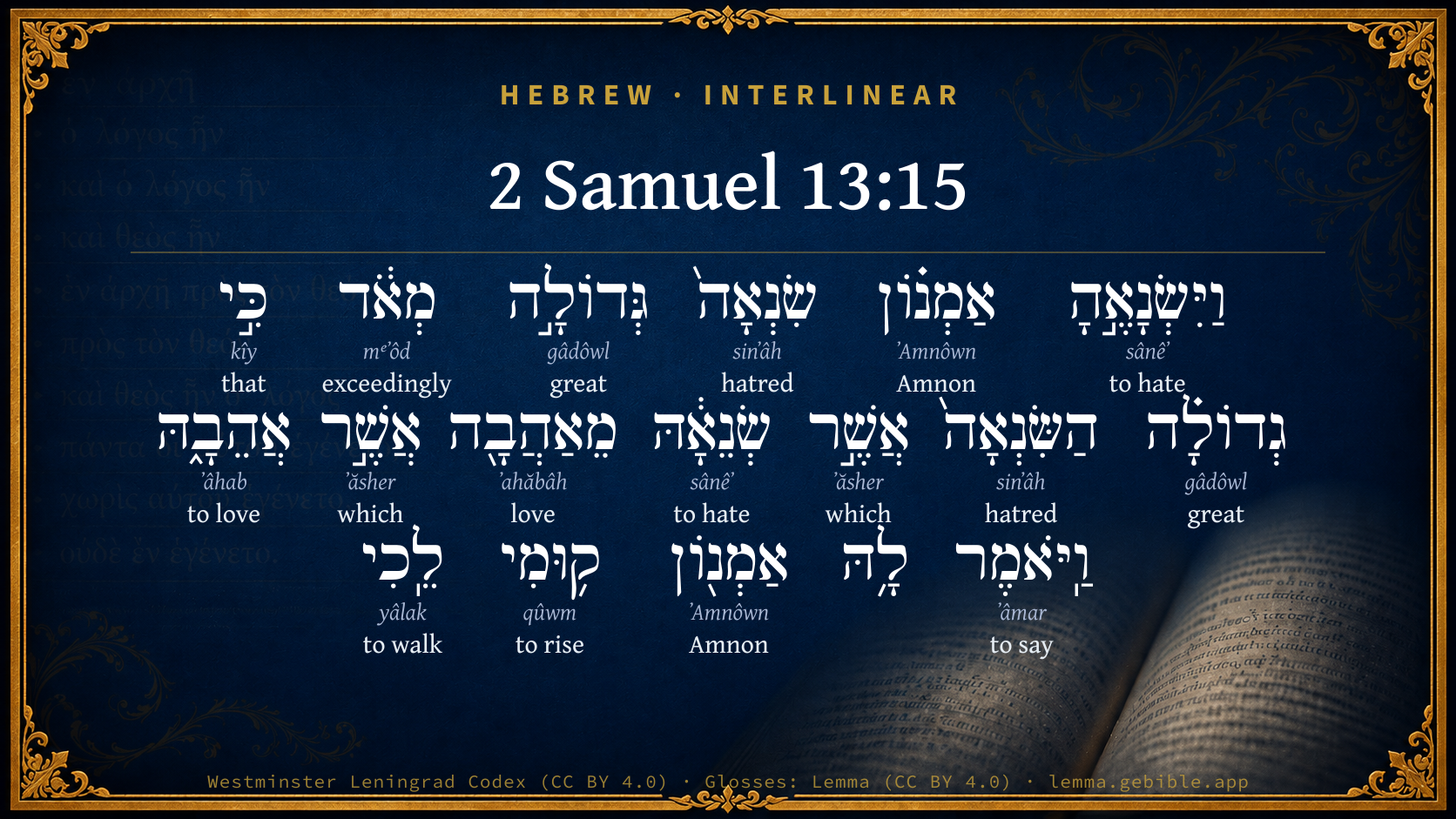
2 Samuel 13:15

Hebrew (Westminster Leningrad Codex) 2 Samuel 13:15 appears in the Hebrew Old Testament. The text above is from the Westminster Leningrad Codex. Each word links to its Strong’s number, a concise gloss, and parsing drawn from the Open Scriptures Hebrew Bible morphology. Click any word for its full Brown-Driver-Briggs (BDB) entry.
Download image
Cite this verse

2 Samuel 13:15 (World English Bible). Public Domain. Lemma interlinear Bible study tool, https://lemma.gebible.app/v/2-samuel/13/15.

Show BibTeX & RIS
BibTeX
RIS
English Translation
Then Amnon hated her with exceeding great hatred; for the hatred with which he hated her was greater than the love with which he had loved her. Amnon said to her, Arise, be gone.
World English Bible · Public Domain
Download a study sheet

One document with this verse’s original text, its word-by-word gloss line, the meaning frame, cross-references with their text, attributed commentary, and full source and license credits — printable, and it pastes into notes with its structure intact.

This verse Autodidact and up

Study sheet (.html) Plain text (.txt)

A passage Seminary Student

Up to 50 verses in one chapter. A passage sheet keeps up to 6 commentary sources and 12 cross-references per verse, in the order this page ranks them, and says so on the sheet whenever that leaves anything out. Ask for a single verse and you get the Autodidact verse sheet above.

Everything on this page stays free to read, with no account — the sheet is a download of what is already on screen, not access to it.

Want to remove ads? Support Godless Engineer
Compare translations 3

The same verse in 3 English versions, stacked beneath the original-language interlinear above. Click any original word for its lexicon entry.

Each is an independent rendering of the whole verse — the interlinear is not word-aligned to these translations.

Highlighted words mark where these versions differ — a whole-verse word diff, not a word-by-word alignment.

  • World English Bible Public Domain
    Then Amnon hated her with exceeding great hatred; for the hatred with which he hated her was greater than the love with which he had loved her. Amnon said to her, Arise, be gone.
  • King James Version Public Domain
    Then Amnon hated her exceedingly; so that the hatred wherewith he hated her was greater than the love wherewith he had loved her. And Amnon said unto her, Arise, be gone.
  • unfoldingWord Literal Text CC BY-SA 4.0
    Then Amnon hated her very great hatred, so that the hatred which he hated her greater than the love which he had loved her. And Amnon said to her, “Arise, go.”

unfoldingWord Literal Text — © unfoldingWord, licensed CC BY-SA 4.0. Word-aligned USFM3 via Door43 (git.door43.org/unfoldingWord/en_ult).

Versions to compare (up to 4)

3 of 4 selected

Show all 18 translations

Every available English version of this verse, each an independent rendering of the whole verse.

  • World English Bible Public Domain
    Then Amnon hated her with exceeding great hatred; for the hatred with which he hated her was greater than the love with which he had loved her. Amnon said to her, Arise, be gone.
  • Berean Standard Bible Public Domain
    Then Amnon hated Tamar with such intensity that his hatred was greater than the love he previously had. “Get up!” he said to her. “Be gone!”
  • Majority Standard Bible Public Domain
    Then Amnon hated Tamar with such intensity that his hatred was greater than the love he previously had. “Get up!” he said to her. “Be gone!”
  • King James Version Public Domain
    Then Amnon hated her exceedingly; so that the hatred wherewith he hated her was greater than the love wherewith he had loved her. And Amnon said unto her, Arise, be gone.
  • American Standard Version (1901) Public Domain
    Then Amnon hated her with exceeding great hatred; for the hatred wherewith he hated her was greater than the love wherewith he had loved her. And Amnon said unto her, Arise, be gone.
  • Revised Version (1885) Public Domain
    Then Amnon hated her with exceeding great hatred; for the hatred wherewith he hated her was greater than the love wherewith he had loved her. And Amnon said unto her, Arise, be gone.
  • Geneva Bible (1599) Public Domain
    Then Amnon hated her exceedingly, so that the hatred wherewith he hated her, was greater then the loue, wherewith hee had loued her: and Amnon sayde vnto her, Vp, get thee hence.
  • Douay-Rheims (1899) Public Domain
    Then Amnon hated her with an exceeding great hatred: so that the hatred wherewith he hated her was greater than the love with which he had loved her before, And Amnon said to her: Arise, and get thee gone.
  • Young's Literal Translation Public Domain
    And Amnon hateth her -- a very great hatred -- that greater `is' the hatred with which he hath hated her than the love with which he loved her, and Amnon saith to her, `Rise, go.'
  • Literal Standard Version CC BY-SA 4.0
    And Amnon hates her—a very great hatred—that greater [is] the hatred with which he has hated her than the love with which he loved her, and Amnon says to her, “Rise, go.”
  • Unlocked Literal Bible CC BY-SA 4.0
    Then Amnon hated Tamar with extreme hatred. He hated her even more than he had desired her. Amnon said to her, “Get up and go.”
  • unfoldingWord Literal Text CC BY-SA 4.0
    Then Amnon hated her very great hatred, so that the hatred which he hated her greater than the love which he had loved her. And Amnon said to her, “Arise, go.”
  • Darby Bible Public Domain
    And Amnon hated her with an exceeding great hatred, for the hatred with which he hated her was greater than the love with which he had loved her. And Amnon said to her, Arise, be gone.
  • World Messianic Bible Public Domain
    Then Amnon hated her with exceedingly great hatred; for the hatred with which he hated her was greater than the love with which he had loved her. Amnon said to her, “Arise, be gone!”
  • Webster's Bible Public Domain
    Then Amnon hated her exceedingly; so that the hatred with which he hated her was greater than the love with which he had loved her. And Amnon said to her, Arise, be gone.
  • Free Bible Version CC BY-SA 4.0
    Then Amnon hated Tamar with immense hatred. His hatred was so strong that it was greater than the love he'd had before. “Get up! Get lost!” he told her.
  • Bible in Basic English Public Domain
    Then Amnon was full of hate for her, hating her with a hate greater than his earlier love for her. And he said to her, Get up and be gone.
  • JPS Tanakh (1917) Public Domain
    Then Amnon hated her with exceeding great hatred; for the hatred wherewith he hated her was greater than the love wherewith he had loved her. And Amnon said unto her: 'Arise, be gone.'

Literal Standard Version (2020), Covenant Press — licensed CC BY-SA 4.0. Text via the HelloAO Bible API (eBible.org). Unlocked Literal Bible (unfoldingWord) — licensed CC BY-SA 4.0. Text via the HelloAO Bible API (eBible.org). unfoldingWord Literal Text — © unfoldingWord, licensed CC BY-SA 4.0. Word-aligned USFM3 via Door43 (git.door43.org/unfoldingWord/en_ult). Free Bible Version, Dr. Jonathan Gallagher — licensed CC BY-SA 4.0. Text via the HelloAO Bible API (eBible.org).

Word by word

More ways to search: Search by grammar → Find every occurrence → Compare this word →

Practice this passage: Drill this verse → Learn its vocabulary →

שִׂנְאָה֙
sinʼâh
H8135
“hatred”
Noun, Common, Feminine, Singular, Absolute
Part of Speech
Noun
Type
Common
Gender
Feminine
Number
Singular
State
Absolute
Full BDB Definition

Origin: from H8130

TWOT: 2272b

hating, hatred, hate - hatred - of man, God
  1. וַיִּשְׂנָאֶ֣הָ sânêʼ H8130 “and · to hate · her” Conjunction + Verb, Qal, Sequential Imperfect, 3rd Person, Masculine, Singular + Suffix, Personal, 3rd Person, Feminine, Singular
  2. אַמְנ֗וֹן ʼAmnôwn H550 “Amnon” Noun, Proper
  3. גְּדוֹלָ֣ה gâdôwl H1419 “great” Adjective, Adjective, Feminine, Singular, Absolute
  4. מְאֹ֔ד mᵉʼôd H3966 “exceedingly” Adverb
  5. כִּ֣י kîy H3588 “that” Conjunction
  6. גְדוֹלָ֗ה gâdôwl H1419 “great” Adjective, Adjective, Feminine, Singular, Absolute
  7. הַשִּׂנְאָה֙ sinʼâh H8135 “the · hatred” Particle, Definite Article + Noun, Common, Feminine, Singular, Absolute
  8. אֲשֶׁ֣ר ʼăsher H834 “which” Particle, Relative
  9. שְׂנֵאָ֔הּ sânêʼ H8130 “to hate · her” Verb, Qal, Perfect, 3rd Person, Masculine, Singular + Suffix, Personal, 3rd Person, Feminine, Singular
  10. מֵאַהֲבָ֖ה ʼahăbâh H160 “from · love” Preposition + Noun, Common, Feminine, Singular, Absolute
  11. אֲשֶׁ֣ר ʼăsher H834 “which” Particle, Relative
  12. אֲהֵבָ֑הּ ʼâhab H157 “to love · her” Verb, Qal, Perfect, 3rd Person, Masculine, Singular + Suffix, Personal, 3rd Person, Feminine, Singular
  13. וַֽיֹּאמֶר ʼâmar H559 “and · to say” Conjunction + Verb, Qal, Sequential Imperfect, 3rd Person, Masculine, Singular
  14. אַמְנ֖וֹן ʼAmnôwn H550 “Amnon” Noun, Proper
  15. ק֥וּמִי qûwm H6965 “rise” Verb, Qal, Imperative, 2nd Person, Feminine, Singular
  16. לֵֽכִי yâlak H3212 “walk” Verb, Qal, Imperative, 2nd Person, Feminine, Singular

About this verse

These counts appear in no published source. They are computed here, from the morphology-tagged text and Lemma’s own curated glosses. What Lemma adds →

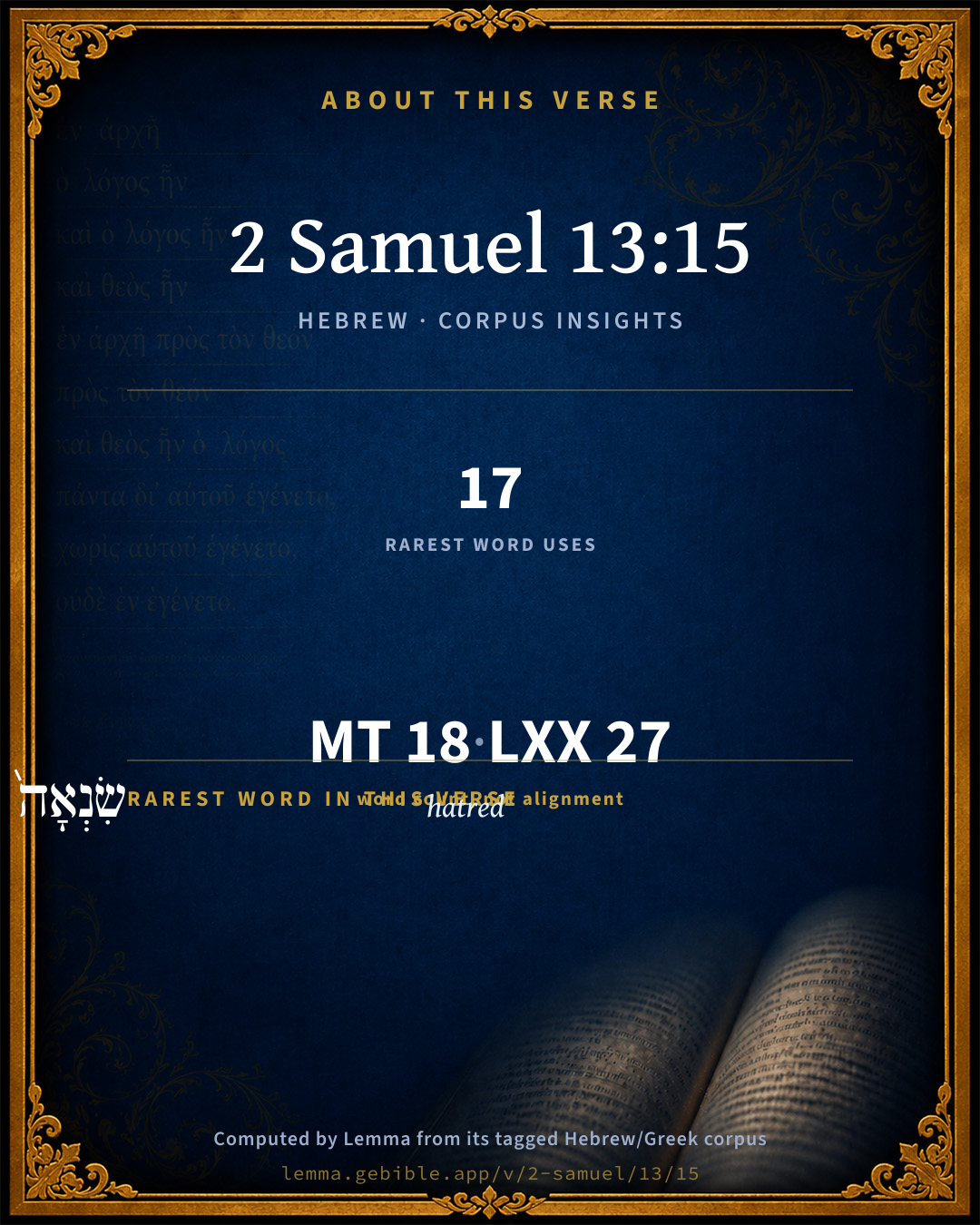
18
words
12
distinct lemmas
Historical
section

Notable vocabulary

The rarest word here is שִׂנְאָה֙ hatred H8135 — appearing just 17 times in the whole Hebrew Bible.

Shared distinctive vocabulary

שִׂנְאָה֙ hatred H8135 occurs in 16 verses of the Hebrew Bible. Also found in:

Grammatical profile

  • 6 verbs
  • 5 nouns
  • 2 adjectives
  • 1 preposition
  • 1 conjunction
  • 1 adverb
  • 2 particles

Verb forms

  • וַיִּשְׂנָאֶ֣הָ Qal · Sequential Imperfect
  • שְׂנֵאָ֔הּ Qal · Perfect
  • אֲהֵבָ֑הּ Qal · Perfect
  • וַֽיֹּאמֶר Qal · Sequential Imperfect
  • ק֥וּמִי Qal · Imperative
  • לֵֽכִי Qal · Imperative

Repetition

Words recur within this verse — often emphatic in Hebrew:

  • וַיִּשְׂנָאֶ֣הָ to hate H8130 ×2
  • אַמְנ֗וֹן Amnon H550 ×2
  • שִׂנְאָה֙ hatred H8135 ×2
  • גְּדוֹלָ֣ה great H1419 ×2
  • אֲשֶׁ֣ר which H834 ×2

Hebrew & Septuagint length

In English translation the verse runs 34 words from the Hebrew and 45 from the Septuagint (LXX English) — closely comparable.

A rough comparison of the two English renderings, which tokenize alike — not a word-level alignment.

Word counts can differ between the Hebrew and the Greek without any difference in meaning — e.g. the Hebrew direct-object marker אֵת has no separate Greek word, and Greek often adds the article ὁ.

In the original languages it is 18 Hebrew tokens and 27 Greek tokens — but the two are counted differently (Hebrew bundles its prefixes and suffixes into one token; the Greek is in lemma form), so that isn’t a like-for-like length.

Cross-references

1

Topical passages linked to 2 Samuel 13:15 in the Treasury of Scripture Knowledge — connected by theme and wording, ordered by reader-vote popularity; previews shown in the World English Bible.

  • Ezekiel 23:17 The Babylonians came to her into the bed of love, and they defiled her with their prostitution, and she was polluted with them, and her soul was alienated from them.

Cross-references courtesy of OpenBible.info (CC BY 4.0).

Hebrew and Greek witnesses Masoretic Hebrew ↔ Greek Septuagint

The same verse in the two great witnesses to the Old Testament, shown verse-for-verse.

These are two independent witnesses, not word-aligned to each other, and the Septuagint is shown in lemma (dictionary) form.

Hebrew 2 Samuel 13:15 Masoretic · Westminster Leningrad Codex

וַיִּשְׂנָאֶ֣הָ אַמְנ֗וֹן שִׂנְאָה֙ גְּדוֹלָ֣ה מְאֹ֔ד כִּ֣י גְדוֹלָ֗ה הַשִּׂנְאָה֙ אֲשֶׁ֣ר שְׂנֵאָ֔הּ מֵאַהֲבָ֖ה אֲשֶׁ֣ר אֲהֵבָ֑הּ וַֽיֹּאמֶר לָ֥הּ אַמְנ֖וֹן ק֥וּמִי לֵֽכִי

Then Amnon hated her with exceeding great hatred; for the hatred with which he hated her was greater than the love with which he had loved her. Amnon said to her, Arise, be gone.

World English Bible · Public Domain

Greek LXX 2 Samuel 13:15 Septuagint · lemma form

καί μισέω αὐτός αμνων μῖσος μέγας σφόδρα ὅτι μέγας ὁ μῖσος ὅς μισέω αὐτός ὑπέρ ὁ ἀγάπη ὅς ἀγαπάω αὐτός καί εἶπον αὐτός αμνων ἀναἵστημι καί πορεύομαι

Then Amnon hated her with very great hatred; for the hatred with which he hated her was greater than the love with which he had loved her, for the last wickedness was greater than the first: and Amnon said to her, Rise, and be gone.

LXX2012 (modern English Septuagint) · Public Domain

Hebrew: Westminster Leningrad Codex (CC BY 4.0). Greek: Septuagint (public domain); English from LXX2012 (modern English Septuagint) (Public Domain). How the Septuagint differs from the Hebrew →

Targum (Aramaic paraphrase)

1

The Targum is the ancient Jewish Aramaic paraphrase of the Hebrew Scriptures — an interpretive translation, not the Hebrew text itself. Onkelos (literal) and Pseudo-Jonathan (expansive) render the Torah, and Jonathan the Prophets. Coverage is partial: where no permissively-licensed English translation exists for a verse, only the Aramaic is shown. This is verse-level text, not a word-by-word alignment to the Hebrew.

  1. Targum Jonathan Prophets (Joshua–Malachi)
    וּסְנָאָהּ אַמְנוֹן סִנְאָתָא רַבְּתָא לַחֲדָא אֲרֵי סַגִיאָה סִנְאָתָא דִי סְנָאָהּ מֵרִחֲמָתָא דִרְחִימָהּ וַאֲמַר לָהּ אַמְנוֹן קוּמִי אֱזִילִי:

    (no public-domain English translation for this verse)

    Targum Jonathan — Aramaic: “Mikraot Gedolot” (public domain). English: “Sefaria Community Translation” (CC0 1.0 (public-domain dedication)); “London "Chaldee Paraphrase," 1871” (public domain). Text via Sefaria.

Commentary

Notes on 2 Samuel 13:15 from classic Christian and Jewish commentators (each source and its license shown beneath its notes). The classic Christian expositions comment on the surrounding passage and are grouped to its opening verse, so a note may address several verses; the Jewish commentaries on the Tanakh (Rashi and others) are per-verse, so they appear only where the commentator wrote on this verse.

Lemma curates 59 commentaries, every one of them public domain or Creative Commons licensed, each selected and text-cleaned for this edition rather than reprinted as found. About our sources →

Trapp's Complete Commentary

John Trapp

2Sa 13:15 Then Amnon hated her exceedingly; so that the hatred wherewith he hated her [was] greater than the love wherewith he had loved her. And Amnon said unto her, Arise, be gone.

Ver. 15. Then Amnon hated her exceedingly.] Heb, With great hatred greatly; so did Nero, that shame of mankind, hate his own mother, after that he had carnally known her. So did Semiramis hate her son Ninus; Phaedra her Hippolitus; Medea her Jason, &c. Of these filthy pleasures, a man may break his neck before his fast:

“ Labor est etiam ipsa voluptas. ”

At the last, howsoever, it biteth] like a serpent, and stingeth like a cockatrice. {Pro 23:32} Amnon was now pricked in conscience, and ashamed of his horrible sin; hence this extreme hatred. Neither was it without the Lord that this foul crime might come abroad to David’s grief, as Martyr noteth, that he might further feel what "an evil and bitter thing sin is."

John Trapp, A Commentary or Exposition upon All the Books of the Old and New Testament (1647–1656) — public domain. Text from a community e-Sword module.

Joseph Benson's Commentary

2Sa 13:15-17. Then Amnon hated her exceedingly — His mind, which at first had been impelled by lust, was now agitated by remorse, which drove it to a different extreme, like the vibration of a pendulum. The horror of his guilt struck him with a sudden detestation of her whom he deemed the cause of it, and he hated his sister when he should have hated himself. Thus, through God’s abandoning him, in just judgment, to the tumult of his own intemperate mind, this other punishment of David’s adultery became more flagrant; and the prophet’s prediction, of evil being raised up to him out of his own house, more conspicuous. For Amnon’s barbarous behaviour now precluded all possibility of concealing his guilt. The moment his brutality was indulged, he commanded his sister out of his sight. And she said, There is no cause — For me to go, or for this hard usage. She had given him no cause for aggravating his first offence, by loading it with an immediate and public scandal, and indelible reproach upon her, himself, and his house; upon religion, and the people of God. This evil is greater than the former — Not a greater sin, but an act of greater cruelty, and a greater calamity to her; because it exposed her to general infamy and contempt. And, besides, it turned a private offence into a matter of public scandal, to the great dishonour of God and of his people, and especially of all the royal family. But he would not hearken to her —

He was now as deaf to decency and humanity as he had been before to all sense of shame and conscience, and, therefore, called to his servant that attended him, and bid him turn out that woman from him, and bolt the door after her.

Joseph Benson's Commentary on the Old and New Testaments (1811–1818) — public domain. Text from a community e-Sword module.

Tyndale Open Study Notes

Tyndale Open Resources

13:15 That Amnon’s feelings for Tamar so quickly turned to hate shows that his so-called “love” for her (13:4) was really only selfish lust.

Tyndale Open Study Notes — © Tyndale Open Resources, licensed CC BY-SA 4.0. Text via the HelloAO Bible API.

Jamieson, Fausset & Brown

Robert Jamieson, A. R. Fausset & David Brown

Then Amnon hated her exceedingly--It is not unusual for persons instigated by violent and irregular passions to go from one extreme to another. In Amnon's case the sudden revulsion is easily accounted for; the atrocity of his conduct, with all the feelings of shame, remorse, and dread of exposure and punishment, now burst upon his mind, rendering the presence of Tamar intolerably painful to him.

Jamieson, Fausset & Brown — Commentary Critical and Explanatory on the Whole Bible (1871) — public domain (CC PDM 1.0). Text via the HelloAO Bible API.

Adam Clarke's Commentary

Verse 15. Hated her exceedingly] Amnon's conduct to his sister was not only brutal but inexplicable. It would be easy to form conjectures concerning the cause, but we can arrive at no certainty.

Adam Clarke's Commentary on the Bible (1810–1826) — public domain. Text from a community e-Sword/MySword module.

Ellicott's Commentary for English Readers

(15) Hated her exceedingly.—“It is characteristic of human nature to hate one whom you have injured” (Tacitus, quoted by Kirkpatrick), This result shows that Amnon was governed, not by love, but by mere animal passion.

A Bible Commentary for English Readers, edited by Charles John Ellicott (1878–1897) — public domain. Text from a community e-Sword module.

The Cambridge Bible for Schools and Colleges

gen. ed. J. J. S. Perowne

15. hated her exceedingly] “Proprium humani ingenii est odisse quem laeseris.” “It is characteristic of human nature to hate one whom you have injured.” Tac. Agric. c. 42.

The Cambridge Bible for Schools and Colleges (gen. ed. J. J. S. Perowne; Cambridge University Press, 1878–1918) — public domain. Text from a community e-Sword module.

John Gill's Exposition

Then Amnon hated her exceedingly,.... Having gratified his lust, his conscience stung him for it, that he could not bear the sight of the object that had been the instrument of it; and it may be the sharp words she had used, representing him as one of the fools in Israel, and perhaps she used sharper words still after he had abused her, filled him with hatred to her:

so that the hatred wherewith he hated her was greater than the love wherewith he had loved her; a like instance of love being changed into hatred, after the gratification of lust, we have in Honorius towards his sister Placidia (b):

and Amnon said unto her, arise, be gone; without calling her by her name, or owning the relation she bore to him, using her as the basest and vilest of creatures. This conduct was very brutish, as well as imprudent, and foolish to the last degree; had he had any regard to his own reputation, he would never have turned her out of doors so soon, and in such a public manner; but so it was ordered by divine Providence, that his sin might be made known, and so the murder of him for it by Absalom was brought on, and both were suffered as a correction and chastisement to David for his sins of adultery and murder, Sa2 12:11.

(b) Olympiodorus apud Grotium in loc.

John Gill's Exposition of the Whole Bible (1746–1763) — public domain (CC PDM 1.0). Text via the HelloAO Bible API.

Haydock's Catholic Bible Commentary

Before. Such changes are not unfrequent in those who give way to disordered passions, as Aristotle (prob. iv.) proves. Semiramis slew her lovers, and among the rest her own son. (Tirinus) --- God caused Amnon to be stung with remorse, and the evil spirit pushed him on to extremities, which filled the palace with scandal and bloodshed. (Menochius)

George Leo Haydock (1774–1849), Haydock's Catholic Family Bible and Commentary, 1859 edition — public domain. Excludes Psalms (Douay-Rheims chapter numbering differs from Protestant) and Deuterocanonical books (Catholic canon only).

Matthew Poole's English Annotations

Then Amnon hated her exceedingly; partly because, his lust being now satisfied, his mind and conscience had a true and clear prospect and deep sense of the natural turpitude and baseness of the action, and of that shame, and contempt, and loss, and mischief which was likely to follow it, and consequently an utter aversion from her who had been the instrument and occasion of his sin; and principally by the just judgment of God, both upon Amnon and David, that so the sin might be made public, and way made for the succeeding tragedies; for otherwise it would probably produce love and kindness to her, as it did in another, Gen 34:2,3; especially, in him, whom both nature, and interest, and even lust itself, obliged to allay her grief and shame by all possible demonstrations of kindness.

Matthew Poole's English Annotations on the Holy Bible (1683–1685) — public domain. Text from a community e-Sword/MySword module.

Whedon's Commentary on the Bible

Daniel D. Whedon

15. Hated her exceedingly — His love had been the offspring of his foul desire, and when that was satiated his sin, his danger, and shame all rushed upon his thoughts, and generated this hatred in his soul. “He now feels for the first time,” says Ewald, “the sinfulness of his deed, and the impossibility of his love being ever reciprocated.”

Daniel D. Whedon (gen. ed.), Commentary on the Old and New Testaments (1874–1909) — public domain. Text from a community e-Sword module.

The Pulpit Commentary

Anmon hated her exceedingly. Ashen had not really ever loved Tamar; his passion had been mere animal desire, which, by a well known psychological law, when gratified turned to hatred. Had he possessed any dignity of character or self-respect, he would have resisted this double wrong to one so near to him, and whom he had so terribly disgraced; but he can only remember the indignant words she had spoken her comparison of him to "the fools in Israel," and her obstinateresistance to his wishes. With coarse violence he orders her away; and when, humbled and heartbroken, she begs for milder treatment, he adds insult to the wrong, and bids his manservant push her out, am! belt the door after her. By such an order the manservant and all Amnon"s people would be led to believe that she was the guilty person, and Ashen the victim of her enticements.

The Pulpit Commentary (1880–1919), ed. H.D.M. Spence-Jones & Joseph S. Exell — public domain. Text from a community e-Sword module.

John Wesley's Explanatory Notes

Hated her - By the just judgment of God both upon Amnon and David, that so the sin might be made publick, and way for the succeeding tragedies.

John Wesley, Explanatory Notes Upon the Whole Bible (1754–1765) — public domain. Text via the GEBible commentary corpus.

Kretzmann's Popular Commentary

Paul E. Kretzmann

Amnon Spurns Tamar

v. 15. Then Amnon, having gratified his bestial lust, hated her exceedingly, this being the usual consequence of a relation such as pictured in this chapter, so that the hatred wherewith he hated her was greater than the love wherewith he had loved her; he now loathed the object of his former intense passion. And Amnon said unto her, Arise, be gone!

v. 16. And she said unto him, there is no cause; this evil in sending me away is greater than the other that thou didst unto me. The Hebrew text shows an unfinished sentence, spoken in great agitation: On account of this greater evil than the other which thou didst to me in sending me away-. If he persisted in driving her from his house, men might believe that she had given him occasion to act toward her in such a manner, and the disgrace would be all the greater. But he would not hearken unto her, did not, in fact, even let her finish her protest.

v. 17. Then he called his servant that ministered unto him, his own private attendant, and said, Put now this woman out from me, and bolt the door after her, just as if she had tempted him to a shameful act and he wanted to insure against a repetition of her shamelessness.

v. 18. And she had a garment of divers colors upon her, a coat or upper garment with long sleeves; for with such robes were the king’s daughters that were virgins appareled. Although she was a virgin and a princess, Amnon treated Tamar like a common prostitute. Then his servant brought her out, and bolted the door after her.

v. 19. And Tamar, as a sign of her great grief over the shame laid upon her, put ashes on her head, and rent her garment of divers colors that was on her, and laid her hand on her head, as a token of the fact that the hand of God lay heavily on her in this visitation, and went on crying, bewailing the greatness of her shame and disgrace.

v. 20. And Absalom, her brother, said unto her, Hath Amnon, thy brother, been with thee? He guessed the state of affairs at once, expressing his opinion thus delicately. But hold now thy peace, my sister; he is thy brother; regard not this thing, lay it not to heart. He feigned a carelessness which he was far from feeling, because he wanted to conceal his purpose to revenge himself in the sight of all men. If Tamar would act in the same manner, he would have a better opportunity to carry out his design. So Tamar remained desolate in her brother Absalom’s house, literally, "as desolated," as one whose happiness in life had been destroyed.

v. 21. But when King David heard of all these things, he was very wroth. His anger, unfortunately, did not cause him to act, to punish Amnon. Either the consciousness of his own recent sin held him back, or he practiced a false indulgence toward his first-born son.

v. 22. And Absalom, true to his plan of hiding his feelings for the time being and lulling Amnon to security, spake unto his brother Amnon neither good nor bad, he simply avoided him; for Absalom hated Amnon because he had forced his sister Tamar. Such examples of sin as here narrated instill a loathing and a horror of sin. They show that every sin and especially such sins of the flesh are an abomination in the sight of God, evils which cause only sorrow and heartache among men.

Paul E. Kretzmann, Popular Commentary of the Bible (1921–1924) — public domain. Text from a community e-Sword module.

unfoldingWord translationNotes

Door43 World Missions Community

Because this great evil of making me leave is even worse

The abstract noun "this great evil" can be expressed as a verb. AT: "It would be very evil to make me leave! It would be even worse" (See: Abstract Nouns)

bolt the door after her

This means to lock the door so that she will not be able to come back in again. AT: "lock the door so that she cannot come back in" (See: Assumed Knowledge and Implicit Information)

translationWords

evil

call

servant

unfoldingWord translationNotes — © Distant Shores Media and the Door43 World Missions Community, licensed CC BY-SA 4.0. Source: git.door43.org/Door43/en_tn.

Rashi

Rabbi Shlomo Yitzchaki (Rashi)

Amnon hated her. Our Rabbis say she tied a hair for him [in his genital area] and caused him to have a severed organ.

Rashi on the Tanakh — English translations: “The Judaica Press complete Tanach with Rashi, translated by A. J. Rosenberg” (CC BY 4.0); “Pentateuch with Rashi's commentary by M. Rosenbaum and A.M. Silbermann, 1929-1934” (public domain); “The Metsudah Tanach series, Lakewood, N.J” (CC BY 4.0); and “The Book of Joshua, Metsudah Publications, 1997” (CC BY 4.0). Text via Sefaria.

Lesson kit

Teaching starters — assembled from the data on this page, not authored interpretation. Every prompt links to the verse data it draws on. Edit before teaching.

2 Samuel, in the Historical, opens this verse with 18 words (12 distinct Hebrew lemmas). Its most distinctive word is sinʼâh (“hatred”). A historical commentator’s framing appears above. Read the whole chapter for the surrounding context.

Discussion questions

  1. The word sinʼâh carries the sense “hatred.” How does it shape the verse?
  2. How does Numbers 35:20, which shares the word «hatred», read alongside this verse?
  3. What does the repetition of “to hate” (2× in this one verse) do in this verse?
  4. These translations render this verse differently. What is at stake in choosing one wording over another?
  5. «וַיִּשְׂנָאֶ֣הָ» is a Qal Sequential Imperfect verb. How does that grammatical form shape the action described?
  6. Compare how Trapp's Complete Commentary and Joseph Benson's Commentary read this verse. Where do they agree or differ?

Things to notice

Reading settings

Reading text

Shown beneath each verse's original-language words.

Old Testament
Old Testament edition

Read the OT as the Masoretic Hebrew (MT) or the Greek Septuagint (LXX).

English shown for the Greek Septuagint (in the Hebrew ↔ Greek comparison).

Comparing translations? Open the Compare panel on any verse page to stack up to four side by side.