
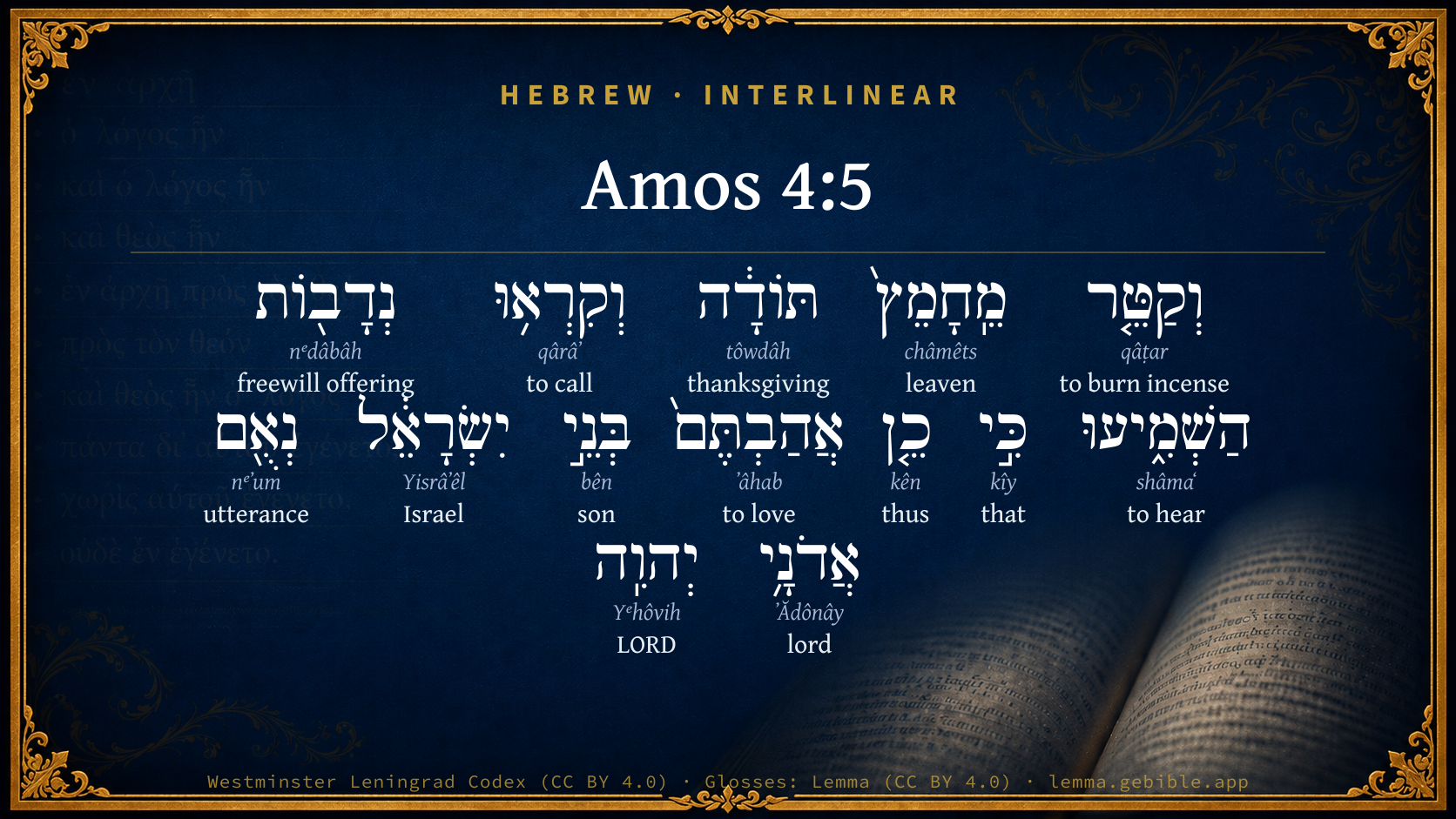
Amos 4:5

Hebrew (Westminster Leningrad Codex) Amos 4:5 appears in the Hebrew Old Testament. The text above is from the Westminster Leningrad Codex. Each word links to its Strong’s number, a concise gloss, and parsing drawn from the Open Scriptures Hebrew Bible morphology. Click any word for its full Brown-Driver-Briggs (BDB) entry.
Download image
Cite this verse

Amos 4:5 (World English Bible). Public Domain. Lemma interlinear Bible study tool, https://lemma.gebible.app/v/amos/4/5.

Show BibTeX & RIS
BibTeX
RIS
English Translation
Offer a sacrifice of thanksgiving of that which is leavened, And proclaim free will offerings and brag about them: For this pleases you, you children of Israel," says the Lord Yahweh.
World English Bible · Public Domain
Download a study sheet

One document with this verse’s original text, its word-by-word gloss line, the meaning frame, cross-references with their text, attributed commentary, and full source and license credits — printable, and it pastes into notes with its structure intact.

This verse Autodidact and up

Study sheet (.html) Plain text (.txt)

A passage Seminary Student

Up to 50 verses in one chapter. A passage sheet keeps up to 6 commentary sources and 12 cross-references per verse, in the order this page ranks them, and says so on the sheet whenever that leaves anything out. Ask for a single verse and you get the Autodidact verse sheet above.

Everything on this page stays free to read, with no account — the sheet is a download of what is already on screen, not access to it.

Want to remove ads? Support Godless Engineer
Compare translations 3

The same verse in 3 English versions, stacked beneath the original-language interlinear above. Click any original word for its lexicon entry.

Each is an independent rendering of the whole verse — the interlinear is not word-aligned to these translations.

Highlighted words mark where these versions differ — a whole-verse word diff, not a word-by-word alignment.

  • World English Bible Public Domain
    Offer a sacrifice of thanksgiving of that which is leavened, And proclaim free will offerings and brag about them: For this pleases you, you children of Israel," says the Lord Yahweh.
  • King James Version Public Domain
    And offer a sacrifice of thanksgiving with leaven, and proclaim and publish the free offerings: for this liketh you, O ye children of Israel, saith the Lord GOD.
  • unfoldingWord Literal Text CC BY-SA 4.0
    Offer a thanksgiving sacrifice with bread; proclaim freewill offerings; announce them, for this pleases you, you sons of Israel— this is the declaration of the Lord Yahweh.

unfoldingWord Literal Text — © unfoldingWord, licensed CC BY-SA 4.0. Word-aligned USFM3 via Door43 (git.door43.org/unfoldingWord/en_ult).

Versions to compare (up to 4)

3 of 4 selected

Show all 18 translations

Every available English version of this verse, each an independent rendering of the whole verse.

  • World English Bible Public Domain
    Offer a sacrifice of thanksgiving of that which is leavened, And proclaim free will offerings and brag about them: For this pleases you, you children of Israel," says the Lord Yahweh.
  • Berean Standard Bible Public Domain
    Offer leavened bread as a thank offering, and loudly proclaim your freewill offerings. For that is what you children of Israel love to do,” declares the Lord GOD.
  • Majority Standard Bible Public Domain
    Offer leavened bread as a thank offering, and loudly proclaim your freewill offerings. For that is what you children of Israel love to do,” declares the Lord GOD.
  • King James Version Public Domain
    And offer a sacrifice of thanksgiving with leaven, and proclaim and publish the free offerings: for this liketh you, O ye children of Israel, saith the Lord GOD.
  • American Standard Version (1901) Public Domain
    and offer a sacrifice of thanksgiving of that which is leavened, and proclaim freewill-offerings and publish them: for this pleaseth you, O ye children of Israel, saith the Lord Jehovah.
  • Revised Version (1885) Public Domain
    and offer a sacrifice of thanksgiving of that which is leavened, and proclaim freewill offerings and publish them: for this liketh you, O ye children of Israel, saith the Lord GOD.
  • Geneva Bible (1599) Public Domain
    And offer a thankesgiuing of leauen, publish and proclaime the free offrings: for this liketh you, O ye children of Israel, saith the Lord God.
  • Douay-Rheims (1899) Public Domain
    And offer a sacrifice of praise with leaven: and call free offerings, and proclaim it: for so you would do, O children of Israel, saith the Lord God.
  • Young's Literal Translation Public Domain
    And perfume with leaven a thank-offering, And proclaim willing gifts, sound ye! For so ye have loved, O sons of Israel, An affirmation of the Lord Jehovah.
  • Literal Standard Version CC BY-SA 4.0
    And burn a thank-offering with leaven as incense, || And proclaim willing gifts, sound! For so you have loved, O sons of Israel,” || A declaration of Lord YHWH.
  • Unlocked Literal Bible CC BY-SA 4.0
    Offer a thanksgiving sacrifice with bread; proclaim freewill offerings; announce them, for this pleases you, you people of Israel —this is the declaration of the Lord Yahweh.
  • unfoldingWord Literal Text CC BY-SA 4.0
    Offer a thanksgiving sacrifice with bread; proclaim freewill offerings; announce them, for this pleases you, you sons of Israel— this is the declaration of the Lord Yahweh.
  • Darby Bible Public Domain
    and burn a thank-offering with leaven, and proclaim, publish, voluntary offerings: for this pleaseth you, children of Israel, saith the Lord Jehovah.
  • World Messianic Bible Public Domain
    offer a sacrifice of thanksgiving of that which is leavened, and proclaim free will offerings and brag about them; for this pleases you, you children of Israel,” says the Lord GOD.
  • Webster's Bible Public Domain
    And offer a sacrifice of thanksgiving with leaven, and proclaim and publish the free-offerings: for this pleaseth you, O ye children of Israel, saith the Lord GOD.
  • Free Bible Version CC BY-SA 4.0
    Burn a thank offering of bread made with yeast, and announce what you're giving as freewill offerings so everyone will know. This is what you love to do! declares the Lord God.
  • Bible in Basic English Public Domain
    Let that which is leavened be burned as a praise-offering, let the news of your free offerings be given out publicly; for this is pleasing to you, O children of Israel, says the Lord.
  • JPS Tanakh (1917) Public Domain
    And offer a sacrifice of thanksgiving of that which is leavened, and proclaim freewill-offerings and publish them; for so ye love to do, O ye children of Israel, saith the Lord GOD.

Literal Standard Version (2020), Covenant Press — licensed CC BY-SA 4.0. Text via the HelloAO Bible API (eBible.org). Unlocked Literal Bible (unfoldingWord) — licensed CC BY-SA 4.0. Text via the HelloAO Bible API (eBible.org). unfoldingWord Literal Text — © unfoldingWord, licensed CC BY-SA 4.0. Word-aligned USFM3 via Door43 (git.door43.org/unfoldingWord/en_ult). Free Bible Version, Dr. Jonathan Gallagher — licensed CC BY-SA 4.0. Text via the HelloAO Bible API (eBible.org).

Word by word

More ways to search: Search by grammar → Find every occurrence → Compare this word →

Practice this passage: Drill this verse → Learn its vocabulary →

מֵֽחָמֵץ֙
châmêts
H2557
“from · leaven”
Preposition + Noun, Common, Masculine, Singular, Absolute
Part of Speech
Preposition + Noun
Type
Common
Gender
Masculine
Number
Singular
State
Absolute
Full BDB Definition

Origin: from H2556

TWOT: TWOT- 679a

the thing leavened, leaven
  1. וְקַטֵּ֤ר qâṭar H6999 “and · to burn incense” Conjunction + Verb, Piel, Infinitive Absolute
  2. תּוֹדָ֔ה tôwdâh H8426 “thanksgiving” Noun, Common, Feminine, Singular, Absolute
  3. וְקִרְא֥וּ qârâʼ H7121 “and · call” Conjunction + Verb, Qal, Imperative, 2nd Person, Masculine, Plural
  4. נְדָב֖וֹת nᵉdâbâh H5071 “freewill offerings” Noun, Common, Feminine, Plural, Absolute
  5. הַשְׁמִ֑יעוּ shâmaʻ H8085 “hear” Verb, Hiphil, Imperative, 2nd Person, Masculine, Plural
  6. כִּ֣י kîy H3588 “that” Conjunction
  7. כֵ֤ן kên H3651 “thus” Adverb
  8. אֲהַבְתֶּם֙ ʼâhab H157 “to love” Verb, Qal, Perfect, 2nd Person, Masculine, Plural
  9. בְּנֵ֣י bên H1121 “sons of” Noun, Common, Masculine, Plural, Construct
  10. יִשְׂרָאֵ֔ל Yisrâʼêl H3478 “Israel” Noun, Proper
  11. נְאֻ֖ם nᵉʼum H5002 “utterance of” Noun, Common, Masculine, Singular, Construct
  12. אֲדֹנָ֥י ʼĂdônây H136 “Lord · my” Noun, Common, Masculine, Plural, Construct + Suffix, Personal, 1st Person, Common, Singular
  13. יְהוִֽה Yᵉhôvih H3069 “LORD” Noun, Proper

About this verse

These counts appear in no published source. They are computed here, from the morphology-tagged text and Lemma’s own curated glosses. What Lemma adds →

14
words
14
distinct lemmas
Prophets
section

Notable vocabulary

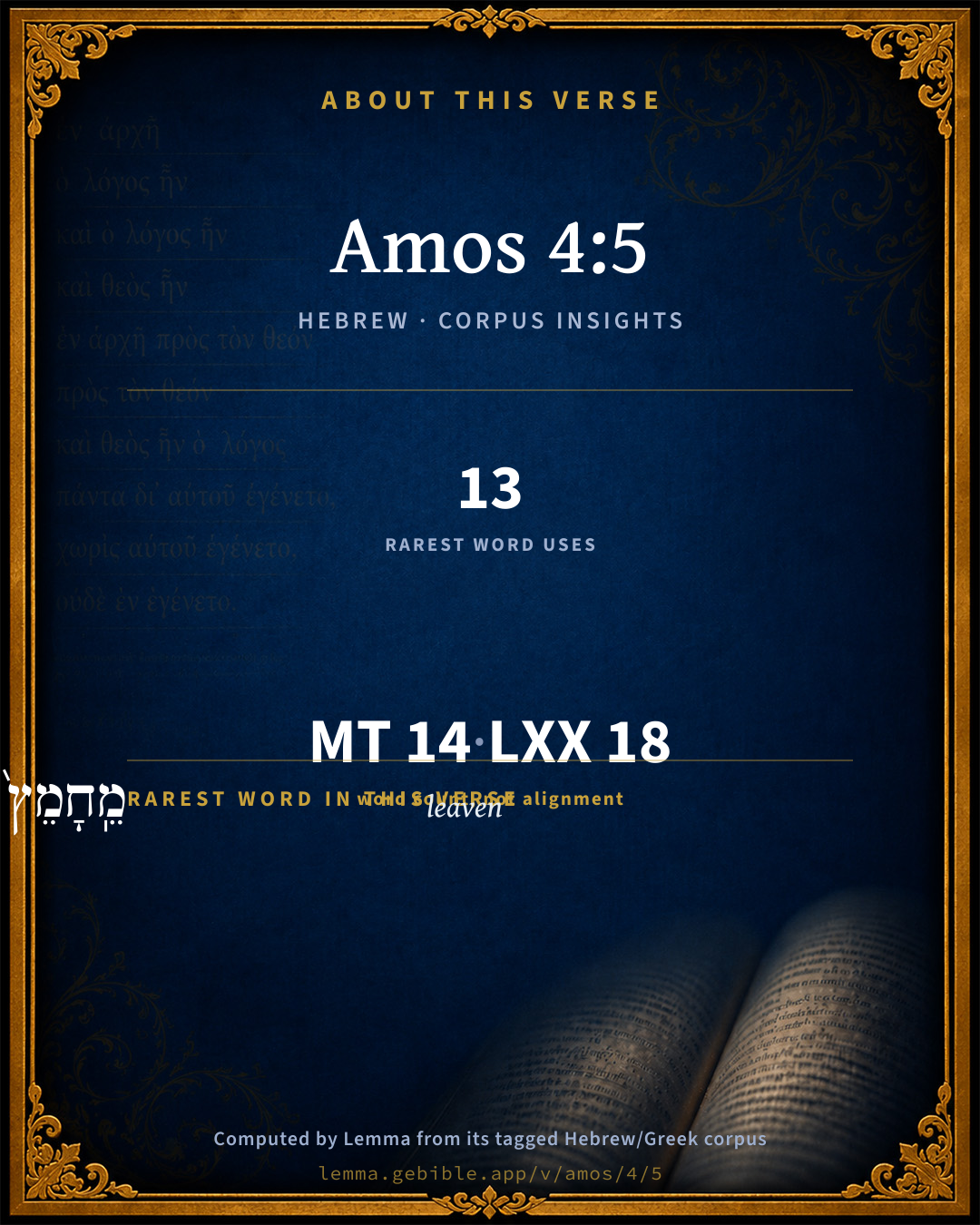
The rarest word here is מֵֽחָמֵץ֙ leaven H2557 — appearing just 13 times in the whole Hebrew Bible.

Shared distinctive vocabulary

מֵֽחָמֵץ֙ leaven H2557 occurs in 13 verses of the Hebrew Bible. Also found in:

Grammatical profile

  • 4 verbs
  • 8 nouns
  • 1 conjunction
  • 1 adverb

Verb forms

  • וְקַטֵּ֤ר Piel · Infinitive Absolute
  • וְקִרְא֥וּ Qal · Imperative
  • הַשְׁמִ֑יעוּ Hiphil · Imperative
  • אֲהַבְתֶּם֙ Qal · Perfect

Hebrew & Septuagint length

In English translation the verse runs 31 words from the Hebrew and 25 from the Septuagint (LXX English) — closely comparable.

A rough comparison of the two English renderings, which tokenize alike — not a word-level alignment.

Word counts can differ between the Hebrew and the Greek without any difference in meaning — e.g. the Hebrew direct-object marker אֵת has no separate Greek word, and Greek often adds the article ὁ.

In the original languages it is 14 Hebrew tokens and 18 Greek tokens — but the two are counted differently (Hebrew bundles its prefixes and suffixes into one token; the Greek is in lemma form), so that isn’t a like-for-like length.

Cross-references

13

Topical passages linked to Amos 4:5 in the Treasury of Scripture Knowledge — connected by theme and wording, ordered by reader-vote popularity; previews shown in the World English Bible.

  • Leviticus 22:18–21 "Speak to Aaron, and to his sons, and to all the children of Israel, and say to them, 'Whoever is of the house of Israel, or of the foreigners in Israel, who offers his offering, whether it be any of their vows, or any of their freewill offerings, which they offer to Yahweh for a burnt offering;
  • Psalms 81:12 So I let them go after the stubbornness of their hearts, That they might walk in their own counsels.
  • Hosea 9:10 I found Israel like grapes in the wilderness. I saw your fathers as the first ripe in the fig tree at its first season; But they came to Baal Peor, and consecrated themselves to the shameful thing, And became abominable like that which they loved.
  • Leviticus 7:12–13 If he offers it for a thanksgiving, then he shall offer with the sacrifice of thanksgiving unleavened cakes mixed with oil, and unleavened wafers anointed with oil, and cakes mixed with oil.
  • Hosea 9:1 Don't rejoice, Israel, to jubilation like the nations; For you were unfaithful to your God. You love the wages of a prostitute at every grain threshing floor.
  • Matthew 6:2 Therefore when you do merciful deeds, don't sound a trumpet before yourself, as the hypocrites do in the synagogues and in the streets, that they may get glory from men. Most assuredly I tell you, they have received their reward.
  • Matthew 15:13–14 But he answered, "Every plant which my heavenly Father didn't plant will be uprooted.
  • Matthew 23:23 "Woe to you, scribes and Pharisees, hypocrites! For you tithe mint, dill, and cumin, and have left undone the weightier matters of the law: justice, mercy, and faith. But you ought to have done these, and not to have left the other undone.
  • Leviticus 23:17 You shall bring out of your habitations two wave-loaves of two tenth parts of an ephah: they shall be of fine flour, they shall be baked with yeast, for first fruits to Yahweh.
  • Deuteronomy 12:6–7 and there you shall bring your burnt offerings, and your sacrifices, and your tithes, and the heave-offering of your hand, and your vows, and your freewill-offerings, and the firstborn of your herd and of your flock:
  • Matthew 15:9 And in vain do they worship me, Teaching as doctrine rules made by men.'"
  • Romans 1:28 Even as they refused to have God in their knowledge, God gave them up to a reprobate mind, to do those things which are not fitting;
  • 2 Thessalonians 2:10–12 and with all deception of wickedness for those who are being lost, because they didn't receive the love of the truth, that they might be saved.

Cross-references courtesy of OpenBible.info (CC BY 4.0).

Hebrew and Greek witnesses Masoretic Hebrew ↔ Greek Septuagint

The same verse in the two great witnesses to the Old Testament, shown verse-for-verse.

These are two independent witnesses, not word-aligned to each other, and the Septuagint is shown in lemma (dictionary) form.

Hebrew Amos 4:5 Masoretic · Westminster Leningrad Codex

וְקַטֵּ֤ר מֵֽחָמֵץ֙ תּוֹדָ֔ה וְקִרְא֥וּ נְדָב֖וֹת הַשְׁמִ֑יעוּ כִּ֣י כֵ֤ן אֲהַבְתֶּם֙ בְּנֵ֣י יִשְׂרָאֵ֔ל נְאֻ֖ם אֲדֹנָ֥י יְהוִֽה

Offer a sacrifice of thanksgiving of that which is leavened, And proclaim free will offerings and brag about them: For this pleases you, you children of Israel," says the Lord Yahweh.

World English Bible · Public Domain

Greek LXX Amos 4:5 Septuagint · lemma form

καί ἀναγιγνώσκω ἔξω νόμος καί ἐπικαλέω ὁμολογία ἀποἀγγέλλω ὅτι οὗτος ἀγαπάω ὁ υἱός ἰσραήλ λέγω κύριος ὁ θεός

And they read the law without, and called for public professions: proclaim aloud that the children of Israel have loved these things, says the Lord.

LXX2012 (modern English Septuagint) · Public Domain

On this verse, Haydock's Catholic Bible Commentary discusses the Septuagint’s reading. Read the note in Commentary ↓

Hebrew: Westminster Leningrad Codex (CC BY 4.0). Greek: Septuagint (public domain); English from LXX2012 (modern English Septuagint) (Public Domain). How the Septuagint differs from the Hebrew →

Targum (Aramaic paraphrase)

1

The Targum is the ancient Jewish Aramaic paraphrase of the Hebrew Scriptures — an interpretive translation, not the Hebrew text itself. Onkelos (literal) and Pseudo-Jonathan (expansive) render the Torah, and Jonathan the Prophets. Coverage is partial: where no permissively-licensed English translation exists for a verse, only the Aramaic is shown. This is verse-level text, not a word-by-word alignment to the Hebrew.

  1. Targum Jonathan Prophets (Joshua–Malachi)
    וּמַגְבַן מִן אוֹנֶס תּוֹדָתָא וּמַיְתָן לֵיהּ בִּזְמַר וְאָמְרִין דֵין לְרַעֲוָא אֲרֵי כֵן רְחִמְתּוּן בֵּית יִשְׂרָאֵל אֲמַר יְיָ אֱלֹהִים:

    (no public-domain English translation for this verse)

    Targum Jonathan — Aramaic: “Mikraot Gedolot” (public domain). English: “Sefaria Community Translation” (CC0 1.0 (public-domain dedication)); “London "Chaldee Paraphrase," 1871” (public domain). Text via Sefaria.

Commentary

Notes on Amos 4:5 from classic Christian and Jewish commentators (each source and its license shown beneath its notes). The classic Christian expositions comment on the surrounding passage and are grouped to its opening verse, so a note may address several verses; the Jewish commentaries on the Tanakh (Rashi and others) are per-verse, so they appear only where the commentator wrote on this verse.

Lemma curates 59 commentaries, every one of them public domain or Creative Commons licensed, each selected and text-cleaned for this edition rather than reprinted as found. About our sources →

Trapp's Complete Commentary

John Trapp

Amo 4:5 And offer a sacrifice of thanksgiving with leaven, and proclaim [and] publish the free offerings: for this liketh you, O ye children of Israel, saith the Lord GOD.

Ver. 5. And offer a sacrifice of thanksgiving with leaven] Which I have flatly forbidden to be done, Lev 2:11. Neither leaven nor honey (which hath a leavening property in it) might be burnt in any offering made by fire; to show how God hateth hypocrisy; which, as leaven, soureth, swelleth, impureth, both us and our services. Out with it, therefore, 1Co 5:7. God indeed permitted his people to offer leavened bread with the peace offerings, Lev 7:13, ut ostenderetur, Deum ferre nostram infirmitatem, saith Alsted, to show that God beareth with our infirmities. But those leavened loaves were not to be burnt upon the altar; they were only for food to be eaten.

And proclaim and publish the free offerings] That you may not seem in anything to come short of my most forward worshippers; nor to be without your holy convocations solemnly proclaimed. Atque ita omnino in caepta idololatria strenue pergite, and so show yourselves thorough idolaters (Tarnov.); as the historian saith of our Richard III, that knowing it was no good policy to play the villain by half deal, he resolved to suffer never a rub to lie in his way that might hinder the true running of his heart.

For this liketh you] Heb. so ye love. Idolatry is marvellously pleasing to corrupt nature; as is to be seen in little ones delighting in babies. The whole world wondered after the beast, Rev 13:3. The papacy with its pomp and pleasure is an alluring, tempting, bewitching religion. The great whore with her cup of fornications may easily boast, as that harlot in Aelian did, that she could soon get scholars from Socrates; not he from her. But what an odd or rather sad thing is it, that men should so like that which will be their bane? and that God should be put to complain, as here, and Jer 5:31, "My people love to have it so; and what will ye do in the end thereof?" Polybius saith, that whereas man is counted the wisest of all creatures here below, to him he seemeth to be the most foolish; for other things love and seek their own preservation, Solus homo ab aevo ad aevum peccat fere in iisdem et punitur. Man only persisteth in sin, and is punished, as if he were ambitious for destruction.

John Trapp, A Commentary or Exposition upon All the Books of the Old and New Testament (1647–1656) — public domain. Text from a community e-Sword module.

Tyndale Open Study Notes

Tyndale Open Resources

4:5 Leavened bread (that is, sourdough fermented by wild yeast) was for daily consumption. The more primitive unleavened bread (made without yeast) became a sacred symbol, commemorating Israel’s affliction as slaves in Egypt (Deut 16:3), the Passover (Exod 12:17-20), and their hasty departure from that land (Exod 12:34, 39). Unleavened bread thus became altar bread (Lev 6:17; 7:12). However, bread made with yeast could accompany a peace offering of thanksgiving (Lev 7:13).

Tyndale Open Study Notes — © Tyndale Open Resources, licensed CC BY-SA 4.0. Text via the HelloAO Bible API.

Geneva Bible (1599)

Geneva Bible translators

As Lev. 7:13.

You only delight in these outward ceremonies and have none other respect.

Geneva Bible (1599) marginal notes — public domain. Text via Bolls.life.

Jamieson, Fausset & Brown

Robert Jamieson, A. R. Fausset & David Brown

offer--literally, "burn incense"; that is, "offer a sacrifice of thanksgiving with burnt incense and with leavened bread." The frankincense was laid on the meat offering, and taken by the priest from it to burn on the altar (Lev 2:1-2, Lev 2:8-11). Though unleavened cakes were to accompany the peace offering sacrifice of animals, leavened bread was also commanded (Lev 7:12-13), but not as a "meat offering" (Lev 2:11).

this liketh you--that is, this is what ye like.

Jamieson, Fausset & Brown — Commentary Critical and Explanatory on the Whole Bible (1871) — public domain (CC PDM 1.0). Text via the HelloAO Bible API.

Adam Clarke's Commentary

Verse 5. Over a sacrifice of thanksgiving] To the senseless metal, and the unfeeling stock and stone images, from which ye never did, and never could receive any help. Proceed yet farther, and bring free-will offerings; testify superabundant gratitude to your wooden and metallic gods, to whom ye are under such immense imaginary obligations! Proclaim and publish these offerings, and set forth the perfections of the objects of your worship; and see what they can do for you, when I, Jehovah, shall send drought, and blasting, and famine, and pestilence, and the sword among you.

Adam Clarke's Commentary on the Bible (1810–1826) — public domain. Text from a community e-Sword/MySword module.

John Calvin's Commentaries

And burn incense with the leaven of thank offering He speaks of peace-offerings; sacrifices of thanksgiving were wont to be offered with leaven; but with other sacrifices they presented cakes and unleavened bread. It was lawful in peace-offerings to offer leaven. However sedulous, then, the Israelites were in performing these rites, the Prophet intimates that they were in no way approved by God inasmuch as they had departed from the pure command of the law. Some take leaven in a bad sense, as meaning a vicious and impure sacrifice, which the law required to be free from leaven; but this view seems not suitable here; for nothing is here condemned in the Israelites, but that they had departed from what the law prescribed, that they had presumptuously changed the place of the temple, and also raised up a new priesthood. They were in other things careful and diligent enough; but this defection was the chief abomination. It could not then be, that God would approve of deprivations; for obedience, as it is said elsewhere, is of more account before him than all sacrifices, (1 Samuel 15:22) Proclaim, he says, נדבות, nudabut, voluntary oblations. What he means is, “Though ye not only offer sacrifices morning and evenings as it has been commanded you, though ye not only present other sacrifices on festivals, but also add voluntary oblations to any extent, yet nothing pleases me.”

Bring forth then, and proclaim voluntary offerings; that is, “Appoint solemn assemblies with great pomp; yet this would be nothing else than to add sin to sin: ye are acting wickedly for this reason, — because the very beginning is impious.”

But the last part of the verse must be noticed, For so it has pleased you, O children of Israel, saith the Lord Jehovah. By saying that the Israelites loved to do these things, he reprobates their presumption in devising at their own will new modes of worship; as though he said, “I require no sacrifices from you except those offered at Jerusalem; but ye offer them to me in a profane place. Regard then your sacrifices as offered to yourselves, and not to me.” We indeed know how hypocrites ever make God a debtor to themselves; when they undertake any labor in their frivolous ceremonies, they think that God is bound to them. But God denies that this work was done for him, for he had not enjoined it in his law. “It has thus pleased you,” he says, “Vous faites cela pour votre plaisir et bien mettez le sur vos comptes“. We then see what Amos meant here by saying, ‘It has so pleased you, O children of Israel:’ it is, as if he had said, “Ye ought to have consulted me, and simply to have obeyed my word, to have regarded what pleased me, what I have commanded; but ye have despised my word, neglected my law, and followed what pleased yourselves, and proceeded from your own fancies. Since, then, your own will is your law, seek a recompense from yourselves, for I allow none of these things. What I require is implicit submission, I look for nothing else but obedience to my law; as ye render not this but according to your own will, it is no worship of my name.”

John Calvin's Commentaries (1540-1563) — public domain. Text from the Calvin Translation Society English edition (1840s-50s) via the Christian Classics Ethereal Library (ccel.org). Calvin's coverage is partial (roughly two-thirds of the Bible); uncommented books and verses are honest gaps, never fabricated. The 19th-century editor's footnotes and remarks are omitted so the notes are faithfully Calvin's own voice.

Ellicott's Commentary for English Readers

(5) The margin is more correct, and gives the key to the passage. Render, and offer by burning your thank-offering of leaven. Leaven was not allowed in any sacrifice offered by fire. Amos ironically calls upon them to break the Levitical law (Lev_7:13; Lev_23:17), as he knew they were in the habit of doing.

A Bible Commentary for English Readers, edited by Charles John Ellicott (1878–1897) — public domain. Text from a community e-Sword module.

The Cambridge Bible for Schools and Colleges

gen. ed. J. J. S. Perowne

5. offer] make into sweet smoke (the Homeric κνίση, Il. I. 319), a term used technically of the consumption of sacrifices upon the altar (Lev_1:9, &c.). The idea is that of a repast: comp. Gen_8:19. The root ḳatara in Arabic signifies to exhale an odour in roasting.

a sacrifice of thanksgiving] The tôdâh, or thanksgiving-offering, of Jer_17:26; Jer_33:11; Lev_7:12-13; Lev_7:15; Lev_22:29; 2Ch_29:31; 2Ch_33:16; Psa_56:12, c. title, Psa_107:22, Psa_116:17.

with leaven] of that which is leavened (R.V.). “Leaven,”—a term including, as Lev_2:11 shews, not only yeast, but also dibs or grape-honey,—was forbidden as an ingredient in sacrifices (Exo_23:18; Lev_2:11; Lev_6:17) on account of its liability to putrefy. In Lev_7:14 cakes of leavened bread are, it is true, to be offered with the thanksgiving offering: they are not, however, to be consumed upon the altar, but to be eaten by the offerer, with the flesh of the offering, at a sacrificial feast: the leaven was thus not a part of the sacrifice itself. The custom of not offering leaven prevailed, it may be inferred, at Beth-el: the Israelites of Amos’s day, however, with mistaken zeal, thought to make their thanksgiving-offerings more acceptable by using yeast or grape-honey in their preparation. It is not improbable that luscious sacrifices of this kind were a feature in the Canaanite worship of Baal, and were for this reason viewed with particular disfavour by the prophet (cf. Hos_3:1; W. R. Smith, O.T.J.C.1, p. 434; Rel. Sem.2 p. 220 f.).

proclaim free-will offerings and publish them] i.e. announce them ostentatiously (cf. Mat_6:2; Mat_23:5), and invite all the world to the sacrificial feast accompanying them. The free-will offerings are such as were prompted by the spontaneous devotion of the worshipper: they are mentioned in Deu_12:6; Deu_12:17 as a common form of sacrifice.

this liketh you] lit. so ye love (Jer_5:31): this is what pleases you; act accordingly: it is not Jehovah’s choice, and will not deliver you from the impending doom. To like in Old English = to please: so Deu_23:16, Est_8:8.

The Cambridge Bible for Schools and Colleges (gen. ed. J. J. S. Perowne; Cambridge University Press, 1878–1918) — public domain. Text from a community e-Sword module.

John Gill's Exposition

And offer a sacrifice of thanksgiving with leaven,.... Which some observe was contrary to the law, which forbids all leaven in a meat offering; or "burning" it in any offering, Lev 2:11; which the word (t) here used suggests was done by these idolaters, as well as eaten by them, their priests not liking to eat unleavened bread; but; though it was forbidden in the meat offering, was allowed, yea, ordered, with the sacrifice of thanksgiving, Lev 7:13. So Abarbinel understands it here, as what was according, to law, but ironically commanded to be offered to idols:

and proclaim and publish the free offerings; let all know of them when you make your freewill offerings, and invite them to partake of them:

for this liketh you, O ye children of Israel, saith the Lord God; or ye love to offer such sacrifices to your idols, rather than to the Lord God; preferring these to him, and delighting more in the worship of them than of him.

(t) "incendendo", Munster, Tigurine version; "incendito incensum", Vatablus.

John Gill's Exposition of the Whole Bible (1746–1763) — public domain (CC PDM 1.0). Text via the HelloAO Bible API.

Albert Barnes' Notes on the Bible

And offer a sacrifice of thanksgiving with leaven - But amid this boastful service, all was self-will. In little or great, the calf-worship at Bethel, or the use of leaven in the sacrifice, they did as they willed. The prophet seems to have joined purposely the fundamental change, by which Jeroboam substituted the worship of nature for its God, and a minute alteration of the ritual, to show that one and the same temper, self-will, reigned in all, dictated all they did. The use of leaven in the things sacrificed was forbidden, out of a symbolic reason, that is, not in itself, but as representing something else. The Eastern leaven, like that used in France, consisting of what is sour, had the idea of decay and corruption connected with it. Hence, it was unfit to be offered to God. For whatever was the object of any sacrifice, whether of atonement or thanksgiving, perfection in its kind was essential to the idea of offering. Hence, it was expressly forbidden. “No meat offering, which ye shall bring unto the Lord, shall be made with leaven, for ye shall burn no leaven in an offering of the Lord made by fire” (Lev 2:11; add. Lev 6:17). At other times it is expressly commanded, that “unleavened bread” should be used. In two cases only, in which the offering was not to be burned, were offerings to be made of leavened bread:

(1) the two loaves of first-fruits at Pentecost Lev 23:17, and

(2) an offering with which the thank offering was accompanied, and which was to be the priest’s Lev 7:13-14.

The special meat offering of the thank offering was to be without leaven Lev 7:12. To “offer a sacrifice of thanksgiving with leaven” was a direct infringement of God’s appointment. It proceeded from the same frame of mind, as the breach of the greatest. Self-will was their only rule. What they willed, they kept; and what they willed, they brake. Amos bids them then go on, as they did in their willfulness, breaking God’s commands of set purpose, and keeping them by accident.

Rup.: “This is a most grave mode of speaking, whereby He now saith, ‘Come and do so and so, and He Himself who saith this, hateth those same deeds of theirs. He so speaketh, not as willing, but as abandoning not as inviting, but as expelling; not in exhortation but in indignation. He subjoins then, (as the case required,) ‘for so ye loved.’ As if He said, ‘I therefore say, ‘come to Bethel’ where is your god, your calf, because ‘so ye loved,’ and hitherto ye have come. I therefore say, ‘transgress,’ because ye do transgress, and ye will to transgress. I say, ‘come to Gilgal,’ where were idols (Jdg 3:19, English margin) long before Jeroboam’s calves, because ye come and ye will to come. I say, ‘multiply transgressions,’ because ye do multiply it, and yet will to multiply it. I say, ‘bring your sacrifices,’ because ye offer them and ye will to offer them, to whom ye ought not. I say, ‘offer a sacrifice of thanksgiving with leaven,’ because ye so do, and ye will do it, leavened as ye are with ‘the old leaven of malice and wickedness,’ against the whole authority of the holy and spiritual law, which forbiddeth to offer in sacrifice anything leavened.

This pleaseth your gods, that ye be leavened, and without ‘the unleavened bread of sincerity and truth’ 1Co 5:8. To them then ‘sacrifice the sacrifice of thanksgiving with leaven,’ because to Me ye, being sinners, cannot offer a seemly sacrifice of praise. And so doing, ‘proclaim and publish the free offerings,’ for so ye do, and so ye will to do, honoring the sacrifices which ye offer to your calves with the same names, whereby the authority of the law nameth those which are offered unto Me; ‘burnt offerings,’ and ‘peace offerings;’ and ‘proclaim’ them ‘with the sound of trumpet and harp, with timbrel and dancing, with strings and organ, upon the well turned cymbals and the loud cymbals’ Psa 150:1-6, that so ye may be thought to have sung louder and stronger than the tribe of Judah or the house of David in the temple of the Lord, because ye are more.’ All these things are said, not with the intention of one willing, but with the indignation of one forsaking, as in many other instances. As that which the same Lord said to His betrayer; ‘what thou doest, do quickly’ Joh 13:27. And in the Revelations we read, ‘He that is unjust, let him be unjust still; and he that is filthy, let him be filthy still’ Rev 22:11. These things, and the rest of the like sort, are not the words of one commanding, or, of His own Will, conceding, but permitting and forsaking. ‘For He was not ignorant, (Wisdom saith) (Wisdom Rev 12:10) that they were a naughty generation, and their malice was inbred, and that their cogitation never would be changed. ‘“

Proclaim and publish the free offerings - o: “Account much of what ye offer to God, and think that ye do great things, as though ye honored God condignly, and were under no obligation to offer such gifts. The whole is said in irony. For some there are, who appreciate magnificently the gifts and services which they offer to God, and think they have attained to great perfection, as though they made an adequate return to the divine benefits, not weighing the infinite dignity of the Divine Majesty, the incomparable greatness of the divine benefits, the frailty of their own condition and the imperfection of their service. Against whom is that which the Saviour saith, ‘When ye shall have done all those things which are commanded you, say, We are unprofitable servants, we have done that which was our duty to do’ Luk 17:10. Hence, David saith ‘all things come of Thee, and of Thine own have we given Thee.’ 1Ch 19:14.”

Albert Barnes' Notes on the Bible (1834–1885) — public domain. Text from a community e-Sword/MySword module.

Haydock's Catholic Bible Commentary

With. Hebrew mechamets, (Haydock) also "without leaven." It was expressly forbidden, (Leviticus ii. 11.) though not in the first fruits, Leviticus xxiii. 17. --- It, to beg that God would remember you, Numbers x. 10. Hence the Pharisees did so when they gave alms, (Matthew vi. 2.; Calmet) but out of ostentation. (Haydock) --- Septuagint, "And they read the law of their own invention, (Theodoret) or of God, out of the land, (which the Jews were not to do; St. Chrysostom, or. 3. c. Jud. Const. Apost. vi. 24.) and proclaimed praise or confession." (Haydock)

George Leo Haydock (1774–1849), Haydock's Catholic Family Bible and Commentary, 1859 edition — public domain. Excludes Psalms (Douay-Rheims chapter numbering differs from Protestant) and Deuterocanonical books (Catholic canon only).

Matthew Poole's English Annotations

Offer a sacrifice of thanksgiving with leaven; as all the rest of your will-worship, so this also is against the express law, Lev 2:11, but yet you will persist in it; and do so at your peril, try whether it end in good to you.

Proclaim and publish the free-offerings; publicly, frequently, and earnestly persuade your people to voluntary sacrifices, in which you think to please me; but you offer them all to idols; this your religion is impiety.

This liketh you; as you invented it, so it pleaseth you, and you will not be reclaimed.

Ye children of Israel; ye idolatrous, apostate Israelites.

Saith the Lord God; for these you shall be punished by the Lord your God.

Matthew Poole's English Annotations on the Holy Bible (1683–1685) — public domain. Text from a community e-Sword/MySword module.

The Pulpit Commentary

Offer a sacrifice of thanksgiving with leaven; more definitely, offer by burning a thank offering of that which is leavened. This is an alteration of the prescribed ritual in two particulars. The Law forbade leaven in any meat offering consumed by fire; (Lev_2:11 Lev_7:12) and if it allowed cakes of leavened bread to be offered on one occasion, these were not to be placed on the altar and burned, but one was to be assigned to the officiating priest, and the rest eaten at the sacrificial meal. (Lev_7:13, Lev_7:14) The ironical charge to the Israelites is that in their unlicensed zeal they should not only burn on the altar that which was leavened, but, with the idea of being more bountiful, they should also offer.by fire that which was to be set apart for other uses. The Septuagint Version can only be explained by considering the translators to have had a different reading, kaignwsan egw nomon, "and they read the Law without." Proclaim publish. Make public proclamation that free will offerings are to be made, or else, like the Pharisees, (Mat_6:2) announce with ostentation that you are about to offer. The essence of such offerings was that they should be voluntary, not of command or compulsion (Lev_22:18, etc.; Deu_12:6) Septuagint, kaisanto oJmologiav, "and called for public professions". (as Deu_12:6, Deu_12:17, Deu_12:18) This liketh you; this ye love; Septuagint, "Proclaim ye that the children of Israel loved these things." Their whole heart was set on this will worship.

The Pulpit Commentary (1880–1919), ed. H.D.M. Spence-Jones & Joseph S. Exell — public domain. Text from a community e-Sword module.

John Wesley's Explanatory Notes

With leaven - As all the rest of your will-worship, so this also is against the express law, Lev. ii, 11. However, do so at your peril, try whether it will end in good. Proclaim - Publickly persuaded your people to voluntary sacrifices.

John Wesley, Explanatory Notes Upon the Whole Bible (1754–1765) — public domain. Text via the GEBible commentary corpus.

Scofield Reference Notes

C. I. Scofield

thanksgiving

(See Scofield "Lev 7:13").

The Scofield Reference Bible (1917 edition), notes by C. I. Scofield — public domain. Text from a community e-Sword module.

Rashi

Rabbi Shlomo Yitzchaki (Rashi)

and proclaim and publish the freewill offerings—with a song, and say that this sacrifice is desirable and acceptable as a freewill offering. So did Jonathan render.

Rashi on the Tanakh — English translations: “The Judaica Press complete Tanach with Rashi, translated by A. J. Rosenberg” (CC BY 4.0); “Pentateuch with Rashi's commentary by M. Rosenbaum and A.M. Silbermann, 1929-1934” (public domain); “The Metsudah Tanach series, Lakewood, N.J” (CC BY 4.0); and “The Book of Joshua, Metsudah Publications, 1997” (CC BY 4.0). Text via Sefaria.

Lesson kit

Teaching starters — assembled from the data on this page, not authored interpretation. Every prompt links to the verse data it draws on. Edit before teaching.

Amos, in the Prophets, opens this verse with 14 words (14 distinct Hebrew lemmas). Its most distinctive word is châmêts (“leaven”). A historical commentator’s framing appears above. Read the whole chapter for the surrounding context.

Discussion questions

  1. The word châmêts carries the sense “leaven.” How does it shape the verse?
  2. How does Exodus 12:15, which shares the word «leaven», read alongside this verse?
  3. These translations render this verse differently; the difference is in the English rendering, not the original. What questions does that raise?
  4. «וְקַטֵּ֤ר» is a Piel Infinitive Absolute verb. How does that grammatical form shape the action described?
  5. Compare how Trapp's Complete Commentary and Tyndale Open Study Notes read this verse. Where do they agree or differ?

Things to notice

Reading settings

Reading text

Shown beneath each verse's original-language words.

Old Testament
Old Testament edition

Read the OT as the Masoretic Hebrew (MT) or the Greek Septuagint (LXX).

English shown for the Greek Septuagint (in the Hebrew ↔ Greek comparison).

Comparing translations? Open the Compare panel on any verse page to stack up to four side by side.