
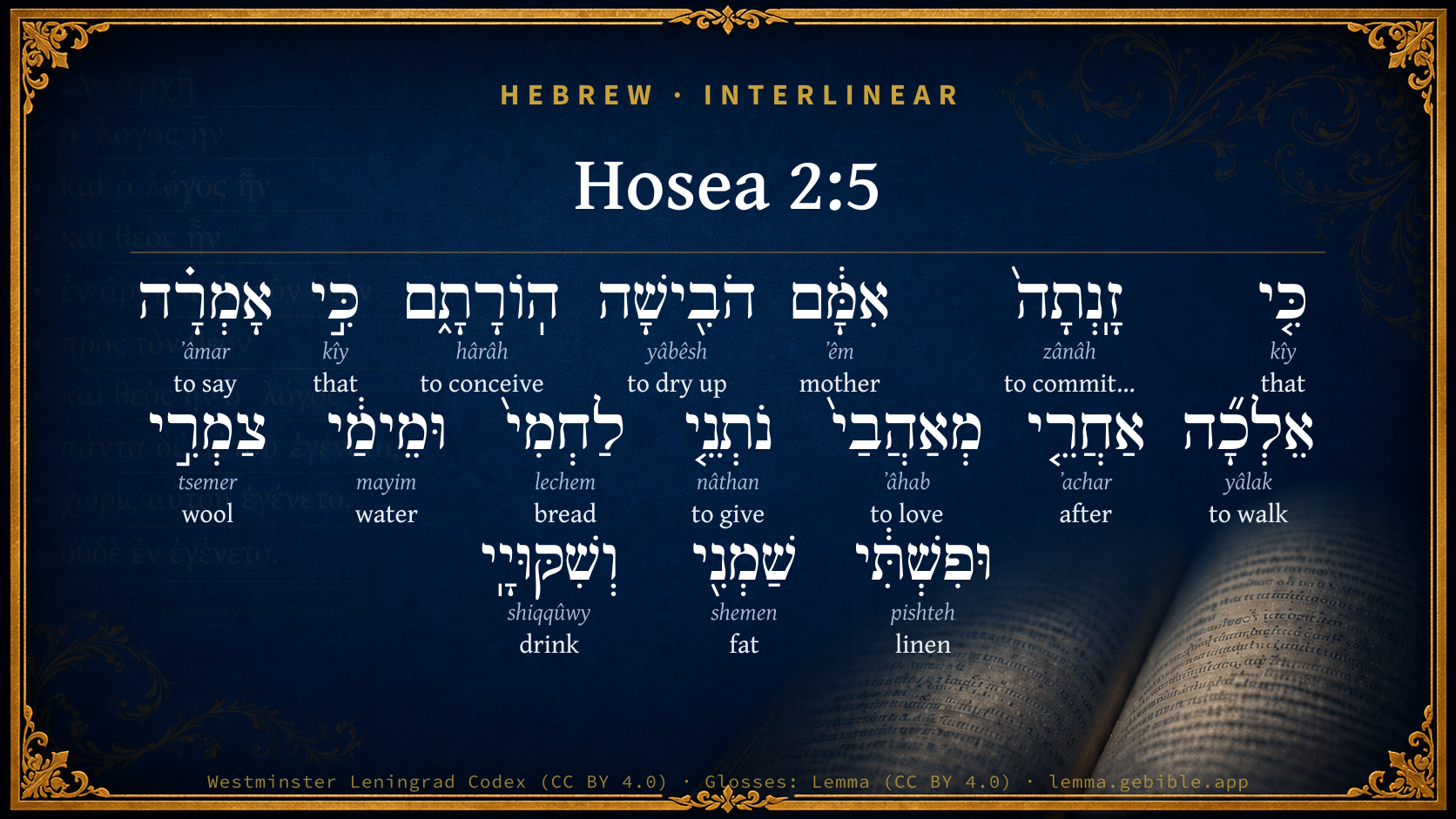
Hosea 2:5

Hebrew (Westminster Leningrad Codex) Hosea 2:5 appears in the Hebrew Old Testament. The text above is from the Westminster Leningrad Codex. Each word links to its Strong’s number, a concise gloss, and parsing drawn from the Open Scriptures Hebrew Bible morphology. Click any word for its full Brown-Driver-Briggs (BDB) entry.
Download image
Cite this verse

Hosea 2:5 (World English Bible). Public Domain. Lemma interlinear Bible study tool, https://lemma.gebible.app/v/hosea/2/5.

Show BibTeX & RIS
BibTeX
RIS
English Translation
For their mother has played the prostitute. She who conceived them has done shamefully; For she said, 'I will go after my lovers, Who give me my bread and my water, My wool and my flax, My oil and my drink.'
World English Bible · Public Domain
Download a study sheet

One document with this verse’s original text, its word-by-word gloss line, the meaning frame, cross-references with their text, attributed commentary, and full source and license credits — printable, and it pastes into notes with its structure intact.

This verse Autodidact and up

Study sheet (.html) Plain text (.txt)

A passage Seminary Student

Up to 50 verses in one chapter. A passage sheet keeps up to 6 commentary sources and 12 cross-references per verse, in the order this page ranks them, and says so on the sheet whenever that leaves anything out. Ask for a single verse and you get the Autodidact verse sheet above.

Everything on this page stays free to read, with no account — the sheet is a download of what is already on screen, not access to it.

Want to remove ads? Support Godless Engineer
Compare translations 3

The same verse in 3 English versions, stacked beneath the original-language interlinear above. Click any original word for its lexicon entry.

Each is an independent rendering of the whole verse — the interlinear is not word-aligned to these translations.

Highlighted words mark where these versions differ — a whole-verse word diff, not a word-by-word alignment.

  • World English Bible Public Domain
    For their mother has played the prostitute. She who conceived them has done shamefully; For she said, 'I will go after my lovers, Who give me my bread and my water, My wool and my flax, My oil and my drink.'
  • King James Version Public Domain
    For their mother hath played the harlot: she that conceived them hath done shamefully: for she said, I will go after my lovers, that give me my bread and my water, my wool and my flax, mine oil and my drink.
  • unfoldingWord Literal Text CC BY-SA 4.0
    For their mother has prostituted; the one who conceived them has acted shamefully, for she said, “Let me go after my lovers, the givers of my bread and my water, my wool and my linen, my oil and my drink.”

unfoldingWord Literal Text — © unfoldingWord, licensed CC BY-SA 4.0. Word-aligned USFM3 via Door43 (git.door43.org/unfoldingWord/en_ult).

Versions to compare (up to 4)

3 of 4 selected

Show all 18 translations

Every available English version of this verse, each an independent rendering of the whole verse.

  • World English Bible Public Domain
    For their mother has played the prostitute. She who conceived them has done shamefully; For she said, 'I will go after my lovers, Who give me my bread and my water, My wool and my flax, My oil and my drink.'
  • Berean Standard Bible Public Domain
    For their mother has played the harlot and has conceived them in disgrace. For she thought, ‘I will go after my lovers, who give me bread and water, wool and linen, oil and drink.’
  • Majority Standard Bible Public Domain
    For their mother has played the harlot and has conceived them in disgrace. For she thought, ‘I will go after my lovers, who give me bread and water, wool and linen, oil and drink.’
  • King James Version Public Domain
    For their mother hath played the harlot: she that conceived them hath done shamefully: for she said, I will go after my lovers, that give me my bread and my water, my wool and my flax, mine oil and my drink.
  • American Standard Version (1901) Public Domain
    for their mother hath played the harlot; she that conceived them hath done shamefully; for she said, I will go after my lovers, that give me my bread and my water, my wool and my flax, mine oil and my drink.
  • Revised Version (1885) Public Domain
    for their mother hath played the harlot: she that conceived them hath done shamefully: for she said, I will go after my lovers, that give me my bread and my water, my wool and my flax, mine oil and my drink.
  • Geneva Bible (1599) Public Domain
    For their mother hath plaied the harlot: she that conceiued them, hath done shamefully: for shee said, I will goe after my louers that giue me my bread and my water, my wooll and my flaxe, mine oyle and my drinke.
  • Douay-Rheims (1899) Public Domain
    For their mother hath committed fornication, she that conceived them is covered with shame: for she said: I will go after my lovers, that give me my bread, and my water, my wool, and my flax, my oil, and my drink.
  • Young's Literal Translation Public Domain
    For gone a-whoring hath their mother, Acted shamefully hath their conceiver, For she hath said, I go after my lovers, Those giving my bread and my water, My wool and my flax, my oil and my drink.
  • Literal Standard Version CC BY-SA 4.0
    For their mother has gone whoring, || Their conceiver has acted shamefully, || For she has said, I go after my lovers, || Those giving my bread and my water, || My wool and my flax, my oil and my drink.
  • Unlocked Literal Bible CC BY-SA 4.0
    For their mother has been a prostitute, and she who conceived them has acted shamefully. She said, “I will go after my lovers, for they give me my bread and water, my wool and flax, my oil and drink.”
  • unfoldingWord Literal Text CC BY-SA 4.0
    For their mother has prostituted; the one who conceived them has acted shamefully, for she said, “Let me go after my lovers, the givers of my bread and my water, my wool and my linen, my oil and my drink.”
  • Darby Bible Public Domain
    For their mother hath played the harlot; she that conceived them hath done shamefully: for she said, I will go after my lovers, that give [me] my bread and my water, my wool and my flax, mine oil and my drink.
  • World Messianic Bible Public Domain
    For their mother has played the prostitute. She who conceived them has done shamefully; for she said, ‘I will go after my lovers, who give me my bread and my water, my wool and my flax, my oil and my drink.’
  • Webster's Bible Public Domain
    For their mother hath played the harlot: she that conceived them hath done shamefully: for she said, I will go after my lovers, that give me my bread and my water, my wool and my flax, my oil and my drink.
  • Free Bible Version CC BY-SA 4.0
    For their mother was a prostitute who conceived them in a shameful way. She said, ‘I'll run after my lovers who give me my food and water, my wool and flax and olive oil, and my drink.’
  • Bible in Basic English Public Domain
    For their mother has been untrue; she who gave them birth has done things of shame, for she said, I will go after my lovers, who give me my bread and my water, my wool and my linen, my oil and my wine.
  • JPS Tanakh (1917) Public Domain
    (2-7) For their mother hath played the harlot, she that conceived them hath done shamefully; for she said: 'I will go after my lovers, that give me my bread and my water, my wool and my flax, mine oil and my drink.'

Literal Standard Version (2020), Covenant Press — licensed CC BY-SA 4.0. Text via the HelloAO Bible API (eBible.org). Unlocked Literal Bible (unfoldingWord) — licensed CC BY-SA 4.0. Text via the HelloAO Bible API (eBible.org). unfoldingWord Literal Text — © unfoldingWord, licensed CC BY-SA 4.0. Word-aligned USFM3 via Door43 (git.door43.org/unfoldingWord/en_ult). Free Bible Version, Dr. Jonathan Gallagher — licensed CC BY-SA 4.0. Text via the HelloAO Bible API (eBible.org).

Word by word

More ways to search: Search by grammar → Find every occurrence → Compare this word →

Practice this passage: Drill this verse → Learn its vocabulary →

וְשִׁקּוּיָֽי
shiqqûwy
H8250
“and · drinks · my”
Conjunction + Noun, Common, Masculine, Plural, Construct + Suffix, Personal, 1st Person, Common, Singular
Part of Speech
Conjunction + Noun
Type
Common
Gender
Masculine
Number
Plural
State
Construct
Full BDB Definition

Origin: from H8248

TWOT: 2452a

drink, refreshment
  1. כִּ֤י kîy H3588 “that” Conjunction
  2. זָֽנְתָה֙ zânâh H2181 “to commit fornication” Verb, Qal, Perfect, 3rd Person, Feminine, Singular
  3. אִמָּ֔ם ʼêm H517 “mother · their” Noun, Common, Feminine, Singular, Construct + Suffix, Personal, 3rd Person, Masculine, Plural
  4. הֹבִ֖ישָׁה yâbêsh H3001 “to dry up” Verb, Hiphil, Perfect, 3rd Person, Feminine, Singular
  5. הֽוֹרָתָ֑ם hârâh H2029 “conceiving · them” Verb, Qal, Participle Active, Feminine, Singular, Construct + Suffix, Personal, 3rd Person, Masculine, Plural
  6. כִּ֣י kîy H3588 “that” Conjunction
  7. אָמְרָ֗ה ʼâmar H559 “to say” Verb, Qal, Perfect, 3rd Person, Feminine, Singular
  8. אֵלְכָ֞ה yâlak H3212 “to walk” Verb, Qal, Imperfect, 1st Person, Common, Singular
  9. אַחֲרֵ֤י ʼachar H310 “after” Preposition
  10. מְאַהֲבַי֙ ʼâhab H157 “loving · me” Verb, Piel, Participle Active, Masculine, Plural, Construct + Suffix, Personal, 1st Person, Common, Singular
  11. נֹתְנֵ֤י nâthan H5414 “giving” Verb, Qal, Participle Active, Masculine, Plural, Construct
  12. לַחְמִי֙ lechem H3899 “bread · my” Noun, Common, Both, Singular, Construct + Suffix, Personal, 1st Person, Common, Singular
  13. וּמֵימַ֔י mayim H4325 “and · water(s) · my” Conjunction + Noun, Common, Masculine, Plural, Construct + Suffix, Personal, 1st Person, Common, Singular
  14. צַמְרִ֣י tsemer H6785 “wool · my” Noun, Common, Masculine, Singular, Construct + Suffix, Personal, 1st Person, Common, Singular
  15. וּפִשְׁתִּ֔י pishteh H6593 “and · linen · my” Conjunction + Noun, Common, Masculine, Singular, Construct + Suffix, Personal, 1st Person, Common, Singular
  16. שַׁמְנִ֖י shemen H8081 “fat · my” Noun, Common, Masculine, Singular, Construct + Suffix, Personal, 1st Person, Common, Singular

About this verse

These counts appear in no published source. They are computed here, from the morphology-tagged text and Lemma’s own curated glosses. What Lemma adds →

17
words
16
distinct lemmas
Prophets
section

Notable vocabulary

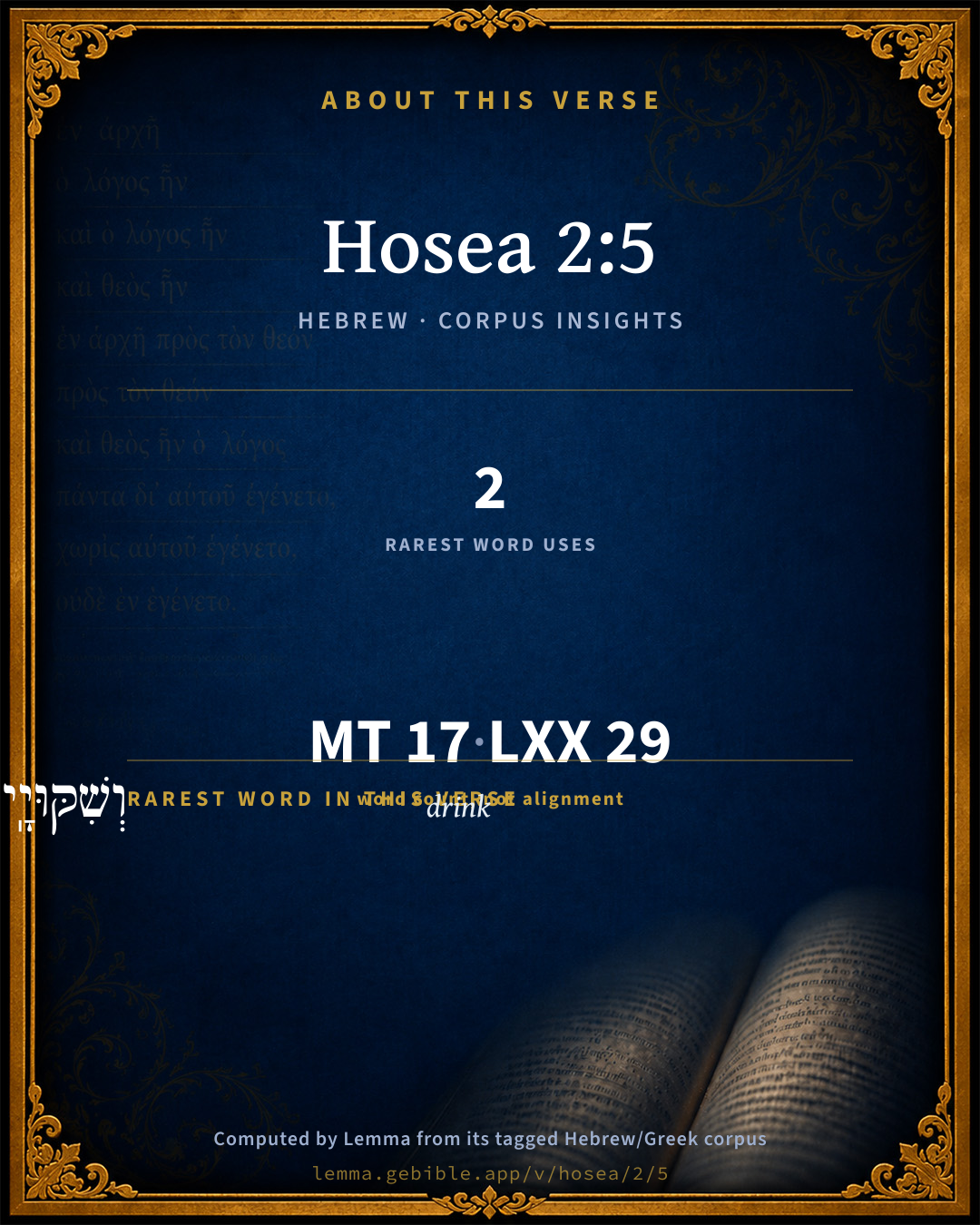
The rarest word here is וְשִׁקּוּיָֽי drink H8250 — appearing just 2 times in the whole Hebrew Bible.

Shared distinctive vocabulary

וְשִׁקּוּיָֽי drink H8250 occurs in 2 verses of the Hebrew Bible. Also found in:

Grammatical profile

  • 7 verbs
  • 7 nouns
  • 1 preposition
  • 2 conjunctions

Verb forms

  • זָֽנְתָה֙ Qal · Perfect
  • הֹבִ֖ישָׁה Hiphil · Perfect
  • הֽוֹרָתָ֑ם Qal · Participle Active
  • אָמְרָ֗ה Qal · Perfect
  • אֵלְכָ֞ה Qal · Imperfect
  • מְאַהֲבַי֙ Piel · Participle Active
  • נֹתְנֵ֤י Qal · Participle Active

Repetition

A word recurs within this verse — often emphatic in Hebrew:

  • כִּ֤י that H3588 ×2

Hebrew & Septuagint length

In English translation the verse runs 41 words from the Hebrew and 40 from the Septuagint (LXX English) — closely comparable.

A rough comparison of the two English renderings, which tokenize alike — not a word-level alignment.

Word counts can differ between the Hebrew and the Greek without any difference in meaning — e.g. the Hebrew direct-object marker אֵת has no separate Greek word, and Greek often adds the article ὁ.

In the original languages it is 17 Hebrew tokens and 29 Greek tokens — but the two are counted differently (Hebrew bundles its prefixes and suffixes into one token; the Greek is in lemma form), so that isn’t a like-for-like length.

Cross-references

26

Topical passages linked to Hosea 2:5 in the Treasury of Scripture Knowledge — connected by theme and wording, ordered by reader-vote popularity; previews shown in the World English Bible.

  • Jeremiah 44:17–18 But we will certainly perform every word that is gone forth out of our mouth, to burn incense to the queen of the sky, and to pour out drink-offerings to her, as we have done, we and our fathers, our kings and our princes, in the cities of Judah, and in the streets of Jerusalem; for then had we plenty of food, and were well, and saw no evil.
  • Isaiah 1:21 How the faithful city has become a prostitute! She was full of justice; righteousness lodged in her, But now murderers.
  • Hosea 2:8 For she did not know that I gave her the grain, the new wine, and the oil, And multiplied to her silver and gold, which they used for Baal.
  • Hosea 3:1 Yahweh said to me, "Go again, love a woman loved by another, and an adulteress, even as Yahweh loves the children of Israel, though they turn to other gods, and love cakes of raisins."
  • Jeremiah 3:1–9 They say, If a man put away his wife, and she go from him, and become another man's, will he return to her again? Won't that land be greatly polluted? But you have played the prostitute with many lovers; yet return again to me, says Yahweh.
  • Hosea 2:12–13 I will lay waste her vines and her fig trees, About which she has said, 'These are my wages that my lovers have given me; And I will make them a forest,' And the animals of the field shall eat them.
  • Judges 16:23 The lords of the Philistines gathered them together to offer a great sacrifice to Dagon their god, and to rejoice; for they said, Our god has delivered Samson our enemy into our hand.
  • Ezra 9:6–7 and I said, my God, I am ashamed and blush to lift up my face to you, my God; for our iniquities are increased over our head, and our guiltiness is grown up to the heavens.
  • Isaiah 50:1 Thus says Yahweh, Where is the bill of your mother's divorce, with which I have put her away? or which of my creditors is it to whom I have sold you? Behold, for your iniquities were you sold, and for your transgressions was your mother put away.
  • Isaiah 57:7–8 On a high and lofty mountain have you set your bed; there also you went up to offer sacrifice.
  • Jeremiah 2:20 For of old time I have broken your yoke, and burst your bonds; and you said, I will not serve; for on every high hill and under every green tree you did bow yourself, playing the prostitute.
  • Jeremiah 2:25–27 Withhold your foot from being unshod, and your throat from thirst: but you said, It is in vain; no, for I have loved strangers, and after them will I go.
  • Jeremiah 11:13 For according to the number of your cities are your gods, Judah; and according to the number of the streets of Jerusalem have you set up altars to the shameful thing, even altars to burn incense to Baal.
  • Ezekiel 16:15–16 But you did trust in your beauty, and played the prostitute because of your renown, and poured out your prostitution on everyone who passed by; his it was.
  • Ezekiel 16:28–34 You have played the prostitute also with the Assyrians, because you were insatiable; yes, you have played the prostitute with them, and yet you weren't satisfied.
  • Ezekiel 23:5–11 Oholah played the prostitute when she was mine; and she doted on her lovers, on the Assyrians [her] neighbors,
  • Ezekiel 23:16–17 As soon as she saw them she doted on them, and sent messengers to them into Chaldea.
  • Ezekiel 23:40–44 Furthermore you have sent for men who come from far, to whom a messenger was sent, and, behold, they came; for whom you did wash yourself, paint your eyes, and deck yourself with ornaments,
  • Daniel 9:5–8 we have sinned, and have dealt perversely, and have done wickedly, and have rebelled, even turning aside from your precepts and from your ordinances;
  • Hosea 2:2 Contend with your mother! Contend, for she is not my wife, Neither am I her husband; And let her put away her prostitution from her face, And her adulteries from between her breasts;
  • Hosea 4:5 You will stumble in the day, And the prophet will also stumble with you in the night; And I will destroy your mother.
  • Hosea 4:12–15 My people consult with their wooded idol, And answer to a stick of wood. Indeed the spirit of prostitution has led them astray, And they have been unfaithful to their God.
  • Hosea 8:9 For they have gone up to Assyria, Like a wild donkey wandering alone. Ephraim has hired lovers for himself.
  • Hosea 9:10 I found Israel like grapes in the wilderness. I saw your fathers as the first ripe in the fig tree at its first season; But they came to Baal Peor, and consecrated themselves to the shameful thing, And became abominable like that which they loved.
  • Revelation 2:20–23 But I have this against you, that you tolerate your woman, Jezebel, who calls herself a prophetess. She teaches and seduces my servants to commit sexual immorality, and to eat things sacrificed to idols.
  • Revelation 17:1–5 One of the seven angels who had the seven bowls came and spoke with me, saying, "Come here. I will show you the judgment of the great prostitute who sits on many waters,

Cross-references courtesy of OpenBible.info (CC BY 4.0).

Hebrew and Greek witnesses Masoretic Hebrew ↔ Greek Septuagint

The same verse in the two great witnesses to the Old Testament, shown verse-for-verse.

These are two independent witnesses, not word-aligned to each other, and the Septuagint is shown in lemma (dictionary) form.

Hebrew Hosea 2:5 Masoretic · Westminster Leningrad Codex

כִּ֤י זָֽנְתָה֙ אִמָּ֔ם הֹבִ֖ישָׁה הֽוֹרָתָ֑ם כִּ֣י אָמְרָ֗ה אֵלְכָ֞ה אַחֲרֵ֤י מְאַהֲבַי֙ נֹתְנֵ֤י לַחְמִי֙ וּמֵימַ֔י צַמְרִ֣י וּפִשְׁתִּ֔י שַׁמְנִ֖י וְשִׁקּוּיָֽי

For their mother has played the prostitute. She who conceived them has done shamefully; For she said, 'I will go after my lovers, Who give me my bread and my water, My wool and my flax, My oil and my drink.'

World English Bible · Public Domain

Greek LXX Hosea 2:5 Septuagint · lemma form

ὅπως ἄν ἐκδύω αὐτός γυμνός καί ἀπο καταἵστημι αὐτός καθώς ἡμέρα γένεσις αὐτός καί τίθημι αὐτός ὡς ἔρημος καί τάσσω αὐτός ὡς γῆ ἄνυδρος καί ἀποκτείνω αὐτός ἐν δίψος

And their mother went a-whoring: she that bore them disgraced them: for she said, I will go after my lovers, that give me my bread and my water, and my garments, and my linen clothes, my oil and my necessaries.

LXX2012 (modern English Septuagint) · Public Domain

Hebrew: Westminster Leningrad Codex (CC BY 4.0). Greek: Septuagint (public domain); English from LXX2012 (modern English Septuagint) (Public Domain). How the Septuagint differs from the Hebrew →

Targum (Aramaic paraphrase)

1

The Targum is the ancient Jewish Aramaic paraphrase of the Hebrew Scriptures — an interpretive translation, not the Hebrew text itself. Onkelos (literal) and Pseudo-Jonathan (expansive) render the Torah, and Jonathan the Prophets. Coverage is partial: where no permissively-licensed English translation exists for a verse, only the Aramaic is shown. This is verse-level text, not a word-by-word alignment to the Hebrew.

  1. Targum Jonathan Prophets (Joshua–Malachi)
    דִלְמָא אֲסַלֵק שְׁכִנְתִּי מִנָהּ וְאַעְדֵי יְקָרָהּ וְאַשְׁוִינָהּ רְטִישָׁא כְּיוֹמַיָא קַדְמָאֵי עַד לָא אִתְקְרִיבַת לְפוּלְחָנִי וְיָחוּל רוּגְזִי עֲלָהּ כְּמָא דְחַל עַל עַם דָרָא דַעֲבָרוּ עַל אוֹרַיְתִי בְּמַדְבְּרָא וַאֲשַׁוֵי אַרְעָא צַדְיָא וְאֶקְטְלִינָהּ בְּבַצוֹרְתָּא:

    (no public-domain English translation for this verse)

    Targum Jonathan — Aramaic: “Mikraot Gedolot” (public domain). English: “Sefaria Community Translation” (CC0 1.0 (public-domain dedication)); “London "Chaldee Paraphrase," 1871” (public domain). Text via Sefaria.

Commentary

Notes on Hosea 2:5 from classic Christian and Jewish commentators (each source and its license shown beneath its notes). The classic Christian expositions comment on the surrounding passage and are grouped to its opening verse, so a note may address several verses; the Jewish commentaries on the Tanakh (Rashi and others) are per-verse, so they appear only where the commentator wrote on this verse.

Lemma curates 59 commentaries, every one of them public domain or Creative Commons licensed, each selected and text-cleaned for this edition rather than reprinted as found. About our sources →

Trapp's Complete Commentary

John Trapp

Hos 2:5 For their mother hath played the harlot: she that conceived them hath done shamefully: for she said, I will go after my lovers, that give [me] my bread and my water, my wool and my flax, mine oil and my drink.

Ver. 5. For their mother hath played the harlot] Being a "wife of whoredoms," Hos 1:2 {See Trapp on "Hos 1:2"} therefore I will not have mercy upon her children, but will root out all her increase, Job 31:12. Either she shall commit whoredom, and not increase, Hos 4:10; or if she do, it is for mischief she shall bring forth children to the murderer: or at least she shall bequeath them a fearful legacy of sin and punishment, worse than that leprosy that Gehazi left to his posterity, or that Joab left to his, 2Sa 3:29 : lameness and gonorrhoea, &c. It is a dangerous thing to keep up the succession of a sin in the world, and to propagate guilt from one generation to another: it is a great provocation. When the wickedness of such is ripe in the field (and they have filled up the measure of their fathers’ sins), God will not let it shed to grow again: but cuts it up by a just and seasonable vengeance. Let parents therefore break off their sins and get into God’s favour; if for nothing else, yet for their poor children’s sake: labouring to mend that by education which they have marred by propagation and evil example. And let children of wicked parents (as they tender their own eternal good) take God’s counsel, Eze 20:18; Eze 20:30 : Are ye polluted after the manner of your fathers? and commit ye whoredom after their abominations? Oh, walk ye not after the statutes of your fathers: neither observe their judgments, nor defile yourselves with their idols. True it is men are wondrous apt to dote upon their fathers’ doings, and are hardly drawn off from their vain conversation received by tradition from their ancestors, 1Pe 1:18. A bore maiori discit arare minor (Ovid). Prescription is held authority sufficient. Me ex ea opinione quam a maioribus accepi de cultu deorum nullius unquam movebit oratio, saith Cicero, No man shall ever dissuade me from that way of divine worship that my forefathers lived and died in. It is reported of a certain monarch of Morocco, that having read St Paul’s Epistles, he liked them so well that he professed that were he then to choose his religion, he would, before any other, embrace Christianity. But every one ought, said he, to die in his own religion: and the leaving of the faith wherein he was born was the only thing that he disliked in that apostle. Thus he. Sed toto erravit coelo, Antiquity must have no more authority than what it can maintain. Eμοι αρχεια εστον ‘Iησους ο Cριστος, Mine antiquity (said Ignatius) is Christ Jesus, who said not to the young man, Do as thy forefathers, but Follow thou me.

She that conceived them hath done shamefully] She hath utterly shamed herself and all her friends, husband, children, all. The woman is, or should be, the glory of the man. Solomon’s good housewife was she, Pro 31:28-29. Her children rise up and call her blessed: her husband also, and he praiseth her, saying, "Many daughters have done virtuously: but thou excellest them all." Alphonsus, king of Aragon, was once resolved never to commend his wife, lest he should be accounted immodest or uxorious: but afterwards he changed his mind, and was so taken with his wife’s virtues and constancy, that he resolved to praise her quocunque in trivio, cuique obvio, sine modo, et modestia, in all places and companies. So did Budaeus, Pareus, and others. But a wicked wife (a harlot especially) puts her husband to the blush, and is a great heart-break, as Livia was to Augustus (Eudemus was both her physician and her stallion); his children also proved stark naught: which made him wish that either he had lived a bachelor, or died childless, {a} "Righteousness exalteth a nation: but sin is a shame to any people," Pro 14:34. It is the snuff that dimmeth their candlestick, the leaven that soureth their passover, the reproach that rendereth them a proverb and a byword, an astonishment and a hissing, a taunt and a talk to other countries, Deu 28:37 Jer 25:9 Eze 5:15 Such was Israel’s apostasy and idolatry, their subjecting religion to carnal policy in setting up the two calves and Baalim: when Ephraim spake "there was trembling, and then he exalted himself in Israel: but when he offended in Baal, he died," Hos 13:1. While he kept close to God, who but Ephraim? None dared to quack, but all quaked at the name of Ephraim: he was on high, and much honoured. But when he declined to idolatry, he became contemptible: and every paltry adversary cast dirt in his face, and crowed over him. So true is that of Solomon, "The wise shall inherit glory: but shame shall be the promotion of fools," Pro 3:35 What a victorious prince was Henry IV of France, till he (for political respects) turned Papist! Till then he was Bonus Orbi: the good of the world, but after that Orbus Boni, bereft of good, as the wits of the time played upon his name Borbonius, by way of anagram. Once he was (before his revolt) persuaded by Du Plessy to do public penance for having abused the daughter of a certain gentleman in Rochelle, by whom he had a son (Life of Phil. de Mornay). Hereunto he was drawn with some difficulty, being ready to fight a battle: and this was no disgrace to him. But when, by compliance at least, he became an idolater for lucre of a crown and love of life, he became a vile person, as Antiochus is called, Dan 11:21, and was worthily lashed with rods by the pope, in the person of his ambassadors; and butchered by the instigation of those Jesuits whom he basely recalled into France, whence they had been banished, and admitted them into his bosom; making Father Cotton his confessor et sic probrose se gessit, et rem confusione dignam admisit, as here. He both shamed and undid himself.

For she hath said, I will go after my lovers] Amasios meos, My sweethearts, those that have drawn away my heart from my husband. But if that persecutor could say to the martyr, What a devil made thee to meddle with the Scriptures? how much better might it be said to the synagogue, and so to all apostates, What a devil meant you to go a whoring from such a husband who is totus, totus desiderabilis, altogether lovely, even the chief of ten thousand, Son 5:16, after dumb idols, and false prophets, who are their brokers ( proxenetae et proci) and spokesmen? Athenaeus brings in Plato bewailing himself and his own condition, that he was taken so much with a filthy whore. Adultery is a filthiness in the abstract: so is also idolatry: and therefore idols are called by a word that signifieth the very excrements that come out of a man, {gelulim, Eze 22:8} a term too good for those dung hill deities, those abominable idolatries, as St Peter expresseth it, 1Pe 4:3. Mention is made in histories of a certain heathen people that punish adultery with death: and with such a death as is suitable to the sin. For they thrust the adulterer’s or adulteress’s head into the paunch of a beast where lieth all the filth and garbage of it, there to be stufficated to death. Sodom and Gomorrah had fire from heaven for their burning lust, and stinking brimstone for their stinking brutishness. They are also thrown out (as St Jude phraseth it) for an example, suffering the vengeance of eternal fire, προκεινται, Jdg 1:7. And in the like pickle are the beast and the false prophet (those arch-idolaters), for these both are cast alive into a lake of fire burning with brimstone, Rev 19:20. And worthily, since they declared their sin as Sodom, they hid it not, Isa 3:9. And as this housewife in the text, who said, "I will go after my lovers"; she did, of wickedness forethought, upon deliberation, de industria, ex consilio, wilfully and of purpose, impudently and without all shame of sin, say, "I will go after." This was shameless indeed: they should rather have gone after her, than she after them. Moses fitly compareth a whore to a salt bitch that is followed after by all the dogs in a town, Deu 23:18. "Am I a dog’s head?" said Abner to Ishbosheth, 2Sa 3:8, that is, Am I so given to lust and lasciviousness as dogs are that run after every salt bitch? But this harlot verified that saying in Ezekiel: The contrary is in thee from other women in thy whoredoms: whereas none followed thee to commit whoredoms, thou followest them; and gloriest in thy so doing, as Lot’s daughters did in their detestable incest, naming their children, Moab, that is, a birth by my father; and Benammi, that is, begotten by one of my near kindred. These all might have held their tongues with shame enough. But such kind of sinners are singularly impudent, Jer 3:3, infatuated, Hos 4:11, and past feeling, Eph 4:19. And so are idolaters wickedly wilful, and irreclaimable for most part. See Jer 44:16-17; Jer 2:10 Isa 44:19-20 : "A seduced heart hath turned him aside, that he cannot deliver his soul; nor say, Is there not a lie in my right hand?" How stiff are Papists to this day in defence of their image worship! how severe against such as deface or but disgrace them! Murder is not so heinous a sin.

That give me my bread and my water, &c.] What can be more like to the doings of the Papists than this? saith Danaeus. Who knows not what suit they make, and what thanks they return to their he-saints and she-saints, and how they sacrilegiously transfer the glory due to God alone, to the creature. The Lord rightly resolveth the genealogy of grain, wine, and oil into himself, Hos 2:22 of this chapter. And the apostle tells us that it is he that "filleth men’s hearts with food and gladness," Act 14:17.

-- “ Et cum charissima semper

Munera sint Author quae preciosa facit. ”

This should make us lift up many a humble, joyful, and thankful heart to God: well content if we may have offam et aquam, bread and water, and the gospel; and vowing with Jacob, Gen 28:20, that if God will give us bread to eat and raiment to put on, then shall he be our God, and we will honour him with the best of our substance. As for other gods, whether pagan or papagan, say we as that heathen did, Contemno minutulos istos deos modo Iove mihi propitium habeam, I care not for these petty deities: I trust in the living God, who giveth us all things richly to enjoy: all things, I say, both ad esum, et ad usum, for back and belly (besides better things), which is all that carnal people care for. There be many (too many) that say (and can skill of no other language), Who will show us any good? Psa 4:6; who will give us bread, water, wool, oil? &c.; they look no higher, know no heaven but plenty, hell but penury, God but their belly, whereunto they offer sacrifice, with Poliphemus, and care for no more, quam ut ventri bene sit ut lateri, than that their bellies may be filled, their backs fitted. Let them have but plenty of victuals, and the queen of heaven shall be their good lady, Jer 44:17. Base spirits look only after low things: gain and credit carry them any way. They work for their penny a day; and are like little children, which will not say their prayers unless they may be promised their breakfast. Whereas a true worshipper of God soareth aloft, hath his feet, at least, where other men’s heads are, trades for higher commodities, cannot be put off with mean matters. When great gifts were sent to Luther, he refused them with this brave speech, Valde protestatus sum me nolle sic satiari: I deeply protested that I would not be put off by God with these low things (Melch. Adam). The Papists offered to make him a cardinal if he would be quiet. He replied, No, not if I might be pope. They sent Vergerius, the pope’s nuncio, {b} to tempt him with preferment, and to tell him of Aeneas Sylvius, who following his own opinions, with much slavery and labour, could get no further preferment than to be Canon of Trent, but being changed to the better, became bishop, cardinal, and, finally, Pope Pius II. The same Vergerius also minded him of Bessarion of Nice, who of a poor collier of Trapezond, became a great renowned cardinal, and wanted not much of being pope. But what said Luther to all this? Contemptus est a me Romanus et favor et furor, I care neither for the favour nor fury of Rome. The bramble thought it a brave business to reign over the trees: not so the vine and fig tree. We read of Pope Silvester, that he gave his soul to the devil for seven years’ enjoyment of the popedom; which Luther spurned at. One good cast of God’s loving countenance was more to David than a confluence of all outward comforts and contentments. "Thou hast put gladness in my heart," saith he, "more than in the time that their corn and their wine increased," Psa 4:7. Their grain and their wine he calleth it; because it is their portion (poor souls), and they are too well paid of it. Wealth upon any terms is welcome to them, and those are their lovers that will keep them to it, yea, though it be the devil himself: whose language also here they seem to have learned when they say, "My grain and my water," &c. All is their own if you will believe them: like as the devil said to our Saviour, Luk 4:6, "All this wealth is mine, and to whomsoever I will, I give it." But God is the true proprietary, the owner of all: and it is his alone to say Cui vole, do illa, Dan 4:22. The devil is god of this world, 2Co 4:4; but it is but titular only, as a king at chess; or at best, by usurpation only, as Absalom was a king; and as the pope is lord of all the kingdoms of the world, both for temporals and spirituals, to dispose of them at his pleasure. When he makes cardinals, he useth these big swollen words, Estote confratres nostri, et principes mundi, Be you brethren to us, and princes of the world. And by such high honours, bishoprics, and benefices, he prevaileth with very many to be wholly at his devotion. One of his poor beneficiaries ingenuously confessed that he and those of his rank preached the gospel for nothing else, nisi ut nos pascat et vestiat, than to get a poor living by it. Let saints say, Non est mortale quod opto, We breathe after better things: we have the moon under our feet, Rev 12:1, and are above grain, wool, flax. The devil shall not stop our mouths with these palterments. Balaam may run and ride after the wages of wickedness, and get a sword in his guts. Ahab may make a match with mischief, and sell himself to do wickedly; Judas hunt after lying vanities, and hasten to his own place; but Moses was of another spirit, and "refused to be called the son of Pharaoh’s daughter," Heb 11:24. And those worthies that were tempted with offers of profit and preferment, could not be won over, but resisted the devil, and he fled from them, Heb 11:37. The world was crucified to St Paul, and he to the world, he was of too generous a spirit: he was no malleable matter: all was but dung and dog’s meat in his account, Php 3:8. Dr Taylor, martyr, was promised not only his pardon, but great promotion; yea, a bishopric: but he would have none of it. Another Dr Taylor, Bishop of Lincoln, was violently thrust out of the parliament house in his robes, in Queen Mary’s reign, and deprived. So was Hirmanius, Archbishop of Colen, for certain reformations done by the aid and advice of Martin Bucer. I dare say (said Bishop Bonner to Mr Hawkes, martyr) - that Cranmer would recant if he might have his living: so judging others by himself. But Latimer and Shaxton parted with their bishoprics in King Henry VIII’s time, rather than submit to the Six Articles. And John Knox refused a bishopric offered him by King Edward VI, as having aliquid commune cum Antichristo (Knox’s Life, by Mr Clark): so did Miles Coverdale in Queen Elizabeth’s reign, choosing rather to continue a poor schoolmaster. Pliny saith of Cato, that he took as much glory in those dignities and honours that he denied as he did in those that he enjoyed (Plin. Nat. Hist. praef.). He was wont also to say that he had rather men should question why he had no statue or monuments erected to him, than why he had: certainly it is so with the saints; and upon better grounds.

{a} Plin. Tacit. Utinam aut caelebs vixissem, aut orbus periissem.

{b} A permanent official representative of the Roman See at a foreign court. ŒD

John Trapp, A Commentary or Exposition upon All the Books of the Old and New Testament (1647–1656) — public domain. Text from a community e-Sword module.

The Biblical Illustrator

Joseph S. Exell

Hos_2:5

For she said, I will go after my lovers.

The sin of Israel

The sin of Israel was not simple whoredom, which may be done in the dark, but avowed, effronted idolatry. Whence learn--

1. Such is the stupidity of grossest sinners, that they neither see the ill nor danger of their way, unless it be much and frequently inculcated.

2. A visible church declining, will readily turn impudent in sin. The more corruption hath been hemmed in by the external bonds of order, it swells the more over all banks and bounds; and God justly giveth such up to be filled with their own devices.

3. It is a great aggravation of the sin of idolatry, that idols do become lovers, and do bewitch and draw the heart from God.

4. As it is a great sin to depart from God and His true worship, so especially it is a shameful way of departing from Him, when mens ends are so low and base, that they will follow any way of religion for interest and advantage, and account the thriving way to be the best way.

5. It is also a great evidence of impudence, when men do not sin through infirmity or temptation, but deliberately, and do wilfully follow their resolutions, whatever may be said to the contrary. For, herein also she did shamefully, in that she said, I will go after my lovers. She avowed it, and was obstinate in it against all warnings. (George Hutcheson.)

The Biblical Illustrator, edited by Joseph S. Exell (c. 1880s–1900s) — public domain. Text from a community e-Sword module.

The Preacher's Complete Homiletical Commentary

Joseph S. Exell (gen. ed.)

CRITICAL NOTES.—

Hos_2:6. Hedge and make] Build a wall, a double enclosure of stones and thorns. In the East cattle are fenced with thorns and closes. God with determined purpose will interpose between Israel and her idols. Behold, I will hedge] Exile and distress, and the inability of her gods to help, would prove the folly of her conduct (Job_19:18; Lam_3:7-9).

Hos_2:7. Follow after and seek] In eager pursuit and diligent search. “They express together a pursuit, whose minuteness is not hindered by its vehemence, nor its extent and wideness by its exactness. She shall seek far and wide, minutely and carefully, everywhere and in all things, and shall fail in all” [Pusey]. Not find] deliverance from calamity.

HOMILETICS

THE UNSUCCESSFUL PURSUIT.—Hos_2:6-7

Though Israel is dishonoured and fallen, she is not left to herself. God’s mercy yearns over and seeks to check her in sin and recall her to himself. God even now has not written a bill of divorcement, nor cast away the people whom he did foreknow. Through eighteen hundred years they have been wandering without a dwelling-place and a temple; but the day will come, when she will “no more be termed Forsaken,” nor “the land be termed Desolate; but she will be called Hephzi-bah and the land Beulah.” Men are prone to wander. They are disappointed in their wanderings, and God rouses, instructs, and restores his backsliding people.

I. A pursuit after wrong objects. Man is a creature of strong affections. His feelings cling round the objects of his choice like ivy round a tree. Through sin these affections are misplaced. He loves the things which he should hate, and hates the things which he should love; forsakes the true God, and pursues lovers of his own. He must love, he will worship, something; “that I may win” is the desire of every soul. Wealth, honour, position, and learning are eagerly sought, loved for their own sake and for the sake of what they are thought to give. Thus men are seeking happiness where it cannot be found; committing two evils, forsaking the fountain of living waters, and hewing out cisterns for themselves, broken cisterns which will hold no water. “Who will show us any good?” is the cry of the many. “Lord, lift thou upon us the light of thy countenance,” is the prayer of the few.

II. A pursuit with intense anxiety. Man’s spiritual desires are insatiable, yet ever seek gratification. They forbid him to rest, and compel him to seek supply. Inward sense of want, incapacity for alliance with sin, and instinctive longing for God, the “first good, first perfect, and first fair”—of whom all created beauty and good are mere shadows—make men restless and discontented. But instead of lifting the soul to God, they look to the creature for satisfaction; “seek” and “follow after” in eager pursuit of what they love; labour harder in sin, and seeking pleasure, than in serving God. They weary themselves in pursuit, rendered more eager by thorn-hedges and hindrances. Vexation and disappointment excite to desperate tenacity; affliction and remorse are often no check to the sinner; fuel is added to the fire, and with renewed ardour onward he goes to ruin and despair. “I will go after my lovers.” The impenitent struggle on after that which God is taking from them, and will not give up, until the pursuit is found hopeless and exhaustive, and God in preserving mercy brings him back. “Turn ye, turn ye from your evil ways; for why will ye die, O house of Israel?”

III. A pursuit under Divine restraint. God governs the world, and seeks the good of his creatures. The way of transgressors is rendered hard “through much tribulation.” It is a warfare against conscience, reason, and revelation. In consciousness of guilt we may discern our relationship to God. The trouble and anguish of spirit springing from this consciousness, “the inward unrest which sometimes seizes the slave of sin are proofs that he has not quite broken away from God.” God works within by his Spirit and without by his providences. Hedges and walls are fixed up to restrain men in sin.

1. The restraints of God’s providence are various in their nature. God sought to cut off Israel from idolatry by solitude and affliction. Like a thorn-hedge, affliction is painful. “No chastening for the present seemeth to be joyous, but grievous.” Conscience, the Divine officer, warns and checks the sinner. Disappointments in pursuits, pains attending pleasures, Divine judgments, and special manifestations, turn men from their purpose. Saul was overcome by light from heaven; Balaam was met by an angel, and David by Abigail (1Sa_25:32).

2. The restraints of God’s providence are merciful in their design, “that she shall not find her paths.” (a) Given to withdraw men from sinful pursuits. “She shall not overtake them; and she shall seek them, but shall not find them.” (b) Given to restore men to God. “Then shall she say, I will go and return.” Strong barriers and painful providences are not sufficient. If God did not mercifully interfere we should all go astray. Let us repent of sin, be thankful for correction, and admire the wondrous grace of God. “Before I was afflicted I went astray, but now have I kept thy word.”

IV. A pursuit ending in failure. “She shall not overtake” what she follows; “she shall not find” what she seeks. Failure and disappointment after all her eagerness and effort! Egypt and Assyria were trusted in vain. Worldly alliances were of no service; did not give the anticipated deliverance. Idols were impotent; foreign nations were a broken reed, a source of sorrow and bitterness of spirit. Israel was obliged to confess, “it was better with me than now.” The sinner gains nothing, but loses everything, by forsaking God. He pursues phantoms of bliss. The pursuit will disgust, and end in failure. “Why did the cannon-balls spare me to die in this manner? I am no longer the Great Napoleon. How fallen and disappointed I am!” cried Napoleon in his latter end. Nothing can take the place of God—nothing can satisfy but bread. A sinful life can never give peace of conscience and peace with God. The beast may be satisfied with what it finds on earth, for its nature aspires no higher; but man is linked to God, longs for him, and cannot be contented without him. Though the heart once alienated from him turns further away, and moves not towards him until renewed, yet even in its wandering it retains its nature and necessities. God is its centre, and it is restless and void till it meets with him again. Men go here and there, do this and that, in quest of good, as moments dictate and circumstances call forth, but all in vain. They faint in mind and fail in hope. God never created man to find rest and happiness in utter rejection of himself. “Thou madest us for thyself, and our heart is restless until it repose in thee” [Augustine]. “Wherefore do ye spend money for that which is not bread? and your labour for that which satisfieth not? hearken diligently unto me, and eat ye that which is good, and let your soul delight itself in fatness.”

THE BACKSLIDER’S WAY HEDGED UP.—Hos_2:5-7

Consider the text, and seek to arouse and restore backsliders, who have left their first love, and may have forsaken the Church of God, given up their profession and all attendance upon Divine worship.

I. While sinful men are in prosperity they pervert the mercies of God to their own injury, making them instruments of sin and weapons of warfare against God. While Israel enjoyed abundance of temporal comforts they ascribed all these blessings to false gods. Prosperous sinners make three great mistakes. At the outset they give their temporal mercies the first place in their hearts. Business prospers, but they consider not their soul. They say, “We must live,” but they forget that they must die. Such folly most shameful, base ingratitude, in one who has known, or professed to have known, better. One error leads to another, and hence such people hold their temporal things upon a wrong tenure. Observe how many times the word “my” is found in the text. “Give me my bread,” &c. They were not hers, but God’s, who expressly claims them, and threatens to take them all away (Hos_2:9). The backslider once professed himself to be God’s servant; nothing is his now—houses, lands, profits, and children, only lent for a season. He is but God’s under-bailiff, possesses only as tenant-at-will, or as a borrower, holding a loan. Then, further, backsliders are apt to ascribe their prosperity and their mercies to their sins. I have even heard one say, “Ever since I gave up a profession of religion I have made more headway in business than I did before.” Some apostates have boasted, “Since I broke through puritanical restraint, and went out into worldly company, I have been better in spirits, and better in purse than ever I was before.” Thus they ascribe the mercies which God has given them to their sins, and wickedly bow down to their lusts, as Israel did before the golden calf, and cry, “These be thy gods, O Israel!” These things are given to try you, to see how far you will go, and to what extravagances of ingratitude you will descend.

II. Turn from the gloomy side, and observe that the Lord interposes adversity in order to bring back his wandering children. Consider the hindrances which a God of love puts in the way. You see an unexpected hindrance, for it is placed right in the man’s way. “I will hedge up thy way”—it was his way, his habit; he had fallen into it, and he meant to keep on; but suddenly he met with an unlooked-for obstacle. This hedge is placed in your way in different shapes. Business grows slack; bad debts multiply; bankruptcy stares you in the face; and where you had enough to lavish on pleasure you have not enough to supply your need. You thought you would live a millionnaire; more likely now to die a pauper. Or sudden sickness falls upon a strong healthy person. Possibly the hedge is of other thorns. The first-born son, the expected heir, the joy of the father’s heart, falls like a withered flower; his wife is cut off as a lily snapped from its stalk. These are walls across the way of those whom God ordains to bless. Observe, it has a very disappointing impediment. The prosperous sinner is stopped when securely pursuing his way. “Why,” says the man, “if it had not been for that I should have made a fortune.” “Why did death come just when my fair girl looked so lovely, and when my dear boy had grown so engaging? Ah! this is trouble indeed. To meet with misfortune just when I built that new house, and held my head so high, and expected to see my daughters so respectably married; this is very disappointing.” The man kicks, and though once professed to be a child of God, he is ready to curse God and die. If he knew the Divine nature, he would thank God for his troubles on bended knees. What painful hindrances our heavenly Father often uses. He hedges the sinner’s path, not with rhododendrons and azaleas, not with roses and laurels, but with thorns—prickly thorns, which curse the soil and tear the flesh, are God’s instruments of restraint. Furthermore, the fence is effectual; if the thorn hedge will not suffice, it is written, “I will make a wall.” Some are so desperate in sin that they break through ordinary restraints; then a wall shall be tried, through which there is no breaking, over which there is no climbing.

III. You would think that the sinner would now stop, but instead of that, according to the text, even though God walls up the way of sin, men will try to follow it, but this resolve shall be in vain. He is desperately set on destruction, as though it were to be desired. What a creature is man, though he knows that sin will be his ruin, yet he hugs it as though it were his chief mercy; heaps to himself destruction as though it were gold. If the righteous were half as intent in seeking after goodness as the wicked are in hunting sin, how much more active would they be. Truly this love is so strange, that if we did not see it in ourselves we should wonder at it. It is in you, Christians, as in the worst of men, and but for Divine mercy you would have plunged on from bad to worse.

IV. Consider that the backslider’s failure is followed by a blessed result. Observe, here is repentance attended with sorrow. The poor creature deeply feels to the very soul the wretchedness of her condition. It is an active repentance. It is not merely “I will return,” but, “I will go and return.” There is much earnestness in a sinner seeking Christ; but more, if possible, in a backslider returning from the error of his ways; for he has not only the guilt of sin to mourn over, but the double guilt of having despised the Saviour, of having known the way of righteousness and turned from it. The confession which this poor soul makes of folly is one which is sustained by the best of reasons. “Then was it better with me than now.” Backslider, what have you gained? Have you gained anything more comfortable than the light of your Father’s face? Before, you had the privilege of going to the throne of grace, you could tell your wants before God, and spread your sorrows there; but now you have no throne of grace to go to. Then you had God’s promises to fall back upon. Once you had communion with Christ. What can the world afford you comparable to this? There is no room to entertain a comparison for a moment. Lastly, this repentance was acceptable. It is not often that a husband is willing to take back his wife when she has so grossly sinned, as the metaphor here implies; yet God is willing to receive the sinner, though his sin is even more aggravated. “Return unto me, for I am married unto thee.”

V. Observe that there is an awful contrast to all this. Some prosper until, like a wide-spread tree, they are cut down and cast into the fire. There are backsliders who, never having had the root of the matter in them, go back unto their own ways and continue there for ever. Never trifle with backsliding. Chosen vessels, notwithstanding their backslidings, are brought back; but, ah! remember that nine out of ten of those who backslide never were God’s people. You must be born again, and only the man who continues to the end shall be saved.

VI. We conclude with this—is not this subject a very solemn warning to the people of God? If one man falls, another may. If one professor turns out to be a hypocrite, another may. There must be the continual keeping and anointing of the Holy Spirit. No man backslides at once. Do not forsake the assembling of yourselves together. Wake up your coldness in private prayer. If love to Christ has grown cold, pray to the Master to inflame your heart again. Let us trust the Saviour. There is the sinner’s hope; there is the saint’s strength [Spurgeon].

HOMILETIC HINTS AND OUTLINES

Hos_2:6. Subject:—Divine Restraints. I. These restraints are manifold. “I will hedge up thy way with thorns, and make a wall.” The first metaphor is from a husbandman who plants a prickly hedge to prevent cattle from breaking away. The other from architecture. If thorns are insufficient, high and massive walls must be built.

1. There is the restraint of affliction. When the wicked purpose some great crime, affliction comes, breaks their plans, and strikes them down.

2. There is the restraint of public sentiment. Public opinion, as it gets enlightened and strong, is a tremendous check to the wicked. The most daring cower before the public voice.

3. There is the restraint of conscience. Conscience is a Divine officer holding the sinner.

II. These restraints are necessary. It is necessary that God should plant thorny hedges and build massive walls around the sinner.

1. It is necessary for the sinner himself. Were it not for these he would go galloping to perdition. “O, unhappy men,” says Luther, “when God leaves them to themselves, and does not resist them in their lusts. You bless yourselves many times that in the way of sin you find no difficulty. Bless thyself! Thou hast cause to howl and wring thy hands, thou hast the curse of God on thee. A dreadful curse to make pleasant the way of sin.”

2. It is necessary for the world. What would become of the world if the wicked were not reined in? Were it not for restraints the Cæsars, the Alexanders, and the Napoleons would soon turn it into a Pandemonium.

3. It is necessary for the Church. Had wicked men their full fling, how long would the Church last? The flames of martyrdom would soon blaze to heaven and consume Zion to ashes. Thank God for thorny hedges and massive walls, for all the restraints he puts on sinful men [The Homilist].

The Danger of outward Prosperity—sufferings a specific against apostasy.

Divine Chastisements.

1. Love, their source.

2. Sorrow, their means.

3. Good, their end. “Crosses and obstacles in an evil course are a great blessing, and are so to be accounted. They are God’s hedges, to keep us from transgressing, to restrain us from wandering out of the green pastures, to withdraw man from his purpose (Job_33:17), to make the way of sin difficult, that we may not go on in it, and to keep us from it whether we will or not. We have reason to bless God both for restraining grace and for restraining providences” [Matt. Henry].

Hos_2:7. The Course of Sin.

1. A course of labour—unrequited toil—vexation of spirit and bitter bondage. Sinners labour harder than saints, and receive nothing but exhaustion and fatigue.

2. A course of failure. Loss of health and peace—all loss and no gain.

3. The service of God the only true gain. “It was better with me.” Godliness is profitable to all things—body and soul, this world and the next. Sin suicidal. God’s service real advantage. Those who embrace God, would take him up as the best of choices, and his way as the shortest cut to do well and to be well: they are sensible of their own disadvantage in forsaking him: for so much is imported as the reason for her return, “for then was it better with me than now” [Hutcheson].

I will go and return.

1. The sinner’s wandering.

2. The sinner’s penitence.

3. The sinner’s return to God. “By this text we may gather what true repentance is: namely, when a sinner not only confesseth himself guilty and worthy of punishment, but truly displeaseth himself and seriously returns to God. Here we have two essential parts of true repentance—namely, contrition and conversion; or humiliation and reformation. The former is called in Scripture repentance for sin, the latter repentance from sin: and the one without the other is to no purpose or profit” [Trapp].

ILLUSTRATIONS TO CHAPTER 2

Hos_2:6-7. Affliction. The hedge stops or gives a turn. God, in pursuance of his covenant, and with a gracious meaning to a revolting people, hedges them up by affliction to stop them from undoing. It is a mercy to be kept out of the pond, though it be by a thorn hedge, sharpest troubles. This stop the Lord doth often give, though not always to sinners; he sometimes lets them run on to fill up their measure of sin and to receive their full measure of punishment. Reproof for sin is a great favour. Though God is angry for what we have done, yet it is a mercy that he will not let us do more, and so make ourselves vile and miserable [Caryl].

The Preacher's Complete Homiletical Commentary (gen. ed. Joseph S. Exell; Funk & Wagnalls, c. 1892) — public domain (pre-1929). A full-Bible homiletical/sermon-outline anthology covering 65 of 66 books (2 John is absent from the source module). Text from a community e-Sword module.

Keil & Delitzsch

C. F. Keil & F. Delitzsch

"For their mother hath committed whoredom; she that bare them hath practised shame: for she said, I will go after my lovers, who give (me) my bread and my water, my wool and my flax, my oil and my drink." By kı̄ (for) and the suffixes attached to 'immâm (their mother) and hōrâthâm (that bare them), the first clauses are indeed introduced as though simply explanatory and confirmatory of the last clause of Hos 2:4; but if we look at the train of thought generally, it is obvious that Hos 2:5 is not merely intended to explain the expression sons of whoredom, but to explain and vindicate the main thought, viz., that the children of whoredom, i.e., the idolatrous Israelites, will find no mercy. Now, as the mother and children are identical, if we trace back the figurative drapery to its actual basis, the punishment with which the children are threatened applies to the mother also; and the description of the mother's whoredom serves also to explain the reason for the punishment with which the mother is threatened in Hos 2:3. And this also accounts for the fact that, in the threat which follows in Hos 2:6, "I hedge up thy way," the other herself is again directly addressed. The hiphil hōbhı̄sh, which is traceable to yâbhēsh, so far as the form is concerned, but derives its meaning from בּושׁ, is not used here in its ordinary sense of being put to shame, but in the transitive sense of practising shame, analogous to the transitive meaning "to shame," which we find in Sa2 19:5. To explain this thought, the coquetting with idols is more minutely described in the second hemistich. The delusive idea expressed by the wife (אמרה, in the perfect, indicates speaking or thinking which stretches from the past into the present), viz., that the idols give her food (bread and water), clothing (wool and flax), and the delicacies of life (oil and drink, i.e., wine and must and strong drink), that is to say, "everything that conduces to luxury and superfluity," which we also find expressed in Jer 44:17-18, arose from the sight of the heathen nations round about, who were rich and mighty, and attributed this to their gods. It is impossible, however, that such a thought can ever occur, except in cases where the heart is already estranged from the living God. For so long as a man continues in undisturbed vital fellowship with God, "he sees with the eye of faith the hand in the clouds, from which he receives all, by which he is guided, and on which everything, even that which has apparently the most independence and strength, entirely depends" (Hengstenberg).

Keil & Delitzsch — Biblical Commentary on the Old Testament (1861–1891) — public domain (CC PDM 1.0). Text via the HelloAO Bible API. (Old Testament only.)

Tyndale Open Study Notes

Tyndale Open Resources

2:5 The only evidence needed to prove Israel’s unfaithfulness comes from her own words: I’ll run after other lovers. Israel’s lovers were the Canaanite fertility deities, especially the baals (local representations of Baal). The Israelites worshiped them because they believed that these gods controlled the reproductive forces in nature. The Israelites attributed to them the basic necessities of life, food and water, their clothing of wool and linen, and oil, used for both sacred and secular purposes.

Tyndale Open Study Notes — © Tyndale Open Resources, licensed CC BY-SA 4.0. Text via the HelloAO Bible API.

Geneva Bible (1599)

Geneva Bible translators

Meaning, the idol which they served, and by whom they thought they had wealth and abundance.

Geneva Bible (1599) marginal notes — public domain. Text via Bolls.life.

Jamieson, Fausset & Brown

Robert Jamieson, A. R. Fausset & David Brown

I will go after--The Hebrew expresses a settled determination.

lovers--the idols which Israel fancied to be the givers of all their goods, whereas God gave all these goods (Hos 2:8-13; compare Jer 44:17-19).

bread and . . . water--the necessaries of life in food.

wool . . . flax--clothing.

oil . . . drink--perfumed unguents and palatable drinks: the luxuries of Hebrew life.

Jamieson, Fausset & Brown — Commentary Critical and Explanatory on the Whole Bible (1871) — public domain (CC PDM 1.0). Text via the HelloAO Bible API.

Adam Clarke's Commentary

Verse 5. That give me my bread] See the note on Jer 44:17-18, where nearly the same words are found and illustrated.

Adam Clarke's Commentary on the Bible (1810–1826) — public domain. Text from a community e-Sword/MySword module.

John Calvin's Commentaries

He afterwards declares how the children became spurious; their mother, who conceived or bare them, has been wanton; with shameful acts has she defiled herself בושbush, means, to be ashamed; but here the Prophet means not that the Israelites were touched with shame, for such a meaning would be inconsistent with the former sentence; but that they were like a shameless and infamous woman, touched with no shame for her baseness. Their mother, then, had been wanton, and she who bare them had become scandalous Here the Prophet strips the Israelites of their foolish confidence, who were wont to profess the name of God, while they were entirely alienated from him: for they had fallen away by their impiety from pure worship, they had rejected the law, yea, and every yoke. Since then they were wild beasts, it was extreme stupidity ever to set up for their shield the name of God, and ever to boast of the adoption of their father Abraham. But as the Jews were so perversely proud, the Prophet here answers them, “Your mother has been wanton, and with shameful acts has she defiled herself; I will not therefore count nor own you as my children, for ye were born by adultery.”

This passage confirms what I have shortly before explained, — that it is not enough that God should choose any people for himself, except the people themselves persevere in the obedience of faith; for this is the spiritual chastity which the Lord requires from all his people. But when is a wife, whom God has bound to himself by a sacred marriage, said to become wanton? When she falls away, as we shall more clearly see hereafter, from pure and sound faith. Then it follows that the marriage between God and men so long endures at they who have been adopted continue in pure faith, and apostasy in a manner frees God from us, so that he may justly repudiate us. Since such apostasy prevails under the Papacy, and has for many ages prevailed, how senseless they are in their boasting, while they would be thought to be the holy Catholic Church, and the elect people of God? For they are all born by wantonness, they are all spurious children. The incorruptible seed is the word of God; but what sort of doctrine have they? It is a spurious seed. Then as to God all the Papists are bastards. In vain then they boast themselves to be the children of God, and that they have the holy Mother Church, for they are born by filthy wantonness.

The Prophet pursues still the same subject: “She said, I will go after my lovers, the givers of my bread, of my waters, of my wool, and of my flax, and of my oil, and of my drink The Prophet here defines the whoredom of which he had spoken: this part is explanatory; the Prophet unfolds in several words what he had briefly touched when he said, your mother has been wanton. Now, if the Jews object and say, How has she become wanton? Because, “she said, I will go after my lovers, who give me my bread and my waters, etc. The Prophet here compares false gods to lovers, who seduce women from their conjugal fidelity; for he pursues the similitude which he had introduced. The Church, to whom God has pledged his faith, is represented as a wife; and as a woman does, when enticed by gifts, and as many women follow covetousness and become lascivious, that they may dress sumptuously, and live luxuriously, so the Prophet now points out this vice in the Israelitic Church, She said, I will go after my lovers Some understand by lovers either the Assyrians or the Egyptians; for when the Israelites formed connections with these heathen nations, they were drawn away, we know, from their God. But the Prophet inveighs especially against false and corrupt modes of worship, and all kinds of superstitions; for the pure worship of God, we know, is ever to have the first place, and that justly; for on this depend all the duties of life. I therefore doubt not, but that he includes all false gods, when he says, “I will go after my lovers”.

But by introducing the word, “said”, he amplifies the shamelessness of the people, who deliberately forsook their God, who was to them as a legitimate husband. It indeed happens sometimes that a man is thoughtlessly drawn aside by a mistake or folly, but he soon repents; for we see many of the unexperienced deceived for a short time: but the Prophet here shows that the Israelites premeditated their unfaithfulness, so that they wilfully departed from God. Hence she said; and we know that this said means so much; and it is to be referred, not to the outward word as pronounced, but to the inward purpose. She therefore said, that is, she made this resolution; as though he said, “Let no one make this frivolous excuse, that they were deceived, that they did it in their simplicity: ye are, he says, avowedly perfidious, ye have with a premeditated purpose sought this divorce.” He, however, ascribes this to their mother: for defection began at the root, when they were drawn away by Jeroboam into corrupt superstitions; and the promotion of this evil became as it were hereditary. He therefore intended to condemn here the whole community. Hence, “she said, I will go after my lovers, who give me my bread and my waters”. But I cannot finish today; I must therefore break off the sentence.

John Calvin's Commentaries (1540-1563) — public domain. Text from the Calvin Translation Society English edition (1840s-50s) via the Christian Classics Ethereal Library (ccel.org). Calvin's coverage is partial (roughly two-thirds of the Bible); uncommented books and verses are honest gaps, never fabricated. The 19th-century editor's footnotes and remarks are omitted so the notes are faithfully Calvin's own voice.

Ellicott's Commentary for English Readers

(5) For their mother hath played . . .—We might render, with Ewald, yea, their mother hath played . . . This would more easily account for the change of person (“your “. . . “their “), which is, however, very frequent in Hebrew prophecy. The next “for” introduces a parenthetical clause—“her lovers”—a word used in a bad sense. The aggravation of her shame is that she seeks them, and not they her. She attributes to these idol-gods all those temporal benefits which theocratic history shows to have been Jehovah’s gift, and the consequence of loyalty to Him. The modern analogue of this sin of Israel is the use of “Fortune,” “Nature,” “Destiny,” “Impersonal Law,” and even “Humanity,” as the giver of all good things, as though it were superstitious or heretical to speak of God as the giver.

A Bible Commentary for English Readers, edited by Charles John Ellicott (1878–1897) — public domain. Text from a community e-Sword module.

The Cambridge Bible for Schools and Colleges

gen. ed. J. J. S. Perowne

5. I will go after my lovers …] Israel, then, had given up the true Jehovah for ‘lovers’ (i.e. not, as the Targum explains it, and as the phrase often means, especially in Ezekiel, the neighbouring peoples whose favour was courted by the Israelites, but, as Hos_2:10; Hos_2:15 suggest, the Baalim).

mine oil and my drink] Rather, drinks (as margin), i.e. wine and various fermented liquors made from fruits such as the date, the mulberry, the fig, and the dried raisin (see Tristram, Natural Hist. of Bible, p. 412). Observe the influence of the primitive idea that the land (rather than the people) was in mystic relation to Jehovah; see on Hos_2:21-22.

The Cambridge Bible for Schools and Colleges (gen. ed. J. J. S. Perowne; Cambridge University Press, 1878–1918) — public domain. Text from a community e-Sword module.

John Gill's Exposition

For their mother hath played the harlot,.... Or committed idolatry; which is the reason why she is to be pleaded with, and why the Lord will not own her as his wife, or be a husband to her; and why she is to be exhorted to put away her whoredoms from her; and was in danger of all the above evils coming upon her, continuing in the same practice; and why her children were children of whoredoms. Though the connection may be with the verse following, "for" or "because their mother hath played the harlot", &c. "therefore I will hedge up her way", &c.

She that conceived them hath done shamefully; all sin is shameful and scandalous, especially adultery; it brings a reproach and a blot upon a person, that will not be wiped off; and so idolatry, worshipping stocks and stones instead of the living God; and particularly the sin of the Jewish church, in rejecting the true Messiah and his righteousness, and setting up their own, and tenaciously adhering to the traditions of the elders; and so departing from the true God, and his word and worship, which is no other than spiritual adultery or idolatry. The Targum is,

"because their congregation hath erred after the false prophets, their teachers are confounded;''

and which Jarchi interprets of the wise men that teach doctrines, who are ashamed because of the people of the earth; to whom they say, ye shall not steal, and yet they steal themselves; see Rom 2:21. Or, "she hath made ashamed" (f); her husband, and her children: or, "she is confounded" (g), and "ashamed" herself, for what she has done.

For she said, I will go after my lovers; her idols, as the ten tribes did after the calves at Dan and Bethel. So Kimchi's father interprets it of the sun, moon, and stars, they worshipped: though he himself understands it of the Assyrians and Egyptians they were in alliance with, and trusted in. Some join together the Gentile nations and their gods. Or else it may be understood of the Jews seeking to the Romans, and courting their favour and friendship; desiring to be governed not by their own kings, but by the Romans (h); declaring they had no king but Caesar, and rejecting Christ as such, Joh 19:12 or rather of their beloved tenets, concerning traditions, the rites and ceremonies of the law, self-righteousness, &c.: the words are expressive of impudence, obstinacy, and self-will; resolving to pursue their own fancies and have their own wills, be it as it would.

That give me my bread and any water, my wool and my flax, mine oil and my drink; "or drinks" (i); wine and other liquors, as Kimchi; these take in everything belonging to food and raiment, and all the necessaries, and even delights and pleasures, of life: bread and water; all sorts of food: wool and flax; all sorts of clothing, both woollen and linen, for outward or inward covering: and oil, and drinks, or liquors; everything for pleasure and delight; all which she ascribed not to God, from whence all good things come; but, which was an aggravation of her sin, to her lovers, her allies, or her idols; as the Jews did their plenty of victuals to the queen of heaven, and their worship of her, Jer 44:17 and as, in the times of Christ, they ascribed not only their enjoyment of temporal good things, but their righteousness, life, and salvation, to their observance of traditions, rites, and ceremonies, and the externals of religion.

(f) "pudefecit", Junius apud Rivet. (g) "Confusa, vel pudefacta", Pagninus, Montanus; "pudore suffusa est", Gussetius. (h) Joseph. Antiqu. l. 17. c. 13, sect. 2. (i) "potationes meas", Montanus, "potiones meas", Junius & Tremellius, Piscator; "potus meos", Cocceius, Schmidt.

John Gill's Exposition of the Whole Bible (1746–1763) — public domain (CC PDM 1.0). Text via the HelloAO Bible API.

Albert Barnes' Notes on the Bible

She that conceived them hath done shamefully, literally, hath made shameful - The silence as to “what” she “made shameful” is more emphatic than any words. She “made shameful” everything which she could “make shameful,” her acts, her children, and herself.

I will go after my lovers - (:iterally let me go, I would go). The Hebrew word “Meahabim” denotes intense passionate love; the plural form implies that they were sinful loves. Every word aggravates the shamelessness. Amid God’s chastisements, she encourages herself, “Come, let me go,” as people harden and embolden, and, as it were, lash themselves into further sin, lest they should shrink back, or stop short in it. “Let me go after.” She waits not, as it were, to be enticed, allured, seduced. She herself, uninvited, unbidden, unsought, contrary to the accustomed and natural feeling of woman, follows after those by whom she is not drawn, and refuses to follow God who would draw her (see Eze 16:31-34). The “lovers” are, whatever a man loves and courts, out of God. They were the idols and false gods, whom the Jews, like the pagan, took to themselves, besides God. But in truth they were devils. Devils she sought; the will of devils she followed; their pleasure she fulfilled, abandoning herself to sin, shamefully filled with all wickedness, and travailing with all manner of impurity. These she professed that she loved, and that they, not God, loved her. For whoever receives the gifts of God, except from God and in God’s way, receives them from devils. Whoso seeks what God forbids, seeks it from Satan, and holds that Satan, not God, loves him; since God refuses it, Satan encourages him to possess himself of it. Satan, then, is his lover.

That gave me my bread and my water - The sense of human weakness abides, even when divine love is gone. The whole history of man’s superstitions is an evidence of this, whether they have been the mere instincts of nature, or whether they have attached themselves to religion or irreligion, Jewish or Pagan or Muslim, or have been practiced by half-Christians. “She is conscious that she hath not these things by her own power, but is beholden to some other for them; but not remembering Him (as was commanded) who had “given her power to get wealth, and richly all things to enjoy,” she professes them to be the gifts of her lovers.” “Bread and water, wool and flax,” express the necessaries of life, food and clothing; “mine oil and my drink” (Hebrew, drinks), its luxuries. Oil includes also ointments, and so served both for health, food and medicine, for anointing the body, and for perfume. In perfumes and choice drinks, the rich people of Israel were guilty of great profusion; from where it is said, “He that loveth wine and oil shall not be rich” Pro 21:17. For such things alone, the things of the body, did Israel care. Ascribing them to her false gods, she loved these gods, and held that they loved her. In like way, the Jewish women shamelessly told Jeremiah, “we will certainly do whatsoever thing goes out of our own mouth, to burn incense unto the queen of heaven, and to pour out drink-offerings unto her, as we have done, we and our fathers, our kings and our princes, in the cities of Judah and in the streets of Jerusalem. For then had we plenty of victuals, and were well, and saw no evil. But since we left off to burn incense to the queen of heaven, and to pour out drink-offerings unto her, we have wanted all things, and have been consumed by the sword and by the famine” Jer 44:17-18.

Albert Barnes' Notes on the Bible (1834–1885) — public domain. Text from a community e-Sword/MySword module.

Haydock's Catholic Bible Commentary

Lovers: idols, and foreign nations, Ezechiel xvi. 15, 33.

George Leo Haydock (1774–1849), Haydock's Catholic Family Bible and Commentary, 1859 edition — public domain. Excludes Psalms (Douay-Rheims chapter numbering differs from Protestant) and Deuterocanonical books (Catholic canon only).

Matthew Poole's English Annotations

For: this demonstrates the truth of the charge, and justifieth the severity of the punishment.

Their mother: see Hos 2:2.

Played the harlot; doted on idols, worshipped them, and brought forth and educated children for diem.

She hath done shamefully: this practice, in the best circumstances it can be put, was dishonourable as well as dishonest; but here is an aggravation of it, it was done with shameless impudence, and openly avowed, with a whore’s forehead, Jer 3:3.

She said; she took lip resolutions, declared them, stood to them, none could alter her course.

I will go after: when they came not to her, she will go to them. Impudent adulteress! forsaken, thou courtest and wooest.

My lovers: this spoken as if they loved her better than her Husband loved her; a high degree of impudence. These are the idols she worshipped, and the idolaters she associated and traded with.

That give me my bread, & c.: whereas every mercy she enjoyed was God’s gift to her, and a fruit of his covenant love and faithfulness towards her; yet she denies (like an impudent strumpet) all his kindness, and in a manner chargeth him with such hardness and ill usage, that she had starved if her idols and idolatrous friends had not maintained her, and gives out, the bread she ate, and water she drank, and the clothes she wore, all was of their kindness. This is shameful indeed, and the prophet hath set it forth to the life: and now is there not good reason why a Husband so abused should without pity cast off such a mother, such children, and leave them to live on their chosen lovers, or to perish under the hatred of their despised God?

Matthew Poole's English Annotations on the Holy Bible (1683–1685) — public domain. Text from a community e-Sword/MySword module.

The Pulpit Commentary

Nor their mother hath played the harlot: she that conceived them hath dons shamefully: for she said, I will go after my lovers. The charge of idolatry under the figure of harlotry, spiritual harlotry, is reiterated. "Mother" is repeated in and emphasized by the parallel words, "she that conceived them." A somewhat similar form of expression is that Psa_58:3, "The wicked are estranged from the womb: they go astray as soon as they be born, speaking lies." To bosh, to be ashamed, belong the Hiphil forms, hebhish and hobhish (the latter formed from zabhish), properly "to put to shame," but also "to practice shame or do shameful things." The nature of her shameful conduct is more definitely and distinctly expressed in the clauses which follow; and consisted of several particulars. There is the persistent pursuit of her lovers; then the unblushing boldness with which she avows her determination to continue that course; and next come her expectations from them. That give me my bread and my water, my wool and my flax, mine oil and my drink (margin, drinks). The original word here rendered "lovers" is the Piel participle, which may have either its usual intensive sense or its occasional causative sense in which it is taken by Rosenm who has "a-mare me facientes," equivalent to "wooers." It matters little which way we understand it. The more important point is to determine who or what are here meant by lovers. Most commentators understand them to be those nations whose friendship Israel set such store by the Assyrians and the Egyptians. Thus Grotius and Jerome, the latter explains them of the Assyrians and Egyptians and other nations, with whose idols Israel committed fornication, and from which in distress they vainly hoped for help; so also Kimchi, in the following comment: "By friends he implies the Assyrians and Egyptians joined in alliance to the Israelites, who delivered them from their enemies, so that they lived safely, in return for the gifts (tribute) which they (the Israelites) were in the habit of giving them. And as they lived in tranquility in virtue of the compact entered into with them, the prophet represents it as if they supplied them with all the necessaries of life. For with their help they tilled their land without fear and in safety traded from country to country." Kimchi quotes at the same time his father"s (Joseph Kimchi) interpretation: "But my lord my father of blessed memory explained "after her lovers" of the sun and moon and stars, which they worshipped; while their intention was that they gave them their food and their sufficiency, as they said, "But since we left off to burn incense to the queen of heaven, and to pour out drink offerings unto her, we have wanted all things, and have been consumed by the sword and by the famine. This exposition of Joseph Kimchi is much nearer the truth than that of his son David; it is, however, too restricted. The "lovers" were the idols on which the people of the northern kingdom so dented, and on which they placed so much dependence. The blessings which they vainly expected from these idols are enumerated: they were food and raiment and luxuries; the bread and water were the articles of food as it is written elsewhere. "Bread shall be given him; his waters shall be sure;" the wool and flax were the materials for clothing; while the oil and drinks were, the former for ornament, the latter for refresh-merit, and so included all luxuries; thus in Psa_23:5, Thou anointest my head with oil;" and in Psa_102:9, "And mingled my drink literally, "drinks," the same word, shigguyar with weeping;" also in Psa_104:15 we read of "wine that maketh glad the heart of man, and oil to make his face to shine, and bread which strengthened man"s heart.

HOMILIES BY J.R. THOMSON Ver. 5. The delusions of the ungodly.

Israel sinned, not only by forsaking God and by worshipping the idols of the heathen, but by defending this conduct by justifying her apostasy, and attributing to the supposed deities her mercies and enjoyments. This is a common case with sinners; who first do wickedly in departing from God, and then give God"s honor to another, praising those whom they have substituted for the great Giver for what they owe to him alone.

I THE UNGODLY ATTRIBUTE THEIR ADVANTAGES AND ENJOYMENTS TO OTHERS THAN TO GOD. It is not only professed idolaters who act thus. Whoever they may be who turn aside from the Lord, they are one in this they all assign to inferior beings or principles the credit and honor which are properly due to God alone. For example, men deify their own created and limited powers of body and of mind. They give me my bread and my water," etc. Or they attribute all prosperity and happiness to society, to the political authority under which they live, to human kindred or patrons. God is not in all their thoughts. The agents they see, but him who is above all they see not and will not see.

II THE UNGODLY CONSEQUENTLY ENCOURAGE THEMSELVES IN DEVOTION TO OTHERS THAN GOD. The unfaithful wife perseveres in the adulterous connections she has formed, because she persuades herself that her happiness and welfare are dependent upon others than her lawful spouse. "I will go after my lovers," etc. Thus men first forget God, and give themselves to the pleasures and the service of sin, and then, fancying themselves to be under obligation to the gods they have made, they addict themselves the more zealously to the debasing worship in which they have engaged.

III THE UNGODLY MUST BE CONFRONTED WITH THE SHAMEFULNESS AND VILENESS OF THEIR COURSES. The language of the prophet is frank and unsparing; had it been otherwise it would have been unfaithful. The case is one that does not admit of nice language, or of gentle tones and bated breath. The spiritual harlotry of ungodliness must be exposed and rebuked; otherwise there is no prospect of repentance and of reformation. T.

Vers. 5-9. The philosophy of the Divine chastisements.

The punishment of Israel, while retributive, was designed also to be reformatory. It would display the Divine wisdom. Consider

I THE DELUSION UNDERLYING ISRAEL"S DEVOTION TO THE IDOLS. (Vers. 5, 8, 12)

1. The nature of the delusion. The root of it was the notion that her prosperity was attributable to the assiduity of her service of the idols. It was they, she thought, who had given her her corn and wine and oil, her bread and water, her wool and flax. She ignored the real Giver. The delusion is not uncommon. Men put natural laws, second causes, their own skill and power, or the skill and power of others, in place of the living God. They forget him .

2. The sources of the delusion.

(1) Ignorance of the true God. Israel had parted with the right knowledge of Jehovah. (Hos_4:6) She had it not, because she did not wish to have it. (cf. Rom_1:28)

(2) Corrupt propensities. The state of the heart pointed out the way for the devotions. The heathen idols were more congenial objects of worship than the spiritual, holy God.

3. The effects of the delusion. The prosperity which the people enjoyed confirmed them in their adhesion to the Baals. It led them to redouble their assiduity in serving them (ver. 5). It led them increasingly to disregard the true Giver. Hence the necessity for breaking up the delusion by withdrawing the gifts.

II THE DIVINE DEALING AS DIRECTED TO THE BREAKING UP OF THIS DELUSION. (Vers. 6, 7, 9) God declares that he will:

1. Block up Israels way in pursuit of her idols. "Therefore, behold, I will hedge up thy way with thorns," etc. (ver. 6). That is, he would put bars and difficulties in the way of the service of the idol-gods, tie would interrupt and suspend their worship. He would break up the sense of fellowship with them. He would do this by means of afflictions. The effect would be to shatter the dreams of the worshippers. They would find to their discomfiture that the service of the idols was not all bliss. They would be led to consider de novo what they should do. Unexpected checks in the pursuit of favorite objects are among God"s means of inciting us to reflection.

2. Take away from her the blessings which are the chief support of her delusion. (Ver. 9) The removal of the corn and wine and oil, in fulfillment of the threatening, would show that these blessings were from Jehovah, and were not the gift of the idols. They must be his, else he could not thus take them away. Conversely, the inability of the idols to prevent this deprivation, or to restore the gifts, or to help their devotees in the time of need, would demonstrate the futility of putting trust in gods that were no gods. The removal of earthly blessings is intended in this way to work for our good. God seeks by it to break up false confidences. He would dispel our illusions. He would teach us dependence. He would lead us to recognize in him the only Giver of our good.

III THE BEHAVIOR OF ISRAEL UNDER THIS DIVINE DISCIPLINE. (Ver. 7)

1. A first effect would be to make Israel more earnest than ever in pursuit of her idol-gods. "O Baal, hear us!". (2Ki_18:26) Dawning conviction has often this result. The heart is slow to believe that it has been so utterly befooled. It tries hard to defeat God.

2. The second effect when she had had full experience of the inability of the idol-gods to help her would be to lead her to bethink herself of returning to Jehovah. "I will go and return to my first husband," etc. She sees now, like the prodigal, (Luk_15:17, Luk_15:18) the folly of her past conduct; she realizes its wickedness; she feels that it was better with her formerly than now, and that "the way of transgressors is hard". (Pro_13:15) So, cured of her delusions, she returns to her Lord. He, in turn, is ready to receive her. This was the end to which the whole discipline pointed. God is equally willing to receive every sinner who returns to him. (Isa_55:6, Isa_55:7) The experience of the bitterness of thefruits of sin is designed to lead to repentance. Well for the transgressor when chastisement produces in him the result here described! J.O.

The Pulpit Commentary (1880–1919), ed. H.D.M. Spence-Jones & Joseph S. Exell — public domain. Text from a community e-Sword module.

John Wesley's Explanatory Notes

That give me - Whereas every mercy she enjoyed was God's gift, a fruit of his covenant, love and faithfulness towards her; yet she denies all his kindness, and ascribes to her idols, the bread she ate, the water she drank, and the clothes she wore.

John Wesley, Explanatory Notes Upon the Whole Bible (1754–1765) — public domain. Text via the GEBible commentary corpus.

Rashi

Rabbi Shlomo Yitzchaki (Rashi)

as [on] the day she was born Like the day that I found her in Egypt, as is delineated in Ezekiel (16: 4, 5): “And as for your birth, on the day you were born your navel was not cut etc. No eye took pity on you etc. with a loathing of your body.”

like a desert This alludes to the decrees that I decreed upon you (Parshandatha: them) in the desert, viz. that there they should perish and there they would die (Num. 14:35).

and [I will] cause her to die Jonathan renders: And I will kill her.

Rashi on the Tanakh — English translations: “The Judaica Press complete Tanach with Rashi, translated by A. J. Rosenberg” (CC BY 4.0); “Pentateuch with Rashi's commentary by M. Rosenbaum and A.M. Silbermann, 1929-1934” (public domain); “The Metsudah Tanach series, Lakewood, N.J” (CC BY 4.0); and “The Book of Joshua, Metsudah Publications, 1997” (CC BY 4.0). Text via Sefaria.

Lesson kit

Teaching starters — assembled from the data on this page, not authored interpretation. Every prompt links to the verse data it draws on. Edit before teaching.

Hosea, in the Prophets, opens this verse with 17 words (16 distinct Hebrew lemmas). Its most distinctive word is shiqqûwy (“drink”). A historical commentator’s framing appears above. Read the whole chapter for the surrounding context.

Discussion questions

  1. How does “drink” (shiqqûwy) shape what this verse is saying?
  2. How does Proverbs 3:8, which shares the word «drink», read alongside this verse?
  3. What does the repetition of “that” (2× in this one verse) do in this verse?
  4. These translations render this verse differently. What is at stake in choosing one wording over another?
  5. «זָֽנְתָה֙» is a Qal Perfect verb. How does that grammatical form shape the action described?
  6. Compare how Trapp's Complete Commentary and The Biblical Illustrator read this verse. Where do they agree or differ?

Things to notice

Reading settings

Reading text

Shown beneath each verse's original-language words.

Old Testament
Old Testament edition

Read the OT as the Masoretic Hebrew (MT) or the Greek Septuagint (LXX).

English shown for the Greek Septuagint (in the Hebrew ↔ Greek comparison).

Comparing translations? Open the Compare panel on any verse page to stack up to four side by side.