
Isaiah 56:6

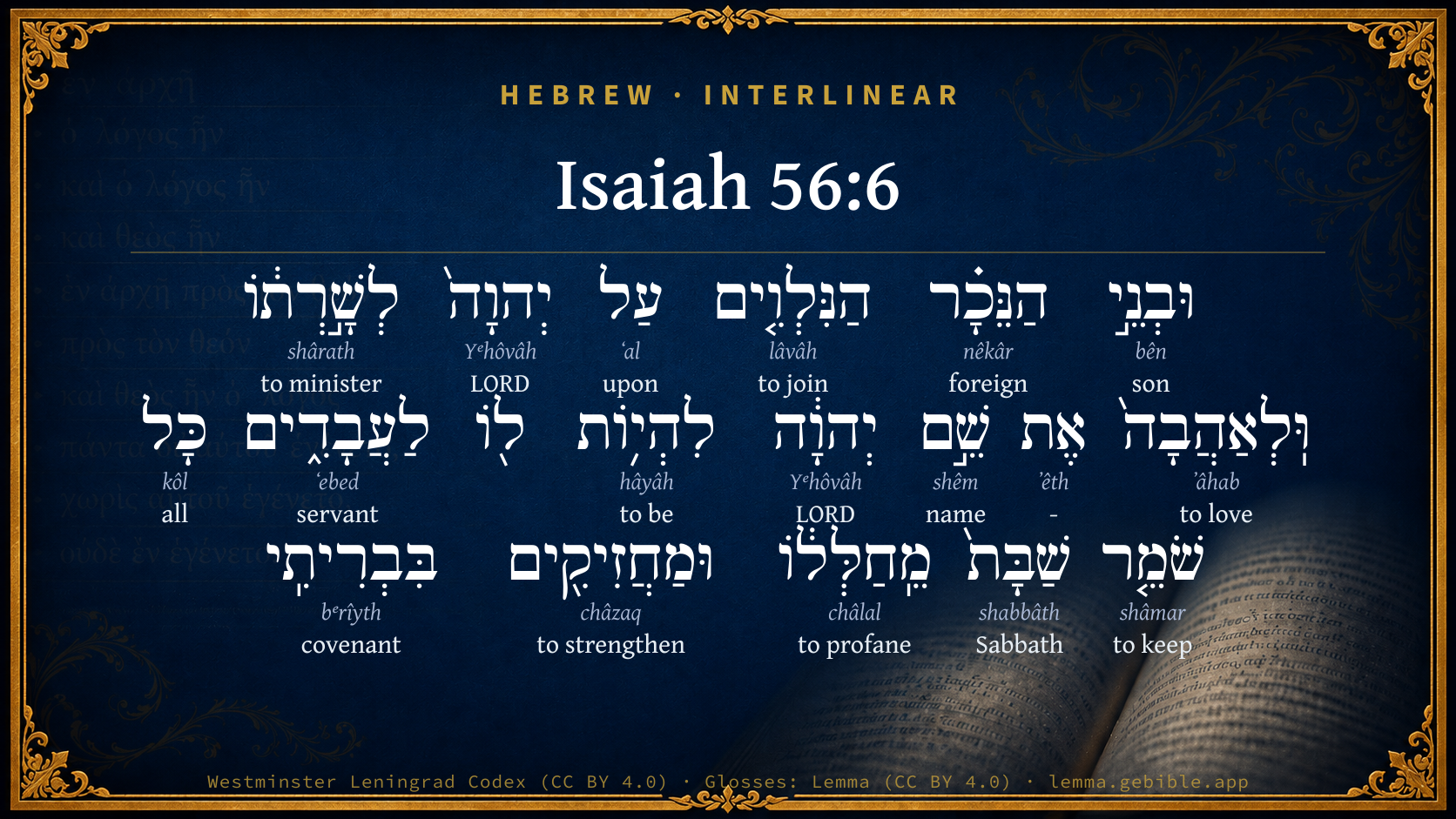
Hebrew (Westminster Leningrad Codex) Isaiah 56:6 appears in the Hebrew Old Testament. The text above is from the Westminster Leningrad Codex. Each word links to its Strong’s number, a concise gloss, and parsing drawn from the Open Scriptures Hebrew Bible morphology. Click any word for its full Brown-Driver-Briggs (BDB) entry.
Download image
Cite this verse

Isaiah 56:6 (World English Bible). Public Domain. Lemma interlinear Bible study tool, https://lemma.gebible.app/v/isaiah/56/6.

Show BibTeX & RIS
BibTeX
RIS
English Translation
Also the foreigners who join themselves to Yahweh, to minister to him, and to love the name of Yahweh, to be his servants, everyone who keeps the Sabbath from profaning it, and holds fast my covenant;
World English Bible · Public Domain
Download a study sheet

One document with this verse’s original text, its word-by-word gloss line, the meaning frame, cross-references with their text, attributed commentary, and full source and license credits — printable, and it pastes into notes with its structure intact.

This verse Autodidact and up

Study sheet (.html) Plain text (.txt)

A passage Seminary Student

Up to 50 verses in one chapter. A passage sheet keeps up to 6 commentary sources and 12 cross-references per verse, in the order this page ranks them, and says so on the sheet whenever that leaves anything out. Ask for a single verse and you get the Autodidact verse sheet above.

Everything on this page stays free to read, with no account — the sheet is a download of what is already on screen, not access to it.

Want to remove ads? Support Godless Engineer
Compare translations 3

The same verse in 3 English versions, stacked beneath the original-language interlinear above. Click any original word for its lexicon entry.

Each is an independent rendering of the whole verse — the interlinear is not word-aligned to these translations.

Highlighted words mark where these versions differ — a whole-verse word diff, not a word-by-word alignment.

  • World English Bible Public Domain
    Also the foreigners who join themselves to Yahweh, to minister to him, and to love the name of Yahweh, to be his servants, everyone who keeps the Sabbath from profaning it, and holds fast my covenant;
  • King James Version Public Domain
    Also the sons of the stranger, that join themselves to the LORD, to serve him, and to love the name of the LORD, to be his servants, every one that keepeth the sabbath from polluting it, and taketh hold of my covenant;
  • unfoldingWord Literal Text CC BY-SA 4.0
    And the sons of the foreigner joining themselves to Yahweh to serve him and to love the name of Yahweh to be servants to him, everyone keeping the Sabbath from profaning it and holding onto my covenant,

unfoldingWord Literal Text — © unfoldingWord, licensed CC BY-SA 4.0. Word-aligned USFM3 via Door43 (git.door43.org/unfoldingWord/en_ult).

Versions to compare (up to 4)

3 of 4 selected

Show all 18 translations

Every available English version of this verse, each an independent rendering of the whole verse.

  • World English Bible Public Domain
    Also the foreigners who join themselves to Yahweh, to minister to him, and to love the name of Yahweh, to be his servants, everyone who keeps the Sabbath from profaning it, and holds fast my covenant;
  • Berean Standard Bible Public Domain
    And the foreigners who join themselves to the LORD to minister to Him, to love the name of the LORD, and to be His servants—all who keep the Sabbath without profaning it and who hold fast to My covenant—
  • Majority Standard Bible Public Domain
    And the foreigners who join themselves to the LORD to minister to Him, to love the name of the LORD, and to be His servants—all who keep the Sabbath without profaning it and who hold fast to My covenant—
  • King James Version Public Domain
    Also the sons of the stranger, that join themselves to the LORD, to serve him, and to love the name of the LORD, to be his servants, every one that keepeth the sabbath from polluting it, and taketh hold of my covenant;
  • American Standard Version (1901) Public Domain
    Also the foreigners that join themselves to Jehovah, to minister unto him, and to love the name of Jehovah, to be his servants, every one that keepeth the sabbath from profaning it, and holdeth fast my covenant;
  • Revised Version (1885) Public Domain
    Also the strangers, that join themselves to the LORD, to minister unto him, and to love the name of the LORD, to be his servants, every one that keepeth the sabbath from profaning it, and holdeth fast by my covenant;
  • Geneva Bible (1599) Public Domain
    Also the strangers that cleaue vnto the Lord, to serue him, and to loue the Name of the Lord, and to be his seruants: euery one that keepeth the Sabbath, and polluteth it not and imbraceth my couenant,
  • Douay-Rheims (1899) Public Domain
    And the children of the stranger that adhere to the Lord, to worship him, and to love his name, to be his servants: every one that keepeth the sabbath from profaning it, and that holdeth fast my covenant:
  • Young's Literal Translation Public Domain
    And sons of the stranger, who are joined to Jehovah, To serve Him, and to love the name of Jehovah, To be to Him for servants, Every keeper of the sabbath from polluting it, And those keeping hold on My covenant.
  • Literal Standard Version CC BY-SA 4.0
    And sons of the stranger, who are joined to YHWH, || To serve Him, and to love the Name of YHWH, || To be for servants to Him, || All keeping from defiling the Sabbath, || And those keeping hold on My covenant,
  • Unlocked Literal Bible CC BY-SA 4.0
    Also foreigners who join themselves to Yahweh— to serve him, and who love the name of Yahweh, to worship him, every one who observes the Sabbath and who keeps from defiling it, and who holds fast my covenant
  • unfoldingWord Literal Text CC BY-SA 4.0
    And the sons of the foreigner joining themselves to Yahweh to serve him and to love the name of Yahweh to be servants to him, everyone keeping the Sabbath from profaning it and holding onto my covenant,
  • Darby Bible Public Domain
    Also the sons of the alien, that join themselves to Jehovah, to minister unto him and to love the name of Jehovah, to be his servants, every one that keepeth the sabbath from profaning it, and holdeth fast to my covenant;
  • World Messianic Bible Public Domain
    Also the foreigners who join themselves to the LORD to serve him, and to love the LORD’s name, to be his servants, everyone who keeps the Sabbath from profaning it, and holds fast my covenant,
  • Webster's Bible Public Domain
    Also the sons of the stranger, that join themselves to the LORD, to serve him, and to love the name of the LORD, to be his servants, every one that keepeth the sabbath from profaning it, and taketh hold of my covenant;
  • Free Bible Version CC BY-SA 4.0
    About the foreigners who have dedicated themselves to the Lord, who worship him, who love the Lord, and who are his servants—all who observe the Sabbath without violating it and who keep to my agreement—
  • Bible in Basic English Public Domain
    And as for those from a strange country, who are joined to the Lord, to give worship to him and honour to his name, to be his servants, even everyone who keeps the Sabbath holy, and keeps his agreement with me:
  • JPS Tanakh (1917) Public Domain
    Also the aliens, that join themselves to the LORD, to minister unto Him, and to love the name of the LORD, to be His servants, every one that keepeth the sabbath from profaning it, and holdeth fast by My covenant:

Literal Standard Version (2020), Covenant Press — licensed CC BY-SA 4.0. Text via the HelloAO Bible API (eBible.org). Unlocked Literal Bible (unfoldingWord) — licensed CC BY-SA 4.0. Text via the HelloAO Bible API (eBible.org). unfoldingWord Literal Text — © unfoldingWord, licensed CC BY-SA 4.0. Word-aligned USFM3 via Door43 (git.door43.org/unfoldingWord/en_ult). Free Bible Version, Dr. Jonathan Gallagher — licensed CC BY-SA 4.0. Text via the HelloAO Bible API (eBible.org).

Word by word

More ways to search: Search by grammar → Find every occurrence → Compare this word →

Practice this passage: Drill this verse → Learn its vocabulary →

הַנִּלְוִ֤ים
lâvâh
H3867
“the · joining”
Particle, Definite Article + Verb, Niphal, Participle Active, Masculine, Plural, Absolute
Part of Speech
Particle + Verb
Stem
Niphal
Form
Participle Active
Gender
Masculine
Number
Plural
State
Absolute
Full BDB Definition

Origin: a primitive root

TWOT: 1087 , 1088

to join, be joined - (Qal) to join, be joined, attend - (Niphal) to join oneself to, be joined unto - to borrow, lend - (Qal) to borrow - (Hiphil) to cause to borrow, lend to
  1. וּבְנֵ֣י bên H1121 “and · sons of” Conjunction + Noun, Common, Masculine, Plural, Construct
  2. הַנֵּכָ֗ר nêkâr H5236 “the · foreign” Particle, Definite Article + Noun, Common, Masculine, Singular, Absolute
  3. עַל ʻal H5921 “upon” Preposition
  4. יְהוָה֙ Yᵉhôvâh H3068 “LORD” Noun, Proper
  5. לְשָׁ֣רְת֔וֹ shârath H8334 “to minister · him” Preposition + Verb, Piel, Infinitive Construct + Suffix, Personal, 3rd Person, Masculine, Singular
  6. וּֽלְאַהֲבָה֙ ʼâhab H157 “and · to love” Conjunction + Preposition + Verb, Qal, Infinitive Construct
  7. אֶת ʼêth H853 “-” Particle, Direct Object
  8. שֵׁ֣ם shêm H8034 “name of” Noun, Common, Masculine, Singular, Construct
  9. יְהוָ֔ה Yᵉhôvâh H3068 “LORD” Noun, Proper
  10. לִהְי֥וֹת hâyâh H1961 “to be” Preposition + Verb, Qal, Infinitive Construct
  11. לַעֲבָדִ֑ים ʻebed H5650 “to/for · servants” Preposition + Noun, Common, Masculine, Plural, Absolute
  12. כָּל kôl H3605 “all of” Noun, Common, Masculine, Singular, Construct
  13. שֹׁמֵ֤ר shâmar H8104 “keeping” Verb, Qal, Participle Active, Masculine, Singular, Absolute
  14. שַׁבָּת֙ shabbâth H7676 “Sabbath” Noun, Common, Both, Singular, Absolute
  15. מֵֽחַלְּל֔וֹ châlal H2490 “from · to profane · him” Preposition + Verb, Piel, Infinitive Construct + Suffix, Personal, 3rd Person, Masculine, Singular
  16. וּמַחֲזִיקִ֖ים châzaq H2388 “and · strengthening” Conjunction + Verb, Hiphil, Participle Active, Masculine, Plural, Absolute
  17. בִּבְרִיתִֽי bᵉrîyth H1285 “in/at · covenant · my” Preposition + Noun, Common, Feminine, Singular, Construct + Suffix, Personal, 1st Person, Common, Singular

About this verse

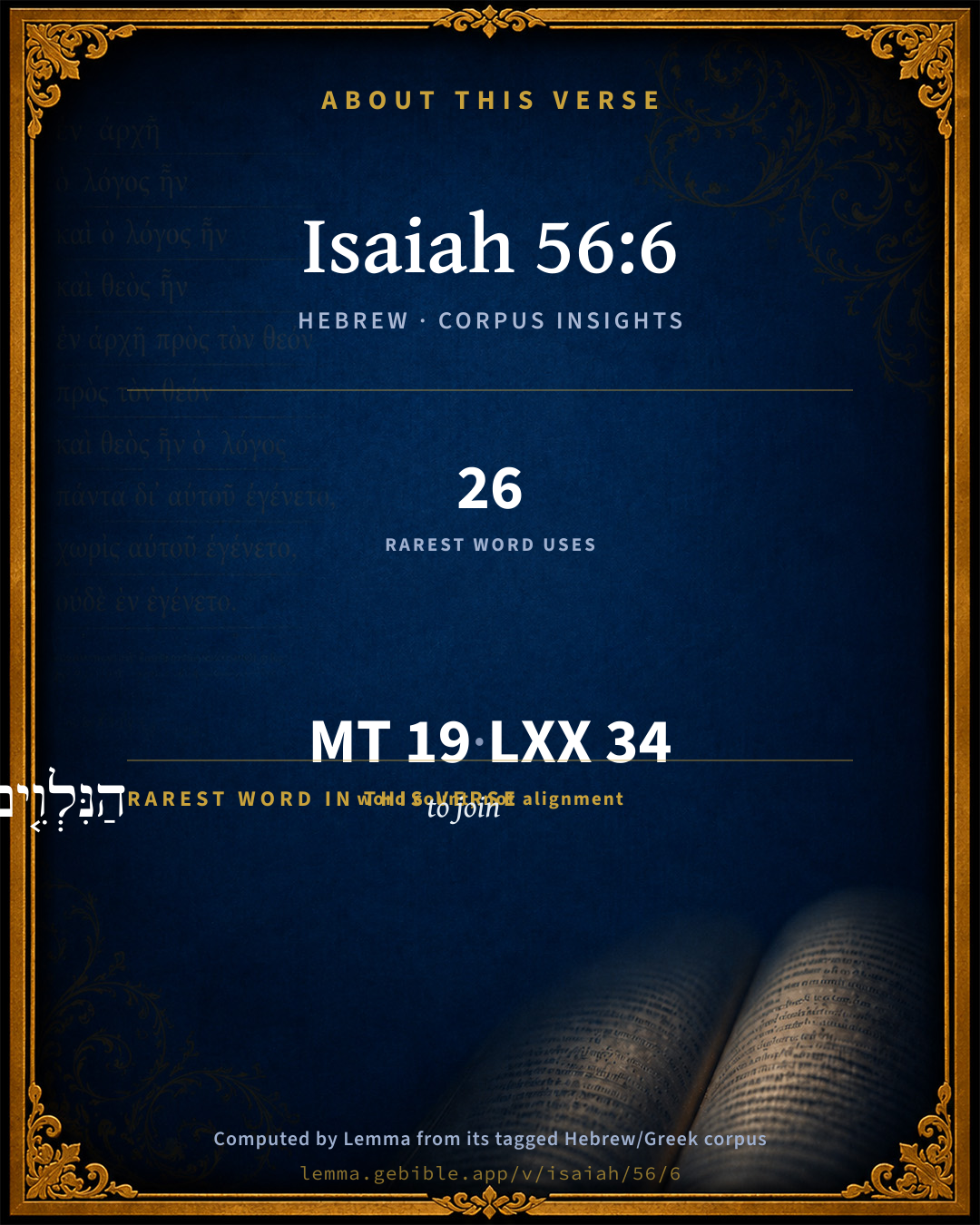
These counts appear in no published source. They are computed here, from the morphology-tagged text and Lemma’s own curated glosses. What Lemma adds →

19
words
17
distinct lemmas
Prophets
section

Shared distinctive vocabulary

הַנִּלְוִ֤ים to join H3867 occurs in 22 verses of the Hebrew Bible. Also found in:

Grammatical profile

  • 7 verbs
  • 9 nouns
  • 2 prepositions
  • 1 particle

Verb forms

  • הַנִּלְוִ֤ים Niphal · Participle Active
  • לְשָׁ֣רְת֔וֹ Piel · Infinitive Construct
  • וּֽלְאַהֲבָה֙ Qal · Infinitive Construct
  • לִהְי֥וֹת Qal · Infinitive Construct
  • שֹׁמֵ֤ר Qal · Participle Active
  • מֵֽחַלְּל֔וֹ Piel · Infinitive Construct
  • וּמַחֲזִיקִ֖ים Hiphil · Participle Active

Repetition

A word recurs within this verse — often emphatic in Hebrew:

  • יְהוָה֙ LORD H3068 ×2

Hebrew & Septuagint length

In English translation the verse runs 36 words from the Hebrew and 50 from the Septuagint (LXX English) — closely comparable.

A rough comparison of the two English renderings, which tokenize alike — not a word-level alignment.

Word counts can differ between the Hebrew and the Greek without any difference in meaning — e.g. the Hebrew direct-object marker אֵת has no separate Greek word, and Greek often adds the article ὁ.

In the original languages it is 19 Hebrew tokens and 34 Greek tokens — but the two are counted differently (Hebrew bundles its prefixes and suffixes into one token; the Greek is in lemma form), so that isn’t a like-for-like length.

Cross-references

18

Topical passages linked to Isaiah 56:6 in the Treasury of Scripture Knowledge — connected by theme and wording, ordered by reader-vote popularity; previews shown in the World English Bible.

  • Jeremiah 50:5 They shall inquire concerning Zion with their faces turned toward it, [saying], Come you, and join yourselves to Yahweh in an everlasting covenant that shall not be forgotten.
  • Isaiah 56:2–4 Blessed is the man who does this, and the son of man who holds it fast; who keeps the Sabbath from profaning it, and keeps his hand from doing any evil.
  • Isaiah 58:13 If you turn away your foot from the Sabbath, from doing your pleasure on my holy day; and call the Sabbath a delight, [and] the holy of Yahweh honorable; and shall honor it, not doing your own ways, nor finding your own pleasure, nor speaking [your own] words:
  • Isaiah 44:5 One shall say, I am Yahweh's; and another shall call [himself] by the name of Jacob; and another shall subscribe with his hand to Yahweh, and surname [himself] by the name of Israel.
  • Galatians 5:6 For in Christ Jesus neither circumcision amounts to anything, nor uncircumcision, but faith working through love.
  • James 2:5 Listen, my beloved brothers. Didn't God choose those who are poor in this world to be rich in faith, and heirs of the Kingdom which he promised to those who love him?
  • Mark 12:30–34 you shall love the Lord your God with all your heart, and with all your soul, and with all your mind, and with all your strength.' This is the first commandment.
  • Acts 2:41 Then those who gladly received his word were baptized. There were added that day about three thousand souls.
  • Revelation 1:10 I was in the Spirit on the Lord's day, and I heard behind me a loud voice, like a trumpet
  • Isaiah 60:10 Foreigners shall build up your walls, and their kings shall minister to you: for in my wrath I struck you, but in my favor have I had mercy on you.
  • Isaiah 61:5 Strangers shall stand and feed your flocks, and foreigners shall be your plowmen and your vine-dressers.
  • Acts 11:23 who, when he had come, and had seen the grace of God, was glad. He exhorted them all, that with purpose of heart they should remain near to the Lord.
  • Romans 8:28 We know that all things work together for good for those who love God, to those who are called according to his purpose.
  • 1 Corinthians 16:22 If any man doesn't love the Lord Jesus Christ, let him be accursed. Come, Lord!
  • 2 Corinthians 8:5 This was not as we had hoped, but first they gave their own selves to the Lord, and to us through the will of God.
  • Ephesians 6:24 Grace be with all those who love our Lord Jesus Christ with incorruptible love. Amen.
  • 1 Thessalonians 1:9–10 For they themselves report concerning us what kind of a reception we had from you; and how you turned to God from idols, to serve a living and true God,
  • James 1:12 Blessed is the man who endures temptation, for when he has been approved, he will receive the crown of life, which the Lord promised to those who love him.

Cross-references courtesy of OpenBible.info (CC BY 4.0).

Hebrew and Greek witnesses Masoretic Hebrew ↔ Greek Septuagint

The same verse in the two great witnesses to the Old Testament, shown verse-for-verse.

These are two independent witnesses, not word-aligned to each other, and the Septuagint is shown in lemma (dictionary) form.

Hebrew Isaiah 56:6 Masoretic · Westminster Leningrad Codex

וּבְנֵ֣י הַנֵּכָ֗ר הַנִּלְוִ֤ים עַל יְהוָה֙ לְשָׁ֣רְת֔וֹ וּֽלְאַהֲבָה֙ אֶת שֵׁ֣ם יְהוָ֔ה לִהְי֥וֹת ל֖וֹ לַעֲבָדִ֑ים כָּל שֹׁמֵ֤ר שַׁבָּת֙ מֵֽחַלְּל֔וֹ וּמַחֲזִיקִ֖ים בִּבְרִיתִֽי

Also the foreigners who join themselves to Yahweh, to minister to him, and to love the name of Yahweh, to be his servants, everyone who keeps the Sabbath from profaning it, and holds fast my covenant;

World English Bible · Public Domain

Greek LXX Isaiah 56:6 Septuagint · lemma form

καί ὁ ἀλλογενής ὁ προςκεῖμαι κύριος δουλεύω αὐτός καί ἀγαπάω ὁ ὄνομα κύριος ὁ εἰμί αὐτός εἰς δοῦλος καί δούλη καί πᾶς ὁ φυλάσσω ὁ σάββατον ἐγώ μή βεβηλόω καί ἀντιἔχω ὁ διαθήκη ἐγώ

And I will give it to the strangers that attach themselves to the Lord, to serve him, and to love the name of the Lord, to be to him servants and handmaids; and as for all that keep my sabbaths from profaning them, and that take hold of my covenant;

LXX2012 (modern English Septuagint) · Public Domain

Hebrew: Westminster Leningrad Codex (CC BY 4.0). Greek: Septuagint (public domain); English from LXX2012 (modern English Septuagint) (Public Domain). How the Septuagint differs from the Hebrew →

Targum (Aramaic paraphrase)

1

The Targum is the ancient Jewish Aramaic paraphrase of the Hebrew Scriptures — an interpretive translation, not the Hebrew text itself. Onkelos (literal) and Pseudo-Jonathan (expansive) render the Torah, and Jonathan the Prophets. Coverage is partial: where no permissively-licensed English translation exists for a verse, only the Aramaic is shown. This is verse-level text, not a word-by-word alignment to the Hebrew.

  1. Targum Jonathan Prophets (Joshua–Malachi)
    וּבְנֵי עַמְמַיָא דְמִתּוֹסְפִין עַל עַמֵהּ דַייָ לְשַׁמָשׁוּתֵהּ וּלְמִרְחַם יַת שְׁמָא דַייָ לְמֶהֱוֵי לֵיהּ לְעָבְדִין כָּל דְיִטַר שַׁבְּתָא לְאַחֲלוּתֵהּ וּמַתְקְפִין בִּקְיָמִי:

    And the sons of the Gentiles, that are joined unto the people of the Lord, to serve Him, and to love the name of the Lord, to be His servants, every one that keepeth the Sabbath from polluting it, and taketh hold of my covenant;

    Targum Jonathan — Aramaic: “Mikraot Gedolot” (public domain). English: “Sefaria Community Translation” (CC0 1.0 (public-domain dedication)); “London "Chaldee Paraphrase," 1871” (public domain). Text via Sefaria.

Commentary

Notes on Isaiah 56:6 from classic Christian and Jewish commentators (each source and its license shown beneath its notes). The classic Christian expositions comment on the surrounding passage and are grouped to its opening verse, so a note may address several verses; the Jewish commentaries on the Tanakh (Rashi and others) are per-verse, so they appear only where the commentator wrote on this verse.

Lemma curates 59 commentaries, every one of them public domain or Creative Commons licensed, each selected and text-cleaned for this edition rather than reprinted as found. About our sources →

Trapp's Complete Commentary

John Trapp

Isa 56:6 Also the sons of the stranger, that join themselves to the LORD, to serve him, and to love the name of the LORD, to be his servants, every one that keepeth the sabbath from polluting it, and taketh hold of my covenant;

Ver. 6. Also the sons of the stranger that joineth.] Relinquishing his heathenish superstition, and devoting himself to my fear. The Levites had their name from the word here used; and leviathan, whose scales and parts are so fast joined and jointed together.

To love the name of the Lord, to be his servants.] Plato could say, Parere legibus est Deo servire: et haec summa est libertas, To obey the laws, is to serve God; and this is the chiefest liberty, this is perfect freedom. But Plato never knew what it was to love to be God’s servant. Lex voluntarios quaerit, saith Ambrose. {a} All God’s soldiers are volunteers, all his people free hearted; {Psa 110:3} they wait for his law. {Isa 42:8 Deu 10:12}

Every one that keepeth the Sabbath.] See on Isa 56:2.

{a} In Psalm i.

John Trapp, A Commentary or Exposition upon All the Books of the Old and New Testament (1647–1656) — public domain. Text from a community e-Sword module.

The Biblical Illustrator

Joseph S. Exell

Isa_56:6-7

Also the sons of the stranger

Gentiles enjoying Gods favour

This is a clear prophecy of the call of the Gentiles into the Church of Christ.

Let us attend to this description of those who are objects of the Divine favour, and entitled to the privileges of His house.

1. They join themselves to the Lord. This supposes a former distance and alienation from Him. But that is removed by humble repentance and returning to the Lord. It includes, renouncing all their idols; forsaking all their sin, everything contrary to the nature and will of God: a deliberate choice of Him, as their portion and felicity; and of His people, as their friends and associates.

2. The design of their thus joining themselves unto the Lord is to serve Him. This is further expressed in the phrase, to be His servants; not only to serve Him occasionally, or for a while, but perpetually; to adhere to Him and His ways, from a deep conviction that nothing can be more reasonable, important, and advantageous than to hear what He saith, and to do it.

3. It is added, and to love the name of the Lord. They take delight in His service; they perform it not from fear and a servile dread, but from a sincere and strong affection. They love His name; that is, they love him, His worship and His ways, and pursue His work with delight. It is opposed to narrow; selfish, mercenary views, which render the service less acceptable and comfortable. They esteem it their meat and drink to do His will.

4. Another thing-expected from Gods people is, that they keep His Sabbath from polluting it. This is an essential character, a distinguishing mark, of good men.

5. Gods people take hold of His covenant. They enter into serious, deliberate, solemn engagements to observe and keep His laws, in order to obtain the blessings which He hath promised; and which, in so doing, they cheerfully expect. They take hold of it; which implies a hearty consent to Gods terms, a cheerful approbation and acceptance of them and delight in them. It likewise implies a steady resolution. They take hold of it, as those who are determined not to let it go. (J. Orton.)

The rewards of Gods servants

The text--

I. HOLDS OUT UNIVERSAL ENCOURAGEMENT TO MAN.

1. By the transfer of the priesthood from Aaron to Christ.

2. By the change of sacrifice. From the blood of bulls and of goats to the precious blood of the Son of God.

3. By the removal of place. From Jerusalem to the temple of the universe.

4. By a change of worship. From ritual to spiritual. What an encouraging prospect! (Eph_2:11-22.)

II. INCULCATES UNIVERSAL PIETY, Piety in heart and practice. The duties enumerated may be divided into three classes.

1. Those which relate to Christ, expressed by taking hold of His covenant--accepting--agreeing to it.

2. Those which relate to God as the Governor of the world.

(1) His servants.

(2) Walk by His laws.

(3) Keep His Sabbaths.

3. Those which relate to the Church.

III. PROMISES UNIVERSAL HAPPINESS.

1. Access to heaven. I will bring them to My holy mountain.

2. Joyfulness in His service. I will make them joyful in My house of prayer.

3. The Divine acceptance of their religious engagements. Their burnt-offerings and sacrifices shall be accepted upon Mine altar. (R. Watson.)

The Biblical Illustrator, edited by Joseph S. Exell (c. 1880s–1900s) — public domain. Text from a community e-Sword module.

Joseph Benson's Commentary

Isa 56:6-7. The sons of the stranger that join themselves to the Lord — That with purpose of heart cleave unto him, as is said Act 11:23. To love the Lord, to be his servants — To serve him out of love to him and to his worship. Them will I bring to my holy mountain — To my house which stood upon mount Zion, including mount Moriah; and make them joyful — By accepting their services, and comforting their hearts with the sense of my love; in my house of prayer — In my temple, in and toward which prayers are daily made unto me. Their sacrifices shall be accepted upon mine altar — They shall have as free access to my house and altar as the Jews themselves, and their services shall be as acceptable to me. Evangelical worship is here described under such expressions as agreed to the worship of God which was then in use. My house shall be called a house of prayer for all people — Jews and Gentiles shall have equal freedom to my house, and shall there call upon my name. “The temple was originally designed for strangers as well as Jews, as a place to offer up their prayers to the Divine Majesty; which is sufficiently plain from the prayer of Solomon, at the dedication of it, though the number of proselytes was small till the time of the second temple. But there can be no doubt that this verse alludes particularly to the conversion of the Gentiles. This truth could not be told the Jewish people otherwise than by using terms taken from rites familiar to them, unless the nature of the Christian dispensation had been previously explained; a matter evidently unfit for their information, when they were yet to live so long under the Jewish law. For though the prophets speak of the little value of their regard to the ceremonial law, they easily make themselves understood, that they mean, when it was observed without the moral law; which they describe in the purity and perfection of the gospel. So admirable was this conduct, that while it hid the future dispensation it prepared men for it.” — Bishop Warburton’s Div. Leg. Upon the whole, the reader may observe, “that the principal scope of this paragraph is to teach that all the privileges of the covenant of grace should be common to all, without distinction of nation, state, or condition; that God would distribute to all believers, according to the measure of their grace, equal gifts, as our Lord hath taught in the parable of the labourers in the vineyard, Matthew 20.”

Joseph Benson's Commentary on the Old and New Testaments (1811–1818) — public domain. Text from a community e-Sword module.

Keil & Delitzsch

C. F. Keil & F. Delitzsch

The fears of proselytes from among the heathen are also removed. "And the foreigners, who have joined themselves to Jehovah, to serve Him, and to love the name of Jehovah, to be His servants, whoever keepeth the Sabbath from desecrating it, and those who hold fast to my covenant, I bring them to my holy mountain, and make them joyful in my house of prayer; their whole-offerings and their slain-offerings are well-pleasing upon mine altar: for my house, a house of prayer shall it be called for all nations." The proselytes, who have attached themselves to Jehovah (על־הא),

(Note: The oriental reading, not in Isa 56:3, but here in Isa 56:6, is על־ה; the western, אל־ה. The Masora follows the western (מערבאי( nre), i.e., the Palestinian, and reckons this passage as one of the 31 על־ה in the Old Testament Scriptures.)

the God of Israel, with the pure intention of serving Him with love, are not to be left behind in the strange land. Jehovah will bring them along with His people to the holy mountain, upon which His temple rises once more; there will He cause them to rejoice, and all that they place upon His altar will find a most gracious acceptance. It is impossible that the prophet should be thinking here of the worship of the future without sacrifice, although in Isa 53:1-12 he predicts the self-sacrifice of the "Servant of Jehovah," which puts an end to all animals sacrifices. But here the temple is called "the house of prayer," from the prayer which is the soul of all worship. It will be called a house of prayer for all nations; and therefore its nature will correspond to its name. This ultimate intention is already indicated in Solomon's dedicatory prayer (Kg1 8:41-43); but our prophet was the first to give it this definite universal expression. Throughout this passage the spirit of the law is striving to liberate itself from its bondage. Nor is there anything to surprise us in the breaking down of the party wall, built up so absolutely between the eunuchs on the one hand and the congregation on the other, or the one partially erected between the heathen and the congregation of Israel; as we may see from Isa 66:21, where it is affirmed that Jehovah will even take priests and Levites out of the midst of the heathen whom Israel will bring back with it into its own land.

Keil & Delitzsch — Biblical Commentary on the Old Testament (1861–1891) — public domain (CC PDM 1.0). Text via the HelloAO Bible API. (Old Testament only.)

Tyndale Open Study Notes

Tyndale Open Resources

56:6 The essential ingredient for covenant fellowship is love for God (Deut 6:5; 30:20; Matt 22:34-38). • Keeping the Sabbath is a sign of keeping the covenant itself (see Exod 31:13-17).

Tyndale Open Study Notes — © Tyndale Open Resources, licensed CC BY-SA 4.0. Text via the HelloAO Bible API.

Jamieson, Fausset & Brown

Robert Jamieson, A. R. Fausset & David Brown

join . . . Lord-- (Jer 50:6). Conditions of admission to the privileges of adoption.

Jamieson, Fausset & Brown — Commentary Critical and Explanatory on the Whole Bible (1871) — public domain (CC PDM 1.0). Text via the HelloAO Bible API.

Adam Clarke's Commentary

Verse 6. The sons of the stranger] The Gentiles.

That join themselves to the Lord] Who shall enter into the Christian covenant by baptism and faith in Christ, as the Jews and proselytes did by circumcision.

To serve him] To live according to the Gospel, and ever do that which is right in the sight of the Lord.

To love the name of the Lord] The name of JESUS, the Christ, the Saviour of sinners, the Anointed of God, and the Giver of the Holy Spirit to his followers.

To be his servants] To worship no other God but JEHOVAH, and to trust in none for salvation but his CHRIST.

That keepeth the Sabbath] That observes it as a type of the rest that remains for the people of God.

And taketh hold of my covenant] בבריתי biberithi, "of my covenant sacrifice;" as without this he can do nothing good; and without it nothing can be acceptable to the infinite majesty of the Most High.

Adam Clarke's Commentary on the Bible (1810–1826) — public domain. Text from a community e-Sword/MySword module.

Ellicott's Commentary for English Readers

(6) Also the sons of the stranger . . .—Proselytes also were to share in the blessings of the wider covenant. The words “to serve him” have been referred to some menial offices like that of the Nethinim, “hewers of wood and drawers of water” (Jos_9:27; Ezr_8:20). The usage of the word, however, limits it to honourable functions. The germ of Isaiah’s thought appears in Solomon’s dedication prayer (1Ki_8:41-43). It receives its highest development (in its entire separation from the building with which there and here it is associated), in Joh_4:23. Comp. a further emancipation from the bondage of the law in Isa_66:21.

A Bible Commentary for English Readers, edited by Charles John Ellicott (1878–1897) — public domain. Text from a community e-Sword module.

The Cambridge Bible for Schools and Colleges

gen. ed. J. J. S. Perowne

6, 7. The answer to the misgivings of proselytes (Isa_56:3).

to serve him] Better as R.V. to minister unto him. The verb is used of honourable personal service (Gen_39:4; Gen_40:4), and especially of the priestly service of God at the sanctuary. It is found again in ch. Isa_60:7; Isa_60:10, Isa_61:6.

to love the name of the Lord] Cf. Deu_6:5; Deu_11:1, &c.

to be his servants] i.e. worshippers (a different word from that used above).

The Cambridge Bible for Schools and Colleges (gen. ed. J. J. S. Perowne; Cambridge University Press, 1878–1918) — public domain. Text from a community e-Sword module.

John Gill's Exposition

Also the sons of the stranger that join themselves to the Lord,.... Having answered the objection and removed the discouragement of the eunuch, he now returns to the sons of the stranger, who also join themselves to the Lord, as the eunuch had done; see Isa 56:4 and who do this,

to serve him, and to love the name of the Lord, to be his servants; who give up themselves to him, not only to be saved by him, but to serve him in righteousness and holiness, with reverence and godly fear, and from a principle of love to him; being heartily desirous, and accounting it an honour, to be his servants:

everyone that keepeth the sabbath from polluting it, and taketh hold of my covenant; See Gill on Isa 56:4.

John Gill's Exposition of the Whole Bible (1746–1763) — public domain (CC PDM 1.0). Text via the HelloAO Bible API.

Albert Barnes' Notes on the Bible

Also the sons of the stranger - (see the note at Isa 56:3). The conditions on which they should be admitted to the same privileges are specified, and are the following:

1. They were to ‘join themselves to the Lord’ (see the note at Isa 56:3).

2. This should be with a purpose to ‘serve him.’ Their aim and design should be to keep his commandments and to do his will.

3. They were to ‘love the name of the Lord;’ that is, to love Yahweh himself, for the ‘name’ of the Lord is often used as denoting the Lord himself.

4. They were to keep his sabbaths (see the notes at Isa 56:4).

5. They were to take hold of his covenant (see the notes at Isa 56:4).

On these conditions the sons of the foreigner were to be admitted to all the privileges of the children of God, and to be united with all who love and serve him.

Albert Barnes' Notes on the Bible (1834–1885) — public domain. Text from a community e-Sword/MySword module.

Matthew Poole's English Annotations

That join themselves to the Lord; that with purpose of heart cleave unto him, as is said, Act 11:23.

To serve him, and to love the name of the Lord; to serve him out of love to him, and to his worship.

Matthew Poole's English Annotations on the Holy Bible (1683–1685) — public domain. Text from a community e-Sword/MySword module.

Whedon's Commentary on the Bible

Daniel D. Whedon

6, 7. Stranger — Again, Gentiles throughout the world are more than urged and invited — they are made welcome with outstretched arms, if seen coming, even before invitation, “to the mountain of the Lord’s house.” Only a sense of penitence and spiritual want could influence their steps thitherward.

Daniel D. Whedon (gen. ed.), Commentary on the Old and New Testaments (1874–1909) — public domain. Text from a community e-Sword module.

The Pulpit Commentary

Also the sons of the stranger (comp. ver. 3). The proselytes shall not be treated as they fear. On the contrary, God will treat them in exactly the same way as his original people will conduct them to Palestine, settle them in his "holy mountain," admit them to the temple services, accept their burnt offerings and their sacrifices. All this will be a foretaste of their position in the Christian Church, where there will be neither Jew nor Gentile, neither circumcision nor uncircumcision, but a community where all are brethren and all have equal privileges.

HOMILIES BY W.M. STATHAM Ver. 6. Service.

"The sons of the stranger, that join themselves to the Lord, to serve him," etc. This word is often degraded in human speech. "Service" is con-sidereal humiliating, and only mastership is glorious. But "the Son of man came not to be ministered unto, but to minister." We are all of us debtors to others; we owe them much, and we owe Christ all.

I SERVICE CALLS OUT WHAT IS BEST IN MEN.

1. Their unselfishness.

2. Their heroism.

3. Their patience.

II SERVICE CHARACTERIZES THE NOBLEST AND THE BEST OF MEN.

1. Think of the world"s great leaders.

2. Think of the Church"s sufferers and martyrs.

III SERVICE IS EMBODIED IN MANY FORMS. There is a service of gift; a service of speech; a service of submission. "They also serve who only stand and wait.

All God"s universe is alive with blest activity. The idler is out of harmony with the entire creation of God. W.M.S.

The Pulpit Commentary (1880–1919), ed. H.D.M. Spence-Jones & Joseph S. Exell — public domain. Text from a community e-Sword module.

J. A. Alexander on Isaiah

Joseph Addison Alexander

“And (as to) the foreigners joining themselves to Jehovah, to serve Him and to love the name of Jehovah, to be to Him for servants, every one keeping the Sabbath from profaning it, and holding fast my covenant, I will bring them to my mount of holiness, and make them joyful in my house of prayer; their offerings and their sacrifices (shall be) to acceptance on my altar; for my house shall be called a house of prayer for all nations.” The verb sharath although strictly a generic term, is specially appropriated to the official service of the priests and Levites. Some interpreters accordingly suppose it to be here said that the heathen shall partake of the sacerdotal honors elsewhere promised to the church. (See Isa 61:6; Exo 19:6; 1Pe 2:5; 1Pe 2:9; Rev 1:6). To ‘love the name of Jehovah’, is to love His attributes as manifested in His word and works. (Compare Isa 60:9; Isa 66:5). “Shall be called”, as in many other cases, implies that it shall be so. Our Savior quotes a part of the last clause, not in reference to its main sense, but to what is incidentally mentioned, viz. its being called ‘a house of prayer’. This part of the sentence was applicable to the material temple while it lasted; but the whole prediction could be verified only after its destruction, when the house of God even upon earth ceased to be a limited locality, and became co-extensive with the church in its enlargement and diffusion. The form of expression is derived, however, from the ceremonies of the old economy, and worship is described by names familiar to the writer and his original readers. (Compare Hos 14:3; Heb 13:13; Joh 4:21-23). The general promise is the same as that in Mal 1:11, and is so far from being inconsistent with the principles on which the old economy was founded, that it simply carries out its original design as settled and announced from the beginning.

Joseph Addison Alexander, The Prophecies of Isaiah (1846–1847; New York: Scribner, 1870–1878) — public domain. Text from a community e-Sword module.

unfoldingWord translationNotes

Door43 World Missions Community

who join themselves to Yahweh

This refers to foreigners who have joined Yahweh's people.

who love the name of Yahweh

Yahweh's "name" represents himself. AT: "who love Yahweh" (See: Metonymy)

holy mountain

See how you translated this in Isaiah 11:9.

will be accepted on my altar

This can be stated in active form. AT: "I will accept on my altar" (See: Active or Passive)

my house will be called a house of prayer

This can be stated in active form. AT: "my house will be a house of prayer" (See: Active or Passive)

translationWords

alien

Yahweh

servant

love

name

worship

Sabbath

defile

covenant

holy

joy

house of God

pray

burnt offering

sacrifice

altar

nation

unfoldingWord translationNotes — © Distant Shores Media and the Door43 World Missions Community, licensed CC BY-SA 4.0. Source: git.door43.org/Door43/en_tn.

Ibn Ezra

Rabbi Abraham ibn Ezra

Also the sons of the stranger, etc. The eunuchs are mentioned before the sons of the strangers, because they are the last named (ver. 3). Comp. And I gave to Isaac, Jacob, and Esau, and I gave to Esau, etc. (Jos. 24:4).

To serve him. The service of the Lord consists in keeping His commandments.

Ibn Ezra on the Tanakh — English translations: “Sefaria Community Translation” (CC0 1.0 (public-domain dedication)); “Yalkut, Sifsei Chachomim Chumash, Metsudah Publications, 2009” (CC BY 4.0); and “Commentary of Ibn Ezra on Isaiah - trans. by M. Friedlander, 1873” (public domain). Text via Sefaria.

Lesson kit

Teaching starters — assembled from the data on this page, not authored interpretation. Every prompt links to the verse data it draws on. Edit before teaching.

Isaiah, in the Prophets, opens this verse with 19 words (17 distinct Hebrew lemmas). Its most distinctive word is lâvâh (“to join”). A historical commentator’s framing appears above. Read the whole chapter for the surrounding context.

Discussion questions

  1. How does “to join” (lâvâh) shape what this verse is saying?
  2. Genesis 29:34 shares the word «to join» with this verse. How do the two illuminate each other?
  3. “LORD” occurs 2× in this one verse. What is the effect of the repetition?
  4. These translations render this verse differently; the difference is in the English rendering, not the original. What questions does that raise?
  5. The verb «הַנִּלְוִ֤ים» is Niphal Participle Active. How does its form color the action?
  6. Reading how Trapp's Complete Commentary and The Biblical Illustrator read this verse, where do the two commentators agree and where do they part?

Things to notice

Reading settings

Reading text

Shown beneath each verse's original-language words.

Old Testament
Old Testament edition

Read the OT as the Masoretic Hebrew (MT) or the Greek Septuagint (LXX).

English shown for the Greek Septuagint (in the Hebrew ↔ Greek comparison).

Comparing translations? Open the Compare panel on any verse page to stack up to four side by side.