
Proverbs 29:3

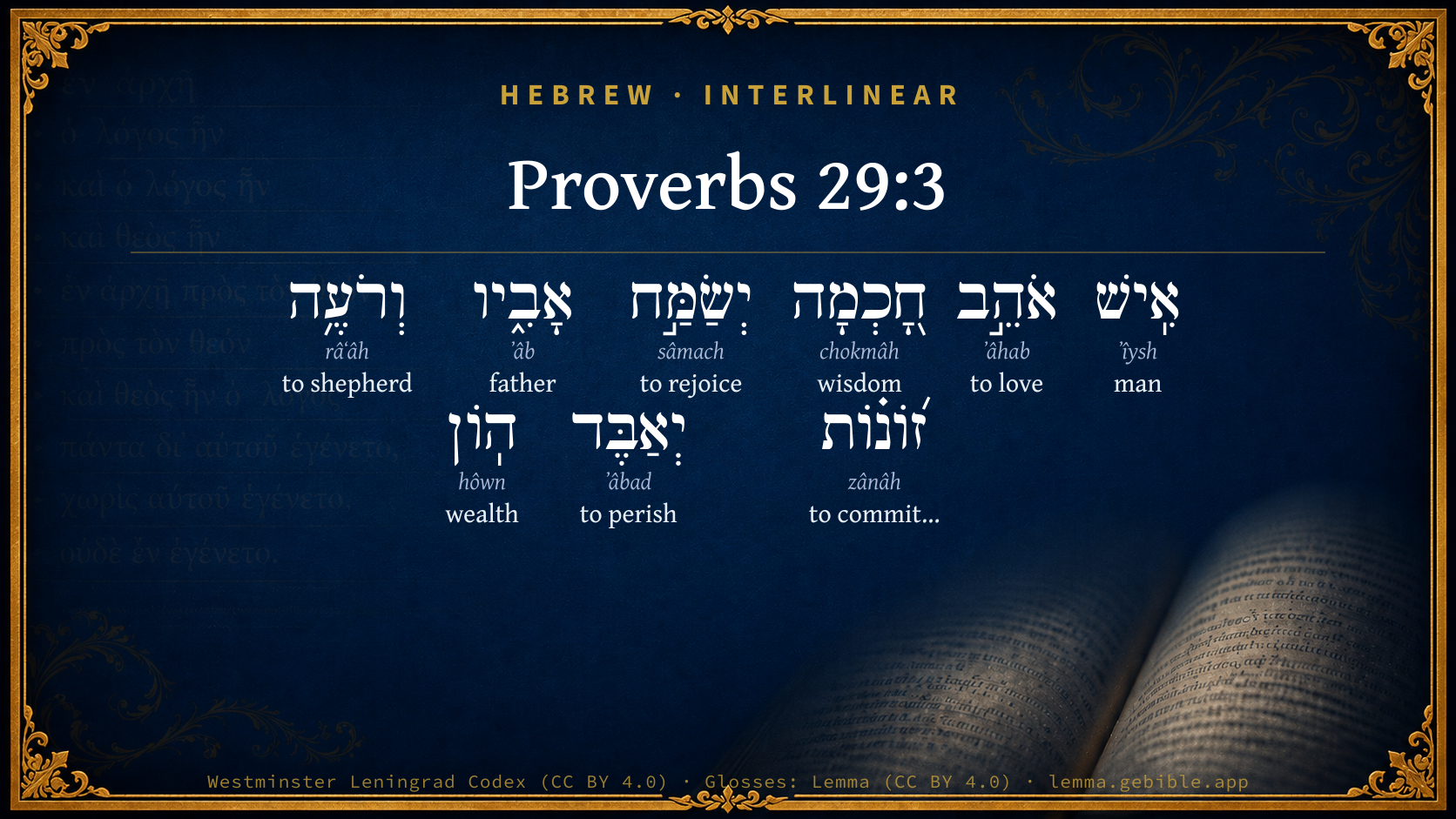
Hebrew (Westminster Leningrad Codex) Proverbs 29:3 appears in the Hebrew Old Testament. The text above is from the Westminster Leningrad Codex. Each word links to its Strong’s number, a concise gloss, and parsing drawn from the Open Scriptures Hebrew Bible morphology. Click any word for its full Brown-Driver-Briggs (BDB) entry.
Download image
Cite this verse

Proverbs 29:3 (World English Bible). Public Domain. Lemma interlinear Bible study tool, https://lemma.gebible.app/v/proverbs/29/3.

Show BibTeX & RIS
BibTeX
RIS
English Translation
Whoever loves wisdom brings joy to his father; But a companion of prostitutes squanders his wealth.
World English Bible · Public Domain
Download a study sheet

One document with this verse’s original text, its word-by-word gloss line, the meaning frame, cross-references with their text, attributed commentary, and full source and license credits — printable, and it pastes into notes with its structure intact.

This verse Autodidact and up

Study sheet (.html) Plain text (.txt)

A passage Seminary Student

Up to 50 verses in one chapter. A passage sheet keeps up to 6 commentary sources and 12 cross-references per verse, in the order this page ranks them, and says so on the sheet whenever that leaves anything out. Ask for a single verse and you get the Autodidact verse sheet above.

Everything on this page stays free to read, with no account — the sheet is a download of what is already on screen, not access to it.

Want to remove ads? Support Godless Engineer
Compare translations 3

The same verse in 3 English versions, stacked beneath the original-language interlinear above. Click any original word for its lexicon entry.

Each is an independent rendering of the whole verse — the interlinear is not word-aligned to these translations.

Highlighted words mark where these versions differ — a whole-verse word diff, not a word-by-word alignment.

  • World English Bible Public Domain
    Whoever loves wisdom brings joy to his father; But a companion of prostitutes squanders his wealth.
  • King James Version Public Domain
    Whoso loveth wisdom rejoiceth his father: but he that keepeth company with harlots spendeth his substance.
  • unfoldingWord Literal Text CC BY-SA 4.0
    A man who loves wisdom gladdens his father, but one who associates with prostitutes destroys wealth.

unfoldingWord Literal Text — © unfoldingWord, licensed CC BY-SA 4.0. Word-aligned USFM3 via Door43 (git.door43.org/unfoldingWord/en_ult).

Versions to compare (up to 4)

3 of 4 selected

Show all 18 translations

Every available English version of this verse, each an independent rendering of the whole verse.

  • World English Bible Public Domain
    Whoever loves wisdom brings joy to his father; But a companion of prostitutes squanders his wealth.
  • Berean Standard Bible Public Domain
    A man who loves wisdom brings joy to his father, but a companion of prostitutes squanders his wealth.
  • Majority Standard Bible Public Domain
    A man who loves wisdom brings joy to his father, but a companion of prostitutes squanders his wealth.
  • King James Version Public Domain
    Whoso loveth wisdom rejoiceth his father: but he that keepeth company with harlots spendeth his substance.
  • American Standard Version (1901) Public Domain
    Whoso loveth wisdom rejoiceth his father; But he that keepeth company with harlots wasteth `his' substance.
  • Revised Version (1885) Public Domain
    Whoso loveth wisdom rejoiceth his father: but he that keepeth company with harlots wasteth his substance.
  • Geneva Bible (1599) Public Domain
    A man that loueth wisdome, reioyceth his father: but he that feedeth harlots, wasteth his substance.
  • Douay-Rheims (1899) Public Domain
    A man that loveth wisdom, rejoiceth his father: but he that maintaineth bar lots, shall squander away his substance.
  • Young's Literal Translation Public Domain
    A man loving wisdom rejoiceth his father, And a friend of harlots destroyeth wealth.
  • Literal Standard Version CC BY-SA 4.0
    A man loving wisdom makes his father glad, || And a friend of harlots destroys wealth.
  • Unlocked Literal Bible CC BY-SA 4.0
    Whoever loves wisdom makes his father rejoice, but he who keeps company with prostitutes destroys his wealth.
  • unfoldingWord Literal Text CC BY-SA 4.0
    A man who loves wisdom gladdens his father, but one who associates with prostitutes destroys wealth.
  • Darby Bible Public Domain
    Whoso loveth wisdom rejoiceth his father; but he that is a companion of harlots destroyeth [his] substance.
  • World Messianic Bible Public Domain
    Whoever loves wisdom brings joy to his father; but a companion of prostitutes squanders his wealth.
  • Webster's Bible Public Domain
    He that loveth wisdom rejoiceth his father: but he that keepeth company with harlots spendeth his substance.
  • Free Bible Version CC BY-SA 4.0
    A man who loves wisdom makes his father happy, but one who visits prostitutes throws away his money.
  • Bible in Basic English Public Domain
    A man who is a lover of wisdom is a joy to his father: but he who goes in the company of loose women is a waster of wealth.
  • JPS Tanakh (1917) Public Domain
    Whoso loveth wisdom rejoiceth his father; but he that keepeth company with harlots wasteth his substance.

Literal Standard Version (2020), Covenant Press — licensed CC BY-SA 4.0. Text via the HelloAO Bible API (eBible.org). Unlocked Literal Bible (unfoldingWord) — licensed CC BY-SA 4.0. Text via the HelloAO Bible API (eBible.org). unfoldingWord Literal Text — © unfoldingWord, licensed CC BY-SA 4.0. Word-aligned USFM3 via Door43 (git.door43.org/unfoldingWord/en_ult). Free Bible Version, Dr. Jonathan Gallagher — licensed CC BY-SA 4.0. Text via the HelloAO Bible API (eBible.org).

Word by word

More ways to search: Search by grammar → Find every occurrence → Compare this word →

Practice this passage: Drill this verse → Learn its vocabulary →

הֽוֹן
hôwn
H1952
“wealth”
Noun, Common, Masculine, Singular, Absolute
Part of Speech
Noun
Type
Common
Gender
Masculine
Number
Singular
State
Absolute
Full BDB Definition

Origin: from the same as H1951 in the sense of H202

TWOT: 487a

wealth, riches, substance (noun masculine) - wealth - price, high value - enough!, sufficiency (interjection)
  1. אִֽישׁ ʼîysh H376 “man” Noun, Common, Masculine, Singular, Absolute
  2. אֹהֵ֣ב ʼâhab H157 “loving” Verb, Qal, Participle Active, Masculine, Singular, Absolute
  3. חָ֭כְמָה chokmâh H2451 “wisdom” Noun, Common, Feminine, Singular, Absolute
  4. יְשַׂמַּ֣ח sâmach H8055 “to rejoice” Verb, Piel, Imperfect, 3rd Person, Masculine, Singular
  5. אָבִ֑יו ʼâb H1 “father · his” Noun, Common, Masculine, Singular, Construct + Suffix, Personal, 3rd Person, Masculine, Singular
  6. וְרֹעֶ֥ה râʻâh H7462 “and · shepherding” Conjunction + Verb, Qal, Participle Active, Masculine, Singular, Absolute
  7. ז֝וֹנ֗וֹת zânâh H2181 “committing fornication” Verb, Qal, Participle Active, Feminine, Plural, Absolute
  8. יְאַבֶּד ʼâbad H6 “to perish” Verb, Piel, Imperfect, 3rd Person, Masculine, Singular

About this verse

These counts appear in no published source. They are computed here, from the morphology-tagged text and Lemma’s own curated glosses. What Lemma adds →

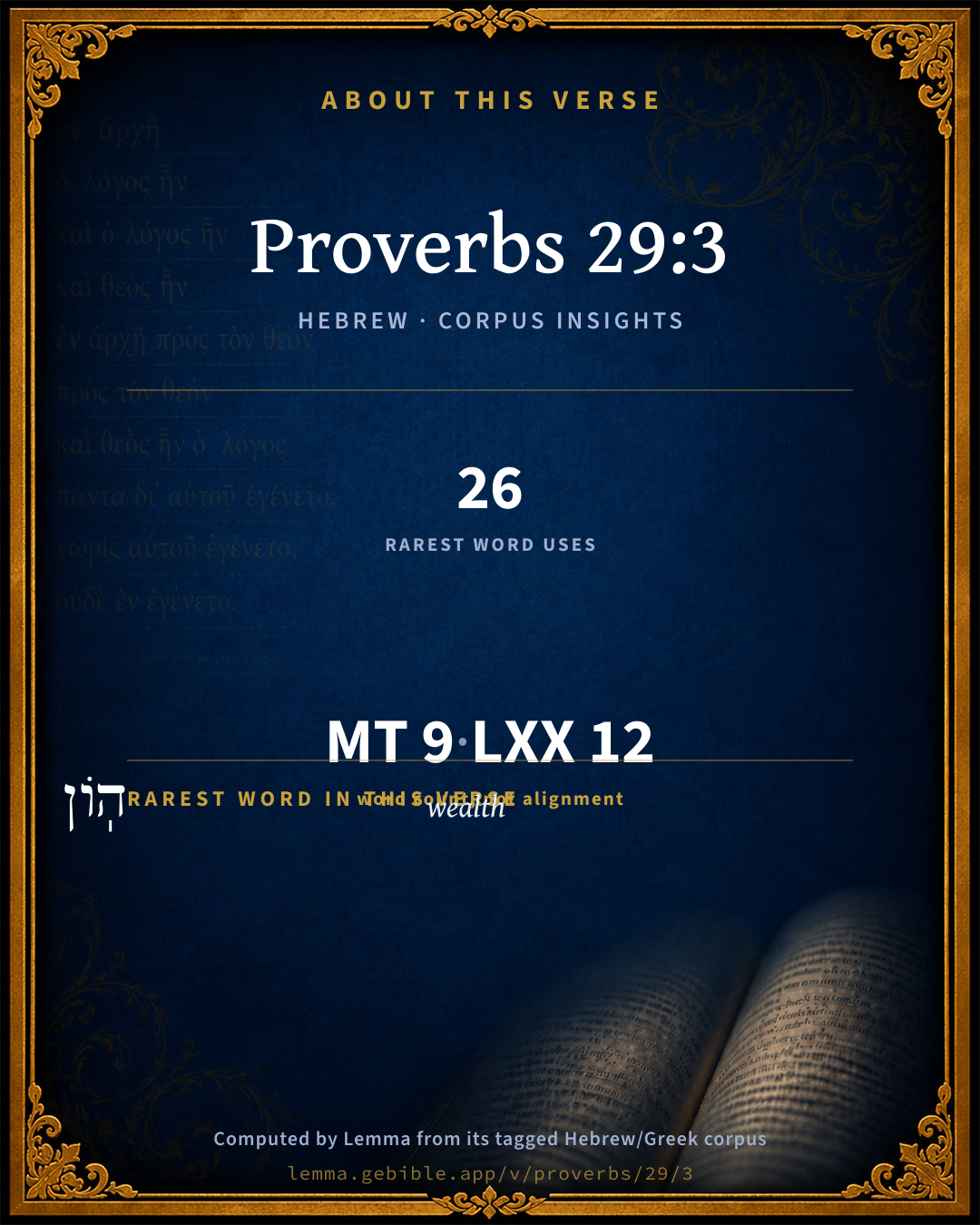
9
words
9
distinct lemmas
Wisdom
section

Shared distinctive vocabulary

הֽוֹן wealth H1952 occurs in 26 verses of the Hebrew Bible. Also found in:

Grammatical profile

  • 5 verbs
  • 4 nouns

Verb forms

  • אֹהֵ֣ב Qal · Participle Active
  • יְשַׂמַּ֣ח Piel · Imperfect
  • וְרֹעֶ֥ה Qal · Participle Active
  • ז֝וֹנ֗וֹת Qal · Participle Active
  • יְאַבֶּד Piel · Imperfect

Hebrew & Septuagint length

In English translation the verse runs 16 words from the Hebrew and 16 from the Septuagint (LXX English) — the same length.

A rough comparison of the two English renderings, which tokenize alike — not a word-level alignment.

Word counts can differ between the Hebrew and the Greek without any difference in meaning — e.g. the Hebrew direct-object marker אֵת has no separate Greek word, and Greek often adds the article ὁ.

In the original languages it is 9 Hebrew tokens and 12 Greek tokens — but the two are counted differently (Hebrew bundles its prefixes and suffixes into one token; the Greek is in lemma form), so that isn’t a like-for-like length.

Cross-references

14

Topical passages linked to Proverbs 29:3 in the Treasury of Scripture Knowledge — connected by theme and wording, ordered by reader-vote popularity; previews shown in the World English Bible.

  • Proverbs 27:11 Be wise, my son, And bring joy to my heart, Then I can answer my tormentor.
  • Proverbs 10:1 The proverbs of Solomon. A wise son makes a glad father; But a foolish son brings grief to his mother.
  • Proverbs 15:20 A wise son makes a father glad, But a foolish man despises his mother.
  • Luke 15:30 But when this, your son, came, who has devoured your living with prostitutes, you killed the fattened calf for him.'
  • Proverbs 6:26 For a prostitute reduces you to a piece of bread. The adulteress hunts for your precious life.
  • Proverbs 28:7 Whoever keeps the law is a wise son; But he who is a companion of gluttons shames his father.
  • Luke 15:13 Not many days after, the younger son gathered all of this together and traveled into a far country. There he wasted his property with riotous living.
  • Proverbs 5:8–10 Remove your way far from her. Don't come near the door of her house,
  • Proverbs 21:17 He who loves pleasure shall be a poor man: He who loves wine and oil shall not be rich.
  • Proverbs 21:20 There is precious treasure and oil in the dwelling of the wise; But a foolish man swallows it up.
  • Proverbs 23:15 My son, if your heart is wise, Then my heart will be glad, even mine:
  • Proverbs 23:24–25 The father of the righteous has great joy. Whoever fathers a wise child delights in him.
  • Proverbs 28:19 One who works his land will have an abundance of food; But one who chases fantasies will have his fill of poverty.
  • Luke 1:13–17 But the angel said to him, "Don't be afraid, Zacharias, because your request has been heard, and your wife, Elizabeth, will bear you a son, and you shall call his name John.

Cross-references courtesy of OpenBible.info (CC BY 4.0).

Hebrew and Greek witnesses Masoretic Hebrew ↔ Greek Septuagint

The same verse in the two great witnesses to the Old Testament, shown verse-for-verse.

These are two independent witnesses, not word-aligned to each other, and the Septuagint is shown in lemma (dictionary) form.

Hebrew Proverbs 29:3 Masoretic · Westminster Leningrad Codex

אִֽישׁ אֹהֵ֣ב חָ֭כְמָה יְשַׂמַּ֣ח אָבִ֑יו וְרֹעֶ֥ה ז֝וֹנ֗וֹת יְאַבֶּד הֽוֹן

Whoever loves wisdom brings joy to his father; But a companion of prostitutes squanders his wealth.

World English Bible · Public Domain

Greek LXX Proverbs 29:3 Septuagint · lemma form

ἀνήρ φιλέω σοφία εὐφραίνω πατήρ αὐτός ὅς δέ ποιμαίνω πόρνη ἀποὀλλύω πλοῦτος

When a man loves wisdom, his father rejoices: but he that keeps harlots will waste wealth.

LXX2012 (modern English Septuagint) · Public Domain

On this verse, The Cambridge Bible for Schools and Colleges discusses the Septuagint’s reading. Read the note in Commentary ↓

Hebrew: Westminster Leningrad Codex (CC BY 4.0). Greek: Septuagint (public domain); English from LXX2012 (modern English Septuagint) (Public Domain). How the Septuagint differs from the Hebrew →

Commentary

Notes on Proverbs 29:3 from classic Christian and Jewish commentators (each source and its license shown beneath its notes). The classic Christian expositions comment on the surrounding passage and are grouped to its opening verse, so a note may address several verses; the Jewish commentaries on the Tanakh (Rashi and others) are per-verse, so they appear only where the commentator wrote on this verse.

Lemma curates 59 commentaries, every one of them public domain or Creative Commons licensed, each selected and text-cleaned for this edition rather than reprinted as found. About our sources →

Trapp's Complete Commentary

John Trapp

Pro 29:3 Whoso loveth wisdom rejoiceth his father: but he that keepeth company with harlots spendeth [his] substance.

Ver. 3. Whoso loveth wisdom rejoiceth his father.] {See Trapp on "Pro 10:1"}

But he that keepeth company with harlots.] {See Trapp on "Pro 5:9"} Those she sinners, as they call them, are costly creatures, and they that keep them care not what cost they cast away upon them.

John Trapp, A Commentary or Exposition upon All the Books of the Old and New Testament (1647–1656) — public domain. Text from a community e-Sword module.

Tyndale Open Study Notes

Tyndale Open Resources

29:3 A man’s wisdom affects his parents (10:1; 15:20; 17:21). • Prostitutes cost money and a man’s wealth is rapidly wasted on them.

Tyndale Open Study Notes — © Tyndale Open Resources, licensed CC BY-SA 4.0. Text via the HelloAO Bible API.

Matthew Henry's Commentary

Both the parts of this verse repeat what has been often said, but, on comparing them together, the sense of them will be enlarged from each other. 1. Be it observed, to the honour of a virtuous young man, that he loves wisdom, he is a philosopher (for that signifies a lover of wisdom), for religion is the best philosophy; he avoids bad company, and especially the company of lewd women. Hereby he rejoices his parents, and has the satisfaction of being a comfort to them, and increases his estate, and is likely to live comfortably. 2. Be it observed, to the reproach of a vicious young man, that he hates wisdom; he keeps company with scandalous women, who will be his ruin, both in soul and body; he grieves his parents, and, like the prodigal son, devours their living with harlots. Nothing will beggar men sooner than the lusts of uncleanness; and the best preservative from those ruinous lusts is wisdom.

Matthew Henry's Commentary on the Whole Bible (1708–1710) — public domain (CC PDM 1.0). Text via the HelloAO Bible API.

Jamieson, Fausset & Brown

Robert Jamieson, A. R. Fausset & David Brown

(Compare Pro 4:6-7; Pro 10:1, &c.).

Jamieson, Fausset & Brown — Commentary Critical and Explanatory on the Whole Bible (1871) — public domain (CC PDM 1.0). Text via the HelloAO Bible API.

Adam Clarke's Commentary

Verse 3. But he that keepeth company] רעה roeh, he that feedeth harlots, יאבד yeabed, shall utterly destroy his substance. Has there ever been a single case to the contrary?

Adam Clarke's Commentary on the Bible (1810–1826) — public domain. Text from a community e-Sword/MySword module.

Ellicott's Commentary for English Readers

(3) Whoso loveth wisdom . . .—This verse is illustrated by the parable of the prodigal son (see Luke 15).

A Bible Commentary for English Readers, edited by Charles John Ellicott (1878–1897) — public domain. Text from a community e-Sword module.

The Cambridge Bible for Schools and Colleges

gen. ed. J. J. S. Perowne

3. wisdom] regarded, as the second clause of the verse shews, as leading to purity of life. Comp. Pro_2:10; Pro_2:16.

spendeth] Rather, wasteth, R.V. ἀπολεῖ, LXX. Comp. διεσκόρπισε τὴν οὐσίαν αὐτοῦ … ὁ καταφαγών σου τὸν βίον μετὰ τῶν πορνῶν, Luk_15:13; Luk_15:30.

The Cambridge Bible for Schools and Colleges (gen. ed. J. J. S. Perowne; Cambridge University Press, 1878–1918) — public domain. Text from a community e-Sword module.

John Gill's Exposition

Whoso loveth wisdom rejoiceth his father,.... He that is a philosopher, especially a religious one, that not only loves and seeks after natural wisdom, but moral wisdom and knowledge; and more particularly evangelical wisdom, Christ the Wisdom of God, who is to be valued and loved above all things; the Gospel of Christ, which is the wisdom of God in a mystery; and the knowledge of it which is the wisdom which comes from above and is pure and peaceable; and which lies much in the fear of God, and in the faith of Jesus Christ, attended with all the fruits of righteousness: such a son makes glad his father, both because of his temporal good, since he does not waste but improve the substance he has given him; and because of his spiritual and eternal welfare; and since instead of being a reproach he is an honour to him; see Pro 10:1;

but he that keepeth company with harlots spendeth his substance: his father has given him, and comes to want and beggary; all which is a grief to his parents: or, "that feeds harlots" (i); who live in a riotous and voluptuous manner, and soon drain a man of his substance, and bring him to a morsel of bread; see Luk 15:13; and such a son grieves his father, seeing he spends his substance and damns his soul.

(i) "nutrit", V. L. "pascit", Pagninus, Piscator, Gejerus, Schultens; "pascitur", Michaelis; "pascens", Montanus, Mercerus.

John Gill's Exposition of the Whole Bible (1746–1763) — public domain (CC PDM 1.0). Text via the HelloAO Bible API.

Albert Barnes' Notes on the Bible

Spendeth ... - The laws of parallelism would lead us to expect “troubleth his father,” but that is passed over as a thing about which the profligate would not care, and he is reminded of what comes home to him, that he is on the road to ruin.

The king - The ruler, as the supreme fountain of all justice, and as the ideal judge, is contrasted with the taker of bribers.

Albert Barnes' Notes on the Bible (1834–1885) — public domain. Text from a community e-Sword/MySword module.

Matthew Poole's English Annotations

Loveth wisdom; and therefore hateth and escheweth all folly and wickedness.

Keepeth company with harlots; whereby he plainly discovers himself to want wisdom; of which see Pro 7:7, &c.

Spendeth his substance; whereby he not only ruineth himself, but also grieveth his father, as is implied from the opposite clause.

Matthew Poole's English Annotations on the Holy Bible (1683–1685) — public domain. Text from a community e-Sword/MySword module.

Whedon's Commentary on the Bible

Daniel D. Whedon

3. Spendeth his substance — Squanders his wealth. There are but few ways in which riches are so soon and so surely dissipated as by association with lewd women. Comp. Pro_10:1; Pro_6:26; Pro_28:7.

Daniel D. Whedon (gen. ed.), Commentary on the Old and New Testaments (1874–1909) — public domain. Text from a community e-Sword module.

The Pulpit Commentary

The first hemistich is a variation of Pr 10. I (where see note). Keepeth company with; literally, feedeth, as Pro_28:7. Harlots. (see on Pro_6:26) Such vice leads to the wasting of substance, (Luk_15:13) and the great sorrow of the parent. Septuagint, "But he that pastureth (poimainei ) harlots shall waste wealth."

The Pulpit Commentary (1880–1919), ed. H.D.M. Spence-Jones & Joseph S. Exell — public domain. Text from a community e-Sword module.

Keil & Delitzsch

C. F. Keil & F. Delitzsch

This political proverb is now followed by one of general ethics:

3 A man who loveth wisdom delighteth his father;

And he who keepeth company with harlots spendeth his substance.

Line first is a variation of Pro 10:1. אישׁ־אהב has, according to rule, the Metheg, cf. 9a. אישׁ is man, without distinction of age, from childhood (Gen 4:1) up to ripe old age (Isa 66:13); love and dutiful relation towards father and mother never cease. Line second reminds of Pro 28:7 (cf. Pro 13:20).

Keil & Delitzsch — Biblical Commentary on the Old Testament (1861–1891) — public domain (CC PDM 1.0). Text via the HelloAO Bible API. (Old Testament only.)

Bridges on Proverbs

Charles Bridges

These Proverbs in substance have been given before.†1 Yet the variations are instructive. The wisdom is here more distinctly described as loving wisdom. For ’he is wise not only, who hath arrived at a complete habit of wisdom, but who doth as yet love it, or desire it, and listen to it.’†2 Do not we hang off too loosely from its heavenly influence? Let it be manifestly our great object, not as a good thing, but the best — "the principle thing."†3 The awakened sinner loves it from the sense of want; the Christian from its satisfying delight. The taste gives a keen edge to the appetite. What we have grasped of the blessing bears no comparison to what remains. The day-dreams of a world of vanity engage our affections no longer.

Let the young man consider "wisdom’s pleasantness and peace,"†4 her light and security,†5 her "durable riches,"†6 and glorious inheritance;†7 and "wilt thou not from this time cry" to the God of wisdom — "My Father! thou art the guide of my youth"? (Jer 3:4 .) Let him have the flower of thine age. Is not the best sacrifice due to him, who is above the songs of heaven, who has obtained a kingdom for those that love him? No worldly honor, no success of talent, will rejoice a godly father, as will this choice for eternity. (Pro 23:23-25 .)

Folly brings its own shame and sorrow. "The companion of the riotous and vain persons" is readily found in fellowship with harlots, saddening his father, by spending his substance. (Pro 28:7, Pro 28:19 .) One course of vanity leads to another. All end alike in ruin.†8 He may possess the external endowment. But the love of wisdom is the only preservative from "besetting snares."†9

Deep indeed is the anxiety — the joy or the sorrow — connected with children.†10 May it give a deeper tone of simplicity and pleading in dedicating them to God,†11 and training them up for his service! Let us early present them, as "the children, whom the Lord hath given us;" but as his, more than our own — his property — his inheritance. (Psa 127:3 .) Here are our springs of diligence, of hope, and of ultimate reward.

Footnotes:

†1 Pro 10:1; Pro 15:20 ; Pro 23:15, Pro 23:24-25 ; Pro 27:11 ; Pro 28:7 .

†2 Basil, quoted by Bp. Patrick. Preface to Proverbs.

†3 Pro 4:7. See the beautiful description, Sir 6:18-31 ; Sir 6:24 . Bp. Lowth’s elegant translation. - Lect. On Heb. Poetry, 24.

†4 Pro 3:17.

†5 Pro 8:20; Pro 4:11-12 .

†6 Pro 3:14-15; Pro 8:18-19 .

†7 Pro 3:35.

†8 Pro 5:9; Pro 6:26 . Luk 15:30 .

†9 Pro 4:6; Pro 7:4-5 .

†10 Pro 17:21, Pro 17:25 .

†11 1Sa 1:26-28 .

Charles Bridges, An Exposition of the Book of Proverbs (1846) — public domain. Text from a community e-Sword module.

unfoldingWord translationNotes

Door43 World Missions Community

by justice

The abstract noun "justice" can be translated as a noun phrase. AT: "by doing what is just" or "by making just laws" (See: Abstract Nouns)

translationWords

love

wise

joy

prostitute

king

just

bribe

unfoldingWord translationNotes — © Distant Shores Media and the Door43 World Missions Community, licensed CC BY-SA 4.0. Source: git.door43.org/Door43/en_tn.

Rashi

Rabbi Shlomo Yitzchaki (Rashi)

but one who keeps company with harlots Heb. ורעה. He joins harlots to himself, as its apparent meaning. Our Sages, however, said: “He who says, ‘This tradition is acceptable, I will learn it, but this one is not acceptable, I will not learn it.’” The support [for this view] from the verse is that זונות throughout the Scriptures is not spelled fully [with two “vavim”] except this once only.

Rashi on the Tanakh — English translations: “The Judaica Press complete Tanach with Rashi, translated by A. J. Rosenberg” (CC BY 4.0); “Pentateuch with Rashi's commentary by M. Rosenbaum and A.M. Silbermann, 1929-1934” (public domain); “The Metsudah Tanach series, Lakewood, N.J” (CC BY 4.0); and “The Book of Joshua, Metsudah Publications, 1997” (CC BY 4.0). Text via Sefaria.

Lesson kit

Teaching starters — assembled from the data on this page, not authored interpretation. Every prompt links to the verse data it draws on. Edit before teaching.

Proverbs, in the Wisdom, opens this verse with 9 words (9 distinct Hebrew lemmas). Its most distinctive word is hôwn (“wealth”). A historical commentator’s framing appears above. Read the whole chapter for the surrounding context.

Discussion questions

  1. What does “wealth” (hôwn) contribute to the verse as a whole?
  2. How does Psalms 44:12, which shares the word «wealth», read alongside this verse?
  3. The translations on this page render this verse differently — a whole-verse word diff, not a word-by-word alignment. What might account for the different wordings?
  4. «אֹהֵ֣ב» is a Qal Participle Active verb. How does that grammatical form shape the action described?
  5. Compare how Trapp's Complete Commentary and Tyndale Open Study Notes read this verse. Where do they agree or differ?

Things to notice

Reading settings

Reading text

Shown beneath each verse's original-language words.

Old Testament
Old Testament edition

Read the OT as the Masoretic Hebrew (MT) or the Greek Septuagint (LXX).

English shown for the Greek Septuagint (in the Hebrew ↔ Greek comparison).

Comparing translations? Open the Compare panel on any verse page to stack up to four side by side.