

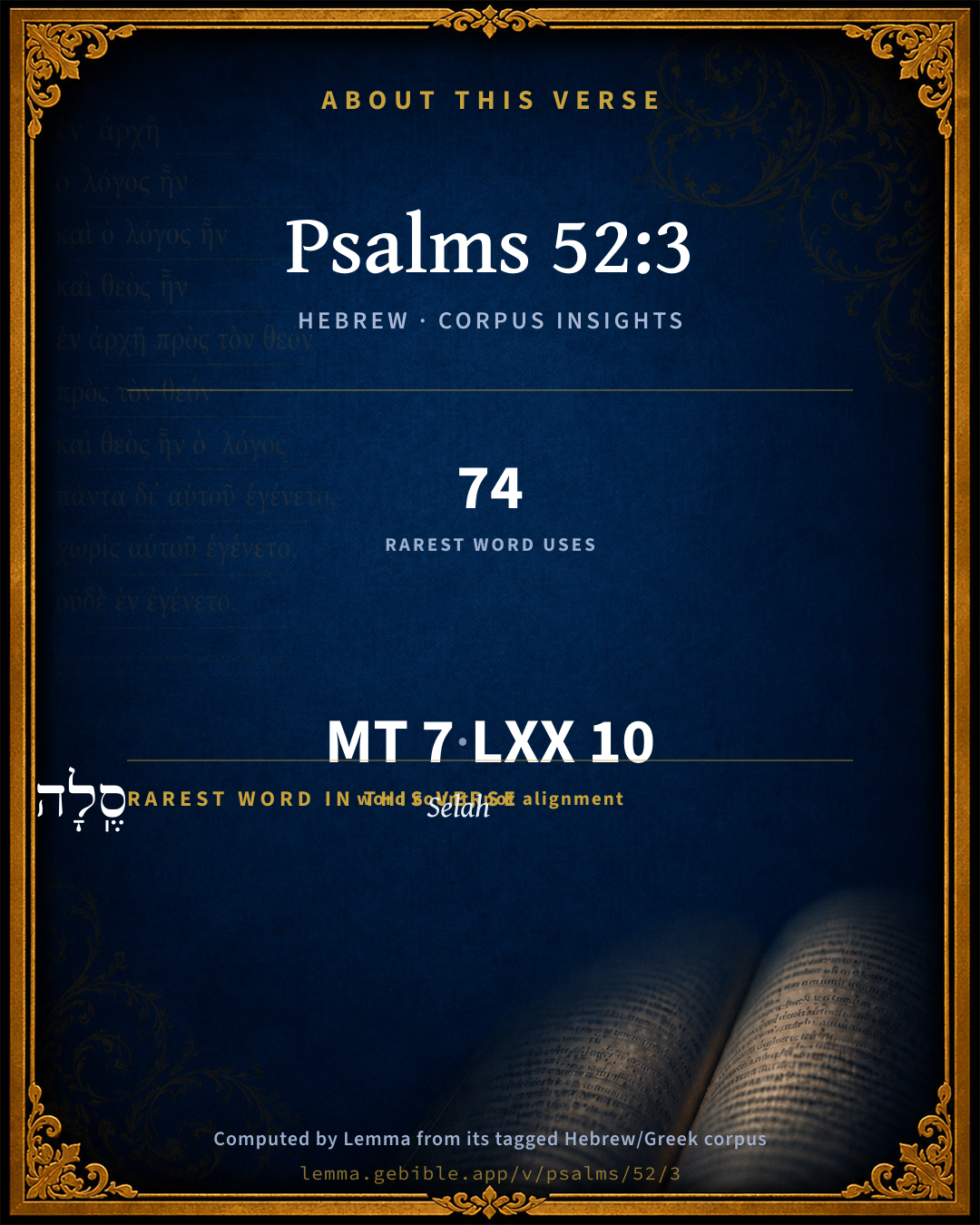
Psalms 52:3

Hebrew (Westminster Leningrad Codex) Psalms 52:3 appears in the Hebrew Old Testament. The text above is from the Westminster Leningrad Codex. Each word links to its Strong’s number, a concise gloss, and parsing drawn from the Open Scriptures Hebrew Bible morphology. Click any word for its full Brown-Driver-Briggs (BDB) entry.
Download image
Cite this verse

Psalms 52:3 (World English Bible). Public Domain. Lemma interlinear Bible study tool, https://lemma.gebible.app/v/psalms/52/3.

Show BibTeX & RIS
BibTeX
RIS
English Translation
You love evil more than good, Lying rather than speaking the truth. Selah.
World English Bible · Public Domain
Download a study sheet

One document with this verse’s original text, its word-by-word gloss line, the meaning frame, cross-references with their text, attributed commentary, and full source and license credits — printable, and it pastes into notes with its structure intact.

This verse Autodidact and up

Study sheet (.html) Plain text (.txt)

A passage Seminary Student

Up to 50 verses in one chapter. A passage sheet keeps up to 6 commentary sources and 12 cross-references per verse, in the order this page ranks them, and says so on the sheet whenever that leaves anything out. Ask for a single verse and you get the Autodidact verse sheet above.

Everything on this page stays free to read, with no account — the sheet is a download of what is already on screen, not access to it.

Want to remove ads? Support Godless Engineer
Compare translations 3

The same verse in 3 English versions, stacked beneath the original-language interlinear above. Click any original word for its lexicon entry.

Each is an independent rendering of the whole verse — the interlinear is not word-aligned to these translations.

Highlighted words mark where these versions differ — a whole-verse word diff, not a word-by-word alignment.

  • World English Bible Public Domain
    You love evil more than good, Lying rather than speaking the truth. Selah.
  • King James Version Public Domain
    Thou lovest evil more than good; and lying rather than to speak righteousness. Selah.
  • unfoldingWord Literal Text CC BY-SA 4.0
    You love evil more than good, lying more than speaking righteousness. Selah

unfoldingWord Literal Text — © unfoldingWord, licensed CC BY-SA 4.0. Word-aligned USFM3 via Door43 (git.door43.org/unfoldingWord/en_ult).

Versions to compare (up to 4)

3 of 4 selected

Show all 18 translations

Every available English version of this verse, each an independent rendering of the whole verse.

  • World English Bible Public Domain
    You love evil more than good, Lying rather than speaking the truth. Selah.
  • Berean Standard Bible Public Domain
    You love evil more than good, falsehood more than speaking truth. Selah
  • Majority Standard Bible Public Domain
    You love evil more than good, falsehood more than speaking truth. Selah
  • King James Version Public Domain
    Thou lovest evil more than good; and lying rather than to speak righteousness. Selah.
  • American Standard Version (1901) Public Domain
    Thou lovest evil more than good, And lying rather than to speak righteousness. Selah
  • Revised Version (1885) Public Domain
    Thou lovest evil more than good; and lying rather than to speak righteousness. Selah
  • Geneva Bible (1599) Public Domain
    Thou doest loue euill more then good, and lies more then to speake the trueth. Selah.
  • Douay-Rheims (1899) Public Domain
    Why dost thou glory in malice, thou that art mighty in iniquity?
  • Young's Literal Translation Public Domain
    Thou hast loved evil rather than good, Lying, than speaking righteousness. Selah.
  • Literal Standard Version CC BY-SA 4.0
    You have loved evil rather than good, || Lying, than speaking righteousness. Selah.
  • Unlocked Literal Bible CC BY-SA 4.0
    You love evil more than good and lying rather than speaking righteousness. Selah
  • unfoldingWord Literal Text CC BY-SA 4.0
    You love evil more than good, lying more than speaking righteousness. Selah
  • Darby Bible Public Domain
    Thou hast loved evil rather than good, lying rather than to speak righteousness. Selah.
  • World Messianic Bible Public Domain
    You love evil more than good, lying rather than speaking the truth. Selah.
  • Webster's Bible Public Domain
    \\52:1\\To the chief Musician, Maschil, A Psalm of David, when Doeg the Edomite came and told Saul, and said to him, David is come to the house of Ahimelech. Why boastest thou thyself in mischief, O mighty man? the goodness of God endureth continually.
  • Free Bible Version CC BY-SA 4.0
    You love evil more than good, and telling lies more than speaking the truth. Selah.
  • Bible in Basic English Public Domain
    You have more love for evil than for good, for deceit than for works of righteousness. (Selah.)
  • JPS Tanakh (1917) Public Domain
    (52-5) Thou lovest evil more than good; falsehood rather than speaking righteousness. Selah

Literal Standard Version (2020), Covenant Press — licensed CC BY-SA 4.0. Text via the HelloAO Bible API (eBible.org). Unlocked Literal Bible (unfoldingWord) — licensed CC BY-SA 4.0. Text via the HelloAO Bible API (eBible.org). unfoldingWord Literal Text — © unfoldingWord, licensed CC BY-SA 4.0. Word-aligned USFM3 via Door43 (git.door43.org/unfoldingWord/en_ult). Free Bible Version, Dr. Jonathan Gallagher — licensed CC BY-SA 4.0. Text via the HelloAO Bible API (eBible.org).

Word by word

More ways to search: Search by grammar → Find every occurrence → Compare this word →

Practice this passage: Drill this verse → Learn its vocabulary →

About this verse

These counts appear in no published source. They are computed here, from the morphology-tagged text and Lemma’s own curated glosses. What Lemma adds →

7
words
7
distinct lemmas
Wisdom
section

Grammatical profile

  • 2 verbs
  • 2 nouns
  • 2 adjectives
  • 1 particle

Verb forms

  • אָהַ֣בְתָּ Qal · Perfect
  • מִדַּבֵּ֖ר Piel · Infinitive Construct

Hebrew & Septuagint length

In English translation the verse runs 13 words from the Hebrew and 14 from the Septuagint (LXX English) — closely comparable.

A rough comparison of the two English renderings, which tokenize alike — not a word-level alignment.

Word counts can differ between the Hebrew and the Greek without any difference in meaning — e.g. the Hebrew direct-object marker אֵת has no separate Greek word, and Greek often adds the article ὁ.

In the original languages it is 7 Hebrew tokens and 10 Greek tokens — but the two are counted differently (Hebrew bundles its prefixes and suffixes into one token; the Greek is in lemma form), so that isn’t a like-for-like length.

Cross-references

9

Topical passages linked to Psalms 52:3 in the Treasury of Scripture Knowledge — connected by theme and wording, ordered by reader-vote popularity; previews shown in the World English Bible.

  • Jeremiah 9:3–5 They bend their tongue, [as it were] their bow, for falsehood; and they are grown strong in the land, but not for truth: for they proceed from evil to evil, and they don't know me, says Yahweh.
  • John 8:44 You are of your Father, the devil, and you want to do the desires of your father. He was a murderer from the beginning, and doesn't stand in the truth, because there is no truth in him. When he speaks a lie, he speaks on his own; for he is a liar, and the father of it.
  • 2 Timothy 3:4 traitors, headstrong, conceited, lovers of pleasure rather than lovers of God;
  • Micah 3:2 You who hate the good, And love the evil; Who tear off their skin, And their flesh from off their bones;
  • Revelation 22:15 Outside are the dogs, the sorcerers, the sexually immoral, the murderers, the idolaters, and everyone who loves and practices falsehood.
  • Jeremiah 4:22 For my people are foolish, they don't know me; they are foolish children, and they have no understanding; they are wise to do evil, but to do good they have no knowledge.
  • Jeremiah 9:8 Their tongue is a deadly arrow; it speaks deceit: one speaks peaceably to his neighbor with his mouth, but in his heart he lays wait for him.
  • Romans 1:25 who exchanged the truth of God for a lie, and worshiped and served the creature rather than the Creator, who is blessed forever. Amen.
  • Psalms 62:4 They fully intend to throw him down from his lofty place. They delight in lies. They bless with their mouth, but they curse inwardly. Selah.

Cross-references courtesy of OpenBible.info (CC BY 4.0).

Hebrew and Greek witnesses Masoretic Hebrew ↔ Greek Septuagint

The same verse in the two great witnesses to the Old Testament, shown verse-for-verse.

You’re reading Greek Psalm 51 (Hebrew Psalm 52). The Septuagint counts the superscription, so verse numbers can differ from the Hebrew — chapter-level alignment, not verse-by-verse. Numbering follows Rahlfs.

These are two independent witnesses, not word-aligned to each other, and the Septuagint is shown in lemma (dictionary) form.

Hebrew Psalms 52:3 Masoretic · Westminster Leningrad Codex

אָהַ֣בְתָּ רָּ֣ע מִטּ֑וֹב שֶׁ֓קֶר מִדַּבֵּ֖ר צֶ֣דֶק סֶֽלָה

You love evil more than good, Lying rather than speaking the truth. Selah.

World English Bible · Public Domain

Greek LXX Greek Psalm 51:3 Septuagint · lemma form

τίς ἐνκαυχάομαι ἐν κακία ὁ δυνατός ἀνομία ὅλος ὁ ἡμέρα

You have loved wickedness more than goodness; unrighteousness better than to speak righteousness. Pause.

LXX2012 (modern English Septuagint) · Public Domain

Hebrew: Westminster Leningrad Codex (CC BY 4.0). Greek: Septuagint (public domain); English from LXX2012 (modern English Septuagint) (Public Domain). How the Septuagint differs from the Hebrew →

Commentary

Notes on Psalms 52:3 from classic Christian and Jewish commentators (each source and its license shown beneath its notes). The classic Christian expositions comment on the surrounding passage and are grouped to its opening verse, so a note may address several verses; the Jewish commentaries on the Tanakh (Rashi and others) are per-verse, so they appear only where the commentator wrote on this verse.

Lemma curates 59 commentaries, every one of them public domain or Creative Commons licensed, each selected and text-cleaned for this edition rather than reprinted as found. About our sources →

Trapp's Complete Commentary

John Trapp

Psa 52:3 Thou lovest evil more than good; [and] lying rather than to speak righteousness. Selah.

Ver. 3. Thou lovest evil more than good] Indeed, evil only, and not at all good, whatever thou pretendest. Thy heart is naught, and thence it is that thy tongue is so mischievous, as stinking breath cometh from corrupt inwards.

And lying, rather than to speak righteousness] For thou hast cunningly insinuated, for thine own base ends and against thine own conscience, that those innocent and faithful priests were of the combination; and so hast built thyself upon their ruins, thou false sycophant, artifex doli. Selah.

John Trapp, A Commentary or Exposition upon All the Books of the Old and New Testament (1647–1656) — public domain. Text from a community e-Sword module.

J. A. Alexander on Psalms

Joseph Addison Alexander

5. (Psa 52:3). Thou hast loved evil (more) than good, falsehood (more) than speaking righteousness. The past tense, like the futures in the foregoing verses, includes the idea of the present; but unlike them, it represents the love of sin as already long-continued and habitual. Compare the form of expresion with that in Psa 45:8 (7). Righteousness includes truth or veracity, as the genus comprehends the species. The particular unrighteousness here meant is falsehood, as appears from the antithesis. The selah tacitly suggests the writer's abhorrence of that which he describes.

Joseph Addison Alexander, The Psalms Translated and Explained (1850) — public domain. Text from a community e-Sword module.

Tyndale Open Study Notes

Tyndale Open Resources

52:3 Deceptive speech changes one’s character.

Tyndale Open Study Notes — © Tyndale Open Resources, licensed CC BY-SA 4.0. Text via the HelloAO Bible API.

Geneva Bible (1599)

Geneva Bible translators

Hebrew, righteousness.

Geneva Bible (1599) marginal notes — public domain. Text via Bolls.life.

Adam Clarke's Commentary

Verse 3. Thou lovest evil] This was a finished character. Let us note the particulars:

1. He boasted in the power to do evil.

2. His tongue devised, studied, planned, and spoke mischiefs.

3. He was a deceitful worker.

4. He loved evil and not good.

5. He loved lying; his delight was in falsity.

6. Every word that tended to the destruction of others he loved.

7. His tongue was deceitful; he pretended friendship while his heart was full of enmity, Ps 52:1-4. Now behold the punishment: -

Adam Clarke's Commentary on the Bible (1810–1826) — public domain. Text from a community e-Sword/MySword module.

The Cambridge Bible for Schools and Colleges

gen. ed. J. J. S. Perowne

3. evil more than good] Evil rather than good, evil and not good. The meaning is not merely that he has a preference for evil, but that he chooses evil instead of good, like the nobles censured in Mic_3:2, “who hate the good and love the evil.”

righteousness] Not merely truth, but truth regarded as promoting and securing justice. The aim and result of his falsehoods was injustice.

The Cambridge Bible for Schools and Colleges (gen. ed. J. J. S. Perowne; Cambridge University Press, 1878–1918) — public domain. Text from a community e-Sword module.

John Gill's Exposition

Thou lovest evil more than good,.... Indeed not good at all; such comparatives being strong negatives; see Psa 118:8; a wicked man loves evil, and nothing else; his carnal mind being enmity to all that is good

and lying rather than to speak righteousness; as appears by his affirming that Ahimelech inquired of the Lord for David, when he did not, Sa1 22:10; and by suffering some things to pass for truths which were falsehoods, when it lay in his power to have disproved them: and such a lover of lies is antichrist; see Ti1 4:2.

Selah; on this word; see Gill on Psa 3:2. The Targum renders the word "Selah" here "for ever", as in Psa 52:5.

John Gill's Exposition of the Whole Bible (1746–1763) — public domain (CC PDM 1.0). Text via the HelloAO Bible API.

Albert Barnes' Notes on the Bible

Thou lovest evil more than good - Thou dost prefer to do injury to others, rather than to do them good. In the case referred to, instead of aiding the innocent, the persecuted, and the wronged, he had attempted to reveal the place where he might be found, and where an enraged enemy might have an opportunity of wreaking his vengeance upon him.

And lying rather than to speak righteousness - He preferred a lie to the truth; and, when he supposed that his own interest would be subserved by it, he preferred a falsehood that would promote that interest, rather than a simple statement of the truth. The “lying” in this case was that which was “implied” in his being desirous of giving up David, or betraying him to Saul - as if David was a bad man, and as if the suspicions of Saul were wellfounded. He preferred to give his countenance to a falsehood in regard to him, rather than to state the exact truth in reference to his character. His conduct in this was strongly in contrast with that of Ahimelech, who, when arraigned before Saul, declared his belief that David was innocent; his firm conviction that David was true and loyal. “For” that fidelity he lost his life, 1Sa 22:14. Doeg was willing to lend countenance to the suspicions of Saul, and practically to represent David as a traitor to the king. The word “Selah” here is doubtless a mere musical pause. See the notes at Psa 3:2. It determines nothing in regard to the sense of the passage.

Albert Barnes' Notes on the Bible (1834–1885) — public domain. Text from a community e-Sword/MySword module.

Matthew Poole's English Annotations

Evil and

good may be here taken, either,

1. Morally; Thou lovest wickedness and not goodness; for so comparative passages are oft meant, as Psa 118:8, It is better to trust in the Lord than to put confidence in man, i.e. It is good to trust God, but it is not good to trust man; for this is absolutely forbidden, Psa 146:3; Jer 17:5. Or,

2. Physically. Thou lovest to speak or act to the hurt and ruin of others, rather than to their benefit. Thou mightest, without any danger to thyself, have been silent concerning Ahimelech’s fact, or have put a favourable construction upon it; but thou hast chosen rather to misrepresent and aggravate it. He saith,

thou lovest, to imply that he did this not by any constraint or necessity, but by choice, and with complacency, and out of a love to mischief.

Lying, whereof Doeg was guilty, partly in reporting that he (i.e. Ahimelech) inquired of the Lord for him, (David,) 1Sa 22:10, which he did not, 1Sa 21, where all that history is recorded; and partly in putting a false interpretation upon what he did, in giving him victuals and a sword, as if he had done it knowingly, and in conspiracy with David, and against Saul, as appears by comparing Doeg’s answer with Saul’s inquiry, 1Sa 22:7,8.

Righteousness, i.e. the whole and naked truth, without any such lying or malicious comment upon it, which was but an act of justice due from thee to any man, and much more on the behalf of so innocent and sacred a person.

Matthew Poole's English Annotations on the Holy Bible (1683–1685) — public domain. Text from a community e-Sword/MySword module.

The Treasury of David

Charles H. Spurgeon

Ver. 3. Thou lovest evil more than good. He loved not good at all. If both had been equally profitable and pleasant, he would have preferred evil. And lying rather than to speak righteousness. He was more at home at lying than at truth. He spake not the truth except by accident, but he delighted heartily in falsehood. SELAH. Let us pause and look at the proud blustering liar. Doeg is gone, but other dogs bark at the Lord's people. Saul's cattle master is buried, but the devil still has his drovers, who fain would hurry the saints like sheep to the slaughter.

Ver. 3. Thou lovest evil more than good. --Thou hast loved evil, he says, more than good, not by simply preferring it, but by substituting it; so that in the stead of good he hath done evil, and that from the inmost love of his soul, bent upon evil; wherefore he does not say that he admitted, but loved evil, not moral only, but physical, for the destruction of his neighbours; so to have loved it, that he willed nothing but evil, being averse to all good. Hermann Venema.

Ver. 3. In what cases men clearly love evil more than good.

Psalms 52:4*

Charles H. Spurgeon's The Treasury of David (1869–1885) — public domain. Psalms only. Text from a community e-Sword/MySword module.

Whedon's Commentary on the Bible

Daniel D. Whedon

3. Evil more than good—The sense is, evil and not good, falsehood and not speaking “righteousness.” The good and the true were not loved at all.

Daniel D. Whedon (gen. ed.), Commentary on the Old and New Testaments (1874–1909) — public domain. Text from a community e-Sword module.

The Pulpit Commentary

Thou lovest evil more than good. To "love evil" is to have reached the lowest depth of depravity. It is to say, with Milton"s Satan, "Evil, be thou my good!" And lying rather than to speak righteousness (see the comment on ver. 2). Doeg"s crimes seem to have arisen out of a mere love of evil.

The Pulpit Commentary (1880–1919), ed. H.D.M. Spence-Jones & Joseph S. Exell — public domain. Text from a community e-Sword module.

unfoldingWord translationNotes

Door43 World Missions Community

Connecting Statement:

David continues speaking to the "mighty man" of Psalms 5:1

lying rather than speaking righteousness

"you love lying more than speaking what is right"

translationWords

love

righteous

selah

unfoldingWord translationNotes — © Distant Shores Media and the Door43 World Missions Community, licensed CC BY-SA 4.0. Source: git.door43.org/Door43/en_tn.

Rashi

Rabbi Shlomo Yitzchaki (Rashi)

Why do you boast of evil, you mighty man? Why do you boast and brag of the evil that you do, you who are mighty in Torah?

God’s kindness is constant to rescue the one whom you pursue. Another explanation: God’s kindness is constant. Had Ahimelech not given me bread, do you think that I would have died of hunger? God always shows kindness toward Israel, and if he had not given me [to eat], others would have given me.

Rashi on the Tanakh — English translations: “The Judaica Press complete Tanach with Rashi, translated by A. J. Rosenberg” (CC BY 4.0); “Pentateuch with Rashi's commentary by M. Rosenbaum and A.M. Silbermann, 1929-1934” (public domain); “The Metsudah Tanach series, Lakewood, N.J” (CC BY 4.0); and “The Book of Joshua, Metsudah Publications, 1997” (CC BY 4.0). Text via Sefaria.

Lesson kit

Teaching starters — assembled from the data on this page, not authored interpretation. Every prompt links to the verse data it draws on. Edit before teaching.

Psalms, in the Wisdom, opens this verse with 7 words (7 distinct Hebrew lemmas). Its most distinctive word is çelâh (“Selah”). A historical commentator’s framing appears above. Read the whole chapter for the surrounding context.

Discussion questions

  1. How does “Selah” (çelâh) shape what this verse is saying?
  2. Jeremiah 9:3–5 shares this passage’s theme. How do the two illuminate each other?
  3. These translations render this verse differently. What is at stake in choosing one wording over another?
  4. The verb «אָהַ֣בְתָּ» is Qal Perfect. How does its form color the action?
  5. Reading how Trapp's Complete Commentary and J. A. Alexander on Psalms read this verse, where do the two commentators agree and where do they part?

Things to notice

Reading settings

Reading text

Shown beneath each verse's original-language words.

Old Testament
Old Testament edition

Read the OT as the Masoretic Hebrew (MT) or the Greek Septuagint (LXX).

English shown for the Greek Septuagint (in the Hebrew ↔ Greek comparison).

Comparing translations? Open the Compare panel on any verse page to stack up to four side by side.