
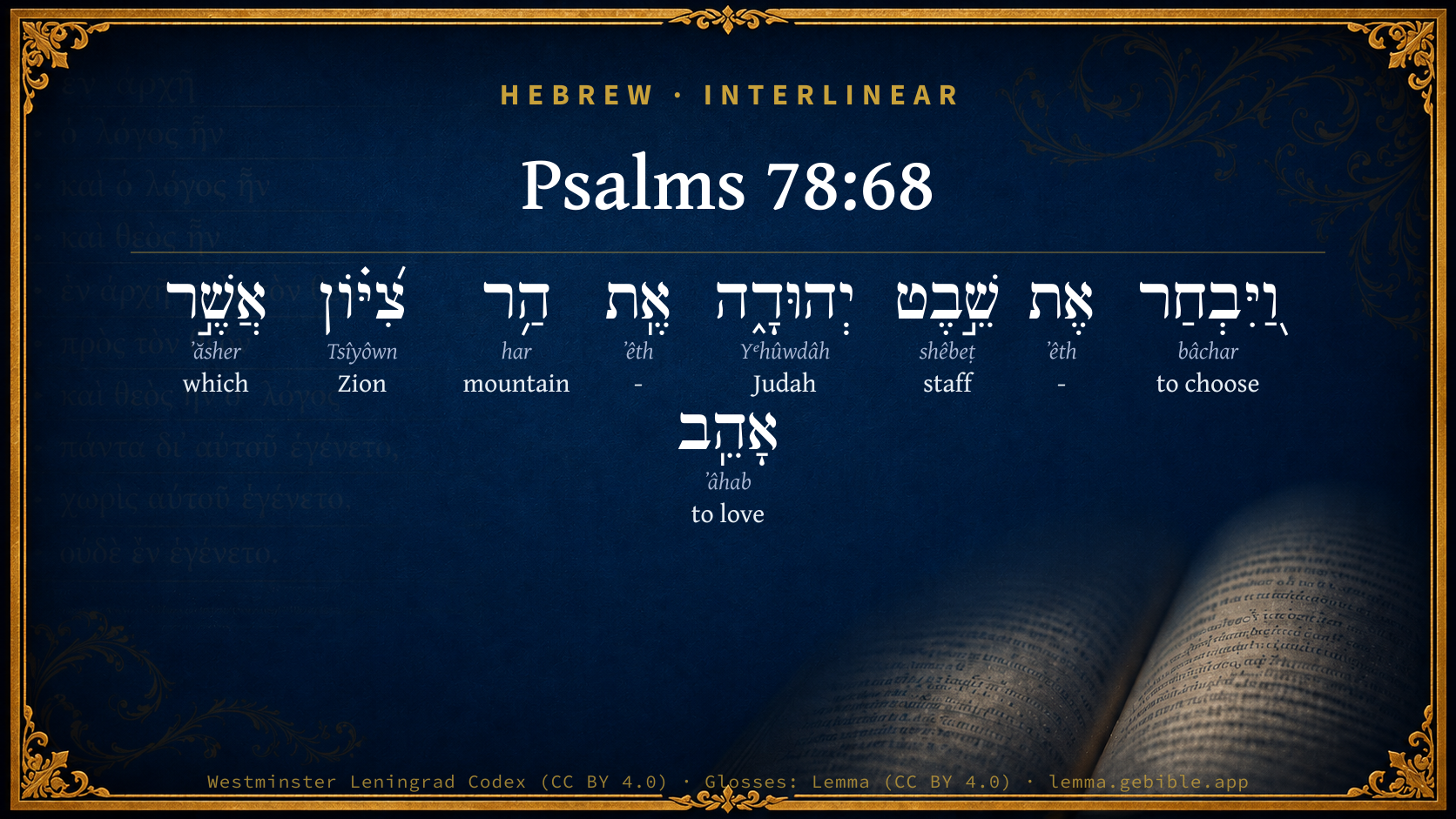
Psalms 78:68

Hebrew (Westminster Leningrad Codex) Psalms 78:68 appears in the Hebrew Old Testament. The text above is from the Westminster Leningrad Codex. Each word links to its Strong’s number, a concise gloss, and parsing drawn from the Open Scriptures Hebrew Bible morphology. Click any word for its full Brown-Driver-Briggs (BDB) entry.
Download image
Cite this verse

Psalms 78:68 (World English Bible). Public Domain. Lemma interlinear Bible study tool, https://lemma.gebible.app/v/psalms/78/68.

Show BibTeX & RIS
BibTeX
RIS
English Translation
But chose the tribe of Judah, Mount Zion which he loved.
World English Bible · Public Domain
Download a study sheet

One document with this verse’s original text, its word-by-word gloss line, the meaning frame, cross-references with their text, attributed commentary, and full source and license credits — printable, and it pastes into notes with its structure intact.

This verse Autodidact and up

Study sheet (.html) Plain text (.txt)

A passage Seminary Student

Up to 50 verses in one chapter. A passage sheet keeps up to 6 commentary sources and 12 cross-references per verse, in the order this page ranks them, and says so on the sheet whenever that leaves anything out. Ask for a single verse and you get the Autodidact verse sheet above.

Everything on this page stays free to read, with no account — the sheet is a download of what is already on screen, not access to it.

Want to remove ads? Support Godless Engineer
Compare translations 3

The same verse in 3 English versions, stacked beneath the original-language interlinear above. Click any original word for its lexicon entry.

Each is an independent rendering of the whole verse — the interlinear is not word-aligned to these translations.

Highlighted words mark where these versions differ — a whole-verse word diff, not a word-by-word alignment.

  • World English Bible Public Domain
    But chose the tribe of Judah, Mount Zion which he loved.
  • King James Version Public Domain
    But chose the tribe of Judah, the mount Zion which he loved.
  • unfoldingWord Literal Text CC BY-SA 4.0
    But he chose the tribe of Judah, Mount Zion, which he loved.

unfoldingWord Literal Text — © unfoldingWord, licensed CC BY-SA 4.0. Word-aligned USFM3 via Door43 (git.door43.org/unfoldingWord/en_ult).

Versions to compare (up to 4)

3 of 4 selected

Show all 18 translations

Every available English version of this verse, each an independent rendering of the whole verse.

  • World English Bible Public Domain
    But chose the tribe of Judah, Mount Zion which he loved.
  • Berean Standard Bible Public Domain
    But He chose the tribe of Judah, Mount Zion, which He loved.
  • Majority Standard Bible Public Domain
    But He chose the tribe of Judah, Mount Zion, which He loved.
  • King James Version Public Domain
    But chose the tribe of Judah, the mount Zion which he loved.
  • American Standard Version (1901) Public Domain
    But chose the tribe of Judah, The mount Zion which he loved.
  • Revised Version (1885) Public Domain
    But chose the tribe of Judah, the mount Zion which he loved.
  • Geneva Bible (1599) Public Domain
    But chose the tribe of Iudah, and mount Zion which he loued.
  • Douay-Rheims (1899) Public Domain
    But he chose the tribe of Juda, mount Sion which he loved.
  • Young's Literal Translation Public Domain
    And He chooseth the tribe of Judah, With mount Zion that He loved,
  • Literal Standard Version CC BY-SA 4.0
    And He chooses the tribe of Judah, || With Mount Zion that He loved,
  • Unlocked Literal Bible CC BY-SA 4.0
    He chose the tribe of Judah and Mount Zion that he loved.
  • unfoldingWord Literal Text CC BY-SA 4.0
    But he chose the tribe of Judah, Mount Zion, which he loved.
  • Darby Bible Public Domain
    But chose the tribe of Judah, the mount Zion which he loved;
  • World Messianic Bible Public Domain
    But chose the tribe of Judah, Mount Zion which he loved.
  • Webster's Bible Public Domain
    But chose the tribe of Judah, the mount Zion which he loved.
  • Free Bible Version CC BY-SA 4.0
    Instead he chose the tribe of Judah, and Mount Zion which he loves.
  • Bible in Basic English Public Domain
    But he took the tribe of Judah for himself, and the mountain of Zion, in which he had pleasure.
  • JPS Tanakh (1917) Public Domain
    But chose the tribe of Judah, the mount Zion which He loved.

Literal Standard Version (2020), Covenant Press — licensed CC BY-SA 4.0. Text via the HelloAO Bible API (eBible.org). Unlocked Literal Bible (unfoldingWord) — licensed CC BY-SA 4.0. Text via the HelloAO Bible API (eBible.org). unfoldingWord Literal Text — © unfoldingWord, licensed CC BY-SA 4.0. Word-aligned USFM3 via Door43 (git.door43.org/unfoldingWord/en_ult). Free Bible Version, Dr. Jonathan Gallagher — licensed CC BY-SA 4.0. Text via the HelloAO Bible API (eBible.org).

Word by word

More ways to search: Search by grammar → Find every occurrence → Compare this word →

Practice this passage: Drill this verse → Learn its vocabulary →

About this verse

These counts appear in no published source. They are computed here, from the morphology-tagged text and Lemma’s own curated glosses. What Lemma adds →

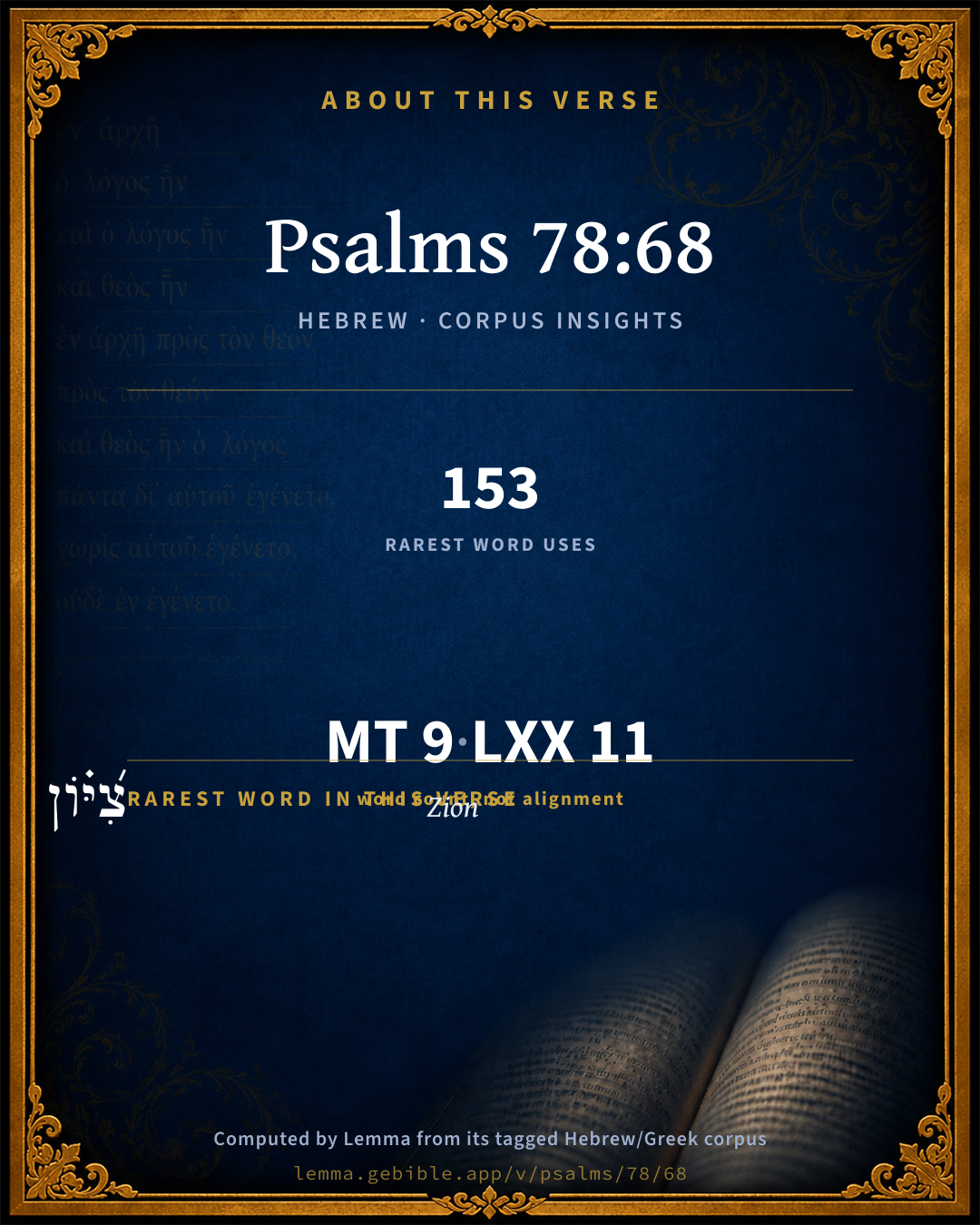
9
words
8
distinct lemmas
Wisdom
section

Grammatical profile

  • 2 verbs
  • 4 nouns
  • 3 particles

Verb forms

  • וַ֭יִּבְחַר Qal · Sequential Imperfect
  • אָהֵֽב Qal · Perfect

Hebrew & Septuagint length

In English translation the verse runs 11 words from the Hebrew and 12 from the Septuagint (LXX English) — closely comparable.

A rough comparison of the two English renderings, which tokenize alike — not a word-level alignment.

Word counts can differ between the Hebrew and the Greek without any difference in meaning — e.g. the Hebrew direct-object marker אֵת has no separate Greek word, and Greek often adds the article ὁ.

In the original languages it is 9 Hebrew tokens and 11 Greek tokens — but the two are counted differently (Hebrew bundles its prefixes and suffixes into one token; the Greek is in lemma form), so that isn’t a like-for-like length.

Cross-references

6

Topical passages linked to Psalms 78:68 in the Treasury of Scripture Knowledge — connected by theme and wording, ordered by reader-vote popularity; previews shown in the World English Bible.

  • Psalms 87:2 Yahweh loves the gates of Zion more than all the dwellings of Jacob.
  • Psalms 132:12–14 If your children will keep my covenant, My testimony that I will teach them, Their children also will sit on your throne forevermore."
  • Genesis 49:8–10 "Judah, your brothers will praise you: Your hand will be on the neck of your enemies; Your father's sons will bow down before you.
  • Ruth 4:17–22 The women her neighbors gave it a name, saying, There is a son born to Naomi; and they named him Obed: he is the father of Jesse, the father of David.
  • 1 Samuel 16:1 Yahweh said to Samuel, How long will you mourn for Saul, seeing I have rejected him from being king over Israel? fill your horn with oil, and go: I will send you to Jesse the Bethlehemite; for I have provided me a king among his sons.
  • 2 Chronicles 6:6 but I have chosen Jerusalem, that my name might be there; and have chosen David to be over my people Israel.

Cross-references courtesy of OpenBible.info (CC BY 4.0).

Hebrew and Greek witnesses Masoretic Hebrew ↔ Greek Septuagint

The same verse in the two great witnesses to the Old Testament, shown verse-for-verse.

You’re reading Greek Psalm 77 (Hebrew Psalm 78). The Septuagint counts the superscription, so verse numbers can differ from the Hebrew — chapter-level alignment, not verse-by-verse. Numbering follows Rahlfs.

These are two independent witnesses, not word-aligned to each other, and the Septuagint is shown in lemma (dictionary) form.

Hebrew Psalms 78:68 Masoretic · Westminster Leningrad Codex

וַ֭יִּבְחַר אֶת שֵׁ֣בֶט יְהוּדָ֑ה אֶֽת הַ֥ר צִ֝יּ֗וֹן אֲשֶׁ֣ר אָהֵֽב

But chose the tribe of Judah, Mount Zion which he loved.

World English Bible · Public Domain

Greek LXX Greek Psalm 77:68 Septuagint · lemma form

καί ἐκλέγω ὁ φυλή ἰουδά ὁ ὄρος ὁ σιων ὅς ἀγαπάω

but chose the tribe of Juda, the mount Sion which he loved.

LXX2012 (modern English Septuagint) · Public Domain

On this verse, John Gill's Exposition discusses the Septuagint’s reading. Read the note in Commentary ↓

Hebrew: Westminster Leningrad Codex (CC BY 4.0). Greek: Septuagint (public domain); English from LXX2012 (modern English Septuagint) (Public Domain). How the Septuagint differs from the Hebrew →

Commentary

Notes on Psalms 78:68 from classic Christian and Jewish commentators (each source and its license shown beneath its notes). The classic Christian expositions comment on the surrounding passage and are grouped to its opening verse, so a note may address several verses; the Jewish commentaries on the Tanakh (Rashi and others) are per-verse, so they appear only where the commentator wrote on this verse.

Lemma curates 59 commentaries, every one of them public domain or Creative Commons licensed, each selected and text-cleaned for this edition rather than reprinted as found. About our sources →

Trapp's Complete Commentary

John Trapp

Psa 78:68 But chose the tribe of Judah, the mount Zion which he loved.

Ver. 68. But chose the tribe of Judah] He chose it for his love, and then loved it for his choice. The word tribe we borrow from the Romans, who at first divided the multitudes into three parts, called thereof tribes. The Hebrew name signifieth a rod or sceptre, and fitly agreeth to Judah.

John Trapp, A Commentary or Exposition upon All the Books of the Old and New Testament (1647–1656) — public domain. Text from a community e-Sword module.

J. A. Alexander on Psalms

Joseph Addison Alexander

68. (Psa 78:68) And chose the tribe of Judah, the Mount Zion which he loved. He now assigned the visible pre-eminence to Judah, who had long enjoyed it in the divine purpose (Gen 49:10). Zion is mentioned as the capital of Judah, the place of the sanctuary, and the seat of the theocratic monarchy. The name, as usual in this book, does not signify the single eminence so called, but the entire height on which Jerusalem was built.

Joseph Addison Alexander, The Psalms Translated and Explained (1850) — public domain. Text from a community e-Sword module.

Tyndale Open Study Notes

Tyndale Open Resources

78:68-69 In the choice of Mount Zion instead of Shiloh as God’s sanctuary on earth, God moved from the north to the south (see Ps 69).

Tyndale Open Study Notes — © Tyndale Open Resources, licensed CC BY-SA 4.0. Text via the HelloAO Bible API.

John Calvin's Commentaries

68. But he chose the tribe of Judah. The meaning is, that God preferred the tribe of Judah to all the rest of the people, and chose from it a king, whom he might set over all the Israelites as well as the Jews. And he chose the mountain of Zion, appointing a certain spot upon it to be the seat of his sanctuary. That the cause of this choice might not be sought any where else but in God, it is particularly stated that the preferring of mount Zion to all other places, and the enriching of it in such a distinguished manner, proceeded entirely from the free and unmerited love of God. The relative which is here put instead of the causal adverb for; the meaning being, that the sanctuary of God was established there, not for any worthiness of the place, but solely because it was the good pleasure of God. It was proper that this second restitution of the people should be no less free than their first adoption was, when God made his covenant with Abraham, or when he delivered them from the land of Egypt. God’s love to the place had a respect to men. From this it follows, that the Church has been gathered together from the beginning, and in all ages, by the pure grace and goodness of God; for never have men been found to possess any intrinsic meritorious claims to his regard, and the Church is too precious to be left to depend upon the power of men.

John Calvin's Commentaries (1540-1563) — public domain. Text from the Calvin Translation Society English edition (1840s-50s) via the Christian Classics Ethereal Library (ccel.org). Calvin's coverage is partial (roughly two-thirds of the Bible); uncommented books and verses are honest gaps, never fabricated. The 19th-century editor's footnotes and remarks are omitted so the notes are faithfully Calvin's own voice.

The Cambridge Bible for Schools and Colleges

gen. ed. J. J. S. Perowne

68. which he loved] Cp. Psa_87:2; Psa_47:4.

The Cambridge Bible for Schools and Colleges (gen. ed. J. J. S. Perowne; Cambridge University Press, 1878–1918) — public domain. Text from a community e-Sword module.

John Gill's Exposition

And he built his sanctuary like high palaces,.... The temple at Jerusalem, called a sanctuary, or holy place, because separated and dedicated to holy use and service; where the holy God had his residence, and was worshipped, and was a figure of the holy place not made with hands: this is said to be built by the Lord, because the materials provided for it, and which David and his people so willingly offered, were his own; "of his own" they gave him; as well as the pattern after which it was made was had from the Spirit of God; and it was the Lord that put it into the heart of David to set such a work afoot, and encouraged Solomon to begin and finish it, and gave wisdom, health, and strength, to the workmen to accomplish it; and in reference to this are the words in Psa 127:1, "except the Lord build the house", &c. and this he built not like the "high places", where idolatry was committed; the temple was not built in imitation of them; but like what high and eminent men, like such buildings as: they erect; like stately palaces, so Aben Ezra and Kimchi, built for kings and great personages; and such a building was the temple, the most magnificent in all the world, as built by Solomon, and even as rebuilt by Zerubbabel, and repaired by Herod; see Mar 13:1 or it was built "on high", as the Syriac version, on a high hill, Mount Moriah: the Targum is,

"as the horn of the unicorn;''

and so the Septuagint, Vulgate Latin, and Arabic versions. Jarchi interprets it as the high heavens, of which it was a figure; it was like them for magnificence and glory, and like the earth for stability, as follows:

like the earth, which he hath established for ever; as to the substance of it; though as to the qualities of it, it will be done away, and a new one arise; otherwise it will abide for ever, Ecc 1:4, this respects the continuance of the temple during the Jewish dispensation, when the Gospel temple, or Gospel church, should take place, which will continue to the end of the world: this is opposed to the frequent moves of the tabernacle and ark before the temple was built, when there was no abiding habitation provided for it.

John Gill's Exposition of the Whole Bible (1746–1763) — public domain (CC PDM 1.0). Text via the HelloAO Bible API.

Albert Barnes' Notes on the Bible

But chose the tribe of Judah - He chose David of the tribe of Judah as ruler and king; he chose a place within the limits of Judah, to wit, Mount Zion, or Jerusalem, as the place where his worship was to be celebrated. Thus, the ancient prediction in regard to the supremacy of Judah was accomplished. Gen 49:8-10.

The Mount Zion, which he loved - Which he chose, for which he had an affection. Compare Psa 87:2.

Albert Barnes' Notes on the Bible (1834–1885) — public domain. Text from a community e-Sword/MySword module.

Matthew Poole's English Annotations

Chose the tribe of Judah; either,

1. For the seat of the kingdom. Or rather,

2. For the seat of the ark and of God’s worship.

Object. Jerusalem was in the tribe of Benjamin, Jos 18:28.

Answ. 1. It was so in part, and part of it was in Judah, as appears from Jos 15:63; to which tribe Zion belonged by special reason, because David the head of that tribe conquered and took it.

2. Benjamin, after the division of the two kingdoms, was incorporated with Judah, and is oft comprehended under the name of Judah.

Matthew Poole's English Annotations on the Holy Bible (1683–1685) — public domain. Text from a community e-Sword/MySword module.

The Treasury of David

Charles H. Spurgeon

Ver. 68. But chose the tribe of Judah. To give the nation another trial this tribe was elected to supremacy. This was according to Jacob's dying prophecy. Our Lord sprang out of Judah, and he it is whom his brethren shall praise.

The Mount Zion which he loved. The tabernacle and ark were removed to Zion during the reign of David; no honour was left to the wayward Ephraimites. Hard by this mountain the Father of the Faithful had offered up his only son, and there in future days the great gatherings of his chosen seed would be, and therefore Zion is said to be lovely unto God.

Charles H. Spurgeon's The Treasury of David (1869–1885) — public domain. Psalms only. Text from a community e-Sword/MySword module.

Whedon's Commentary on the Bible

Daniel D. Whedon

68. But chose the tribe of Judah—This is the point to which the whole psalm has reference, and the ultimate object of the author. God, who had sovereignly led Israel out of Egypt, through the desert, into the Land of Promise, had himself transferred the ark and tabernacle to Zion, and placed the national worship under the protectorate of the tribe of Judah and the house of David.

Daniel D. Whedon (gen. ed.), Commentary on the Old and New Testaments (1874–1909) — public domain. Text from a community e-Sword module.

The Pulpit Commentary

But chose the tribe of Judah. The choice was made when David was, by God"s command, anointed to be king. (1Sa_16:1-12) The Mount Zion which he loved. (comp. Psa_87:2, "The Lord loveth the gates of Zion more than all the dwellings of Jacob God, no doubt, inspired David with the thought of fixing his residence in "the stronghold of Zion", (2Sa_5:9) and of bringing up the ark of the covenant into it. (2Sa_6:12-17) The presence of the ark determined the selection of Jerusalem for the site of the temple.

The Pulpit Commentary (1880–1919), ed. H.D.M. Spence-Jones & Joseph S. Exell — public domain. Text from a community e-Sword module.

John Wesley's Explanatory Notes

Chose - For the seat of the ark and of God's worship.

John Wesley, Explanatory Notes Upon the Whole Bible (1754–1765) — public domain. Text via the GEBible commentary corpus.

Lesson kit

Teaching starters — assembled from the data on this page, not authored interpretation. Every prompt links to the verse data it draws on. Edit before teaching.

Psalms, in the Wisdom, opens this verse with 9 words (8 distinct Hebrew lemmas). Its most distinctive word is Tsîyôwn (“Zion”). A historical commentator’s framing appears above. Read the whole chapter for the surrounding context.

Discussion questions

  1. What does “Zion” (Tsîyôwn) contribute to the verse as a whole?
  2. How does Psalms 87:2, which shares this passage’s theme, read alongside this verse?
  3. «וַ֭יִּבְחַר» is a Qal Sequential Imperfect verb. How does that grammatical form shape the action described?
  4. Compare how Trapp's Complete Commentary and J. A. Alexander on Psalms read this verse. Where do they agree or differ?

Things to notice

Reading settings

Reading text

Shown beneath each verse's original-language words.

Old Testament
Old Testament edition

Read the OT as the Masoretic Hebrew (MT) or the Greek Septuagint (LXX).

English shown for the Greek Septuagint (in the Hebrew ↔ Greek comparison).

Comparing translations? Open the Compare panel on any verse page to stack up to four side by side.