Deuteronomy 10:15

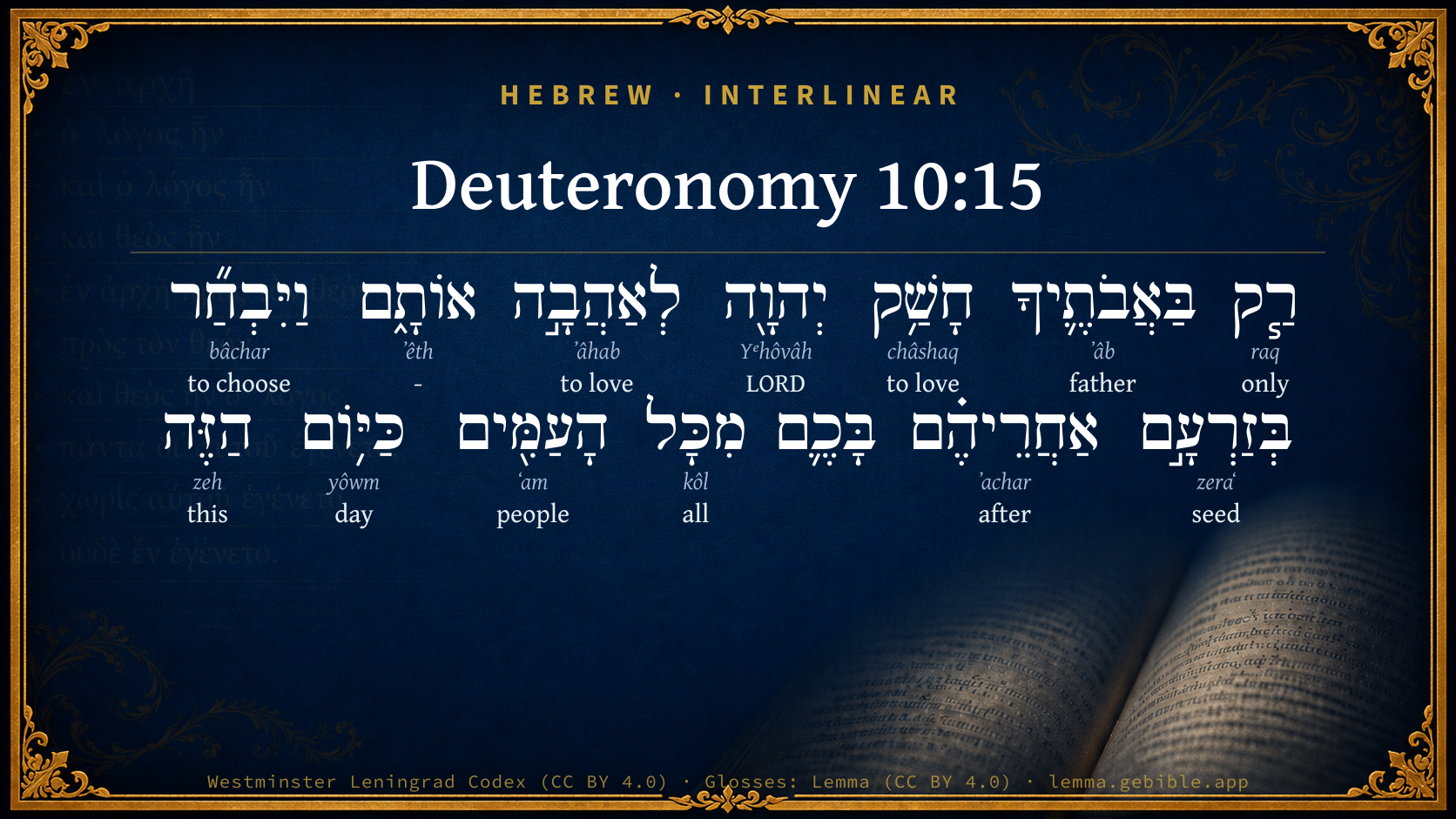
Hebrew (Westminster Leningrad Codex) Deuteronomy 10:15 appears in the Hebrew Old Testament. The text above is from the Westminster Leningrad Codex. Each word links to its Strong’s number, a concise gloss, and parsing drawn from the Open Scriptures Hebrew Bible morphology. Click any word for its full Brown-Driver-Briggs (BDB) entry.
Download image
Cite this verse

Deuteronomy 10:15 (World English Bible). Public Domain. Lemma interlinear Bible study tool, https://lemma.gebible.app/v/deuteronomy/10/15.

Show BibTeX & RIS
BibTeX
RIS
English Translation
Only Yahweh had a delight in your fathers to love them, and he chose their seed after them, even you above all peoples, as at this day.
World English Bible · Public Domain
Download a study sheet

One document with this verse’s original text, its word-by-word gloss line, the meaning frame, cross-references with their text, attributed commentary, and full source and license credits — printable, and it pastes into notes with its structure intact.

This verse Autodidact and up

Study sheet (.html) Plain text (.txt)

A passage Seminary Student

Up to 50 verses in one chapter. A passage sheet keeps up to 6 commentary sources and 12 cross-references per verse, in the order this page ranks them, and says so on the sheet whenever that leaves anything out. Ask for a single verse and you get the Autodidact verse sheet above.

Everything on this page stays free to read, with no account — the sheet is a download of what is already on screen, not access to it.

Want to remove ads? Support Godless Engineer
Compare translations 3

The same verse in 3 English versions, stacked beneath the original-language interlinear above. Click any original word for its lexicon entry.

Each is an independent rendering of the whole verse — the interlinear is not word-aligned to these translations.

Highlighted words mark where these versions differ — a whole-verse word diff, not a word-by-word alignment.

  • World English Bible Public Domain
    Only Yahweh had a delight in your fathers to love them, and he chose their seed after them, even you above all peoples, as at this day.
  • King James Version Public Domain
    Only the LORD had a delight in thy fathers to love them, and he chose their seed after them, even you above all people, as it is this day.
  • unfoldingWord Literal Text CC BY-SA 4.0
    Only Yahweh took pleasure in your fathers to love them, and he chose you, their seed, after them, from all of the peoples, as this day.

unfoldingWord Literal Text — © unfoldingWord, licensed CC BY-SA 4.0. Word-aligned USFM3 via Door43 (git.door43.org/unfoldingWord/en_ult).

Versions to compare (up to 4)

3 of 4 selected

Show all 18 translations

Every available English version of this verse, each an independent rendering of the whole verse.

  • World English Bible Public Domain
    Only Yahweh had a delight in your fathers to love them, and he chose their seed after them, even you above all peoples, as at this day.
  • Berean Standard Bible Public Domain
    Yet the LORD has set His affection on your fathers and loved them. And He has chosen you, their descendants after them, above all the peoples, even to this day.
  • Majority Standard Bible Public Domain
    Yet the LORD has set His affection on your fathers and loved them. And He has chosen you, their descendants after them, above all the peoples, even to this day.
  • King James Version Public Domain
    Only the LORD had a delight in thy fathers to love them, and he chose their seed after them, even you above all people, as it is this day.
  • American Standard Version (1901) Public Domain
    Only Jehovah had a delight in thy fathers to love them, and he chose their seed after them, even you above all peoples, as at this day.
  • Revised Version (1885) Public Domain
    Only the LORD had a delight in thy fathers to love them, and he chose their seed after them, even you above all peoples, as at this day.
  • Geneva Bible (1599) Public Domain
    Notwithstanding, the Lord set his delite in thy fathers to loue them, and did choose their seede after them, euen you aboue all people, as appeareth this day.
  • Douay-Rheims (1899) Public Domain
    And yet the Lord hath been closely joined to thy fathers, and loved them and chose their seed after them, that is to say, you, out of all nations, as this day it is proved.
  • Young's Literal Translation Public Domain
    only in thy fathers hath Jehovah delighted -- to love them, and He doth fix on their seed after them -- on you, out of all the peoples as `at' this day;
  • Literal Standard Version CC BY-SA 4.0
    Only, YHWH has delighted in your fathers, to love them, and He fixes on their seed after them—on you, out of all the peoples, as [at] this day.
  • Unlocked Literal Bible CC BY-SA 4.0
    Only Yahweh took pleasure in your fathers so as to love them, and he chose you, their descendants, after them, more than any of the other peoples, as he does today.
  • unfoldingWord Literal Text CC BY-SA 4.0
    Only Yahweh took pleasure in your fathers to love them, and he chose you, their seed, after them, from all of the peoples, as this day.
  • Darby Bible Public Domain
    Only, Jehovah took pleasure in thy fathers, to love them, and he chose their seed after them, [even] you, out of all the peoples, as it is this day.
  • World Messianic Bible Public Domain
    Only the LORD had a delight in your fathers to love them, and he chose their offspring after them, even you above all peoples, as it is today.
  • Webster's Bible Public Domain
    Only the LORD had a delight in thy fathers to love them, and he chose their seed after them, even you above all people, as it is this day.
  • Free Bible Version CC BY-SA 4.0
    Yet the Lord was attracted to your forefathers and he loved them. He has also chosen you, their descendants, above any other people, even until now.
  • Bible in Basic English Public Domain
    But the Lord had delight in your fathers and love for them, marking out for himself their seed after them, even you, from all peoples, as at this day.
  • JPS Tanakh (1917) Public Domain
    Only the LORD had a delight in thy fathers to love them, and He chose their seed after them, even you, above all peoples, as it is this day.

Literal Standard Version (2020), Covenant Press — licensed CC BY-SA 4.0. Text via the HelloAO Bible API (eBible.org). Unlocked Literal Bible (unfoldingWord) — licensed CC BY-SA 4.0. Text via the HelloAO Bible API (eBible.org). unfoldingWord Literal Text — © unfoldingWord, licensed CC BY-SA 4.0. Word-aligned USFM3 via Door43 (git.door43.org/unfoldingWord/en_ult). Free Bible Version, Dr. Jonathan Gallagher — licensed CC BY-SA 4.0. Text via the HelloAO Bible API (eBible.org).

Word by word

More ways to search: Search by grammar → Find every occurrence → Compare this word →

Practice this passage: Drill this verse → Learn its vocabulary →

חָשַׁ֥ק
châshaq
H2836
“to love”
Verb, Qal, Perfect, 3rd Person, Masculine, Singular
Part of Speech
Verb
Stem
Qal
Form
Perfect
Person
3rd Person
Gender
Masculine
Number
Singular
Full BDB Definition

Origin: a primitive root

TWOT: 773

(Qal) to love, be attached to, long for - (Piel) fillet - (Pual) fillet
  1. רַ֧ק raq H7535 “only” Particle, Accusative
  2. בַּאֲבֹתֶ֛יךָ ʼâb H1 “in/at · fathers · your” Preposition + Noun, Common, Masculine, Plural, Construct + Suffix, Personal, 2nd Person, Masculine, Singular
  3. יְהוָ֖ה Yᵉhôvâh H3068 “LORD” Noun, Proper
  4. לְאַהֲבָ֣ה ʼâhab H157 “to love” Preposition + Verb, Qal, Infinitive Construct
  5. אוֹתָ֑ם ʼêth H853 “- · them” Particle, Direct Object + Suffix, Personal, 3rd Person, Masculine, Plural
  6. וַיִּבְחַ֞ר bâchar H977 “and · to choose” Conjunction + Verb, Qal, Sequential Imperfect, 3rd Person, Masculine, Singular
  7. בְּזַרְעָ֣ם zeraʻ H2233 “in/at · seed · their” Preposition + Noun, Common, Masculine, Singular, Construct + Suffix, Personal, 3rd Person, Masculine, Plural
  8. אַחֲרֵיהֶ֗ם ʼachar H310 “after · them” Preposition + Suffix, Personal, 3rd Person, Masculine, Plural
  9. מִכָּל kôl H3605 “from · all of” Preposition + Noun, Common, Masculine, Singular, Construct
  10. הָעַמִּ֖ים ʻam H5971 “the · peoples” Particle, Definite Article + Noun, Common, Masculine, Plural, Absolute
  11. כַּיּ֥וֹם yôwm H3117 “like/as the · day” Preposition, Determined + Noun, Common, Masculine, Singular, Absolute
  12. הַזֶּה zeh H2088 “the · this” Particle, Definite Article + Pronoun, Demonstrative, Masculine, Singular

About this verse

These counts appear in no published source. They are computed here, from the morphology-tagged text and Lemma’s own curated glosses. What Lemma adds →

14
words
13
distinct lemmas
Pentateuch
section

Notable vocabulary

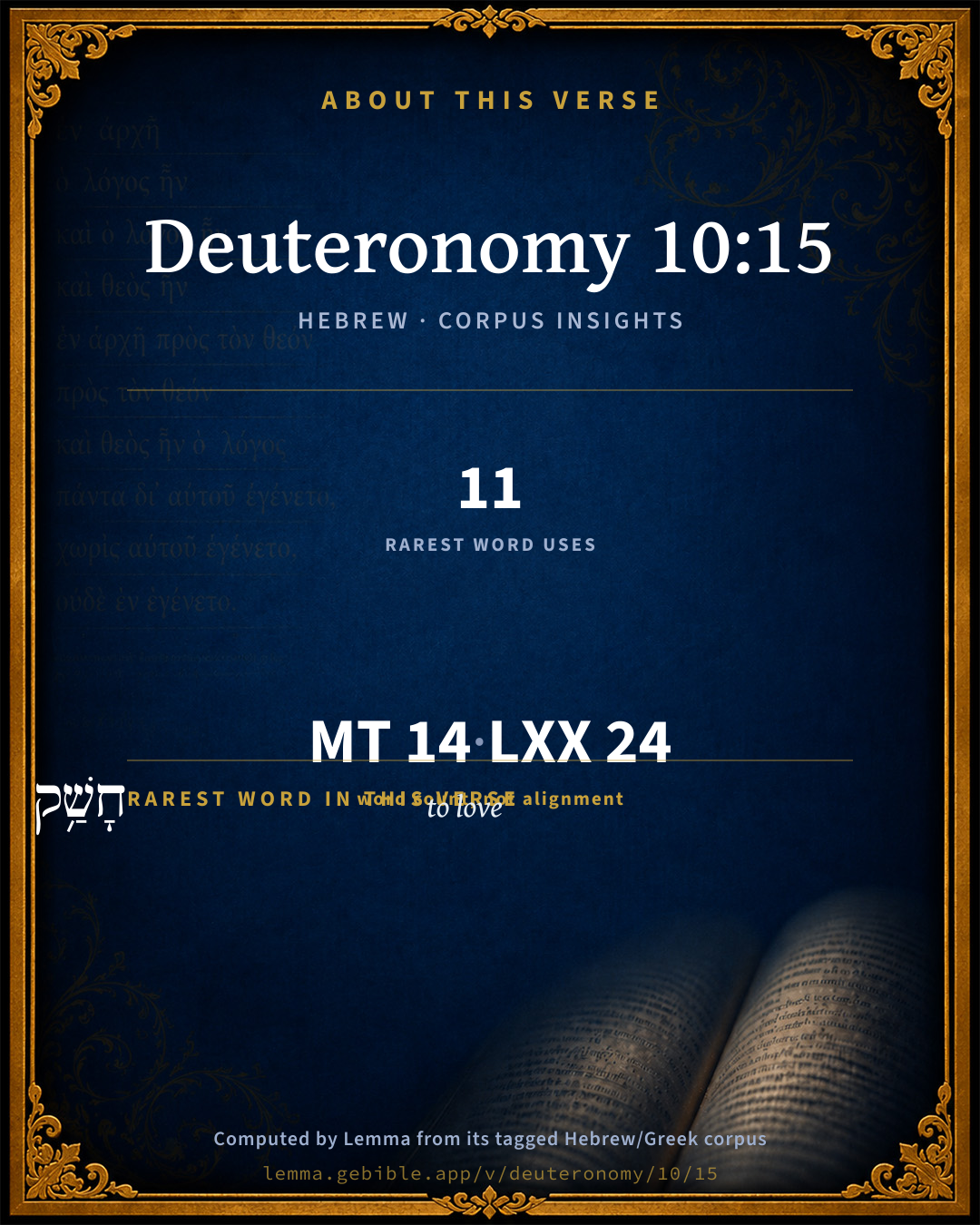
The rarest word here is חָשַׁ֥ק to love H2836 — appearing just 11 times in the whole Hebrew Bible.

Shared distinctive vocabulary

חָשַׁ֥ק to love H2836 occurs in 11 verses of the Hebrew Bible. Also found in:

Grammatical profile

  • 3 verbs
  • 6 nouns
  • 1 pronoun
  • 2 prepositions
  • 2 particles

Verb forms

  • חָשַׁ֥ק Qal · Perfect
  • לְאַהֲבָ֣ה Qal · Infinitive Construct
  • וַיִּבְחַ֞ר Qal · Sequential Imperfect

Hebrew & Septuagint length

In English translation the verse runs 27 words from the Hebrew and 26 from the Septuagint (LXX English) — closely comparable.

A rough comparison of the two English renderings, which tokenize alike — not a word-level alignment.

Word counts can differ between the Hebrew and the Greek without any difference in meaning — e.g. the Hebrew direct-object marker אֵת has no separate Greek word, and Greek often adds the article ὁ.

In the original languages it is 14 Hebrew tokens and 24 Greek tokens — but the two are counted differently (Hebrew bundles its prefixes and suffixes into one token; the Greek is in lemma form), so that isn’t a like-for-like length.

Cross-references

4

Topical passages linked to Deuteronomy 10:15 in the Treasury of Scripture Knowledge — connected by theme and wording, ordered by reader-vote popularity; previews shown in the World English Bible.

  • Deuteronomy 4:37 Because he loved your fathers, therefore he chose their seed after them, and brought you out with his presence, with his great power, out of Egypt;
  • Numbers 14:8 If Yahweh delight in us, then he will bring us into this land, and give it to us; a land which flows with milk and honey.
  • Deuteronomy 7:7–8 Yahweh didn't set his love on you, nor choose you, because you were more in number than any people; for you were the fewest of all peoples:
  • Romans 9:13–23 Even as it is written, "Jacob I loved, but Esau I hated."

Cross-references courtesy of OpenBible.info (CC BY 4.0).

Hebrew and Greek witnesses Masoretic Hebrew ↔ Greek Septuagint

The same verse in the two great witnesses to the Old Testament, shown verse-for-verse.

These are two independent witnesses, not word-aligned to each other, and the Septuagint is shown in lemma (dictionary) form.

Hebrew Deuteronomy 10:15 Masoretic · Westminster Leningrad Codex

רַ֧ק בַּאֲבֹתֶ֛יךָ חָשַׁ֥ק יְהוָ֖ה לְאַהֲבָ֣ה אוֹתָ֑ם וַיִּבְחַ֞ר בְּזַרְעָ֣ם אַחֲרֵיהֶ֗ם בָּכֶ֛ם מִכָּל הָעַמִּ֖ים כַּיּ֥וֹם הַזֶּה

Only Yahweh had a delight in your fathers to love them, and he chose their seed after them, even you above all peoples, as at this day.

World English Bible · Public Domain

Greek LXX Deuteronomy 10:15 Septuagint · lemma form

πλήν ὁ πατήρ σύ προαἱρέω κύριος ἀγαπάω αὐτός καί ἐκλέγω ὁ σπέρμα αὐτός μετά αὐτός σύ παρά πᾶς ὁ ἔθνος κατά ὁ ἡμέρα οὗτος

Only the Lord chose your fathers to love them, and he chose out their seed after them, even you, beyond all nations, as at this day.

LXX2012 (modern English Septuagint) · Public Domain

Hebrew: Westminster Leningrad Codex (CC BY 4.0). Greek: Septuagint (public domain); English from LXX2012 (modern English Septuagint) (Public Domain). How the Septuagint differs from the Hebrew →

Targum (Aramaic paraphrase)

2

The Targum is the ancient Jewish Aramaic paraphrase of the Hebrew Scriptures — an interpretive translation, not the Hebrew text itself. Onkelos (literal) and Pseudo-Jonathan (expansive) render the Torah, and Jonathan the Prophets. Coverage is partial: where no permissively-licensed English translation exists for a verse, only the Aramaic is shown. This is verse-level text, not a word-by-word alignment to the Hebrew.

  1. Targum Onkelos Torah (Genesis–Deuteronomy)
    לְחוֹד בַּאֲבָהָתָךְ צָבֵי יְיָ לְמִרְחַם יָתְהוֹן וְאִתִּרְעֵי בִּבְנֵיהוֹן בַּתְרֵיהוֹן בְּכוֹן מִכָּל עַמְמַיָא כְּיוֹמָא הָדֵין

    (no public-domain English translation for this verse)

    Targum Onkelos — Aramaic: “Onkelos Genesis” (public domain); “Onkelos Exodus” (public domain); “Onkelos Leviticus” (public domain); “Onkelos Numbers” (public domain); “Onkelos Deuteronomy” (public domain). English: “Sefaria Community Translation” (CC0 1.0 (public-domain dedication)); “J.W. Etheridge. The Targums of Onkelos and Jonathan Ben Uzziel on the Pentateuch. London: Longmans, Green, 1862” (public domain). Text via Sefaria.

  2. Targum Pseudo-Jonathan Torah (Genesis–Deuteronomy)
    לְחוֹד בְּאַבְהַתְכוֹן צָבָא יְיָ מְטוּל לְמִרְחַם יַתְהוֹן וְאִתְרְעֵי בִּבְנֵיהוֹן בַּתְרֵיהוֹן כְּוַותְכוֹן מִכָּל עַמְמַיָא דְעַל אַנְפֵּי אַרְעָא כִּזְמַן יוֹמָא הָדֵין

    Only the Lord had pleasure in your fathers, and because He would love you He hath had favour to their children after them, as you, above all the nations upon the face of the earth, at the time of this day.

    Targum Pseudo-Jonathan — Aramaic: “Targum Jonathan on Genesis” (public domain); “Targum Jonathan on Exodus” (public domain); “Targum Jonathan on Leviticus” (public domain); “Targum Jonathan on Numbers” (public domain); “Targum Jonathan on Deuteronomy” (public domain). English: “The Targum of Jonathan ben Uzziel, trans. J. W. Etheridge, London, 1862” (public domain). Text via Sefaria.

Commentary

Notes on Deuteronomy 10:15 from classic Christian and Jewish commentators (each source and its license shown beneath its notes). The classic Christian expositions comment on the surrounding passage and are grouped to its opening verse, so a note may address several verses; the Jewish commentaries on the Tanakh (Rashi and others) are per-verse, so they appear only where the commentator wrote on this verse.

Lemma curates 59 commentaries, every one of them public domain or Creative Commons licensed, each selected and text-cleaned for this edition rather than reprinted as found. About our sources →

Trapp's Complete Commentary

John Trapp

Deu 10:15 Only the LORD had a delight in thy fathers to love them, and he chose their seed after them, [even] you above all people, as [it is] this day.

Ver. 15. To love them.] Because he loved them, as Deu 7:7-8. {See Trapp on "Deu 7:8"}

John Trapp, A Commentary or Exposition upon All the Books of the Old and New Testament (1647–1656) — public domain. Text from a community e-Sword module.

Joseph Benson's Commentary

Deu 10:15. To love them — He shows that God had no particular obligation to their fathers, any more than to other persons and people, all being equally his creation, and that his choice of them out of and above all others, proceeded only from his good pleasure.

Joseph Benson's Commentary on the Old and New Testaments (1811–1818) — public domain. Text from a community e-Sword module.

Geneva Bible (1599)

Geneva Bible translators

Although he was Lord of heaven and earth, yet would he choose none but you.

Geneva Bible (1599) marginal notes — public domain. Text via Bolls.life.

Ellicott's Commentary for English Readers

(15) Only.—“The whole world belongs to Jehovah, and for all that He chose thy fathers above all people.”

A Bible Commentary for English Readers, edited by Charles John Ellicott (1878–1897) — public domain. Text from a community e-Sword module.

The Cambridge Bible for Schools and Colleges

gen. ed. J. J. S. Perowne

15. Only] Heb. raḳ. The use of this restrictive adverb with disjunctive force—a sharp word with the sound of a wrench in it—is found in many O.T. writings, but is particularly frequent in Deut., occurring no less than 20 times, and in deuteronomic passages elsewhere. It is prefixed to clauses which limit, qualify, condition, or offer contrasts to, what has preceded them. The exact meaning varies according to the context, and therefore it is transl. by different English adverbs or conjunctions in R.V. It introduces exceptions to, or reservations upon statements of fact, only or but (Deu_2:28; Deu_2:35; Deu_2:37, Deu_3:11; Deu_3:19), or laws, notwithstanding, only (better, saving that), but (Deu_12:15-16; Deu_12:23; Deu_12:26, Deu_15:23, Deu_17:16, Deu_20:14; Deu_20:20); or a different law for different circumstances, but (Deu_20:16); or an indispensable condition to a command or promise, only, if only (Deu_4:9, Deu_15:5); or an antithesis to what precedes, only (= nevertheless, as here); or a purely assertive statement, as if singling out the fact asserted and putting it beyond doubt, surely, only (Deu_4:6, Deu_28:13; Deu_28:33).

had a delight in] See on Deu_7:7, set his love upon you.

to love] See on Deu_6:5.

chose] See on Deu_7:6.

even you] The only Pl. in this section, 12–15. It is explicable either by the attraction of the following Pls., or as a later insertion, and this is supported by its abruptness; even is not expressed in the text.

The Cambridge Bible for Schools and Colleges (gen. ed. J. J. S. Perowne; Cambridge University Press, 1878–1918) — public domain. Text from a community e-Sword module.

John Gill's Exposition

Only the Lord had a delight in thy fathers to love them,.... Though the heavens and the earth, and all the inhabitants of them are the Lord's by creation, yet he had a special regard unto, and a peculiar complacency in, the fathers of the Israelites, Abraham, Isaac, and Jacob; from whence arose some particular expressions of love to them, signified by various acts of kindness done them, and promises made unto them:

and he chose their seed after them, even you above all the people, as it is this day; to be a special people to him, to enjoy civil and religious privileges greater than any other; and particularly to have his law given to them, his tabernacle and worship set up among them, which were at this time, and which gave them the preference to all other nations; see Deu 4:7.

John Gill's Exposition of the Whole Bible (1746–1763) — public domain (CC PDM 1.0). Text via the HelloAO Bible API.

Haydock's Catholic Bible Commentary

Joined, (conglutinatus) as it were, with glue, (Haydock) to shew the vehemence of love. (Menochius)

George Leo Haydock (1774–1849), Haydock's Catholic Family Bible and Commentary, 1859 edition — public domain. Excludes Psalms (Douay-Rheims chapter numbering differs from Protestant) and Deuterocanonical books (Catholic canon only).

Matthew Poole's English Annotations

He shows that God had no particular reason nor obligation to their fathers any more than to other persons or people, all being equally his creatures, and that his choice of them out of and above all others proceeded only from God’s good pleasure and free love.

Matthew Poole's English Annotations on the Holy Bible (1683–1685) — public domain. Text from a community e-Sword/MySword module.

John Wesley's Explanatory Notes

To love them - He shews that God had no particular obligation to their fathers, any more than to other persons or people, all being equally his creatures, and that his choice of them out of and above all others, proceeded only from God's good pleasure.

John Wesley, Explanatory Notes Upon the Whole Bible (1754–1765) — public domain. Text via the GEBible commentary corpus.

Rashi

Rabbi Shlomo Yitzchaki (Rashi)

בכם [AND HE CHOSE …] YOU, even as you see yourselves the object of His pleasure מכל העמים, כיום הזה MORE THAN ALL OTHER PEOPLES THIS DAY.

Rashi on the Tanakh — English translations: “The Judaica Press complete Tanach with Rashi, translated by A. J. Rosenberg” (CC BY 4.0); “Pentateuch with Rashi's commentary by M. Rosenbaum and A.M. Silbermann, 1929-1934” (public domain); “The Metsudah Tanach series, Lakewood, N.J” (CC BY 4.0); and “The Book of Joshua, Metsudah Publications, 1997” (CC BY 4.0). Text via Sefaria.

Ramban (Nachmanides)

Rabbi Moshe ben Nachman (Ramban / Nachmanides)

AS IT IS THIS DAY. The meaning thereof is that thus it will be with their seed forever [that they will be His chosen ones]. I have already explained the terms “delight” and “choosing.” And the expression the heaven of heavens refers to the spherical bodies of the four elements [fire, water, earth and air] which are in the potential of the heavens below them, similar to what is said, the earth, with all that therein is. And so it is said in the psalm: Praise ye the Eternal from the heavens; praise Him in the heights, and continues to mention His angels, His host, Verse 2. and the stars of light, Verse 3. and afterwards, Praise Him, ye heaven of heavens., Verse 4.

Ramban (Nachmanides) on the Tanakh — English translation: “Commentary on the Torah by Ramban (Nachmanides). Translated and annotated by Charles B. Chavel. New York, Shilo Pub. House, 1971-1976” (CC BY 4.0). Text via Sefaria.

Lesson kit

Teaching starters — assembled from the data on this page, not authored interpretation. Every prompt links to the verse data it draws on. Edit before teaching.

Deuteronomy, in the Pentateuch, opens this verse with 14 words (13 distinct Hebrew lemmas). Its most distinctive word is châshaq (“to love”). A historical commentator’s framing appears above. Read the whole chapter for the surrounding context.

Discussion questions

  1. What does “to love” (châshaq) contribute to the verse as a whole?
  2. Genesis 34:8 shares the word «to love» with this verse. How do the two illuminate each other?
  3. The translations on this page render this verse differently — a whole-verse word diff, not a word-by-word alignment. What might account for the different wordings?
  4. The verb «חָשַׁ֥ק» is Qal Perfect. How does its form color the action?
  5. Reading how Trapp's Complete Commentary and Joseph Benson's Commentary read this verse, where do the two commentators agree and where do they part?

Things to notice

Reading settings

Reading text

Shown beneath each verse's original-language words.

Old Testament
Old Testament edition

Read the OT as the Masoretic Hebrew (MT) or the Greek Septuagint (LXX).

English shown for the Greek Septuagint (in the Hebrew ↔ Greek comparison).

Comparing translations? Open the Compare panel on any verse page to stack up to four side by side.