
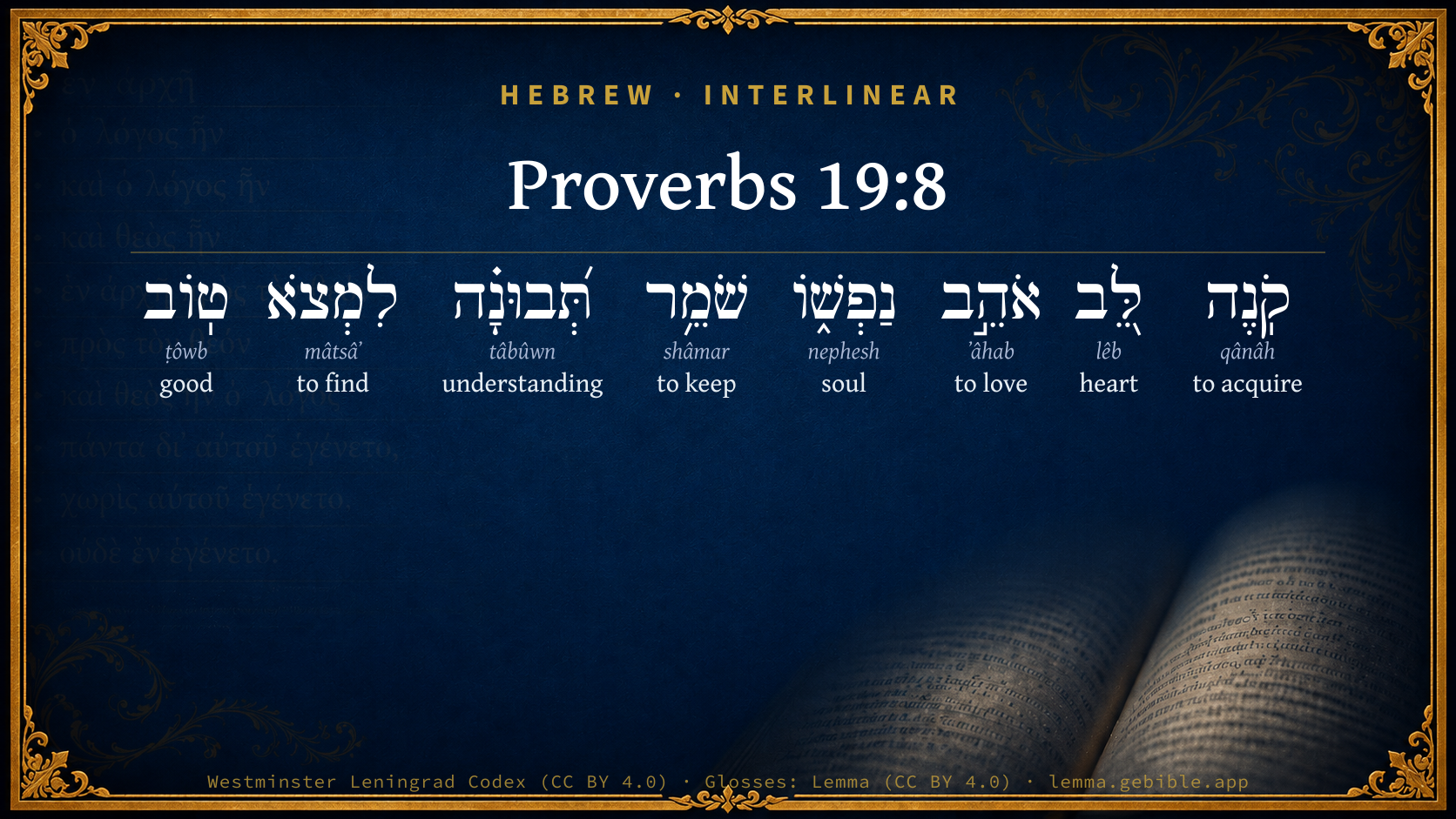
Proverbs 19:8

Hebrew (Westminster Leningrad Codex) Proverbs 19:8 appears in the Hebrew Old Testament. The text above is from the Westminster Leningrad Codex. Each word links to its Strong’s number, a concise gloss, and parsing drawn from the Open Scriptures Hebrew Bible morphology. Click any word for its full Brown-Driver-Briggs (BDB) entry.
Download image
Cite this verse

Proverbs 19:8 (World English Bible). Public Domain. Lemma interlinear Bible study tool, https://lemma.gebible.app/v/proverbs/19/8.

Show BibTeX & RIS
BibTeX
RIS
English Translation
He who gets wisdom loves his own soul. He who keeps understanding shall find good.
World English Bible · Public Domain
Download a study sheet

One document with this verse’s original text, its word-by-word gloss line, the meaning frame, cross-references with their text, attributed commentary, and full source and license credits — printable, and it pastes into notes with its structure intact.

This verse Autodidact and up

Study sheet (.html) Plain text (.txt)

A passage Seminary Student

Up to 50 verses in one chapter. A passage sheet keeps up to 6 commentary sources and 12 cross-references per verse, in the order this page ranks them, and says so on the sheet whenever that leaves anything out. Ask for a single verse and you get the Autodidact verse sheet above.

Everything on this page stays free to read, with no account — the sheet is a download of what is already on screen, not access to it.

Want to remove ads? Support Godless Engineer
Compare translations 3

The same verse in 3 English versions, stacked beneath the original-language interlinear above. Click any original word for its lexicon entry.

Each is an independent rendering of the whole verse — the interlinear is not word-aligned to these translations.

Highlighted words mark where these versions differ — a whole-verse word diff, not a word-by-word alignment.

  • World English Bible Public Domain
    He who gets wisdom loves his own soul. He who keeps understanding shall find good.
  • King James Version Public Domain
    He that getteth wisdom loveth his own soul: he that keepeth understanding shall find good.
  • unfoldingWord Literal Text CC BY-SA 4.0
    The one acquiring heart is loving his life; the one keeping understanding to find good.

unfoldingWord Literal Text — © unfoldingWord, licensed CC BY-SA 4.0. Word-aligned USFM3 via Door43 (git.door43.org/unfoldingWord/en_ult).

Versions to compare (up to 4)

3 of 4 selected

Show all 18 translations

Every available English version of this verse, each an independent rendering of the whole verse.

  • World English Bible Public Domain
    He who gets wisdom loves his own soul. He who keeps understanding shall find good.
  • Berean Standard Bible Public Domain
    He who acquires wisdom loves himself; one who safeguards understanding will find success.
  • Majority Standard Bible Public Domain
    He who acquires wisdom loves himself; one who safeguards understanding will find success.
  • King James Version Public Domain
    He that getteth wisdom loveth his own soul: he that keepeth understanding shall find good.
  • American Standard Version (1901) Public Domain
    He that getteth wisdom loveth his own soul: He that keepeth understanding shall find good.
  • Revised Version (1885) Public Domain
    He that getteth wisdom loveth his own soul: he that keepeth understanding shall find good.
  • Geneva Bible (1599) Public Domain
    He that possesseth vnderstanding, loueth his owne soule, and keepeth wisdome to finde goodnesse.
  • Douay-Rheims (1899) Public Domain
    But he that possesseth a mind, loveth his own soul, and he that keepeth prudence shall find good things.
  • Young's Literal Translation Public Domain
    Whoso is getting heart is loving his soul, He is keeping understanding to find good.
  • Literal Standard Version CC BY-SA 4.0
    Whoever is getting heart is loving his soul, || He is keeping understanding to find good.
  • Unlocked Literal Bible CC BY-SA 4.0
    He who gets wisdom loves his own life; he who keeps understanding will find what is good.
  • unfoldingWord Literal Text CC BY-SA 4.0
    The one acquiring heart is loving his life; the one keeping understanding to find good.
  • Darby Bible Public Domain
    He that getteth sense loveth his own soul; he that keepeth understanding shall find good.
  • World Messianic Bible Public Domain
    He who gets wisdom loves his own soul. He who keeps understanding shall find good.
  • Webster's Bible Public Domain
    He that getteth wisdom loveth his own soul: he that keepeth understanding shall find good.
  • Free Bible Version CC BY-SA 4.0
    If you become wise, you have good self-esteem; if you learn good sense you'll be successful.
  • Bible in Basic English Public Domain
    He who gets wisdom has love for his soul: he who keeps good sense will get what is truly good.
  • JPS Tanakh (1917) Public Domain
    He that getteth wisdom loveth his own soul; he that keepeth understanding shall find good.

Literal Standard Version (2020), Covenant Press — licensed CC BY-SA 4.0. Text via the HelloAO Bible API (eBible.org). Unlocked Literal Bible (unfoldingWord) — licensed CC BY-SA 4.0. Text via the HelloAO Bible API (eBible.org). unfoldingWord Literal Text — © unfoldingWord, licensed CC BY-SA 4.0. Word-aligned USFM3 via Door43 (git.door43.org/unfoldingWord/en_ult). Free Bible Version, Dr. Jonathan Gallagher — licensed CC BY-SA 4.0. Text via the HelloAO Bible API (eBible.org).

Word by word

More ways to search: Search by grammar → Find every occurrence → Compare this word →

Practice this passage: Drill this verse → Learn its vocabulary →

About this verse

These counts appear in no published source. They are computed here, from the morphology-tagged text and Lemma’s own curated glosses. What Lemma adds →

8
words
8
distinct lemmas
Wisdom
section

Shared distinctive vocabulary

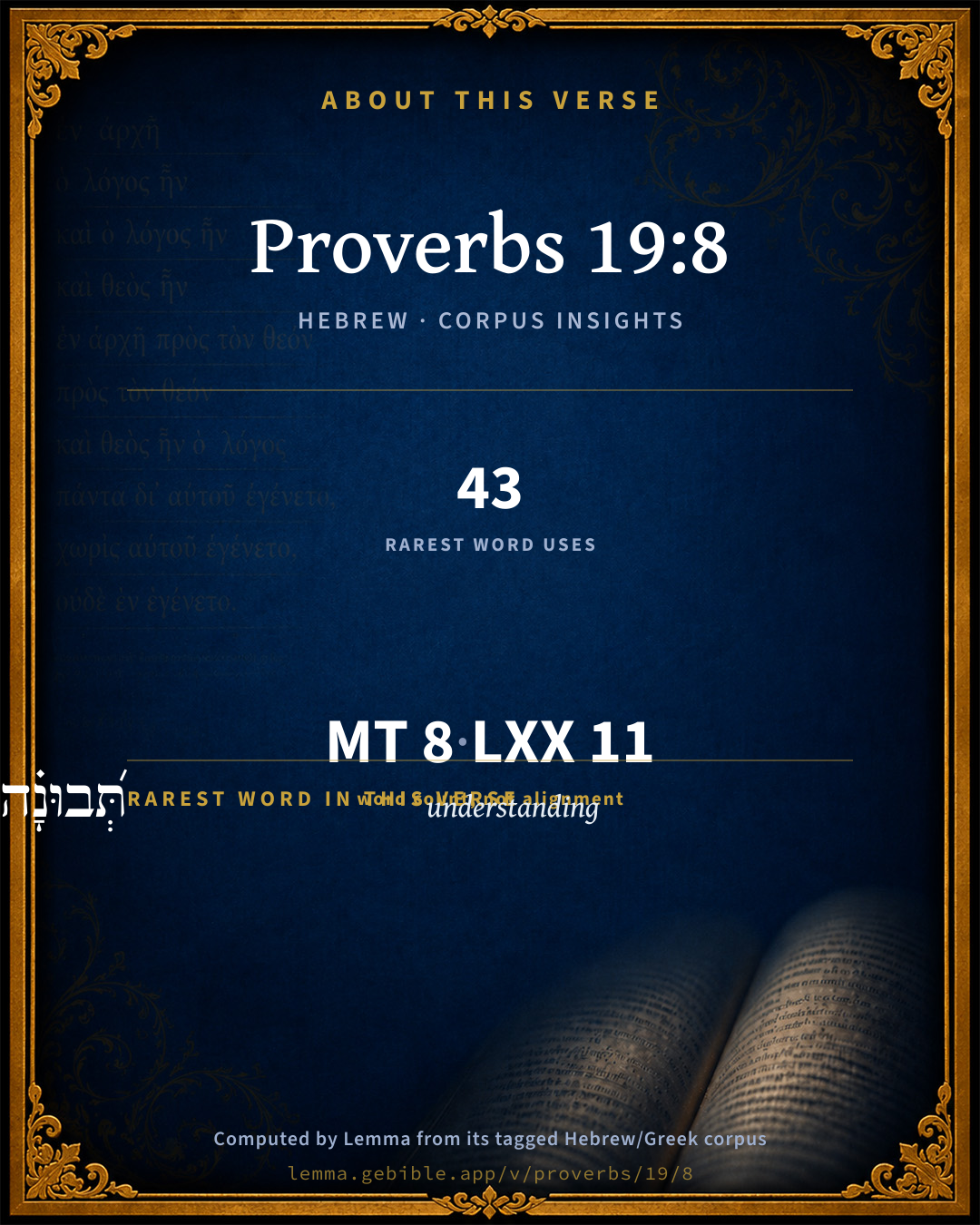
תְּ֝בוּנָ֗ה understanding H8394 occurs in 42 verses of the Hebrew Bible. Also found in:

Grammatical profile

  • 4 verbs
  • 3 nouns
  • 1 adjective

Verb forms

  • קֹֽנֶה Qal · Participle Active
  • אֹהֵ֣ב Qal · Participle Active
  • שֹׁמֵ֥ר Qal · Participle Active
  • לִמְצֹא Qal · Infinitive Construct

Hebrew & Septuagint length

In English translation the verse runs 15 words from the Hebrew and 14 from the Septuagint (LXX English) — closely comparable.

A rough comparison of the two English renderings, which tokenize alike — not a word-level alignment.

Word counts can differ between the Hebrew and the Greek without any difference in meaning — e.g. the Hebrew direct-object marker אֵת has no separate Greek word, and Greek often adds the article ὁ.

In the original languages it is 8 Hebrew tokens and 11 Greek tokens — but the two are counted differently (Hebrew bundles its prefixes and suffixes into one token; the Greek is in lemma form), so that isn’t a like-for-like length.

Cross-references

15

Topical passages linked to Proverbs 19:8 in the Treasury of Scripture Knowledge — connected by theme and wording, ordered by reader-vote popularity; previews shown in the World English Bible.

  • Proverbs 16:20 He who heeds the Word finds prosperity. Whoever trusts in Yahweh is blessed.
  • Proverbs 8:35–36 For whoever finds me, finds life, And will obtain favor from Yahweh.
  • Proverbs 3:18 She is a tree of life to those who lay hold of her. Happy is everyone who retains her.
  • Proverbs 4:6 Don't forsake her, and she will preserve you. Love her, and she will keep you.
  • 1 Peter 3:10 For, "He who would love life, And see good days, Let him keep his tongue from evil, And his lips from speaking deceit.
  • John 14:21 One who has my commandments, and keeps them, that person is one who loves me. One who loves me will be loved by my Father, and I will love him, and will reveal myself to him."
  • Psalms 19:11 Moreover by them is your servant warned. In keeping them there is great reward.
  • Proverbs 2:1–9 My son, if you will receive my words, And store up my commandments within you;
  • Proverbs 4:21 Let them not depart from your eyes. Keep them in the midst of your heart.
  • Ezekiel 36:26 A new heart also will I give you, and a new spirit will I put within you; and I will take away the stony heart out of your flesh, and I will give you a heart of flesh.
  • Proverbs 3:21 My son, let them not depart from your eyes. Keep sound wisdom and discretion:
  • Proverbs 4:4 He taught me, and said to me: "Let your heart retain my words. Keep my commandments, and live.
  • Proverbs 17:16 Why is there money in the hand of a fool to buy wisdom, Seeing he has no understanding?
  • Proverbs 22:18 For it is a pleasant thing if you keep them within you, If all of them are ready on your lips.
  • John 12:25 He who loves his life will lose it. He who hates his life in this world will keep it to eternal life.

Cross-references courtesy of OpenBible.info (CC BY 4.0).

Hebrew and Greek witnesses Masoretic Hebrew ↔ Greek Septuagint

The same verse in the two great witnesses to the Old Testament, shown verse-for-verse.

These are two independent witnesses, not word-aligned to each other, and the Septuagint is shown in lemma (dictionary) form.

Hebrew Proverbs 19:8 Masoretic · Westminster Leningrad Codex

קֹֽנֶה לֵּ֭ב אֹהֵ֣ב נַפְשׁ֑וֹ שֹׁמֵ֥ר תְּ֝בוּנָ֗ה לִמְצֹא טֽוֹב

He who gets wisdom loves his own soul. He who keeps understanding shall find good.

World English Bible · Public Domain

Greek LXX Proverbs 19:8 Septuagint · lemma form

ὁ κτάομαι φρόνησις ἀγαπάω ἑαυτοῦ ὅς δέ φυλάσσω φρόνησις εὑρίσκω ἀγαθός

He that procures wisdom loves himself; and he that keeps wisdom shall find good.

LXX2012 (modern English Septuagint) · Public Domain

On this verse, The Pulpit Commentary discusses the Septuagint’s reading. Read the note in Commentary ↓

Hebrew: Westminster Leningrad Codex (CC BY 4.0). Greek: Septuagint (public domain); English from LXX2012 (modern English Septuagint) (Public Domain). How the Septuagint differs from the Hebrew →

Commentary

Notes on Proverbs 19:8 from classic Christian and Jewish commentators (each source and its license shown beneath its notes). The classic Christian expositions comment on the surrounding passage and are grouped to its opening verse, so a note may address several verses; the Jewish commentaries on the Tanakh (Rashi and others) are per-verse, so they appear only where the commentator wrote on this verse.

Lemma curates 59 commentaries, every one of them public domain or Creative Commons licensed, each selected and text-cleaned for this edition rather than reprinted as found. About our sources →

Trapp's Complete Commentary

John Trapp

Pro 19:8 He that getteth wisdom loveth his own soul: he that keepeth understanding shall find good.

Ver. 8. He that getteth wisdom.] Heb., He that getteth, or possesseth a heart; for we are born brutes, and are compared to "the horse and mule that have no understanding." {Psa 32:9} Hearts we have all, but our "foolish hearts are darkened," {Rom 1:21} yea, "a deceived heart hath turned us aside that we cannot deliver our souls, nor say, Is there not a lie in my right hand?" {Isa 44:20} Well may the rich have many friends, but not many hearts: for without wisdom no man can love his own soul, much less can he truly love another. Therefore, by how much better it is for a man to love his own soul as he ought than to be beloved of others for his gifts, by so much it is better to get wisdom than to get wealth.

John Trapp, A Commentary or Exposition upon All the Books of the Old and New Testament (1647–1656) — public domain. Text from a community e-Sword module.

The Biblical Illustrator

Joseph S. Exell

Pro_19:8

He that getteth wisdom loveth his own soul

On getting and keeping wisdom

The way of getting this wisdom is to be sensible of our need of it; to trust in Him to whom all the treasures of wisdom and knowledge belong, for the communication of it; and to be diligent in the use of the means which He hath appointed, and will bless, for conveying it to us.

We must not only get, but keep, this precious treasure, retaining it in our hearts, showing it forth in all our behaviour, and refusing to part with it on any account. (George Lawson, D. D.)

The Biblical Illustrator, edited by Joseph S. Exell (c. 1880s–1900s) — public domain. Text from a community e-Sword module.

Joseph Benson's Commentary

Pro 19:8. He that getteth wisdom — That takes pains, and labours to get knowledge, grace, and acquaintance with God; loveth his own soul — Or, loveth himself, because he procures great and lasting, yea, everlasting good to himself, as sinners, on the contrary, are said to hate their souls, chap. 29:24, because they bring evil upon them; he that keepeth understanding — That observes, and carefully practises its precepts; shall find good — Shall have great benefit by it, both for his conduct in this life, and for his happiness in the next.

Joseph Benson's Commentary on the Old and New Testaments (1811–1818) — public domain. Text from a community e-Sword module.

Tyndale Open Study Notes

Tyndale Open Resources

19:8 It is in our self-interest to acquire wisdom because understanding helps us prosper.

Tyndale Open Study Notes — © Tyndale Open Resources, licensed CC BY-SA 4.0. Text via the HelloAO Bible API.

Geneva Bible (1599)

Geneva Bible translators

He that is upright in judgment findeth favor of God.

Geneva Bible (1599) marginal notes — public domain. Text via Bolls.life.

Matthew Henry's Commentary

Those are here encouraged, 1. That take pains to get wisdom, to get knowledge, and grace, and acquaintance with God; those that do so show that they love their own souls, and will be found to have done themselves the greatest kindness imaginable. No man ever hated his own flesh, but loves that, yet many are wanting in love to their own souls, for only those love their souls, and consequently love themselves, aright, that get wisdom, true wisdom. 2. That take care to keep it when they have got it; it is health, and wealth, and honour, and all, to the soul, and therefore he that keeps understanding, as he shows that he loves his own soul, so he shall certainly find good, all good. He that retains the good lessons he has learnt, and orders his conversation according to them, shall find the benefit and comfort of it in his own soul and shall be happy here and for ever.

Matthew Henry's Commentary on the Whole Bible (1708–1710) — public domain (CC PDM 1.0). Text via the HelloAO Bible API.

Jamieson, Fausset & Brown

Robert Jamieson, A. R. Fausset & David Brown

(Compare Margin; Pro 15:32).

loveth . . . soul--or, "himself," which he evinces by regarding his best interests.

keepeth--or, "regards."

Jamieson, Fausset & Brown — Commentary Critical and Explanatory on the Whole Bible (1871) — public domain (CC PDM 1.0). Text via the HelloAO Bible API.

Ellicott's Commentary for English Readers

(8) He that getteth wisdom.—Literally, heart. For that “wisdom,” or “knowledge,” that begins with the “fear of the Lord” (see above on Pro_1:7), and ends with loving Him, is not a matter of intellect only, but of the heart also—i.e., the will and affections.

A Bible Commentary for English Readers, edited by Charles John Ellicott (1878–1897) — public domain. Text from a community e-Sword module.

The Cambridge Bible for Schools and Colleges

gen. ed. J. J. S. Perowne

8. wisdom] Heb., a heart. Comp. Pro_7:7, Pro_9:4; Job_12:3; Job_34:10; in all which places the Heb. word rendered understanding is the same as here.

The Cambridge Bible for Schools and Colleges (gen. ed. J. J. S. Perowne; Cambridge University Press, 1878–1918) — public domain. Text from a community e-Sword module.

John Gill's Exposition

He that getteth wisdom loveth his own soul,.... Wisdom and knowledge in things natural and civil; and especially in things divine, spiritual, and evangelical; particularly he that gets Christ, the Wisdom of God, and a saving knowledge of him; see Pro 3:13. Or, "he that getteth a heart" (p); a good heart, as the Targum explains it; which is a new heart, and a new spirit; a clean heart and a right spirit; a heart of flesh, a soft, tender, and contrite one, in opposition to a hard heart, a heart of stone: a wise and understanding heart, such an one as Solomon had; a heart to know the Lord, and to fear him; in which his laws are written, the graces of his Spirit are implanted; and in which God, Christ, and the Holy Spirit, dwell: he who is desirous of such a he art seeks after it, prays for it, and uses all means to obtain it; and who, through the grace of God; does possess it, as the word signifies; he by all this shows that he has a regard to the good and welfare of his immortal soul; when such, who indulge to ignorance and a wicked heart, wrong and hate their own souls; see Pro 29:24;

he that keepeth understanding shall find good; retains the wisdom he has got; holds fast instruction, and keeps it, which is committed to him; abides by the doctrines of the Gospel, and does not depart from them; keeps the ordinances of it, which it is his wisdom and understanding to do; see Deu 4:6; he finds his account in all this; he finds that which is good, good for him now and hereafter; he finds Christ, and life in him; peace, joy, and comfort in this world: and, in the world to come, glory, honour, and happiness.

(p) "cor", Pagninus, Montanus, Vatablus, Mercerus, &c.

John Gill's Exposition of the Whole Bible (1746–1763) — public domain (CC PDM 1.0). Text via the HelloAO Bible API.

Albert Barnes' Notes on the Bible

Wisdom - literally, as in the margin, to gain a “heart,” i. e., the higher faculties both of reason and feeling, is identical with gaining wisdom, i. e., the faculty which seeks and finds.

Albert Barnes' Notes on the Bible (1834–1885) — public domain. Text from a community e-Sword/MySword module.

Haydock's Catholic Bible Commentary

Mind. Hebrew, "heart," intelligence, chap. xv. 32. --- Loveth. This does not contradict the gospel; (John xii. 25.) as those who refrain from what the soul would crave to its own detriment, truly love it.

George Leo Haydock (1774–1849), Haydock's Catholic Family Bible and Commentary, 1859 edition — public domain. Excludes Psalms (Douay-Rheims chapter numbering differs from Protestant) and Deuterocanonical books (Catholic canon only).

Matthew Poole's English Annotations

Loveth his own soul, or loveth himself, because he procures great good to his soul, or to himself, as it follows; as sinners, on the contrary, are said to hate their souls, Pro 29:24, because they bring mischief upon them. That keepeth understanding; that observeth and carefully practiseth its precepts, as that phrase is commonly used.

Shall find good; shall have great benefit by it, both for his conduct in this life, and for his happiness in the next.

Matthew Poole's English Annotations on the Holy Bible (1683–1685) — public domain. Text from a community e-Sword/MySword module.

Whedon's Commentary on the Bible

Daniel D. Whedon

8. Getteth wisdom — Hebrews, heart; tropical of intelligence, understanding.

Loveth his own soul — Himself; does good to himself. The latter clause is explanatory of the former. “To him that watches over discernment the result shall be finding good.” — Miller. Compare Pro_15:32; for opposite Pro_8:36; Pro_29:24.

Daniel D. Whedon (gen. ed.), Commentary on the Old and New Testaments (1874–1909) — public domain. Text from a community e-Sword module.

The Pulpit Commentary

He that getteth wisdom loveth his own soul. "Wisdom" is, in the Hebrew, leb. "heart;" it is a matter, not of intellect only. but of will and affections. (see on Pro_15:32) Septuagint, agapa eauton , "loveth himself." The contrary, "hateth his own soul," occurs in Pro_29:24. By striving to obtain wisdom a man shows that he has regard for the welfare of his soul and body. Hence St. Thomas Aquinas ("Sum. Theol.," 1:2, qu. 25, art. 7, quoted by Corn. a Lapide) takes occasion to demonstrate that only good men are really lovers of themselves, while evil men are practically self-haters, proving his position by a reference to Arislotle"s numeration of the characteristics of friendship, which the former exhibit, and none of which the latter can possess ("Eth. Nic.," 9:4). He that keepeth understanding shall find good. (Pro_16:20) A man must not only strive hard and use all available means to get wisdom and prudence, he must guard them like a precious treasure, not lose them for want of care or let them lie useless; and then he will find that they bring with themselves innumerable benefits.

Vers. 8-17. Maxims of intelligence.

I THE WORTH OF INTELLIGENCE.

1. It is self-conservative (ver. 8). We all love our own soul or life in any healthy state of body and mind. We all want to live as long as possible. It is natural to desire to live again beyond the grave. Then let us understand that there is no way to these ends except that of intelligence, in the highest and in every sense.

2. It is the source of happiness. (Ver. 8) The truth is very general and abstract, like the truth of the whole of these proverbs. It does not amount to this that good sense will in every case procure happiness, but that there is no true happiness without it.

II SOME MAXIMS OF INTELLIGENCE.

1. The sorrow that falsehood brings. (Ver. 9) It is certain. Many a lie is not immediately found out in the ordinary sense of these words; but it is always found in the man"s mind. It vitiates the intelligence, undermines the moral strength. The rest must follow in its timesomewhere, somehow.

2. Vanity stands in its own light. (Ver. 10) Those who have given way to over weening self-esteem and arrogance of temper like Rehoboam, or like Alexander the Great, or Napoleon become only the more conceited and presumptuous in success. The opposite of vanity is not grovelling self-disparagement, but the sense which teaches us to know our place.

3. The prudence of toleration and of conciliation. (Vers. 11, 12) Socrates was a noble example of these virtues in the heathen world. We who have "learned Christ" should not at least fall behind him. To bear our wrongs with patience is the lower degree of this virtue. Positively to "overcome evil with good" stands higher. Highest of all is the Divine art to turn persecutors into friends. (1Pe_2:19 Mat_5:44, sqq.)

4. The arcana of domestic life. (Vers. 13, 14)

(1) The foolish son. "Many are the miseries of a man"s life, but none like that which cometh from him who should be the stay of his life." "Write this man childless" would have been a boon in comparison.

(2) The tiresome spouse. Wearing the heart that is firm as stone by her continual contentions.

(3) The kind and good wife. No gift so clearly shows the tender providence of God.

5. The inevitable fate of idleness. (Ver. 15)

(1) It produces a lethargy in the soul. (Pro_6:9, Pro_6:10) The faculties that are not used become benumbed and effete.

(2) Thus it leads to want. Although these are general maxims of a highly abstract character, still how true on the whole if not without exception they are to life! "He that will not work, neither let him eat.

6. The wisdom of attention to Gods commands. (Ver. 16)

(1) To every man his soul is dear; i.e. his life is sweet.

(2) The great secret, in the lower sense of self-preservation, in the higher of salvation, is obedience to law.

(3) Inattention is the chief source of calamity. In the lower relation it is so. The careless crossing of the road, the unsteady foot on the mountain-side seems to be punished instantly and terribly. And this is the type of the truth in higher aspects.

7. The reward of pity and benevolence. (Ver. 17) Sir Thomas More used to say there was more rhetoric in this sentence than in a whole library. God looks upon the poor as his own, and satisfies the debts they cannot pay. In spending upon the poor the good man serves God in his designs with reference to men. J.

Vers. 8, 16. Making the most of ourself and our life.

How shall we most truly "love our own soul" but by making all we can make of the nature and the life God has entrusted to our care! And how shall we do this? Surely by "getting wisdom" and "keeping understanding." To look at the subject negatively and, beginning at the bottom, to take an upward path, we remark

I THAT CONTEMPTUOUS CARELESSNESS MEANS CERTAIN RUIN. "He that despiseth his ways shall die." The man who never pauses to consider what he can accomplish, how he shall spend his days and his powers, but who goes aimlessly onward, letting youth and manhood pass without any serious thought at all, and content to snatch the enjoyment of the passing hour, is a man of folly, and he can expect nothing, as he certainly will find nothing, hut the most meagre portion and a very speedy end of everything. He sows to the flesh, and of the flesh he reaps corruption. To "despise our way" in this fashion is to forfeit our inheritance and come to utter destitution. Moving higher up, but still failing to reach the right standard, we remark

II THAT ANY COUNSEL WHICH IS NOT OF GOD WILL PROVE DISAPPOINTING. There is much cleverness and keenness that is not wisdom; there is much concern about ourself and our future which is not a true "love for our own soul." There are many counsellors who will advise us to seek certain pleasures, or to aim at certain honours, or to climb to a certain position, or to seek entrance into some particular society, or to secure a certain treasure, and it will be well with us. But any counsel which fall, short of telling us the will of God, which leaves untold the wisdom which is from above, will certainly prove to be unsound. A point will come in our experience where it will break down. It will not meet the deeper necessities of our nature nor the darker passages of our life. We must take higher ground that on which we see

III THAT DIVINE WISDOM WILL LEAD US TO TRUE AND LASTING BLESSEDNESS. "The fear of the Lord, that is wisdom; and to depart from evil is understanding". (Job_28:28; see Pro_1:7 Pro_9:10) And surely:

1. To know God is, in itself, a real and a great blessing. (Jer_9:24) To know God as he is revealed in Jesus Christ is to be enriched in the most precious and valuable knowledge; it is "to be wiser than the ancients;" it is to have that in our mind which is of more intrinsic worth than all that men can put into their pockets.

2. To know God in Jesus Christ is to have rest of heart. (Mat_11:28, Mat_11:29) Those who love themselves will surely care for spiritual rest for a peace which no favouring circumstances can confer.

3. To learn of Christ and keep his commandments is to be preserved immoral and spiritual integrity; he that "keepeth the commandments" by consulting the will of Christ will certainly "keep his own soul" from all that stains and slays a human spirit and a human life from impurity, insobriety, untruthfulness, dishonesty, profanity, selfishness; he will "keep his soul" in the love of God, in the light of his countenance, under his guardian care. To remain loyal to the wisdom of God (to "keep understanding") is to find every good that is open to us. It is to move along that path which is evermore ascending; which conducts to the loftier heights of moral excellency, of exalted spiritual joy, of holy and noble service; which leads to the very gates of heaven and the near presence of God. C.

The Pulpit Commentary (1880–1919), ed. H.D.M. Spence-Jones & Joseph S. Exell — public domain. Text from a community e-Sword module.

Keil & Delitzsch

C. F. Keil & F. Delitzsch

8 He that getteth understanding loveth his soul,

And he that values reasonableness will acquire good;

or, more closely, since this would be the translation of ימצא טוב, Pro 16:20; Pro 17:20 : so it happens, or it comes to this, that he acquires good (= היה למצא); the inf. with ל is here, as at Pro 18:24, the expression of a fut. periphrasticum, as in the Lat. consecturus est. Regarding קנה־לּב, vid., Pro 15:32, and שׁמר תּבוּנה vol. i. p. 119. That the deportment of men is either care for the soul, or the contrary of that, is a thought which runs through the Book of Proverbs.

Keil & Delitzsch — Biblical Commentary on the Old Testament (1861–1891) — public domain (CC PDM 1.0). Text via the HelloAO Bible API. (Old Testament only.)

Bridges on Proverbs

Charles Bridges

It would seem that self-interest might win us to religion. Careless sinner! little do you know your loss of solid happiness. If anything is worth getting, and, when got, worth keeping — "Wisdom is the thing: therefore get wisdom, and with all thy getting get understanding." (Pro 4:5-7 .) How this blessing is to be obtained, Solomon had before explained. Apply thine heart diligently to the search; then bring thy heart to God for his light and teaching; and the treasure is thine own. (Pro 2:1-6 .) Yet it requires as much care to keep the blessing as to get it. Soon may it slip away from a negligent hand. "Keep thy soul diligently" (Deu 4:9 ), and thou wilt keep thy treasure; as the man, who, having found the hidden treasure in the field, buys the field to secure it. (Mat 13:44 .) It is no carnal good, however, that is found here. The Christian’s present portion involves the sacrifice of all. (Luk 14:26, Luk 14:33 .) And yet, as a compensation, abundantly overpaying for all that can be endured, it is real, infinite, heavenly. To get wisdom therefore, whatever be the cost, is to love our own soul. "Whoso findeth me, findeth life" (Pro 8:35 ) — all in me, all with me. Is not this the chief good, above every earthly good (Psa 4:6-7 ); the eternal good, when every earthly good shall have passed away? (Psa 73:25-26 .) Whether Christ or the world shall have our highest love, our supreme trust, our first time, and our choicest talent — one should be ashamed to admit the question. Is not the very mention of it a sufficient answer? It is like comparing pebbles with pearls, dust with diamonds, dross with gold. To follow our own way is then to destroy, not to love, our own souls. "Whoso sinneth against me wrongeth his own soul; all they that hate me love death." (Pro 8:36 .)

Charles Bridges, An Exposition of the Book of Proverbs (1846) — public domain. Text from a community e-Sword module.

Kretzmann's Popular Commentary

Paul E. Kretzmann

v. 8. He that getteth wisdom, proper understanding and common sense, loveth his own soul, for this love is demonstrated and proved by the acquiring of wisdom; he that keepeth understanding shall find good, have true fortune and happiness.

Paul E. Kretzmann, Popular Commentary of the Bible (1921–1924) — public domain. Text from a community e-Sword module.

Lesson kit

Teaching starters — assembled from the data on this page, not authored interpretation. Every prompt links to the verse data it draws on. Edit before teaching.

Proverbs, in the Wisdom, opens this verse with 8 words (8 distinct Hebrew lemmas). Its most distinctive word is tâbûwn (“understanding”). A historical commentator’s framing appears above. Read the whole chapter for the surrounding context.

Discussion questions

  1. How does “understanding” (tâbûwn) shape what this verse is saying?
  2. How does Exodus 31:3, which shares the word «understanding», read alongside this verse?
  3. These translations render this verse differently; the difference is in the English rendering, not the original. What questions does that raise?
  4. «קֹֽנֶה» is a Qal Participle Active verb. How does that grammatical form shape the action described?
  5. Compare how Trapp's Complete Commentary and The Biblical Illustrator read this verse. Where do they agree or differ?

Things to notice

Reading settings

Reading text

Shown beneath each verse's original-language words.

Old Testament
Old Testament edition

Read the OT as the Masoretic Hebrew (MT) or the Greek Septuagint (LXX).

English shown for the Greek Septuagint (in the Hebrew ↔ Greek comparison).

Comparing translations? Open the Compare panel on any verse page to stack up to four side by side.