
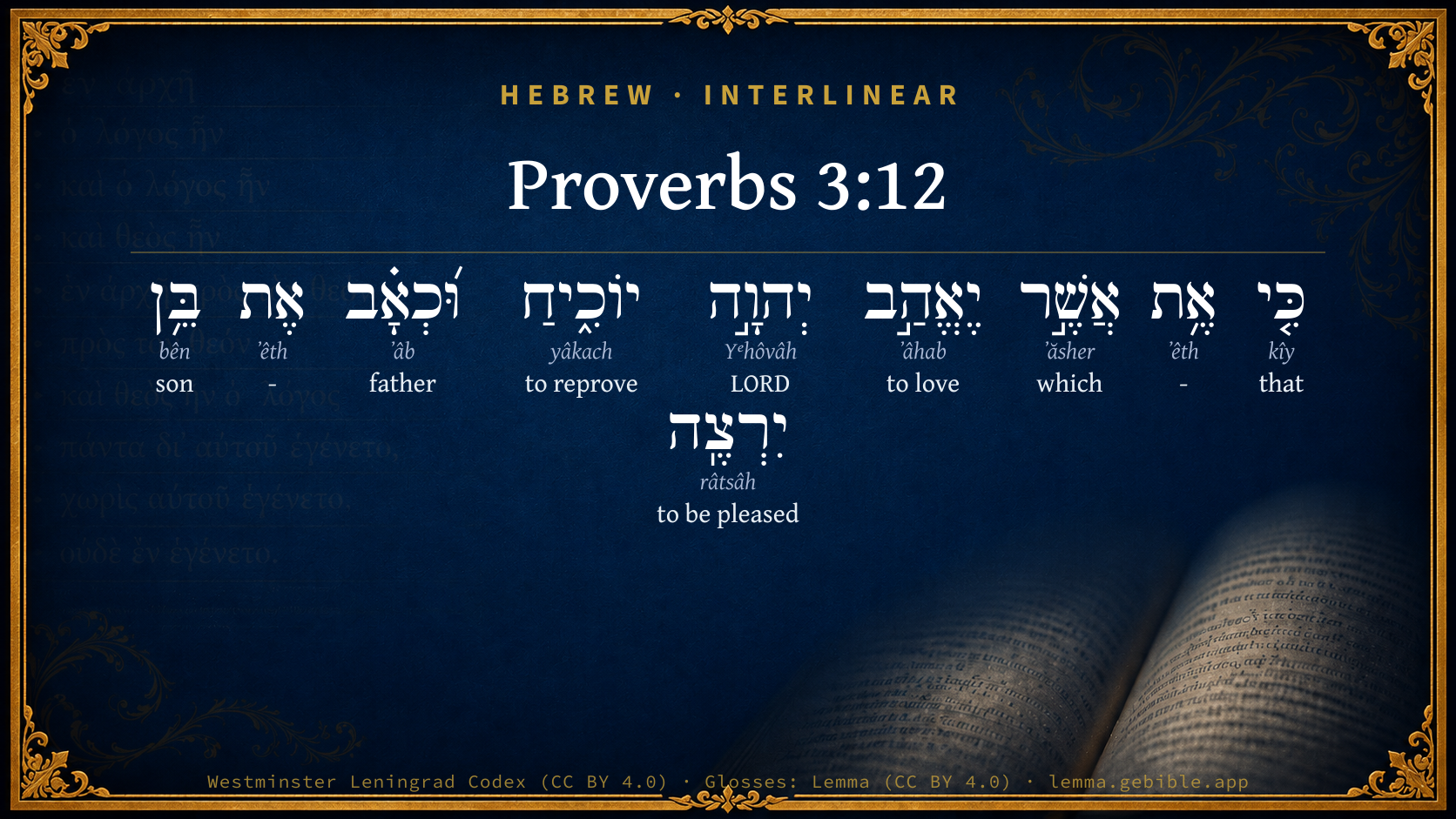
Proverbs 3:12

Hebrew (Westminster Leningrad Codex) Proverbs 3:12 appears in the Hebrew Old Testament. The text above is from the Westminster Leningrad Codex. Each word links to its Strong’s number, a concise gloss, and parsing drawn from the Open Scriptures Hebrew Bible morphology. Click any word for its full Brown-Driver-Briggs (BDB) entry.
Download image
Cite this verse

Proverbs 3:12 (World English Bible). Public Domain. Lemma interlinear Bible study tool, https://lemma.gebible.app/v/proverbs/3/12.

Show BibTeX & RIS
BibTeX
RIS
English Translation
For whom Yahweh loves, he reproves; Even as a father reproves the son in whom he delights.
World English Bible · Public Domain
Download a study sheet

One document with this verse’s original text, its word-by-word gloss line, the meaning frame, cross-references with their text, attributed commentary, and full source and license credits — printable, and it pastes into notes with its structure intact.

This verse Autodidact and up

Study sheet (.html) Plain text (.txt)

A passage Seminary Student

Up to 50 verses in one chapter. A passage sheet keeps up to 6 commentary sources and 12 cross-references per verse, in the order this page ranks them, and says so on the sheet whenever that leaves anything out. Ask for a single verse and you get the Autodidact verse sheet above.

Everything on this page stays free to read, with no account — the sheet is a download of what is already on screen, not access to it.

Want to remove ads? Support Godless Engineer
Compare translations 3

The same verse in 3 English versions, stacked beneath the original-language interlinear above. Click any original word for its lexicon entry.

Each is an independent rendering of the whole verse — the interlinear is not word-aligned to these translations.

Highlighted words mark where these versions differ — a whole-verse word diff, not a word-by-word alignment.

  • World English Bible Public Domain
    For whom Yahweh loves, he reproves; Even as a father reproves the son in whom he delights.
  • King James Version Public Domain
    For whom the LORD loveth he correcteth; even as a father the son in whom he delighteth.
  • unfoldingWord Literal Text CC BY-SA 4.0
    For whom Yahweh loves, he disciplines, and like a father, a son in whom he delights.

unfoldingWord Literal Text — © unfoldingWord, licensed CC BY-SA 4.0. Word-aligned USFM3 via Door43 (git.door43.org/unfoldingWord/en_ult).

Versions to compare (up to 4)

3 of 4 selected

Show all 18 translations

Every available English version of this verse, each an independent rendering of the whole verse.

  • World English Bible Public Domain
    For whom Yahweh loves, he reproves; Even as a father reproves the son in whom he delights.
  • Berean Standard Bible Public Domain
    for the LORD disciplines the one He loves, as does a father the son in whom he delights.
  • Majority Standard Bible Public Domain
    for the LORD disciplines the one He loves, as does a father the son in whom he delights.
  • King James Version Public Domain
    For whom the LORD loveth he correcteth; even as a father the son in whom he delighteth.
  • American Standard Version (1901) Public Domain
    For whom Jehovah loveth he reproveth; Even as a father the son in whom he delighteth.
  • Revised Version (1885) Public Domain
    For whom the LORD loveth he reproveth; even as a father the son in whom he delighteth.
  • Geneva Bible (1599) Public Domain
    For the Lord correcteth him, whome he loueth, euen as the father doeth the childe in whom he deliteth.
  • Douay-Rheims (1899) Public Domain
    For whom the Lord loveth, he chastiseth: and as a father in the son he pleaseth himself.
  • Young's Literal Translation Public Domain
    For whom Jehovah loveth He reproveth, Even as a father the son He is pleased with.
  • Literal Standard Version CC BY-SA 4.0
    For whom YHWH loves He reproves, || Even as a father the son He is pleased with.
  • Unlocked Literal Bible CC BY-SA 4.0
    for Yahweh disciplines those he loves, as a father deals with a son who pleases him.
  • unfoldingWord Literal Text CC BY-SA 4.0
    For whom Yahweh loves, he disciplines, and like a father, a son in whom he delights.
  • Darby Bible Public Domain
    for whom Jehovah loveth he chasteneth, even as a father the son in whom he delighteth.
  • World Messianic Bible Public Domain
    for whom the LORD loves, he corrects, even as a father reproves the son in whom he delights.
  • Webster's Bible Public Domain
    For whom the LORD loveth he correcteth; even as a father the son in whom he delighteth.
  • Free Bible Version CC BY-SA 4.0
    for the Lord corrects those he loves, as a father corrects a son who pleases him.
  • Bible in Basic English Public Domain
    For to those who are dear to him the Lord says sharp words, and makes the son in whom he has delight undergo pain.
  • JPS Tanakh (1917) Public Domain
    For whom the LORD loveth He correcteth, even as a father the son in whom he delighteth.

Literal Standard Version (2020), Covenant Press — licensed CC BY-SA 4.0. Text via the HelloAO Bible API (eBible.org). Unlocked Literal Bible (unfoldingWord) — licensed CC BY-SA 4.0. Text via the HelloAO Bible API (eBible.org). unfoldingWord Literal Text — © unfoldingWord, licensed CC BY-SA 4.0. Word-aligned USFM3 via Door43 (git.door43.org/unfoldingWord/en_ult). Free Bible Version, Dr. Jonathan Gallagher — licensed CC BY-SA 4.0. Text via the HelloAO Bible API (eBible.org).

Word by word

More ways to search: Search by grammar → Find every occurrence → Compare this word →

Practice this passage: Drill this verse → Learn its vocabulary →

יִרְצֶֽה
râtsâh
H7521
“to be pleased”
Verb, Qal, Imperfect, 3rd Person, Masculine, Singular
Part of Speech
Verb
Stem
Qal
Form
Imperfect
Person
3rd Person
Gender
Masculine
Number
Singular
Full BDB Definition

Origin: a primitive root

TWOT: 2207

to be pleased with, be favourable to, accept favourably - (Qal) - to be pleased with, be favourable to - to accept - to be pleased, be determined - to make acceptable, satisfy - to please - (Niphal) to be accepted, be pleased with - (Piel) to seek favour of - (Hiphil) to please, pay off - (Hithpael) to make oneself acceptable or pleasing
  1. כִּ֤י kîy H3588 “that” Conjunction
  2. אֶ֥ת ʼêth H853 “-” Particle, Direct Object
  3. אֲשֶׁ֣ר ʼăsher H834 “which” Particle, Relative
  4. יֶאֱהַ֣ב ʼâhab H157 “to love” Verb, Qal, Imperfect, 3rd Person, Masculine, Singular
  5. יְהוָ֣ה Yᵉhôvâh H3068 “LORD” Noun, Proper
  6. יוֹכִ֑יחַ yâkach H3198 “to reprove” Verb, Hiphil, Imperfect, 3rd Person, Masculine, Singular
  7. וּ֝כְאָ֗ב ʼâb H1 “and · like/as · father” Conjunction + Preposition + Noun, Common, Masculine, Singular, Absolute
  8. אֶת ʼêth H853 “-” Particle, Direct Object
  9. בֵּ֥ן bên H1121 “son” Noun, Common, Masculine, Singular, Absolute

About this verse

These counts appear in no published source. They are computed here, from the morphology-tagged text and Lemma’s own curated glosses. What Lemma adds →

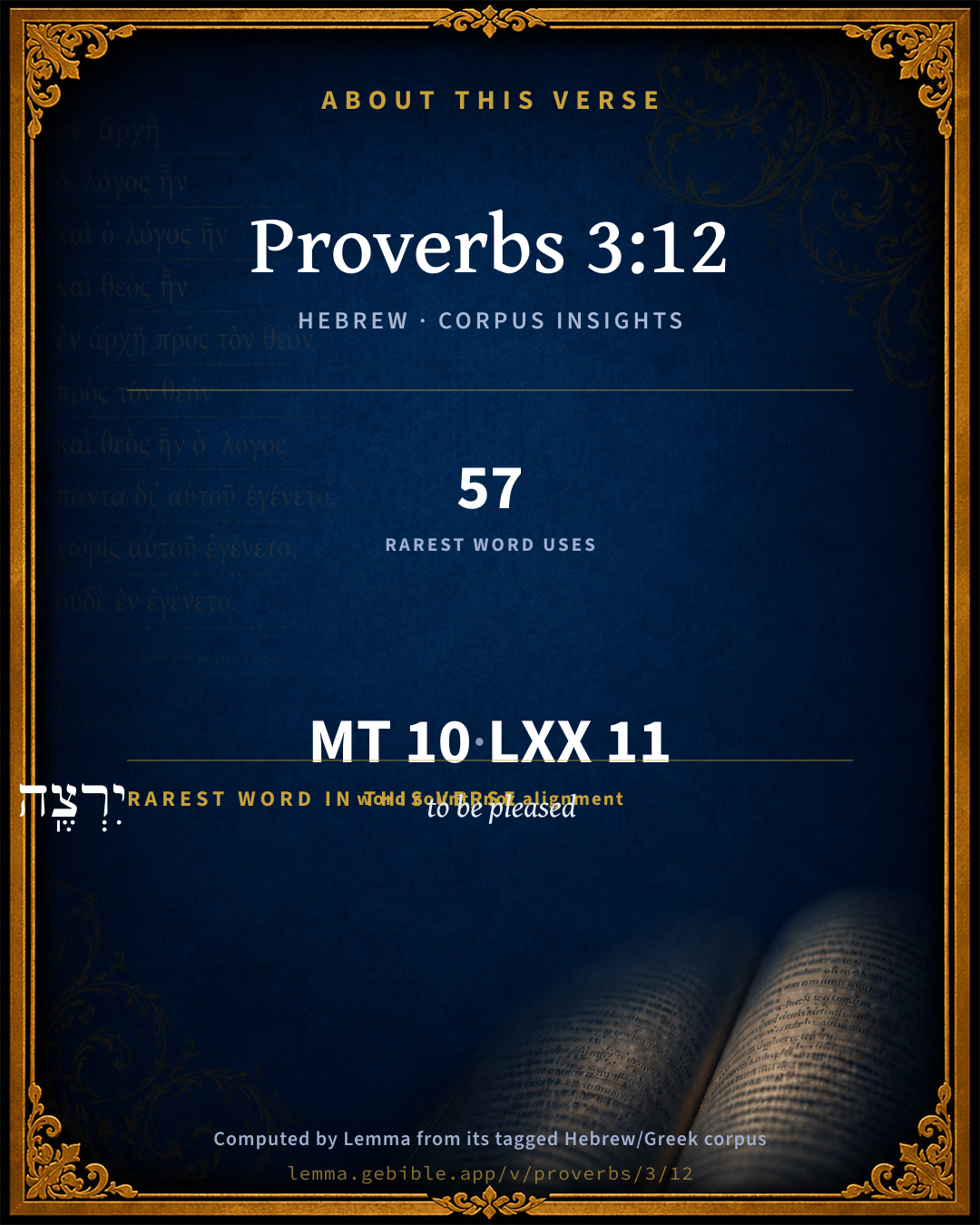
10
words
9
distinct lemmas
Wisdom
section

Shared distinctive vocabulary

יִרְצֶֽה to be pleased H7521 occurs in 55 verses of the Hebrew Bible. Also found in:

Grammatical profile

  • 3 verbs
  • 3 nouns
  • 1 conjunction
  • 3 particles

Verb forms

  • יֶאֱהַ֣ב Qal · Imperfect
  • יוֹכִ֑יחַ Hiphil · Imperfect
  • יִרְצֶֽה Qal · Imperfect

Hebrew & Septuagint length

In English translation the verse runs 17 words from the Hebrew and 14 from the Septuagint (LXX English) — closely comparable.

A rough comparison of the two English renderings, which tokenize alike — not a word-level alignment.

Word counts can differ between the Hebrew and the Greek without any difference in meaning — e.g. the Hebrew direct-object marker אֵת has no separate Greek word, and Greek often adds the article ὁ.

In the original languages it is 10 Hebrew tokens and 11 Greek tokens — but the two are counted differently (Hebrew bundles its prefixes and suffixes into one token; the Greek is in lemma form), so that isn’t a like-for-like length.

Cross-references

5

Topical passages linked to Proverbs 3:12 in the Treasury of Scripture Knowledge — connected by theme and wording, ordered by reader-vote popularity; previews shown in the World English Bible.

  • Deuteronomy 8:5 You shall consider in your heart that as a man chastens his son, so Yahweh your God chastens you.
  • Revelation 3:19 As many as I love, I reprove and chasten. Be zealous therefore, and repent.
  • Proverbs 29:17 Correct your son, and he will give you peace; Yes, he will bring delight to your soul.
  • Proverbs 13:24 One who spares the rod hates his son, But one who loves him is careful to discipline him.
  • Psalms 103:13 Like a father has compassion on his children, So Yahweh has compassion on those who fear him.

Cross-references courtesy of OpenBible.info (CC BY 4.0).

Hebrew and Greek witnesses Masoretic Hebrew ↔ Greek Septuagint

The same verse in the two great witnesses to the Old Testament, shown verse-for-verse.

These are two independent witnesses, not word-aligned to each other, and the Septuagint is shown in lemma (dictionary) form.

Hebrew Proverbs 3:12 Masoretic · Westminster Leningrad Codex

כִּ֤י אֶ֥ת אֲשֶׁ֣ר יֶאֱהַ֣ב יְהוָ֣ה יוֹכִ֑יחַ וּ֝כְאָ֗ב אֶת בֵּ֥ן יִרְצֶֽה

For whom Yahweh loves, he reproves; Even as a father reproves the son in whom he delights.

World English Bible · Public Domain

Greek LXX Proverbs 3:12 Septuagint · lemma form

ὅς γάρ ἀγαπάω κύριος παιδεύω μαστιγόω δέ πᾶς υἱός ὅς παραδέχομαι

for whom the Lord loves, he rebukes, and scourges every son whom he receives.

LXX2012 (modern English Septuagint) · Public Domain

On this verse, Adam Clarke's Commentary discusses the Septuagint’s reading. Read the note in Commentary ↓

Hebrew: Westminster Leningrad Codex (CC BY 4.0). Greek: Septuagint (public domain); English from LXX2012 (modern English Septuagint) (Public Domain). How the Septuagint differs from the Hebrew →

Commentary

Notes on Proverbs 3:12 from classic Christian and Jewish commentators (each source and its license shown beneath its notes). The classic Christian expositions comment on the surrounding passage and are grouped to its opening verse, so a note may address several verses; the Jewish commentaries on the Tanakh (Rashi and others) are per-verse, so they appear only where the commentator wrote on this verse.

Lemma curates 59 commentaries, every one of them public domain or Creative Commons licensed, each selected and text-cleaned for this edition rather than reprinted as found. About our sources →

Trapp's Complete Commentary

John Trapp

Pro 3:12 For whom the LORD loveth he correcteth; even as a father the son [in whom] he delighteth.

Ver. 12. For whom the Lord loveth.] The saints’ afflictions proceed oft from love displeased, offended. And yet we have some now that tell us that God is never displeased with his people, though they fall into adultery, or the like sin, no, not with a fatherly displeasure; that God never chastiseth his people for any sin, no, not with a fatherly chastisement. But he (though a father) doth alter the set of his looks towards his child, who is wanton upon his love, and lets down the diligence of his just observance and duty.

In whom he delighteth.] Quem unice diligit, Whom he cockers above the rest of his children. That son in whom he is well pleased, saith Mercerus; quem approbat, whom he makes his whiteboy. So Theophylact, Qui excipitur a numero flagellatorum, excipitur a numero filiorum. He that escapes affliction, may well suspect his adoption. See my "Love tokens," p. 54,55.

John Trapp, A Commentary or Exposition upon All the Books of the Old and New Testament (1647–1656) — public domain. Text from a community e-Sword module.

The Biblical Illustrator

Joseph S. Exell

Pro_3:12

For whom the Lord loveth He correcteth, even as a father the son in whom he delighteth.

The characteristics of fatherly chastisement

The paternal relation is frequently ascribed to the Almighty, as that in which He stands to His people and servants. This reminds them that they are placed by Him under discipline, and that, if they offend, they must expect to receive chastisement.

I. A father will chastise his son with reluctance. He will try all other means first. When he does chastise it will be as one that yields to a painful necessity. So God does not afflict willingly. We cannot explain the reasons of the distinctions which are made by Divine Providence, apparently without respect to differences of character in the subjects of them. There are circumstances lying too deep for human view, which justify Gods ways.

II. A father will chasten his son with tenderness. He may be severe, he will not be cruel. When God chastens, it is in tenderness; when He sends affliction, He mitigates its severity, and does not permit it utterly to lay waste our comforts. His afflictions leave no permanently injurious effects.

III. A father will chasten his son with a view to his profit. The good of his child is his great and ultimate object. God has many gracious ends to serve by affliction. It may be designed--

1. To restrain us when we are ready to enter on sinful courses.

2. They may operate as seasonable mementoes in regard to the insecurity of our state here, and the necessity of preparing to meet our God.

3. They may be designed to try and call into exercise Christian graces, to wean our affections from the world, to awaken holy desires after God and heaven. (James Henderson, D.D.)

The Biblical Illustrator, edited by Joseph S. Exell (c. 1880s–1900s) — public domain. Text from a community e-Sword module.

Jamieson, Fausset & Brown

Robert Jamieson, A. R. Fausset & David Brown

he delighteth--or receiveth as denoting reconciliation regarding the offense which produced chastisement.

Jamieson, Fausset & Brown — Commentary Critical and Explanatory on the Whole Bible (1871) — public domain (CC PDM 1.0). Text via the HelloAO Bible API.

Adam Clarke's Commentary

Verse 12. Whom the Lord loveth] To encourage thee to bear correction, know that it is a proof of God's love to thee; and thereby he shows that he treats thee as a father does his son, even that one to whom he bears the fondest affection.

The last clause the Septuagint translate μαστιγοι δε παντα υἱον ὁν παραδεχεται, "and chasteneth every son whom he receiveth;" and the apostle, Heb 12:6, quotes this literatim. Both clauses certainly amount to the same sense. Every son whom he receiveth, and the son in whom he delighteth, have very little difference of meaning.

Adam Clarke's Commentary on the Bible (1810–1826) — public domain. Text from a community e-Sword/MySword module.

The Cambridge Bible for Schools and Colleges

gen. ed. J. J. S. Perowne

12. even as a father &c.] The LXX. (reading the same Heb. consonants with different vowels) renders this clause, and scourgeth every son whom he receiveth, which is followed in Heb_12:6.

The R.V., guided perhaps by the direct address, “My son,” Pro_3:11, begins the fresh paragraph there. The thought will then be: Wisdom has been commended to you by the happiness it brings (Pro_3:1-10); but if you have to suffer in the pursuit of it, be not discouraged (Pro_3:11-12); for it is worth the cost (Pro_3:13-20). The argument is in reality continuous, however the paragraphs are arranged.

The Cambridge Bible for Schools and Colleges (gen. ed. J. J. S. Perowne; Cambridge University Press, 1878–1918) — public domain. Text from a community e-Sword module.

John Gill's Exposition

For whom the Lord loveth he correcteth,.... This is a reason why the children of God should not despise corrections, nor be weary of them; since they spring from love, are given in love, nor is there any abatement of it in them: when the Lord chastens and corrects, he does not take away his lovingkindness from them; yea, it is because he loves them that therefore he thus deals with them; wherefore they ought to be patiently bore, and kindly taken by them;

even as a father the son in whom he delighteth; as a father chastens and corrects his son, whom he dearly loves, and has the greatest pleasure in, so the Lord chastens and corrects his people; see Deu 8:5. There is such a relation subsisting between them as that of father and son, which flows from the inexpressible love of God to them; and which is a love of complacency and delight in them, and is invariable and unchangeable, and continues the same under all their afflictions; as appears by what he does for them in them, and by the issue of them; he knows their souls in adversity, and chooses them in the furnace of affliction; he pays love visits to them, and comforts them under all their tribulation; he sympathizes with them, and supports them; he makes their bed in their affliction, and delivers out of it, or takes them to himself: the issue is always his own glory, and their good.

John Gill's Exposition of the Whole Bible (1746–1763) — public domain (CC PDM 1.0). Text via the HelloAO Bible API.

Albert Barnes' Notes on the Bible

The first distinct utterance of a truth which has been so full of comfort to many thousands; it is the summing up of all controversies (compare Joh 9:2) as to the mystery of suffering. The apostle writing to the Hebrews can find no stronger comfort Heb 12:6 than this; the Church, in her visitation service, has no truer message for the sufferer.

Albert Barnes' Notes on the Bible (1834–1885) — public domain. Text from a community e-Sword/MySword module.

Haydock's Catholic Bible Commentary

And as. Septuagint, "but he scourgeth every son whom he receiveth," as St. Paul quotes this passage, Hebrews xii. 6. The verb is now wanting in Hebrew, or ceab; "as a father" may signify "scourgeth, in piel, (Menochius) with i prefixed. (Calmet)

George Leo Haydock (1774–1849), Haydock's Catholic Family Bible and Commentary, 1859 edition — public domain. Excludes Psalms (Douay-Rheims chapter numbering differs from Protestant) and Deuterocanonical books (Catholic canon only).

Matthew Poole's English Annotations

Afflictions are not infelicities, but benefits and comforts, because their are testimonies of God’s love, which is infinitely more desirable than any evil can be terrible. They show God’s purpose, and desire, and care to purge us from our sins, and to make us fit for his presence and kingdom. This and the former verse seem to be here inserted in the midst of his commendations of wisdom, to remove an objection against the excellency and happiness of wise or pious men, taken from those many calamities to which such persons are frequently exposed, the reason of which providence he here giveth.

Matthew Poole's English Annotations on the Holy Bible (1683–1685) — public domain. Text from a community e-Sword/MySword module.

The Pulpit Commentary

In this verse the motive for submissiveness to Jehovah"s corrections is brought forward. They are corrections, but they are the corrections of love. One of the most touching relationships of life, and that with which we are most familiar, viz. that of father and son, is employed to reconcile us to Jehovah"s afflictive dispensations. A comparison is drawn. God corrects those whom he loves after the same manner as a father corrects ("correcteth" has to be understood from the first hemistich) the son whom he loves. The idea of the passage is evidently taken from Deu_8:5, "Thou shalt also consider in thine heart, that as a man chasteneth his son, so the Lord thy God chasteneth thee." The idea of the paternal relationship of God to mankind is found elsewhere, (Jer_31:9 Mal_2:10) and especially finds expression in the Lord"s prayer. When the truth of this passage is learned, we shall be drawn to, rather than repelled from, God by his corrections. The gracious end of earthly trials is expressed in Heb_12:6, Heb_12:2; cf. Rom_5:3-5 2Co_4:17 (Wardlaw). "These gracious words (Heb 12) are written in Holy Scripture for our comfort and instruction; that we should patiently and with thanksgiving bear our heavenly Father"s correction, whensoever by any manner of adversity it shall please his gracious goodness to visit us" (see Visitation Office). Even as a father the son in whom he delighteth ( vuk"av eth-ben yir"tseh); literally, even as a father the son be delighteth in. Various renderings have been given to this passage.

(1) Delitzsch, De Wette, et al., agree with the Authorized Version, and take w vav, as explicative, and yir"tseh, "in whom he delighteth," as a relative sentence. The w is used in this explanatory sense in 1Sa_28:3 (see Gesenius, 1 a). The relative usher, "whom," is omitted in the original, according to the rule that the relative is omitted, especially in poetry, where it would stand as a pronoun in the nominative or accusative case. (comp. Psa_7:16, "And he falls into the pit which he made;" and Pro_5:13) We have the same elision of the relative in the English colloquial expression, "the friend I met" (see Gesenius, a ).

(2) Hitzig and Zockler translate, "and holds him dear as a father his son." This, though grammatically correct, does not preserve the parallelism. It serves only to expand the idea of love, whereas the predominant idea of the verse is that of correction, to which love is an accessory idea (see Delitzsch). For similar parallels, see Deu_8:5 as before, and Psa_103:13. In the comparison which is instituted, yir"tseh, "in whom he delighteth," corresponds with eth asher ye"hav y"hovah, "whom the Lord loveth," and not with yokiah, "correcteth.

(3) Kamph translates, "and (dealeth) as a father (who) wisheth well to his son." This is substantially the same as the Authorized Version, except that in the relative sentence "son" is made accusative after yir"tseh, here translated, "wisheth well to," and the emitted relative (asher) is placed in the nominative instead of the accusative case.

(4) The variation in the LXX, mastigoi de panta uion on paradecetai , "and scourgeth every son whom he rcceiveth," cited literally in Heb_12:5, evidently arises from the translators having read baeky, (yakev ), "he scourgeth" for bakeW (vuk"av), "even as a father." It will be seen that this alteration could be easily effected by a change in the Masoretic pointing.

(5) The Vulgate renders, et quasi pater in filio complacet sibi. He delighteth; yir"tseh is from ratsah, "to be delighted" with any person or thing.

Vers. 11, 12. Patience in affliction.

Well does this lesson contrast with the preceding picture of prosperity and opulence.

I THE RELIGIOUS VIEW OF SUFFERING.

1. It is not a dark doom, a cruel fate, a Blind necessity of things. Such were the ideas of the heathen.

2. Its cause may be known. This is ever a great solace to be persuaded that our troubles lie in the reason of things, that nothing is chance or caprice.

3. That cause is in the Divine mind and will. The power of God is manifested in our suffering; we are but as the clay on the potter"s wheel. Still more the love of God is manifested in our suffering. There is always some mitigation accompanying it. "It might have been worse" may be said of every pain. It serves as the foil to set off some greater good. "The ring may be lost, but the finger remains," as the Spanish proverb says.

4. The object or final cause of suffering. Purification from inward evil; correction of faults. The mind grows of itself; the schoolmaster can do little more than point out and correct faults. So with life"s education from the religious point of view. And the most fertile minds need most; the discipline of suffering. The pruning knife is not applied to the puny plant; languid minds are the least touched by affliction. In these adjustments, love is still revealed.

5. Suffering must be viewed under the analogy of the parental and filial relation. Let these words once become clear, Father, son, in their application to God"s relation to us, and ours to him, and the theory of suffering is mastered. (comp. Deu_8:5 Psa_118:18 Lam_3:31-33)

II THE RELIGIOUS TEMPER UNDER SUFFERING.

1. Humility. No indignant questioning, scornful recalcitration, proud efforts of stoical fortitude. These will but defeat or delay the end. The medicine benefits not if the patient sets his mind against it as unneeded.

2. Patient endurance. Perseverance in a passive, receptive, attitude is far more difficult than perseverance in activity. We haste to snatch at good. But God is never in haste. His processes are slow. And to receive their benefit we must learn the wisdom of the word "wait." While we are thus waiting, things are not at a standstill; God is working, producing a spiritual shape out of the passive material. "Maker, remake, complete, I trust what thou shalt do! (R. Browning"s noble poem, "Rabbi Ben Ezra.") J.

The Pulpit Commentary (1880–1919), ed. H.D.M. Spence-Jones & Joseph S. Exell — public domain. Text from a community e-Sword module.

Rashi

Rabbi Shlomo Yitzchaki (Rashi)

as a father placates his son He desires to benefit his son and he placates him after striking him with the staff. So will the benefit be pleasant to you after the smiting.

Rashi on the Tanakh — English translations: “The Judaica Press complete Tanach with Rashi, translated by A. J. Rosenberg” (CC BY 4.0); “Pentateuch with Rashi's commentary by M. Rosenbaum and A.M. Silbermann, 1929-1934” (public domain); “The Metsudah Tanach series, Lakewood, N.J” (CC BY 4.0); and “The Book of Joshua, Metsudah Publications, 1997” (CC BY 4.0). Text via Sefaria.

Lesson kit

Teaching starters — assembled from the data on this page, not authored interpretation. Every prompt links to the verse data it draws on. Edit before teaching.

Proverbs, in the Wisdom, opens this verse with 10 words (9 distinct Hebrew lemmas). Its most distinctive word is râtsâh (“to be pleased”). A historical commentator’s framing appears above. Read the whole chapter for the surrounding context.

Discussion questions

  1. How does “to be pleased” (râtsâh) shape what this verse is saying?
  2. How does Genesis 33:10, which shares the word «to be pleased», read alongside this verse?
  3. The translations on this page render this verse differently — a whole-verse word diff, not a word-by-word alignment. What might account for the different wordings?
  4. «יֶאֱהַ֣ב» is a Qal Imperfect verb. How does that grammatical form shape the action described?
  5. Compare how Trapp's Complete Commentary and The Biblical Illustrator read this verse. Where do they agree or differ?

Things to notice

Reading settings

Reading text

Shown beneath each verse's original-language words.

Old Testament
Old Testament edition

Read the OT as the Masoretic Hebrew (MT) or the Greek Septuagint (LXX).

English shown for the Greek Septuagint (in the Hebrew ↔ Greek comparison).

Comparing translations? Open the Compare panel on any verse page to stack up to four side by side.