Zechariah 13:6

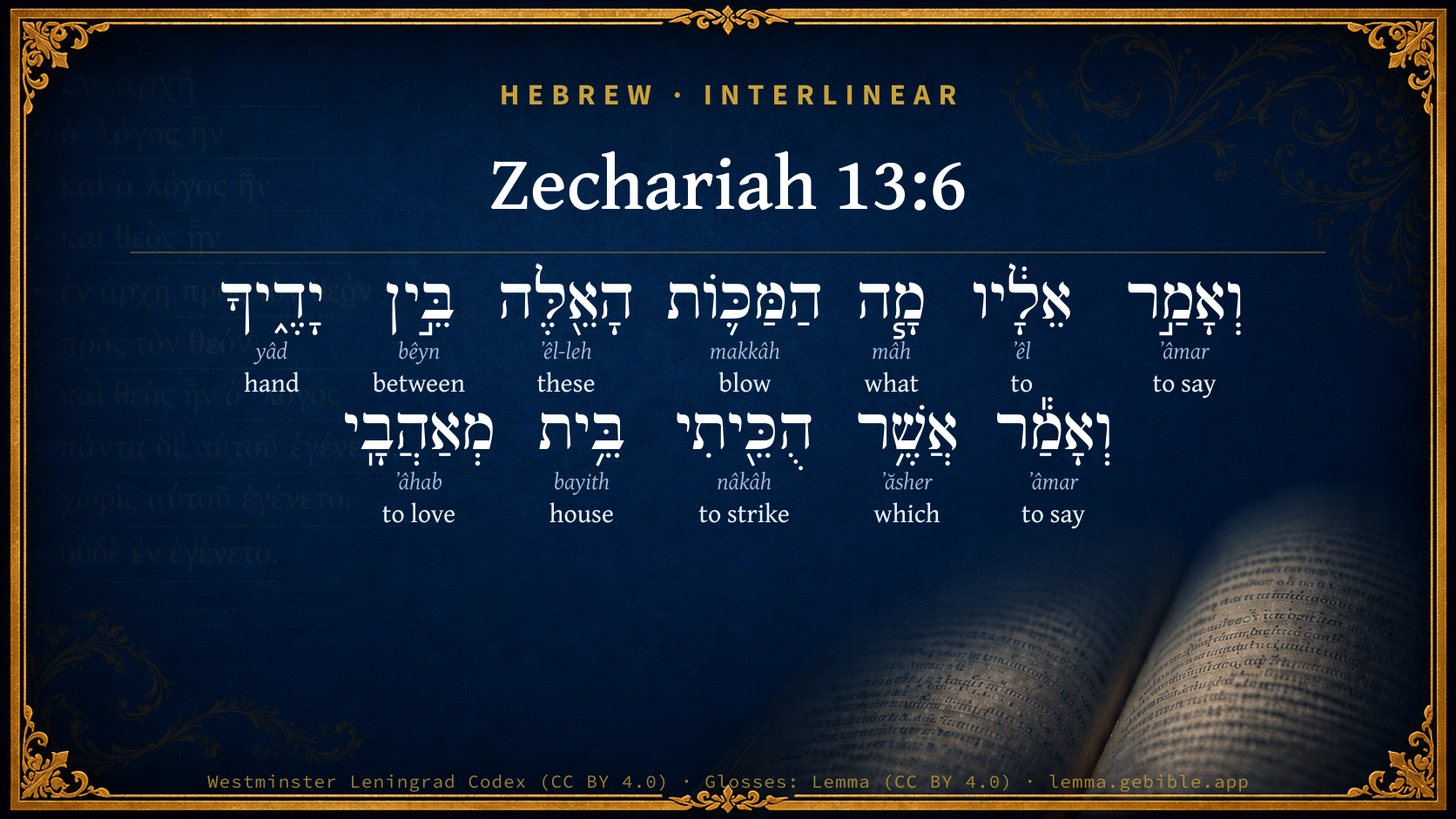
Hebrew (Westminster Leningrad Codex) Zechariah 13:6 appears in the Hebrew Old Testament. The text above is from the Westminster Leningrad Codex. Each word links to its Strong’s number, a concise gloss, and parsing drawn from the Open Scriptures Hebrew Bible morphology. Click any word for its full Brown-Driver-Briggs (BDB) entry.
Download image
Cite this verse

Zechariah 13:6 (World English Bible). Public Domain. Lemma interlinear Bible study tool, https://lemma.gebible.app/v/zechariah/13/6.

Show BibTeX & RIS
BibTeX
RIS
English Translation
One will say to him, 'What are these wounds between your arms?' Then he will answer, 'Those with which I was wounded in the house of my friends.'
World English Bible · Public Domain
Download a study sheet

One document with this verse’s original text, its word-by-word gloss line, the meaning frame, cross-references with their text, attributed commentary, and full source and license credits — printable, and it pastes into notes with its structure intact.

This verse Autodidact and up

Study sheet (.html) Plain text (.txt)

A passage Seminary Student

Up to 50 verses in one chapter. A passage sheet keeps up to 6 commentary sources and 12 cross-references per verse, in the order this page ranks them, and says so on the sheet whenever that leaves anything out. Ask for a single verse and you get the Autodidact verse sheet above.

Everything on this page stays free to read, with no account — the sheet is a download of what is already on screen, not access to it.

Want to remove ads? Support Godless Engineer
Compare translations 3

The same verse in 3 English versions, stacked beneath the original-language interlinear above. Click any original word for its lexicon entry.

Each is an independent rendering of the whole verse — the interlinear is not word-aligned to these translations.

Highlighted words mark where these versions differ — a whole-verse word diff, not a word-by-word alignment.

  • World English Bible Public Domain
    One will say to him, 'What are these wounds between your arms?' Then he will answer, 'Those with which I was wounded in the house of my friends.'
  • King James Version Public Domain
    And one shall say unto him, What are these wounds in thine hands? Then he shall answer, Those with which I was wounded in the house of my friends.
  • unfoldingWord Literal Text CC BY-SA 4.0
    And will say to him, ‘What these wounds between your hands?’ And he will say, ‘These are the wounds with which I was struck in the house of the ones loving me.’

unfoldingWord Literal Text — © unfoldingWord, licensed CC BY-SA 4.0. Word-aligned USFM3 via Door43 (git.door43.org/unfoldingWord/en_ult).

Versions to compare (up to 4)

3 of 4 selected

Show all 18 translations

Every available English version of this verse, each an independent rendering of the whole verse.

  • World English Bible Public Domain
    One will say to him, 'What are these wounds between your arms?' Then he will answer, 'Those with which I was wounded in the house of my friends.'
  • Berean Standard Bible Public Domain
    If someone asks him, ‘What are these wounds on your chest?’ he will answer, ‘These are the wounds I received in the house of my friends.’
  • Majority Standard Bible Public Domain
    If someone asks him, ‘What are these wounds on your chest?’ he will answer, ‘These are the wounds I received in the house of my friends.’
  • King James Version Public Domain
    And one shall say unto him, What are these wounds in thine hands? Then he shall answer, Those with which I was wounded in the house of my friends.
  • American Standard Version (1901) Public Domain
    And one shall say unto him, What are these wounds between thine arms? Then he shall answer, Those with which I was wounded in the house of my friends.
  • Revised Version (1885) Public Domain
    And one shall say unto him, What are these wounds between thine arms? Then he shall answer, Those with which I was wounded in the house of my friends.
  • Geneva Bible (1599) Public Domain
    And one shall say vnto him, What are these woundes in thine hands? Then he shall answere, Thus was I wounded in the house of my friendes.
  • Douay-Rheims (1899) Public Domain
    And they shall say to him: What are these wounds in the midst of thy hands? And he shall say: With these I was wounded in the house of them that loved me.
  • Young's Literal Translation Public Domain
    And `one' hath said unto him, `What `are' these wounds in thy hands?' And he hath said, `Because I was smitten `at' home by my lovers.'
  • Literal Standard Version CC BY-SA 4.0
    And [one] has said to him, || What [are] these wounds in your hands? And he has said, Because I was struck [at] home by my lovers.
  • Unlocked Literal Bible CC BY-SA 4.0
    But someone will say to him, 'What are these wounds between your arms?' and he will answer, 'I was wounded with those in my friends' house.'”
  • unfoldingWord Literal Text CC BY-SA 4.0
    And will say to him, ‘What these wounds between your hands?’ And he will say, ‘These are the wounds with which I was struck in the house of the ones loving me.’
  • Darby Bible Public Domain
    And one shall say unto him, What are those wounds in thy hands? And he will say, Those with which I was wounded in the house of my friends.
  • World Messianic Bible Public Domain
    One will say to him, ‘What are these wounds between your arms?’ Then he will answer, ‘Those with which I was wounded in the house of my friends.’
  • Webster's Bible Public Domain
    And one shall say to him, What are these wounds in thy hands? Then he shall answer, Those with which I was wounded in the house of my friends.
  • Free Bible Version CC BY-SA 4.0
    If somebody asks him, “What are those wounds on your back?” he will answer, “I was wounded in my friend's house.”
  • Bible in Basic English Public Domain
    And if anyone says to him, What are these wounds between your hands? then he will say, Those with which I was wounded in the house of my friends.
  • JPS Tanakh (1917) Public Domain
    And one shall say unto him: 'What are these wounds between thy hands?' Then he shall answer: 'Those with which I was wounded in the house of my friends.'

Literal Standard Version (2020), Covenant Press — licensed CC BY-SA 4.0. Text via the HelloAO Bible API (eBible.org). Unlocked Literal Bible (unfoldingWord) — licensed CC BY-SA 4.0. Text via the HelloAO Bible API (eBible.org). unfoldingWord Literal Text — © unfoldingWord, licensed CC BY-SA 4.0. Word-aligned USFM3 via Door43 (git.door43.org/unfoldingWord/en_ult). Free Bible Version, Dr. Jonathan Gallagher — licensed CC BY-SA 4.0. Text via the HelloAO Bible API (eBible.org).

Word by word

More ways to search: Search by grammar → Find every occurrence → Compare this word →

Practice this passage: Drill this verse → Learn its vocabulary →

הַמַּכּ֛וֹת
makkâh
H4347
“the · blows”
Particle, Definite Article + Noun, Common, Feminine, Plural, Absolute
Part of Speech
Particle + Noun
Type
Common
Gender
Feminine
Number
Plural
State
Absolute
Full BDB Definition

Origin: from H5221

TWOT: 1364d

blow, wound, slaughter - blow, stripe - beating, scourging - wound - slaughter - defeat, conquest - plague
  1. וְאָמַ֣ר ʼâmar H559 “and · to say” Conjunction + Verb, Qal, Sequential Perfect, 3rd Person, Masculine, Singular
  2. אֵלָ֔יו ʼêl H413 “to · him” Preposition + Suffix, Personal, 3rd Person, Masculine, Singular
  3. מָ֧ה mâh H4100 “what” Particle, Interrogative
  4. הָאֵ֖לֶּה ʼêl-leh H428 “the · these” Particle, Definite Article + Pronoun, Demonstrative, Common, Plural
  5. בֵּ֣ין bêyn H996 “between” Preposition
  6. יָדֶ֑יךָ yâd H3027 “hands · your” Noun, Common, Both, Dual, Construct + Suffix, Personal, 2nd Person, Masculine, Singular
  7. וְאָמַ֕ר ʼâmar H559 “and · to say” Conjunction + Verb, Qal, Sequential Perfect, 3rd Person, Masculine, Singular
  8. אֲשֶׁ֥ר ʼăsher H834 “which” Particle, Relative
  9. הֻכֵּ֖יתִי nâkâh H5221 “to strike” Verb, Hophal, Perfect, 1st Person, Common, Singular
  10. בֵּ֥ית bayith H1004 “house of” Noun, Common, Masculine, Singular, Construct
  11. מְאַהֲבָֽי ʼâhab H157 “loving · me” Verb, Piel, Participle Active, Masculine, Plural, Construct + Suffix, Personal, 1st Person, Common, Singular

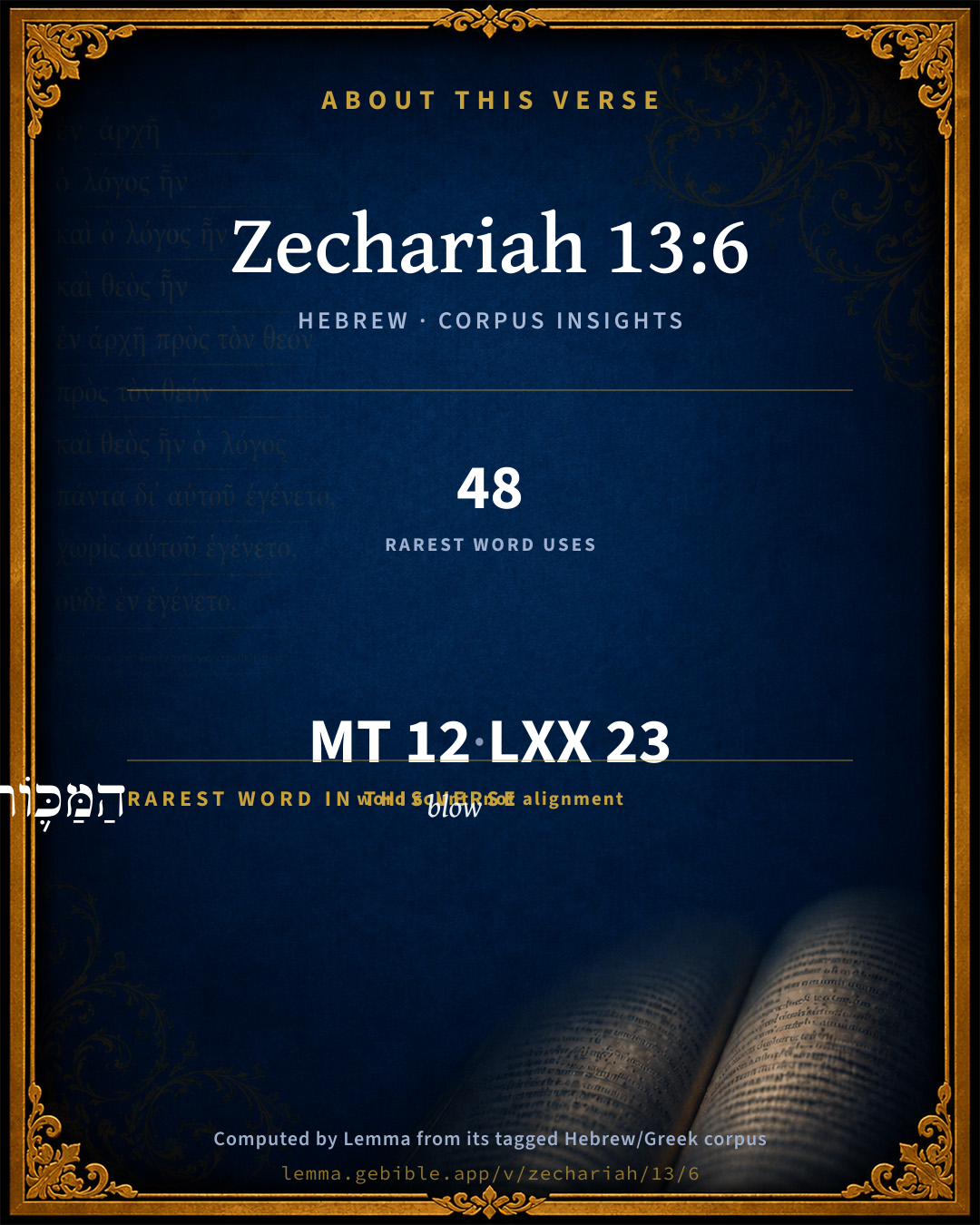
About this verse

These counts appear in no published source. They are computed here, from the morphology-tagged text and Lemma’s own curated glosses. What Lemma adds →

12
words
11
distinct lemmas
Prophets
section

Shared distinctive vocabulary

הַמַּכּ֛וֹת blow H4347 occurs in 46 verses of the Hebrew Bible. Also found in:

Grammatical profile

  • 4 verbs
  • 3 nouns
  • 1 pronoun
  • 2 prepositions
  • 2 particles

Verb forms

  • וְאָמַ֣ר Qal · Sequential Perfect
  • וְאָמַ֕ר Qal · Sequential Perfect
  • הֻכֵּ֖יתִי Hophal · Perfect
  • מְאַהֲבָֽי Piel · Participle Active

Repetition

A word recurs within this verse — often emphatic in Hebrew:

  • וְאָמַ֣ר to say H559 ×2

Hebrew & Septuagint length

In English translation the verse runs 28 words from the Hebrew and 27 from the Septuagint (LXX English) — closely comparable.

A rough comparison of the two English renderings, which tokenize alike — not a word-level alignment.

Word counts can differ between the Hebrew and the Greek without any difference in meaning — e.g. the Hebrew direct-object marker אֵת has no separate Greek word, and Greek often adds the article ὁ.

In the original languages it is 12 Hebrew tokens and 23 Greek tokens — but the two are counted differently (Hebrew bundles its prefixes and suffixes into one token; the Greek is in lemma form), so that isn’t a like-for-like length.

Cross-references

5

Topical passages linked to Zechariah 13:6 in the Treasury of Scripture Knowledge — connected by theme and wording, ordered by reader-vote popularity; previews shown in the World English Bible.

  • John 18:35 Pilate answered, "I'm not a Jew, am I? Your own nation and the chief priests delivered you to me. What have you done?"
  • Psalms 22:16 For dogs have surrounded me. A company of evil-doers have enclosed me. They pierced my hands and my feet.
  • Proverbs 27:5–6 Better is open rebuke Than hidden love.
  • John 19:14–16 Now it was the Preparation Day of the Passover, at about the sixth hour. He said to the Jews, "Behold, your King!"
  • Revelation 14:11 The smoke of their torment goes up forever and ever. They have no rest day and night, those who worship the beast and his image, and whoever receives the mark of his name.

Cross-references courtesy of OpenBible.info (CC BY 4.0).

Hebrew and Greek witnesses Masoretic Hebrew ↔ Greek Septuagint

The same verse in the two great witnesses to the Old Testament, shown verse-for-verse.

These are two independent witnesses, not word-aligned to each other, and the Septuagint is shown in lemma (dictionary) form.

Hebrew Zechariah 13:6 Masoretic · Westminster Leningrad Codex

וְאָמַ֣ר אֵלָ֔יו מָ֧ה הַמַּכּ֛וֹת הָאֵ֖לֶּה בֵּ֣ין יָדֶ֑יךָ וְאָמַ֕ר אֲשֶׁ֥ר הֻכֵּ֖יתִי בֵּ֥ית מְאַהֲבָֽי

One will say to him, 'What are these wounds between your arms?' Then he will answer, 'Those with which I was wounded in the house of my friends.'

World English Bible · Public Domain

Greek LXX Zechariah 13:6 Septuagint · lemma form

καί εἶπον πρός αὐτός τίς ὁ πληγή οὗτος ἀνά μέσος ὁ χείρ σύ καί εἶπον ὅς πλήσσω ἐν ὁ οἶκος ὁ ἀγαπητός ἐγώ

And I will say to him, What are these wounds between your hands? and he shall say, Those with which I was wounded in my beloved house.

LXX2012 (modern English Septuagint) · Public Domain

On this verse, The Pulpit Commentary discusses the Septuagint’s reading. Read the note in Commentary ↓

Hebrew: Westminster Leningrad Codex (CC BY 4.0). Greek: Septuagint (public domain); English from LXX2012 (modern English Septuagint) (Public Domain). How the Septuagint differs from the Hebrew →

Targum (Aramaic paraphrase)

1

The Targum is the ancient Jewish Aramaic paraphrase of the Hebrew Scriptures — an interpretive translation, not the Hebrew text itself. Onkelos (literal) and Pseudo-Jonathan (expansive) render the Torah, and Jonathan the Prophets. Coverage is partial: where no permissively-licensed English translation exists for a verse, only the Aramaic is shown. This is verse-level text, not a word-by-word alignment to the Hebrew.

  1. Targum Jonathan Prophets (Joshua–Malachi)
    וְיֵימַר לֵיהּ מָה מְחָתָא הָאִלֵין דַאֲתָאָה עֲלָנָא הֲלָא בְּעוֹבָדֵי יְדָךְ וְיֵימַר יָאוּת לָקֵינָא בְּחוֹבִין דְרַחֲמָנָא:

    (no public-domain English translation for this verse)

    Targum Jonathan — Aramaic: “Mikraot Gedolot” (public domain). English: “Sefaria Community Translation” (CC0 1.0 (public-domain dedication)); “London "Chaldee Paraphrase," 1871” (public domain). Text via Sefaria.

Commentary

Notes on Zechariah 13:6 from classic Christian and Jewish commentators (each source and its license shown beneath its notes). The classic Christian expositions comment on the surrounding passage and are grouped to its opening verse, so a note may address several verses; the Jewish commentaries on the Tanakh (Rashi and others) are per-verse, so they appear only where the commentator wrote on this verse.

Lemma curates 59 commentaries, every one of them public domain or Creative Commons licensed, each selected and text-cleaned for this edition rather than reprinted as found. About our sources →

Trapp's Complete Commentary

John Trapp

Zec 13:6 And [one] shall say unto him, What [are] these wounds in thine hands? Then he shall answer, [Those] with which I was wounded [in] the house of my friends.

Ver. 6. And one shall say unto him, What are these wounds in thine hands?] Jerome here supposeth the false prophet crucified for his false doctrine, and thereupon thus questioned. This is better than that of the Popish interpreters, who will needs have it to be meant of Christ, and of his wounds on the cross, as a deceiver of the people, Oπλανος, Mat 27:63, that deceiver to our very faces (Eustath.). Lucian the atheist villanously termeth him εσκολοπισμενον σοφιστην, the crucified deceiver; but the text is clear that the person here spoken to, and returning an answer, is the false prophet, now a true convert; as appeareth by his fruits, which he bears quick and thick; being like Aaron’s rod, soon changed from a withered stick into a flourishing tree. Ashamed he is at heart of his former falsities; and as in heart, so in habit he is altered; for he will no longer wear a rough garment, the garb of prophets in those days, to deceive, as the Capuchins and other orders of friars, or rather liars, at this day, 2Ki 1:8 Isa 20:2 Mat 3:4. He abrenounceth and abjureth, quasi conceptis verbis, his former profession of a prophet or chief speaker among others.

I am no prophet] But a plain husbandman, or a shepherd; that is all I can truly pretend to. And lastly, in this verse, having passed through the Church’s discipline as a seducer, he shall do as Joshua advised Achan, Give glory to the Lord my son, and confess thy sin, Jos 7:19; he shall approve of the Church’s severity used for his correction, though he should go maimed or marked for it to his dying day. In point of seducement (saith Mr Cotton, descanting upon this text), if a man upon conviction shall see the wickedness of his way, and humble his soul before God, and give satisfaction to the Church and State where he shall be convinced, on such conviction and repentance we find liberty to pardon, but yet stigmatize him. But what reason had the convocation held at Oxford to set a brand of ignominy upon the cheeks of those outlandish divines that came to assist them, because they pleased them not in the point of priests’ marriage, which they defended? Or Bishop Laud for his Stigmata Landis on renowned Mr Prinne, for his constancy to the truth? How much better his predecessors, Stephen Langton, who crucified that pseudo Christ, who showed marks of wounds in his hands, feet, and sides, A.D. 1206, and Odo Severus, who burnt King Edwin’s concubine (whom he most doted on) in the forehead with a hot iron, and banished her into Ireland, A. D. 934.

John Trapp, A Commentary or Exposition upon All the Books of the Old and New Testament (1647–1656) — public domain. Text from a community e-Sword module.

The Biblical Illustrator

Joseph S. Exell

Zec_13:6

What are these wounds in Thine hands?

The Christianising of Christianity

Christ, or Christianity--the system of thought and life which bears the name of Christ--has been injured by its friends, more, perhaps, than by its enemies. The process of Christianising modern Christianity is a process of purification, of elimination, of dropping what is inferior, of what is a mere misrepresentation; a process of exalting those great spiritual principles that Christ brought into the world, and for which He gave His life. The question is asked, Why is it that Christianity has not yet conquered the world? Christianity did not succeed in the East, its triumphs were only in the West, and we are hearing on every hand today that the forces of Christianity in the Western World seem to be spent. We are even told it is not holding its own against the advancing intelligence of Europe and America. I dont believe these objections are true. I believe real Christianity is conquering and has conquered. I believe that real Christianity is holding its own against this advancing intelligence. I do but mention these objections to call attention to the process that is going on in these days--the process of eliminating from this current popular Christianity that which is unreal in it, and does not belong to it. The first great mistake of the Church was the association of Christianity with the State. Christianity ceasing to be a spiritual religion, and becoming simply a political system allied to the existing Government. Christianity was made into a vast secularised power. Hardly had Christianity time to show what was in it, and what it could do, than the stormy barbarisms of Europe broke upon it, and a wild sea of barbarian tribes surged and heaved where once the cultured fields of the Old World had been. There was thus destruction of civilisation, and there could be no greater proof of the vitality that was at the heart of Christianity, than the fact that after this storm had spent itself, the Church was the only power that raised its head. The sight that met the Church might have appalled the stoutest heart. Half-naked savages were masters of the world. As we look back on the conversion of the barbarians, it was very wonderful, but at the same time most unsatisfactory. It is idle to blame the past. It is the very genius of Christianity to take the world as it finds it, and bring out of its evils and errors some love of goodness and truth. Hallam says, Had religion been more pure, it would have been less permanent, and Christianity has been saved by means of its corruptions. The corruptions of medievalism encased the spiritual truths of Christ which were too pure and lofty for that generation to receive. The Church consecrated almost all the ceremonies of the barbarians, and absorbed a great many of their superstitions. Medieval Christianity is not the Christianity of Christ. It is an amalgam; a union of three things,--the simplicity of Christ; Roman imperialism; and barbarian superstitions. There was, at the time of the Reformation, a great protest against Roman imperialism, and a grave protest against the barbarian superstitions; and these protests are going on today. On the political side it is going on in all Protestant countries. On the religious side, it is the movement which aims to bring to the front what is distinctively Christian. So that when it is said that Christianity has spent its force in the West, that it is not holding its own against advancing intelligence, that missionary triumphs are not so great today as in the apostolic era, we must remember that Christianity has not yet had time to free itself from the alliance with the State, nor yet had time to free itself from barbarian superstitions; and that this process is going on today. It is a process that we can all see going on before our eyes. (K. C. Anderson, D. D.)

Christ wounded in the house of His friends

Wittingly or unwittingly, through a culpable negligence or haste, Christ is wounded in His cause, or in His spiritual body, in the house of His friends.

1. He is wounded when Christians grow cold in zeal, slack in duty, or forgetful of their solemn vows. They show indifference, ingratitude, selfishness.

2. When His cause is injured by the unbecoming conduct of His followers. Scandal in the Church is scandal heaped upon His name.

3. When indifference is shown by them to the success of the instrumentalities by which His cause is promoted. These instrumentalities are vital with Christ, as though His blood flowed through them, and His voice spake by them, and His heart beat in them. He is in the word, the sermon, the prayer, the praise.

4. By inattention to the Gospel, with its messages of duty, its invitations and exhortations.

5. By their lack of sympathy and cooperation within their sphere, with the institutions of charitable beneficence for the spread of the Gospel.

6. When Christians, instead of keeping the unity of the spirit in the bond of peace, treat one another with superciliousness and bitterness; when their intercourse is not marked by that gentleness and forbearance which the Gospel requires. Here looks may be daggers, and words blows. And are there not those who, by inconsistent conduct, by neglect of the ordinances of the sanctuary, by worldliness, by passion, by unbrotherly feeling and act, dishonour their profession, disregard their solemn vows, and do injury to the cause of Christ? Is it not a fact, that all the assaults of infidelity, all the rage of profanity, all the recklessness of vice and crime, do far less to check the power of the Gospel than the scandals and offences of professed disciples? (E. H. Gillet.)

The unkindness of friends

I. Who is the person mentioned as being wounded? No other than the great God, our Creator and Redeemer, the Man Christ Jesus. It was this mysterious man, this God-man, of whom the prophet inquires in the words of our text, What are these wounds in Thy hands?

II. What is meant by being wounded in the house of his friends? This fair world is meant by the house of His friends. All things were made by Him. The house of His friends was His own house; He built it for them; He came into it because He had a right to; He came into it to do them good, to save them from their wickedness and woe; but they wounded Him, and cast Him out. You all know the history of the Divine Jesus, who was wounded for our transgressions. In what sense can they be called His friends who used Him thus? I may call a man my friend in one or both of two senses.

1. Because he acts a friendly part towards me, though I have not deserved it; or,

2. Because I act a friendly part towards him, though he has not deserved it. A man may be a friend to me; or I may be a friend to him. Christ calls us friends, because He was a friend to us, though we were no friends to Him.

III. What is meant by its being mentioned that He was wounded in the hands? By the feet are signified the ways or goings of a man, his moral conduct. By the hands are signified the works of a man, or the deeds of his life in general. The hands are the instruments of the heart, or will, or mind, or soul. In the house of His friends, Jesus was taunted with all His good deeds. His hands were pierced, because He wrought His Fathers will; and His feet were nailed because He chose His Fathers ways.

IV. What think you of the Creator and Proprietor of the world being thus dealt with by His ungrateful creatures? Nevertheless, He deigns to designate them by the gracious name of friends. What think you of the human beings who could persecute to death the benefactor that was come to bless them, to buy them with His blood? Can you possibly be guilty of their crime? Every evil deed you do crucifies the Lord of Glory. (W. H. Henslowe, M. A.)

Wounded by friends

The prophet says, that such would be the discipline among the new people after having repented that each in his own house would chastise his sons and relatives: and it is an evidence of perfect zeal, when not only judges perform their office in correcting wickedness, but when also private individuals assist to preserve public order, each according to his power. We may gather from the answer what proves true repentance. Say will one (it is put in definitely), or it will be said, What mean these wounds in Thine hands? Then He will say, I have been stricken by My friends. The prophet shows that those who had previously deceived the people, would become new men, so as patiently to bear correction; though it might seem hard when the hands are wounded and pierced, yet he says that the punishment, which was in itself severe, would yet be counted mild, for they would be endued with such meekness as willingly to bear to be corrected. Some apply this to Christ, because Zechariah has mentioned wounds on the hands; but this is very puerile; for it is quite evident that he speaks here of false teachers, who had for a time falsely pretended Gods name. As then they say, that they were friends by whom they were smitten, they acknowledge themselves worthy of such punishment, and they murmur not, nor set up any complaint. (Marckins, Adam Clarke, and Henderson, agree with Calvin in repudiating the notion that this verse is to be understood of the Crucifixion of our Saviour,--a notion commonly entertained by papal expositors.) (John Calvin.)

Wounded by friends

There is no wound so painful as the wound inflicted by a familiar friend. The secret devices of the hireling may be anticipated. The blows of an avowed foe can be healed. The neglect of the proudly indifferent can be endured. But the slight of a friend, the faithlessness of the lover, inflicts a wound for which earth provides no cordial and no balm. Mine own familiar friend, in whom I trusted, which did eat of my bread, hath lifted up his heel against me. when, in the palace of the High Priest, in the dim light of the early morning, one of the officers, which stood by, struck Jesus with the palm of his hand, the wound was only skin deep; but when in the outer court of that same palace a friend called Peter was saying, I know not the man, the wound was attended with an agony. When the chief priests and elders gave large money unto the soldiers to induce them to give false witness, the pangs of the crucifixion were intensified; but when Barnabas also was carried away with dissimulation, our Lord was crucified afresh. I am not doubting the friendship; nay, it is essential to my purpose that we should quietly assume its sincerity and its strength. I am not now dealing with masked foes, who wear the Kings livery, who have caught the Kings tones and expression, but who are inwardly fiercely and determinedly hostile to His claim and dominion. No, I speak of His genuine friends, friends as genuine as Simon Peter, and I want to speak of some of the ways in which we sorely wound Him when He abides beneath our roof.

1. We wound our Lord by our destructive zeal. Zeal is a very essential element in the religious life. It is as welcome a thing in the indifferent world as a warm fire on a winters night. Zeal is genial and heartening. It keeps the affections fresh and radiant; it provides the requisite atmosphere in which all the powers of the life can attain their maturity. If the flame of zeal be in any way corrupted it works against the kingdom of our Lord. If the fire of zeal be kept clean it is the friend of life, if it become unclean it is the friend of death. The pure fervour may so easily become an evil fever! when we assume we are working in hallowed zeal. Master, we saw one casting out devils in Thy name, and we forbade him, because he followed not with us. How friendly was the disposition to the Lord, and how strong and decisive the act! A fiery zeal for truth was being corrupted into a clouded passion for sect. Master, wilt Thou that we call down fire from heaven to consume them? How zealous, and yet how blind! It is always so much easier to burn your enemies than to convert them. You know what kind of armour is used by an illiberal zeal. In the supposed interests of the Kingdom we use methods of misrepresentation, misinterpretation, exaggeration--I do not say wilfully, for that would place us outside the ranks of the Masters friends, but blinded by our perverted zeal--and the issue of such warfare is not the discomfiture of the devil but the wounding of the Lord. We detach things from their context.

2. We wound our Lord by our thoughtless kindness. And they brought unto Him little children, that He should touch them and the disciples rebuked them. The disciples acted in presumed kindness to their Master, and yet how unkind was the ministry! They were protecting the Lord because He was tired, saving Him from the embarrassment of the multitude. Their purpose was right; the means they employed were thoughtless. And it frequently happens that even when our deeds are right, the manner in which we perform them is offensive. We can wound the Lord by the clumsy way in which we serve Him. There are some men who boast of their want of refinement. We are responsible to God both for the man and the manner. It is not enough that we serve Him; we must serve Him in a way that will make no wounds. Let your light so shine! It is not enough that the light is shining; we are to take pains that it shines in the right way. There are well-meaning men who throw their kindness at you. All such kindness wounds the Lord Himself. What are these wounds in Thine hands? They are the wounds the Master received from the clumsy kindness of His friends.

3. We wound our Lord by our faithlessness when in the warfare of life the odds are against us. It is easy to be His friends when He walks along the palm-strewn ways of Jerusalem, and everybody vies with everybody else in acclaiming Him the King of Glory. But when the crowd melts away, and the minority is very small, it is so easy to become ashamed of the leader and to say: I know not the man. Our true friends are revealed when we are down. The nightingale is lovely, not because his song is sweeter than the note of the thrush, but because he sings in the night. And this is just our Lords friendship; He is at His best when we are at our weakest. If I am in company, and the intercourse is unseemly, am I a friend of the Lord or a deserter? I would far rather be called a prig by the men of the world than be known as a faithless friend of my Lord. (J. H. Jowett, M. A.)

The wounds of Jesus

The wounds of Jesus speak more eloquently than words.

I. Of what do they speak to us?

1. Of the love of God. How full the Bible is of messages of Gods love.

2. Of sin.

3. Of forgiveness, intercession, and atonement.

II. To whom do these wounds speak?

1. To the children of God. To the advanced Christian ripe for glory. To him they speak of the heavenly perfection to which the Captain of our salvation attained through the suffering of which they are the sign. To those just starting out in the Christian life. To such they point to the path of suffering for His sake; that by the fellowship of suffering we may also be united with Him in His glory. To those who have been unfaithful and neglectful of duty. To these they speak reproach, that they have wounded the Lord afresh, and the voice of tender appeal that they may repent and return to Him.

2. To the doubting, trembling inquirer who has not yet accepted the Lord as his Saviour, and to the hardened unbeliever.

III. By whom inflicted? The text says they were received in the house of His friends. You ask how the friends of Christ may wound Him?

1. By indifference. The present indifference of the Church greatly wounds the Divine heart of our Lord.

2. By opposition. Many things that are being done by His professed followers are out of harmony with His desires, and therefore must wound Him.

3. By preferring other persons and other things to Him. He wants the first place in the hearts of all His disciples, and not to give it to Him wounds Him. (J. I. Blackburn, D. D.)

The Biblical Illustrator, edited by Joseph S. Exell (c. 1880s–1900s) — public domain. Text from a community e-Sword module.

Joseph Benson's Commentary

Zec 13:6. What are these wounds in thy hands — “Two ancient usages,” Blayney thinks, “are alluded to; the one, that of the idolatrous priests and prophets, who sought to engage the attention and favour of their deity by cutting and slashing themselves, as the priests of Baal did, 1Ki 18:28; the other, that of those who cut themselves, as a token of their grief and mourning for their deceased relations and friends:” see note on Jer 16:6. It appears, also, from Jer 48:37, that these cuttings were performed on the hands in particular. “When therefore the man, now ashamed of his pretensions to prophesy, came to be challenged for those scars that were visible on his hands, he would deny them to have proceeded from any idolatrous cause; but would have them thought to be marks left by those wounds which he gave himself in the house of his relations and friends, in the paroxysms of his grief for the loss of them.” The word מכות, however, here rendered wounds, may be translated strokes, or marks, and is thought by many learned interpreters to signify some particular marks or characters, imprinted on the body of the person here spoken of, in honour of the particular God he worshipped. Thus the worshippers of Bacchus had an ivy leaf imprinted on their bodies. These impressions were most frequently made on the hands, to which the expression, Rev 13:16, receiving the mark of the beast on the right hand, alludes; so that, according to this interpretation, the meaning of what is said here must be that, in the times here spoken of, inquiry would be made of those in whose hands any marks or characters were perceived, by what means they came there, and what they signified. These marks, Bishop Lowth observes, on Isa 44:5, “were made by punctures rendered indelible by fire, or by staining; thus the slave was marked with the name of his master; the soldier of his commander; the idolater with the name or ensign of his god. And the Christians seem to have imitated this practice, by what Procopius says, ‘Because many marked their wrists, or their arms, with the sign of the cross, or with the name of Christ.’“ Then he shall answer, Those with which I was wounded in the house of my friends — This is given as the answer which the person who had been addicted to idolatry, and had received the marks of some false god in his hands, would make to the above-mentioned inquiry; he would conceal the truth, and pretend that they were not marks belonging to any god, but marks which he wore in his flesh by way of honour to, or in token of, his dependance on the family which had taken him under their patronage. Several interpreters understand this verse of the wounds of Christ, and the rather because a remarkable prophecy of his being wounded for our transgressions, by the sword of divine justice, follows in the next verse. And certainly the passage is very capable of such an interpretation; for, as the Jews professed to be the friends of the promised Messiah, and he had conducted himself in the most friendly manner toward them; when he was scourged, nailed to the cross, and pierced, he might, with great propriety, be said to have been wounded in the house of his friends.

Joseph Benson's Commentary on the Old and New Testaments (1811–1818) — public domain. Text from a community e-Sword module.

Tyndale Open Study Notes

Tyndale Open Resources

13:6 wounds on your chest?: These wounds might be cuts or bruises that ecstatic prophets, especially in Canaanite religious circles, sometimes gave themselves (see 1 Kgs 18:28). False prophets would make excuses for themselves, such as, I was wounded at my friends’ house!

Tyndale Open Study Notes — © Tyndale Open Resources, licensed CC BY-SA 4.0. Text via the HelloAO Bible API.

Geneva Bible (1599)

Geneva Bible translators

Hereby he showeth that though their parents and friends dealt more gently with them, and put them not to death, yet they would so punish their children, that became false prophets, that the marks and signs should remain forever.

Geneva Bible (1599) marginal notes — public domain. Text via Bolls.life.

Jamieson, Fausset & Brown

Robert Jamieson, A. R. Fausset & David Brown

wounds in thine hand--The interrogator still suspects him: "If so, if you have never pretended to be a prophet, whence come those wounds?" The Hebrew is literally, "between thine hands." The hands were naturally held up to ward off the blows, and so were "thrust through" (Zac 13:3) "between" the bones of the hand. Stoning was the usual punishment; "thrusting through" was also a fit retribution on one who tried to "thrust Israel away" from the Lord (Deu 13:10); and perfects the type of Messiah, condemned as a false prophet, and pierced with "wounds between His hands." Thus the transition to the direct prophecy of Him (Zac 13:7) is natural, which it would not be if He were not indirectly and in type alluded to.

wounded in . . . house of my friends--an implied admission that he had pretended to prophecy, and that his friends had wounded him for it in zeal for God (Zac 13:3). The Holy Spirit in Zechariah alludes indirectly to Messiah, the Antitype, wounded by those whom He came to befriend, who ought to have been His "friends," who were His kinsmen (compare Zac 13:3, as to the false prophet's friends, with Mar 3:21, "His friends," Margin, "kinsmen"; Joh 7:5; "His own," Joh 1:11; the Jews, "of whom as concerning the flesh He came," Rom 9:5), but who wounded Him by the agency of the Romans (Zac 12:10).

Jamieson, Fausset & Brown — Commentary Critical and Explanatory on the Whole Bible (1871) — public domain (CC PDM 1.0). Text via the HelloAO Bible API.

Adam Clarke's Commentary

Verse 6. What are these wounds in thine hands?] Marks which he had received in honour of his idols. But he shall excuse himself by stating that he had received these marks in his own family; when, most probably, they had been dedicated to some of those idols. See Clarke on Isa 44:5. I do not think that these words are spoken at all concerning Jesus Christ. I have heard them quoted in this way; but I cannot hear such an application of them without horror. In quoting from the Old Testament in reference to the New, we cannot be too cautious. We may wound the truth instead of honouring it.

Adam Clarke's Commentary on the Bible (1810–1826) — public domain. Text from a community e-Sword/MySword module.

John Calvin's Commentaries

Here the Prophet, in order to finish what we explained yesterday, says that such would be the discipline among the new people after having repented, that each in his own house would chastise his sons and relatives: and it is an evidence of perfect zeal, when not only judges perform their office in correcting wickedness, but when also private individuals assist to preserve public order, each according to his power. It is indeed true that the use of the sword is not allowed us, so that the offender may be punished by his neighbor: but as it was always allowed by the law of God, that when the matter did not come before a public tribunal, friends might inflict punishment, Zechariah, alluding to this custom, says, that though they who unjustly claimed the prophetic office and spread abroad false and impious errors, should not be visited with capital punishment, yet such would be their zeal for true religion, that friends would privately chastise such as they found to be of this character.

If any one objects and says, that these two things are inconsistent, — that false Prophets were punished with death, and that they were only chastised with stripes or scourges. To this I answer, that Zechariah does not speak precisely of the kind and mode of punishment, but says generally, that false teachers, even in the estimation of their parents, were worthy of death; and that if they were treated more gently they should yet suffer such a punishment, that they would through life be mutilated and ever bear scars as proofs of their shame.

We may at the same time gather from the answer what proves true repentance, Say will one, (it is put indefinitely,) or it will be said, What mean these wounds in thine hands? Then he will say, I have been stricken by my friends. The Prophet shows that those who had previously deceived the people would become new men, so as patiently to bear correction; though it might seem hard when the hands are wounded and pierced, yet he says that the punishment, which was in itself severe, would bee counted mild, for they would be endued with such meekness as willingly to bear to be corrected. Some apply this to Christ, because Zechariah has mentioned wounds on the hands; but this is very puerile; for it is quite evident that he speaks here of false teachers, who had for a time falsely pretended God’s name. As then they say, that they were friends by whom they were smitten, they acknowledge themselves worthy of such punishment, and they murmur not, nor set up any complaint. It now follows —

John Calvin's Commentaries (1540-1563) — public domain. Text from the Calvin Translation Society English edition (1840s-50s) via the Christian Classics Ethereal Library (ccel.org). Calvin's coverage is partial (roughly two-thirds of the Bible); uncommented books and verses are honest gaps, never fabricated. The 19th-century editor's footnotes and remarks are omitted so the notes are faithfully Calvin's own voice.

Ellicott's Commentary for English Readers

(6) In.—Better, between—i.e., on the hands and up the arms. His interrogator accuses him of having cut himself in idolatrous worship (1Ki_18:28). The meaning of the latter part of the verse depends on the interpretation put on “my friends,” or “my lovers.” Some suppose these to be his false gods, and that he confesses with shame that he had so cut himself in idolatrous worship; but the passive verb is against this explanation. Others, better, suppose him to reply that they are the stripes he has received in loving chastisement in the house of his parents or relatives. In any case, he is anxious to disavow any pretence to prophecy.—Throughout these passages “that day” extends over a considerable period, the limits of which are hidden even from the prophet himself.

A Bible Commentary for English Readers, edited by Charles John Ellicott (1878–1897) — public domain. Text from a community e-Sword module.

The Cambridge Bible for Schools and Colleges

gen. ed. J. J. S. Perowne

6. wounds in thine hands] Lit. between thy hands; i.e. probably, on thy breast: between thine arms, R. V. Comp. “between his arms,” i.e. in his back, 2Ki_9:24; “between your eyes,” i.e. on your foreheads, Deu_11:18. The interrogator, in his zeal against false prophets, is still unsatisfied, and detecting wounds, or scars, on the breast of the quondam false prophet, charges them upon him as proofs of his guilt, because he regards them either as self-inflicted in the service of idols (1Ki_18:28), or as given him by his parents, from whose righteous indignation he had escaped wounded, when they went about to kill him (Zec_13:3).

in the house of my friends] If this be a confession of guilt, we must understand it to mean that the accused person now admits the charge brought against him in the second of the two forms suggested in the last note: “Yes, it is true that I did play the false prophet, and this is the merited punishment which those who loved me inflicted on me.” “Hæc vulnera et has accepi plagas parentum meorum judicio condemnatus, et eorum qui me non oderant sed amabant. Et in tantum, fugato mendacio, veritas obtinebit, ut etiam ipse, qui suo punitus est vitio, recte perpessum se esse fateatur.” Hieron. The “lovers” cannot mean the false gods or idols, in whose service it might have been supposed that he had been wounded. Such gods or idols are indeed appropriately called the “lovers,” or paramours, of the Jewish Church as a whole, which is regarded as the bride or spouse of Jehovah (Hos_2:7; Hos_2:10; Hos_2:12; Eze_16:33; Eze_16:36-37); but the figure is quite inadmissible in the case of an individual prophet. Those who do not regard this clause of the verse as a confession of guilt see in it either an allusion to the loving though severe discipline of youth, or an evasive answer which is purposely indefinite and obscure.

The reference which Dr Pusey and others have seen in this verse to our Lord and to the prints of the nails in His hands is in a high degree forced and arbitrary. It cannot possibly be reconciled with the preceding context, with which the verse intimately coheres. “Quidam hoc traxerunt ad Christum,” writes Calvin, “quia dicit Zacharias manibus inflicta esse vulnera; sed illud est nimis frivolum, quia satis constat sermonem prosequi de falsis doctoribus, qui abusi fuerant Dei nomine ad tempus.”

The Cambridge Bible for Schools and Colleges (gen. ed. J. J. S. Perowne; Cambridge University Press, 1878–1918) — public domain. Text from a community e-Sword module.

John Gill's Exposition

And one shall say unto him, What are these wounds in thine hands?.... That is, if thou art not a prophet, what is the meaning of these wounds in thine hands? which design either those his father and mother had given him, when they thrust him through for being a false prophet, Zac 13:3 or the mark of the beast he received in his right hand, which he was obliged to take when he entered into holy orders, Rev 13:9, or the wounds and stripes he gave himself, in the exercise of his superstition and will worship:

then he shall answer, Those with which I was wounded in the house of my friends; he will pretend that these were wounds he had privately in his father's family, by way of correction, for not doing his civil and secular business as he ought to have done; or he shall be obliged to confess the mark of the beast on him; or that these were wounds he had given himself in the temples and churches, dedicated to angels and saints, his patrons, friends, and lovers; with whom he committed spiritual adultery or idolatry, and before whose images and shrines he had cut and given himself these wounds and gashes, to the great dishonour of Christ, as if his crucifixion and wounds were of no avail; wherefore his sufferings and death are next spoken of: and some understand these words of Christ, introduced after this manner; the prophet having spoken of the false prophet, thrust through by his parents, because that Christ would be reckoned a false prophet and impostor by his countrymen the Jews, and be crucified by them as such, represents the Jews as upbraiding him with his crucifixion, which they suggest he righteously suffered, for seducing their nation: to which he replies, that indeed he was crucified, and thereby wounded with the nails drove into his hands and feet; and this usage he met with from those of his own nation, and who pretended to be the friends of the Messiah, and to expect his coming, and this at or near Jerusalem, where was the temple or house of God; but all this he endured, not for any crime he had been guilty of, but according to the counsel and will, purpose and decree, of God; whereby he was appointed the Shepherd of the flock; the Mediator between God and man; the Saviour of his people; and to die such a death, in order to obtain salvation for them; which counsel and will of God are clearly and strongly expressed in the following verse Zac 13:7, and to this sense Capellus interprets the words.

John Gill's Exposition of the Whole Bible (1746–1763) — public domain (CC PDM 1.0). Text via the HelloAO Bible API.

Albert Barnes' Notes on the Bible

And one shall say unto him, What are those wounds in thy hands? - The words are simple; the meaning different , according as they are united with what immediately precedes, or the main subject, Him whom they pierced, for whom they were to mourn, and, on their mourning, to be cleansed, and of whom it is said in the next verse, “Awake, O sword, against My Shepherd.” Jerome and others explain it of the punishment inflicted by parents. “These wounds and bruises I received, condemned by the judgment of my parents, and of those who did not hate but loved me. And so will truth prevail dissipating falsehood, that he too, who was punished for his own fault, will own that he suffered rightly.”

But wounds of chastisement are not inflicted on the hands, and the punishment of false prophecy was not such wounds, but death. Wounds in the hands were no punishment, which parents would inflict. They were the special punishment of the cross , after sustaining which, One only lived. The most literal interpretation, then, of the wounds in the hands harmonizes with the piercing before, and the smiting of the Good Shepherd which follows, of whom David too prophesied, “They pierced My Hands and My Feet” Psa 22:16. “What are those wounds on Thy hands? How long, think you, and how and by whom will this be said to Him? For ever and ever, unceasingly, and with unspeakable admiration it will be said, both by God the Father, “to whom He was obedient unto death, the death of the Cross” Phi 2:8 : it will be said also both by the holy “angels” who “desire to look into” Him 1Pe 1:12, and by people whom He has redeemed. O great miracle, wonderful spectacle, especially in the Lord of all, to bear wounds in the midst of His Hands! And He shall say; “With these I was wounded in the house of those who loved Me.” O great sacrilege, sacrilegious homicide, that such wounds were inflicted in the house of those who loved. He will not say, ‘with these I was wounded by those who loved Me,’ but ‘in the house of those who loved Me.’ For they who inflicted them, loved Him not.

But they were the house of Abraham and Isaac and Jacob and David, and the rest like them, who loved Me, and expected Me, who was promised to them. Yet so to speak is not to answer the question, ‘what are these wounds?’ For it is one thing to ask, what are these wounds, another to say, where they were inflicted. Having said, that they were inflicted in the house of those who loved Me. He says, what they are, ‘the Cup which My Father hath given Me to drink.’ For what He subjoins, is the Voice of the Father giving the Cup. ‘Sword, awake, etc.’ is as though he said, Ask ye, What are these wounds? I say, ‘the tokens of obedience, the signs of the Father’s will and command. The Lord of hosts, God the Father ‘hath not spared’ Me, ‘His own Son, but hath given’ Me ‘for’ you ‘all.’ And He said, ‘Awake, o sword, against Jify Shepherd, and against the Man cohering to Me,’ which is as much as, ‘O Death, have thou power over My Son, My good Shepherd, the Man who cohereth to Me, that is, who is joined in unity of Person with the Word who is consubstantial with Me!’ And then, as though the sword asked, how or how far shall I arise against this Thy Shepherd, he subjoins, ‘Smite the shepherd, and the sheep shall be scattered.’ Hence, the Shepherd Himself, when about to be smitten, spake, ‘All ye shall be offended because of Me this night. For it is written, I will smite the Shepherd and the sheep shall be scattered’ Mat 26:31. So then to those who say, ‘what are those wounds in the midst of Thy hands?’ is appositely subjoined the Voice of the Father, saying, ‘Awake, O sword, against My Shepherd etc.’ in the meaning, ‘They are monuments of the Father’s love, the tokens of My Obedience, because He ‘spared not His own Son,’ and I ‘became obedient’ to Him for you all, ‘even unto death, and that, the death of the Cross. ‘“

Albert Barnes' Notes on the Bible (1834–1885) — public domain. Text from a community e-Sword/MySword module.

Haydock's Catholic Bible Commentary

Loved me. My parents marked me thus, ver. 3. (Calmet) --- Some have understood this of Jesus Christ. (Rupert) (St. Thomas Aquinas) --- But the context excludes this interpretation, which would be injurious to him. (Calmet) --- The false prophet is reformed by his parents’ correction, so that he applies to agriculture, and owns that he had been justly punished. (St. Jerome) (Haydock)

George Leo Haydock (1774–1849), Haydock's Catholic Family Bible and Commentary, 1859 edition — public domain. Excludes Psalms (Douay-Rheims chapter numbering differs from Protestant) and Deuterocanonical books (Catholic canon only).

Matthew Poole's English Annotations

This verse continueth the account of the reclaimed prophet, and supposeth, what is usual, that some will inquire what was the meaning of the marks or impressions on his hands, whether they were not such as appropriated him to an idol, or declared him a professed diviner.

Then he shall answer, plainly and fully, Not such as you imagine, but

those with which I was wounded in the house of my friends; the scars of the wounds my stubbornness deserved, and the love of my friends gave me under a severe discipline, to recover me from mining myself and others by impostures and lies.

Matthew Poole's English Annotations on the Holy Bible (1683–1685) — public domain. Text from a community e-Sword/MySword module.

The Pulpit Commentary

What are these wounds in thine hands? or rather, between thy hands, i.e. on thy breast; Revised Version, between thine arms. Cheyne compares, "between his arms," i.e. , in his back (2Ki_9:24) and "between your eyes" i.e. on your foreheads. (Deu_11:18) Not satisfied with the assertion in ver. 5, the questioner asks the meaning of these wounds which he sees on his body. Jerome considers these scars to be marks of correction and punishment at the hands of his parents. More probably they are thought to be self-inflicted in the service of some idol, according to the practice mentioned in 1Ki_18:28 Jer_48:37. Those with which I was wounded in the house of my friends. This may be a confession of guilt, the impostor owning that his friends, had thus punished him for his pretensions; or, as the word rendered "friends" is generally used in the case of illicit or impure love or spiritual fornication, it may be here applied to the idols whom he served. But it seems most probable that the answer is intentionally false and misleading; as if he had said, "The wounds were not made as you suppose, but are the result of something that happened to me in my friends" house." The LXX renders, av eplhghn en tw oikw tw agaphtw mou , "with which I was struck in my beloved house." To see in this passage a reference to our blessed Lord and his crucifixion, though such an opinion has the support of the Roman Liturgy and of many interpreters, is to do violence to the context, and to read into the words a meaning wholly alien from the subject of false prophets, which is the matter in hand.

The Pulpit Commentary (1880–1919), ed. H.D.M. Spence-Jones & Joseph S. Exell — public domain. Text from a community e-Sword module.

John Wesley's Explanatory Notes

With which I was wounded - To recover me from ruining myself and others by imposture, see ver. 3.

John Wesley, Explanatory Notes Upon the Whole Bible (1754–1765) — public domain. Text via the GEBible commentary corpus.

Rashi

Rabbi Shlomo Yitzchaki (Rashi)

And one will say to him, “What are these wounds between your hands?” Between your shoulders. There they flog the sinners.

in the house of my friends who loved me and reproved me to the straight path.

Rashi on the Tanakh — English translations: “The Judaica Press complete Tanach with Rashi, translated by A. J. Rosenberg” (CC BY 4.0); “Pentateuch with Rashi's commentary by M. Rosenbaum and A.M. Silbermann, 1929-1934” (public domain); “The Metsudah Tanach series, Lakewood, N.J” (CC BY 4.0); and “The Book of Joshua, Metsudah Publications, 1997” (CC BY 4.0). Text via Sefaria.

Lesson kit

Teaching starters — assembled from the data on this page, not authored interpretation. Every prompt links to the verse data it draws on. Edit before teaching.

Zechariah, in the Prophets, opens this verse with 12 words (11 distinct Hebrew lemmas). Its most distinctive word is makkâh (“blow”). A historical commentator’s framing appears above. Read the whole chapter for the surrounding context.

Discussion questions

  1. What does “blow” (makkâh) contribute to the verse as a whole?
  2. How does Leviticus 26:21, which shares the word «blow», read alongside this verse?
  3. What does the repetition of “to say” (2× in this one verse) do in this verse?
  4. These translations render this verse differently; the difference is in the English rendering, not the original. What questions does that raise?
  5. «וְאָמַ֣ר» is a Qal Sequential Perfect verb. How does that grammatical form shape the action described?
  6. Compare how Trapp's Complete Commentary and The Biblical Illustrator read this verse. Where do they agree or differ?

Things to notice

Reading settings

Reading text

Shown beneath each verse's original-language words.

Old Testament
Old Testament edition

Read the OT as the Masoretic Hebrew (MT) or the Greek Septuagint (LXX).

English shown for the Greek Septuagint (in the Hebrew ↔ Greek comparison).

Comparing translations? Open the Compare panel on any verse page to stack up to four side by side.