Amos 5:15

Hebrew (Westminster Leningrad Codex) Amos 5:15 appears in the Hebrew Old Testament. The text above is from the Westminster Leningrad Codex. Each word links to its Strong’s number, a concise gloss, and parsing drawn from the Open Scriptures Hebrew Bible morphology. Click any word for its full Brown-Driver-Briggs (BDB) entry.
Download image
Cite this verse

Amos 5:15 (World English Bible). Public Domain. Lemma interlinear Bible study tool, https://lemma.gebible.app/v/amos/5/15.

Show BibTeX & RIS
BibTeX
RIS
English Translation
Hate evil, love good, And establish justice in the courts. It may be that Yahweh, the God of hosts, will be gracious to the remnant of Joseph."
World English Bible · Public Domain
Download a study sheet

One document with this verse’s original text, its word-by-word gloss line, the meaning frame, cross-references with their text, attributed commentary, and full source and license credits — printable, and it pastes into notes with its structure intact.

This verse Autodidact and up

Study sheet (.html) Plain text (.txt)

A passage Seminary Student

Up to 50 verses in one chapter. A passage sheet keeps up to 6 commentary sources and 12 cross-references per verse, in the order this page ranks them, and says so on the sheet whenever that leaves anything out. Ask for a single verse and you get the Autodidact verse sheet above.

Everything on this page stays free to read, with no account — the sheet is a download of what is already on screen, not access to it.

Want to remove ads? Support Godless Engineer
Compare translations 3

The same verse in 3 English versions, stacked beneath the original-language interlinear above. Click any original word for its lexicon entry.

Each is an independent rendering of the whole verse — the interlinear is not word-aligned to these translations.

Highlighted words mark where these versions differ — a whole-verse word diff, not a word-by-word alignment.

  • World English Bible Public Domain
    Hate evil, love good, And establish justice in the courts. It may be that Yahweh, the God of hosts, will be gracious to the remnant of Joseph."
  • King James Version Public Domain
    Hate the evil, and love the good, and establish judgment in the gate: it may be that the LORD God of hosts will be gracious unto the remnant of Joseph.
  • unfoldingWord Literal Text CC BY-SA 4.0
    Hate evil, love good, establish justice in the city gate. Perhaps Yahweh, the God of hosts, will be gracious to the remnant of Joseph.

unfoldingWord Literal Text — © unfoldingWord, licensed CC BY-SA 4.0. Word-aligned USFM3 via Door43 (git.door43.org/unfoldingWord/en_ult).

Versions to compare (up to 4)

3 of 4 selected

Show all 18 translations

Every available English version of this verse, each an independent rendering of the whole verse.

  • World English Bible Public Domain
    Hate evil, love good, And establish justice in the courts. It may be that Yahweh, the God of hosts, will be gracious to the remnant of Joseph."
  • Berean Standard Bible Public Domain
    Hate evil and love good; establish justice in the gate. Perhaps the LORD, the God of Hosts, will be gracious to the remnant of Joseph.”
  • Majority Standard Bible Public Domain
    Hate evil and love good; establish justice in the gate. Perhaps the LORD, the God of Hosts, will be gracious to the remnant of Joseph.”
  • King James Version Public Domain
    Hate the evil, and love the good, and establish judgment in the gate: it may be that the LORD God of hosts will be gracious unto the remnant of Joseph.
  • American Standard Version (1901) Public Domain
    Hate the evil, and love the good, and establish justice in the gate: it may be that Jehovah, the God of hosts, will be gracious unto the remnant of Joseph.
  • Revised Version (1885) Public Domain
    Hate the evil, and love the good, and establish judgment in the gate: it may be that the LORD, the God of hosts, will be gracious unto the remnant of Joseph.
  • Geneva Bible (1599) Public Domain
    Hate the euil, and loue the good, and establish iudgement in the gate: it may bee that the Lord God of hostes will be mercifull vnto the remnant of Ioseph.
  • Douay-Rheims (1899) Public Domain
    Hate evil, and love good, and establish judgment in the gate: it may be the Lord the God of hosts may have mercy on the remnant of Joseph.
  • Young's Literal Translation Public Domain
    Hate evil, and love good, And set up judgment in the gate, It may be Jehovah, God of Hosts, doth pity the remnant of Joseph.
  • Literal Standard Version CC BY-SA 4.0
    Hate evil, and love good, || And set up judgment in the gate, || It may be YHWH, God of Hosts, pities the remnant of Joseph.
  • Unlocked Literal Bible CC BY-SA 4.0
    Hate evil, love good, establish justice in the city gate. Perhaps Yahweh, the God of hosts, will be gracious to the remnant of Joseph.
  • unfoldingWord Literal Text CC BY-SA 4.0
    Hate evil, love good, establish justice in the city gate. Perhaps Yahweh, the God of hosts, will be gracious to the remnant of Joseph.
  • Darby Bible Public Domain
    Hate evil, and love good, and establish judgment in the gate: it may be that Jehovah, the God of hosts, will be gracious unto the remnant of Joseph.
  • World Messianic Bible Public Domain
    Hate evil, love good, and establish justice in the courts. It may be that the LORD, the God of Hosts, will be gracious to the remnant of Joseph.”
  • Webster's Bible Public Domain
    Hate the evil, and love the good, and establish judgment in the gate: it may be that the LORD God of hosts will be gracious to the remnant of Joseph.
  • Free Bible Version CC BY-SA 4.0
    Hate evil and love good—and make sure justice wins out in your courts. Maybe the Lord God of power will have mercy on those who are left of Jacob's people.
  • Bible in Basic English Public Domain
    Be haters of evil and lovers of good, and let right be done in the public place: it may be that the Lord, the God of armies, will have mercy on the rest of Joseph.
  • JPS Tanakh (1917) Public Domain
    Hate the evil, and love the good, and establish justice in the gate; it may be that the LORD, the God of hosts, will be gracious unto the remnant of Joseph.

Literal Standard Version (2020), Covenant Press — licensed CC BY-SA 4.0. Text via the HelloAO Bible API (eBible.org). Unlocked Literal Bible (unfoldingWord) — licensed CC BY-SA 4.0. Text via the HelloAO Bible API (eBible.org). unfoldingWord Literal Text — © unfoldingWord, licensed CC BY-SA 4.0. Word-aligned USFM3 via Door43 (git.door43.org/unfoldingWord/en_ult). Free Bible Version, Dr. Jonathan Gallagher — licensed CC BY-SA 4.0. Text via the HelloAO Bible API (eBible.org).

Word by word

More ways to search: Search by grammar → Find every occurrence → Compare this word →

Practice this passage: Drill this verse → Learn its vocabulary →

וְהַצִּ֥יגוּ
yâtsag
H3322
“and · set”
Conjunction + Verb, Hiphil, Imperative, 2nd Person, Masculine, Plural
Part of Speech
Conjunction + Verb
Stem
Hiphil
Form
Imperative
Person
2nd Person
Gender
Masculine
Number
Plural
Full BDB Definition

Origin: a primitive root

TWOT: 895

to place, set, establish - (Hiphil) - to set, place - to present - to exhibit - (Hophal) to be stopped, be stayed, be detained
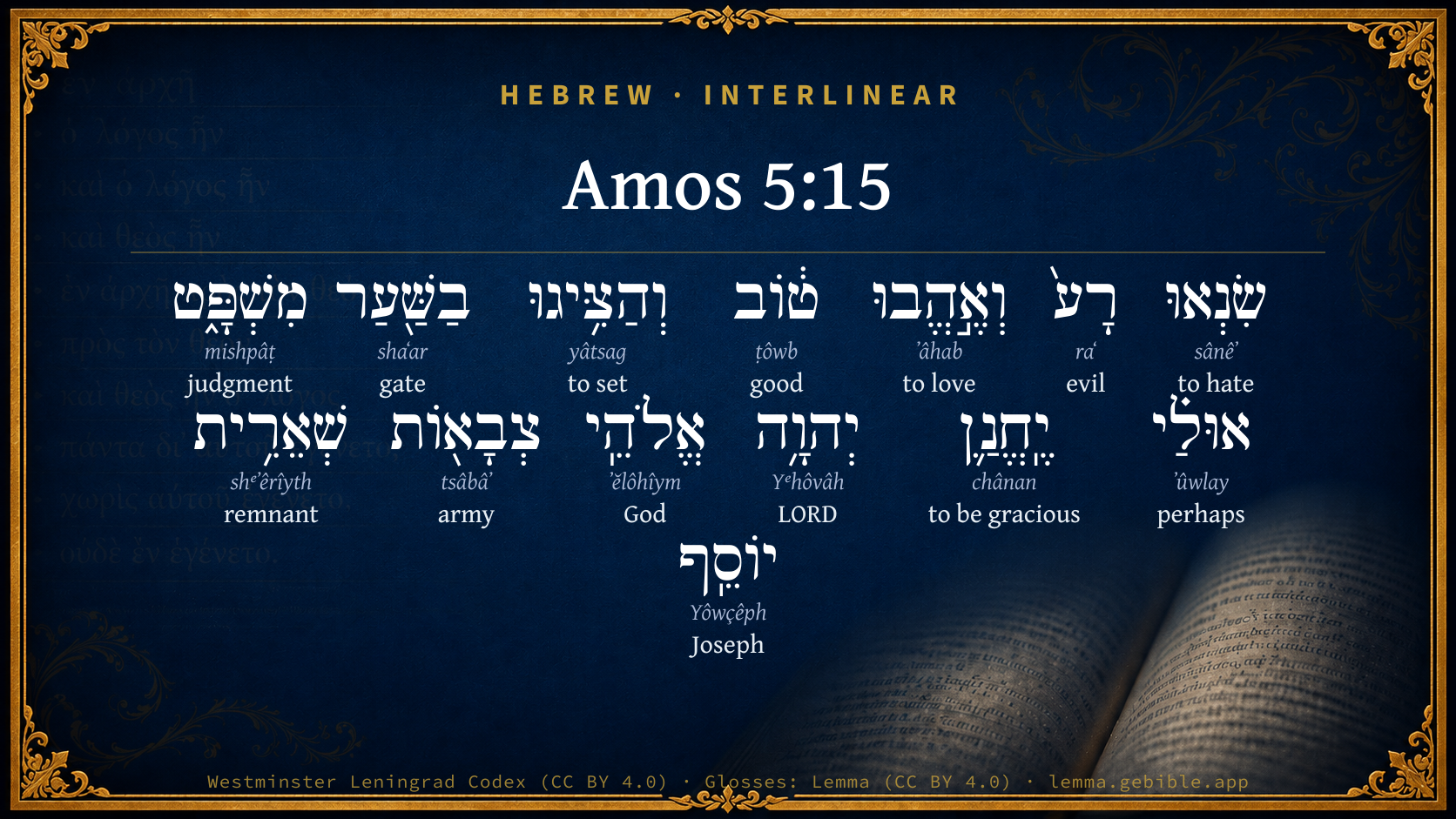
  1. שִׂנְאוּ sânêʼ H8130 “hate” Verb, Qal, Imperative, 2nd Person, Masculine, Plural
  2. רָע֙ raʻ H7451 “evil” Adjective, Adjective, Masculine, Singular, Absolute
  3. וְאֶ֣הֱבוּ ʼâhab H157 “and · love” Conjunction + Verb, Qal, Imperative, 2nd Person, Masculine, Plural
  4. ט֔וֹב ṭôwb H2896 “good” Adjective, Adjective, Masculine, Singular, Absolute
  5. בַשַּׁ֖עַר shaʻar H8179 “in/at the · gate” Preposition, Determined + Noun, Common, Masculine, Singular, Absolute
  6. מִשְׁפָּ֑ט mishpâṭ H4941 “judgment” Noun, Common, Masculine, Singular, Absolute
  7. אוּלַ֗י ʼûwlay H194 “perhaps” Adverb
  8. יֶֽחֱנַ֛ן chânan H2603 “to be gracious” Verb, Qal, Imperfect, 3rd Person, Masculine, Singular
  9. יְהוָ֥ה Yᵉhôvâh H3068 “LORD” Noun, Proper
  10. אֱלֹהֵֽי ʼĕlôhîym H430 “God(s) of” Noun, Common, Masculine, Plural, Construct
  11. צְבָא֖וֹת tsâbâʼ H6635 “armies” Noun, Common, Both, Plural, Absolute
  12. שְׁאֵרִ֥ית shᵉʼêrîyth H7611 “remnant of” Noun, Common, Feminine, Singular, Construct
  13. יוֹסֵֽף Yôwçêph H3130 “Joseph” Noun, Proper

About this verse

These counts appear in no published source. They are computed here, from the morphology-tagged text and Lemma’s own curated glosses. What Lemma adds →

14
words
14
distinct lemmas
Prophets
section

Notable vocabulary

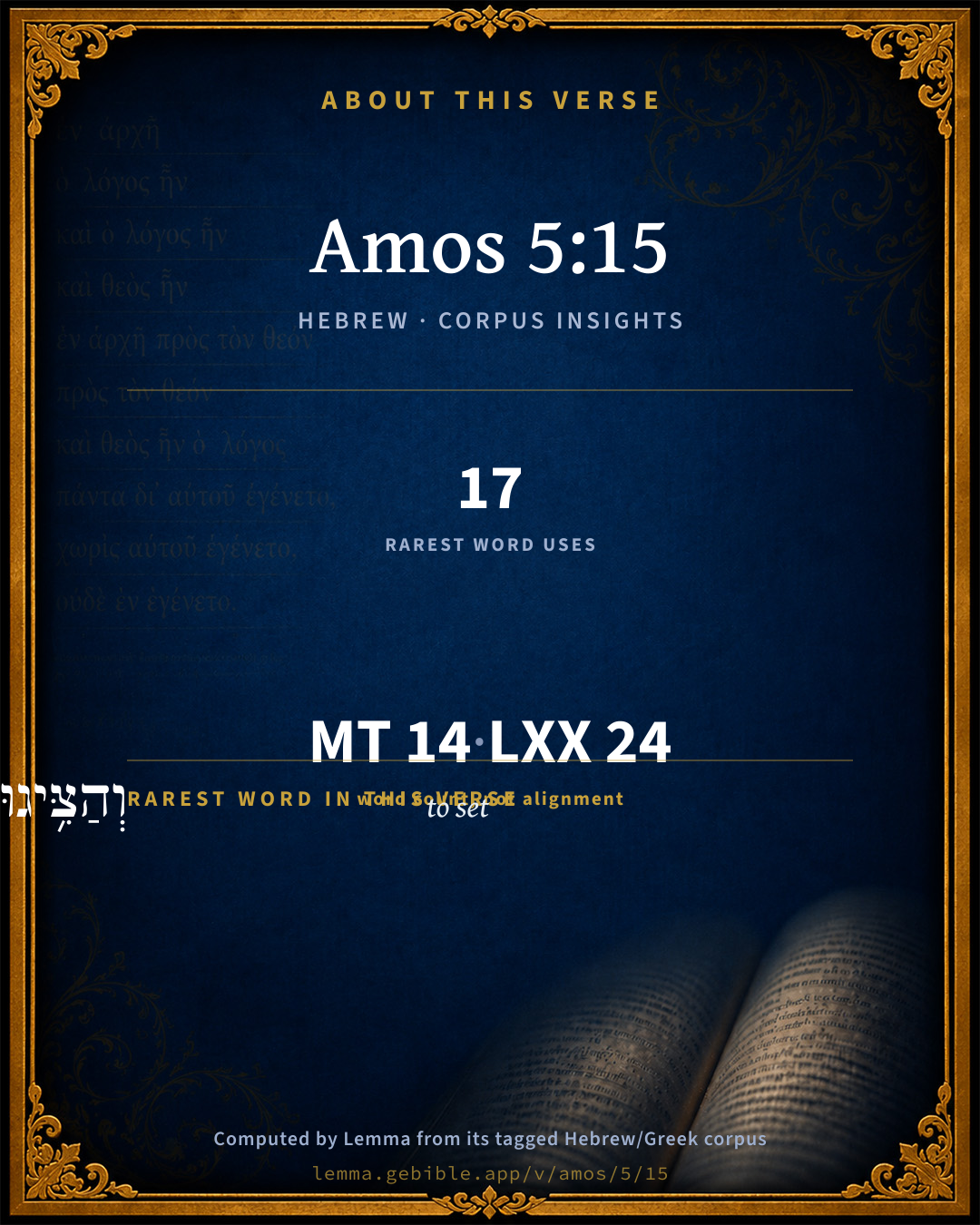
The rarest word here is וְהַצִּ֥יגוּ to set H3322 — appearing just 17 times in the whole Hebrew Bible.

Shared distinctive vocabulary

וְהַצִּ֥יגוּ to set H3322 occurs in 16 verses of the Hebrew Bible. Also found in:

Grammatical profile

  • 4 verbs
  • 7 nouns
  • 2 adjectives
  • 1 adverb

Verb forms

  • שִׂנְאוּ Qal · Imperative
  • וְאֶ֣הֱבוּ Qal · Imperative
  • וְהַצִּ֥יגוּ Hiphil · Imperative
  • יֶֽחֱנַ֛ן Qal · Imperfect

Hebrew & Septuagint length

In English translation the verse runs 27 words from the Hebrew and 27 from the Septuagint (LXX English) — the same length.

A rough comparison of the two English renderings, which tokenize alike — not a word-level alignment.

Word counts can differ between the Hebrew and the Greek without any difference in meaning — e.g. the Hebrew direct-object marker אֵת has no separate Greek word, and Greek often adds the article ὁ.

In the original languages it is 14 Hebrew tokens and 24 Greek tokens — but the two are counted differently (Hebrew bundles its prefixes and suffixes into one token; the Greek is in lemma form), so that isn’t a like-for-like length.

Cross-references

32

Topical passages linked to Amos 5:15 in the Treasury of Scripture Knowledge — connected by theme and wording, ordered by reader-vote popularity; previews shown in the World English Bible.

  • Romans 12:9 Let love be without hypocrisy. Abhor that which is evil. Cling to that which is good.
  • 3 John 1:11 Beloved, don't imitate that which is evil, but that which is good. He who does good is of God. He who does evil hasn't seen God.
  • Psalms 97:10 You who love Yahweh, hate evil. He preserves the souls of his saints. He delivers them out of the hand of the wicked.
  • Joel 2:14 Who knows? He may turn and relent, And leave a blessing behind him, Even a meal offering and a drink offering to Yahweh, your God.
  • 1 Thessalonians 5:21–22 Test all things, and hold firmly that which is good.
  • Micah 5:7–8 The remnant of Jacob will be in the midst of many peoples, Like dew from Yahweh, Like showers on the grass, That don't wait for man, Nor wait for the sons of men.
  • Romans 8:7 because the mind of the flesh is hostile towards God; for it is not subject to God's law, neither indeed can it be.
  • Micah 5:3 Therefore he will abandon them until the time that she who is in labor gives birth. Then the rest of his brothers will return to the children of Israel.
  • Exodus 32:30 It happened on the next day, that Moses said to the people, "You have sinned a great sin. Now I will go up to Yahweh. Perhaps I shall make atonement for your sin."
  • 1 Kings 20:31 His servants said to him, See now, we have heard that the kings of the house of Israel are merciful kings: let us, we pray you, put sackcloth on our loins, and ropes on our heads, and go out to the king of Israel: peradventure he will save your life.
  • 2 Kings 19:4 It may be Yahweh your God will hear all the words of Rabshakeh, whom the king of Assyria his master has sent to defy the living God, and will rebuke the words which Yahweh your God has heard. Therefore lift up your prayer for the remnant that is left.
  • Psalms 36:4 He plots iniquity on his bed. He sets himself in a way that is not good; He doesn't abhor evil.
  • Amos 5:24 But let justice roll on like rivers, And righteousness like a mighty stream.
  • Jonah 3:9 Who knows whether God will not turn and repent, and turn away from his fierce anger, so that we might not perish?"
  • 2 Samuel 16:12 It may be that Yahweh will look on the wrong done to me, and that Yahweh will requite me good for [his] cursing of me this day.
  • 2 Kings 13:7 For he didn't leave to Jehoahaz of the people save fifty horsemen, and ten chariots, and ten thousand footmen; for the king of Syria destroyed them, and made them like the dust in threshing.
  • 2 Kings 14:26–27 For Yahweh saw the affliction of Israel, that it was very bitter; for there was none shut up nor left at large, neither was there any helper for Israel.
  • 2 Chronicles 19:6–11 and said to the judges, Consider what you do: for you don't judge for man, but for Yahweh; and [he is] with you in the judgment.
  • Psalms 34:14 Depart from evil, and do good. Seek peace, and pursue it.
  • Psalms 37:27 Depart from evil, and do good; Live securely forever.
  • Psalms 82:2–4 "How long will you judge unjustly, And show partiality to the wicked?" Selah.
  • Psalms 119:104 Through your precepts, I get understanding; Therefore I hate every false way.
  • Jeremiah 7:5–7 For if you thoroughly amend your ways and your doings; if you thoroughly execute justice between a man and his neighbor;
  • Jeremiah 31:7 For thus says Yahweh, Sing with gladness for Jacob, and shout for the chief of the nations: publish you, praise you, and say, Yahweh, save your people, the remnant of Israel.
  • Amos 5:6 Seek Yahweh, and you will live; Lest he break out like fire in the house of Joseph, And it devour, and there be no one to quench it in Bethel.
  • Amos 5:10 They hate him who reproves in the gate, And they abhor him who speaks blamelessly.
  • Amos 6:12 Do horses run on the rocky crags? Does one plow there with oxen? But you have turned justice into poison, And the fruit of righteousness into bitterness;
  • Micah 2:12 I will surely assemble, Jacob, all of you; I will surely gather the remnant of Israel; I will put them together as the sheep of Bozrah, As a flock in the midst of their pasture; They will swarm with people.
  • Romans 7:15–16 For I don't know what I am doing. For I don't practice what I desire to do; but what I hate, that I do.
  • Romans 7:22 For I delight in God's law after the inward man,
  • 2 Kings 15:29 In the days of Pekah king of Israel came Tiglath Pileser king of Assyria, and took Ijon, and Abel Beth Maacah, and Janoah, and Kedesh, and Hazor, and Gilead, and Galilee, all the land of Naphtali; and he carried them captive to Assyria.
  • Psalms 139:21–22 Yahweh, don't I hate those who hate you? Am I not grieved with those who rise up against you?

Cross-references courtesy of OpenBible.info (CC BY 4.0).

Hebrew and Greek witnesses Masoretic Hebrew ↔ Greek Septuagint

The same verse in the two great witnesses to the Old Testament, shown verse-for-verse.

These are two independent witnesses, not word-aligned to each other, and the Septuagint is shown in lemma (dictionary) form.

Hebrew Amos 5:15 Masoretic · Westminster Leningrad Codex

שִׂנְאוּ רָע֙ וְאֶ֣הֱבוּ ט֔וֹב וְהַצִּ֥יגוּ בַשַּׁ֖עַר מִשְׁפָּ֑ט אוּלַ֗י יֶֽחֱנַ֛ן יְהוָ֥ה אֱלֹהֵֽי צְבָא֖וֹת שְׁאֵרִ֥ית יוֹסֵֽף

Hate evil, love good, And establish justice in the courts. It may be that Yahweh, the God of hosts, will be gracious to the remnant of Joseph."

World English Bible · Public Domain

Greek LXX Amos 5:15 Septuagint · lemma form

μισέω ὁ πονηρός καί ἀγαπάω ὁ καλός καί ἀπο καταἵστημι ἐν πύλη κρίμα ὅπως ἐλεέω κύριος ὁ θεός ὁ παντοκράτωρ ὁ περίλοιπος ὁ ιωσηφ

We have hated evil, and loved good: and restore you⌃ judgment in the gates; that the Lord God Almighty may have mercy on the remnant of Joseph.

LXX2012 (modern English Septuagint) · Public Domain

On this verse, The Pulpit Commentary discusses the Septuagint’s reading. Read the note in Commentary ↓

Hebrew: Westminster Leningrad Codex (CC BY 4.0). Greek: Septuagint (public domain); English from LXX2012 (modern English Septuagint) (Public Domain). How the Septuagint differs from the Hebrew →

Targum (Aramaic paraphrase)

1

The Targum is the ancient Jewish Aramaic paraphrase of the Hebrew Scriptures — an interpretive translation, not the Hebrew text itself. Onkelos (literal) and Pseudo-Jonathan (expansive) render the Torah, and Jonathan the Prophets. Coverage is partial: where no permissively-licensed English translation exists for a verse, only the Aramaic is shown. This is verse-level text, not a word-by-word alignment to the Hebrew.

  1. Targum Jonathan Prophets (Joshua–Malachi)
    סְגוּ לְאַבְאָשָׁא וְרִיחֲמוּ לְאַיְטָבָא וְאַתְקִינוּ בְּבֵית כְּנִישַׁתְכוֹן דִינָא מָאִים יִתְרַחֵם מִן קֳדָם יְיָ אֱלָהָא צְבָאוֹת עַל שְׁאָרָא דְיוֹסֵף:

    (no public-domain English translation for this verse)

    Targum Jonathan — Aramaic: “Mikraot Gedolot” (public domain). English: “Sefaria Community Translation” (CC0 1.0 (public-domain dedication)); “London "Chaldee Paraphrase," 1871” (public domain). Text via Sefaria.

Commentary

Notes on Amos 5:15 from classic Christian and Jewish commentators (each source and its license shown beneath its notes). The classic Christian expositions comment on the surrounding passage and are grouped to its opening verse, so a note may address several verses; the Jewish commentaries on the Tanakh (Rashi and others) are per-verse, so they appear only where the commentator wrote on this verse.

Lemma curates 59 commentaries, every one of them public domain or Creative Commons licensed, each selected and text-cleaned for this edition rather than reprinted as found. About our sources →

Trapp's Complete Commentary

John Trapp

Amo 5:15 Hate the evil, and love the good, and establish judgment in the gate: it may be that the LORD God of hosts will be gracious unto the remnant of Joseph.

Ver. 15. Hate the evil, and love the good] God doth so; you must also, or else never look for his gracious presence with you: for idem velle, atque idem nolle, ea demure vera est Amicitia; True friends do both will and nill the same things. Minutius Felix saith, that he and his friend Octavius did so. The like did Basil and Nazianzen, Jonathan and David:

“ Corporibus geminis spiritus unus erat. ”

All God’s people, as they partake of the Divine nature, so they live the life of God, Eph 4:18, and have the same both sympathies and antipathies (as I may so speak), abhorring that which is evil, cleaving to that which is good, Rom 12:9. God, they know, hateth evil worse than he hateth the devil; for he hateth the devil for sin’s sake, and not sin for the devil’s sake: so do they, looking upon sin as the most loathsome thing in the world, the very vomit of the devil, which (so far as they are regenerate) they do infinitely loathe to lick up. And for that which is good, whether things or persons, these they heartily love; not only with a love of desire, as Psa 42:1-2, but also of complacency, as Psa 73:25-26, herein resembling Almighty God; not as an image doth a man, in outward lineaments only, but as a son doth his father, in nature and disposition; being daily more and more conformed to the heavenly pattern, and transformeed into the same image from glory to glory, by his Spirit.

And establish judgment in the gate] Which hitherto ye have not done, Amo 5:10; Amo 5:12. Perform the duties of your own particular places; be good justicers as well as good men. It is said of Galba and of our Richard III, that they were bad men but good princes; but I hardly think it. Some good parts they might have, and some good acts they might do; but good princes they could not be, unless they did "hate the evil and love the good": but so doth not any bad man, for want of better principles. Make the tree good and the fruits will be good: and the contrary. Evil men may be some way useful to the public, and do good offices for the Church, and yet perish, because not in a good manner, upon a good motive, and for a good end. Rev 12:16, the earth helped the woman; and yet, Rev 16:1, the vials of God’s wrath were poured out upon the earth. A good magistrate, as he sits in God’s place (the judgment seat is called the holy place, Ecc 8:10), so he, loving what God loveth, and hating where God hateth, can boldly write over it that distich, that is said to be written over the tribunal in Zant, in letters of gold;

“ Hic locus odit, amat, punit, conservat, honorat,

Nequitiam, pacem, crimina, iura, bones. ”

It may be that the Lord] Or, out of doubt, the Lord God of hosts will be gracious, &c. He is surely ready, were men but ripe and right for mercy; it sticks only on their part, and not on his; he waiteth to be gracious, Isa 30:18. Oh unworthy we that cause him so to do. Currat poenitentia, ne praecurrat sententia (Chrysologus). They are but a remnant that shall have mercy; a few that shall find favour. Oh, labour to be of those few that shall enter into life, Luk 13:24.

John Trapp, A Commentary or Exposition upon All the Books of the Old and New Testament (1647–1656) — public domain. Text from a community e-Sword module.

The Biblical Illustrator

Joseph S. Exell

Amo_5:15

The Lord of hosts will be gracious unto the remnant of Joseph.

A remnant saved

There is a mystery of mercy in the destruction and salvation; but for the destruction and the salvation meeting together in the fulness of time, the race of mankind would all be lost. There are questions we constantly insist on asking with reference to the number of the saved and the lost. I fear we often try to make out a case for the smallest number of the saved; while some are fond of calling the New Jerusalem, the Church, a Zoar--a little one. The Book is a wondrous record of the story of the remnant of grace which God has preserved in every age. (E. Paxton Hood.)

The Biblical Illustrator, edited by Joseph S. Exell (c. 1880s–1900s) — public domain. Text from a community e-Sword module.

Tyndale Open Study Notes

Tyndale Open Resources

5:15 the remnant of his people: The Hebrew text uses the remnant of Joseph to refer to the northern kingdom, who were still God’s people despite their rebellion and idolatry.

Tyndale Open Study Notes — © Tyndale Open Resources, licensed CC BY-SA 4.0. Text via the HelloAO Bible API.

Jamieson, Fausset & Brown

Robert Jamieson, A. R. Fausset & David Brown

Hate . . . evil . . . love . . . good-- (Isa 1:16-17; Rom 12:9).

judgment in the gate--justice in the place where causes are tried.

it may be that the Lord . . . will be gracious--so, "peradventure" (Exo 32:30). Not that men are to come to God with an uncertainty whether or no He will be gracious: the expression merely implies the difficulty in the way, because of the want of true repentance on man's part, so as to stimulate the zealous earnestness of believers in seeking God (compare Gen 16:2; Joe 2:14; Act 8:22).

the remnant of Joseph--(see Amo 5:6). Israel (represented by "Ephraim," the leading tribe, and descendant of Joseph) was, as compared to what it once was, now but a remnant, Hazael of Syria having smitten all the coasts from Jordan eastward, Gilead and Bashan, Gad, Reuben, and Manasseh (Kg2 10:32-33) [HENDERSON]. Rather, "the remnant of Israel that shall have been left after the wicked have been destroyed" [MAURER].

Jamieson, Fausset & Brown — Commentary Critical and Explanatory on the Whole Bible (1871) — public domain (CC PDM 1.0). Text via the HelloAO Bible API.

Adam Clarke's Commentary

Verse 15. Hate the evil, and love the good] What ruins you, avoid; what helps you, cleave to. And as a proof that you take this advice, purify the seats of justice; and then expect God to be gracious to the remnant of Joseph-to the posterity of the ten tribes.

Adam Clarke's Commentary on the Bible (1810–1826) — public domain. Text from a community e-Sword/MySword module.

John Calvin's Commentaries

The Prophet inculcates the same truth; and he did this designedly; for he saw that nothing was more difficult than to bring this people to repentance, who, in the first place, were by nature refractory; and, in the second place, were hardened by long habit in their vices. For Satan gains dominion by degrees in the hearts of men, until he renders them wholly stupid so that they discern not between right and wrong. Such, then, was the blindness which prevailed among the people of Israel: it was therefore necessary often to goad them as Amos does here.

Hence he bids them to hate evil and to love good. And this order ought to be preserved, when we desire really to turn to God and to repent. Amos here addresses perverse men, who were so immersed in their own wickedness, that they distinguished no longer between light and darkness: it was therefore not without reason that he begins with this sentence, that they should hate evil; as though he had said, that there had been hitherto a hostile disagreement between them and God, and that therefore a change was necessary, in order that they might return to him. For when any one has already wished to devote himself to God’s service, this exhortation to hate evil is superfluous: but when one is sunk still in his own vices, he has need of such a stimulant. The Prophet therefore does here reprove them; and though they flattered themselves, he yet shows that they were greatly addicted to their vices.

He afterwards adds, Love good. He intimates, that it would be a new thing for them to cultivate benevolence, and to apply themselves to what was right. The import of the whole is this, — that the Israelites would have no peace with God, until they were wholly changed and became new men; for they were now strangers to goodness, and given to wickedness and depravity. But Amos mentions here only a part of repentance: for טוב, thub, no doubt means the doing of good, as iniquity is properly called רע, ro [the doing of evil.] He speaks not here of faith, or of prayer to God, but describes repentance by its fruits; for our faith, as it has been stated in other places, is proved in this way; it manifests itself, when sincerity and uprightness towards one another flourish in us, when we spontaneously love one another and perform the duties of love. Thus then by stating a part for the whole, is repentance here described; that is, the whole, as they commonly say, is shown by a part.

But now the Prophet adds, And set up judgment in the gate He here glances at the public state of things, of which we have largely spoken in our yesterday’s lecture. A deluge of iniquity had so inundated the land, that in the very courts of justice, and in the passing of judgments, there was no longer any equity, any justice. Since then corruption had taken possession of the very gates, the Prophet exhorts them to set up judgment in the gate; it may be, he says, that God will show mercy to the remnants of Joseph. The Prophet shows here that it was hardly possible that the people should continue safe; nay, that this was altogether hopeless. But as the common degeneracy, like a violent tempest, carried away the good along with it, the Prophet here admonishes the faithful not to despond, though they were few in number, but to retake themselves to God, to suffer others to fall away and to run headlong to ruin, and at the same time to provide for their own safety, as those who flee away from the burning.

We now then understand the object of the Prophet: for when the whole multitude, given up to destruction, had laid aside every care for their safety, a few remained, who yet suffered themselves to be borne along, as though a tempest, as it has been said, had carried them away. The Prophet then does here give comfort to such good men as were still alive, and shows that though the people were sinking, there was no reason for them to despair, for the Lord still promised to be propitious to them. What this doctrine teaches is this, — that ten ought not to regard what a thousand may do; but they ought to hear God speaking, rather than to abandon themselves with the multitude; when they see men blindly and impetuously running headlong to their own ruin, they should not follow them, but rather listen to God, and not reject his offered salvation. However much then their small number may dishearten them, they ought not yet to suffer God’s promises to be forced or snatched away from them, but fully to embrace them.

The expression, it may be, is not one of doubt, as it has been stated in another place, (Joel 2:1) but the Prophet, on the contrary, intended sharply to stimulate the faithful, that he might, as it was needful, increase their alacrity. Whenever then פן, pen, lest perhaps or אולי, auli, it may be, is set down, let us know, that they are not intended to leave men’s minds in suspense or perplexity, that they may despond or come to God in doubt; but that a difficulty is thereby implied, in order to stir them up and to increase the ardor of their desire: and this is necessary in a mixed state of things, for we see how great is the indolence of our flesh. Even they who desire to return to God, do not hasten with that ardor which becomes them, but creep slowly, and hardly draw themselves along; and then when many obstacles meet them, they who would have been otherwise full of courage, almost despair at every step. It is therefore necessary to apply such goadings as these, “Take heed; for when any one is beset on every side by fire, he will not long delay, nor think with himself how he may escape without any hurt and without any inconvenience; but he will risk danger rather than that he should by delay or tardiness deprive himself of a way of escape. So also ye see, that iniquity surrounds you on every side; what then is to be done except that each of you must quickly flee away?”

We now then perceive the design of the Prophet in saying, It may be that he will show mercy. The sum of the whole is this, — That there was need of a great change, that they might become altogether new men, who had hitherto devoted themselves to wickedness, — and then, that the few should not wait until the whole multitude joined them; for though the people resolved to go astray, yet God ought to have been attended to, when recalling the few to himself and bidding them to escape, as it were, from the burning, — and, thirdly, that there is stated here a difficulty, that those still healable might not come tardily to God, but that they might strive against impediments and quickly run to him seeing that they could not without great effort extricate themselves; they were therefore to come to God, not slowly; but having overcome all difficulties, they were on the contrary, to flee to him. It now follows —

John Calvin's Commentaries (1540-1563) — public domain. Text from the Calvin Translation Society English edition (1840s-50s) via the Christian Classics Ethereal Library (ccel.org). Calvin's coverage is partial (roughly two-thirds of the Bible); uncommented books and verses are honest gaps, never fabricated. The 19th-century editor's footnotes and remarks are omitted so the notes are faithfully Calvin's own voice.

The Cambridge Bible for Schools and Colleges

gen. ed. J. J. S. Perowne

15. The exhortation of Amo_5:14 is repeated in yet stronger terms: Hate the evil, and love the good. Cf. Isa_1:16 f.

establish judgment in the gate] Rather, set up firmly, set it standing, opposed to lay it on the ground, Amo_5:7. Judgement, like righteousness in Amo_5:7, is pictured as a concrete object, and almost personified: cf. Isa_59:14.

the remnant of Joseph] The prophet can hardly be thinking of the remnant to which ‘Joseph’ (Amo_5:6) had already been reduced by its many calamities (Amo_4:6-11); for he represents Israel in general as still wealthy and prosperous (cf. Amo_6:13). No doubt he has mentally in view the ‘remnant,’ to which he sees that before long it will have been actually reduced (cf. Amo_3:12), and which he pictures implicitly as including those who respond now to his present invitation to repent; a remnant, such as this, may peradventure merit Jehovah’s mercy (comp. Amo_9:8 f.). The passage contains in germ the doctrine of the preservation, through judgement, of a faithful remnant, which became shortly afterwards a distinctive feature in the teaching of Isaiah.

The Cambridge Bible for Schools and Colleges (gen. ed. J. J. S. Perowne; Cambridge University Press, 1878–1918) — public domain. Text from a community e-Sword module.

John Gill's Exposition

Hate the evil, and love the good,.... Evil is not only not to be sought, but to be hated, especially the evil of sin, because of its evil nature, and pernicious effects and consequences; and, if it was for no other reason but because it is hateful and abominable unto God, therefore they that love him should hate evil, even with a perfect hatred; as all good men do, though it is present with them, and cleaves unto them, and they do it, Psa 97:10; and "good" is to be loved for its goodness' sake; and the good effects of it; a good God is to be loved, and all good men, and all good things; the good word of God, and his commands and ordinances; and highly to be esteemed, and affectionately regarded:

and establish judgment in the gate; openly, publicly, in every court of judicature, which used to be kept in the gates of cities; not only execute judgment and justice in all, cases brought into court, but let it have its constant course, and be always practised according to the settled laws of it:

it may be that the Lord God of hosts will be gracious unto the remnant of Joseph: who should escape the fire that should break out of his house, and devour it, even the ten tribes, Amo 5:6; such of them as should seek the Lord, and that which is good; for in the worst of times God reserves a remnant for himself, as in the times of Elijah, Isaiah, Christ, and his apostles; a remnant according to the election of grace, to whom he has been gracious in the choice and reserve he has made of them; in the stores of grace he has hid up for them; in the provision and mission of his Son as a Saviour; and in waiting the time of their conversion, when he is gracious to them, in regenerating, quickening, pardoning, and justifying of them; and still will be in the visits of his love; in the supplies of his grace, in supporting them under afflictions, temptations, desertions, &c. and in giving them his word and ordinances for their comfort and relief: nor is this "may be" to be understood in a way of doubt or hesitation, but of good hope, yea, of a holy confidence; and so some render it, "without doubt the Lord God of hosts will be gracious" (g), &c. see Zep 2:3.

(g) "sine dubio", Tarnovius; so Burkius.

John Gill's Exposition of the Whole Bible (1746–1763) — public domain (CC PDM 1.0). Text via the HelloAO Bible API.

Albert Barnes' Notes on the Bible

Hate the evil and love the good - Man will not cease wholly to “seek evil,” unless he “hate” it; nor will he “seek good,” unless he “love” it. Jerome: “He ‘hateth evil,’ who not only is not overcome by pleasure, but hates its deeds; and he ‘loveth good,’ who, not unwillingly or of necessity or from fear, doth what is good, but because it is good.” Dionysius: “Evil of sin must be hated, in and for itself; the sinner must not be hated in himself, but only the evil in him.” They hated him, who reproved them; he bids them hate sin. They “set down righteousness on the ground;” he bids them, “establish,” literally, “set up firmly, judgment in the gate.” To undo, as far as anyone can, the effects of past sin, is among the first-fruits of repentance.

It may be that the Lord God of Hosts will be gracious - o: “He speaks so, in regard of the changeableness and uncertainty, not in God, but in man. There is no question but that God is gracious to all who “hate evil and love good;” but He doth not always deliver them from temporal calamity or captivity, because it is not for their salvation. Yet had Israel “hated evil and loved good,” perchance He would have delivered them from captivity, although He frequently said, they should be carried captive. For so He said to the two tribes in Jeremiah, “Amend your ways, and your doings, and I will cause you to dwell in this place” Jer 7:3. But since God knew that most of them would not repent, He saith not, “will be gracious unto Israel,” but, “unto the remnant of Joseph, that is, “the remnant, according to the election of grace” Rom 11:4-5; such as had been “the seven thousand who bowed not the knee unto Baal;” those who repented, while “the rest were hardened.” He says, “Joseph,” not Ephraim, in order to recall to them the deeds of their father. Jacob’s blessing on Joseph descended upon Ephraim, but was forfeited by Jeroboam’s “sin wherewith he made Israel to sin.” Rup.: “Joseph in his deeds and sufferings was a type of Jesus Christ, in whom the remnant is saved.” “A remnant,” however, only, “should be saved;” so the prophet says;

Albert Barnes' Notes on the Bible (1834–1885) — public domain. Text from a community e-Sword/MySword module.

Haydock's Catholic Bible Commentary

May be. God will not be wanting on his side. But this implies that man may find a difficulty in seeking good, and neglect to do it, though he may if he please, with God’s assistance. (Worthington) --- Remnant. Posterity. (Calmet)

George Leo Haydock (1774–1849), Haydock's Catholic Family Bible and Commentary, 1859 edition — public domain. Excludes Psalms (Douay-Rheims chapter numbering differs from Protestant) and Deuterocanonical books (Catholic canon only).

Matthew Poole's English Annotations

Slight dislikes will do little in this ease, you rulers and judges must heartily

hate, and show that you hate, the evil, both ways, doings, contrivers, and abettors of the evil among the people and yourselves;

and love the good; commend, encourage, defend, and reward all good in others, and do it yourselves; let your heart be toward good things and good men.

Establish judgment in the gate: by this it is evident the prophet speaks to governors and judges among them: what the import of the phrase is see Amo 5:10,12. Set up honest and upright judges in every gate, where judges did sit in those days.

It may be that the Lord God of hosts will be gracious; possibly he will forgive, or abate or respite the evil days, possibly he may give you his gracious presence, and yet save

the remnant of Joseph; what the invasions of enemies, or the civil wars, have spared, and left in Samaria and Israel, the ten tribes: Amo 5:6.

Matthew Poole's English Annotations on the Holy Bible (1683–1685) — public domain. Text from a community e-Sword/MySword module.

The Pulpit Commentary

Reverse your former conduct, undo what ye have done (ver. 10). This verse emphasizes the preceding; hating and loving are more real and hearty than mere seeking. The LXX makes this clause to be what the people said, On tropon eipate, memishkamen ta ponra kaisamen ta, "As ye said, We have hated evil, and loved good." Establish judgment. Maintain justice in your tribunals (in contrast to ver. 7); then it may be that the Lord will have mercy on you or some of you. The remnant of Joseph; implying that only a few of them will be saved after this heavy chastisement, which points to the final ruin of their city and nation. The prophet speaks of the "remnant of Joseph" instead of Ephraim, to remind them of their forefather, who received the patriarchal blessing of Jacob, for whose sake this remnant should be spared. (comp. Isa_6:13 Isa_10:21, etc.; Joe_2:32; Rom_11:4, etc.)

The Pulpit Commentary (1880–1919), ed. H.D.M. Spence-Jones & Joseph S. Exell — public domain. Text from a community e-Sword module.

John Wesley's Explanatory Notes

The evil - All evil among the people, and yourselves. Love - Commend, encourage, defend: let your heart be toward good things, and good men. Remnant - What the invasions of enemies, or the civil wars have spared, and left in Samaria and Israel.

John Wesley, Explanatory Notes Upon the Whole Bible (1754–1765) — public domain. Text via the GEBible commentary corpus.

Scofield Reference Notes

C. I. Scofield

remnant

(See Scofield "Jer 15:21").

The Scofield Reference Bible (1917 edition), notes by C. I. Scofield — public domain. Text from a community e-Sword module.

Rashi

Rabbi Shlomo Yitzchaki (Rashi)

the remnant of Joseph—All Israel are called by his name because he sustained them.

Rashi on the Tanakh — English translations: “The Judaica Press complete Tanach with Rashi, translated by A. J. Rosenberg” (CC BY 4.0); “Pentateuch with Rashi's commentary by M. Rosenbaum and A.M. Silbermann, 1929-1934” (public domain); “The Metsudah Tanach series, Lakewood, N.J” (CC BY 4.0); and “The Book of Joshua, Metsudah Publications, 1997” (CC BY 4.0). Text via Sefaria.

Lesson kit

Teaching starters — assembled from the data on this page, not authored interpretation. Every prompt links to the verse data it draws on. Edit before teaching.

Amos, in the Prophets, opens this verse with 14 words (14 distinct Hebrew lemmas). Its most distinctive word is yâtsag (“to set”). A historical commentator’s framing appears above. Read the whole chapter for the surrounding context.

Discussion questions

  1. The word yâtsag carries the sense “to set.” How does it shape the verse?
  2. How does Genesis 30:38, which shares the word «to set», read alongside this verse?
  3. These translations render this verse differently. What is at stake in choosing one wording over another?
  4. «שִׂנְאוּ» is a Qal Imperative verb. How does that grammatical form shape the action described?
  5. Compare how Trapp's Complete Commentary and The Biblical Illustrator read this verse. Where do they agree or differ?

Things to notice

Reading settings

Reading text

Shown beneath each verse's original-language words.

Old Testament
Old Testament edition

Read the OT as the Masoretic Hebrew (MT) or the Greek Septuagint (LXX).

English shown for the Greek Septuagint (in the Hebrew ↔ Greek comparison).

Comparing translations? Open the Compare panel on any verse page to stack up to four side by side.