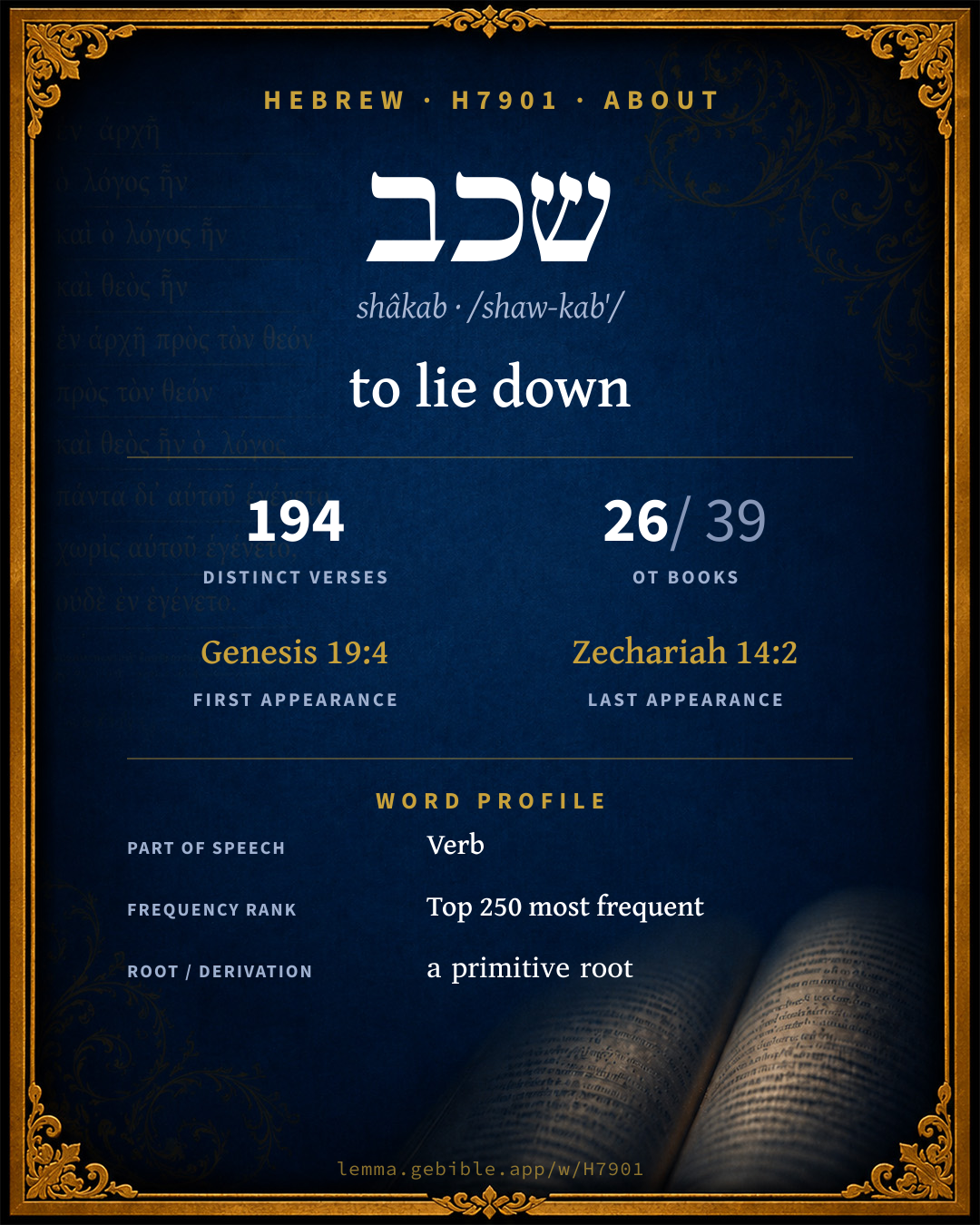
שָׁכַב
to lie down
‘to lie down’ is one of 5 main senses fuller range ↓
Full lexicon entry — Brown-Driver-Briggs (BDB)
From Brown-Driver-Briggs (BDB)
Where this word appears
See every Qal verb in the Hebrew Bible →
Grammar key — what these labels mean
Part of speech
- Verb
- An action or state-of-being word.
Stem
- Qal
- The basic, simple active stem — the plain form of the verb (“he wrote”).
- Hiphil
- The causative active stem (“he caused / brought about”).
- Niphal
- Usually the simple passive or reflexive of the Qal (“he was written”).
- Hophal
- The passive counterpart of the Hiphil (“he was caused to…”).
- Pual
- The passive counterpart of the Piel.
Form
- Sequential Imperfect
- An imperfect with prefixed waw — the standard past-narrative form (waw-consecutive imperfect).
- Imperfect
- An incomplete, ongoing, or future action (“he will / would write”).
- Participle Active
- A verbal adjective expressing ongoing or characteristic action (“writing / one who writes”).
- Perfect
- A completed action or state — Hebrew marks aspect (completeness) more than strict tense (“he wrote”).
- Infinitive Construct
- A bound verbal noun, frequently with prepositions (“to write / in writing”).
- Sequential Perfect
- A perfect with prefixed waw continuing a preceding imperfect or command (waw-consecutive perfect).
- Imperative
- A direct command (“write!”).
- Cohortative
- A first-person volitional form expressing wish or resolve (“let me / let us write”).
- Participle Passive
- A verbal adjective expressing action received (“written”).
- Infinitive Absolute
- An unbound verbal noun, often intensifying or standing in for a finite verb.
State
- Absolute
- The independent form of a noun, not bound to a following word.
- Construct
- A noun bound to a following noun in a possessive / “of” relationship (the construct chain).
Person
- 3rd Person
- The one spoken about (“he / she / it / they”).
- 2nd Person
- The one addressed (“you”).
- 1st Person
- The speaker (“I / we”).
Gender
- Masculine
- Grammatically masculine.
- Common
- Either gender — not distinguished for this form.
- Feminine
- Grammatically feminine.
Number
- Singular
- One.
- Plural
- More than one (in Hebrew, generally three or more).
Grammatical forms 43 distinct
- Verb, Qal, Sequential Imperfect, 3rd Person, Masculine, Singular 54 times (25%)
- Verb, Qal, Participle Active, Masculine, Singular, Absolute 22 times (10%)
- Verb, Qal, Imperfect, 3rd Person, Masculine, Singular 18 times (8%)
- Verb, Qal, Infinitive Construct 17 times (8%)
- Verb, Qal, Perfect, 3rd Person, Masculine, Singular 12 times (6%)
- Verb, Qal, Imperfect, 3rd Person, Masculine, Plural 9 times (4%)
- Verb, Qal, Imperfect, 2nd Person, Masculine, Singular 8 times (4%)
- Verb, Qal, Imperative, 2nd Person, Masculine, Singular 7 times (3%)
+35 more forms (66 occurrences)
Parsed forms decoded from the imported morphology (morphhb / Westminster Leningrad Codex — WLC text public domain, morphhb tagging CC BY 4.0), counted across 213 parsed occurrences — not distinct verses.
Every verse where H7901 appears — 194 distinct verses across 26 books. Click any verse to open its interlinear word-by-word view. Verse text shown in the World English Bible for context — . Each verse’s Hebrew form is shown with its reference; the English is not keyword-highlighted, since the data carries no word-level English alignment. Use “Compare translations” on any verse to read it across multiple English versions. This concordance covers the Hebrew Bible; Septuagint (Greek Old Testament) occurrences are not indexed here.
Genesis 18 verses
- Genesis 19:4 יִשְׁכָּבוּ֒ Qal impf 3mp But before they lay down, the men of the city, the men of Sodom, surrounded the house, both young and old, all the people from every quarter.
- Genesis 19:32 וְ/נִשְׁכְּבָ֣ה conj + Qal coh 1cp Come, let's make our father drink wine, and we will lie with him, that we may preserve our father's seed."
- Genesis 19:33 וַ/תִּשְׁכַּ֣ב בְּ/שִׁכְבָ֖/הּ conj + Qal wimpf 3fs prep + Qal inf.cs + sfx pers 3fs They made their father drink wine that night: and the firstborn went in, and lay with her father. He didn't know when she lay down, nor when she arose.
- Genesis 19:34 שָׁכַ֥בְתִּי שִׁכְבִ֣י Qal pf 1cs Qal impv 2fs It came to pass on the next day, that the firstborn said to the younger, "Behold, I lay last night with my father. Let us make him drink wine again, tonight. You go in, and lie with him, that we may preserve our father's seed."
- Genesis 19:35 וַ/תִּשְׁכַּ֣ב בְּ/שִׁכְבָ֖/הּ conj + Qal wimpf 3fs prep + Qal inf.cs + sfx pers 3fs They made their father drink wine that night also. The younger arose, and lay with him. He didn't know when she lay down, nor when she arose.
- Genesis 26:10 שָׁכַ֞ב Qal pf 3ms Abimelech said, "What is this you have done to us? One of the people might easily have lain with your wife, and you would have brought guilt on us!"
- Genesis 28:11 וַ/יִּשְׁכַּ֖ב conj + Qal wimpf 3ms He came to a certain place, and stayed there all night, because the sun had set. He took one of the stones of the place, and put it under his head, and lay down in that place to sleep.
- Genesis 28:13 שֹׁכֵ֣ב Qal ptcp.act ms Behold, Yahweh stood above it, and said, "I am Yahweh, the God of Abraham your father, and the God of Isaac. The land whereon you lie, to you will I give it, and to your seed.
- Genesis 30:15 יִשְׁכַּ֤ב Qal impf 3ms She said to her, "Is it a small matter that you have taken away my husband? Would you take away my son's mandrakes, also?" Rachel said, "Therefore he will lie with you tonight for your son's mandrakes."
- Genesis 30:16 וַ/יִּשְׁכַּ֥ב conj + Qal wimpf 3ms Jacob came from the field in the evening, and Leah went out to meet him, and said, "You must come in to me; for I have surely hired you with my son's mandrakes." He lay with her that night.
- Genesis 34:2 וַ/יִּשְׁכַּ֥ב conj + Qal wimpf 3ms Shechem the son of Hamor the Hivite, the prince of the land, saw her. He took her, lay with her, and humbled her.
- Genesis 34:7 לִ/שְׁכַּב֙ prep + Qal inf.cs The sons of Jacob came in from the field when they heard it. The men were grieved, and they were very angry, because he had done folly in Israel in lying with Jacob's daughter; which thing ought not to be done.
- Genesis 35:22 וַ/יִּשְׁכַּב֙ conj + Qal wimpf 3ms It happened, while Israel lived in that land, that Reuben went and lay with Bilhah, his father's concubine, and Israel heard of it. Now the sons of Jacob were twelve.
- Genesis 39:7 שִׁכְבָ֥/ה Qal impv 2ms + sfx h It happened after these things, that his master's wife cast her eyes on Joseph; and she said, "Lie with me."
- Genesis 39:10 לִ/שְׁכַּ֥ב prep + Qal inf.cs It happened that as she spoke to Joseph day by day, that he didn't listen to her, to lie by her, or to be with her.
- Genesis 39:12 שִׁכְבָ֣/ה Qal impv 2ms + sfx h She caught him by his garment, saying, "Lie with me!" He left his garment in her hand, and ran outside.
- Genesis 39:14 לִ/שְׁכַּ֣ב prep + Qal inf.cs that she called to the men of her house, and spoke to them, saying, "Behold, he has brought in a Hebrew to us to mock us. He came in to me to lie with me, and I cried with a loud voice.
- Genesis 47:30 וְ/שָֽׁכַבְתִּי֙ conj + Qal wpf 1cs but when I sleep with my fathers, you shall carry me out of Egypt, and bury me in their burying place." He said, "I will do as you have said."
Exodus 3 verses
- Exodus 22:16 וְ/שָׁכַ֣ב conj + Qal pf 3ms "If a man entices a virgin who isn't pledged to be married, and lies with her, he shall surely pay a dowry for her to be his wife.
- Exodus 22:19 שֹׁכֵ֥ב Qal ptcp.act ms "Whoever has sex with an animal shall surely be put to death.
- Exodus 22:27 יִשְׁכָּ֔ב Qal impf 3ms for that is his only covering, it is his garment for his skin. What would he sleep in? It will happen, when he cries to me, that I will hear, for I am gracious.
Leviticus 15 verses
- Leviticus 14:47 וְ/הַ/שֹּׁכֵ֣ב conj + ptcl def.art + Qal ptcp.act ms He who lies down in the house shall wash his clothes; and he who eats in the house shall wash his clothes.
- Leviticus 15:4 יִשְׁכַּ֥ב Qal impf 3ms "'Every bed whereon he who has the discharge lies shall be unclean; and everything he sits on shall be unclean.
- Leviticus 15:18 יִשְׁכַּ֥ב Qal impf 3ms If a man lies with a woman and there is an emission of semen, they shall both bathe themselves in water, and be unclean until the evening.
- Leviticus 15:20 תִּשְׁכַּ֥ב Qal impf 3fs "'Everything that she lies on in her impurity shall be unclean. Everything also that she sits on shall be unclean.
- Leviticus 15:24 שָׁכֹב֩ יִשְׁכַּ֨ב יִשְׁכַּ֥ב Qal inf.abs Qal impf 3ms Qal impf 3ms "'If any man lies with her, and her monthly flow is on him, he shall be unclean seven days; and every bed whereon he lies shall be unclean.
- Leviticus 15:26 תִּשְׁכַּ֤ב Qal impf 3fs Every bed whereon she lies all the days of her discharge shall be to her as the bed of her period: and everything whereon she sits shall be unclean, as the uncleanness of her period.
- Leviticus 15:33 יִשְׁכַּ֖ב Qal impf 3ms and of her who has her period, and of a man or woman who has a discharge, and of him who lies with her who is unclean.
- Leviticus 18:22 תִשְׁכַּ֖ב Qal impf 2ms "'You shall not lie with a man, as with a woman. That is detestible.
- Leviticus 19:20 יִשְׁכַּ֨ב Qal impf 3ms "'If a man lies carnally with a woman who is a slave girl, pledged to be married to another man, and not ransomed, or given her freedom; they shall be punished. They shall not be put to death, because she was not free.
- Leviticus 20:11 יִשְׁכַּב֙ Qal impf 3ms The man who lies with his father's wife has uncovered his father's nakedness: both of them shall surely be put to death; their blood shall be upon them.
- Leviticus 20:12 יִשְׁכַּב֙ Qal impf 3ms "'If a man lies with his daughter-in-law, both of them shall surely be put to death: they have committed a perversion; their blood shall be upon them.
- Leviticus 20:13 יִשְׁכַּ֤ב Qal impf 3ms If a man lies with a male, as with a woman, both of them have committed an abomination: they shall surely be put to death; their blood shall be upon them.
- Leviticus 20:18 יִשְׁכַּ֨ב Qal impf 3ms "'If a man lies with a woman having her monthly period, and uncovers her nakedness; he has made naked her fountain, and she has uncovered the fountain of her blood: and both of them shall be cut off from among their people.
- Leviticus 20:20 יִשְׁכַּב֙ Qal impf 3ms If a man lies with his uncle's wife, he has uncovered his uncle's nakedness: they shall bear their sin; they shall die childless.
- Leviticus 26:6 וּ/שְׁכַבְתֶּ֖ם conj + Qal wpf 2mp "'I will give peace in the land, and you shall lie down, and no one will make you afraid; and I will remove evil animals out of the land, neither shall the sword go through your land.
Numbers 4 verses
- Numbers 5:13 וְ/שָׁכַ֨ב conj + Qal wpf 3ms and a man lies with her carnally, and it is hidden from the eyes of her husband, and is kept close, and she is defiled, and there is no witness against her, and she isn't taken in the act;
- Numbers 5:19 שָׁכַ֥ב Qal pf 3ms The priest shall cause her to swear, and shall tell the woman, 'If no man has lain with you, and if you haven't gone aside to uncleanness, being under your husband, be free from this water of bitterness that brings a curse.
- Numbers 23:24 יִשְׁכַּב֙ Qal impf 3ms Behold, the people rises up as a lioness, As a lion does he lift himself up: He shall not lie down until he eat of the prey, Drink the blood of the slain.
- Numbers 24:9 שָׁכַ֧ב Qal pf 3ms He couched, he lay down as a lion, As a lioness; who shall rouse him up? Blessed be everyone who blesses you, Cursed be everyone who curses you.
Deuteronomy 15 verses
- Deuteronomy 6:7 וּֽ/בְ/שָׁכְבְּ/ךָ֖ conj + prep + Qal inf.cs + sfx pers 2ms and you shall teach them diligently to your children, and shall talk of them when you sit in your house, and when you walk by the way, and when you lie down, and when you rise up.
- Deuteronomy 11:19 וּֽ/בְ/שָׁכְבְּ/ךָ֖ conj + prep + Qal inf.cs + sfx pers 2ms You shall teach them your children, talking of them, when you sit in your house, and when you walk by the way, and when you lie down, and when you rise up.
- Deuteronomy 22:22 שֹׁכֵ֣ב הַ/שֹּׁכֵ֥ב Qal ptcp.act ms ptcl def.art + Qal ptcp.act ms If a man be found lying with a woman married to a husband, then they shall both of them die, the man who lay with the woman, and the woman: so shall you put away the evil from Israel.
- Deuteronomy 22:23 וְ/שָׁכַ֥ב conj + Qal wpf 3ms If there be a young lady who is a virgin pledged to be married to a husband, and a man find her in the city, and lie with her;
- Deuteronomy 22:25 וְ/שָׁכַ֣ב שָׁכַ֥ב conj + Qal wpf 3ms Qal pf 3ms But if the man find the lady who is pledged to be married in the field, and the man force her, and lie with her; then the man only who lay with her shall die:
- Deuteronomy 22:28 וְ/שָׁכַ֣ב conj + Qal wpf 3ms If a man find a lady who is a virgin, who is not pledged to be married, and lay hold on her, and lie with her, and they be found;
- Deuteronomy 22:29 הַ/שֹּׁכֵ֥ב ptcl def.art + Qal ptcp.act ms then the man who lay with her shall give to the lady's father fifty [shekels] of silver, and she shall be his wife, because he has humbled her; he may not put her away all his days.
- Deuteronomy 24:12 תִשְׁכַּ֖ב Qal impf 2ms If he be a poor man, you shall not sleep with his pledge;
- Deuteronomy 24:13 וְ/שָׁכַ֥ב conj + Qal wpf 3ms you shall surely restore to him the pledge when the sun goes down, that he may sleep in his garment, and bless you: and it shall be righteousness to you before Yahweh your God.
- Deuteronomy 27:20 שֹׁכֵב֙ Qal ptcp.act ms Cursed be he who lies with his father's wife, because he has uncovered his father's skirt. All the people shall say, Amen.
- Deuteronomy 27:21 שֹׁכֵ֖ב Qal ptcp.act ms Cursed be he who lies with any manner of animal. All the people shall say, Amen.
- Deuteronomy 27:22 שֹׁכֵב֙ Qal ptcp.act ms Cursed be he who lies with his sister, the daughter of his father, or the daughter of his mother. All the people shall say, Amen.
- Deuteronomy 27:23 שֹׁכֵ֖ב Qal ptcp.act ms Cursed be he who lies with his mother-in-law. All the people shall say, Amen.
- Deuteronomy 28:30 יִשְׁכָּבֶ֔/נָּה Qal impf 3ms + sfx pers 3fs You shall betroth a wife, and another man shall lie with her: you shall build a house, and you shall not dwell therein: you shall plant a vineyard, and shall not use the fruit of it.
- Deuteronomy 31:16 שֹׁכֵ֖ב Qal ptcp.act ms Yahweh said to Moses, Behold, you shall sleep with your fathers; and this people will rise up, and play the prostitute after the strange gods of the land, where they go to be among them, and will forsake me, and break my covenant which I have made with them.
Joshua 2 verses
- Joshua 2:1 וַ/יִּשְׁכְּבוּ conj + Qal wimpf 3mp Joshua the son of Nun sent out of Shittim two men as spies secretly, saying, Go, view the land, and Jericho. They went and came into the house of a prostitute whose name was Rahab, and lay there.
- Joshua 2:8 יִשְׁכָּב֑וּ/ן Qal impf 3mp + sfx n Before they were laid down, she came up to them on the roof;
Judges 2 verses
- Judges 5:27 שָׁכָ֑ב Qal pf 3ms At her feet he bowed, he fell, he lay; At her feet he bowed, he fell; Where he bowed, there he fell down dead.
- Judges 16:3 וַ/יִּשְׁכַּ֣ב conj + Qal wimpf 3ms Samson lay until midnight, and arose at midnight, and laid hold of the doors of the gate of the city, and the two posts, and plucked them up, bar and all, and put them on his shoulders, and carried them up to the top of the mountain that is before Hebron.
Ruth 5 verses
- Ruth 3:4 בְ/שָׁכְב֗/וֹ יִשְׁכַּב ו/שכבתי וְ/שָׁכָ֑בְתְּ prep + Qal inf.cs + sfx pers 3ms Qal impf 3ms conj + Qal wpf 1cs conj + Qal wpf 2fs It shall be, when he lies down, that you shall mark the place where he shall lie, and you shall go in, and uncover his feet, and lay you down; and he will tell you what you shall do.
- Ruth 3:7 לִ/שְׁכַּ֖ב וַ/תִּשְׁכָּֽב prep + Qal inf.cs conj + Qal wimpf 3fs When Boaz had eaten and drunk, and his heart was merry, he went to lie down at the end of the heap of grain: and she came softly, and uncovered his feet, and laid her down.
- Ruth 3:8 שֹׁכֶ֖בֶת Qal ptcp.act fs It happened at midnight, that the man was afraid, and turned himself; and, behold, a woman lay at his feet.
- Ruth 3:13 שִׁכְבִ֖י Qal impv 2fs Stay this night, and it shall be in the morning, that if he will perform to you the part of a kinsman, well; let him do the kinsman's part: but if he will not do the part of a kinsman to you, then will I do the part of a kinsman to you, as Yahweh lives: lie down until the morning.
- Ruth 3:14 וַ/תִּשְׁכַּ֤ב conj + Qal wimpf 3fs She lay at his feet until the morning. She rose up before one could discern another. For he said, Let it not be known that the woman came to the threshing floor.
1 Samuel 9 verses
- 1 Samuel 2:22 יִשְׁכְּבוּ/ן֙ Qal impf 3mp + sfx n Now Eli was very old; and he heard all that his sons did to all Israel, and how that they lay with the women who served at the door of the tent of meeting.
- 1 Samuel 3:2 שֹׁכֵ֣ב Qal ptcp.act ms It happened at that time, when Eli was laid down in his place (now his eyes had begun to grow dim, so that he could not see),
- 1 Samuel 3:3 שֹׁכֵ֑ב Qal ptcp.act ms and the lamp of God hadn't yet gone out, and Samuel had laid down [to sleep], in the temple of Yahweh, where the ark of God was;
- 1 Samuel 3:5 שְׁכָ֑ב וַ/יִּשְׁכָּֽב Qal impv 2ms conj + Qal wimpf 3ms He ran to Eli, and said, Here am I; for you called me. He said, I didn't call; lie down again. He went and lay down.
- 1 Samuel 3:6 שְׁכָֽב Qal impv 2ms Yahweh called yet again, Samuel. Samuel arose and went to Eli, and said, Here am I; for you called me. He answered, I didn't call, my son; lie down again.
- 1 Samuel 3:9 שְׁכָב֒ וַ/יִּשְׁכַּ֖ב Qal impv 2ms conj + Qal wimpf 3ms Therefore Eli said to Samuel, Go, lie down: and it shall be, if he call you, that you shall say, Speak, Yahweh; for your servant hears. So Samuel went and lay down in his place.
- 1 Samuel 3:15 וַ/יִּשְׁכַּ֤ב conj + Qal wimpf 3ms Samuel lay until the morning, and opened the doors of the house of Yahweh. Samuel feared to show Eli the vision.
- 1 Samuel 26:5 שָֽׁכַב שֹׁכֵ֣ב Qal pf 3ms Qal ptcp.act ms David arose, and came to the place where Saul had encamped; and David saw the place where Saul lay, and Abner the son of Ner, the captain of his host: and Saul lay within the place of the wagons, and the people were encamped round about him.
- 1 Samuel 26:7 שֹׁכֵ֤ב שֹׁכְבִ֖ים Qal ptcp.act ms Qal ptcp.act mp So David and Abishai came to the people by night: and, behold, Saul lay sleeping within the place of the wagons, with his spear stuck in the ground at his head; and Abner and the people lay round about him.
2 Samuel 18 verses
- 2 Samuel 4:5 שֹׁכֵ֔ב Qal ptcp.act ms The sons of Rimmon the Beerothite, Rechab and Baanah, went, and came about the heat of the day to the house of Ish-bosheth, as he took his rest at noon.
- 2 Samuel 4:7 שֹׁכֵ֤ב Qal ptcp.act ms Now when they came into the house, as he lay on his bed in his bedchamber, they struck him, and killed him, and beheaded him, and took his head, and went by the way of the Arabah all night.
- 2 Samuel 7:12 וְ/שָֽׁכַבְתָּ֙ conj + Qal wpf 2ms When your days are fulfilled, and you shall sleep with your fathers, I will set up your seed after you, who shall proceed out of your bowels, and I will establish his kingdom.
- 2 Samuel 8:2 הַשְׁכֵּ֣ב Hiphil inf.abs He struck Moab, and measured them with the line, making them to lie down on the ground; and he measured two lines to put to death, and one full line to keep alive. The Moabites became servants to David, and brought tribute.
- 2 Samuel 11:4 וַ/יִּשְׁכַּ֣ב conj + Qal wimpf 3ms David sent messengers, and took her; and she came in to him, and he lay with her (for she was purified from her uncleanness); and she returned to her house.
- 2 Samuel 11:9 וַ/יִּשְׁכַּ֣ב conj + Qal wimpf 3ms But Uriah slept at the door of the king's house with all the servants of his lord, and didn't go down to his house.
- 2 Samuel 11:11 וְ/לִ/שְׁכַּ֣ב conj + prep + Qal inf.cs Uriah said to David, The ark, and Israel, and Judah, abide in booths; and my lord Joab, and the servants of my lord, are encamped in the open field; shall I then go into my house, to eat and to drink, and to lie with my wife? as you live, and as your soul lives, I will not do this thing.
- 2 Samuel 11:13 לִ/שְׁכַּ֤ב prep + Qal inf.cs When David had called him, he ate and drink before him; and he made him drunk: and at even he went out to lie on his bed with the servants of his lord, but didn't go down to his house.
- 2 Samuel 12:3 תִשְׁכָּ֔ב Qal impf 3fs but the poor man had nothing, except one little ewe lamb, which he had bought and raised. It grew up together with him, and with his children. It ate of his own food, drank of his own cup, and lay in his bosom, and was to him like a daughter.
- 2 Samuel 12:11 וְ/שָׁכַב֙ conj + Qal wpf 3ms This is what Yahweh says: 'Behold, I will raise up evil against you out of your own house; and I will take your wives before your eyes, and give them to your neighbor, and he will lie with your wives in the sight of this sun.
- 2 Samuel 12:16 וְ/שָׁכַ֥ב conj + Qal pf 3ms David therefore begged God for the child; and David fasted, and went in, and lay all night on the earth.
- 2 Samuel 12:24 וַ/יִּשְׁכַּ֣ב conj + Qal wimpf 3ms David comforted Bathsheba his wife, and went in to her, and lay with her: and she bore a son, and he called his name Solomon. Yahweh loved him;
- 2 Samuel 13:5 שְׁכַ֥ב Qal impv 2ms Jonadab said to him, Lay you down on your bed, and feign yourself sick: and when your father comes to see you, tell him, Please let my sister Tamar come and give me bread to eat, and dress the food in my sight, that I may see it, and eat it from her hand.
- 2 Samuel 13:6 וַ/יִּשְׁכַּ֥ב conj + Qal wimpf 3ms So Amnon lay down, and feigned himself sick: and when the king was come to see him, Amnon said to the king, Please let her sister Tamar come, and make me a couple of cakes in my sight, that I may eat from her hand.
- 2 Samuel 13:8 שֹׁכֵ֑ב Qal ptcp.act ms So Tamar went to her brother Amnon's house; and he was laid down. She took dough, and kneaded it, and made cakes in his sight, and did bake the cakes.
- 2 Samuel 13:11 שִׁכְבִ֥י Qal impv 2fs When she had brought them near to him to eat, he took hold of her, and said to her, Come, lie with me, my sister.
- 2 Samuel 13:14 וַ/יִּשְׁכַּ֖ב conj + Qal wimpf 3ms However he would not listen to her voice; but being stronger than she, he forced her, and lay with her.
- 2 Samuel 13:31 וַ/יִּשְׁכַּ֣ב conj + Qal wimpf 3ms Then the king arose, and tore his garments, and lay on the earth; and all his servants stood by with their clothes torn.
1 Kings 20 verses
- 1 Kings 1:2 וְ/שָׁכְבָ֣ה conj + Qal wpf 3fs Therefore his servants said to him, Let there be sought for my lord the king a young virgin: and let her stand before the king, and cherish him; and let her lie in your bosom, that my lord the king may keep warm.
- 1 Kings 1:21 כִּ/שְׁכַ֥ב prep + Qal inf.cs Otherwise it will happen, when my lord the king shall sleep with his fathers, that I and my son Solomon shall be counted offenders.
- 1 Kings 2:10 וַ/יִּשְׁכַּ֥ב conj + Qal wimpf 3ms David slept with his fathers, and was buried in the city of David.
- 1 Kings 3:19 שָׁכְבָ֖ה Qal pf 3fs This woman's child died in the night, because she lay on it.
- 1 Kings 3:20 וַ/תַּשְׁכִּיבֵ֖/הוּ הִשְׁכִּ֥יבָה conj + Hiphil wimpf 3fs + sfx pers 3ms Hiphil pf 3fs She arose at midnight, and took my son from beside me, while your handmaid slept, and laid it in her bosom, and laid her dead child in my bosom.
- 1 Kings 11:21 שָׁכַ֤ב Qal pf 3ms When Hadad heard in Egypt that David slept with his fathers, and that Joab the captain of the host was dead, Hadad said to Pharaoh, Let me depart, that I may go to my own country.
- 1 Kings 11:43 וַ/יִּשְׁכַּ֤ב conj + Qal wimpf 3ms Solomon slept with his fathers, and was buried in the city of David his father: and Rehoboam his son reigned in his place.
- 1 Kings 14:20 וַ/יִּשְׁכַּב֙ conj + Qal wimpf 3ms The days which Jeroboam reigned were two and twenty years: and he slept with his fathers, and Nadab his son reigned in his place.
- 1 Kings 14:31 וַ/יִּשְׁכַּ֨ב conj + Qal wimpf 3ms Rehoboam slept with his fathers, and was buried with his fathers in the city of David: and his mother's name was Naamah the Ammonitess. Abijam his son reigned in his place.
- 1 Kings 15:8 וַ/יִּשְׁכַּ֤ב conj + Qal wimpf 3ms Abijam slept with his fathers; and they buried him in the city of David: and Asa his son reigned in his place.
- 1 Kings 15:24 וַ/יִּשְׁכַּ֤ב conj + Qal wimpf 3ms Asa slept with his fathers, and was buried with his fathers in the city of David his father; and Jehoshaphat his son reigned in his place.
- 1 Kings 16:6 וַ/יִּשְׁכַּ֤ב conj + Qal wimpf 3ms Baasha slept with his fathers, and was buried in Tirzah; and Elah his son reigned in his place.
- 1 Kings 16:28 וַ/יִּשְׁכַּ֤ב conj + Qal wimpf 3ms So Omri slept with his fathers, and was buried in Samaria; and Ahab his son reigned in his place.
- 1 Kings 17:19 וַ/יַּשְׁכִּבֵ֖/הוּ conj + Hiphil wimpf 3ms + sfx pers 3ms He said to her, Give me your son. He took him out of her bosom, and carried him up into the chamber, where he abode, and laid him on his own bed.
- 1 Kings 19:5 וַ/יִּשְׁכַּב֙ conj + Qal wimpf 3ms He lay down and slept under a juniper tree; and, behold, an angel touched him, and said to him, Arise and eat.
- 1 Kings 19:6 וַ/יִּשְׁכָּֽב conj + Qal wimpf 3ms He looked, and, behold, there was at his head a cake baked on the coals, and a jar of water. He ate and drink, and laid him down again.
- 1 Kings 21:4 וַ/יִּשְׁכַּב֙ conj + Qal wimpf 3ms Ahab came into his house sullen and angry because of the word which Naboth the Jezreelite had spoken to him; for he had said, I will not give you the inheritance of my fathers. He laid him down on his bed, and turned away his face, and would eat no bread.
- 1 Kings 21:27 וַ/יִּשְׁכַּ֣ב conj + Qal wimpf 3ms It happened, when Ahab heard those words, that he tore his clothes, and put sackcloth on his flesh, and fasted, and lay in sackcloth, and went softly.
- 1 Kings 22:40 וַ/יִּשְׁכַּ֥ב conj + Qal wimpf 3ms So Ahab slept with his fathers; and Ahaziah his son reigned in his place.
- 1 Kings 22:50 וַ/יִּשְׁכַּ֤ב conj + Qal wimpf 3ms Jehoshaphat slept with his fathers, and was buried with his fathers in the city of David his father; Jehoram his son reigned in his place.
2 Kings 19 verses
- 2 Kings 4:11 וַ/יִּשְׁכַּב conj + Qal wimpf 3ms It fell on a day, that he came there, and he turned into the chamber and lay there.
- 2 Kings 4:21 וַ/תַּשְׁכִּבֵ֔/הוּ conj + Hiphil wimpf 3fs + sfx pers 3ms She went up and laid him on the bed of the man of God, and shut [the door] on him, and went out.
- 2 Kings 4:32 מֻשְׁכָּ֖ב Hophal ptcp.pass ms When Elisha was come into the house, behold, the child was dead, and laid on his bed.
- 2 Kings 4:34 וַ/יִּשְׁכַּ֣ב conj + Qal wimpf 3ms He went up, and lay on the child, and put his mouth on his mouth, and his eyes on his eyes, and his hands on his hands: and he stretched himself on him; and the flesh of the child grew warm.
- 2 Kings 8:24 וַ/יִּשְׁכַּ֤ב conj + Qal wimpf 3ms Joram slept with his fathers, and was buried with his fathers in the city of David; and Ahaziah his son reigned in his place.
- 2 Kings 9:16 שֹׁכֵ֣ב Qal ptcp.act ms So Jehu rode in a chariot, and went to Jezreel; for Joram lay there. Ahaziah king of Judah was come down to see Joram.
- 2 Kings 10:35 וַ/יִּשְׁכַּ֤ב conj + Qal wimpf 3ms Jehu slept with his fathers; and they buried him in Samaria. Jehoahaz his son reigned in his place.
- 2 Kings 13:9 וַ/יִּשְׁכַּ֤ב conj + Qal wimpf 3ms Jehoahaz slept with his fathers; and they buried him in Samaria: and Joash his son reigned in his place.
- 2 Kings 13:13 וַ/יִּשְׁכַּ֤ב conj + Qal wimpf 3ms Joash slept with his fathers; and Jeroboam sat on his throne: and Joash was buried in Samaria with the kings of Israel.
- 2 Kings 14:16 וַ/יִּשְׁכַּ֤ב conj + Qal wimpf 3ms Jehoash slept with his fathers, and was buried in Samaria with the kings of Israel; and Jeroboam his son reigned in his place.
- 2 Kings 14:22 שְׁכַֽב Qal inf.cs He built Elath, and restored it to Judah, after that the king slept with his fathers.
- 2 Kings 14:29 וַ/יִּשְׁכַּ֤ב conj + Qal wimpf 3ms Jeroboam slept with his fathers, even with the kings of Israel; and Zechariah his son reigned in his place.
- 2 Kings 15:7 וַ/יִּשְׁכַּ֤ב conj + Qal wimpf 3ms Azariah slept with his fathers; and they buried him with his fathers in the city of David: and Jotham his son reigned in his place.
- 2 Kings 15:22 וַ/יִּשְׁכַּ֥ב conj + Qal wimpf 3ms Menahem slept with his fathers; and Pekahiah his son reigned in his place.
- 2 Kings 15:38 וַ/יִּשְׁכַּ֤ב conj + Qal wimpf 3ms Jotham slept with his fathers, and was buried with his fathers in the city of David his father: and Ahaz his son reigned in his place.
- 2 Kings 16:20 וַ/יִּשְׁכַּ֤ב conj + Qal wimpf 3ms Ahaz slept with his fathers, and was buried with his fathers in the city of David: and Hezekiah his son reigned in his place.
- 2 Kings 20:21 וַ/יִּשְׁכַּ֥ב conj + Qal wimpf 3ms Hezekiah slept with his fathers; and Manasseh his son reigned in his place.
- 2 Kings 21:18 וַ/יִּשְׁכַּ֤ב conj + Qal wimpf 3ms Manasseh slept with his fathers, and was buried in the garden of his own house, in the garden of Uzza: and Amon his son reigned in his place.
- 2 Kings 24:6 וַ/יִּשְׁכַּ֥ב conj + Qal wimpf 3ms So Jehoiakim slept with his fathers; and Jehoiachin his son reigned in his place.
2 Chronicles 12 verses
- 2 Chronicles 9:31 וַ/יִּשְׁכַּ֤ב conj + Qal wimpf 3ms Solomon slept with his fathers, and he was buried in the city of David his father: and Rehoboam his son reigned in his place.
- 2 Chronicles 12:16 וַ/יִּשְׁכַּ֤ב conj + Qal wimpf 3ms Rehoboam slept with his fathers, and was buried in the city of David: and Abijah his son reigned in his place.
- 2 Chronicles 14:1 וַ/יִּשְׁכַּ֨ב conj + Qal wimpf 3ms So Abijah slept with his fathers, and they buried him in the city of David; and Asa his son reigned in his place. In his days the land was quiet ten years.
- 2 Chronicles 16:13 וַ/יִּשְׁכַּ֥ב conj + Qal wimpf 3ms Asa slept with his fathers, and died in the one and fortieth year of his reign.
- 2 Chronicles 16:14 וַ/יַּשְׁכִּיבֻ֗/הוּ conj + Hiphil wimpf 3mp + sfx pers 3ms They buried him in his own tombs, which he had hewn out for himself in the city of David, and laid him in the bed which was filled with sweet odors and various kinds [of spices] prepared by the perfumers' are: and they made a very great burning for him.
- 2 Chronicles 21:1 וַ/יִּשְׁכַּ֤ב conj + Qal wimpf 3ms Jehoshaphat slept with his fathers, and was buried with his fathers in the city of David: and Jehoram his son reigned in his place.
- 2 Chronicles 26:2 שְׁכַֽב Qal inf.cs He built Eloth, and restored it to Judah, after that the king slept with his fathers.
- 2 Chronicles 26:23 וַ/יִּשְׁכַּ֨ב conj + Qal wimpf 3ms So Uzziah slept with his fathers; and they buried him with his fathers in the field of burial which belonged to the kings; for they said, He is a leper: and Jotham his son reigned in his place.
- 2 Chronicles 27:9 וַ/יִּשְׁכַּ֤ב conj + Qal wimpf 3ms Jotham slept with his fathers, and they buried him in the city of David: and Ahaz his son reigned in his place.
- 2 Chronicles 28:27 וַ/יִּשְׁכַּ֨ב conj + Qal wimpf 3ms Ahaz slept with his fathers, and they buried him in the city, even in Jerusalem; for they didn't bring him into the tombs of the kings of Israel: and Hezekiah his son reigned in his place.
- 2 Chronicles 32:33 וַ/יִּשְׁכַּ֨ב conj + Qal wimpf 3ms Hezekiah slept with his fathers, and they buried him in the ascent of the tombs of the sons of David: and all Judah and the inhabitants of Jerusalem did him honor at his death. Manasseh his son reigned in his place.
- 2 Chronicles 33:20 וַ/יִּשְׁכַּ֤ב conj + Qal wimpf 3ms So Manasseh slept with his fathers, and they buried him in his own house: and Amon his son reigned in his place.
Job 11 verses
- Job 3:13 שָׁכַ֣בְתִּי Qal pf 1cs For now should I have lain down and been quiet. I should have slept, then I would have been at rest,
- Job 7:4 שָׁכַ֗בְתִּי Qal pf 1cs When I lie down, I say, 'When shall I arise, and the night be gone?' I toss and turn until the dawning of the day.
- Job 7:21 אֶשְׁכָּ֑ב Qal impf 1cs Why do you not pardon my disobedience, and take away my iniquity? For now shall I lie down in the dust. You will seek me diligently, but I shall not be."
- Job 11:18 תִּשְׁכָּֽב Qal impf 2ms You shall be secure, because there is hope; Yes, you shall search, and shall take your rest in safety.
- Job 14:12 שָׁכַ֗ב Qal pf 3ms So man lies down and doesn't rise; Until the heavens are no more, they shall not awake, Nor be roused out of their sleep.
- Job 20:11 תִּשְׁכָּֽב Qal impf 3fs His bones are full of his youth, But youth shall lie down with him in the dust.
- Job 21:26 יִשְׁכָּ֑בוּ Qal impf 3mp They lie down alike in the dust, The worm covers them.
- Job 27:19 יִ֭שְׁכַּב Qal impf 3ms He lies down rich, but he shall not do so again. He opens his eyes, and he is not.
- Job 30:17 יִשְׁכָּבֽוּ/ן Qal impf 3mp + sfx n In the night season my bones are pierced in me, And the pains that gnaw me take no rest.
- Job 38:37 יַשְׁכִּֽיב Hiphil impf 3ms Who can number the clouds by wisdom? Or who can pour out the bottles of the sky,
- Job 40:21 יִשְׁכָּ֑ב Qal impf 3ms He lies under the lotus trees, In the covert of the reed, and the marsh.
Psalms 6 verses
- Psalms 3:5 שָׁכַ֗בְתִּי Qal pf 1cs I laid myself down and slept. I awakened; for Yahweh sustains me.
- Psalms 4:8 אֶשְׁכְּבָ֪ה Qal coh 1cs In peace I will both lay myself down and sleep, For you, Yahweh alone, make me live in safety.
- Psalms 41:8 שָׁ֝כַ֗ב Qal pf 3ms "An evil disease," they say, "has afflicted him. Now that he lies he shall rise up no more."
- Psalms 57:4 אֶשְׁכְּבָ֪ה Qal coh 1cs My soul is among lions. I lie among those who are set on fire, Even the sons of men, whose teeth are spears and arrows, And their tongue a sharp sword.
- Psalms 68:13 תִּשְׁכְּבוּ/ן֮ Qal impf 2mp + sfx n While you sleep among the campfires, The wings of a dove sheathed with silver, Her feathers with shining gold.
- Psalms 88:5 שֹׁ֥כְבֵי Qal ptcp.act mp cs Set apart among the dead, Like the slain who lie in the grave, Whom you remember no more. They are cut off from your hand.
Proverbs 6 verses
- Proverbs 3:24 תִּשְׁכַּ֥ב וְ֝/שָׁכַבְתָּ֗ Qal impf 2ms conj + Qal wpf 2ms When you lie down, you will not be afraid. Yes, you will lie down, and your sleep will be sweet.
- Proverbs 6:9 תִּשְׁכָּ֑ב Qal impf 2ms How long will you sleep, sluggard? When will you arise out of your sleep?
- Proverbs 6:10 לִ/שְׁכָּֽב prep + Qal inf.cs A little sleep, a little slumber, A little folding of the hands to sleep:
- Proverbs 6:22 בְּֽ֭/שָׁכְבְּ/ךָ prep + Qal inf.cs + sfx pers 2ms When you walk, it will lead you. When you sleep, it will watch over you. When you awake, it will talk with you.
- Proverbs 23:34 כְּ/שֹׁכֵ֣ב וּ֝/כְ/שֹׁכֵ֗ב prep + Qal ptcp.act ms conj + prep + Qal ptcp.act ms Yes, you will be as he who lies down in the midst of the sea, Or as he who lies on top of the rigging:
- Proverbs 24:33 לִ/שְׁכָּֽב prep + Qal inf.cs A little sleep, a little slumber, A little folding of the hands to sleep;
Ecclesiastes 2 verses
Isaiah 7 verses
- Isaiah 13:16 תִּשָּׁכַֽבְנָה Niphal impf 3fp Their infants also shall be dashed in pieces before their eyes; their houses shall be rifled, and their wives ravished.
- Isaiah 14:8 שָׁכַ֔בְתָּ Qal pf 2ms Yes, the fir trees rejoice at you, [and] the cedars of Lebanon, [saying], Since you are laid low, no lumberjack is come up against us.
- Isaiah 14:18 שָׁכְב֥וּ Qal pf 3cp All the kings of the nations, all of them, sleep in glory, everyone in his own house.
- Isaiah 43:17 יִשְׁכְּבוּ֙ Qal impf 3mp who brings forth the chariot and horse, the army and the mighty man (they lie down together, they shall not rise; they are extinct, they are quenched as a wick):
- Isaiah 50:11 תִּשְׁכָּבֽוּ/ן Qal impf 2mp + sfx n Behold, all you who kindle a fire, who gird yourselves about with firebrands; walk you in the flame of your fire, and among the brands that you have kindled. This shall you have of my hand; you shall lie down in sorrow.
- Isaiah 51:20 שָׁכְב֛וּ Qal pf 3cp Your sons have fainted, they lie at the head of all the streets, as an antelope in a net; they are full of the wrath of Yahweh, the rebuke of your God.
- Isaiah 56:10 שֹֽׁכְבִ֔ים Qal ptcp.act mp His watchmen are blind, they are all without knowledge; they are all mute dogs, they can't bark; dreaming, lying down, loving to slumber.
Jeremiah 2 verses
- Jeremiah 3:2 שֻׁכַּ֔בְתְּ Pual pf 2fs Lift up your eyes to the bare heights, and see; where have you not been lain with? By the ways have you sat for them, as an Arabian in the wilderness; and you have polluted the land with your prostitution and with your wickedness.
- Jeremiah 3:25 נִשְׁכְּבָ֣ה Qal coh 1cp Let us lie down in our shame, and let our confusion cover us; for we have sinned against Yahweh our God, we and our fathers, from our youth even to this day; and we have not obeyed the voice of Yahweh our God.
Lamentations 1 verse
Ezekiel 12 verses
- Ezekiel 4:4 שְׁכַב֙ תִּשְׁכַּ֣ב Qal impv 2ms Qal impf 2ms Moreover lie you on your left side, and lay the iniquity of the house of Israel on it; [according to] the number of the days that you shall lie on it, you shall bear their iniquity.
- Ezekiel 4:6 וְ/שָׁ֨כַבְתָּ֜ conj + Qal wpf 2ms Again, when you have accomplished these, you shall lie on your right side, and shall bear the iniquity of the house of Judah: forty days, each day for a year, have I appointed it to you.
- Ezekiel 4:9 שׁוֹכֵ֣ב Qal ptcp.act ms Take for yourself also wheat, and barley, and beans, and lentils, and millet, and spelt, and put them in one vessel, and make you bread of it; [according to] the number of the days that you shall lie on your side, even three hundred ninety days, shall you eat of it.
- Ezekiel 23:8 שָׁכְב֣וּ Qal pf 3cp Neither has she left her prostitution since [the days of] Egypt; for in her youth they lay with her, and they handled the bosom of her virginity; and they poured out their prostitution on her.
- Ezekiel 31:18 תִּשְׁכַּב֙ Qal impf 2ms To whom are you thus like in glory and in greatness among the trees of Eden? yet shall you be brought down with the trees of Eden to the lower parts of the earth: you shall lie in the midst of the uncircumcised, with those who are slain by the sword. This is Pharaoh and all his multitude, says the Lord Yahweh.
- Ezekiel 32:19 וְ/הָשְׁכְּבָ֖/ה conj + Hophal impv 2ms + sfx h Whom do you pass in beauty? Go down, and be laid with the uncircumcised.
- Ezekiel 32:21 שָׁכְב֥וּ Qal pf 3cp The strong among the mighty shall speak to him out of the midst of Sheol with those who help him: they are gone down, they lie still, even the uncircumcised, slain by the sword.
- Ezekiel 32:27 יִשְׁכְּבוּ֙ Qal impf 3mp They shall not lie with the mighty who are fallen of the uncircumcised, who are gone down to Sheol with their weapons of war, and have laid their swords under their heads, and their iniquities are on their bones; for [they were] the terror of the mighty in the land of the living.
- Ezekiel 32:28 וְ/תִשְׁכַּ֖ב conj + Qal impf 2ms But you shall be broken in the midst of the uncircumcised, and shall lie with those who are slain by the sword.
- Ezekiel 32:29 יִשְׁכָּ֖בוּ Qal impf 3mp There is Edom, her kings and all her princes, who in their might are laid with those who are slain by the sword: they shall lie with the uncircumcised, and with those who go down to the pit.
- Ezekiel 32:30 וַ/יִּשְׁכְּב֤וּ conj + Qal wimpf 3mp There are the princes of the north, all of them, and all the Sidonians, who are gone down with the slain; in the terror which they caused by their might they are put to shame; and they lie uncircumcised with those who are slain by the sword, and bear their shame with those who go down to the pit.
- Ezekiel 32:32 וְ/הֻשְׁכַּב֩ conj + Hophal wpf 3ms For I have put his terror in the land of the living; and he shall be laid in the midst of the uncircumcised, with those who are slain by the sword, even Pharaoh and all his multitude, says the Lord Yahweh.
Hosea 1 verse
Amos 1 verse
Jonah 1 verse
Micah 1 verse
Zechariah 1 verse
About this entry
At a glance — auto-summarized from this page’s data, not written by a person. Every figure links to its source below. This summary describes the numbers; it doesn’t interpret them.
“to lie down” is the headline sense of the Hebrew verb שכב (shâkab). Where the King James Version says “slept,” newer translations reach for “rested” (Berean Standard Bible) and “and” (unfoldingWord Literal Text); the renderings breakdown has the detail. The Hebrew Bible uses it across 194 verses — common. First canonically at Genesis 19:4, it enters the text early. Carrying more than one sense, it rewards its full sense range. The sections below give every sense, occurrence, and version rendering.
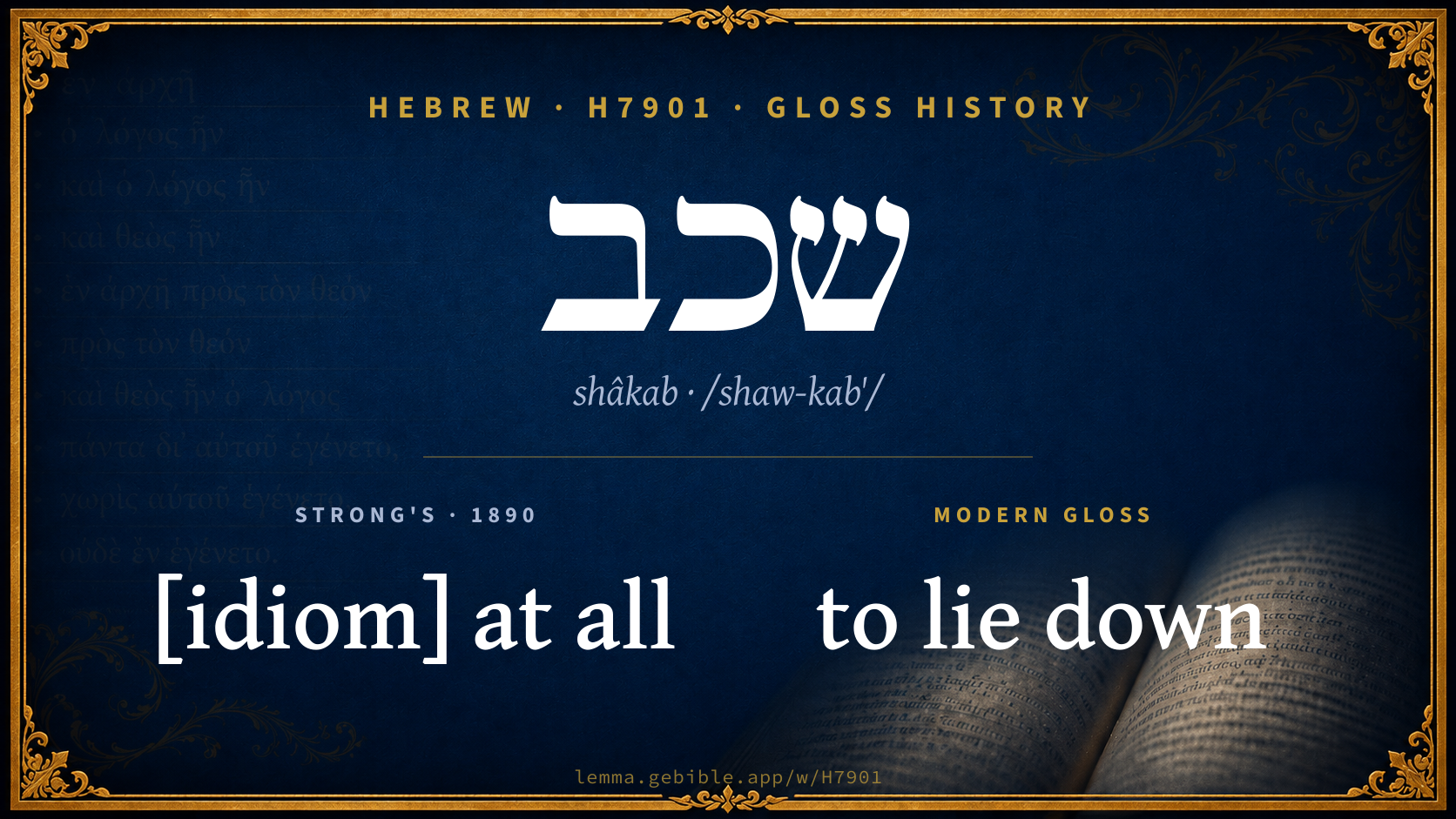
Gloss history
Strong's 1890 vs modern scholarship
About this word
Strong's H7901 catalogs a Hebrew word from the Hebrew Old Testament.
These counts are not copied from any lexicon or concordance. They are computed here, from the morphology-tagged Hebrew Old Testament. What Lemma adds →
- 194
- distinct verses
- The word appears in 194 distinct verses.
- 26 / 39
- OT books
- The word appears in 26 of 39 Old Testament books.
- #225
- by frequency
- Top 250 most frequent Hebrew words (rank 225 of 8,640 Hebrew words by occurrence).
View all 194 occurrences in the concordance →
By section of the Old Testament
By traditional corpus
Conventional, traditional groupings — biblical authorship is debated, so this is a traditional corpus grouping, not an authorship claim. Each share is this word’s portion of its verses in that division of the Hebrew canon. Each figure is a share of the word’s 194 distinct verses.
- Prophets (Nevi'im) 96 verses · 49%
- Torah (Pentateuch) 55 verses · 28%
- Writings (Ketuvim) 43 verses · 22%
How translations render this word
Counts come from each version’s own published word-to-Strong’s tagging or interlinear alignment — an approximate guide to how each version renders this word, not a word-level alignment the data otherwise carries. Because each total is that version’s own tagged count, the per-version totals vary from one another and need not match the appearance or distinct-verse counts above. These counts may also differ from a printed concordance because Lemma counts each distinctly tagged rendering and does not collapse phrase taggings into a single head-word total. This is a fixed set of word-tagged versions (KJV, ASV, BSB, ULT) and does not change with the reading translation you choose elsewhere. Each version’s license is shown beside its name below (and on Sources).
- King James Version: Slept 36×, Lay 23×, Lie 21×
- American Standard Version: Slept 36×, Lay 16×, Lie 10×
- Berean Standard Bible: Rested 33×, Lie down 18×, Lies 12×
- unfoldingWord Literal Text: And 34×, Lay down 31×, Lie down 17×
King James Version Public Domain
Renders H7901 across 212 tagged occurrences — most commonly:
Plus other, less common renderings. Plus 69 renderings that appear only once — usually multi-word phrases or single function words the recovered tagging swept in, not distinct renderings. Not rendered by a distinct English word in 1 further occurrence.
American Standard Version Public Domain
Renders H7901 across 211 tagged occurrences — most commonly:
Plus other, less common renderings. Plus 85 renderings that appear only once — usually multi-word phrases or single function words the recovered tagging swept in, not distinct renderings.
Berean Standard Bible Public Domain
Renders H7901 across 207 tagged occurrences — most commonly:
Plus other, less common renderings. Plus 57 renderings that appear only once — usually multi-word phrases or single function words the recovered tagging swept in, not distinct renderings. Not rendered by a distinct English word in 1 further occurrence.
unfoldingWord Literal Text CC BY-SA 4.0
Renders H7901 across 255 tagged occurrences — most commonly:
Plus other, less common renderings. Plus 56 renderings that appear only once — usually multi-word phrases or single function words the recovered tagging swept in, not distinct renderings.
12 senses and sub-senses in the full BDB
What do BDB’s symbols mean?
BDB uses these scholarly abbreviations:
| Symbol | Meaning |
|---|---|
| 𝔊 | the Septuagint (the ancient Greek translation, LXX) |
| 𝔙 | the Vulgate (the Latin translation) |
| 𝔖 | the Syriac version (the Peshitta) |
| 𝔗 | the Targum (the Aramaic translation) |
| ψ | the Psalms |
| √ | root (the underlying root or stem) |
| ‖ | parallel passage (a synonymous or contrasted parallel) |
| † | the dagger: every passage where the word occurs is cited |
The 12 senses and sub-senses the full Brown-Driver-Briggs lexicon distinguishes for this word, in lexicon order (not ranked by frequency), with BDB’s own verbatim wording and sub-sense lettering. Shown in Hebrew script with BDB’s own scholarly abbreviations. The condensed entry is in the Lexicon Entry tab. See also the Forms in the corpus table below.
- 1. lie down (sometimes opp. קוּם, הֵקִיץ):
- a. Ju 5:27 (prostrated by blow, + כָּרַע, נָפַל). e.g. Judges 5:27
- b. to sleep, Gn 19:4 (J), 28:11 (E), 1 S 3:5; Dt 7:7; Pr 6:22 + often; read וַיִּשְׁכַּב) also (for וַיַּשְׁכֵּם 1 S 9:26 𝔊 Th We Dr and mod.; שׁ׳ + יָשֵׁן sleep 1 K 19:5 ψ 3:6; 4:9, cf. Pr 3:24(×2), + נִרְדָּם Jon 1:5; = be lying 1 S 3:2, 3; 26:5 (all בְּ loc.), v 7 4:5 (acc. cogn. noon-repose), 2 S 13:8, cf. שֹׁכֵב בְּלֶב־יָם Pr 23:34, of two lying (together, for warmth) Ec 4:11; + be sleeping 1 S 26:7; = keep lying, c. עַד Ju 16:3; 1 S 3:15; Ru 3:13; Pr 6:9; emphasis on resting, Lv 26:6 (H), Jb 11:18; token of mourning, וְשָׁכַב אָ֑רְצָה (וְלָן) 2 S 12:16, cf. 13:21, שׁ׳ בַּשָּׂק 1 K 21:27, שׁ׳ בֵּין שְׁפַתָּ֑יִם ψ 68:14 (of indolence?); fig. of prostration by disease 41:9 among foes 57:5; of humiliation Je 3:25; c. עַל rei: land Gn 28:13 (J), usually bed 2 S 13:5; 1 K 21:4; Lv 15:4, 24, 26, cf. v 20, for midday repose 2 S 4:7. e.g. Genesis 19:4
- c. lie on (עַל) one’s side Ez 4:4(×2), 6, 9 (symbol.). e.g. Ezekiel 4:4
- d. lie, עַל pers. 1 K 3:19 (fatally), 2 K 4:34 (to revive). e.g. 1 Kings 3:19
- e. lie בְּחֵיק, of lamb (i.e. be cherished) 2 S 12:3, of woman Mi 7:5 (intimacy), 1 K 1:2 (vital warmth); lie down for copulation Gn 19:33, 35 (of woman, v. 3 infr.; both opp. קוּם). e.g. 2 Samuel 12:3
- 2. = lodge (for night), (שָׁ֫מָּה) שׁ׳ Jos 2:1 (E), 2 K 4:11, cf. 9:16 (yet perhaps = lie ill), Lv 14:47 (בְּ loc.). e.g. Joshua 2:1
- 3. of sexual relations, lie with: subj. man, c. עִם Gn 30:15, 16; 39:7, 12, 14 (J), Ex 22:15 (E), Dt 22:22 + 8 times Dt., 2 S 11:4, 11; 12:11, 24 Lv 15:33; c. אֶת fem. with (MT אֹתָהּ, etc., orig. אִתָּהּ, etc., v. Dr 2 S 13:14 and II. אֵת, p. 85a supra), Gn 26:10; 34:2, 7; 35:22 (all J), 1 S 2:22 (om. 𝔊 and mod.), 2 S 13:14; Ez 23:8 (fig.), Lv 15:24 (שָׁכֹב יִשְׁכַּב), Nu 5:19, also (c. acc. cogn. שִׁכְבַת־זֶרַע) v 13 Lv 15:18; 19:20; c. acc. (sf.) fem. Dt 28:30 Kt (v. [שָׁגֵל]); c. אֵצֶל fem. Gn 39:10 (J); c. אֵת vir. (sodomy), Lv 18:22; 20:13 (both H; c. acc. cogn. מִשְׁכְּבֵי אִשָּׁח); c. עִם־בְּהֵמָה Dt 27:21; Ex 22:18 (E); subj. woman, c. עִם vir. Gn 19:32, 34, 35 (J) 2 S 13:11; אֵת vir. Gn 19:33, 34 (cf. 1 e supra). e.g. Genesis 30:15
- 4.
- a. lie down in death, Is 14:8; 43:17 (opp. קוּם), Ez 31:18; 32:27, 28, 29, 30; Jb 14:12 (opp. קוּם, הֵקִיץ), שׁ׳ וְאֶשְׁקוֹט 3:13; be lying (dead) Is 51:20; La 2:21. e.g. Isaiah 14:8
- b. especially in phr. שׁ׳ עִם אֲבוֹתָיו lie down with his fathers, of kings 1 K 1:21; 2:10 + 35 times K Ch, cf. Gn 47:30 (J), Dt 31:16, and (c. אֵת) 2 S 7:12. e.g. 1 Kings 1:21
- c. in grave, בְּבֵיתוֹ Is 14:18 (opp. מִקִּבְרְךָ), שֹׁכְבֵי קֶבֶר ψ 88:6; לֶעָפָר Jb 7:21, עַל־ע׳ 20:11; 21:26; in She’ôl Ez 32:21; in Gehenna (?) Is 50:11. e.g. Isaiah 14:18
- 5. fig. = relax: Jb 30:17 my gnawing pains do not sleep; = have rest, לֹא שׁ׳ לִבּוֹ Ec 2:23. †Niph.Pu. = be lain with (sexually; subj. woman), only as Qr for Kt [שָׁגֵל] Niph.Pu. q.v. †Hiph. lay, Pf. 3 fs. הִשְׁכִּיבָה c. acc. puer. + בְּחֵיק 1 K 3:20, so Impf. 3 fs. sf. וַתַּשְׁכִּיבֵהוּ v 20, cf. (עַל־מִטָּה) 17:19 2 K 4:21; Inf. abs. הַשְׁכֵּב אוֹתָם אַ֫רְצָה 2 S 8:2 making them lie down on ground; Impf. also lay בַּמִּשְׁכָּב 2 Ch 16:14 (of burial); נִבְלֵי שָׁמַיִם מִי יַשְׁכִּיב Jb 38:37 i.e. tip them so that contents may flow out (cf. Arabic سَكَبَ supra). †Hoph. Pt. מֻשְׁכָּב 2 K 4:32 laid עַל־מִטָּה; Pf. consec. וְהֻשְׁכַּב Ez 32:32 shall be laid (in death), c. בְּתוֹךְ et אֵת pers. (with); so Imv. ms. הָשְׁכְּבָה v 19 (c. אֵת pers. only). e.g. Job 30:17
Senses from the full Brown-Driver-Briggs lexicon (Brown, Driver, Briggs; Oxford 1906 — public domain), digitized via Sefaria, supplemented by the OpenScriptures HebrewLexicon (CC BY 4.0). Full attribution on Sources.
Word origin
(LagBN 63)212 vb. lie down (NH = BH; שכב Ecclus 47:23 (in death), משכב bed 40:5; 47:20 d, = death bed 46:19; Ph. שכב, משכב (v. מ׳ 1 infr.), Lzb375; Ethiopic ሰከበ lie, so Aramaic שְׁכַב, ܫܟܶܒ; Nab. משכבא couch; Arabic سَكَبَ only pour out (water, tears), be poured out (cf. Hiph. infr., and LagBN 63));—Qal Pf. 3 ms. שׁ׳ Gn 26:10 +, etc.; Impf. יִשְׁכַּב Gn 30:15 +, 3 mpl. יִשְׁכְּבֻן 1 S 2:22, יִשְׁכָּב֑וּן Jos 2:8 Jb 30:17, etc.; Imv. ms. שְׁכַב 2 S 13:5 Ez 4:4, שִׁכְבָה Gn 39:7, 12, etc.; Inf. abs. שָׁכֹב Lv 15:24; cstr. שְׁכַב 1 K 1:21 +, sf. שָׁכְבוֹ Ru 3:4, שִׁכְבָהּ Gn 19:33, 35, שָׁכְבְּךָ Dt 6:7 + 2 times; Pt. שֹׁכֵב Gn 28:13 +, f. שֹׁכֶ֫בֶת Mi 7:5; Ru 3:8, etc.;—
— Brown-Driver-Briggs (Oxford 1906, public domain), digitized via Sefaria, supplemented by the OpenScriptures HebrewLexicon (CC BY 4.0). See Sources.
Origin: a primitive root
Jastrow Dictionary
A second Hebrew/Aramaic lexicon for comparison, covering Aramaic and post-biblical (Talmudic, Targumic, Midrashic) usage that the biblical-Hebrew BDB does not. Matched by lemma rather than by Strong’s number, so a lemma may carry more than one Jastrow headword (shown separately below), and the entries cover usage well beyond the Bible.
שָׁכַב
- (b. h.) to incline; to lie down, lie, sleep. Bekh. VII, 2, a. e. גביניו שׁוֹכְבִין, v. גְּבִין II. Gen. R. s. 96 (ref. to Gen. XLVII, 28 sq.) אתה שׁוֹכֵב ואין אתה מת thou shalt lie (in the grave) but not be dead (forever). Ber. I, 3 (ref. to Deut. VI, 9) בשעה … שׁוֹכְבִים וכ׳ (you must read the Sh’mʿa) at the time of the day when people lie down, and when people get up. Ib. 62ᵇ על כל משכב שְׁכַב וכ׳ lie on any couch, only not on the bare ground; a. v. fr.—Part. pass. שָׁכוּב. Mekh. B’shall., Vayassʿa, s. 3 תפלתם … שהיו שְׁכוּבִים בעפר the prayer of our fathers who were asleep in the ground; Yalk. Ex. 260 שוכבין. e.g. Genesis 47:28
- 1. to cause to lie down. Ber. 60ᵇ (in a night prayer) שתַּשְׁכִּיבֵנִי לשלום וכ׳ that thou make me to lie down for peace and to rise for peace &c. Ber. 4ᵇ הַשְׁכִּיבֵנוּ (cause us to lie down,) hashkibenu, a section of the evening prayers, inserted between G’ullah and T’fillah (v. גְּאוּלָּה). Ib. 9ᵇ; a. fr.
- 2. to let lie with, to allow sodomy. Ker. 3ᵃ (ref. to Lev. XVIII, 22) קרי ביה לא תַשְׁכִּיב read it as lo thashkib, do not allow &c.; Snh. 54ᵇ לא תַשְׁכֵּב (or תִשָּׁכֵב Nif.); a. e. e.g. Leviticus 18:22
- to be lain with, esp. to be the subject of sodomy. Ib. אזהרה לנִשְׁכָּב מנין whence do we derive the warning (אַזְהָרָה) for the person that allows sodomy? Ib. [read:] לר׳ ישמעאל אזהרה לנ׳ לבהמה וכ׳ (v. Rabb. D. S. a. l. note 200, a. Yalk. Lev. 599) according to R. Yishmael’s interpretation, whence do we derive the warning for the person that is made the subject of coupling with a beast? Ib. לא תִשָּׁכֵב, v. supra; a. fr.
שְׁכֵב
- , to lie down; to die; to lie with. Targ. O. Deut. XXIV, 12, sq. Targ. Gen. XXVI, 10. Targ. O. Lev. XV, 24. Targ. O. Deut. XXVIII, 30; a. fr.—Part. pass. שָׁכִיב. Targ. Ezek. IV, 9; a. fr.—V. שָׁכִיב.—Yeb. 46ᵃ איכו שְׁכִיבִי לא וכ׳ I might have died without telling you this thing; B. Mets. 73ᵇ השתא איכו שְׁכִיבְנָא (not שכיבא); Ab. Zar. 55ᵃ (corr. acc.; v. Rabb. D. S. a. l. note 10). Yeb. 24ᵇ, a. e. כי ניים ושָׁכִיב, v. נוּם ch. B. Mets. 85ᵃ לא ש׳ אינש וכ׳ no one died before his time. B. Kam. 91ᵇ; B. Bath. 26ᵃ לא ש׳ וכ׳ my son Shikhḥat died (early) for no other sin than that he cut down a fig tree before its time; a. fr.
- to be lain with, be ravished. Targ. Zech. XIV, 2. Targ. Is. XIII, 16.
שֶׁכֶב
- (preced.) the lower millstone, opp. רֶכֶב. B. Bath. II, 1, v. רֶכֶב; Tosef. ib. I, 3.
A Dictionary of the Targumim, the Talmud Babli and Yerushalmi, and the Midrashic Literature (Marcus Jastrow; London, Luzac, 1903) — Public Domain. Digitized via Sefaria. Digitized via Sefaria. Full attribution on Sources.
Forms in the corpus
The 132 distinct written forms H7901 takes in the Hebrew Bible, most frequent first — each parse links to that stem’s occurrences in the concordance. Hebrew forms include their vowel points and cantillation, so a single lemma takes many written forms.
The 60 most common forms are shown; 72 rarer forms follow in the full concordance.
Same root — word family
Other BDB entries built from the same root as H7901, grouped by Strong’s listed origin. These share a root / origin per the lexicon — not necessarily a shared meaning. Each links to that word’s own entry.
Derived from this word
- משכב mishkâb H4904 bed
- שכבה shᵉkâbâh H7902 layer
- שכבת shᵉkôbeth H7903 copulation
- שכן shâkan H7931 to dwell
Compare all same-root words → Showing 4 of 5 — not the complete family. They share a root, not necessarily a meaning.
Septuagint verse parallels
This word appears in 189 verses that also exist in the Greek Old Testament (Septuagint), out of the 194 Hebrew verses it occurs in. You can read those verses in Greek by switching the Old Testament edition to the Septuagint.
Read these verses in the Septuagint
- Genesis 19:4
- Exodus 22:16
- Leviticus 14:47
- Numbers 5:13
- Deuteronomy 6:7
- Joshua 2:1
- Judges 5:27
- Ruth 3:4
- 1 Samuel 2:22
- 2 Samuel 4:5
- 1 Kings 1:2
- 2 Kings 4:11
This is a verse-level parallel only — the same verses exist in both the Hebrew and Greek Old Testaments. No word-level Hebrew↔Greek correspondence is claimed: the data carries no such alignment, so no Greek word is shown as this Hebrew word’s translation. Coverage is not total — the Septuagint omits the deuterocanon and renumbers the Psalms, so some Hebrew verses have no direct Greek parallel.