
1 Samuel 3:9

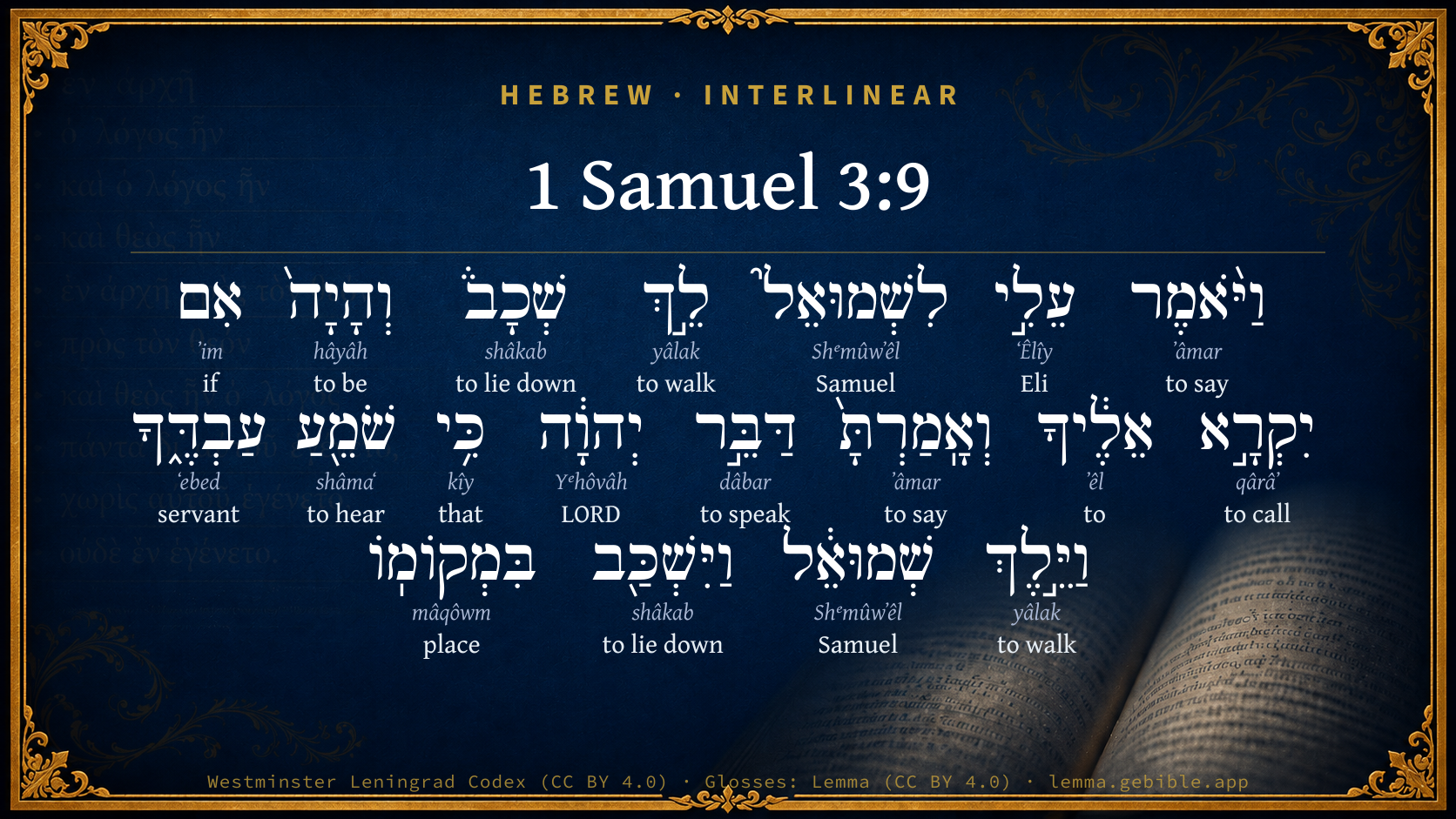
Hebrew (Westminster Leningrad Codex) 1 Samuel 3:9 appears in the Hebrew Old Testament. The text above is from the Westminster Leningrad Codex. Each word links to its Strong’s number, a concise gloss, and parsing drawn from the Open Scriptures Hebrew Bible morphology. Click any word for its full Brown-Driver-Briggs (BDB) entry.
Download image
Cite this verse

1 Samuel 3:9 (World English Bible). Public Domain. Lemma interlinear Bible study tool, https://lemma.gebible.app/v/1-samuel/3/9.

Show BibTeX & RIS
BibTeX
RIS
English Translation
Therefore Eli said to Samuel, Go, lie down: and it shall be, if he call you, that you shall say, Speak, Yahweh; for your servant hears. So Samuel went and lay down in his place.
World English Bible · Public Domain
Download a study sheet

One document with this verse’s original text, its word-by-word gloss line, the meaning frame, cross-references with their text, attributed commentary, and full source and license credits — printable, and it pastes into notes with its structure intact.

This verse Autodidact and up

Study sheet (.html) Plain text (.txt)

A passage Seminary Student

Up to 50 verses in one chapter. A passage sheet keeps up to 6 commentary sources and 12 cross-references per verse, in the order this page ranks them, and says so on the sheet whenever that leaves anything out. Ask for a single verse and you get the Autodidact verse sheet above.

Everything on this page stays free to read, with no account — the sheet is a download of what is already on screen, not access to it.

Want to remove ads? Support Godless Engineer
Compare translations 3

The same verse in 3 English versions, stacked beneath the original-language interlinear above. Click any original word for its lexicon entry.

Each is an independent rendering of the whole verse — the interlinear is not word-aligned to these translations.

Highlighted words mark where these versions differ — a whole-verse word diff, not a word-by-word alignment.

  • World English Bible Public Domain
    Therefore Eli said to Samuel, Go, lie down: and it shall be, if he call you, that you shall say, Speak, Yahweh; for your servant hears. So Samuel went and lay down in his place.
  • King James Version Public Domain
    Therefore Eli said unto Samuel, Go, lie down: and it shall be, if he call thee, that thou shalt say, Speak, LORD; for thy servant heareth. So Samuel went and lay down in his place.
  • unfoldingWord Literal Text CC BY-SA 4.0
    And Eli said to Samuel, “Go, lie down. And it will happen that, if he calls to you, then you shall say, ‘Speak, Yahweh, for your servant is listening.’” So Samuel went and lay down in his place.

unfoldingWord Literal Text — © unfoldingWord, licensed CC BY-SA 4.0. Word-aligned USFM3 via Door43 (git.door43.org/unfoldingWord/en_ult).

Versions to compare (up to 4)

3 of 4 selected

Show all 18 translations

Every available English version of this verse, each an independent rendering of the whole verse.

  • World English Bible Public Domain
    Therefore Eli said to Samuel, Go, lie down: and it shall be, if he call you, that you shall say, Speak, Yahweh; for your servant hears. So Samuel went and lay down in his place.
  • Berean Standard Bible Public Domain
    “Go and lie down,” he said to Samuel, “and if He calls you, say, ‘Speak, LORD, for Your servant is listening.’” So Samuel went and lay down in his place.
  • Majority Standard Bible Public Domain
    “Go and lie down,” he said to Samuel, “and if He calls you, say, ‘Speak, LORD, for Your servant is listening.’” So Samuel went and lay down in his place.
  • King James Version Public Domain
    Therefore Eli said unto Samuel, Go, lie down: and it shall be, if he call thee, that thou shalt say, Speak, LORD; for thy servant heareth. So Samuel went and lay down in his place.
  • American Standard Version (1901) Public Domain
    Therefore Eli said unto Samuel, Go, lie down: and it shall be, if he call thee, that thou shalt say, Speak, Jehovah; for thy servant heareth. So Samuel went and lay down in his place.
  • Revised Version (1885) Public Domain
    Therefore Eli said unto Samuel, Go, lie down: and it shall be, if he call thee, that thou shalt say, Speak, LORD; for thy servant heareth. So Samuel went and lay down in his place.
  • Geneva Bible (1599) Public Domain
    Therefore Eli saide vnto Samuel, Goe and sleepe: and if he call thee, then say, Speake Lord, for thy seruant heareth. So Samuel went, and slept in his place.
  • Douay-Rheims (1899) Public Domain
    And said: Here am I: for thou didst call me. Then Heli understood that the Lord called the child, and he said to Samuel: Go, and sleep: and if he shall call thee any more, thou shalt say: Speak, Lord, for thy servant heareth. So Samuel went and slept in his place.
  • Young's Literal Translation Public Domain
    And Eli saith to Samuel, `Go, lie down, and it hath been, if He doth call unto thee, that thou hast said, Speak, Jehovah, for Thy servant is hearing;' and Samuel goeth and lieth down in his place.
  • Literal Standard Version CC BY-SA 4.0
    And Eli says to Samuel, “Go, lie down, and it has been, if He calls to you, that you have said, Speak, YHWH, for Your servant is hearing”; and Samuel goes and lies down in his place.
  • Unlocked Literal Bible CC BY-SA 4.0
    Then Eli said to Samuel, “Go and lie down again; if he calls you again, you must say, 'Speak, Yahweh, for your servant is listening.'” So Samuel went and lay down in his own place once more.
  • unfoldingWord Literal Text CC BY-SA 4.0
    And Eli said to Samuel, “Go, lie down. And it will happen that, if he calls to you, then you shall say, ‘Speak, Yahweh, for your servant is listening.’” So Samuel went and lay down in his place.
  • Darby Bible Public Domain
    And Eli said to Samuel, Go, lie down; and it shall be, if he call thee, that thou shalt say, Speak, Jehovah, for thy servant heareth. So Samuel went and lay down in his place.
  • World Messianic Bible Public Domain
    Therefore Eli said to Samuel, “Go, lie down. It shall be, if he calls you, that you shall say, ‘Speak, LORD; for your servant hears.’” So Samuel went and lay down in his place.
  • Webster's Bible Public Domain
    Therefore Eli said to Samuel, Go, lie down: and it shall be, if he should call thee, that thou shalt say, Speak, LORD; for thy servant heareth. So Samuel went and lay down in his place.
  • Free Bible Version CC BY-SA 4.0
    Eli told Samuel, “Go back to bed, and if he calls you, say, ‘Speak, Lord, because your servant is listening.’” So Samuel went back to his bed.
  • Bible in Basic English Public Domain
    So Eli said to Samuel, Go back: and if the voice comes again, let your answer be, Say on, Lord; for the ears of your servant are open. So Samuel went back to his bed.
  • JPS Tanakh (1917) Public Domain
    Therefore Eli said unto Samuel: 'Go, lie down; and it shall be, if thou be called, that thou shalt say: Speak, LORD; for Thy servant heareth.' So Samuel went and lay down in his place.

Literal Standard Version (2020), Covenant Press — licensed CC BY-SA 4.0. Text via the HelloAO Bible API (eBible.org). Unlocked Literal Bible (unfoldingWord) — licensed CC BY-SA 4.0. Text via the HelloAO Bible API (eBible.org). unfoldingWord Literal Text — © unfoldingWord, licensed CC BY-SA 4.0. Word-aligned USFM3 via Door43 (git.door43.org/unfoldingWord/en_ult). Free Bible Version, Dr. Jonathan Gallagher — licensed CC BY-SA 4.0. Text via the HelloAO Bible API (eBible.org).

Word by word

More ways to search: Search by grammar → Find every occurrence → Compare this word →

Practice this passage: Drill this verse → Learn its vocabulary →

עֵלִ֣י
ʻÊlîy
H5941
“Eli”
Noun, Proper
Part of Speech
Noun
Type
Proper
Full BDB Definition

Origin: from H5927

TWOT: None

Eli = "ascension" - descendant of Aaron through Ithamar and high priest and judge of Israel when Samuel entered service as a child
  1. וַיֹּ֨אמֶר ʼâmar H559 “and · to say” Conjunction + Verb, Qal, Sequential Imperfect, 3rd Person, Masculine, Singular
  2. לִשְׁמוּאֵל֮ Shᵉmûwʼêl H8050 “to/for · Samuel” Preposition + Noun, Proper
  3. לֵ֣ךְ yâlak H3212 “walk” Verb, Qal, Imperative, 2nd Person, Masculine, Singular
  4. שְׁכָב֒ shâkab H7901 “lie down” Verb, Qal, Imperative, 2nd Person, Masculine, Singular
  5. וְהָיָה֙ hâyâh H1961 “and · to be” Conjunction + Verb, Qal, Sequential Perfect, 3rd Person, Masculine, Singular
  6. אִם ʼim H518 “if” Conjunction
  7. יִקְרָ֣א qârâʼ H7121 “to call” Verb, Qal, Imperfect, 3rd Person, Masculine, Singular
  8. אֵלֶ֔יךָ ʼêl H413 “to · you” Preposition + Suffix, Personal, 2nd Person, Masculine, Singular
  9. וְאָֽמַרְתָּ֙ ʼâmar H559 “and · to say” Conjunction + Verb, Qal, Sequential Perfect, 2nd Person, Masculine, Singular
  10. דַּבֵּ֣ר dâbar H1696 “speak” Verb, Piel, Imperative, 2nd Person, Masculine, Singular
  11. יְהוָ֔ה Yᵉhôvâh H3068 “LORD” Noun, Proper
  12. כִּ֥י kîy H3588 “that” Conjunction
  13. שֹׁמֵ֖עַ shâmaʻ H8085 “hearing” Verb, Qal, Participle Active, Masculine, Singular, Absolute
  14. עַבְדֶּ֑ךָ ʻebed H5650 “servant · your” Noun, Common, Masculine, Singular, Construct + Suffix, Personal, 2nd Person, Masculine, Singular
  15. וַיֵּ֣לֶךְ yâlak H3212 “and · to walk” Conjunction + Verb, Qal, Sequential Imperfect, 3rd Person, Masculine, Singular
  16. שְׁמוּאֵ֔ל Shᵉmûwʼêl H8050 “Samuel” Noun, Proper
  17. וַיִּשְׁכַּ֖ב shâkab H7901 “and · to lie down” Conjunction + Verb, Qal, Sequential Imperfect, 3rd Person, Masculine, Singular
  18. בִּמְקוֹמֽוֹ mâqôwm H4725 “in/at · place · his” Preposition + Noun, Common, Masculine, Singular, Construct + Suffix, Personal, 3rd Person, Masculine, Singular

About this verse

These counts appear in no published source. They are computed here, from the morphology-tagged text and Lemma’s own curated glosses. What Lemma adds →

19
words
15
distinct lemmas
Historical
section

Shared distinctive vocabulary

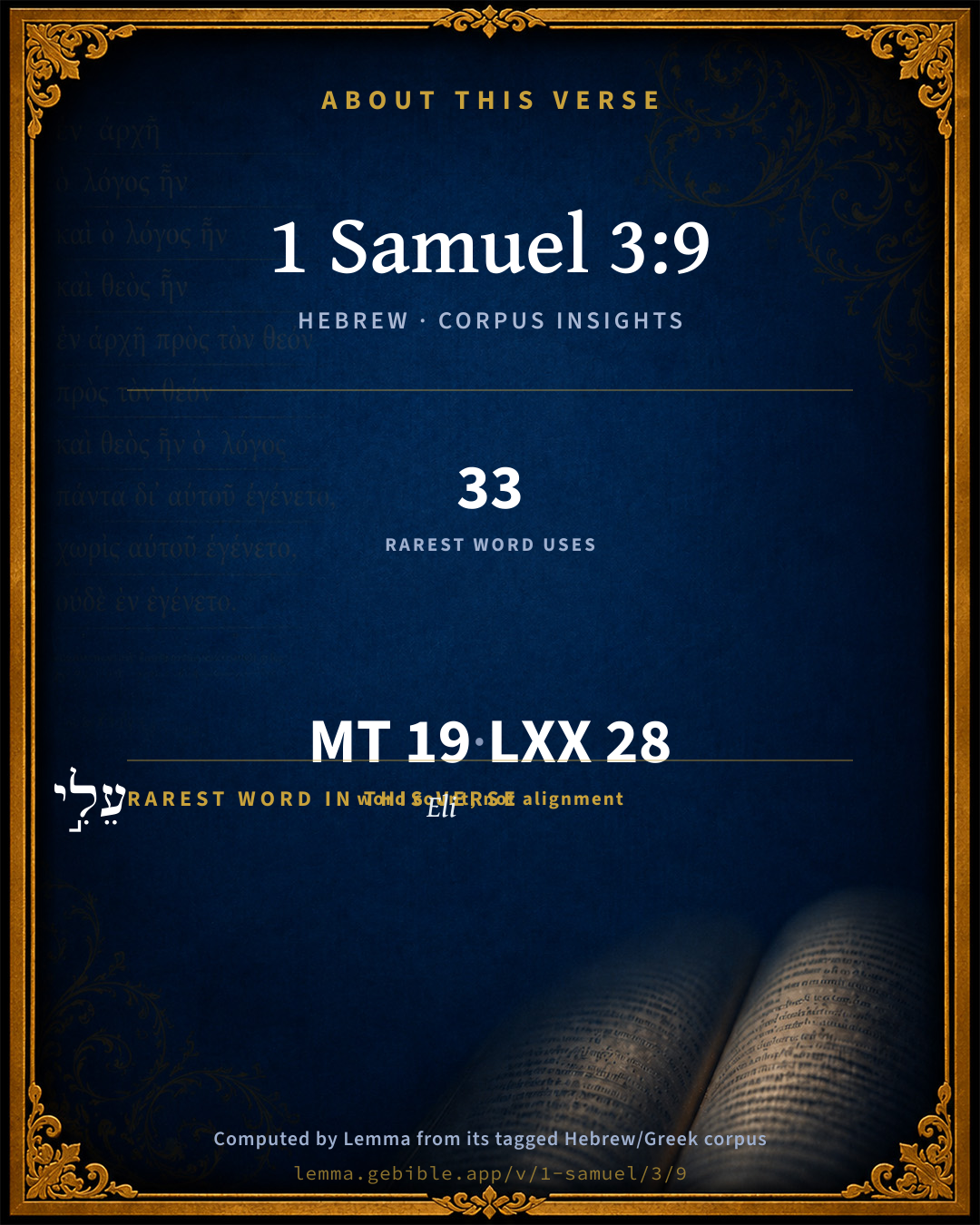
עֵלִ֣י Eli H5941 occurs in 30 verses of the Hebrew Bible. Also found in:

Grammatical profile

  • 10 verbs
  • 6 nouns
  • 1 preposition
  • 2 conjunctions

Verb forms

  • וַיֹּ֨אמֶר Qal · Sequential Imperfect
  • לֵ֣ךְ Qal · Imperative
  • שְׁכָב֒ Qal · Imperative
  • וְהָיָה֙ Qal · Sequential Perfect
  • יִקְרָ֣א Qal · Imperfect
  • וְאָֽמַרְתָּ֙ Qal · Sequential Perfect
  • דַּבֵּ֣ר Piel · Imperative
  • שֹׁמֵ֖עַ Qal · Participle Active
  • וַיֵּ֣לֶךְ Qal · Sequential Imperfect
  • וַיִּשְׁכַּ֖ב Qal · Sequential Imperfect

Repetition

Words recur within this verse — often emphatic in Hebrew:

  • וַיֹּ֨אמֶר to say H559 ×2
  • לִשְׁמוּאֵל֮ Samuel H8050 ×2
  • לֵ֣ךְ to walk H3212 ×2
  • שְׁכָב֒ to lie down H7901 ×2

Hebrew & Septuagint length

In English translation the verse runs 35 words from the Hebrew and 37 from the Septuagint (LXX English) — closely comparable.

A rough comparison of the two English renderings, which tokenize alike — not a word-level alignment.

Word counts can differ between the Hebrew and the Greek without any difference in meaning — e.g. the Hebrew direct-object marker אֵת has no separate Greek word, and Greek often adds the article ὁ.

In the original languages it is 19 Hebrew tokens and 28 Greek tokens — but the two are counted differently (Hebrew bundles its prefixes and suffixes into one token; the Greek is in lemma form), so that isn’t a like-for-like length.

Cross-references

5

Topical passages linked to 1 Samuel 3:9 in the Treasury of Scripture Knowledge — connected by theme and wording, ordered by reader-vote popularity; previews shown in the World English Bible.

  • Exodus 20:19 They said to Moses, "Speak with us yourself, and we will listen; but don't let God speak with us, lest we die."
  • Isaiah 6:8 I heard the Lord's voice, saying, "Whom shall I send, and who will go for us?" Then I said, "Here I am. Send me!"
  • Psalms 85:8 I will hear what God, Yahweh, will speak, For he will speak peace to his people, his saints; But let them not turn again to folly.
  • Acts 9:6 But rise up, and enter into the city, and you will be told what you must do."
  • Daniel 10:19 He said, "Greatly beloved man, don't be afraid: peace be to you, be strong, yes, be strong." When he spoke to me, I was strengthened, and said, "Let my lord speak; for you have strengthened me."

Cross-references courtesy of OpenBible.info (CC BY 4.0).

Hebrew and Greek witnesses Masoretic Hebrew ↔ Greek Septuagint

The same verse in the two great witnesses to the Old Testament, shown verse-for-verse.

These are two independent witnesses, not word-aligned to each other, and the Septuagint is shown in lemma (dictionary) form.

Hebrew 1 Samuel 3:9 Masoretic · Westminster Leningrad Codex

וַיֹּ֨אמֶר עֵלִ֣י לִשְׁמוּאֵל֮ לֵ֣ךְ שְׁכָב֒ וְהָיָה֙ אִם יִקְרָ֣א אֵלֶ֔יךָ וְאָֽמַרְתָּ֙ דַּבֵּ֣ר יְהוָ֔ה כִּ֥י שֹׁמֵ֖עַ עַבְדֶּ֑ךָ וַיֵּ֣לֶךְ שְׁמוּאֵ֔ל וַיִּשְׁכַּ֖ב בִּמְקוֹמֽוֹ

Therefore Eli said to Samuel, Go, lie down: and it shall be, if he call you, that you shall say, Speak, Yahweh; for your servant hears. So Samuel went and lay down in his place.

World English Bible · Public Domain

Greek LXX 1 Samuel 3:9 Septuagint · lemma form

καί εἶπον ἀναστρέφω καταεὕδω τέκνον καί εἰμί ἐάν καλέω σύ καί εἶπον λαλέω κύριος ὅτι ἀκούω ὁ δοῦλος σύ καί πορεύομαι σαμουηλ καί κοιμάω ἐν ὁ τόπος αὐτός

And he said, Return, child, go to sleep; and it shall come to pass if he shall call you, that you shall say, Speak for your servant hears: and Samuel went and lay down in his place.

LXX2012 (modern English Septuagint) · Public Domain

Hebrew: Westminster Leningrad Codex (CC BY 4.0). Greek: Septuagint (public domain); English from LXX2012 (modern English Septuagint) (Public Domain). How the Septuagint differs from the Hebrew →

Targum (Aramaic paraphrase)

1

The Targum is the ancient Jewish Aramaic paraphrase of the Hebrew Scriptures — an interpretive translation, not the Hebrew text itself. Onkelos (literal) and Pseudo-Jonathan (expansive) render the Torah, and Jonathan the Prophets. Coverage is partial: where no permissively-licensed English translation exists for a verse, only the Aramaic is shown. This is verse-level text, not a word-by-word alignment to the Hebrew.

  1. Targum Jonathan Prophets (Joshua–Malachi)
    וַאֲמַר עֵלִי לִשְׁמוּאֵל אֱזִיל שְׁכוּב וִיהֵי אִם יִקְרֵי לָךְ וְתֵימַר מַלֵיל יְיָ אֲרֵי שְׁמַע עַבְדָךְ וַאֲזַל שְׁמוּאֵל וּשְׁכִיב בְּאַתְרֵיהּ:

    (no public-domain English translation for this verse)

    Targum Jonathan — Aramaic: “Mikraot Gedolot” (public domain). English: “Sefaria Community Translation” (CC0 1.0 (public-domain dedication)); “London "Chaldee Paraphrase," 1871” (public domain). Text via Sefaria.

Commentary

Notes on 1 Samuel 3:9 from classic Christian and Jewish commentators (each source and its license shown beneath its notes). The classic Christian expositions comment on the surrounding passage and are grouped to its opening verse, so a note may address several verses; the Jewish commentaries on the Tanakh (Rashi and others) are per-verse, so they appear only where the commentator wrote on this verse.

Lemma curates 59 commentaries, every one of them public domain or Creative Commons licensed, each selected and text-cleaned for this edition rather than reprinted as found. About our sources →

Trapp's Complete Commentary

John Trapp

1Sa 3:9 Therefore Eli said unto Samuel, Go, lie down: and it shall be, if he call thee, that thou shalt say, Speak, LORD; for thy servant heareth. So Samuel went and lay down in his place.

Ver. 9. That thou shalt say, Speak, Lord; for thy servant heareth.] Eli, though his conscience told him that Samuel would shortly bespeak him, as afterwards Ahijah the prophet did Jeroboam’s wife, "I am sent to thee with heavy tidings," {1Ki 14:6} yet he instructeth him when God called again, what answer he should make: and saith in effect, as that holy Dutch doctor did, Veniat, veniat verbum Dei et submittemus ei, sexcenta si nobis essent colla. Let the word of God be what it will, I will surely submit to it.

John Trapp, A Commentary or Exposition upon All the Books of the Old and New Testament (1647–1656) — public domain. Text from a community e-Sword module.

Adam Clarke's Commentary

Verse 9. Speak, Lord; for thy servant heareth] This was the usual way in which the prophets spoke, when they had intimations that the Lord was about to make some especial revelation.

Adam Clarke's Commentary on the Bible (1810–1826) — public domain. Text from a community e-Sword/MySword module.

Ellicott's Commentary for English Readers

(9, 10) And the Lord came, and stood.—Then before the boy, as he lay and waited for the voice, came something, and it stood before him. The question naturally occurs to us, What came and stood before the boy’s couch? As a rule, we find that generally, when the Lord was pleased to take some form, the form is specified. Now, as in Abraham’s case at Mamre, it was a traveller; now, as in Joshua’s, an armed warrior; very frequently, as to Manoah, the form was that of an angel; here nothing is specially described. Was it not that simply “the glory” on which Moses gazed when he met the Holy One on Sinai—“the glory” which seemed to rest at times in the lightless Holy of Holies on the golden mercy-seat of the Ark of the Covenant? Was it not this “visible glory”—Shekinah. as the Hebrews termed it—which filled the chamber of the child, and from out of this came the voice of the Eternal, and spoke to Samuel? “See how God loves holiness in children. The child Samuel was preferred by Him to Eli, the aged high priest and judge.”—Theodoret, quoted by Bishop Wordsworth.

A Bible Commentary for English Readers, edited by Charles John Ellicott (1878–1897) — public domain. Text from a community e-Sword module.

John Gill's Exposition

Therefore Eli said unto Samuel, go, lie down,.... Once more:

and it shall be, if he call thee; the voice, or the Lord by it:

that thou shalt say, speak, Lord, for thy servant heareth; his meaning is, that he should not rise and come to him, as he had done, but continue on his bed, on hearing the voice again, but desire the Lord to speak to him what he had to say, to which he was ready to attend:

so Samuel went and lay down in his place; which, as commonly understood, was in the court of the Levites; see Gill on Sa1 3:3.

John Gill's Exposition of the Whole Bible (1746–1763) — public domain (CC PDM 1.0). Text via the HelloAO Bible API.

Haydock's Catholic Bible Commentary

Heareth; ready to comply with whatever may be required. (Haydock)

George Leo Haydock (1774–1849), Haydock's Catholic Family Bible and Commentary, 1859 edition — public domain. Excludes Psalms (Douay-Rheims chapter numbering differs from Protestant) and Deuterocanonical books (Catholic canon only).

Matthew Poole's English Annotations

Thy servant heareth, i.e. I am ready to hear what thou speakest, and to do what thou requirest.

Matthew Poole's English Annotations on the Holy Bible (1683–1685) — public domain. Text from a community e-Sword/MySword module.

unfoldingWord translationNotes

Door43 World Missions Community

your servant is

Eli tells Samuel to speak to Yahweh as if Samuel were another person so that Samuel would show respect to Yahweh. AT: "I am" (See: Pronouns)

translationWords

servant

unfoldingWord translationNotes — © Distant Shores Media and the Door43 World Missions Community, licensed CC BY-SA 4.0. Source: git.door43.org/Door43/en_tn.

Lesson kit

Teaching starters — assembled from the data on this page, not authored interpretation. Every prompt links to the verse data it draws on. Edit before teaching.

1 Samuel, in the Historical, opens this verse with 19 words (15 distinct Hebrew lemmas). Its most distinctive word is ʻÊlîy (“Eli”). A historical commentator’s framing appears above. Read the whole chapter for the surrounding context.

Discussion questions

  1. The word ʻÊlîy carries the sense “Eli.” How does it shape the verse?
  2. 1 Samuel 1:3 shares the word «Eli» with this verse. How do the two illuminate each other?
  3. “to say” occurs 2× in this one verse. What is the effect of the repetition?
  4. These translations render this verse differently. What is at stake in choosing one wording over another?
  5. The verb «וַיֹּ֨אמֶר» is Qal Sequential Imperfect. How does its form color the action?
  6. Reading how Trapp's Complete Commentary and Adam Clarke's Commentary read this verse, where do the two commentators agree and where do they part?

Things to notice

Reading settings

Reading text

Shown beneath each verse's original-language words.

Old Testament
Old Testament edition

Read the OT as the Masoretic Hebrew (MT) or the Greek Septuagint (LXX).

English shown for the Greek Septuagint (in the Hebrew ↔ Greek comparison).

Comparing translations? Open the Compare panel on any verse page to stack up to four side by side.