Genesis 39:10

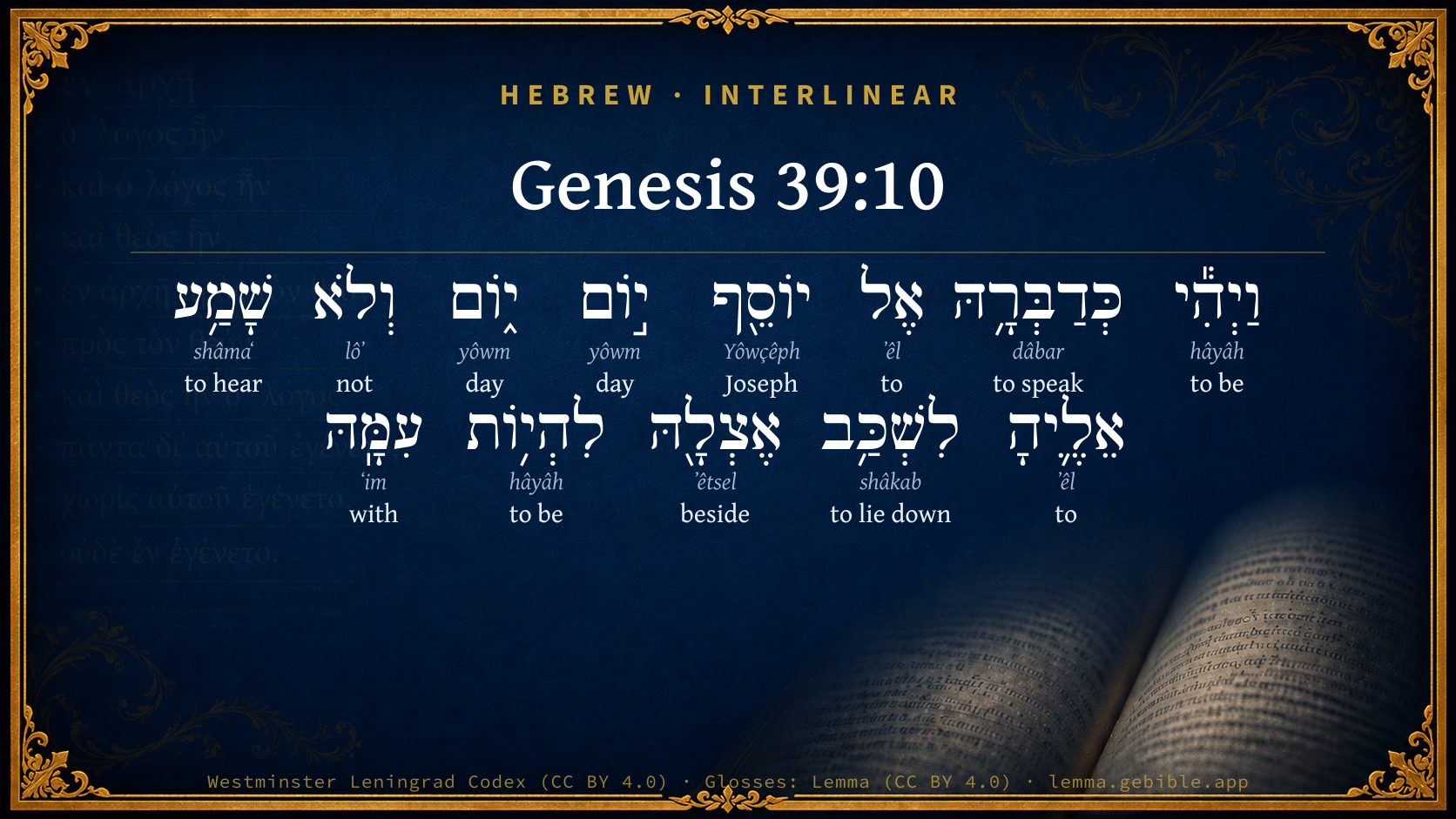
Hebrew (Westminster Leningrad Codex) Genesis 39:10 appears in the Hebrew Old Testament. The text above is from the Westminster Leningrad Codex. Each word links to its Strong’s number, a concise gloss, and parsing drawn from the Open Scriptures Hebrew Bible morphology. Click any word for its full Brown-Driver-Briggs (BDB) entry.
Download image
Cite this verse

Genesis 39:10 (World English Bible). Public Domain. Lemma interlinear Bible study tool, https://lemma.gebible.app/v/genesis/39/10.

Show BibTeX & RIS
BibTeX
RIS
English Translation
It happened that as she spoke to Joseph day by day, that he didn't listen to her, to lie by her, or to be with her.
World English Bible · Public Domain
Highlights
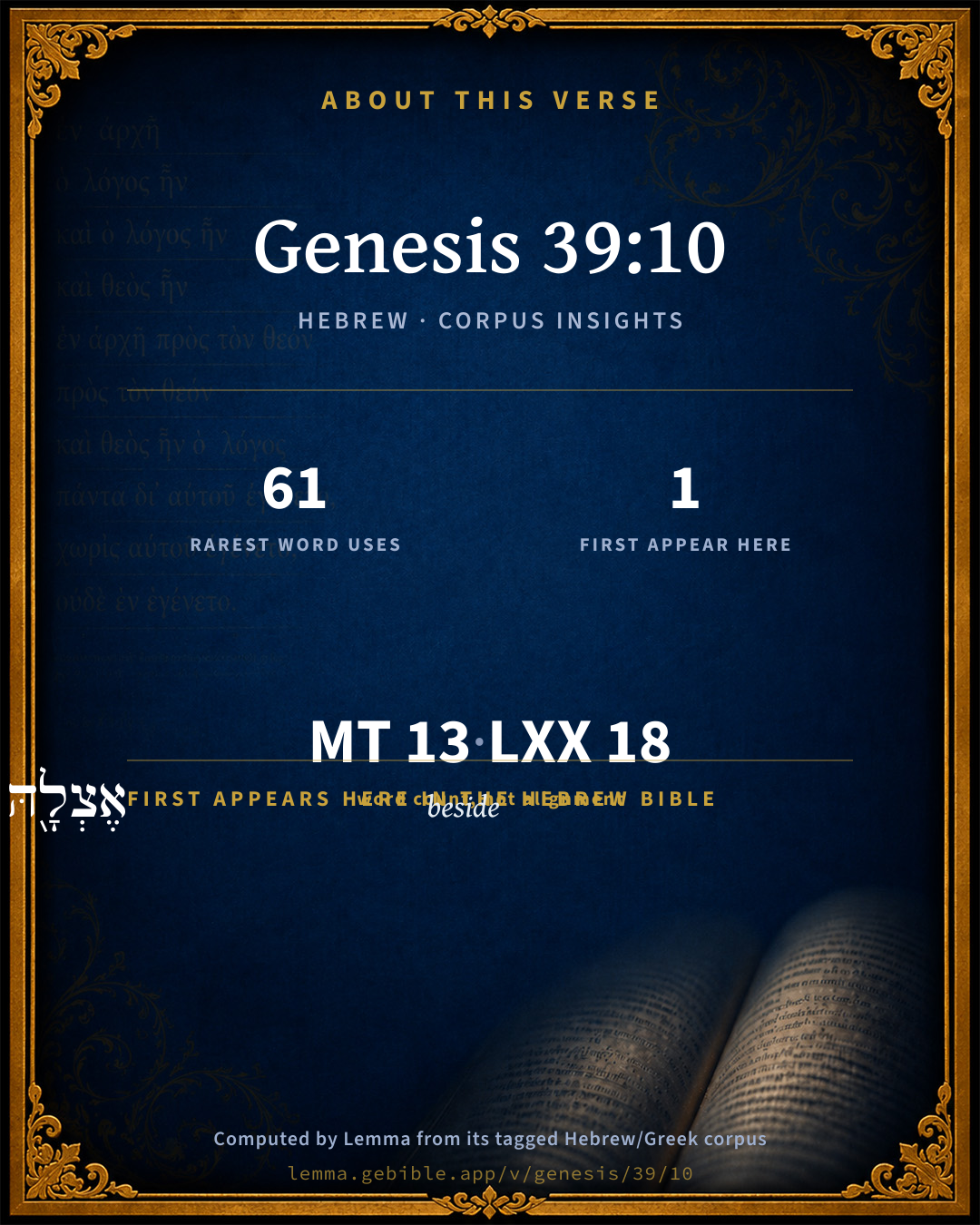
  • 1 first appearance in the Hebrew Bible
Full analysis ↓
Download a study sheet

One document with this verse’s original text, its word-by-word gloss line, the meaning frame, cross-references with their text, attributed commentary, and full source and license credits — printable, and it pastes into notes with its structure intact.

This verse Autodidact and up

Study sheet (.html) Plain text (.txt)

A passage Seminary Student

Up to 50 verses in one chapter. A passage sheet keeps up to 6 commentary sources and 12 cross-references per verse, in the order this page ranks them, and says so on the sheet whenever that leaves anything out. Ask for a single verse and you get the Autodidact verse sheet above.

Everything on this page stays free to read, with no account — the sheet is a download of what is already on screen, not access to it.

Want to remove ads? Support Godless Engineer
Compare translations 3

The same verse in 3 English versions, stacked beneath the original-language interlinear above. Click any original word for its lexicon entry.

Each is an independent rendering of the whole verse — the interlinear is not word-aligned to these translations.

Highlighted words mark where these versions differ — a whole-verse word diff, not a word-by-word alignment.

  • World English Bible Public Domain
    It happened that as she spoke to Joseph day by day, that he didn't listen to her, to lie by her, or to be with her.
  • King James Version Public Domain
    And it came to pass, as she spake to Joseph day by day, that he hearkened not unto her, to lie by her, or to be with her.
  • unfoldingWord Literal Text CC BY-SA 4.0
    And it happened, even though she kept speaking to Joseph day day, yet he did not listen to her to lie beside her, to be with her.

unfoldingWord Literal Text — © unfoldingWord, licensed CC BY-SA 4.0. Word-aligned USFM3 via Door43 (git.door43.org/unfoldingWord/en_ult).

Versions to compare (up to 4)

3 of 4 selected

Show all 17 translations

Every available English version of this verse, each an independent rendering of the whole verse.

  • World English Bible Public Domain
    It happened that as she spoke to Joseph day by day, that he didn't listen to her, to lie by her, or to be with her.
  • Berean Standard Bible Public Domain
    Although Potiphar’s wife spoke to Joseph day after day, he refused to go to bed with her or even be near her.
  • Majority Standard Bible Public Domain
    Although Potiphar’s wife spoke to Joseph day after day, he refused to go to bed with her or even be near her.
  • King James Version Public Domain
    And it came to pass, as she spake to Joseph day by day, that he hearkened not unto her, to lie by her, or to be with her.
  • American Standard Version (1901) Public Domain
    And it came to pass, as she spake to Joseph day by day, that he hearkened not unto her, to lie by her, `or' to be with her.
  • Revised Version (1885) Public Domain
    And it came to pass, as she spake to Joseph day by day, that he hearkened not unto her, to lie by her, or to be with her.
  • Geneva Bible (1599) Public Domain
    And albeit she spake to Ioseph day by day, yet he hearkened not vnto her, to lye with her, or to be in her company.
  • Young's Literal Translation Public Domain
    And it cometh to pass at her speaking unto Joseph day `by' day, that he hath not hearkened unto her, to lie near her, to be with her;
  • Literal Standard Version CC BY-SA 4.0
    And it comes to pass at her speaking to Joseph day [by] day, that he has not listened to her, to lie near her, to be with her;
  • Unlocked Literal Bible CC BY-SA 4.0
    She spoke to Joseph day after day, but he refused to sleep with her or to be with her.
  • unfoldingWord Literal Text CC BY-SA 4.0
    And it happened, even though she kept speaking to Joseph day day, yet he did not listen to her to lie beside her, to be with her.
  • Darby Bible Public Domain
    And it came to pass as she spoke to Joseph day by day and he hearkened not to her, to lie with her [and] to be with her,
  • World Messianic Bible Public Domain
    As she spoke to Joseph day by day, he didn’t listen to her, to lie by her, or to be with her.
  • Webster's Bible Public Domain
    And it came to pass, as she spoke to Joseph day by day, that he hearkened not to her, to lie by her, or to be with her.
  • Free Bible Version CC BY-SA 4.0
    Day after day she persisted in asking him, but he refused to sleep with her and tried to avoid her.
  • Bible in Basic English Public Domain
    And day after day she went on requesting Joseph to come to her and be her lover, but he would not give ear to her.
  • JPS Tanakh (1917) Public Domain
    And it came to pass, as she spoke to Joseph day by day, that he hearkened not unto her, to lie by her, or to be with her.

Literal Standard Version (2020), Covenant Press — licensed CC BY-SA 4.0. Text via the HelloAO Bible API (eBible.org). Unlocked Literal Bible (unfoldingWord) — licensed CC BY-SA 4.0. Text via the HelloAO Bible API (eBible.org). unfoldingWord Literal Text — © unfoldingWord, licensed CC BY-SA 4.0. Word-aligned USFM3 via Door43 (git.door43.org/unfoldingWord/en_ult). Free Bible Version, Dr. Jonathan Gallagher — licensed CC BY-SA 4.0. Text via the HelloAO Bible API (eBible.org).

Word by word

More ways to search: Search by grammar → Find every occurrence → Compare this word →

Practice this passage: Drill this verse → Learn its vocabulary →

אֶצְלָ֖הּ
ʼêtsel
H681
“beside · her”
Preposition + Suffix, Personal, 3rd Person, Feminine, Singular
Part of Speech
Preposition
Full BDB Definition

Origin: from H680 (in the sense of joining)

TWOT: 153a

beside, by, near, nearness, joining, proximity - (BDB) (substantive) - conjunction, proximity - beside, in proximity, contiguous to, from beside
  1. וַיְהִ֕י hâyâh H1961 “and · to be” Conjunction + Verb, Qal, Sequential Imperfect, 3rd Person, Masculine, Singular
  2. כְּדַבְּרָ֥הּ dâbar H1696 “like/as · to speak · her” Preposition + Verb, Piel, Infinitive Construct + Suffix, Personal, 3rd Person, Feminine, Singular
  3. אֶל ʼêl H413 “to” Preposition
  4. יוֹסֵ֖ף Yôwçêph H3130 “Joseph” Noun, Proper
  5. י֣וֹם yôwm H3117 “day” Noun, Common, Masculine, Singular, Absolute
  6. י֑וֹם yôwm H3117 “day” Noun, Common, Masculine, Singular, Absolute
  7. וְלֹא lôʼ H3808 “and · not” Conjunction + Particle, Negative
  8. שָׁמַ֥ע shâmaʻ H8085 “to hear” Verb, Qal, Perfect, 3rd Person, Masculine, Singular
  9. אֵלֶ֛יהָ ʼêl H413 “to · her” Preposition + Suffix, Personal, 3rd Person, Feminine, Singular
  10. לִשְׁכַּ֥ב shâkab H7901 “to lie down” Preposition + Verb, Qal, Infinitive Construct
  11. לִהְי֥וֹת hâyâh H1961 “to be” Preposition + Verb, Qal, Infinitive Construct
  12. עִמָּֽהּ ʻim H5973 “with · her” Preposition + Suffix, Personal, 3rd Person, Feminine, Singular

About this verse

These counts appear in no published source. They are computed here, from the morphology-tagged text and Lemma’s own curated glosses. What Lemma adds →

13
words
10
distinct lemmas
Pentateuch
section

First appearance in Scripture

This word makes its first canonical appearance in the Hebrew Bible here:

  • אֶצְלָ֖הּ beside H681

Grammatical profile

  • 5 verbs
  • 3 nouns
  • 4 prepositions
  • 1 particle

Verb forms

  • וַיְהִ֕י Qal · Sequential Imperfect
  • כְּדַבְּרָ֥הּ Piel · Infinitive Construct
  • שָׁמַ֥ע Qal · Perfect
  • לִשְׁכַּ֥ב Qal · Infinitive Construct
  • לִהְי֥וֹת Qal · Infinitive Construct

Repetition

Words recur within this verse — often emphatic in Hebrew:

  • וַיְהִ֕י to be H1961 ×2
  • י֣וֹם day H3117 ×2
  • אֶל to H413 ×2

Hebrew & Septuagint length

In English translation the verse runs 26 words from the Hebrew and 25 from the Septuagint (LXX English) — closely comparable.

A rough comparison of the two English renderings, which tokenize alike — not a word-level alignment.

Word counts can differ between the Hebrew and the Greek without any difference in meaning — e.g. the Hebrew direct-object marker אֵת has no separate Greek word, and Greek often adds the article ὁ.

In the original languages it is 13 Hebrew tokens and 18 Greek tokens — but the two are counted differently (Hebrew bundles its prefixes and suffixes into one token; the Greek is in lemma form), so that isn’t a like-for-like length.

Cross-references

18

Topical passages linked to Genesis 39:10 in the Treasury of Scripture Knowledge — connected by theme and wording, ordered by reader-vote popularity; previews shown in the World English Bible.

  • 1 Peter 2:11 Beloved, I beg you as foreigners and pilgrims, to abstain from fleshly lusts, which war against the soul;
  • 1 Corinthians 6:18 Flee sexual immorality! "Every sin that a man does is outside the body," but he who commits sexual immorality sins against his own body.
  • 1 Corinthians 15:33 Don't be deceived! "Evil companionships corrupt good morals."
  • 1 Thessalonians 5:22 Abstain from every form of evil.
  • 2 Timothy 2:22 Flee from youthful lusts; but pursue righteousness, faith, love, and peace with those who call on the Lord out of a pure heart.
  • Genesis 39:8 But he refused, and said to his master's wife, "Behold, my master doesn't know what is with me in the house, and he has put all that he has into my hand.
  • Proverbs 2:16 To deliver you from the strange woman, Even from the foreigner who flatters with her words;
  • Proverbs 1:15 My son, don't walk in the way with them. Keep your foot from their path,
  • Proverbs 5:3 For the lips of an adulteress drip honey. Her mouth is smoother than oil,
  • Proverbs 5:8 Remove your way far from her. Don't come near the door of her house,
  • Proverbs 6:25–26 Don't lust after her beauty in your heart, Neither let her captivate you with her eyelids.
  • Proverbs 7:5 That they may keep you from the strange woman, From the foreigner who flatters with her words.
  • Proverbs 7:13 So she caught him, and kissed him. With an impudent face she said to him:
  • Proverbs 9:14 She sits at the door of her house, On a seat in the high places of the city,
  • Proverbs 22:14 The mouth of an adulteress is a deep pit: He who is under Yahweh's wrath will fall into it.
  • Proverbs 23:27 For a prostitute is a deep pit; And a wayward wife is a narrow well.
  • Proverbs 9:16 "Whoever is simple, let him turn in here." As for him who is void of understanding, she says to him,
  • 1 Timothy 5:14 I desire therefore that the younger widows marry, bear children, rule the household, and give no occasion to the adversary for reviling.

Cross-references courtesy of OpenBible.info (CC BY 4.0).

Hebrew and Greek witnesses Masoretic Hebrew ↔ Greek Septuagint

The same verse in the two great witnesses to the Old Testament, shown verse-for-verse.

These are two independent witnesses, not word-aligned to each other, and the Septuagint is shown in lemma (dictionary) form.

Hebrew Genesis 39:10 Masoretic · Westminster Leningrad Codex

וַיְהִ֕י כְּדַבְּרָ֥הּ אֶל יוֹסֵ֖ף י֣וֹם י֑וֹם וְלֹא שָׁמַ֥ע אֵלֶ֛יהָ לִשְׁכַּ֥ב אֶצְלָ֖הּ לִהְי֥וֹת עִמָּֽהּ

It happened that as she spoke to Joseph day by day, that he didn't listen to her, to lie by her, or to be with her.

World English Bible · Public Domain

Greek LXX Genesis 39:10 Septuagint · lemma form

ἡνίκα δέ λαλέω ὁ ιωσηφ ἡμέρα ἐκ ἡμέρα καί οὐ ὑποἀκούω αὐτός καταεὕδω μετά αὐτός ὁ συνγίγνομαι αὐτός

And when she talked with Joseph day by day, and he listened not to her to sleep with her, so as to be with her,

LXX2012 (modern English Septuagint) · Public Domain

Hebrew: Westminster Leningrad Codex (CC BY 4.0). Greek: Septuagint (public domain); English from LXX2012 (modern English Septuagint) (Public Domain). How the Septuagint differs from the Hebrew →

Targum (Aramaic paraphrase)

2

The Targum is the ancient Jewish Aramaic paraphrase of the Hebrew Scriptures — an interpretive translation, not the Hebrew text itself. Onkelos (literal) and Pseudo-Jonathan (expansive) render the Torah, and Jonathan the Prophets. Coverage is partial: where no permissively-licensed English translation exists for a verse, only the Aramaic is shown. This is verse-level text, not a word-by-word alignment to the Hebrew.

  1. Targum Onkelos Torah (Genesis–Deuteronomy)
    וַהֲוָה כַּד מַלֵּילַת עִם יוֹסֵף יוֹם יוֹם וְלָא קַבִּיל מִנַּהּ לְמִשְׁכַּב לְוָתַהּ לְמֶהֱוֵי עִמַּהּ

    (no public-domain English translation for this verse)

    Targum Onkelos — Aramaic: “Onkelos Genesis” (public domain); “Onkelos Exodus” (public domain); “Onkelos Leviticus” (public domain); “Onkelos Numbers” (public domain); “Onkelos Deuteronomy” (public domain). English: “Sefaria Community Translation” (CC0 1.0 (public-domain dedication)); “J.W. Etheridge. The Targums of Onkelos and Jonathan Ben Uzziel on the Pentateuch. London: Longmans, Green, 1862” (public domain). Text via Sefaria.

  2. Targum Pseudo-Jonathan Torah (Genesis–Deuteronomy)
    וַהֲוָה כְּדֵי מַלִילַת עִם יוֹסֵף יוֹמָא דֵין וְיוֹם מָחְרָא וְלָא קַבֵּיל מִינָהּ לְמִשְׁכּוּב גַבָּהּ לְמֶהֱוֵי מִתְחַיֵיב עִמָהּ בְּיוֹם דִינָא רַבָּא לְעַלְמָא דְאָתֵי

    And it was when she spake with Joseph this day and the next, and be hearkened not to her to lie with her, lest with her be should be condemned in the day of the great judgment of the world to come;

    Targum Pseudo-Jonathan — Aramaic: “Targum Jonathan on Genesis” (public domain); “Targum Jonathan on Exodus” (public domain); “Targum Jonathan on Leviticus” (public domain); “Targum Jonathan on Numbers” (public domain); “Targum Jonathan on Deuteronomy” (public domain). English: “The Targum of Jonathan ben Uzziel, trans. J. W. Etheridge, London, 1862” (public domain). Text via Sefaria.

Commentary

Notes on Genesis 39:10 from classic Christian and Jewish commentators (each source and its license shown beneath its notes). The classic Christian expositions comment on the surrounding passage and are grouped to its opening verse, so a note may address several verses; the Jewish commentaries on the Tanakh (Rashi and others) are per-verse, so they appear only where the commentator wrote on this verse.

Lemma curates 59 commentaries, every one of them public domain or Creative Commons licensed, each selected and text-cleaned for this edition rather than reprinted as found. About our sources →

Trapp's Complete Commentary

John Trapp

Gen 39:10 And it came to pass, as she spake to Joseph day by day, that he hearkened not unto her, to lie by her, [or] to be with her.

Ver. 10. And it came to pass, as she spake, &c.] A violent temptation valiantly withstood and vanquished; and that by the force of the fear of God, that powerful grace where it may bear sway. Alexander, Scipio, Pompey, tempted with the exquisiteness and variety of choicest beauties, forbare that villany; not for conscience’ sake, or fear of God, whom they knew not, but lest thereby they should stop the current of their victories, and obscure the glory of their remarkable valour. But what saith Cyprian? As it is the greatest pleasure to have overcome pleasure, so there is no such victory as that that is gotten over a man’s lusts. This none but a Joseph fearing God can do. For "the fear of the Lord is pure," saith David: {Psa 19:9} it "is to hate evil," not forbear it only, saith Solomon; and he instanceth in inward evils, as pride, arrogancy, &c., so unchaste thoughts, lustful vipers, and hankerings after strange flesh. These the fear of God purgeth upon and represseth; not suffering a man to sin, though he could do it so closely and covertly that the world should be never the wiser. Lo, this is chastity: and it differs herein from continency, which is the best we can say for those heathens aforementioned. The continent person refrains the outward act of uncleanness, either for love of praise or fear of punishment, but not without grief; for inwardly he is scalded with boiling lust. Whereas the chaste man, like St Paul’s virgin, {1Co 7:34} is "holy both in body and in spirit"; and this with delight, out of fear of God and love of virtue. Now, if upon such a ground we can refuse proffered pleasures and preferments, resolving rather to lie in the dust with Joseph than to rise by wicked principles, the trial is as sound as if we had endured the tortures of the rack. {Heb 11:35}

As she spake to Joseph day by day.] Satan will not be said with a little, nor sit down by a light repulse. A man must give him a peremptory denial (απαρνησασθω) again and again, as our Saviour did; and yet the tempter departed not, but for a season. He is called Beelzebub, that is, the Master Fly, because he is impudent as a fly, and soon returns to the bait from which he was beaten. He will be egging us again and again to the same sin, and try every way to overturn us. Many times he tempts by extremes, as he did Mr John Knox, on his deathbed; first, to despair, by setting before him his sins; and, when foiled there, afterwards to presumption, and challenging of heaven as his due, for his many good works, and zeal in the Scottish Reformation. {a} So he dealt here by Joseph. He first set upon him on the left hand, when he sold him for a slave; and when this prevailed not, he sets here a Delilah to tickle him on the right side, and to tie him with the green withes of youthful pleasures. Sed pari successu: but he lost his labour. Joseph was semper idem; famous for all the four cardinal virtues, if ever any were. See here in this one temptation, his fortitude; justice; temperance; and prudence, in that he shuns the occasion; for he would not only not lie with her, but not "be with her," saith the text: and that a man is indeed, that he is in a temptation; which is but a tap to give vent to corruption.

To lie by her, or to be with her.] "Keep thee far from an evil matter," saith Moses. {Exo 23:7} "Come not nigh the door of" the harlot’s "house," saith Solomon. {Pro 5:8} "Flee fornication," saith Paul. {1Co 6:18} And "Flee youthful lusts." {2Ti 2:22} Not abstain from them only, but "flee" them, as ye would do a flying serpent. These are God’s commandments: and they are to be "kept as the sight of the eye." {Pro 7:2} The Nazarite might not only not drink wine, but not taste a raisin or the husk of a grape. {Num 6:3-4} The good Christian is taught to "abstain from all appearance of evil"; {1Th 5:22} and to "hate the very garment that is spotted by the flesh." The devil counts a fit occasion half a conquest; for he knows that corrupt nature hath a πανσπερμια, a seed plot of all sin: which being drawn forth and watered by the breath of ill company, or some other occasion, is soon set awork, to the producing of death. Satan cheats us, when he persuades us that it is no conquest, except we beat away the temptation, yet keep the occasion by us. God will not remove the temptation till we remove the occasion. And in such case to pray, "Lead us not into temptation, but deliver us from evil," is to thrust our finger into the fire, and then pray it may not be burnt. A bird while aloft is safe; but she comes not near the snare without danger. Solomon thought himself wise enough to convert his wives, and not be corrupted by them. But "it came to pass, when Solomon was old, that his wives turned away his heart after other gods," &c. {1Ki 11:4} He that can shun or remove the occasion, of his own proper motion, as Joseph did, he is the man; this is grace; here is a victory.

{a} Mr Perkins.

John Trapp, A Commentary or Exposition upon All the Books of the Old and New Testament (1647–1656) — public domain. Text from a community e-Sword module.

Joseph Benson's Commentary

Gen 39:10-12. She spake to Joseph from day to day — Joseph was single, was in the vigour of youth, was a man of like passions with us, was solicited and importuned to gratify those passions, and that in a way that promised both present pleasure and profit, and by one on whom he was dependant, and whom it was dangerous to provoke; whose frown might be followed by great sufferings, and whose favour might advance and establish his prosperity: opportunity and privacy also were afforded. But Joseph feared God; Joseph believed in a judgment to come. He therefore denied himself, and would not, for the sake of those pleasures of sin which are but for a season, involve himself in the divine wrath, and in certain and lasting misery and ruin. Hence he hearkened not to her, so much as to be with her. Finding her dead to all sense of shame, and deaf to the calls of duty, honour, conscience, and the fear of God, and that she was not to be reclaimed, he avoided her company, being distrustful of himself. For those that would be kept from harm must keep out of harm’s way. And when she laid hold on him, he left his garment in her hand — He would not stay to parley with the temptation, but flew from it with the utmost abhorrence, as one escaping for his life.

Joseph Benson's Commentary on the Old and New Testaments (1811–1818) — public domain. Text from a community e-Sword module.

John Calvin's Commentaries

10. As she spake to Joseph day by day. The constancy of Joseph is commended; from which it appears that a real fear of God reigned in his mind. Whence it came to pass that he not only repelled one attack, but stood forth, to the last, the conqueror of all temptations. We know how easy it is to fall when Satan tempts us through another: because we seem exempt from blame, if he who induces us to commit the crime, bears a part of it. Holy Joseph, therefore, must have been endowed with the extraordinary power of the Spirit, seeing that he stood invincible to the last, against all the allurements of the impious woman. So much the more detestable is the wickedness of her, who is neither corrected by time, nor restrained by many repulses. When she sees a stranger, and one who had been sold as a slave, so discreet and so faithful to his master, when she is also sacredly admonished by him not to provoke the anger of God, how indomitable is that lust which gives no place to shame. Now, because we here see into what evils persons will rush, when regard to propriety is extinguished by carnal intemperance, we must entreat the Lord that He will not suffer the light of his Spirit to be quenched within us.

John Calvin's Commentaries (1540-1563) — public domain. Text from the Calvin Translation Society English edition (1840s-50s) via the Christian Classics Ethereal Library (ccel.org). Calvin's coverage is partial (roughly two-thirds of the Bible); uncommented books and verses are honest gaps, never fabricated. The 19th-century editor's footnotes and remarks are omitted so the notes are faithfully Calvin's own voice.

John Gill's Exposition

And it came to pass, that as she spake to Joseph day by day,.... Continually, incessantly, hoping in time to prevail upon him to comply with her desires; so that the temptation, as it was strong, and very ensnaring, it was urgent, and frequent, and pressed with great importunity; which required the more grace and spiritual strength to resist:

that he hearkened not unto her; not only did not yield to her, but would not give her an hearing, at least as little as possible he could, lest he should be overcome by her persuasions:

to lie by her, or to be with her; she might tempt him to lie by her, if he would not lie with her; or to lie, as Aben Ezra interprets it, in a place near her, in a chamber next to hers, in hopes by degrees to gain her point; but he would not yield to either, nor to be in her company, and have any conversation with her, at least as little as possible, that he might not be in the way of temptation, and be led into it; though these phrases may all signify carnal copulation with her, which was what his mistress solicited, and he would not hearken to her in, and comply with her.

John Gill's Exposition of the Whole Bible (1746–1763) — public domain (CC PDM 1.0). Text via the HelloAO Bible API.

Haydock's Catholic Bible Commentary

Both the woman was importunate, &c. Hebrew does not express this so fully. (Du Hamel)

George Leo Haydock (1774–1849), Haydock's Catholic Family Bible and Commentary, 1859 edition — public domain. Excludes Psalms (Douay-Rheims chapter numbering differs from Protestant) and Deuterocanonical books (Catholic canon only).

Matthew Poole's English Annotations

He avoided her company and familiar conversation, as evil in itself, the present circumstances considered, and as an occasion of further evil. See Pro 1:15; 5:8; 1Co 15:33; 1Th 5:22; 1Ti 5:14.

Matthew Poole's English Annotations on the Holy Bible (1683–1685) — public domain. Text from a community e-Sword/MySword module.

The Pulpit Commentary

And it came to pass, as she spake or, though she spake (Kalisch)to Joseph day by day, that he hearkened not unto her, to lie by her (an euphemistic expression), or (which is not in the original, and may be omitted) to be with her.

The Pulpit Commentary (1880–1919), ed. H.D.M. Spence-Jones & Joseph S. Exell — public domain. Text from a community e-Sword module.

John Wesley's Explanatory Notes

He hearkened not to her, so much as to be with her. Those that would be kept from harm, must keep themselves out of harm's way.

John Wesley, Explanatory Notes Upon the Whole Bible (1754–1765) — public domain. Text via the GEBible commentary corpus.

Keil & Delitzsch

C. F. Keil & F. Delitzsch

But after she had repeated her enticements day after day without success, "it came to pass at that time (הזּה כּהיּום for the more usual הזּה כּיּום (Gen 50:20), lit., about this day, i.e., the day in the writer's mind, on which the thing to be narrated occurred) that Joseph came into his house to attend to his duties, and there were none of the house-servants within." And she laid hold of him by his garment and entreated him to lie with her; but he left his garment in her hand and fled from the house.

Keil & Delitzsch — Biblical Commentary on the Old Testament (1861–1891) — public domain (CC PDM 1.0). Text via the HelloAO Bible API. (Old Testament only.)

unfoldingWord translationNotes

Door43 World Missions Community

She spoke to Joseph day after day

This means that she kept asking him to sleep with her. The full meaning of this statement can be made explicit. AT: "She kept on asking Joseph to sleep with her" (See: Assumed Knowledge and Implicit Information)

to be with her

"to be near her"

It came about

"And so." This phrase is used here to mark a new event in the story. (See: Introduction of a New Event)

None of the men of the house

"None of the other men who worked in the house"

fled, and went outside

"and quickly ran outside" or "and quickly ran out of the house"

translationWords

Joseph (OT)

had relations with

unfoldingWord translationNotes — © Distant Shores Media and the Door43 World Missions Community, licensed CC BY-SA 4.0. Source: git.door43.org/Door43/en_tn.

Rashi

Rabbi Shlomo Yitzchaki (Rashi)

לשכב אצלה TO LIE BY HER — even without sinning (Genesis Rabbah 87:6).

להיות עמה TO BE WITH HER, in the world to come (Gehinnom) (Genesis Rabbah 87:6).

Rashi on the Tanakh — English translations: “The Judaica Press complete Tanach with Rashi, translated by A. J. Rosenberg” (CC BY 4.0); “Pentateuch with Rashi's commentary by M. Rosenbaum and A.M. Silbermann, 1929-1934” (public domain); “The Metsudah Tanach series, Lakewood, N.J” (CC BY 4.0); and “The Book of Joshua, Metsudah Publications, 1997” (CC BY 4.0). Text via Sefaria.

Ramban (Nachmanides)

Rabbi Moshe ben Nachman (Ramban / Nachmanides)

TO LIE ‘ETZLA’ (BY HER). The meaning of this expression is as Rabbi Abraham ibn Ezra interpreted it: “even to lie near her, each in their garment, or to be with her for general conversation.” This interpretation is correct since we do not find the word etzla (near her) in Scripture in connection with sexual intercourse, only the word ima (with her) or othah (with her), as for example: Lie ‘imi’ (with me); And if any man lie ‘othah’ (with her); And the women ravished (‘tishachavnah’)., the plural form of othah is implicit.

Ramban (Nachmanides) on the Tanakh — English translation: “Commentary on the Torah by Ramban (Nachmanides). Translated and annotated by Charles B. Chavel. New York, Shilo Pub. House, 1971-1976” (CC BY 4.0). Text via Sefaria.

Radak

Rabbi David Kimhi (Radak)

לשכב אצלה להיות עמה, she lowered her demands, even to at least lie down on the same bed beside her, or merely keeping her company. Joseph refused all these suggestions. According to an aggadic interpretation, the apparent repetition of the line לשכב אצלה להיות עמה refers to intimacy in this world on earth, לשכב אצלה, and the spiritual equivalent in the world to come, i.e. להיות עמה. (Sotah 3)

Radak on the Tanakh — English translations: “Sefaria Community Translation” (CC0 1.0 (public-domain dedication)); “Eliyahu Munk, HaChut Hameshulash” (CC BY 4.0); “Rabbi Mike Feuer, Jerusalem Anthology” (CC BY 4.0); and “R. David Kimhi on the first book of Psalms, Translated by R.G. Finch, London, 1919” (public domain). Text via Sefaria.

Lesson kit

Teaching starters — assembled from the data on this page, not authored interpretation. Every prompt links to the verse data it draws on. Edit before teaching.

Genesis, in the Pentateuch, opens this verse with 13 words (10 distinct Hebrew lemmas). Its most distinctive word is ʼêtsel (“beside”). A historical commentator’s framing appears above. Read the whole chapter for the surrounding context.

Discussion questions

  1. The word ʼêtsel carries the sense “beside.” How does it shape the verse?
  2. This is the first place “beside” appears in Scripture (first appears here). What does its debut here establish?
  3. How does 1 Peter 2:11, which shares this passage’s theme, read alongside this verse?
  4. What does the repetition of “to be” (2× in this one verse) do in this verse?
  5. These translations render this verse differently. What is at stake in choosing one wording over another?
  6. «וַיְהִ֕י» is a Qal Sequential Imperfect verb. How does that grammatical form shape the action described?
  7. Compare how Trapp's Complete Commentary and Joseph Benson's Commentary read this verse. Where do they agree or differ?

Things to notice

Reading settings

Reading text

Shown beneath each verse's original-language words.

Old Testament
Old Testament edition

Read the OT as the Masoretic Hebrew (MT) or the Greek Septuagint (LXX).

English shown for the Greek Septuagint (in the Hebrew ↔ Greek comparison).

Comparing translations? Open the Compare panel on any verse page to stack up to four side by side.