
1 Kings 17:19

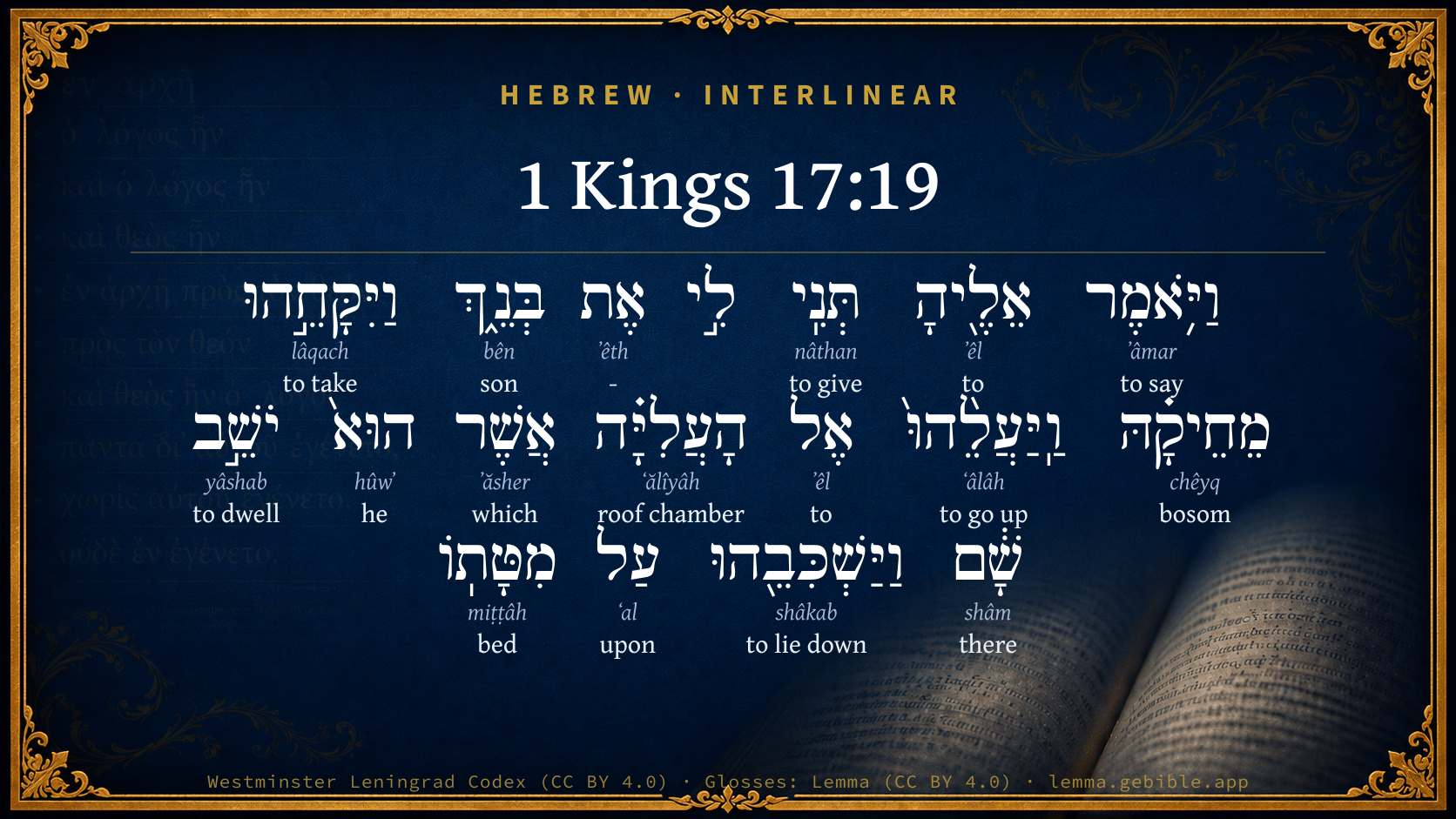
Hebrew (Westminster Leningrad Codex) 1 Kings 17:19 appears in the Hebrew Old Testament. The text above is from the Westminster Leningrad Codex. Each word links to its Strong’s number, a concise gloss, and parsing drawn from the Open Scriptures Hebrew Bible morphology. Click any word for its full Brown-Driver-Briggs (BDB) entry.
Download image
Cite this verse

1 Kings 17:19 (World English Bible). Public Domain. Lemma interlinear Bible study tool, https://lemma.gebible.app/v/1-kings/17/19.

Show BibTeX & RIS
BibTeX
RIS
English Translation
He said to her, Give me your son. He took him out of her bosom, and carried him up into the chamber, where he abode, and laid him on his own bed.
World English Bible · Public Domain
Download a study sheet

One document with this verse’s original text, its word-by-word gloss line, the meaning frame, cross-references with their text, attributed commentary, and full source and license credits — printable, and it pastes into notes with its structure intact.

This verse Autodidact and up

Study sheet (.html) Plain text (.txt)

A passage Seminary Student

Up to 50 verses in one chapter. A passage sheet keeps up to 6 commentary sources and 12 cross-references per verse, in the order this page ranks them, and says so on the sheet whenever that leaves anything out. Ask for a single verse and you get the Autodidact verse sheet above.

Everything on this page stays free to read, with no account — the sheet is a download of what is already on screen, not access to it.

Want to remove ads? Support Godless Engineer
Compare translations 3

The same verse in 3 English versions, stacked beneath the original-language interlinear above. Click any original word for its lexicon entry.

Each is an independent rendering of the whole verse — the interlinear is not word-aligned to these translations.

Highlighted words mark where these versions differ — a whole-verse word diff, not a word-by-word alignment.

  • World English Bible Public Domain
    He said to her, Give me your son. He took him out of her bosom, and carried him up into the chamber, where he abode, and laid him on his own bed.
  • King James Version Public Domain
    And he said unto her, Give me thy son. And he took him out of her bosom, and carried him up into a loft, where he abode, and laid him upon his own bed.
  • unfoldingWord Literal Text CC BY-SA 4.0
    And he said to her, “Give your son to me.” And he took him from her lap, and he brought him up to the upper room where he was dwelling there, and he laid him down on his bed.

unfoldingWord Literal Text — © unfoldingWord, licensed CC BY-SA 4.0. Word-aligned USFM3 via Door43 (git.door43.org/unfoldingWord/en_ult).

Versions to compare (up to 4)

3 of 4 selected

Show all 18 translations

Every available English version of this verse, each an independent rendering of the whole verse.

  • World English Bible Public Domain
    He said to her, Give me your son. He took him out of her bosom, and carried him up into the chamber, where he abode, and laid him on his own bed.
  • Berean Standard Bible Public Domain
    But Elijah said to her, “Give me your son.” So he took him from her arms, carried him to the upper room where he was staying, and laid him on his own bed.
  • Majority Standard Bible Public Domain
    But Elijah said to her, “Give me your son.” So he took him from her arms, carried him to the upper room where he was staying, and laid him on his own bed.
  • King James Version Public Domain
    And he said unto her, Give me thy son. And he took him out of her bosom, and carried him up into a loft, where he abode, and laid him upon his own bed.
  • American Standard Version (1901) Public Domain
    And he said unto her, Give me thy son. And he took him out of her bosom, and carried him up into the chamber, where he abode, and laid him upon his own bed.
  • Revised Version (1885) Public Domain
    And he said unto her, Give me thy son. And he took him out of her bosom, and carried him up into the chamber, where he abode, and laid him upon his own bed.
  • Geneva Bible (1599) Public Domain
    And he said vnto her, Giue me thy sonne. and he tooke him out of her bosome, and caryed him vp into a chamber, where he abode, and laid him vpon his owne bed.
  • Douay-Rheims (1899) Public Domain
    And Elias said to her: Give me thy son. And he took him out of her bosom, and carried him into the upper chamber where he abode, and laid him upon his own bed.
  • Young's Literal Translation Public Domain
    And he saith unto her, `Give to me thy son;' and he taketh him out of her bosom, and taketh him up unto the upper chamber where he is abiding, and layeth him on his own bed,
  • Literal Standard Version CC BY-SA 4.0
    And he says to her, “Give your son to me”; and he takes him out of her bosom, and takes him up to the upper chamber where he is abiding, and lays him on his own bed,
  • Unlocked Literal Bible CC BY-SA 4.0
    Then Elijah replied to her, “Give me your son.” He took the boy from her arms and carried him up into the room where he was staying, and he laid the boy on his own bed.
  • unfoldingWord Literal Text CC BY-SA 4.0
    And he said to her, “Give your son to me.” And he took him from her lap, and he brought him up to the upper room where he was dwelling there, and he laid him down on his bed.
  • Darby Bible Public Domain
    And he said to her, Give me thy son. And he took him out of her bosom, and carried him up into the upper chamber where he abode, and laid him upon his own bed.
  • World Messianic Bible Public Domain
    He said to her, “Give me your son.” He took him out of her bosom, and carried him up into the room where he stayed, and laid him on his own bed.
  • Webster's Bible Public Domain
    And he said to her, Give me thy son. And he took him out of her bosom, and carried him up into a loft, where he abode, and laid him upon his own bed.
  • Free Bible Version CC BY-SA 4.0
    “Give me your son,” Elijah replied. He picked him up from her arms, carried him upstairs to the room where he was staying, and laid him on his bed.
  • Bible in Basic English Public Domain
    And he said to her, Give your son to me. And lifting him out of her arms, he took him up to his room and put him down on his bed.
  • JPS Tanakh (1917) Public Domain
    And he said unto her: 'Give me thy son.' And he took him out of her bosom, and carried him up into the upper chamber, where he abode, and laid him upon his own bed.

Literal Standard Version (2020), Covenant Press — licensed CC BY-SA 4.0. Text via the HelloAO Bible API (eBible.org). Unlocked Literal Bible (unfoldingWord) — licensed CC BY-SA 4.0. Text via the HelloAO Bible API (eBible.org). unfoldingWord Literal Text — © unfoldingWord, licensed CC BY-SA 4.0. Word-aligned USFM3 via Door43 (git.door43.org/unfoldingWord/en_ult). Free Bible Version, Dr. Jonathan Gallagher — licensed CC BY-SA 4.0. Text via the HelloAO Bible API (eBible.org).

Word by word

More ways to search: Search by grammar → Find every occurrence → Compare this word →

Practice this passage: Drill this verse → Learn its vocabulary →

הָעֲלִיָּ֗ה
ʻălîyâh
H5944
“the · roof chamber”
Particle, Definite Article + Noun, Common, Feminine, Singular, Absolute
Part of Speech
Particle + Noun
Type
Common
Gender
Feminine
Number
Singular
State
Absolute
Full BDB Definition

Origin: from H5927

TWOT: 1624f

roof-room, roof chamber
  1. וַיֹּ֥אמֶר ʼâmar H559 “and · to say” Conjunction + Verb, Qal, Sequential Imperfect, 3rd Person, Masculine, Singular
  2. אֵלֶ֖יהָ ʼêl H413 “to · her” Preposition + Suffix, Personal, 3rd Person, Feminine, Singular
  3. תְּנִֽי nâthan H5414 “give” Verb, Qal, Imperative, 2nd Person, Feminine, Singular
  4. אֶת ʼêth H853 “-” Particle, Direct Object
  5. בְּנֵ֑ךְ bên H1121 “son · your” Noun, Common, Masculine, Singular, Construct + Suffix, Personal, 2nd Person, Feminine, Singular
  6. וַיִּקָּחֵ֣הוּ lâqach H3947 “and · to take · him” Conjunction + Verb, Qal, Sequential Imperfect, 3rd Person, Masculine, Singular + Suffix, Personal, 3rd Person, Masculine, Singular
  7. מֵחֵיקָ֗הּ chêyq H2436 “from · bosom · her” Preposition + Noun, Common, Masculine, Singular, Construct + Suffix, Personal, 3rd Person, Feminine, Singular
  8. וַֽיַּעֲלֵ֨הוּ֙ ʻâlâh H5927 “and · to go up · him” Conjunction + Verb, Hiphil, Sequential Imperfect, 3rd Person, Masculine, Singular + Suffix, Personal, 3rd Person, Masculine, Singular
  9. אֶל ʼêl H413 “to” Preposition
  10. אֲשֶׁר ʼăsher H834 “which” Particle, Relative
  11. הוּא֙ hûwʼ H1931 “he” Pronoun, Personal, 3rd Person, Masculine, Singular
  12. יֹשֵׁ֣ב yâshab H3427 “dwelling” Verb, Qal, Participle Active, Masculine, Singular, Absolute
  13. שָׁ֔ם shâm H8033 “there” Adverb
  14. וַיַּשְׁכִּבֵ֖הוּ shâkab H7901 “and · to lie down · him” Conjunction + Verb, Hiphil, Sequential Imperfect, 3rd Person, Masculine, Singular + Suffix, Personal, 3rd Person, Masculine, Singular
  15. עַל ʻal H5921 “upon” Preposition
  16. מִטָּתֽוֹ miṭṭâh H4296 “bed · his” Noun, Common, Feminine, Singular, Construct + Suffix, Personal, 3rd Person, Masculine, Singular

About this verse

These counts appear in no published source. They are computed here, from the morphology-tagged text and Lemma’s own curated glosses. What Lemma adds →

18
words
16
distinct lemmas
Historical
section

Notable vocabulary

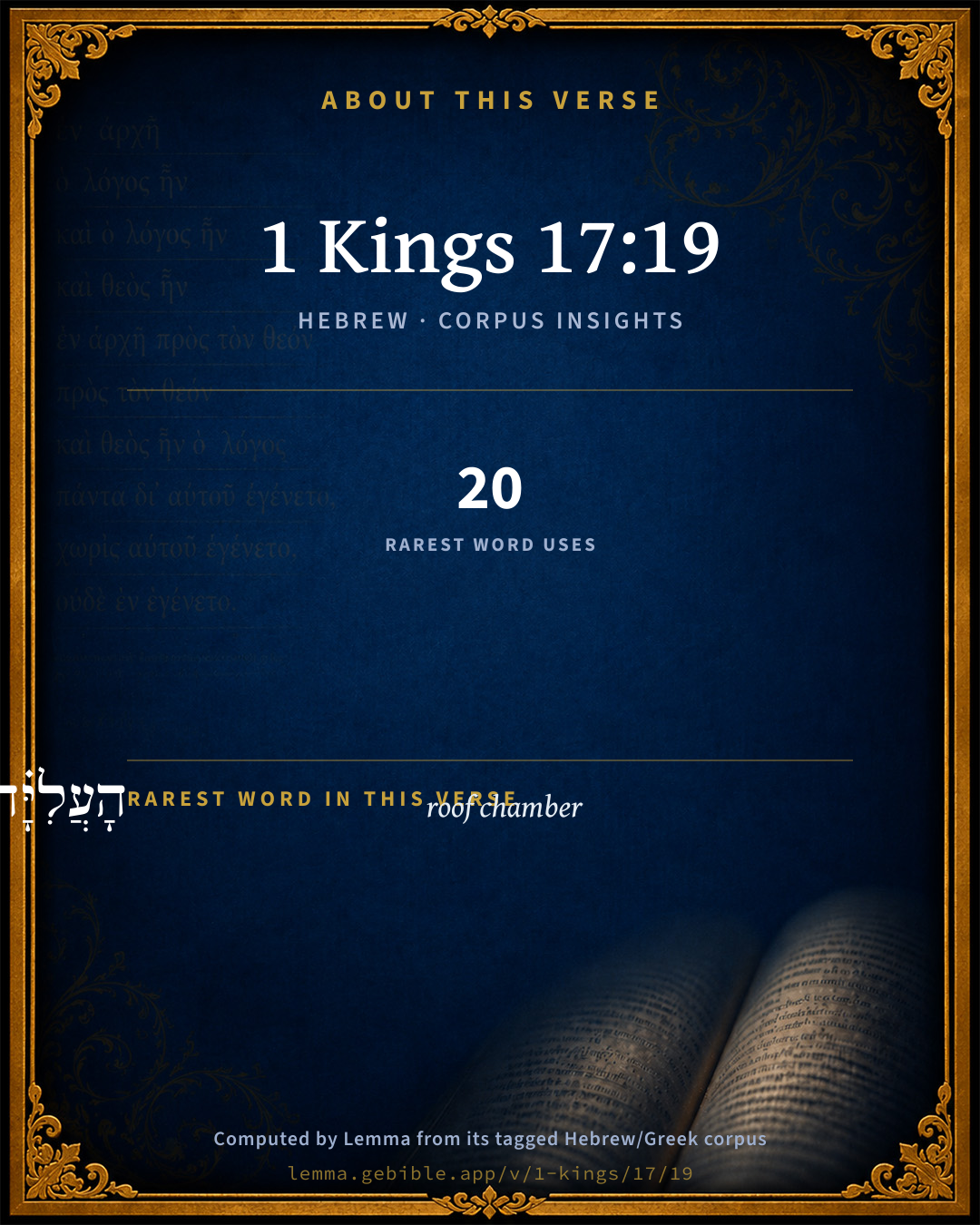
The rarest word here is הָעֲלִיָּ֗ה roof chamber H5944 — appearing just 20 times in the whole Hebrew Bible.

Shared distinctive vocabulary

הָעֲלִיָּ֗ה roof chamber H5944 occurs in 20 verses of the Hebrew Bible. Also found in:

Grammatical profile

  • 6 verbs
  • 4 nouns
  • 1 pronoun
  • 4 prepositions
  • 1 adverb
  • 2 particles

Verb forms

  • וַיֹּ֥אמֶר Qal · Sequential Imperfect
  • תְּנִֽי Qal · Imperative
  • וַיִּקָּחֵ֣הוּ Qal · Sequential Imperfect
  • וַֽיַּעֲלֵ֨הוּ֙ Hiphil · Sequential Imperfect
  • יֹשֵׁ֣ב Qal · Participle Active
  • וַיַּשְׁכִּבֵ֖הוּ Hiphil · Sequential Imperfect

Repetition

A word recurs within this verse — often emphatic in Hebrew:

  • אֵלֶ֖יהָ to H413 ×2

Hebrew & Septuagint length

In English translation the verse runs 32 words from the Hebrew and 36 from the Septuagint (LXX English) — closely comparable.

A rough comparison of the two English renderings, which tokenize alike — not a word-level alignment.

Word counts can differ between the Hebrew and the Greek without any difference in meaning — e.g. the Hebrew direct-object marker אֵת has no separate Greek word, and Greek often adds the article ὁ.

Cross-references

4

Topical passages linked to 1 Kings 17:19 in the Treasury of Scripture Knowledge — connected by theme and wording, ordered by reader-vote popularity; previews shown in the World English Bible.

  • 2 Kings 4:32 When Elisha was come into the house, behold, the child was dead, and laid on his bed.
  • 2 Kings 4:10 Let us make, Please, a little chamber on the wall; and let us set for him there a bed, and a table, and a seat, and a lamp stand: and it shall be, when he comes to us, that he shall turn in there.
  • 2 Kings 4:21 She went up and laid him on the bed of the man of God, and shut [the door] on him, and went out.
  • Acts 9:37 It happened in those days that she fell sick, and died. When they had washed her, they laid her in an upper chamber.

Cross-references courtesy of OpenBible.info (CC BY 4.0).

Hebrew and Greek witnesses Masoretic Hebrew ↔ Greek Septuagint

The same verse in the two great witnesses to the Old Testament, shown verse-for-verse.

These are two independent witnesses, not word-aligned to each other, and the Septuagint is shown in lemma (dictionary) form.

Hebrew 1 Kings 17:19 Masoretic · Westminster Leningrad Codex

וַיֹּ֥אמֶר אֵלֶ֖יהָ תְּנִֽי לִ֣י אֶת בְּנֵ֑ךְ וַיִּקָּחֵ֣הוּ מֵחֵיקָ֗הּ וַֽיַּעֲלֵ֨הוּ֙ אֶל הָעֲלִיָּ֗ה אֲשֶׁר הוּא֙ יֹשֵׁ֣ב שָׁ֔ם וַיַּשְׁכִּבֵ֖הוּ עַל מִטָּתֽוֹ

He said to her, Give me your son. He took him out of her bosom, and carried him up into the chamber, where he abode, and laid him on his own bed.

World English Bible · Public Domain

Greek LXX 1 Kings 17:19 Septuagint · lemma form

καί εἶπον ηλιου πρός ὁ γυνή δίδωμι ἐγώ ὁ υἱός σύ καί λαμβάνω αὐτός ἐκ ὁ κόλπος αὐτός καί ἀναφέρω αὐτός εἰς ὁ ὑπερῷον ἐν ὅς αὐτός καταἧμαι ἐκεῖ καί κοιμίζω αὐτός ἐπί ὁ κλίνη αὐτός

And Eliu said to the woman, Give me your son. And he took him out of her bosom, and took him up to the chamber in which he himself lodged, and laid him on the bed.

LXX2012 (modern English Septuagint) · Public Domain

On this verse, The Pulpit Commentary discusses the Septuagint’s reading. Read the note in Commentary ↓

Hebrew: Westminster Leningrad Codex (CC BY 4.0). Greek: Septuagint (public domain); English from LXX2012 (modern English Septuagint) (Public Domain). How the Septuagint differs from the Hebrew →

Targum (Aramaic paraphrase)

1

The Targum is the ancient Jewish Aramaic paraphrase of the Hebrew Scriptures — an interpretive translation, not the Hebrew text itself. Onkelos (literal) and Pseudo-Jonathan (expansive) render the Torah, and Jonathan the Prophets. Coverage is partial: where no permissively-licensed English translation exists for a verse, only the Aramaic is shown. This is verse-level text, not a word-by-word alignment to the Hebrew.

  1. Targum Jonathan Prophets (Joshua–Malachi)
    וַאֲמַר לָהּ הָבִי לִי יַת בְּרִיךְ וְנַסְבֵיהּ מֵחֵינָהּ וְאַסְקֵיהּ לְעֵלִיתָא דְהוּא יָתֵב תַּמָן וְאַשְׁכְּבֵיהּ עַל עַרְסֵיהּ:

    (no public-domain English translation for this verse)

    Targum Jonathan — Aramaic: “Mikraot Gedolot” (public domain). English: “Sefaria Community Translation” (CC0 1.0 (public-domain dedication)); “London "Chaldee Paraphrase," 1871” (public domain). Text via Sefaria.

Commentary

Notes on 1 Kings 17:19 from classic Christian and Jewish commentators (each source and its license shown beneath its notes). The classic Christian expositions comment on the surrounding passage and are grouped to its opening verse, so a note may address several verses; the Jewish commentaries on the Tanakh (Rashi and others) are per-verse, so they appear only where the commentator wrote on this verse.

Lemma curates 59 commentaries, every one of them public domain or Creative Commons licensed, each selected and text-cleaned for this edition rather than reprinted as found. About our sources →

Trapp's Complete Commentary

John Trapp

1Ki 17:19 And he said unto her, Give me thy son. And he took him out of her bosom, and carried him up into a loft, where he abode, and laid him upon his own bed.

Ver. 19. And he said unto her.] So to clear himself.

Carried him up into a loft.] For privacy’s sake, which is a good help to fervency in prayer; therefore Isaac got forth into the fields, Peter up to the leads, Daniel to the river side, &c.

John Trapp, A Commentary or Exposition upon All the Books of the Old and New Testament (1647–1656) — public domain. Text from a community e-Sword module.

Joseph Benson's Commentary

1Ki 17:19-20. Give me thy son — Into my arms. He took him out of her bosom — By which it appears he was but a little child. And carried him up into a loft — A private place, where he might more freely and fully pour out his soul to God, and use such gestures and methods as his heart inclined him to use, without any offence or observation. And laid him upon his own bed — So that it was the room where he lodged, though near the top of the house. And he cried unto the Lord — And, in his prayer, humbly reasons with God concerning the death of the child, using most powerful arguments. Thou art the Lord, that canst revive the child; and my God, and therefore wilt not deny me. She is a widow, add not affliction to the afflicted; deprive her not of the support and staff of her age: she hath given me kind entertainment: let her not fare the worse for her kindness to a prophet, whereby wicked men will take occasion to reproach both her and religion.

Joseph Benson's Commentary on the Old and New Testaments (1811–1818) — public domain. Text from a community e-Sword module.

Tyndale Open Study Notes

Tyndale Open Resources

17:19 Following ancient Near Eastern custom, Elijah’s quarters were probably situated in a separate room accessed by an outside stairway. This arrangement maintained the woman’s reputation and offered Elijah a measure of privacy.

Tyndale Open Study Notes — © Tyndale Open Resources, licensed CC BY-SA 4.0. Text via the HelloAO Bible API.

The Cambridge Bible for Schools and Colleges

gen. ed. J. J. S. Perowne

19. And he took him out of her bosom] Her arms were clasped about the dead boy. We need not understand the expression as of a child who was still young enough to be carried in the arms, though the prophet was able to carry him into his own chamber.

into a loft] R.V. the chamber. The word is so rendered in 1Ki_17:23, and the two should be made to agree.

The Cambridge Bible for Schools and Colleges (gen. ed. J. J. S. Perowne; Cambridge University Press, 1878–1918) — public domain. Text from a community e-Sword module.

John Gill's Exposition

And he cried unto the Lord,.... Or prayed unto him, as the Targum, with great vehemence and importunity:

and said, O Lord, my God, hast thou also brought evil upon the widow, with whom I sojourn, by slaying her son? he pleads his interest in the Lord, and makes use of it as an argument with him to hear his prayer; he observes the character and condition of the woman, a widow, such as the Lord has a compassionate regard for; and he urges the kindness of her to him, with whom he had sojourned so long; and seems to represent the case as an additional evil or affliction to him, as well as to the widow.

John Gill's Exposition of the Whole Bible (1746–1763) — public domain (CC PDM 1.0). Text via the HelloAO Bible API.

Albert Barnes' Notes on the Bible

Into a loft - Rather, “into the upper chamber;” often the best apartment in an Eastern house.

Albert Barnes' Notes on the Bible (1834–1885) — public domain. Text from a community e-Sword/MySword module.

Matthew Poole's English Annotations

Give me thy son into mine arms.

Into a loft; a private place, where he might more freely and fully pour out his soul to God, and use such gestures or methods as he thought most proper, without any offence or observation.

Matthew Poole's English Annotations on the Holy Bible (1683–1685) — public domain. Text from a community e-Sword/MySword module.

Whedon's Commentary on the Bible

Daniel D. Whedon

19. A loft — העליה, the aliyah; the upper chamber. “This is the most desirable part of an establishment, is best fitted up, and is still given to guests who are to be treated with honour. It is more retired than the lower apartments of the house, and, of course, appropriate for the restingplace of prophets. The poorer sort of houses have no aliyeh. We may infer from this word that the mode of building in Elijah’s time, and the custom of giving the aliyeh to the guest, were the same as now; also, that this widow was not originally among the very poorest classes, but that her extreme destitution was owing to the dreadful famine which then prevailed.” — Thomson.

Daniel D. Whedon (gen. ed.), Commentary on the Old and New Testaments (1874–1909) — public domain. Text from a community e-Sword module.

The Pulpit Commentary

And he said unto her, Give me thy son. And he took him out Of her bosom, the age of the child may hence be roughly inferred and carried him up into a loft Heb. hYli the upper chamber. LXX to uJperwon. Loft is most misleading. The upper room, was often rather, always the best apartment in an Eastern house" (Rawlinson). It was sometimes the guest chamber, (Luk_22:11, Luk_22:12) and, from the uses to which it was put, must have been large (Act_1:13 Act_9:39 Act_20:8; 2Ki_1:2) Thomson (L. & B. 1:235) infers from the fact that the widow"s house had an upper room, "that the mode of building in Elijah"s time and the custom of giving the ;"alliyeh to the guest were the same as now; also that this poor widow was not originally among the poorest classes (who bare no "alliyeh), but that her extreme destitution was owing to the famine", and laid him upon his own bed. It may be doubted whether the verb WhbeKivy" lit., made him to lie down, would be used of a corpse.

Vers. 19-24.

The Sign of the Widow"s Son.

Here is a touching scene a poor widow pressing to her bosom the corpse of her only child, while in the agony of her bereaved soul, addressing Elijah, she says, "What have I to do with thee, O thou man of God? art thou come to call my sin to my remembrance, and to slay my son?" Now note the words of the text: "And he said unto her, Give me thy son," etc. In this history we have

I AN EXAMPLE OF THE POWER OF FAITH. Behold here

1. The spirit of faith.

(1) He had confidence in God before he prayed. This is evident from the manner in which he asked the widow for the corpse. He did not tell her what he intended; but, on the other hand, neither did he express any hesitation as in the comfort she might expect.

(2) This confidence must have been divinely authorized, else it would have been presumption which, instead of conciliating the favour, would have awakened the displeasure of God

(3) This was what Elisha and the sons of the prophets called "the Spirit of Elijah," i.e. , the. Spirit of God abiding with him. (See 2Ki_2:9, 2Ki_2:15)

2. The prayer of faith.

(1) He recognized the hand of God in the bereavement: "Hast thou also brought evil upon the widow with whom I sojourn by slaying her son?" He calls it "evil," yet attributes it to God. Moral evil God cannot perpetrate, but evil which comes in the form of affliction or punishment is a very different thing. (See Job_2:10; Isa_45:7; Amo_3:6; Joh_9:1-8)

(2) He entreated God to restore the child"s life. "He cried unto the Lord." Here is the "fervency" which characterizes "effectual" prayer.

(3) He entreated Him confidingly: "O Lord my God." This appealing to God in the possessive expresses a loving trust in a Covenant Friend. (See Lev_26:12; Jer_31:33; 2Co_6:16; Heb_11:16; Rev_21:3)

(4) Hence his success. "The Lord heard the voice of Elijah." He saw in Elijah those moral qualifications which make it fitting that He should answer prayer. So the prophet was able to restore the child alive to his mother.

3. But what example is this for us?

(1) Elijah"s success in prayer was not because he was a prophet. James replies to this objection when he assures us that "Elias was a man subject to like passions as we are." For this is the ground on which he proceeds to lay down the broad principle, viz., that "the effectual fervent prayer of a righteous man availeth much" (Jam_5:16; see also. Act_11:24)

(2) Therefore we also may be moved by the Holy Ghost; and we must be so moved if we would pray effectually. True faith is "of the operation of God" (Luther"s prayer for the recovery of Myconius instanced in Krummacher).

(3) But how may we know that we are so influenced? God will make it plain as one of the secrets of holy communion with Him. (Psa_25:14; Joh_7:17 Joh_15:15) When we are free from selfish desire, and above all things seek God"s glory, there is little danger of being led astray.

(4) The widow was no prophetess, but she also was an example of faith. (Heb_11:35) Witness her recognition of God, and the readiness with which she gave her son from her bosom at the prophet"s request. Her faith was honoured as well as his.

II A PROPHETIC SIGN.

1. So the widow interpreted it (ver. 24).

(1) It authenticated Elijah as a "man of God." Not only that he was a good man, but that he was a prophet of the Lord.

(2) Consequently "that the word of the Lord in his mouth" was no sham. (Comp. ch. 22.) Spurious prophets could not give miraculous signs.

2. Such signs were parables. The question, then, is, what did this parable teach?

(1) Could it be a sign that the drought would be removed which had now lasted two years, working fearful ravages, and must, if continued long, destroy the nations visited? For the "word of the Lord in the mouth of Elijah" did encourage the hope that rain should come upon the earth (ver. 14). The coming of rain would be a national resurrection.

(2) Could it be a pledge of the resurrection of the dead at the last day? The gospel has thrown floods of illustration upon this subject, but in old times it was obscure. This miracle taught the separate existence of the soul. Also that the disembodied spirit may and shall be reunited to its organic companion.

(3) Why did Elijah stretch himself upon the child? He was a type of Christ. So he made himself like the dead to foreshow that Christ by dying in our room should give us life. This He does morally. Also physically, viz., in the resurrection of the body. (Comp. 2Ki_4:34; Joh_11:43-45; Act_20:10) Is there any correspondence between the "three times" mentioned in the text and the "three times" in which our Lord prayed for the removal of the cup of His suffering?. J.A.M. (Mat_26:44)

The Pulpit Commentary (1880–1919), ed. H.D.M. Spence-Jones & Joseph S. Exell — public domain. Text from a community e-Sword module.

John Wesley's Explanatory Notes

Into a loft - A private place, where he might more freely pour out his soul to God, and use such gestures as he thought most proper.

John Wesley, Explanatory Notes Upon the Whole Bible (1754–1765) — public domain. Text via the GEBible commentary corpus.

unfoldingWord translationNotes

Door43 World Missions Community

where he was staying

Here "he" refers to Elijah.

on his own bed

Here "his" refers to Elijah.

have you also brought disaster on the widow with whom I am staying, by killing her son?

Possible meanings are 1) Elijah is truly asking a question. AT: "why would you cause the widow with whom I am staying to suffer even more by killing her son" or 2) Elijah uses a question to express how sad he is. AT: "surely, you would not cause the widow with whom I am staying to suffer even more by killing her son" (See: Rhetorical Question)

have you also brought disaster on the widow

Causing the widow to suffer is spoken of as if "disaster" were an object that is placed on the widow. (See: Metaphor)

also brought disaster

Here "also" means in addition to the disaster that the drought has caused.

stretched himself on the child

This is an idiom. AT: "lay on top of the child" (See: Idiom)

translationWords

Elijah

Yahweh

God

beg

life

unfoldingWord translationNotes — © Distant Shores Media and the Door43 World Missions Community, licensed CC BY-SA 4.0. Source: git.door43.org/Door43/en_tn.

Lesson kit

Teaching starters — assembled from the data on this page, not authored interpretation. Every prompt links to the verse data it draws on. Edit before teaching.

1 Kings, in the Historical, opens this verse with 18 words (16 distinct Hebrew lemmas). Its most distinctive word is ʻălîyâh (“roof chamber”). A historical commentator’s framing appears above. Read the whole chapter for the surrounding context.

Discussion questions

  1. The word ʻălîyâh carries the sense “roof chamber.” How does it shape the verse?
  2. How does Judges 3:20, which shares the word «roof chamber», read alongside this verse?
  3. What does the repetition of “to” (2× in this one verse) do in this verse?
  4. The translations on this page render this verse differently — a whole-verse word diff, not a word-by-word alignment. What might account for the different wordings?
  5. «וַיֹּ֥אמֶר» is a Qal Sequential Imperfect verb. How does that grammatical form shape the action described?
  6. Compare how Trapp's Complete Commentary and Joseph Benson's Commentary read this verse. Where do they agree or differ?

Things to notice

Reading settings

Reading text

Shown beneath each verse's original-language words.

Old Testament
Old Testament edition

Read the OT as the Masoretic Hebrew (MT) or the Greek Septuagint (LXX).

English shown for the Greek Septuagint (in the Hebrew ↔ Greek comparison).

Comparing translations? Open the Compare panel on any verse page to stack up to four side by side.