Ecclesiastes 2:23

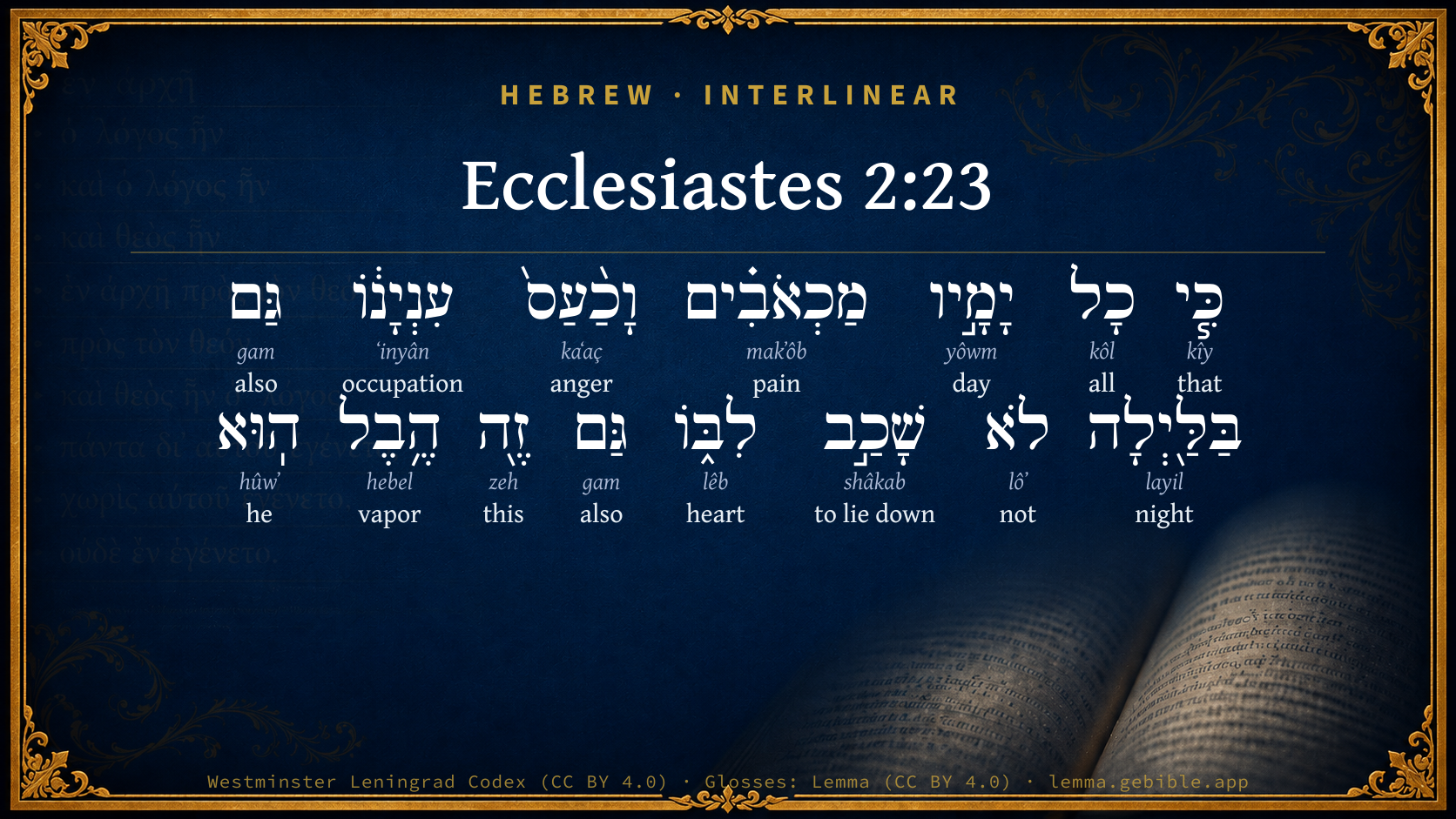
Hebrew (Westminster Leningrad Codex) Ecclesiastes 2:23 appears in the Hebrew Old Testament. The text above is from the Westminster Leningrad Codex. Each word links to its Strong’s number, a concise gloss, and parsing drawn from the Open Scriptures Hebrew Bible morphology. Click any word for its full Brown-Driver-Briggs (BDB) entry.
Download image
Cite this verse

Ecclesiastes 2:23 (World English Bible). Public Domain. Lemma interlinear Bible study tool, https://lemma.gebible.app/v/ecclesiastes/2/23.

Show BibTeX & RIS
BibTeX
RIS
English Translation
For all his days are sorrows, and his travail is grief; yes, even in the night his heart takes no rest. This also is vanity.
World English Bible · Public Domain
Download a study sheet

One document with this verse’s original text, its word-by-word gloss line, the meaning frame, cross-references with their text, attributed commentary, and full source and license credits — printable, and it pastes into notes with its structure intact.

This verse Autodidact and up

Study sheet (.html) Plain text (.txt)

A passage Seminary Student

Up to 50 verses in one chapter. A passage sheet keeps up to 6 commentary sources and 12 cross-references per verse, in the order this page ranks them, and says so on the sheet whenever that leaves anything out. Ask for a single verse and you get the Autodidact verse sheet above.

Everything on this page stays free to read, with no account — the sheet is a download of what is already on screen, not access to it.

Want to remove ads? Support Godless Engineer
Compare translations 3

The same verse in 3 English versions, stacked beneath the original-language interlinear above. Click any original word for its lexicon entry.

Each is an independent rendering of the whole verse — the interlinear is not word-aligned to these translations.

Highlighted words mark where these versions differ — a whole-verse word diff, not a word-by-word alignment.

  • World English Bible Public Domain
    For all his days are sorrows, and his travail is grief; yes, even in the night his heart takes no rest. This also is vanity.
  • King James Version Public Domain
    For all his days are sorrows, and his travail grief; yea, his heart taketh not rest in the night. This is also vanity.
  • unfoldingWord Literal Text CC BY-SA 4.0
    For all his days pains, and anger his business; even in the night, his heart does not rest. Also this—it vapor.

unfoldingWord Literal Text — © unfoldingWord, licensed CC BY-SA 4.0. Word-aligned USFM3 via Door43 (git.door43.org/unfoldingWord/en_ult).

Versions to compare (up to 4)

3 of 4 selected

Show all 18 translations

Every available English version of this verse, each an independent rendering of the whole verse.

  • World English Bible Public Domain
    For all his days are sorrows, and his travail is grief; yes, even in the night his heart takes no rest. This also is vanity.
  • Berean Standard Bible Public Domain
    Indeed, all his days are filled with grief, and his task is sorrowful; even at night, his mind does not rest. This too is futile.
  • Majority Standard Bible Public Domain
    Indeed, all his days are filled with grief, and his task is sorrowful; even at night, his mind does not rest. This too is futile.
  • King James Version Public Domain
    For all his days are sorrows, and his travail grief; yea, his heart taketh not rest in the night. This is also vanity.
  • American Standard Version (1901) Public Domain
    For all his days are `but' sorrows, and his travail is grief; yea, even in the night his heart taketh no rest. This also is vanity.
  • Revised Version (1885) Public Domain
    For all his days are but sorrows, and his travail is grief; yea, even in the night his heart taketh no rest. This also is vanity.
  • Geneva Bible (1599) Public Domain
    For all his dayes are sorowes, and his trauaile griefe: his heart also taketh not rest in the night: which also is vanitie.
  • Douay-Rheims (1899) Public Domain
    All his days axe full of sorrows and miseries, even in the night he doth not rest in mind: and is not this vanity?
  • Young's Literal Translation Public Domain
    For all his days are sorrows, and his travail sadness; even at night his heart hath not lain down; this also `is' vanity.
  • Literal Standard Version CC BY-SA 4.0
    For all his days are sorrows, and his travail sadness; even at night his heart has not lain down; this [is] also vanity.
  • Unlocked Literal Bible CC BY-SA 4.0
    Every day his work is painful and stressful, so at night his soul does not find rest. This also is vapor.
  • unfoldingWord Literal Text CC BY-SA 4.0
    For all his days pains, and anger his business; even in the night, his heart does not rest. Also this—it vapor.
  • Darby Bible Public Domain
    For all his days are sorrows, and his travail vexation: even in the night his heart taketh no rest. This also is vanity.
  • World Messianic Bible Public Domain
    For all his days are sorrows, and his travail is grief; yes, even in the night his heart takes no rest. This also is vanity.
  • Webster's Bible Public Domain
    For all his days are sorrows, and his labor grief; yes, his heart taketh not rest in the night. This is also vanity.
  • Free Bible Version CC BY-SA 4.0
    Your working life is full of trouble and strife—even at night your thoughts keep you awake. This is tough to comprehend!
  • Bible in Basic English Public Domain
    All his days are sorrow, and his work is full of grief. Even in the night his heart has no rest. This again is to no purpose.
  • JPS Tanakh (1917) Public Domain
    For all his days are pains, and his occupation vexation; yea, even in the night his heart taketh not rest. This also is vanity.

Literal Standard Version (2020), Covenant Press — licensed CC BY-SA 4.0. Text via the HelloAO Bible API (eBible.org). Unlocked Literal Bible (unfoldingWord) — licensed CC BY-SA 4.0. Text via the HelloAO Bible API (eBible.org). unfoldingWord Literal Text — © unfoldingWord, licensed CC BY-SA 4.0. Word-aligned USFM3 via Door43 (git.door43.org/unfoldingWord/en_ult). Free Bible Version, Dr. Jonathan Gallagher — licensed CC BY-SA 4.0. Text via the HelloAO Bible API (eBible.org).

Word by word

More ways to search: Search by grammar → Find every occurrence → Compare this word →

Practice this passage: Drill this verse → Learn its vocabulary →

עִנְיָנ֔וֹ
ʻinyân
H6045
“occupation · his”
Noun, Common, Masculine, Singular, Construct + Suffix, Personal, 3rd Person, Masculine, Singular
Part of Speech
Noun
Type
Common
Gender
Masculine
Number
Singular
State
Construct
Full BDB Definition

Origin: from H6031

TWOT: 1651a

occupation, task, job
  1. כִּ֧י kîy H3588 “that” Conjunction
  2. כָל kôl H3605 “all of” Noun, Common, Masculine, Singular, Construct
  3. יָמָ֣יו yôwm H3117 “days · his” Noun, Common, Masculine, Plural, Construct + Suffix, Personal, 3rd Person, Masculine, Singular
  4. מַכְאֹבִ֗ים makʼôb H4341 “pains” Noun, Common, Masculine, Plural, Absolute
  5. וָכַ֨עַס֙ kaʻaç H3708 “and · anger” Conjunction + Noun, Common, Masculine, Singular, Absolute
  6. גַּם gam H1571 “also” Particle, Accusative
  7. בַּלַּ֖יְלָה layil H3915 “in/at the · night” Preposition, Determined + Noun, Common, Masculine, Singular, Absolute
  8. לֹא lôʼ H3808 “not” Particle, Negative
  9. שָׁכַ֣ב shâkab H7901 “to lie down” Verb, Qal, Perfect, 3rd Person, Masculine, Singular
  10. לִבּ֑וֹ lêb H3820 “heart · his” Noun, Common, Masculine, Singular, Construct + Suffix, Personal, 3rd Person, Masculine, Singular
  11. גַּם gam H1571 “also” Particle, Accusative
  12. זֶ֖ה zeh H2088 “this” Pronoun, Demonstrative, Masculine, Singular
  13. הֶ֥בֶל hebel H1892 “vapor” Noun, Common, Masculine, Singular, Absolute
  14. הֽוּא hûwʼ H1931 “he” Pronoun, Personal, 3rd Person, Masculine, Singular

About this verse

These counts appear in no published source. They are computed here, from the morphology-tagged text and Lemma’s own curated glosses. What Lemma adds →

15
words
14
distinct lemmas
Wisdom
section

Notable vocabulary

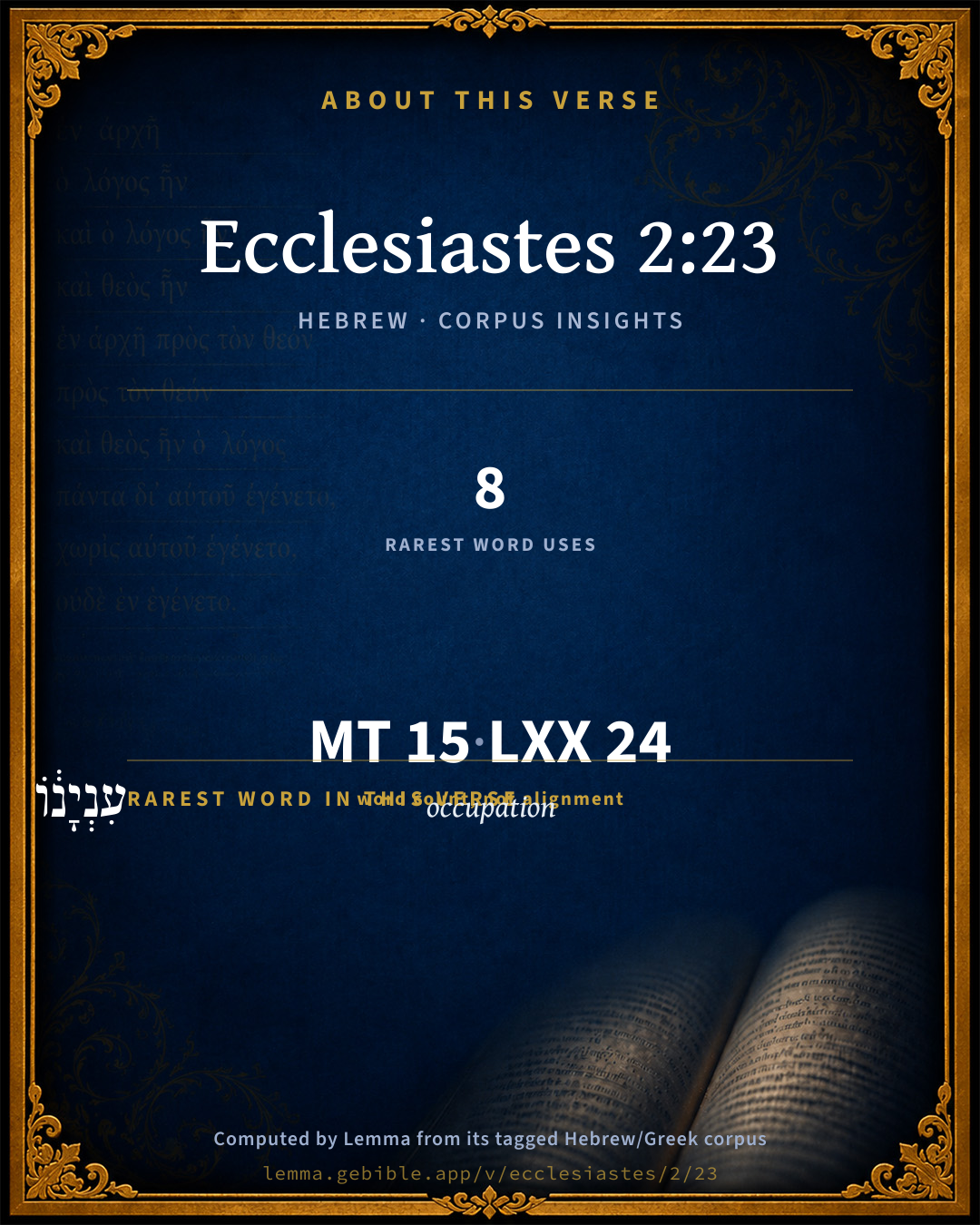
The rarest word here is עִנְיָנ֔וֹ occupation H6045 — appearing just 8 times in the whole Hebrew Bible.

Shared distinctive vocabulary

עִנְיָנ֔וֹ occupation H6045 occurs in 8 verses of the Hebrew Bible. Also found in:

Grammatical profile

  • 1 verb
  • 8 nouns
  • 2 pronouns
  • 1 conjunction
  • 3 particles

Verb forms

  • שָׁכַ֣ב Qal · Perfect

Repetition

A word recurs within this verse — often emphatic in Hebrew:

  • גַּם also H1571 ×2

Hebrew & Septuagint length

In English translation the verse runs 25 words from the Hebrew and 26 from the Septuagint (LXX English) — closely comparable.

A rough comparison of the two English renderings, which tokenize alike — not a word-level alignment.

Word counts can differ between the Hebrew and the Greek without any difference in meaning — e.g. the Hebrew direct-object marker אֵת has no separate Greek word, and Greek often adds the article ὁ.

In the original languages it is 15 Hebrew tokens and 24 Greek tokens — but the two are counted differently (Hebrew bundles its prefixes and suffixes into one token; the Greek is in lemma form), so that isn’t a like-for-like length.

Cross-references

15

Topical passages linked to Ecclesiastes 2:23 in the Treasury of Scripture Knowledge — connected by theme and wording, ordered by reader-vote popularity; previews shown in the World English Bible.

  • Job 14:1 "Man, who is born of a woman, Is of few days, and full of trouble.
  • Job 5:7 But man is born to trouble, As the sparks fly upward.
  • Job 7:13–14 When I say, 'My bed shall comfort me, My couch shall ease my complaint;'
  • Psalms 6:6–7 I am weary with my groaning; Every night I flood my bed; I drench my couch with my tears.
  • Psalms 127:2 It is vain for you to rise up early, To stay up late, Eating the bread of toil; For he gives sleep to his loved ones.
  • Genesis 47:9 Jacob said to Pharaoh, "The days of the years of my pilgrimage are one hundred thirty years. Few and evil have been the days of the years of my life, and they have not attained to the days of the years of the life of my fathers in the days of their pilgrimage."
  • Esther 6:1 On that night the king couldn't sleep; and he commanded to bring the book of records of the chronicles, and they were read before the king.
  • Psalms 32:4 For day and night your hand was heavy on me. My strength was sapped in the heat of summer. Selah.
  • Psalms 77:2–4 In the day of my trouble I sought the Lord. My hand was stretched out in the night, and didn't get tired. My soul refused to be comforted.
  • Psalms 90:7–10 For we are consumed in your anger. We are troubled in your wrath.
  • Psalms 90:15 Make us glad for as many days as you have afflicted us, For as many years as we have seen evil.
  • Ecclesiastes 1:18 For in much wisdom is much grief; and he who increases knowledge increases sorrow.
  • Ecclesiastes 5:12 The sleep of a laboring man is sweet, whether he eats little or much; but the abundance of the rich will not allow him to sleep.
  • Daniel 6:18 Then the king went to his palace, and passed the night fasting; neither were instruments of music brought before him: and his sleep fled from him.
  • Acts 14:22 confirming the souls of the disciples, exhorting them to continue in the faith, and that through many afflictions we must enter into the Kingdom of God.

Cross-references courtesy of OpenBible.info (CC BY 4.0).

Hebrew and Greek witnesses Masoretic Hebrew ↔ Greek Septuagint

The same verse in the two great witnesses to the Old Testament, shown verse-for-verse.

These are two independent witnesses, not word-aligned to each other, and the Septuagint is shown in lemma (dictionary) form.

Hebrew Ecclesiastes 2:23 Masoretic · Westminster Leningrad Codex

כִּ֧י כָל יָמָ֣יו מַכְאֹבִ֗ים וָכַ֨עַס֙ עִנְיָנ֔וֹ גַּם בַּלַּ֖יְלָה לֹא שָׁכַ֣ב לִבּ֑וֹ גַּם זֶ֖ה הֶ֥בֶל הֽוּא

For all his days are sorrows, and his travail is grief; yes, even in the night his heart takes no rest. This also is vanity.

World English Bible · Public Domain

Greek LXX Ecclesiastes 2:23 Septuagint · lemma form

ὅτι πᾶς ὁ ἡμέρα αὐτός ἄλγημα καί θυμός περισπασμός αὐτός καί γέ ἐν νύξ οὐ κοιμάω ὁ καρδία αὐτός καί γέ οὗτος ματαιότης εἰμί

For all his days are days of sorrows, and vexation of spirit is his; in the night also his heart rests not. This is also vanity.

LXX2012 (modern English Septuagint) · Public Domain

Hebrew: Westminster Leningrad Codex (CC BY 4.0). Greek: Septuagint (public domain); English from LXX2012 (modern English Septuagint) (Public Domain). How the Septuagint differs from the Hebrew →

Commentary

Notes on Ecclesiastes 2:23 from classic Christian and Jewish commentators (each source and its license shown beneath its notes). The classic Christian expositions comment on the surrounding passage and are grouped to its opening verse, so a note may address several verses; the Jewish commentaries on the Tanakh (Rashi and others) are per-verse, so they appear only where the commentator wrote on this verse.

Lemma curates 59 commentaries, every one of them public domain or Creative Commons licensed, each selected and text-cleaned for this edition rather than reprinted as found. About our sources →

Trapp's Complete Commentary

John Trapp

Ecc 2:23 For all his days [are] sorrows, and his travail grief; yea, his heart taketh not rest in the night. This is also vanity.

Ver. 23. For all his days are sorrows, &c.] All the days of the afflicted are evil, {Pro 15:15} and every day hath a sufficient evil laid upon it by God. {Mat 6:34} "Few and evil" were the days of Jacob’s pilgrimage. {Gen 47:9} God gave him not a draught only of the cup of affliction, but made him a diet drink. "Man is born to trouble," saith Eliphaz, {Job 5:7} "as the sparks fly upward." Man and miserable are in a manner terms convertible. He that remembers that himself is a man, will not think much of any sorrow betides him, saith the heathen orator. {a} For,

“ Si nisi res cuius nulla est contraria votis

Vivere nemo potest, vivere nemo potest. ”

Yea, his heart taketh no rest in the night.] As a clock can never stand still so long as the plummets hang thereat, so neither can a worldling’s heart for cares and anxieties. These gnats will not suffer him to sleep; these flies of Egypt are continually stinging him, Nocte ac die non dabunt requiem, as those tyrants. {Jer 16:13} Night and day he is disquieted with them; he lies upon a pillow stuffed with thorns. Not so the godly man; he contracts his cares into a narrow compass, communes with his own heart upon his bed, and having made all even with God, sleeps undisturbed. {Psa 3:5; Psa 4:8} Jacob rests sweetly when his head lay upon a hard stone at Bethel. Ahasuerus cannot rest, though upon a bed of down, but calls for the chronicles. It was wisely done of Burleigh, Lord Treasurer, to put off his cares together with his clothes; when he laid by his gown he would commonly say, Lie there Lord Treasurer, and so quietly compose himself to take his sleep. {b} "In nothing be careful," saith the apostle, "but let the peace of God guard your hearts and minds in Christ Jesus." {Php 4:6-7}

{a} O μεμνημενος οτι εστιν ανθρωπος, &c. - Isocr.

{b} Camden.

John Trapp, A Commentary or Exposition upon All the Books of the Old and New Testament (1647–1656) — public domain. Text from a community e-Sword module.

Jamieson, Fausset & Brown

Robert Jamieson, A. R. Fausset & David Brown

The only fruit he has is, not only sorrows in his days, but all his days are sorrows, and his travail (not only has griefs connected with it, but is itself), grief.

Jamieson, Fausset & Brown — Commentary Critical and Explanatory on the Whole Bible (1871) — public domain (CC PDM 1.0). Text via the HelloAO Bible API.

Adam Clarke's Commentary

Verse 23. His days are sorrows] What a picture of human life where the heart is not filled with the peace and love of God! All his days are sorrows; all his labours griefs; all his nights restless; for he has no portion but merely what earth can give; and that is embittered by the labour of acquisition, and the disappointment in the using.

This is also vanity.] Emptiness of good and substantial misery.

Adam Clarke's Commentary on the Bible (1810–1826) — public domain. Text from a community e-Sword/MySword module.

Ellicott's Commentary for English Readers

(23) The fact that the wise man must surrender his acquisitions exhibits the inutility of the painful toil by which he has gained them.

A Bible Commentary for English Readers, edited by Charles John Ellicott (1878–1897) — public domain. Text from a community e-Sword module.

The Cambridge Bible for Schools and Colleges

gen. ed. J. J. S. Perowne

23. yea, his heart taketh not rest in the night] The verse speaks out the experience of the men who labour for that which does not profit. There is no real pleasure, even at the time. The “cares of this world” come together with “the pleasures of this life” (Luk_8:14). We trace the same yearning after the “sweet sleep” that lies in the far-off past as in ch. Ecc_5:12, perhaps also in the “almond tree” of ch. Ecc_12:5. So has the great master-poet portrayed the wakefulness of successful ambition, the yearning for the sleep of the “smoky crib,” or even of the ship-boy on the mast, the terrible conclusion,

“Uneasy lies the head that wears a crown.”

Shakespeare, Henry IV. Part II. Act iii. 1.

No “poppies” or “mandragora” can restore that sleep to the slave of mammon or the worn out sensualist.

The Cambridge Bible for Schools and Colleges (gen. ed. J. J. S. Perowne; Cambridge University Press, 1878–1918) — public domain. Text from a community e-Sword module.

John Gill's Exposition

For all his days are sorrows, and his travail grief,.... All his days are full of sorrows, of a variety of them; and all his affairs and transactions of life are attended with grief and trouble; not only the days of old age are evil ones, in which he can take no pleasure; or those times which exceed the common age of man, when he is got to fourscore years or more, and when his strength is labour and sorrow; but even all his days, be they fewer or more, from his youth upward, are all evil and full of trouble, Gen 47:9;

yea, his heart taketh not rest in the night; which is appointed for rest and ease; and when laid down on his bed for it, as the word signifies; yet, either through an eager desire of getting wealth, or through anxious and distressing cares for the keeping it when gotten, he cannot sleep quietly and comfortably, his carking cares and anxious thoughts keep him waking; or, if he sleeps, his mind is distressed with dreams and frightful apprehensions of things, so that his sleep is not sweet and refreshing to him.

This is also vanity; or one of the vanities which belong to human life.

John Gill's Exposition of the Whole Bible (1746–1763) — public domain (CC PDM 1.0). Text via the HelloAO Bible API.

Matthew Poole's English Annotations

For all his days are sorrows; or, though all his days were sorrows, i.e. full of sorrows. For this seems added to aggravate the evil mentioned in the foregoing verse. Though he took great and unwearied pains all his days, yet after death he hath no more benefit by it than another man hath.

His travail grief; the toils of his body are, or were, accompanied with the vexations of his mind.

Taketh not rest in the night; either because his mind is distracted, or his sleep broken, with perplexing cares and fears.

Matthew Poole's English Annotations on the Holy Bible (1683–1685) — public domain. Text from a community e-Sword/MySword module.

Whedon's Commentary on the Bible

Daniel D. Whedon

23. His days… sorrows — Better, All his days his business is anxious and vexing: and often fails, both in its prosecution and results, to yield the satisfaction and comfort he had expected. Surely, this is also vanity.

Daniel D. Whedon (gen. ed.), Commentary on the Old and New Testaments (1874–1909) — public domain. Text from a community e-Sword module.

The Pulpit Commentary

All his days are sorrow, and his travail grief (comp. Ecc_5:16, Ecc_5:17) These are the real results of his lifelong efforts. All his days are pains and sorrows, bring trouble with them, and all his labor ends in grief. "Sorrows" and "grief" are pretreated respectively of "days" and "travail." Abstract nouns are often so used. Thus Ecc_10:12, "The words of a wise man"s mouth are grace." The free-thinkers in RAPC Wis 2:1 complain that life is short and tedious (luphrov). Yea, his heart taketh not rest in the night. He cannot sleep for thinking over his plans and hopes and disappointments. Not for him is the sweet sleep of the laboring man, who does his day"s work, earns his repose, and frets not about the future. On the one hand care, on the ether satiety, murder sleep, and make the night torment.

The Pulpit Commentary (1880–1919), ed. H.D.M. Spence-Jones & Joseph S. Exell — public domain. Text from a community e-Sword module.

John Wesley's Explanatory Notes

Sorrows - Full of sorrows. Tho' he took great and unwearied pains all his days, yet the toils of his body were accompanied with vexation of mind. His heart - Because his sleep was broken with perplexing cares.

John Wesley, Explanatory Notes Upon the Whole Bible (1754–1765) — public domain. Text via the GEBible commentary corpus.

Rashi

Rabbi Shlomo Yitzchaki (Rashi)

his occupation Heb. עִנְיָנוֹ, his custom.

this too is one of the vanities that prevail in the world.

Rashi on the Tanakh — English translations: “The Judaica Press complete Tanach with Rashi, translated by A. J. Rosenberg” (CC BY 4.0); “Pentateuch with Rashi's commentary by M. Rosenbaum and A.M. Silbermann, 1929-1934” (public domain); “The Metsudah Tanach series, Lakewood, N.J” (CC BY 4.0); and “The Book of Joshua, Metsudah Publications, 1997” (CC BY 4.0). Text via Sefaria.

Lesson kit

Teaching starters — assembled from the data on this page, not authored interpretation. Every prompt links to the verse data it draws on. Edit before teaching.

Ecclesiastes, in the Wisdom, opens this verse with 15 words (14 distinct Hebrew lemmas). Its most distinctive word is ʻinyân (“occupation”). A historical commentator’s framing appears above. Read the whole chapter for the surrounding context.

Discussion questions

  1. The word ʻinyân carries the sense “occupation.” How does it shape the verse?
  2. How does Ecclesiastes 1:13, which shares the word «occupation», read alongside this verse?
  3. What does the repetition of “also” (2× in this one verse) do in this verse?
  4. The translations on this page render this verse differently — a whole-verse word diff, not a word-by-word alignment. What might account for the different wordings?
  5. «שָׁכַ֣ב» is a Qal Perfect verb. How does that grammatical form shape the action described?
  6. Compare how Trapp's Complete Commentary and Jamieson, Fausset & Brown read this verse. Where do they agree or differ?

Things to notice

Reading settings

Reading text

Shown beneath each verse's original-language words.

Old Testament
Old Testament edition

Read the OT as the Masoretic Hebrew (MT) or the Greek Septuagint (LXX).

English shown for the Greek Septuagint (in the Hebrew ↔ Greek comparison).

Comparing translations? Open the Compare panel on any verse page to stack up to four side by side.