
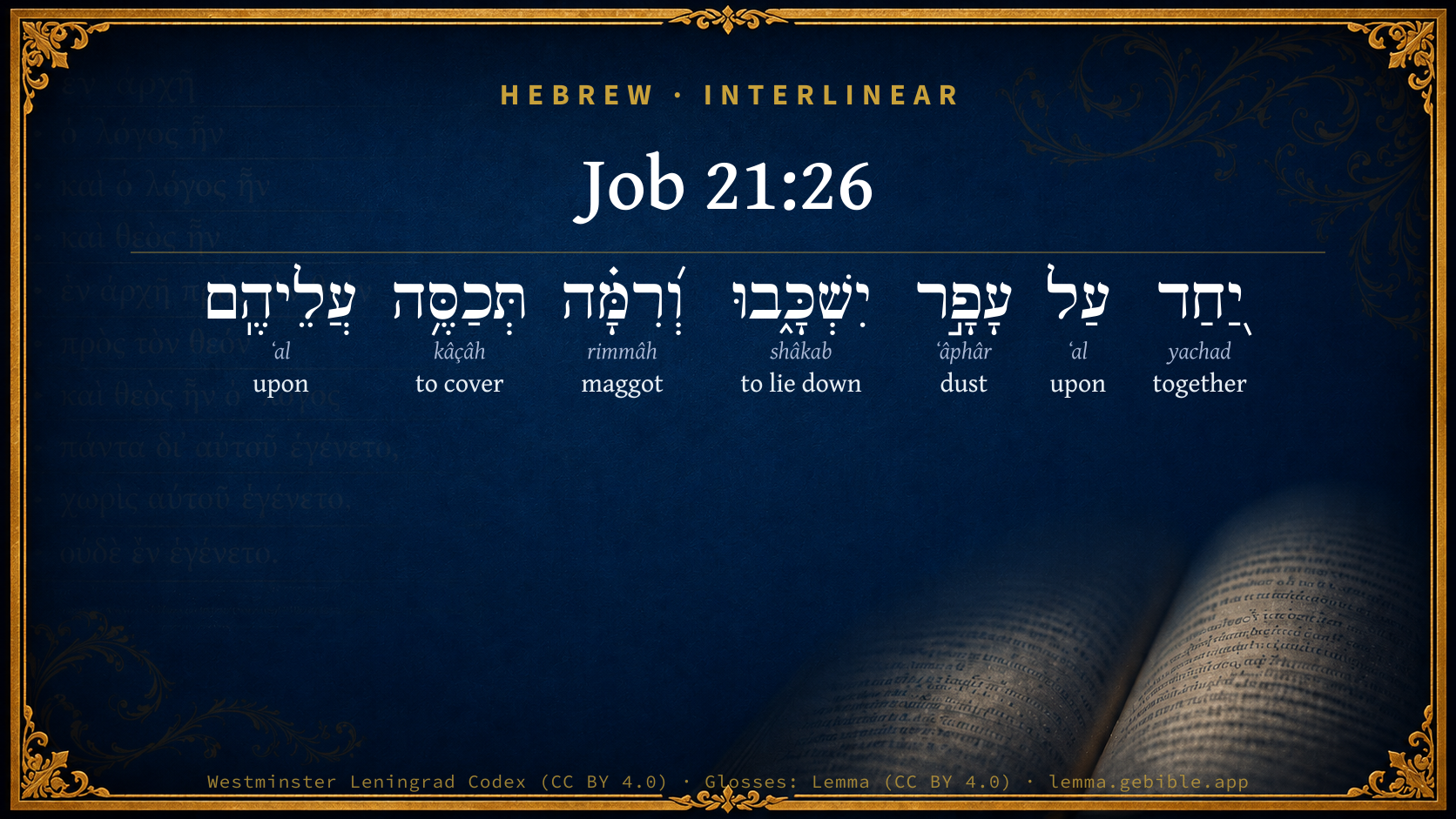
Job 21:26

Hebrew (Westminster Leningrad Codex) Job 21:26 appears in the Hebrew Old Testament. The text above is from the Westminster Leningrad Codex. Each word links to its Strong’s number, a concise gloss, and parsing drawn from the Open Scriptures Hebrew Bible morphology. Click any word for its full Brown-Driver-Briggs (BDB) entry.
Download image
Cite this verse

Job 21:26 (World English Bible). Public Domain. Lemma interlinear Bible study tool, https://lemma.gebible.app/v/job/21/26.

Show BibTeX & RIS
BibTeX
RIS
English Translation
They lie down alike in the dust, The worm covers them.
World English Bible · Public Domain
Download a study sheet

One document with this verse’s original text, its word-by-word gloss line, the meaning frame, cross-references with their text, attributed commentary, and full source and license credits — printable, and it pastes into notes with its structure intact.

This verse Autodidact and up

Study sheet (.html) Plain text (.txt)

A passage Seminary Student

Up to 50 verses in one chapter. A passage sheet keeps up to 6 commentary sources and 12 cross-references per verse, in the order this page ranks them, and says so on the sheet whenever that leaves anything out. Ask for a single verse and you get the Autodidact verse sheet above.

Everything on this page stays free to read, with no account — the sheet is a download of what is already on screen, not access to it.

Want to remove ads? Support Godless Engineer
Compare translations 3

The same verse in 3 English versions, stacked beneath the original-language interlinear above. Click any original word for its lexicon entry.

Each is an independent rendering of the whole verse — the interlinear is not word-aligned to these translations.

Highlighted words mark where these versions differ — a whole-verse word diff, not a word-by-word alignment.

  • World English Bible Public Domain
    They lie down alike in the dust, The worm covers them.
  • King James Version Public Domain
    They shall lie down alike in the dust, and the worms shall cover them.
  • unfoldingWord Literal Text CC BY-SA 4.0
    They lie down alike in the dust, and the worm covers over them.

unfoldingWord Literal Text — © unfoldingWord, licensed CC BY-SA 4.0. Word-aligned USFM3 via Door43 (git.door43.org/unfoldingWord/en_ult).

Versions to compare (up to 4)

3 of 4 selected

Show all 18 translations

Every available English version of this verse, each an independent rendering of the whole verse.

  • World English Bible Public Domain
    They lie down alike in the dust, The worm covers them.
  • Berean Standard Bible Public Domain
    But together they lie down in the dust, and worms cover them both.
  • Majority Standard Bible Public Domain
    But together they lie down in the dust, and worms cover them both.
  • King James Version Public Domain
    They shall lie down alike in the dust, and the worms shall cover them.
  • American Standard Version (1901) Public Domain
    They lie down alike in the dust, And the worm covereth them.
  • Revised Version (1885) Public Domain
    They lie down alike in the dust, and the worm covereth them.
  • Geneva Bible (1599) Public Domain
    They shall sleepe both in the dust, and the wormes shall couer them.
  • Douay-Rheims (1899) Public Domain
    And yet they shall sleep together in the dust, and worms shall cover them.
  • Young's Literal Translation Public Domain
    Together -- on the dust they lie down, And the worm doth cover them over.
  • Literal Standard Version CC BY-SA 4.0
    Together they lie down on the dust, || And the worm covers them over.
  • Unlocked Literal Bible CC BY-SA 4.0
    They lie down alike in the dust; the worms cover them both.
  • unfoldingWord Literal Text CC BY-SA 4.0
    They lie down alike in the dust, and the worm covers over them.
  • Darby Bible Public Domain
    Together they lie down in the dust, and the worms cover them.
  • World Messianic Bible Public Domain
    They lie down alike in the dust. The worm covers them.
  • Webster's Bible Public Domain
    They shall lie down alike in the dust, and the worms shall cover them.
  • Free Bible Version CC BY-SA 4.0
    Yet they are both buried in the same dust; they are treated alike in death, eaten by maggots.
  • Bible in Basic English Public Domain
    Together they go down to the dust, and are covered by the worm.
  • JPS Tanakh (1917) Public Domain
    They lie down alike in the dust, and the worm covereth them.

Literal Standard Version (2020), Covenant Press — licensed CC BY-SA 4.0. Text via the HelloAO Bible API (eBible.org). Unlocked Literal Bible (unfoldingWord) — licensed CC BY-SA 4.0. Text via the HelloAO Bible API (eBible.org). unfoldingWord Literal Text — © unfoldingWord, licensed CC BY-SA 4.0. Word-aligned USFM3 via Door43 (git.door43.org/unfoldingWord/en_ult). Free Bible Version, Dr. Jonathan Gallagher — licensed CC BY-SA 4.0. Text via the HelloAO Bible API (eBible.org).

Word by word

More ways to search: Search by grammar → Find every occurrence → Compare this word →

Practice this passage: Drill this verse → Learn its vocabulary →

About this verse

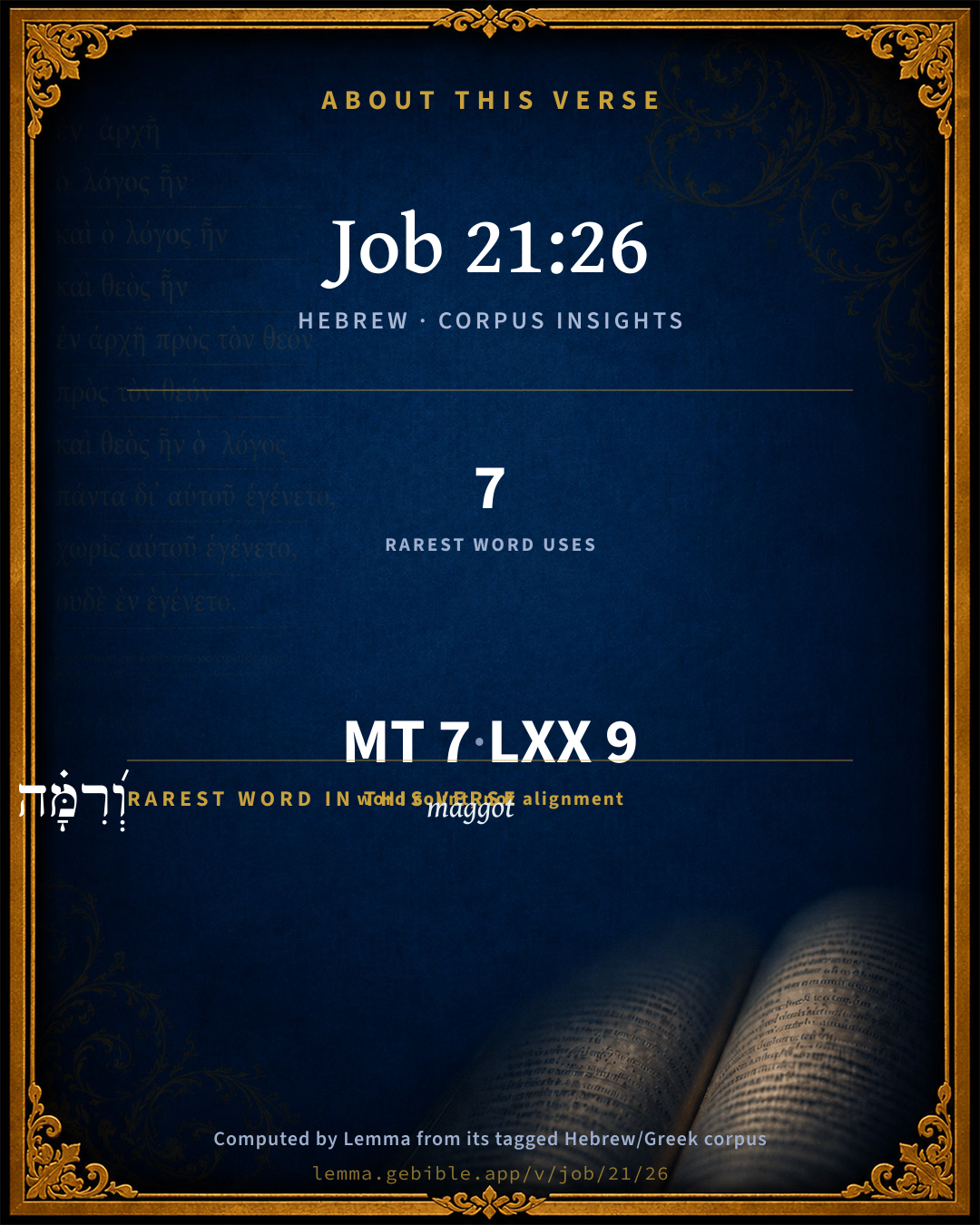
These counts appear in no published source. They are computed here, from the morphology-tagged text and Lemma’s own curated glosses. What Lemma adds →

7
words
6
distinct lemmas
Wisdom
section

Notable vocabulary

The rarest word here is וְ֝רִמָּ֗ה maggot H7415 — appearing just 7 times in the whole Hebrew Bible.

Shared distinctive vocabulary

וְ֝רִמָּ֗ה maggot H7415 occurs in 7 verses of the Hebrew Bible. Also found in:

Grammatical profile

  • 2 verbs
  • 2 nouns
  • 2 prepositions
  • 1 adverb

Verb forms

  • יִשְׁכָּ֑בוּ Qal · Imperfect
  • תְּכַסֶּ֥ה Piel · Imperfect

Repetition

A word recurs within this verse — often emphatic in Hebrew:

Hebrew & Septuagint length

In English translation the verse runs 11 words from the Hebrew and 12 from the Septuagint (LXX English) — closely comparable.

A rough comparison of the two English renderings, which tokenize alike — not a word-level alignment.

Word counts can differ between the Hebrew and the Greek without any difference in meaning — e.g. the Hebrew direct-object marker אֵת has no separate Greek word, and Greek often adds the article ὁ.

In the original languages it is 7 Hebrew tokens and 9 Greek tokens — but the two are counted differently (Hebrew bundles its prefixes and suffixes into one token; the Greek is in lemma form), so that isn’t a like-for-like length.

Cross-references

8

Topical passages linked to Job 21:26 in the Treasury of Scripture Knowledge — connected by theme and wording, ordered by reader-vote popularity; previews shown in the World English Bible.

  • Ecclesiastes 9:2 All things come alike to all. There is one event to the righteous and to the wicked; to the good, to the clean, to the unclean, to him who sacrifices, and to him who doesn't sacrifice. As is the good, so is the sinner; he who takes an oath, as he who fears an oath.
  • Isaiah 14:11 Your pomp is brought down to Sheol, [and] the noise of your viols: the worm is spread under you, and worms cover you.
  • Job 20:11 His bones are full of his youth, But youth shall lie down with him in the dust.
  • Job 3:18–19 There the prisoners are at ease together. They don't hear the voice of the taskmaster.
  • Job 17:14 If I have said to corruption, 'You are my father;' To the worm, 'My mother,' and 'my sister;'
  • Job 19:26 After my skin is destroyed, Then in my flesh shall I see God,
  • Job 24:20 The womb shall forget him. The worm shall feed sweetly on him. He shall be no more remembered. Unrighteousness shall be broken as a tree.
  • Psalms 49:14 They are appointed as a flock for Sheol. Death shall be their shepherd. The upright shall have dominion over them in the morning. Their beauty shall decay in Sheol, Far from their mansion.

Cross-references courtesy of OpenBible.info (CC BY 4.0).

Hebrew and Greek witnesses Masoretic Hebrew ↔ Greek Septuagint

The same verse in the two great witnesses to the Old Testament, shown verse-for-verse.

These are two independent witnesses, not word-aligned to each other, and the Septuagint is shown in lemma (dictionary) form.

Hebrew Job 21:26 Masoretic · Westminster Leningrad Codex

יַ֭חַד עַל עָפָ֣ר יִשְׁכָּ֑בוּ וְ֝רִמָּ֗ה תְּכַסֶּ֥ה עֲלֵיהֶֽם

They lie down alike in the dust, The worm covers them.

World English Bible · Public Domain

Greek LXX Job 21:26 Septuagint · lemma form

ὁμοθυμαδόν δέ ἐπί γῆ κοιμάω σαπρία δέ αὐτός καλύπτω

But they lie down in the earth together, and corruption covers them.

LXX2012 (modern English Septuagint) · Public Domain

Hebrew: Westminster Leningrad Codex (CC BY 4.0). Greek: Septuagint (public domain); English from LXX2012 (modern English Septuagint) (Public Domain). How the Septuagint differs from the Hebrew →

Commentary

Notes on Job 21:26 from classic Christian and Jewish commentators (each source and its license shown beneath its notes). The classic Christian expositions comment on the surrounding passage and are grouped to its opening verse, so a note may address several verses; the Jewish commentaries on the Tanakh (Rashi and others) are per-verse, so they appear only where the commentator wrote on this verse.

Lemma curates 59 commentaries, every one of them public domain or Creative Commons licensed, each selected and text-cleaned for this edition rather than reprinted as found. About our sources →

Trapp's Complete Commentary

John Trapp

Job 21:26 They shall lie down alike in the dust, and the worms shall cover them.

Ver. 26. They shall lie down alike in the dust, and worms, &c.] Death and afflictions are common to them both, as Ecc 9:2-3 How then do ye pronounce me wicked, because afflicted, and free among the dead, free of that company? &c.

And the worms shall cover them] Who haply were once covered with costliest clothing. The best are but worm’s meat; why then should we pamper and trick up these carcases?

John Trapp, A Commentary or Exposition upon All the Books of the Old and New Testament (1647–1656) — public domain. Text from a community e-Sword module.

Tyndale Open Study Notes

Tyndale Open Resources

21:26 eaten by the same maggots: Cp. 17:14; Isa 14:11; see Job 19:26.

Tyndale Open Study Notes — © Tyndale Open Resources, licensed CC BY-SA 4.0. Text via the HelloAO Bible API.

Geneva Bible (1599)

Geneva Bible translators

As concerning their bodies: and this he speaketh according to the common judgment.

Geneva Bible (1599) marginal notes — public domain. Text via Bolls.life.

Jamieson, Fausset & Brown

Robert Jamieson, A. R. Fausset & David Brown

(Ecc 9:2).

Jamieson, Fausset & Brown — Commentary Critical and Explanatory on the Whole Bible (1871) — public domain (CC PDM 1.0). Text via the HelloAO Bible API.

Adam Clarke's Commentary

Verse 26. They shall lie down alike in the dust] Death levels all distinctions, and the grave makes all equal. There may be a difference in the grave itself; but the human corpse is the same in all. Splendid monuments enshrine corruption; but the sod must lie close and heavy upon the putrefying carcass, to prevent it from becoming the bane of the living.

Adam Clarke's Commentary on the Bible (1810–1826) — public domain. Text from a community e-Sword/MySword module.

Ellicott's Commentary for English Readers

(26) They shall lie down alike in the dust.—Not only, therefore, is the inequality of their life a stumbling-block, but so also is the equality which obliterates all distinction between them in death.

A Bible Commentary for English Readers, edited by Charles John Ellicott (1878–1897) — public domain. Text from a community e-Sword module.

The Cambridge Bible for Schools and Colleges

gen. ed. J. J. S. Perowne

26. Wholly different in life the two are alike in death; cf. Ecc_2:15 seq.

They shall lie down] They lie down. Similarly, the worms cover.

The Cambridge Bible for Schools and Colleges (gen. ed. J. J. S. Perowne; Cambridge University Press, 1878–1918) — public domain. Text from a community e-Sword module.

John Gill's Exposition

Behold, I know your thoughts,.... God only truly, really, and in fact, knows the thoughts of men; this is his peculiar prerogative, he only is the searcher of the hearts and the trier of the reins of the children of men. Christ, the eternal Logos, or Word, by his being a discerner of the thoughts and intents of the heart, appears to be truly God. No man knows the things of a than, or the thoughts of his heart, but himself, and such to whomsoever he reveals them; but a wise and understanding man, a careful observer of men and things, may make some shrewd guesses at the thoughts of others, by hints and half words, or sentences expressed by them; by the show of their countenance, which is the index of the mind, and by the gestures and motions of their bodies; by these they may in a good measure judge whether they like or dislike, approve or, disapprove, of what is said to them: and thus Job knew the thoughts of his friends, that they were different from his, that the sentiments of their minds did not agree with his; and though he had so clearly proved his point, yet he saw by their looks and gestures that what he had said was not satisfactory to them; that they did not think it a sufficient confutation of their arguments, and a full answer to their objections:

and the devices which ye wrongfully imagine against me; that he was an hypocrite, a wicked man, guilty of crimes, and which they were devising to produce against him, and charge and load him with, as Eliphaz does in the following chapter; he knew they meant him in all that they had said concerning wicked men, and their afflictions, and what would be their portion at death, and after it; and though they did not name his name, they might as well have done it, since he was the man they struck at in all, particularly it, Job 20:5.

John Gill's Exposition of the Whole Bible (1746–1763) — public domain (CC PDM 1.0). Text via the HelloAO Bible API.

Albert Barnes' Notes on the Bible

They shall lie down alike in the dust - The emphasis here is on the word “alike” - יחד yachad. The idea is, that they should die “in a similar manner.” There would be no such difference in the mode of their death as to determine anything about their character or to show that one was the friend of God, and that the other was not. The friends of Job had maintained, that that could be certainly known by the divine dealings with people, either in their life, or in their death. Job combats this opinion, and says, that there is no such marked distinction in their life, nor is there any certain indication of their character in their death. Prosperity often attends the wicked as well as the righteous, and the death of the righteous and the wicked resemble each other.

And the worms shall cover them - Cover them “both.” They shall alike moulder back to dust. There is no distinction in the grave. There is no difference in the manner in which they moulder back to dust. No argument can be drawn respecting their character from the divine dealings toward them when in life - none from the manner of their death - none from the mode in which they moulder back to dust. On the reference to the “worm” here, see the notes at Job 14:11.

Albert Barnes' Notes on the Bible (1834–1885) — public domain. Text from a community e-Sword/MySword module.

Matthew Poole's English Annotations

All these worldly differences are ended by death, and they lie in the grave without any distinction, till the time of general resurrection and judgment comes. So that no man can tell who is good, and who is bad, by any events which befall them in this life.

Matthew Poole's English Annotations on the Holy Bible (1683–1685) — public domain. Text from a community e-Sword/MySword module.

Whedon's Commentary on the Bible

Daniel D. Whedon

26. Alike — Together, side by side. Whatever life men live, one common fate awaits all — to lie down together in the dust. What, then, argues Job, becomes of the law of retribution in this present life? The same difficulty perplexed the Preacher, Ecc_2:15.

Daniel D. Whedon (gen. ed.), Commentary on the Old and New Testaments (1874–1909) — public domain. Text from a community e-Sword module.

The Pulpit Commentary

They shall lie down alike in the dust, and the worms shall cover them. However different the circumstances of their life, men are alike in their death. One event happens to all. All die, are laid in the dust, and become the prey of worms.

The Pulpit Commentary (1880–1919), ed. H.D.M. Spence-Jones & Joseph S. Exell — public domain. Text from a community e-Sword module.

John Wesley's Explanatory Notes

Alike - All these worldly differences are ended by death, and they lie in the grave without any distinction. So that no man can tell who is good, and who is bad by events which befall them in this life. And if one wicked man die in a palace, and another in a dungeon, they will meet in the congregation of the dead and damned; and the worm that dieth not, and the fire that is not quenched will be the same to both: which makes those differences inconsiderable, and not worth perplexing ourselves about.

John Wesley, Explanatory Notes Upon the Whole Bible (1754–1765) — public domain. Text via the GEBible commentary corpus.

Rashi

Rabbi Shlomo Yitzchaki (Rashi)

Together on the earth they lie After their death, it is not recognizable to the people who is good and who is bad, because this one is like that one; they lie on the earth together.

Rashi on the Tanakh — English translations: “The Judaica Press complete Tanach with Rashi, translated by A. J. Rosenberg” (CC BY 4.0); “Pentateuch with Rashi's commentary by M. Rosenbaum and A.M. Silbermann, 1929-1934” (public domain); “The Metsudah Tanach series, Lakewood, N.J” (CC BY 4.0); and “The Book of Joshua, Metsudah Publications, 1997” (CC BY 4.0). Text via Sefaria.

Lesson kit

Teaching starters — assembled from the data on this page, not authored interpretation. Every prompt links to the verse data it draws on. Edit before teaching.

Job, in the Wisdom, opens this verse with 7 words (6 distinct Hebrew lemmas). Its most distinctive word is rimmâh (“maggot”). A historical commentator’s framing appears above. Read the whole chapter for the surrounding context.

Discussion questions

  1. What does “maggot” (rimmâh) contribute to the verse as a whole?
  2. Exodus 16:24 shares the word «maggot» with this verse. How do the two illuminate each other?
  3. “upon” occurs 2× in this one verse. What is the effect of the repetition?
  4. These translations render this verse differently; the difference is in the English rendering, not the original. What questions does that raise?
  5. The verb «יִשְׁכָּ֑בוּ» is Qal Imperfect. How does its form color the action?
  6. Reading how Trapp's Complete Commentary and Tyndale Open Study Notes read this verse, where do the two commentators agree and where do they part?

Things to notice

Reading settings

Reading text

Shown beneath each verse's original-language words.

Old Testament
Old Testament edition

Read the OT as the Masoretic Hebrew (MT) or the Greek Septuagint (LXX).

English shown for the Greek Septuagint (in the Hebrew ↔ Greek comparison).

Comparing translations? Open the Compare panel on any verse page to stack up to four side by side.