
Job 3:13

Hebrew (Westminster Leningrad Codex) Job 3:13 appears in the Hebrew Old Testament. The text above is from the Westminster Leningrad Codex. Each word links to its Strong’s number, a concise gloss, and parsing drawn from the Open Scriptures Hebrew Bible morphology. Click any word for its full Brown-Driver-Briggs (BDB) entry.
Download image
Cite this verse

Job 3:13 (World English Bible). Public Domain. Lemma interlinear Bible study tool, https://lemma.gebible.app/v/job/3/13.

Show BibTeX & RIS
BibTeX
RIS
English Translation
For now should I have lain down and been quiet. I should have slept, then I would have been at rest,
World English Bible · Public Domain
Download a study sheet

One document with this verse’s original text, its word-by-word gloss line, the meaning frame, cross-references with their text, attributed commentary, and full source and license credits — printable, and it pastes into notes with its structure intact.

This verse Autodidact and up

Study sheet (.html) Plain text (.txt)

A passage Seminary Student

Up to 50 verses in one chapter. A passage sheet keeps up to 6 commentary sources and 12 cross-references per verse, in the order this page ranks them, and says so on the sheet whenever that leaves anything out. Ask for a single verse and you get the Autodidact verse sheet above.

Everything on this page stays free to read, with no account — the sheet is a download of what is already on screen, not access to it.

Want to remove ads? Support Godless Engineer
Compare translations 3

The same verse in 3 English versions, stacked beneath the original-language interlinear above. Click any original word for its lexicon entry.

Each is an independent rendering of the whole verse — the interlinear is not word-aligned to these translations.

Highlighted words mark where these versions differ — a whole-verse word diff, not a word-by-word alignment.

  • World English Bible Public Domain
    For now should I have lain down and been quiet. I should have slept, then I would have been at rest,
  • King James Version Public Domain
    For now should I have lain still and been quiet, I should have slept: then had I been at rest,
  • unfoldingWord Literal Text CC BY-SA 4.0
    For now I had lain down and was reposing, I had slept, then it was being rest to me

unfoldingWord Literal Text — © unfoldingWord, licensed CC BY-SA 4.0. Word-aligned USFM3 via Door43 (git.door43.org/unfoldingWord/en_ult).

Versions to compare (up to 4)

3 of 4 selected

Show all 18 translations

Every available English version of this verse, each an independent rendering of the whole verse.

  • World English Bible Public Domain
    For now should I have lain down and been quiet. I should have slept, then I would have been at rest,
  • Berean Standard Bible Public Domain
    For now I would be lying down in peace; I would be asleep and at rest
  • Majority Standard Bible Public Domain
    For now I would be lying down in peace; I would be asleep and at rest
  • King James Version Public Domain
    For now should I have lain still and been quiet, I should have slept: then had I been at rest,
  • American Standard Version (1901) Public Domain
    For now should I have lain down and been quiet; I should have slept; then had I been at rest,
  • Revised Version (1885) Public Domain
    For now should I have lain down and been quiet; I should have slept; then had I been at rest:
  • Geneva Bible (1599) Public Domain
    For so shoulde I now haue lyen and bene quiet, I should haue slept then, and bene at rest,
  • Douay-Rheims (1899) Public Domain
    For now I should have been asleep and still, and should have rest in my sleep.
  • Young's Literal Translation Public Domain
    For now, I have lain down, and am quiet, I have slept -- then there is rest to me,
  • Literal Standard Version CC BY-SA 4.0
    For now, I have lain down, and am quiet, I have slept—then there is rest to me,
  • Unlocked Literal Bible CC BY-SA 4.0
    For now I would have been lying down quietly. I would have slept and been at rest
  • unfoldingWord Literal Text CC BY-SA 4.0
    For now I had lain down and was reposing, I had slept, then it was being rest to me
  • Darby Bible Public Domain
    For now should I have lain down and been quiet; I should have slept: then had I been at rest,
  • World Messianic Bible Public Domain
    For now I should have lain down and been quiet. I should have slept, then I would have been at rest,
  • Webster's Bible Public Domain
    For now should I have lain still and been quiet, I should have slept: then had I been at rest,
  • Free Bible Version CC BY-SA 4.0
    For now I would be lying down in peace. I would be sleeping and at rest,
  • Bible in Basic English Public Domain
    For then I might have gone to my rest in quiet, and in sleep have been in peace,
  • JPS Tanakh (1917) Public Domain
    For now should I have lain still and been quiet; I should have slept; then had I been at rest —

Literal Standard Version (2020), Covenant Press — licensed CC BY-SA 4.0. Text via the HelloAO Bible API (eBible.org). Unlocked Literal Bible (unfoldingWord) — licensed CC BY-SA 4.0. Text via the HelloAO Bible API (eBible.org). unfoldingWord Literal Text — © unfoldingWord, licensed CC BY-SA 4.0. Word-aligned USFM3 via Door43 (git.door43.org/unfoldingWord/en_ult). Free Bible Version, Dr. Jonathan Gallagher — licensed CC BY-SA 4.0. Text via the HelloAO Bible API (eBible.org).

Word by word

More ways to search: Search by grammar → Find every occurrence → Compare this word →

Practice this passage: Drill this verse → Learn its vocabulary →

יָ֝שַׁ֗נְתִּי
yâshên
H3462
“to sleep”
Verb, Qal, Perfect, 1st Person, Common, Singular
Part of Speech
Verb
Stem
Qal
Form
Perfect
Person
1st Person
Gender
Common
Number
Singular
Full BDB Definition

Origin: a primitive root

TWOT: 928

to sleep, be asleep - (Qal) to sleep, go to sleep, be asleep - (Niphal) - to remain a long time, be stored up - to be festering (of leprosy) - (Piel) to cause to sleep, entice to sleep
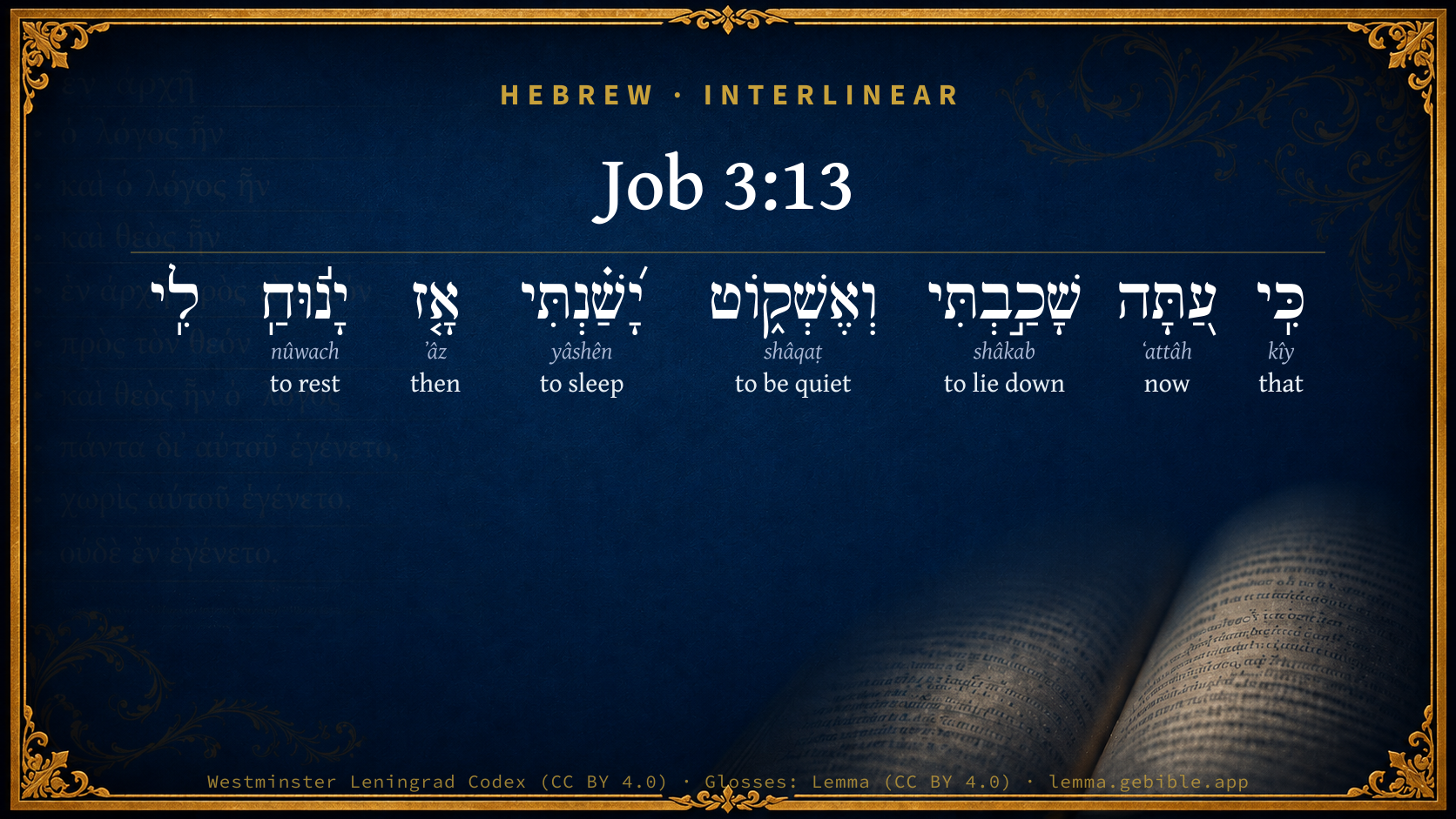
  1. כִּֽי kîy H3588 “that” Conjunction
  2. עַ֭תָּה ʻattâh H6258 “now” Adverb
  3. שָׁכַ֣בְתִּי shâkab H7901 “to lie down” Verb, Qal, Perfect, 1st Person, Common, Singular
  4. וְאֶשְׁק֑וֹט shâqaṭ H8252 “and · to be quiet” Conjunction + Verb, Qal, Imperfect, 1st Person, Common, Singular
  5. אָ֤ז ʼâz H227 “then” Adverb
  6. יָנ֬וּחַֽ nûwach H5117 “to rest” Verb, Qal, Imperfect, 3rd Person, Masculine, Singular

About this verse

These counts appear in no published source. They are computed here, from the morphology-tagged text and Lemma’s own curated glosses. What Lemma adds →

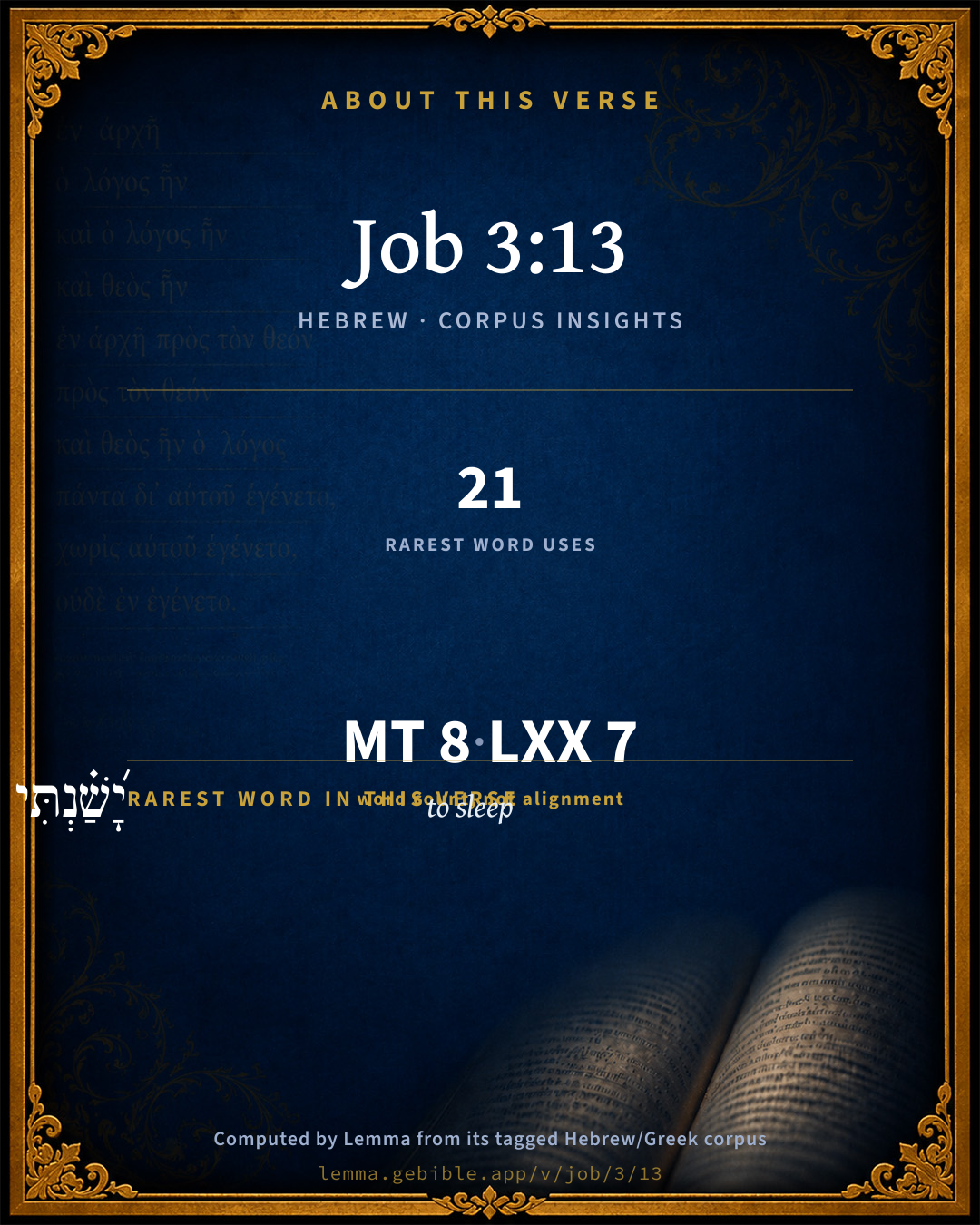
8
words
7
distinct lemmas
Wisdom
section

Notable vocabulary

The rarest word here is יָ֝שַׁ֗נְתִּי to sleep H3462 — appearing just 21 times in the whole Hebrew Bible.

Shared distinctive vocabulary

יָ֝שַׁ֗נְתִּי to sleep H3462 occurs in 21 verses of the Hebrew Bible. Also found in:

Grammatical profile

  • 4 verbs
  • 1 preposition
  • 1 conjunction
  • 2 adverbs

Verb forms

  • שָׁכַ֣בְתִּי Qal · Perfect
  • וְאֶשְׁק֑וֹט Qal · Imperfect
  • יָ֝שַׁ֗נְתִּי Qal · Perfect
  • יָנ֬וּחַֽ Qal · Imperfect

Hebrew & Septuagint length

In English translation the verse runs 21 words from the Hebrew and 17 from the Septuagint (LXX English) — closely comparable.

A rough comparison of the two English renderings, which tokenize alike — not a word-level alignment.

Word counts can differ between the Hebrew and the Greek without any difference in meaning — e.g. the Hebrew direct-object marker אֵת has no separate Greek word, and Greek often adds the article ὁ.

In the original languages it is 8 Hebrew tokens and 7 Greek tokens — but the two are counted differently (Hebrew bundles its prefixes and suffixes into one token; the Greek is in lemma form), so that isn’t a like-for-like length.

Cross-references

10

Topical passages linked to Job 3:13 in the Treasury of Scripture Knowledge — connected by theme and wording, ordered by reader-vote popularity; previews shown in the World English Bible.

  • Job 14:10–12 But man dies, and is laid low. Yes, man gives up the spirit, and where is he?
  • Job 21:13 They spend their days in prosperity. In an instant they go down to Sheol.
  • Ecclesiastes 9:10 Whatever your hand finds to do, do it with your might; for there is no work, nor device, nor knowledge, nor wisdom, in Sheol, where you are going.
  • Job 7:8–10 The eye of him who sees me shall see me no more. Your eyes shall be on me, but I shall not be.
  • Job 7:21 Why do you not pardon my disobedience, and take away my iniquity? For now shall I lie down in the dust. You will seek me diligently, but I shall not be."
  • Job 10:22 The land dark as midnight, Of the shadow of death, without any order, Where the light is as midnight.'"
  • Job 17:13 If I look for Sheol as my house, If I have spread my couch in the darkness,
  • Job 19:27 Whom I, even I, shall see on my side. My eyes shall see, and not as a stranger. "My heart is consumed within me.
  • Job 21:23 One dies in his full strength, Being wholly at ease and quiet.
  • Ecclesiastes 6:3–5 If a man fathers a hundred children, and lives many years, so that the days of his years are many, but his soul is not filled with good, and moreover he has no burial; I say, that an untimely birth is better than he:

Cross-references courtesy of OpenBible.info (CC BY 4.0).

Hebrew and Greek witnesses Masoretic Hebrew ↔ Greek Septuagint

The same verse in the two great witnesses to the Old Testament, shown verse-for-verse.

These are two independent witnesses, not word-aligned to each other, and the Septuagint is shown in lemma (dictionary) form.

Hebrew Job 3:13 Masoretic · Westminster Leningrad Codex

כִּֽי עַ֭תָּה שָׁכַ֣בְתִּי וְאֶשְׁק֑וֹט יָ֝שַׁ֗נְתִּי אָ֤ז יָנ֬וּחַֽ לִֽי

For now should I have lain down and been quiet. I should have slept, then I would have been at rest,

World English Bible · Public Domain

Greek LXX Job 3:13 Septuagint · lemma form

νῦν ἄν κοιμάω ἡσυχάζω ὑπνόω δέ ἀναπαύω

Now I should have lain down and been quiet, I should have slept and been at rest,

LXX2012 (modern English Septuagint) · Public Domain

Hebrew: Westminster Leningrad Codex (CC BY 4.0). Greek: Septuagint (public domain); English from LXX2012 (modern English Septuagint) (Public Domain). How the Septuagint differs from the Hebrew →

Commentary

Notes on Job 3:13 from classic Christian and Jewish commentators (each source and its license shown beneath its notes). The classic Christian expositions comment on the surrounding passage and are grouped to its opening verse, so a note may address several verses; the Jewish commentaries on the Tanakh (Rashi and others) are per-verse, so they appear only where the commentator wrote on this verse.

Lemma curates 59 commentaries, every one of them public domain or Creative Commons licensed, each selected and text-cleaned for this edition rather than reprinted as found. About our sources →

Trapp's Complete Commentary

John Trapp

Job 3:13 For now should I have lain still and been quiet, I should have slept: then had I been at rest,

Ver. 13. For now should I have lain still and been quiet] Why, but is it not better to be preserved in salt than to putrefy in sugar? to be emptied from vessel to vessel, than to be at ease, and so to settle on the lees? Jer 48:11; to be tumbled up and down, as fishes are in the streams of Jordan, than to perish in the Dead Sea? It is not always (if at all) a happiness to lie still and be quiet. Life consists in action; and in all these things is the life of my spirit, saith good Hezekiah, who had been in death’s hands (where Job so much desired to be), and could therefore make a better judgment, Isa 38:16. What haste, then, was there of his lying still, and being quiet; say that he were assured of his salvation (for else death had been but a trap door to eternal torments), was there nothing more to be done, but taking present possession? nothing to be suffered with Christ, or ere we come to be glorified with him? Rom 8:17. Ought not he himself first to have suffered and then to have entered into his glory? Luk 24:26. And ought not we to be conformed to his image (in sufferings also) that he might be the firstborn among many brethren? Rom 8:29. Let us run with patience (running is active, and patience passive) the race that is set before us, looking unto Jesus, &c., and looking off our present troubles (as the word αφορωντες, Heb 1:12, importeth), which while Job beheld too wishtly, and was more sensible of than was meet, he brake out in this sort, and showed himself too much a man. Let us do up our work, and then God will send us to bed all in good time, Isa 57:1-21 : 2Ki 16:13.

John Trapp, A Commentary or Exposition upon All the Books of the Old and New Testament (1647–1656) — public domain. Text from a community e-Sword module.

Joseph Benson's Commentary

Job 3:13-14. For now should I have lain still, and been quiet — Free from those torments of body, and that anguish of mind, which now oppress me. With kings and counsellors of the earth — I had then been as happy as the proudest monarchs, who, after all their great achievements, go down into their graves; which built desolate places for themselves — Who distinguished themselves for a while, and to show their great wealth and power, and to leave behind them a glorious name, and perpetuate their memories, with great labour and expense erected pompous and magnificent buildings; and, to render themselves the more famous, raised them up in places which seemed before to be forsaken, and abandoned to entire desolation.

Joseph Benson's Commentary on the Old and New Testaments (1811–1818) — public domain. Text from a community e-Sword module.

Whedon's Commentary on the Bible

Daniel D. Whedon

13. Then had I been at rest — The gradation is to be remarked — lain still, been quiet, have slept, been at rest. The idea of “rest” in our text, is not one of unconsciousness. The expressions are such as we ourselves continue to use in anticipation of the quiet of the grave. The inscriptions in the Catacombs are in harmony with this passage, (Job_3:13-20,) which we may not improperly regard as a strain from nature’s oratorio of the grave. “In those inscriptions the Christian is always at peace — in pace. This phrase occurs either at the beginning or at the end of most of them as a necessary formula.” — NORTHCOTE, Catac., p. 162. The idea of immortality was most vivid in the heart of the infant Church, “yet the Christian, not content with calling his burial ground a sleeping place, (cemetery,) pushes the notion of slumber to its fullest extent.” — MAITLAND, Catac., page 42.

Daniel D. Whedon (gen. ed.), Commentary on the Old and New Testaments (1874–1909) — public domain. Text from a community e-Sword module.

Geneva Bible (1599)

Geneva Bible translators

The vehemency of his afflictions made him to utter these words, as though death were the end of all miseries, and as if there were no life after this, which he speaketh not as though it were so, but the infirmities of his flesh caused him to burst out in this error of the wicked.

Geneva Bible (1599) marginal notes — public domain. Text via Bolls.life.

Jamieson, Fausset & Brown

Robert Jamieson, A. R. Fausset & David Brown

lain . . . quiet . . . slept--a gradation. I should not only have lain, but been quiet, and not only been quiet, but slept. Death in Scripture is called "sleep" (Psa 13:3); especially in the New Testament, where the resurrection-awakening is more clearly set forth (Co1 15:51; Th1 4:14; Th1 5:10).

Jamieson, Fausset & Brown — Commentary Critical and Explanatory on the Whole Bible (1871) — public domain (CC PDM 1.0). Text via the HelloAO Bible API.

Adam Clarke's Commentary

Verse 13. For now should I have lain still] In that case I had been insensible; quiet - without these overwhelming agitations; slept - unconscious of evil; been at rest - been out of the reach of calamity and sorrow.

Adam Clarke's Commentary on the Bible (1810–1826) — public domain. Text from a community e-Sword/MySword module.

The Cambridge Bible for Schools and Colleges

gen. ed. J. J. S. Perowne

13. The words receive their pathos from the contrast of his present anguish, Job_3:26.

The Cambridge Bible for Schools and Colleges (gen. ed. J. J. S. Perowne; Cambridge University Press, 1878–1918) — public domain. Text from a community e-Sword module.

John Gill's Exposition

For now should I have lain still, and been quiet,.... Signifying, that if the above had been his case, if he had died as soon as born, or quickly after, then he would have been laid in the grave, where he would have lain as still as on a bed; for such is the grave to dead bodies as a bed is to those that lie down and sleep upon it; a place of ease and quiet, where there is freedom from all care and thought, from all trouble, anxiety, and distress; nay, more so than on a bed, where there is often tossing to and fro, and great disquietude, but none to the body in the grave, that is still and silent, where there is no uneasiness nor disturbance, see Job 17:13,

I should have slept; soundly and quietly, which persons do not always upon their beds; sometimes they cannot sleep at all, and when they do, they are frequently distressed with uneasy thoughts, frightful dreams, and terrifying visions, Job 4:13; but death is a sound sleep until the resurrection morn, which Job had knowledge of, and faith in, and so considered the state of the dead in this light; death is often in Scripture expressed by sleeping, Dan 12:2; which refers not to the soul, which in a separate state is active and vigorous, and always employed; but to the body, which, as in sleep, so in death, is deprived of the senses, and the exercise of them; on which account there is a great likeness between sleep and death, and out of which a man awakes brisk and cheerful, as the saints will at the time of their resurrection, which will be like an awaking out of sleep:

then had I been at rest; from all toil and labour, from all diseases and pains of body, from all troubles of whatsoever kind, and particularly from those he now laboured under; see Gill on Job 3:17.

John Gill's Exposition of the Whole Bible (1746–1763) — public domain (CC PDM 1.0). Text via the HelloAO Bible API.

Albert Barnes' Notes on the Bible

For now should I have lain still - In this verse Job uses four expressions to describe the state in which be would have been if he had been so happy as to have died when an infant. It is evidently a very pleasant subject to him, and he puts it in a great variety of form. He uses thc words which express the most quiet repose, a state of perfect rest, a gentle slumber; and then in the next verses he says, that instead of being in the miserable condition in which he then was, he would have been in the same state with kings and the most illustrious men of the earth.

I should have lain still - - שׁכב shâkab. I should have been “lying down,” as one does who is taking grateful repose. This is a word of less strength than any of those which follow.

And been quiet - - שׁקט shâqaṭ. A word of stronger signification than that before used. It means to rest, to lie down, to have quiet. It is used of one who is never troubled, harassed, or infested by others, Jdg 3:11; Jdg 5:31; Jdg 8:25; and of one who has no fear or dread, Psa 76:9. The meaning is, that he would not only have lain down, but; would have been perfectly tranquil. Nothing would have harassed him, nothing would have given him any annoyance.

I should have slept - - ישׁן yâshên. This expression also is in advance of those before used. There would not only have been “quiet,” but there would have been a calm and gentle slumber. Sleep is often representcd as “the kinsman of death.” Thus, Virgil speaks of it:

“Tum consanguineus Leti sopor - “

Aeneid vi. 278.

So Homer:

Enth' hupnō cumblēto chasignēto thanatoio -

Iliad, 14:231.

This comparsion is an obvious one, and is frequently used in the Classical writers. It is employed to denote the calmness, stillness, and quiet of death. In the Scriptures it frequently occurs, and with a significancy far more beautiful. It is there employed not only to denote the tranquility of death, but also to denote the Christian hopes of a resurrection and the prospect of being awakened out of the long sleep. We lie down to rest at night with the hopes of awaking again. We sleep calmly, with the expectation that it will be only a temporary repose, and that we shall be aroused, invigorated for augmented toil, and refreshed for sweeter pleasure. So the Christian lies down in the grave. So the infant is committed to the calm slumber of the tomb. It may be a sleep stretching on through many nights and weeks and years and centuries, and even cycles of ages, but it is not eternal. The eyes will be opened again to behold the beauties of creation; the ear will be unstoppod to hear the sweet voice of fricndship and the harmony of music; and the frame will be raised up beautiful and immortal to engage in the service of the God that made us; compare Psa 13:3; Psa 90:5; Joh 11:11; 1Co 15:51; 1Th 4:14; 1Th 5:10. Whether Job used the word in this sense and with this understanding, has been made a matter of question, and will be considered more fully in the examination of the passage in Job 19:25-27.

Then had I been at rest - Instead of the troubles and anxieties which I now experience. That is, he would have been lying in calm and honorable repose with the kings and princes of the earth.

Albert Barnes' Notes on the Bible (1834–1885) — public domain. Text from a community e-Sword/MySword module.

Haydock's Catholic Bible Commentary

CHAPTER III.

Sleep. So death is often styled. Olli dura quies oculos et ferreus urget

Somnus: in æternam clauduntur lumina noctem. (Virgil, Æneid x.)

George Leo Haydock (1774–1849), Haydock's Catholic Family Bible and Commentary, 1859 edition — public domain. Excludes Psalms (Douay-Rheims chapter numbering differs from Protestant) and Deuterocanonical books (Catholic canon only).

Matthew Poole's English Annotations

Quiet; free from all those torments of my body and mind which now oppress me.

Matthew Poole's English Annotations on the Holy Bible (1683–1685) — public domain. Text from a community e-Sword/MySword module.

The Pulpit Commentary

For now should I have lain still and been quiet. "In that case, I should now (hT) have been lying still and resting myself," instead of tossing about, and being full of restlessness and suffering." I should have slept. The life in the intermediate state is called "sleep," even in the New Testament. (Mat_9:24 Joh_11:11 Act_7:60 1Co_15:18, 1Co_15:51, etc.) Job, perhaps, imagined it to be, actually, a sound, dreamless slumber. Then should I have been at rest; literally, then (za) would there have been rest for me.

Vers. 13-19. The grave.

I A REGION OF IMPENETRABLE DARKNESS.

II A REALM OF UNBROKEN SILENCE.

III AN ABODE OF DEEP TRANQUILLITY.

IV A BED OF PEACEFUL SLUMBER.

V A WORLD OF ABSOLUTE EQUALITY.

VI A PLACE OF UNIVERSAL RENDEZVOUS.

VII A HOUSE OF TEMPORARY LODGING. LESSONS.

1. Humility.

2. Contentment.

3. Diligence.

4. Watchfulness.

Vers. 13-19. The grave a rest.

In the toil and sorrow of life men long for rest. They lighten the toils and brighten the darkness of the present by the hope of repose and gladness in the future. Without such a hope life"s burdens would be much heavier than they are; and in some cases almost insupportable. As the worn labourer longs for the rest of the even-tide, so does the over-wrought spirit of the sad desire the rest of the grave. It is proper to consider if this is a healthy, a just, a well-grounded desire. To the grave men of widely different characters look for rest. Let us think of the grave

I AS LONGED FOR BY THE WEARY. "Then had I been at rest." This is not always to be commended. The present is our time for toil. These are the hours of the day. They that sleep should sleep in the night. It is not a Christian spirit to wish life shorter. Rather should we ask for grace to be faithful, even unto death. Resignation, obedience, hope, will check the desire to diminish the term of life. What is suicide but the adding violence to this desire? For our change we must wait.

II AS THE ONLY REST KNOWN TO THE IGNORANT. By Christian teaching and discipline we learn where the spirit may find rest; and we are encouraged to wait for the end of our toil. But the ignorant know nothing of this good hope.

III THE GRAVE BRINGS NO REST TO THE UNFAITHFUL. He owns rest who does a day"s work. To him that rest is sleep. To the idler death will bring no rest. It will change the conditions and surroundings of life. But it is a dire delusion to suppose that the spirit, in putting off the garment of the flesh, will escape from all toil. Its burdens are within itself, not in the fleshy tent. All sensation is in the mind during the bodily life, and all the sad weariness of the spirit, springing from consciousness of disobedience, that spirit carries with it. The sting of punishment for the wicked pierces the spirit; often through the flesh, it is true. But the sting is not left in the flesh, to be cast off when the body is laid down. The weapons of the spiritual foe penetrate beyond the clothes. The wicked deluded in life is deluded by death. Some long so eagerly for death that they rush through the thin veil that separates them from the regions of the dead. But it is rushing from darkness to light. It is rushing into the presence of the All-seeing One whose apprehended judgment upon life is the severest of all punishments.

IV THE REST OF THE GRAVE IS A TRUE REWARD TO THE FAITHFUL. Fidelity in toil has its reward in rest. To the faithful ones it is sweet. But not as a mere cessation of activity.

1. It ends for them the time of exposure to temptation.

2. It marks the limits of probation.

3. It exchanges warfare for triumph; hard toil for honourable repose; danger for safety; the cross for the crown.

4. It brings the perfectness of all blessing in the everlasting life and the fulness of joy which are promised to the obedient and the pure. R.G.

The Pulpit Commentary (1880–1919), ed. H.D.M. Spence-Jones & Joseph S. Exell — public domain. Text from a community e-Sword module.

Keil & Delitzsch

C. F. Keil & F. Delitzsch

13 So should I now have lain and had quiet,

I should have slept, then it would have been well with me,

14 With kings and councillors of the earth,

Who built ruins for themselves,

15 Or with princes possessing gold,

Who filled their houses with silver:

16 Or like a hidden untimely birth I had not been,

And as children that have never seen the light.

The perf. and interchanging fut. have the signification of oriental imperfecta conjunctivi, according to Ges. 126, 5; עתּה כּי is the usual expression after hypothetical clauses, and takes the perf. if the preceding clause specifies a condition which has not occurred in the past (Gen 31:42; Gen 43:10; Num 22:29, Num 22:33; Sa1 14:30), the fut. if a condition is not existing in the present (Job 6:3; Job 8:6; Job 13:19). It is not to be translated: for then; כי rather commences the clause following: so I should now, indeed then I should. Ruins, הרבות, are uninhabited desolate buildings, elsewhere such as have become, here such as are from the first intended to remain, uninhabited and desolate, consequently sepulchres, mausoleums; probably, since the book has Egyptian allusions, in other passages also, a play upon the pyramids, in whose name (III-XPAM, according to Coptic glossaries) III is the Egyptian article (vid., Bunsen, Aeg. ii. 361); Arab. without the art. hirâm or ahrâm (vid., Abdollatf, ed. de Sacy, p. 293, s.).

(Note: We think that חרבות sounds rather like חרמות, the name of the pyramids, as the Arabic haram (instead of hharam), derived from XPAM, recalls harmân (e.g., beith harmân, a house in ruins), the synonym of hhardân (חרבאן).)

Also Renan: Qui se btissent des mausoles. Bttch. de inferis, 298 (who, however, prefers to read רחבות, wide streets), rightly directs attention to the difference between החרבות בנה (to rebuild the ruins) and לו בנה ח (to build ruins for one's self). With או like things are then ranged after one another. Builders of the pyramids, millionaires, abortions (vid., Ecc 6:3), and the still-born: all these are removed from the sufferings of this life in their quiet of the grave, be their grave a "ruin" gazed upon by their descendants, or a hole dug out in the earth, and again filled in as it was before.

Keil & Delitzsch — Biblical Commentary on the Old Testament (1861–1891) — public domain (CC PDM 1.0). Text via the HelloAO Bible API. (Old Testament only.)

unfoldingWord translationNotes

Door43 World Missions Community

For now I would have been lying down quietly. I would have slept and been at rest

Job uses two sentences to think about what it would be like if he had never been born or had died at birth. (See: Parallelism and Euphemism)

I would have been lying down quietly

Job imagines something that could have happened in the past but which did not happen, as noted above. AT: "I should have been lying down quietly" (See: Hypothetical Situations)

lying down quietly

"asleep, resting peacefully"

been at rest

Here the word "rest" means to sleep peacefully, but also that Job would not be experiencing the pain that he does. (See: Idiom)

with kings and counselors of the earth

"with kings and their advisers"

translationWords

asleep

king

advice

earth

grave

ruin

unfoldingWord translationNotes — © Distant Shores Media and the Door43 World Missions Community, licensed CC BY-SA 4.0. Source: git.door43.org/Door43/en_tn.

Rashi

Rabbi Shlomo Yitzchaki (Rashi)

I would be lying Heb. ושכבתי, I would be lying in the grave.

Rashi on the Tanakh — English translations: “The Judaica Press complete Tanach with Rashi, translated by A. J. Rosenberg” (CC BY 4.0); “Pentateuch with Rashi's commentary by M. Rosenbaum and A.M. Silbermann, 1929-1934” (public domain); “The Metsudah Tanach series, Lakewood, N.J” (CC BY 4.0); and “The Book of Joshua, Metsudah Publications, 1997” (CC BY 4.0). Text via Sefaria.

Lesson kit

Teaching starters — assembled from the data on this page, not authored interpretation. Every prompt links to the verse data it draws on. Edit before teaching.

Job, in the Wisdom, opens this verse with 8 words (7 distinct Hebrew lemmas). Its most distinctive word is yâshên (“to sleep”). A historical commentator’s framing appears above. Read the whole chapter for the surrounding context.

Discussion questions

  1. How does “to sleep” (yâshên) shape what this verse is saying?
  2. Genesis 2:21 shares the word «to sleep» with this verse. How do the two illuminate each other?
  3. These translations render this verse differently. What is at stake in choosing one wording over another?
  4. The verb «שָׁכַ֣בְתִּי» is Qal Perfect. How does its form color the action?
  5. Reading how Trapp's Complete Commentary and Joseph Benson's Commentary read this verse, where do the two commentators agree and where do they part?

Things to notice

Reading settings

Reading text

Shown beneath each verse's original-language words.

Old Testament
Old Testament edition

Read the OT as the Masoretic Hebrew (MT) or the Greek Septuagint (LXX).

English shown for the Greek Septuagint (in the Hebrew ↔ Greek comparison).

Comparing translations? Open the Compare panel on any verse page to stack up to four side by side.