Psalms 88:5

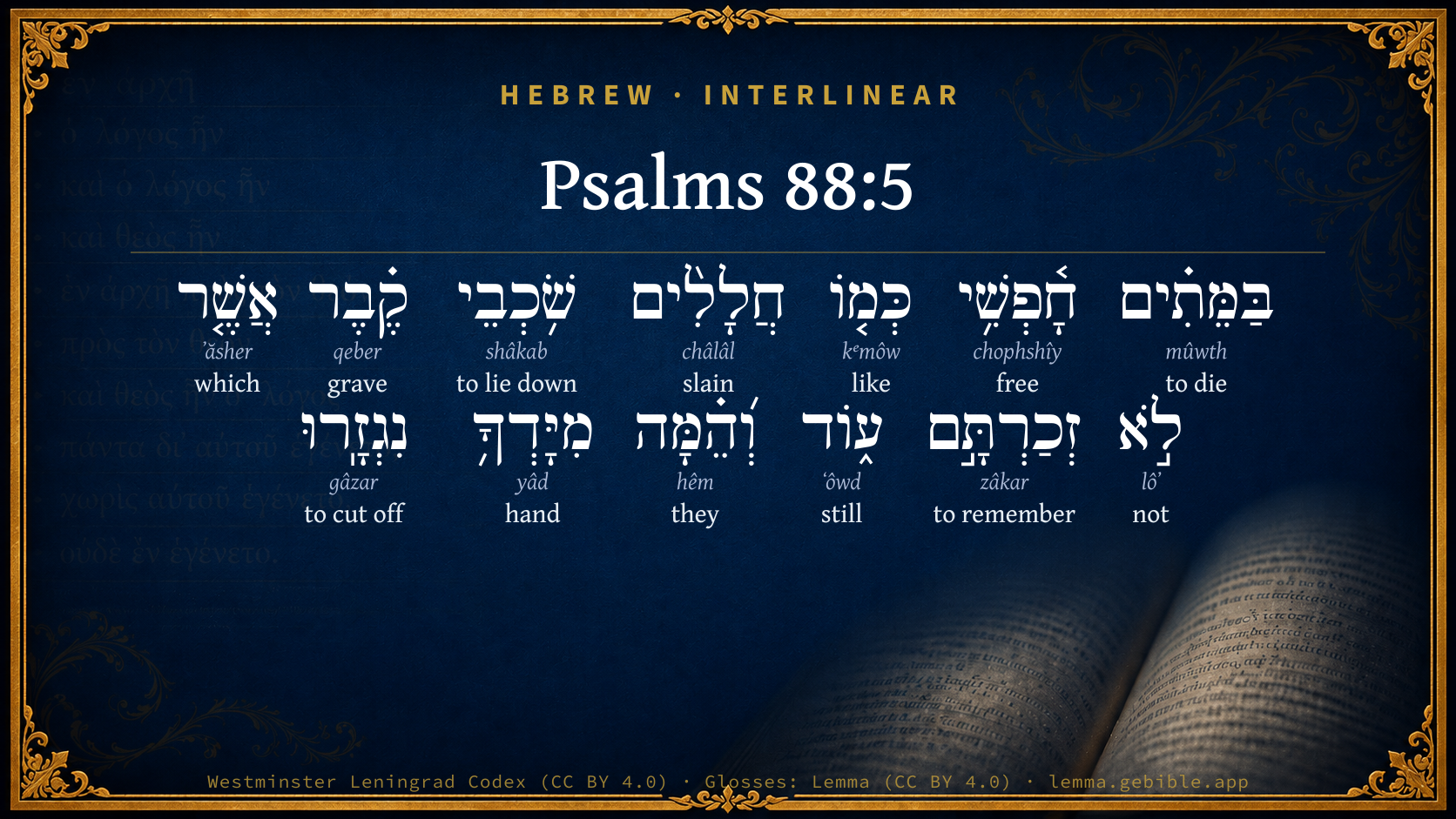
Hebrew (Westminster Leningrad Codex) Psalms 88:5 appears in the Hebrew Old Testament. The text above is from the Westminster Leningrad Codex. Each word links to its Strong’s number, a concise gloss, and parsing drawn from the Open Scriptures Hebrew Bible morphology. Click any word for its full Brown-Driver-Briggs (BDB) entry.
Download image
Cite this verse

Psalms 88:5 (World English Bible). Public Domain. Lemma interlinear Bible study tool, https://lemma.gebible.app/v/psalms/88/5.

Show BibTeX & RIS
BibTeX
RIS
English Translation
Set apart among the dead, Like the slain who lie in the grave, Whom you remember no more. They are cut off from your hand.
World English Bible · Public Domain
Download a study sheet

One document with this verse’s original text, its word-by-word gloss line, the meaning frame, cross-references with their text, attributed commentary, and full source and license credits — printable, and it pastes into notes with its structure intact.

This verse Autodidact and up

Study sheet (.html) Plain text (.txt)

A passage Seminary Student

Up to 50 verses in one chapter. A passage sheet keeps up to 6 commentary sources and 12 cross-references per verse, in the order this page ranks them, and says so on the sheet whenever that leaves anything out. Ask for a single verse and you get the Autodidact verse sheet above.

Everything on this page stays free to read, with no account — the sheet is a download of what is already on screen, not access to it.

Want to remove ads? Support Godless Engineer
Compare translations 3

The same verse in 3 English versions, stacked beneath the original-language interlinear above. Click any original word for its lexicon entry.

Each is an independent rendering of the whole verse — the interlinear is not word-aligned to these translations.

Highlighted words mark where these versions differ — a whole-verse word diff, not a word-by-word alignment.

  • World English Bible Public Domain
    Set apart among the dead, Like the slain who lie in the grave, Whom you remember no more. They are cut off from your hand.
  • King James Version Public Domain
    Free among the dead, like the slain that lie in the grave, whom thou rememberest no more: and they are cut off from thy hand.
  • unfoldingWord Literal Text CC BY-SA 4.0
    free among the ones having died, like the slain lying in the grave, whom you do not remember them anymore, and they, they are cut off from your hand.

unfoldingWord Literal Text — © unfoldingWord, licensed CC BY-SA 4.0. Word-aligned USFM3 via Door43 (git.door43.org/unfoldingWord/en_ult).

Versions to compare (up to 4)

3 of 4 selected

Show all 18 translations

Every available English version of this verse, each an independent rendering of the whole verse.

  • World English Bible Public Domain
    Set apart among the dead, Like the slain who lie in the grave, Whom you remember no more. They are cut off from your hand.
  • Berean Standard Bible Public Domain
    I am forsaken among the dead, like the slain who lie in the grave, whom You remember no more, who are cut off from Your care.
  • Majority Standard Bible Public Domain
    I am forsaken among the dead, like the slain who lie in the grave, whom You remember no more, who are cut off from Your care.
  • King James Version Public Domain
    Free among the dead, like the slain that lie in the grave, whom thou rememberest no more: and they are cut off from thy hand.
  • American Standard Version (1901) Public Domain
    Cast off among the dead, Like the slain that lie in the grave, Whom thou rememberest no more, And they are cut off from thy hand.
  • Revised Version (1885) Public Domain
    Cast off among the dead, like the slain that lie in the grave, whom thou rememberest no more; and they are cut off from thy hand.
  • Geneva Bible (1599) Public Domain
    Free among the dead, like the slaine lying in the graue, whome thou remembrest no more, and they are cut off from thine hand.
  • Douay-Rheims (1899) Public Domain
    I am counted among them that go down to the pit: I am become as a man without help,
  • Young's Literal Translation Public Domain
    Among the dead -- free, As pierced ones lying in the grave, Whom Thou hast not remembered any more, Yea, they by Thy hand have been cut off.
  • Literal Standard Version CC BY-SA 4.0
    Among the dead—free, || As pierced ones lying in the grave, || Whom You have not remembered anymore, || Indeed, they have been cut off by Your hand.
  • Unlocked Literal Bible CC BY-SA 4.0
    I am abandoned among the dead; I am like the dead who lie in the grave, about whom you care no more because they are cut off from your power.
  • unfoldingWord Literal Text CC BY-SA 4.0
    free among the ones having died, like the slain lying in the grave, whom you do not remember them anymore, and they, they are cut off from your hand.
  • Darby Bible Public Domain
    Prostrate among the dead, like the slain that lie in the grave; whom thou rememberest no more, and who are cut off from thy hand.
  • World Messianic Bible Public Domain
    set apart among the dead, like the slain who lie in the grave, whom you remember no more. They are cut off from your hand.
  • Webster's Bible Public Domain
    \\88:4\\I am counted with them that go down into the pit: I am as a man that hath no strength:
  • Free Bible Version CC BY-SA 4.0
    I am abandoned among the dead, lying like a corpse in the grave, forgotten and beyond your care.
  • Bible in Basic English Public Domain
    My soul is among the dead, like those in the underworld, to whom you give no more thought; for they are cut off from your care.
  • JPS Tanakh (1917) Public Domain
    (88-6) Set apart among the dead, like the slain that lie in the grave, whom Thou rememberest no more; and they are cut off from Thy hand.

Literal Standard Version (2020), Covenant Press — licensed CC BY-SA 4.0. Text via the HelloAO Bible API (eBible.org). Unlocked Literal Bible (unfoldingWord) — licensed CC BY-SA 4.0. Text via the HelloAO Bible API (eBible.org). unfoldingWord Literal Text — © unfoldingWord, licensed CC BY-SA 4.0. Word-aligned USFM3 via Door43 (git.door43.org/unfoldingWord/en_ult). Free Bible Version, Dr. Jonathan Gallagher — licensed CC BY-SA 4.0. Text via the HelloAO Bible API (eBible.org).

Word by word

More ways to search: Search by grammar → Find every occurrence → Compare this word →

Practice this passage: Drill this verse → Learn its vocabulary →

נִגְזָֽרוּ
gâzar
H1504
“to cut off”
Verb, Niphal, Perfect, 3rd Person, Common, Plural
Part of Speech
Verb
Stem
Niphal
Form
Perfect
Person
3rd Person
Gender
Common
Number
Plural
Full BDB Definition

Origin: a primitive root

TWOT: 340

to cut, divide, cut down, cut off, cut in two, snatch, decree - (Qal) - to cut in two, divide - to cut down - to cut off, destroy, exterminate - to decree - (Niphal) - to be cut off, separated, excluded - to be destroyed, cut off - to be decreed
  1. בַּמֵּתִ֗ים mûwth H4191 “in/at the · dying” Preposition, Determined + Verb, Qal, Participle Active, Masculine, Plural, Absolute
  2. חָ֫פְשִׁ֥י chophshîy H2670 “free” Adjective, Adjective, Masculine, Singular, Absolute
  3. כְּמ֤וֹ kᵉmôw H3644 “like” Preposition
  4. חֲלָלִ֨ים châlâl H2491 “slain” Adjective, Adjective, Masculine, Plural, Absolute
  5. שֹׁ֥כְבֵי shâkab H7901 “lying down” Verb, Qal, Participle Active, Masculine, Plural, Construct
  6. קֶ֗בֶר qeber H6913 “grave” Noun, Common, Masculine, Singular, Absolute
  7. אֲשֶׁ֤ר ʼăsher H834 “which” Particle, Relative
  8. לֹ֣א lôʼ H3808 “not” Particle, Negative
  9. זְכַרְתָּ֣ם zâkar H2142 “to remember · them” Verb, Qal, Perfect, 2nd Person, Masculine, Singular + Suffix, Personal, 3rd Person, Masculine, Plural
  10. ע֑וֹד ʻôwd H5750 “still” Adverb
  11. וְ֝הֵ֗מָּה hêm H1992 “and · they” Conjunction + Pronoun, Personal, 3rd Person, Masculine, Plural
  12. מִיָּדְךָ֥ yâd H3027 “from · hand · your” Preposition + Noun, Common, Both, Singular, Construct + Suffix, Personal, 2nd Person, Masculine, Singular

About this verse

These counts appear in no published source. They are computed here, from the morphology-tagged text and Lemma’s own curated glosses. What Lemma adds →

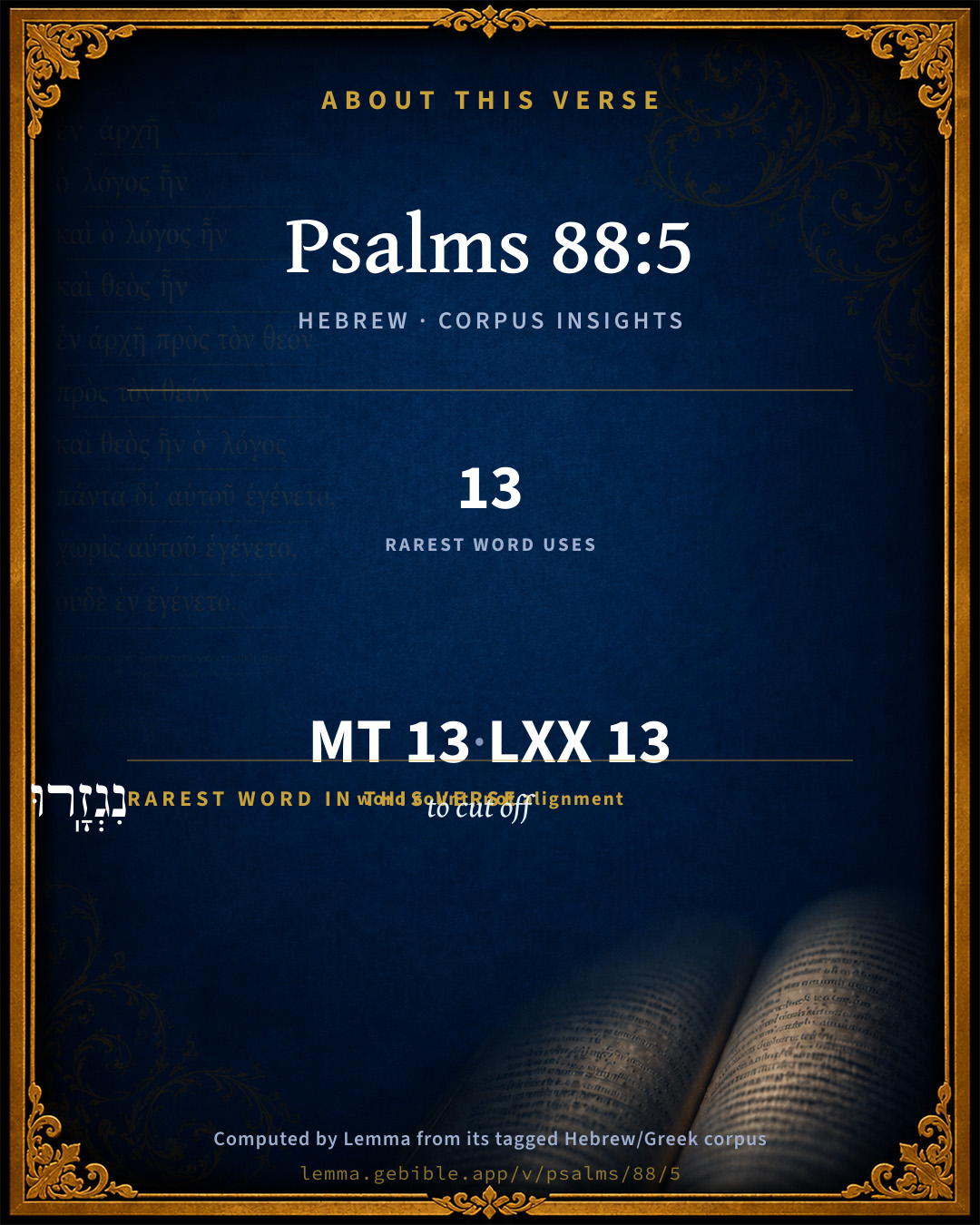
13
words
13
distinct lemmas
Wisdom
section

Notable vocabulary

The rarest word here is נִגְזָֽרוּ to cut off H1504 — appearing just 13 times in the whole Hebrew Bible.

Shared distinctive vocabulary

נִגְזָֽרוּ to cut off H1504 occurs in 13 verses of the Hebrew Bible. Also found in:

Grammatical profile

  • 4 verbs
  • 2 nouns
  • 2 adjectives
  • 1 pronoun
  • 1 preposition
  • 1 adverb
  • 2 particles

Verb forms

  • בַּמֵּתִ֗ים Qal · Participle Active
  • שֹׁ֥כְבֵי Qal · Participle Active
  • זְכַרְתָּ֣ם Qal · Perfect
  • נִגְזָֽרוּ Niphal · Perfect

Hebrew & Septuagint length

In English translation the verse runs 25 words from the Hebrew and 27 from the Septuagint (LXX English) — closely comparable.

A rough comparison of the two English renderings, which tokenize alike — not a word-level alignment.

Word counts can differ between the Hebrew and the Greek without any difference in meaning — e.g. the Hebrew direct-object marker אֵת has no separate Greek word, and Greek often adds the article ὁ.

In the original languages it is 13 Hebrew tokens and 13 Greek tokens — but the two are counted differently (Hebrew bundles its prefixes and suffixes into one token; the Greek is in lemma form), so that isn’t a like-for-like length.

Cross-references

12

Topical passages linked to Psalms 88:5 in the Treasury of Scripture Knowledge — connected by theme and wording, ordered by reader-vote popularity; previews shown in the World English Bible.

  • Isaiah 53:8 By oppression and judgment he was taken away; and as for his generation, who [among them] considered that he was cut off out of the land of the living for the disobedience of my people to whom the stroke [was due]?
  • Psalms 31:22 As for me, I said in my haste, "I am cut off from before your eyes." Nevertheless you heard the voice of my petitions when I cried to you.
  • Isaiah 14:9–12 Sheol from beneath is moved for you to meet you at your coming; it stirs up the dead for you, even all the chief ones of the earth; it has raised up from their thrones all the kings of the nations.
  • Genesis 8:1 God remembered Noah, all the animals, and all the cattle that were with him in the ark; and God made a wind to pass over the earth. The waters subsided.
  • Genesis 19:29 It happened, when God destroyed the cities of the plain, that God remembered Abraham, and sent Lot out of the midst of the overthrow, when he overthrew the cities in which Lot lived.
  • Job 6:9 Even that it would please God to crush me; That he would let loose his hand, and cut me off!
  • Job 11:10 If he passes by, or confines, Or convenes a court, then who can oppose him?
  • Psalms 31:12 I am forgotten from their hearts like a dead man. I am like broken pottery.
  • Psalms 88:16 Your fierce wrath has gone over me. Your terrors have cut me off.
  • Psalms 136:23 Who remembered us in our low estate; For his loving kindness endures forever;
  • Isaiah 38:10–12 I said, In the noontide of my days I shall go into the gates of Sheol: I am deprived of the residue of my years.
  • Ezekiel 32:18–32 Son of man, wail for the multitude of Egypt, and cast them down, even her, and the daughters of the famous nations, to the lower parts of the earth, with those who go down into the pit.

Cross-references courtesy of OpenBible.info (CC BY 4.0).

Hebrew and Greek witnesses Masoretic Hebrew ↔ Greek Septuagint

The same verse in the two great witnesses to the Old Testament, shown verse-for-verse.

You’re reading Greek Psalm 87 (Hebrew Psalm 88). The Septuagint counts the superscription, so verse numbers can differ from the Hebrew — chapter-level alignment, not verse-by-verse. Numbering follows Rahlfs.

These are two independent witnesses, not word-aligned to each other, and the Septuagint is shown in lemma (dictionary) form.

Hebrew Psalms 88:5 Masoretic · Westminster Leningrad Codex

בַּמֵּתִ֗ים חָ֫פְשִׁ֥י כְּמ֤וֹ חֲלָלִ֨ים שֹׁ֥כְבֵי קֶ֗בֶר אֲשֶׁ֤ר לֹ֣א זְכַרְתָּ֣ם ע֑וֹד וְ֝הֵ֗מָּה מִיָּדְךָ֥ נִגְזָֽרוּ

Set apart among the dead, Like the slain who lie in the grave, Whom you remember no more. They are cut off from your hand.

World English Bible · Public Domain

Greek LXX Greek Psalm 87:5 Septuagint · lemma form

προςλογίζομαι μετά ὁ καταβαίνω εἰς λάκκος γίγνομαι ὡς ἄνθρωπος ἀβοήθητος ἐν νεκρός ἐλεύθερος

free among the dead, as the slain ones cast out, who sleep in the tomb; whom you remember no more; and they are rejected from your hand.

LXX2012 (modern English Septuagint) · Public Domain

Hebrew: Westminster Leningrad Codex (CC BY 4.0). Greek: Septuagint (public domain); English from LXX2012 (modern English Septuagint) (Public Domain). How the Septuagint differs from the Hebrew →

Commentary

Notes on Psalms 88:5 from classic Christian and Jewish commentators (each source and its license shown beneath its notes). The classic Christian expositions comment on the surrounding passage and are grouped to its opening verse, so a note may address several verses; the Jewish commentaries on the Tanakh (Rashi and others) are per-verse, so they appear only where the commentator wrote on this verse.

Lemma curates 59 commentaries, every one of them public domain or Creative Commons licensed, each selected and text-cleaned for this edition rather than reprinted as found. About our sources →

Trapp's Complete Commentary

John Trapp

Psa 88:5 Free among the dead, like the slain that lie in the grave, whom thou rememberest no more: and they are cut off from thy hand.

Ver. 5. Free among the dead] Free of that company, one of the many among the manes, or ghosts; a free denizen of that society of that moiety of mankind that are dead. Yea, I am mortuorum minimus, as R. Jonah rendereth it, according to the Arabic, A mundo manumissus.

Like the slain that lie in the grave] That are thrown on heaps into a pit, as after a field fought (R. David).

Whom thou rememberest no more] As to this present world, and as it may seem to others, with whom out of sight out of mind; dead folk are soon forgotten. Varro thinks Lethum, death, hath its name απο την ληθης, from forgetfulness; because they which have now forgotten all the world should soon be forgotten of the world.

And they are cut off from thine hand] Thy providence over them in matters belonging to life is at an end.

John Trapp, A Commentary or Exposition upon All the Books of the Old and New Testament (1647–1656) — public domain. Text from a community e-Sword module.

The Biblical Illustrator

Joseph S. Exell

Psa_88:5

Free among the dead, like the slain that lie in the grave.

A true and a false idea of the grave

I. A true idea of the grave: Free--

1. From all physical sufferings.

2. From all secular anxieties.

3. From all social tumults.

4. From all human tyrannies.

II. A false idea of the grave. That the dead are--

1. Forgotten by God.

2. Separated from God. They are not cut off from Him in any sense. (Homilist.)

Free among the dead

This remarkable expression is to he interpreted in the light of Job_3:19, which counts it as one blessing of the grave, that there the servant is free from his master. But the psalmist thinks that that freedom is loathsome, not desirable, for it means removal from the stir of a life, the heaviest duties and cares of which are better than the torpid immunity from these, which makes the state of the dead a dreary monotony. In some strange fashion they are and yet are not. Their death has a simulacrum of life. Their shadowy life is death. The psalmist speaks in riddles; and the contradictions in his speech reflect his dim knowledge of that place of darkness, He looks into its gloomy depths, and he sees little but gloom. It needed the resurrection of Jesus to flood these depths with light, and to show that the life beyond may be fuller of bright activity than life here--a state in which vital strength is increased beyond all earthly experience, and wherein Gods all-quickening hand grasps more closely, and communicates richer gifts than are attainable in that death which sense calls life. (A. Maclaren, D. D.)

The Biblical Illustrator, edited by Joseph S. Exell (c. 1880s–1900s) — public domain. Text from a community e-Sword module.

Joseph Benson's Commentary

Psa 88:5. Free among the dead — Well nigh discharged from the warfare of the present life, and entered, as a member, into the society of the dead; or, removed from all the affairs and conversation of men as if I were really dead. Like the slain, whom thou rememberest no more — Whom thou seemest wholly to neglect and to bury in oblivion. He speaks of these matters, not as they are in truth, for he knew very well that forgetfulness was not incident to God, and that God did remember all the dead, and would call them to an account; but only as to appearance, and the opinion of the world, and the things of this life. And they are cut off from thy hand — From the care and conduct of thy providence, which is to be understood as the former clause.

Joseph Benson's Commentary on the Old and New Testaments (1811–1818) — public domain. Text from a community e-Sword module.

J. A. Alexander on Psalms

Joseph Addison Alexander

6. (Psa 88:5) With (or among) the dead, free, like the slain, lying in the grave, whom thou rememberest no more, and they by (or from) thy hand are cut off. As to be God's servant is the highest privilege and honour (Psa 86:16), so to be free from his service (Job 3:19) is to be miserable. The reference is not to death in general, but to death by violence and as a punishment. The slain, literally the (mortally) wounded. See above on Psa 69:26. The latter half of the verse contains a strong poetical description of the wicked, as no longer the objects of God's protecting care. Of the two translations, from and by thy hand, the first conveys the same idea with the foregoing words, while the second represents the destruction of God's enemies as the work of his own hands.

Joseph Addison Alexander, The Psalms Translated and Explained (1850) — public domain. Text from a community e-Sword module.

Geneva Bible (1599)

Geneva Bible translators

That is, from thy providence and care, which is meant according to the judgment of the flesh.

For he that is dead, is free from all cares and business of this life: and thus he saith, because he was unprofitable for all matters concerning man’s life, and as it were cut off from this world.

Geneva Bible (1599) marginal notes — public domain. Text via Bolls.life.

Adam Clarke's Commentary

Verse 5. Free among the dead] במתים צפשי bammethim chophshi, I rather think, means stripped among the dead. Both the fourth and fifth verses seem to allude to a field of battle: the slain and the wounded, are found scattered over the plain; the spoilers come among them, and strip, not only the dead, but those also who appear to be mortally wounded, and cannot recover, and are so feeble as not to be able to resist. Hence the psalmist says, "I am counted with them that go down into the pit; I am as a man that hath no strength," Ps 88:4. And I am stripped among the dead, like the mortally wounded (חללים chalalim) that lie in the grave. "Free among the dead," inter mortuos liber, has been applied by the fathers to our Lord's voluntary death: all others were obliged to die, he alone gave up his life, and could take it again, Joh 10:18. He went into the grave, and came out when he chose. The dead are bound in the grave; he was free, and not obliged to continue in that state as they were.

They are cut off from thy hand.] An allusion to the roll in which the general has the names of all that compose his army under their respective officers. And when one is killed, he is erased from this register, and remembered no more, as belonging to the army; but his name is entered among those who are dead, in a separate book. This latter is termed the black book, or the book of death; the other is called the book of life, or the book where the living are enrolled. From this circumstance, expressed in different parts of the sacred writings, the doctrine of unconditional reprobation and election has been derived. How wonderful!

Adam Clarke's Commentary on the Bible (1810–1826) — public domain. Text from a community e-Sword/MySword module.

John Calvin's Commentaries

5 Free among the dead, lie the slain who lie in the grave. The prophet intended to express something more distressing and grievous than common death. First, he says, that he was free among the dead, because he was rendered unfit for all the business which engages human life, and, as it were, cut off from the world. The refined interpretation of Augustine, that Christ is here described, and that he is said to be free among the dead, because he obtained the victory over death by a special privilege, that it might not have dominion over him, has no connection with the meaning of the passage. The prophet is rather to be understood as affirming, that having finished the course of this present life, his mind had become disengaged from all worldly solicitude; his afflictions having deprived him of all feeling. In the next place, comparing himself with those who have been wounded, he bewails his condition as worse than if, enfeebled by calamities, he were going down to death by little and little; for we are naturally inspired with horror at the prospect of a violent death.

What he adds, that he is forgotten of God, and cut off from his hand or guardianship, is apparently harsh and improper, since it is certain that the dead are no less under the Divine protection than the living. Even wicked Balaam, whose purpose it was to turn light into darkness, was, nevertheless, constrained to cry out,

“Let me die the death of the righteous, and let my last end be like his,” (Numbers 23:10.)

To say, then, that God is no longer mindful of man after he is dead, might seem to be the language of a heathen. To this it may be answered, That the prophet speaks according to the opinion of the generality of men; just as the Scriptures, in like manner, when treating of the providence of God, accommodate their style to the state of the world as presented to the eye, because our thoughts ascend only by slow degrees to the future and invisible world. I, however, think, that he rather gave utterance to those confused conceptions which arise in the mind of a man under affliction, than that he had an eye to the opinion of the ignorant and uninstructed part of mankind. Nor is it wonderful that a man endued with the Spirit of God was, as it were, so stunned and stupified when sorrow overmastered him, as to allow unadvised words to escape from his lips. Although faith in the truth that God extends his care both to the living and the dead is deeply rooted in the hearts of all his genuine servants, yet sorrow often so overclouds their minds as to exclude from them for the time all remembrance of his providence. From perusing the complaints of Job, we may perceive, that when the minds of the godly are preoccupied with sorrow, they do not immediately pierce to the consideration of the secret providence of God, which yet has been before the subject of their careful meditation, and the truth of which they bear engraven on their hearts. Although the prophet, then, was persuaded that the dead also are under the Divine protection, yet, in the first paroxysm of his grief, he spoke less advisedly than he ought to have done; for the light of faith was, as it were, extinguished in him, although, as we shall see, it soon after shone forth. This it will be highly useful particularly to observe, that, should we be at any time weakened by temptation, we may, nevertheless, be kept from falling into despondency or despair.

John Calvin's Commentaries (1540-1563) — public domain. Text from the Calvin Translation Society English edition (1840s-50s) via the Christian Classics Ethereal Library (ccel.org). Calvin's coverage is partial (roughly two-thirds of the Bible); uncommented books and verses are honest gaps, never fabricated. The 19th-century editor's footnotes and remarks are omitted so the notes are faithfully Calvin's own voice.

Ellicott's Commentary for English Readers

(5) Free among the dead . . .—So the old versions without exception, taking chaphshî as an adjective, as in Job_3:19 (where used of an emancipated slave); 1Sa_17:25 (free from public burdens). So of the separate house for lepers, who were cut off from society (2Ki_15:5). Hence some refer the psalm to Uzziah. The Targum explains, “freed from legal duties.” But plainly the meaning is here exactly that of defunctus. The verse offers an instance of introverted parallelism, and this clause answers to “they are cut off from thy hand.” Gesenius, however, makes the Hebrew word a noun (comp. Eze_27:20), and renders, among the dead is my couch.

Whom thou.—The dead are “clean forgotten, out of mind” even to God.

From thy hand—i.e., from the guiding, helping hand which, though stretched out for living men, does not reach to the grave.

A Bible Commentary for English Readers, edited by Charles John Ellicott (1878–1897) — public domain. Text from a community e-Sword module.

The Cambridge Bible for Schools and Colleges

gen. ed. J. J. S. Perowne

5. Free among the dead] There can hardly be any allusion to Job_3:19, where the word is used of a welcome release from servitude, for it is a far-fetched interpretation to suppose that a new turn is given to the phrase and that it here means ‘dismissed against his will from the service of God.’ Render as R.V., cast off, or R.V. marg., cast away. A cognate word is used for ‘the house of separation’ in which Uzziah lived as a leper (2Ch_26:21).

Another but doubtful translation is, My couch is among the dead: cp. Job_17:13.

the slain &c.] The slain in battle, whose corpses are flung into a nameless common grave. Cp. Eze_32:24 ff.

whom thou rememberest no more] Sheol is the ‘land of oblivion,’ where men neither remember God (Psa_6:5; Psa_30:9) nor are remembered by Him. They are cut off from thy hand, severed from Thy gracious help and protection. Cp. Psa_31:22; Lam_3:54; 2Ch_26:21. On this gloomy view of the future state see Introd. pp. xciii ff.

The Cambridge Bible for Schools and Colleges (gen. ed. J. J. S. Perowne; Cambridge University Press, 1878–1918) — public domain. Text from a community e-Sword module.

John Gill's Exposition

Free among the dead,.... If he was a freeman, it was only among the dead, not among the living; if he was free of any city, it was of the city of the dead; he looked upon himself as a dead man, as one belonging to the state of the dead, who are free from all relations, and from all business and labour, and removed from all company and society; he thought himself quite neglected, of whom there was no more care and notice taken than of a dead man:

like the slain that lie in the grave, whom thou rememberest no more; in a providential way, as in life, to clothe them, and feed them, and protect and preserve them; in which sense God is said to be mindful of men, Psa 8:4, who when dead have no need to be minded, and remembered in such a manner; otherwise God does remember the dead, and takes care of their dust, and will raise them again; and especially he remembers his own people, those that sleep in Jesus, who will be thought of in the resurrection morn, and will be raised first, and brought with Christ; see Job 14:13,

and they are cut off from thy hand; that is, the slain that lie in the grave, the dead that are buried there; these are cut off from the hand of Providence, they needing no supplies from thence as in the time of life. The Targum is,

"and they are separated from the face of thy majesty.''

or "they are cut off by thine hand" (i); by the immediate hand of God, in a judicial way; so Christ in his death was like one of these, he was cut off in a judicial way, not for his own sins, but for the transgressions of his people, Isa 53:8.

(i) "manu tua", Junius & Tremellius, Piscator, Amama.

John Gill's Exposition of the Whole Bible (1746–1763) — public domain (CC PDM 1.0). Text via the HelloAO Bible API.

Albert Barnes' Notes on the Bible

Free among the dead - Luther renders this, “I lie forgotten among the dead.” DeWette renders it, “Pertaining to the dead - (den Todten angehorend) - stricken down, like the slain, I lie in the grave,” and explains it as meaning, “I am as good as dead.” The word rendered “free” - חפשׁי chophshı̂y - means properly, according to Gesenius (Lexicon),

(1) prostrate, weak, feeble;

(2) free, as opposed to a slave or a captive;

(3) free from public taxes or burdens.

The word is translated “free” in Exo 21:2, Exo 21:5,Exo 21:26-27; Deu 15:12-13, Deu 15:18; 1Sa 17:25; Job 3:19; Job 39:5; Isa 58:6; Jer 34:9-11, Jer 34:14; and at liberty in Jer 34:16. It occurs nowhere else except in this verse. In all these places (except in 1Sa 17:25, where it refers to a house or family made free, and Job 39:5, where it refers to the freedom of the wild ass), it denotes the freedom of one who had been a servant or slave. In Job 3:19, it has reference to the grave, and to the fact that the grave delivers a slave or servant from obligation to his master: “And the servant is free from his master.” This is the idea, I apprehend, here. It is not, as DeWette supposes, that he was weak and feeble, as the spirits of the departed are represented to be (compare the notes at Isa 14:9-11), but that the dead are made free from the burdens, the toils, the calamities, the servitudes of life; that they are like those who are emancipated from bondage (compare Job 7:1-2; Job 14:6); that death comes to discharge them, or to set them at liberty. So the psalmist applies the expression here to himself, as if he had already reached that point; as if it were so certain that he must die that he could speak of it as if it had occurred; as if he were actually in the condition of the dead. The idea is that he was to all appearance near the grave, and that there was no hope of his recovery. It is not here, however, the idea of release or emancipation which was mainly before his mind, or any idea of consolation as from that, but it is the idea of death - of hopeless disease that must end in death. This he expresses in the usual language; but it is evident that he did not admit any comfort into his mind from the idea of freedom in the grave.

Like the slain that lie in the grave - When slain in battle. They are free from the perils and the toils of life; they are emancipated from its cares and dangers. Death is freedom; and it is possible to derive solace from that idea of death, as Job did Job 3:19; but the psalmist here, as remarked above, did not so admit that idea into his mind as to be comforted by it.

Whom thou rememberest no more - As if they were forgotten by thee; as if they were no longer the object of thy care. They are suffered to lie and waste away, with no care on thy part to restore them to life, or to preserve them from offensiveness and decay. So the great, the beautiful, and the good lie neglected in the grave.

And they are cut off from thy hand - Margin, “by.” The Hebrew is literally “from thy hand,” but still the idea is that it was by the agency of God. They had been cut down, and were forgotten - as if God regarded them no more. So we shall all moulder in the grave - in that deep, dark, cold, silent, repulsive abode, as if even God had forgotten us.

Albert Barnes' Notes on the Bible (1834–1885) — public domain. Text from a community e-Sword/MySword module.

Matthew Poole's English Annotations

Free among the dead; well nigh discharged from the warfare of the present life, and entered es a member into the society of the dead; as Israelitish servants, when they were made flee, were thereby made denizens of the commonwealth of Israel. I expect no other freedom from my miseries but that which death gives, as Job 3:17,18.

Whom thou rememberest no more; whom thou seemest wholly to neglect and to bury in oblivion; for he speaks of these matters not as they are in truth, for he knew very well that forgetfulness was not incident to God, and that God did remember all the dead, and would call them to an account, but only as to sense and appearance, and the opinion of the world, and the state and things of this life.

From thy hand; from the care and conduct of thy providence, which is to be understood as the former clause. Or, by thy hand. But our translation seems better to agree both with the foregoing branch, which it explains and improves, and with the order of the words; for it seems improper, after he had represented the persons as dead, and in their graves, to add that they

are cut off, to wit, by death.

Matthew Poole's English Annotations on the Holy Bible (1683–1685) — public domain. Text from a community e-Sword/MySword module.

The Treasury of David

Charles H. Spurgeon

Ver. 5. Free among the dead. Unbound from all that links a man with life, familiar with death's door, a freeman of the city of the sepulchre, I seem no more one of earth's drudges, but begin to anticipate the rest of the tomb. It is a sad case when our only hope lies in the direction of death, our only liberty of spirit amid the congenial horrors of corruption.

Like the slain that lie in the grave, whom you remember no more. He felt as if he were as utterly forgotten as those whose carcasses are left to rot on the battle field. As when a soldier, mortally wounded, bleeds unheeded amid the heaps of slain, and remains to his last expiring groan unpitied and unsuccoured, so did Heman sigh out his soul in loneliest sorrow, feeling as if even God himself had quite forgotten him. How low the spirits of good and brave men will sometimes sink. Under the influence of certain disorders everything will wear a sombre aspect, and the heart will dive into the profoundest deeps of misery. It is all very well for those who are in robust health and full of spirits to blame those whose lives are sicklied over with the pale cast of melancholy, but the evil is as real as a gaping wound, and all the more hard to bear because it lies so much in the region of the soul that to the inexperienced it appears to be a mere matter of fancy and diseased imagination. Reader, never ridicule the nervous and hypochondriacal, their pain is real; though much of the evil lies in the imagination, it is not imaginary.

And they are cut off from thy hand. Poor Heman felt as if God himself had put him away, smitten him and laid him among the corpses of those executed by divine justice. He mourned that the hand of the Lord had gone out against him, and that lie was divided from the great author of his life. This is the essence of wormwood. Man's blows are trifles, but God's smitings are terrible to a gracious heart. To feel utterly forsaken of the Lord and cast away as though hopelessly corrupt is the very climax of heart desolation.

Ver. 5. Free among the dead. In the former verse he had said that he had approached very near to death, now he is plainly dead: there he was about to be buried, here he is laid in the sepulchre: thus had his sufferings increased. Free is to be understood of the affairs of this life, as when it is said, Job 3:19, "And the servant is free from his master." Martin Bucer, 1491-1551.

Ver. 5. Free among the dead. yvpx Mytmg bammethim chophshi, I rather think, means stripped among the dead. Both the fourth and fifth verses seem to allude to a field of battle: the slain and the wounded are found scattered over the plain; the spoilers come among them, and strip, not only the dead, but those also who appear to be mortally wounded and cannot recover, and are so feeble as not to be able to resist. Hence the Psalmist says, "I am as a man that hath no strength", Ps 88:4. Adam Clarke.

Ver. 5. Free. There is no immunity so long as we are in the flesh, there is no truce, but constant unrest distracts us. Liberty, therefore, is given to us after death, because we rest from our labourers. Franciscus Vatablus.

Ver. 5. Cut off from the hand. Beware how you ever look upon yourself as cut off from life and from enjoyment; you are not cut off, only taken apart, laid aside, it may be but for a season, or it may be for life; but still you are part of the body of which Christ is the Head. Some must suffer and some must serve, but each one is necessary to the other, "the whole body is fitly framed together by that which every joint supplieth", "the eye cannot say to the hand, I have no need of thee: nor again the head to the feet, I have no need of you:" Eph 4:16 1Co 12:21. Your feet may be set fast; they may have run with great activity, and you sorrow now, because they can run no more. But do not sorrow thus, do not envy those who are running; you have a work to do; it may be the work of the head, or of the eye, it surely is whatever work God gives to you. It may be the work of lying still, of not stirring hand or foot, of scarcely speaking, scarcely showing life. Fear not: if He your heavenly Master has given it to you to do, it is His work, and He will bless it. Do not repine. Do not say, This is work, and, this is not; how do you know? What work, think you, was Daniel doing in the lion's den? Or Shadrach, Meshach, and Abednego in the fiery furnace? Their work was glorious, "laudable, and honourable", they were glorifying God in suffering. From "Sickness, its Trials and Blessings." (Anon.) 1868.

Psalms 88:6*

Charles H. Spurgeon's The Treasury of David (1869–1885) — public domain. Psalms only. Text from a community e-Sword/MySword module.

Whedon's Commentary on the Bible

Daniel D. Whedon

5. Free among the dead—If הפשׁי, (haphshee,) is to be translated free, as in the common version, which is its prevailing sense; it must here denote freedom “from the cares and oppression of life,” and so Dr. Robinson.

Thus it is used, Job_3:19, “There [in death] the servant is free from the master.” This sense also would suit to the political condition of the author. Death would free him from the Chaldean yoke. But this is not in harmony with the connexion or scope. Better to translate prostrate among the dead. Furst: “My couch is among the dead.” Gesenius: “Among the dead I am laid prostrate.” The next clause explains it.

Like the slain that lie in the grave—Like those killed in battle who lie down in the grave. The expression is very strong. It is not merely to die, nor to be buried, but to be in sheol among the spirits of the departed. So the same verb, to lie, signifies, (Gen_47:30,) “I will lie with my fathers.”

Whom thou rememberest no more—That is, with a view to treat them as living men upon the earth. The word remember is never used in the metaphysical sense of simply recalling past impressions or ideas, but always in the ethical sense—that is, with the adsignification of the object or purpose of remembering.

From thy hand—By thy hand. So Exo_2:23 :

“Sighed by reason of the bondage.” Hebrew, Sighed from, that is, from the effects of, their bondage. In the text the reference is to those who are dead from—from the effects of—God’s hand by reason of his judgments.

Daniel D. Whedon (gen. ed.), Commentary on the Old and New Testaments (1874–1909) — public domain. Text from a community e-Sword module.

The Pulpit Commentary

Free among the dead; or, "east out among the dead." Placed with corpses, as one that needs burial. Like the slain that lie in the grave. Like those who are thrown into a pit dug on a battlefield, among whom there are often some who have not breathed their last (see the Prayerbook Version). Whom thou rememberest no more. We have already beard the complaint that in death there is no remembrance of God on the part of man; (Psa_6:5) now we have the converse statement, that neither is there then any remembrance of man on the part of God. The psalmist speaks, not absolute truth, but the belief of his day a belief which vanished when life and immortality were brought to light by the gospel. And they are out off from thy hand; i.e. severed from thee, shut up in a place where thou dwell eat not. (see Job_10:21, Job_10:22)

The Pulpit Commentary (1880–1919), ed. H.D.M. Spence-Jones & Joseph S. Exell — public domain. Text from a community e-Sword module.

John Wesley's Explanatory Notes

Free - Well nigh discharged from the warfare of the present life, and entered as a member into the society of the dead. Whom - Thou seemest to neglect and bury in oblivion.

John Wesley, Explanatory Notes Upon the Whole Bible (1754–1765) — public domain. Text via the GEBible commentary corpus.

unfoldingWord translationNotes

Door43 World Missions Community

I am abandoned among the dead

People treating the writer as if he were already dead is spoken of as if he were a corpse that they left unburied. AT: I am left alone as if I were dead" (See: Metaphor)

I am like the dead who lie in the grave

The writer feeling like people and God have abandoned him speaks about himself as if he were already a dead person lying in a grave. (See: Simile)

the dead who lie

The nominal adjective "the dead" can be stated as an adjective. AT: "a dead person who lies" or "dead people who lie" (See: Nominal Adjectives)

about whom you care no more

"who no longer receive your care" or "people you have stopped caring about"

they are cut off from your power

God no longer using his power to help dead people is spoken of as if God literally cut him off or removed him from his power. AT: "you no longer use your power to help them" (See: Metaphor)

You place me in the lowest part of the pit, in the dark and deep places

The writer feeling like God has abandoned him speaks about himself as if God has put the him in the deepest and darkest grave. (See: Metaphor)

translationWords

die

grave

cut off

power

pit

unfoldingWord translationNotes — © Distant Shores Media and the Door43 World Missions Community, licensed CC BY-SA 4.0. Source: git.door43.org/Door43/en_tn.

Rashi

Rabbi Shlomo Yitzchaki (Rashi)

without strength Heb. איל, as (above 22:20): “My strength (אילותי), hasten to my assistance.”

Rashi on the Tanakh — English translations: “The Judaica Press complete Tanach with Rashi, translated by A. J. Rosenberg” (CC BY 4.0); “Pentateuch with Rashi's commentary by M. Rosenbaum and A.M. Silbermann, 1929-1934” (public domain); “The Metsudah Tanach series, Lakewood, N.J” (CC BY 4.0); and “The Book of Joshua, Metsudah Publications, 1997” (CC BY 4.0). Text via Sefaria.

Lesson kit

Teaching starters — assembled from the data on this page, not authored interpretation. Every prompt links to the verse data it draws on. Edit before teaching.

Psalms, in the Wisdom, opens this verse with 13 words (13 distinct Hebrew lemmas). Its most distinctive word is gâzar (“to cut off”). A historical commentator’s framing appears above. Read the whole chapter for the surrounding context.

Discussion questions

  1. What does “to cut off” (gâzar) contribute to the verse as a whole?
  2. How does 1 Kings 3:25, which shares the word «to cut off», read alongside this verse?
  3. These translations render this verse differently. What is at stake in choosing one wording over another?
  4. «בַּמֵּתִ֗ים» is a Qal Participle Active verb. How does that grammatical form shape the action described?
  5. Compare how Trapp's Complete Commentary and The Biblical Illustrator read this verse. Where do they agree or differ?

Things to notice

Reading settings

Reading text

Shown beneath each verse's original-language words.

Old Testament
Old Testament edition

Read the OT as the Masoretic Hebrew (MT) or the Greek Septuagint (LXX).

English shown for the Greek Septuagint (in the Hebrew ↔ Greek comparison).

Comparing translations? Open the Compare panel on any verse page to stack up to four side by side.