2 Kings 8:24

Hebrew (Westminster Leningrad Codex) 2 Kings 8:24 appears in the Hebrew Old Testament. The text above is from the Westminster Leningrad Codex. Each word links to its Strong’s number, a concise gloss, and parsing drawn from the Open Scriptures Hebrew Bible morphology. Click any word for its full Brown-Driver-Briggs (BDB) entry.
Download image
Cite this verse

2 Kings 8:24 (World English Bible). Public Domain. Lemma interlinear Bible study tool, https://lemma.gebible.app/v/2-kings/8/24.

Show BibTeX & RIS
BibTeX
RIS
English Translation
Joram slept with his fathers, and was buried with his fathers in the city of David; and Ahaziah his son reigned in his place.
World English Bible · Public Domain
Download a study sheet

One document with this verse’s original text, its word-by-word gloss line, the meaning frame, cross-references with their text, attributed commentary, and full source and license credits — printable, and it pastes into notes with its structure intact.

This verse Autodidact and up

Study sheet (.html) Plain text (.txt)

A passage Seminary Student

Up to 50 verses in one chapter. A passage sheet keeps up to 6 commentary sources and 12 cross-references per verse, in the order this page ranks them, and says so on the sheet whenever that leaves anything out. Ask for a single verse and you get the Autodidact verse sheet above.

Everything on this page stays free to read, with no account — the sheet is a download of what is already on screen, not access to it.

Want to remove ads? Support Godless Engineer
Compare translations 3

The same verse in 3 English versions, stacked beneath the original-language interlinear above. Click any original word for its lexicon entry.

Each is an independent rendering of the whole verse — the interlinear is not word-aligned to these translations.

Highlighted words mark where these versions differ — a whole-verse word diff, not a word-by-word alignment.

  • World English Bible Public Domain
    Joram slept with his fathers, and was buried with his fathers in the city of David; and Ahaziah his son reigned in his place.
  • King James Version Public Domain
    And Joram slept with his fathers, and was buried with his fathers in the city of David: and Ahaziah his son reigned in his stead.
  • unfoldingWord Literal Text CC BY-SA 4.0
    And Joram lay down with his fathers, and he was buried with his fathers in the City of David. And Ahaziah his son reigned in his place.

unfoldingWord Literal Text — © unfoldingWord, licensed CC BY-SA 4.0. Word-aligned USFM3 via Door43 (git.door43.org/unfoldingWord/en_ult).

Versions to compare (up to 4)

3 of 4 selected

Show all 18 translations

Every available English version of this verse, each an independent rendering of the whole verse.

  • World English Bible Public Domain
    Joram slept with his fathers, and was buried with his fathers in the city of David; and Ahaziah his son reigned in his place.
  • Berean Standard Bible Public Domain
    And Jehoram rested with his fathers and was buried with them in the City of David. And his son Ahaziah reigned in his place.
  • Majority Standard Bible Public Domain
    And Jehoram rested with his fathers and was buried with them in the City of David. And his son Ahaziah reigned in his place.
  • King James Version Public Domain
    And Joram slept with his fathers, and was buried with his fathers in the city of David: and Ahaziah his son reigned in his stead.
  • American Standard Version (1901) Public Domain
    And Joram slept with his fathers, and was buried with his fathers in the city of David; and Ahaziah his son reigned in his stead.
  • Revised Version (1885) Public Domain
    And Joram slept with his fathers, and was buried with his fathers in the city of David: and Ahaziah his son reigned in his stead.
  • Geneva Bible (1599) Public Domain
    And Ioram slept with his fathers, and was buried with his fathers in the citie of Dauid. And Ahaziah his sonne reigned in his stead.
  • Douay-Rheims (1899) Public Domain
    And Joram slept with his fathers, and was buried with them in the city of David, and Ochozias his son reigned in Iris stead.
  • Young's Literal Translation Public Domain
    And Joram lieth with his fathers, and is buried with his fathers in the city of David, and reign doth Ahaziah his son in his stead.
  • Literal Standard Version CC BY-SA 4.0
    And Joram lies with his fathers, and is buried with his fathers in the City of David, and his son Ahaziah reigns in his stead.
  • Unlocked Literal Bible CC BY-SA 4.0
    Jehoram rested with his fathers and was buried with them in the city of David. Then Ahaziah his son became king in his place.
  • unfoldingWord Literal Text CC BY-SA 4.0
    And Joram lay down with his fathers, and he was buried with his fathers in the City of David. And Ahaziah his son reigned in his place.
  • Darby Bible Public Domain
    And Joram slept with his fathers, and was buried with his fathers in the city of David; and Ahaziah his son reigned in his stead.
  • World Messianic Bible Public Domain
    Joram slept with his fathers, and was buried with his fathers in David’s city; and Ahaziah his son reigned in his place.
  • Webster's Bible Public Domain
    And Joram slept with his fathers, and was buried with his fathers, in the city of David; and Ahaziah his son reigned in his stead.
  • Free Bible Version CC BY-SA 4.0
    Jehoram died and was buried with his forefathers in the City of David. His son Ahaziah succeeded him as king.
  • Bible in Basic English Public Domain
    And Joram went to rest with his fathers and was put into the earth with his fathers in the town of David: and Ahaziah his son became king in his place.
  • JPS Tanakh (1917) Public Domain
    And Joram slept with his fathers, and was buried with his fathers in the city of David; and Ahaziah his son reigned in his stead.

Literal Standard Version (2020), Covenant Press — licensed CC BY-SA 4.0. Text via the HelloAO Bible API (eBible.org). Unlocked Literal Bible (unfoldingWord) — licensed CC BY-SA 4.0. Text via the HelloAO Bible API (eBible.org). unfoldingWord Literal Text — © unfoldingWord, licensed CC BY-SA 4.0. Word-aligned USFM3 via Door43 (git.door43.org/unfoldingWord/en_ult). Free Bible Version, Dr. Jonathan Gallagher — licensed CC BY-SA 4.0. Text via the HelloAO Bible API (eBible.org).

Word by word

More ways to search: Search by grammar → Find every occurrence → Compare this word →

Practice this passage: Drill this verse → Learn its vocabulary →

יוֹרָם֙
Yôwrâm
H3141
“Joram”
Noun, Proper
Part of Speech
Noun
Type
Proper
Full BDB Definition

Origin: a form of H3088

TWOT: None

Joram = "Jehovah is exalted" - son of king Jehoshaphat of Judah and himself king of Judah for 8 years; his wife was the wicked Athaliah who was probably the instigator for his returning the nation of Judah to the worship of Baal - son of king Ahab of the northern kingdom of Israel and king of Israel himself for 12 years; he was murdered by Jehu on the plot of land for which his father had murdered Naboth thus fulfilling the prophecy of Elijah to the very letter - a Levite in the time of David and an ancestor of Shelomith - son of Toi, king of Hamath
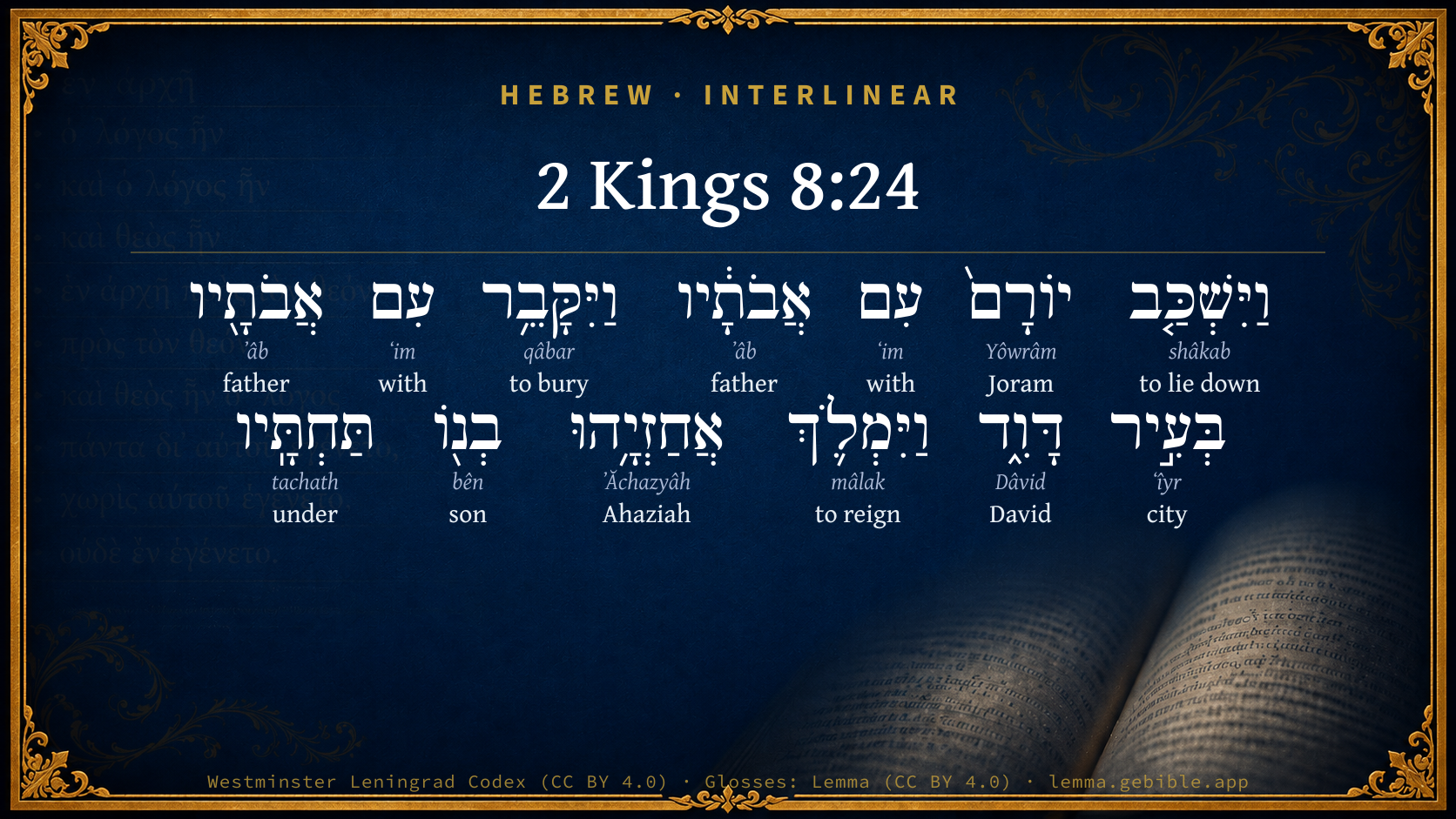
  1. וַיִּשְׁכַּ֤ב shâkab H7901 “and · to lie down” Conjunction + Verb, Qal, Sequential Imperfect, 3rd Person, Masculine, Singular
  2. עִם ʻim H5973 “with” Preposition
  3. אֲבֹתָ֔יו ʼâb H1 “fathers · his” Noun, Common, Masculine, Plural, Construct + Suffix, Personal, 3rd Person, Masculine, Singular
  4. וַיִּקָּבֵ֥ר qâbar H6912 “and · to bury” Conjunction + Verb, Niphal, Sequential Imperfect, 3rd Person, Masculine, Singular
  5. עִם ʻim H5973 “with” Preposition
  6. אֲבֹתָ֖יו ʼâb H1 “fathers · his” Noun, Common, Masculine, Plural, Construct + Suffix, Personal, 3rd Person, Masculine, Singular
  7. בְּעִ֣יר ʻîyr H5892 “in/at · city of” Preposition + Noun, Common, Feminine, Singular, Construct
  8. דָּוִ֑ד Dâvid H1732 “David” Noun, Proper
  9. וַיִּמְלֹ֛ךְ mâlak H4427 “and · to reign” Conjunction + Verb, Qal, Sequential Imperfect, 3rd Person, Masculine, Singular
  10. אֲחַזְיָ֥הוּ ʼĂchazyâh H274 “Ahaziah” Noun, Proper
  11. בְנ֖וֹ bên H1121 “son · his” Noun, Common, Masculine, Singular, Construct + Suffix, Personal, 3rd Person, Masculine, Singular
  12. תַּחְתָּֽיו tachath H8478 “under · him” Preposition + Suffix, Personal, 3rd Person, Masculine, Singular

About this verse

These counts appear in no published source. They are computed here, from the morphology-tagged text and Lemma’s own curated glosses. What Lemma adds →

13
words
11
distinct lemmas
Historical
section

Notable vocabulary

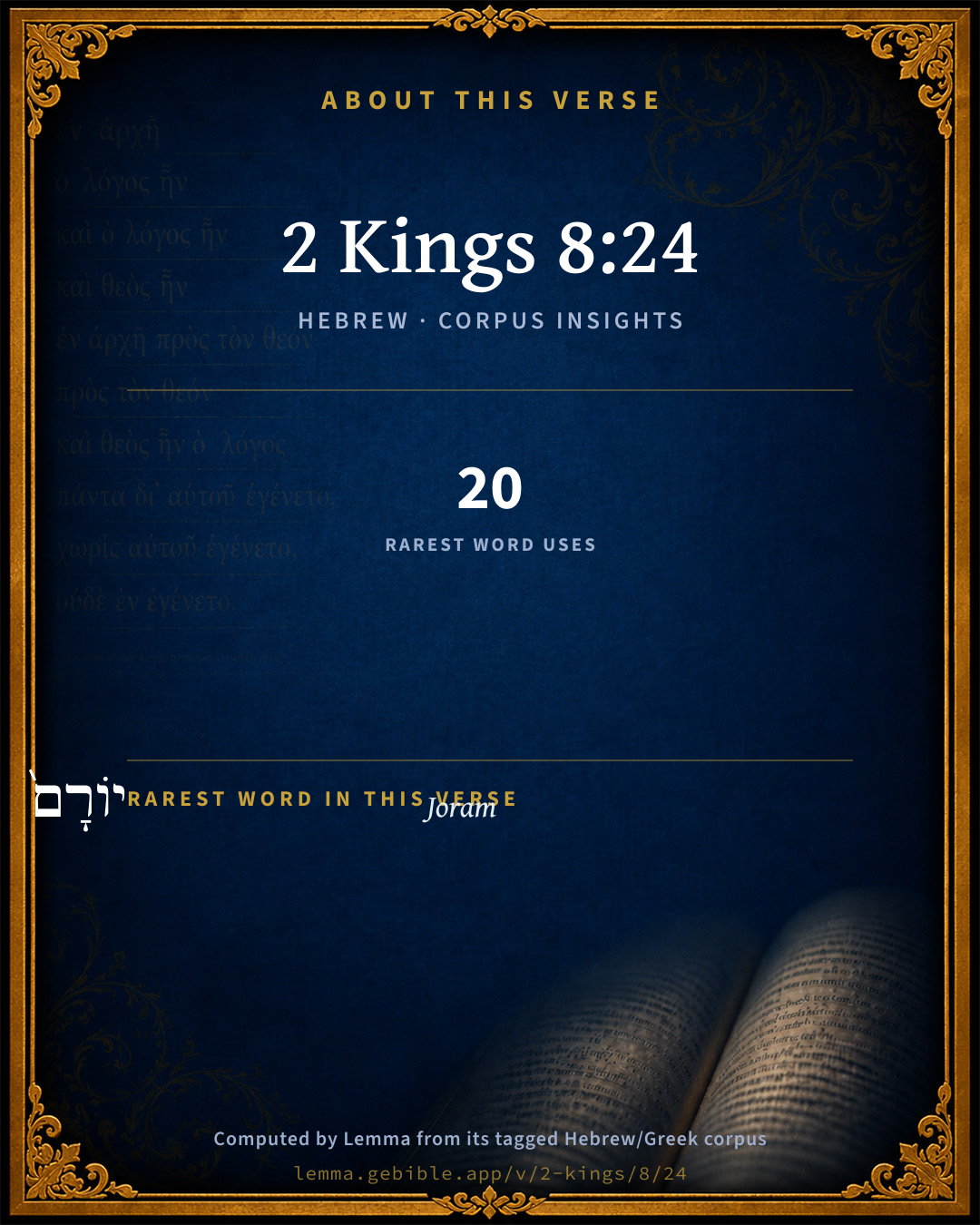
The rarest word here is יוֹרָם֙ Joram H3141 — appearing just 20 times in the whole Hebrew Bible.

Shared distinctive vocabulary

יוֹרָם֙ Joram H3141 occurs in 16 verses of the Hebrew Bible. Also found in:

Grammatical profile

  • 3 verbs
  • 7 nouns
  • 3 prepositions

Verb forms

  • וַיִּשְׁכַּ֤ב Qal · Sequential Imperfect
  • וַיִּקָּבֵ֥ר Niphal · Sequential Imperfect
  • וַיִּמְלֹ֛ךְ Qal · Sequential Imperfect

Repetition

Words recur within this verse — often emphatic in Hebrew:

  • אֲבֹתָ֔יו father H1 ×2
  • עִם with H5973 ×2

Hebrew & Septuagint length

In English translation the verse runs 24 words from the Hebrew and 27 from the Septuagint (LXX English) — closely comparable.

A rough comparison of the two English renderings, which tokenize alike — not a word-level alignment.

Word counts can differ between the Hebrew and the Greek without any difference in meaning — e.g. the Hebrew direct-object marker אֵת has no separate Greek word, and Greek often adds the article ὁ.

Cross-references

10

Topical passages linked to 2 Kings 8:24 in the Treasury of Scripture Knowledge — connected by theme and wording, ordered by reader-vote popularity; previews shown in the World English Bible.

  • 2 Chronicles 21:1 Jehoshaphat slept with his fathers, and was buried with his fathers in the city of David: and Jehoram his son reigned in his place.
  • 2 Chronicles 21:17 and they came up against Judah, and broke into it, and carried away all the substance that was found in the king's house, and his sons also, and his wives; so that there was never a son left him, save Jehoahaz, the youngest of his sons.
  • 2 Chronicles 22:6 He returned to be healed in Jezreel of the wounds which they had given him at Ramah, when he fought against Hazael king of Syria. Azariah the son of Jehoram king of Judah went down to see Jehoram the son of Ahab in Jezreel, because he was sick.
  • 2 Chronicles 25:23 Joash king of Israel took Amaziah king of Judah, the son of Joash the son of Jehoahaz, at Beth-shemesh, and brought him to Jerusalem, and broke down the wall of Jerusalem from the gate of Ephraim to the corner gate, four hundred cubits.
  • 1 Kings 2:10 David slept with his fathers, and was buried in the city of David.
  • 1 Kings 11:43 Solomon slept with his fathers, and was buried in the city of David his father: and Rehoboam his son reigned in his place.
  • 1 Kings 14:20 The days which Jeroboam reigned were two and twenty years: and he slept with his fathers, and Nadab his son reigned in his place.
  • 1 Kings 14:31 Rehoboam slept with his fathers, and was buried with his fathers in the city of David: and his mother's name was Naamah the Ammonitess. Abijam his son reigned in his place.
  • 1 Chronicles 3:11 Joram his son, Ahaziah his son, Joash his son,
  • 2 Chronicles 21:20–22:1 Thirty-two years old was he when he began to reign, and he reigned in Jerusalem eight years: and he departed without being desired; and they buried him in the city of David, but not in the tombs of the kings.

Cross-references courtesy of OpenBible.info (CC BY 4.0).

Hebrew and Greek witnesses Masoretic Hebrew ↔ Greek Septuagint

The same verse in the two great witnesses to the Old Testament, shown verse-for-verse.

These are two independent witnesses, not word-aligned to each other, and the Septuagint is shown in lemma (dictionary) form.

Hebrew 2 Kings 8:24 Masoretic · Westminster Leningrad Codex

וַיִּשְׁכַּ֤ב יוֹרָם֙ עִם אֲבֹתָ֔יו וַיִּקָּבֵ֥ר עִם אֲבֹתָ֖יו בְּעִ֣יר דָּוִ֑ד וַיִּמְלֹ֛ךְ אֲחַזְיָ֥הוּ בְנ֖וֹ תַּחְתָּֽיו

Joram slept with his fathers, and was buried with his fathers in the city of David; and Ahaziah his son reigned in his place.

World English Bible · Public Domain

Greek LXX 2 Kings 8:24 Septuagint · lemma form

καί κοιμάω ιωραμ μετά ὁ πατήρ αὐτός καί θάπτω μετά ὁ πατήρ αὐτός ἐν πόλις δαυίδ ὁ πατήρ αὐτός καί βασιλεύω οχοζιας υἱός αὐτός ἀντί αὐτός

So Joram slept with his fathers, and was buried with his fathers in the city of his father David: and Ochozias his son reigned in his stead.

LXX2012 (modern English Septuagint) · Public Domain

Hebrew: Westminster Leningrad Codex (CC BY 4.0). Greek: Septuagint (public domain); English from LXX2012 (modern English Septuagint) (Public Domain). How the Septuagint differs from the Hebrew →

Targum (Aramaic paraphrase)

1

The Targum is the ancient Jewish Aramaic paraphrase of the Hebrew Scriptures — an interpretive translation, not the Hebrew text itself. Onkelos (literal) and Pseudo-Jonathan (expansive) render the Torah, and Jonathan the Prophets. Coverage is partial: where no permissively-licensed English translation exists for a verse, only the Aramaic is shown. This is verse-level text, not a word-by-word alignment to the Hebrew.

  1. Targum Jonathan Prophets (Joshua–Malachi)
    וּשְׁכִיב יוֹרָם עִם אֲבָהָתוֹהִי וְאִתְקְבַר עִם אֲבָהָתוֹהִי בְּקַרְתָּא דְדָוִד וּמְלַךְ אֲחַזְיָהוּ בְרֵיהּ תְּחוֹתוֹהִי:

    (no public-domain English translation for this verse)

    Targum Jonathan — Aramaic: “Mikraot Gedolot” (public domain). English: “Sefaria Community Translation” (CC0 1.0 (public-domain dedication)); “London "Chaldee Paraphrase," 1871” (public domain). Text via Sefaria.

Commentary

Notes on 2 Kings 8:24 from classic Christian and Jewish commentators (each source and its license shown beneath its notes). The classic Christian expositions comment on the surrounding passage and are grouped to its opening verse, so a note may address several verses; the Jewish commentaries on the Tanakh (Rashi and others) are per-verse, so they appear only where the commentator wrote on this verse.

Lemma curates 59 commentaries, every one of them public domain or Creative Commons licensed, each selected and text-cleaned for this edition rather than reprinted as found. About our sources →

Jamieson, Fausset & Brown

Robert Jamieson, A. R. Fausset & David Brown

AHAZIAH SUCCEEDS HIM. (Kg2 8:24)

Ahaziah his son reigned in his stead--(See on Ch2 22:1).

Next: 2 Kings Chapter 9

Jamieson, Fausset & Brown — Commentary Critical and Explanatory on the Whole Bible (1871) — public domain (CC PDM 1.0). Text via the HelloAO Bible API.

Trapp's Complete Commentary

John Trapp

2Ki 8:24 And Joram slept with his fathers, and was buried with his fathers in the city of David: and Ahaziah his son reigned in his stead.

Ver. 24. And was buried with his fathers.] Buried as they had been, yet not in the sepulchres of the kings, but in some other common burying place, without the ordinary funeral solemnities. {2Ch 21:20}

John Trapp, A Commentary or Exposition upon All the Books of the Old and New Testament (1647–1656) — public domain. Text from a community e-Sword module.

Tyndale Open Study Notes

Tyndale Open Resources

8:24 Jehoram died of a painful disease of the bowels and was excluded from the royal tombs (2 Chr 21:18-20).

Tyndale Open Study Notes — © Tyndale Open Resources, licensed CC BY-SA 4.0. Text via the HelloAO Bible API.

Ellicott's Commentary for English Readers

(24) Was buried with his fathers in the city of David.—But not in the royal tombs (2Ch_21:20).

A Bible Commentary for English Readers, edited by Charles John Ellicott (1878–1897) — public domain. Text from a community e-Sword module.

John Gill's Exposition

In the twelfth year of Joram the son of Ahab, king of Israel did Ahaziah the son of Jehoram king of Judah begin to reign. He is called Jehoahaz, and said to be the youngest son of Jehoram, Ch2 21:17.

.

2 Kings 8:26

kg2 8:26

kg2 8:26

kg2 8:26Two and twenty years old was Ahaziah when he began to reign,.... In Ch2 22:2 he is said to be forty two years of age; for the solution of that difficulty See Gill on Ch2 22:2,

and he reigned one year in Jerusalem; which was the whole of his reign:

and his mother's name was Athaliah the daughter of Omri king of Israel; that is, his granddaughter; for she was the daughter of Ahab the son of Omri, Kg2 8:18, it was usual for grandchildren to be called children, sons and daughters, and perhaps she might be educated in the family of Omri.

John Gill's Exposition of the Whole Bible (1746–1763) — public domain (CC PDM 1.0). Text via the HelloAO Bible API.

Albert Barnes' Notes on the Bible

On the death of Jehoram, see 2Ch 21:12-19. His son is also called Jehoahaz (margin) by a transposition of the two elements of the name.

Albert Barnes' Notes on the Bible (1834–1885) — public domain. Text from a community e-Sword/MySword module.

Haydock's Catholic Bible Commentary

Slept, after a lingering and painful illness of two years’ continuance. Joram was not buried in the tomb of the other kings, nor were perfumes burnt over his corpse; (Calmet) as his memory was abhorred, 2 Paralipomenon xxi.

George Leo Haydock (1774–1849), Haydock's Catholic Family Bible and Commentary, 1859 edition — public domain. Excludes Psalms (Douay-Rheims chapter numbering differs from Protestant) and Deuterocanonical books (Catholic canon only).

Whedon's Commentary on the Bible

Daniel D. Whedon

24. Joram slept with his fathers — He died of a horrible disease, and was buried unwept and unhonoured. Compare the account in 2 Chronicles 21.

Daniel D. Whedon (gen. ed.), Commentary on the Old and New Testaments (1874–1909) — public domain. Text from a community e-Sword module.

The Pulpit Commentary

And Joram slept with his fathers. Joram died after an illness, that lasted two years, of an incurable disease of his bowels. "No burning" was made for him, and there was no regret at his death. And was buried with his fathers in the city of David; i.e. in the portion of Jerusalem which David built; but, according to Josephus ("Ant. Jud:," 9:5. and the author of Chronicles, (2Ch_21:20) not in the sepulchers of the kings. And Ahaziah his son reigned in his stead. Ahaziah is called "Jehoahaz" in 2Ch_21:17, by an inversion of the two elements of his name, and "Azariah" in 2Ch_22:6, apparently by a slip of the pen.

The Pulpit Commentary (1880–1919), ed. H.D.M. Spence-Jones & Joseph S. Exell — public domain. Text from a community e-Sword module.

Rashi

Rabbi Shlomo Yitzchaki (Rashi)

And was buried with his forefathers in the City of Dovid. In Divrei Hayomim it states, “[They buried him] in the City of Dovid, but not in the graves of the kings.”

Rashi on the Tanakh — English translations: “The Judaica Press complete Tanach with Rashi, translated by A. J. Rosenberg” (CC BY 4.0); “Pentateuch with Rashi's commentary by M. Rosenbaum and A.M. Silbermann, 1929-1934” (public domain); “The Metsudah Tanach series, Lakewood, N.J” (CC BY 4.0); and “The Book of Joshua, Metsudah Publications, 1997” (CC BY 4.0). Text via Sefaria.

Lesson kit

Teaching starters — assembled from the data on this page, not authored interpretation. Every prompt links to the verse data it draws on. Edit before teaching.

2 Kings, in the Historical, opens this verse with 13 words (11 distinct Hebrew lemmas). Its most distinctive word is Yôwrâm (“Joram”). A historical commentator’s framing appears above. Read the whole chapter for the surrounding context.

Discussion questions

  1. What does “Joram” (Yôwrâm) contribute to the verse as a whole?
  2. 2 Samuel 8:10 shares the word «Joram» with this verse. How do the two illuminate each other?
  3. “father” occurs 2× in this one verse. What is the effect of the repetition?
  4. These translations render this verse differently. What is at stake in choosing one wording over another?
  5. The verb «וַיִּשְׁכַּ֤ב» is Qal Sequential Imperfect. How does its form color the action?
  6. Reading how Jamieson, Fausset & Brown and Trapp's Complete Commentary read this verse, where do the two commentators agree and where do they part?

Things to notice

Reading settings

Reading text

Shown beneath each verse's original-language words.

Old Testament
Old Testament edition

Read the OT as the Masoretic Hebrew (MT) or the Greek Septuagint (LXX).

English shown for the Greek Septuagint (in the Hebrew ↔ Greek comparison).

Comparing translations? Open the Compare panel on any verse page to stack up to four side by side.