
Leviticus 18:22

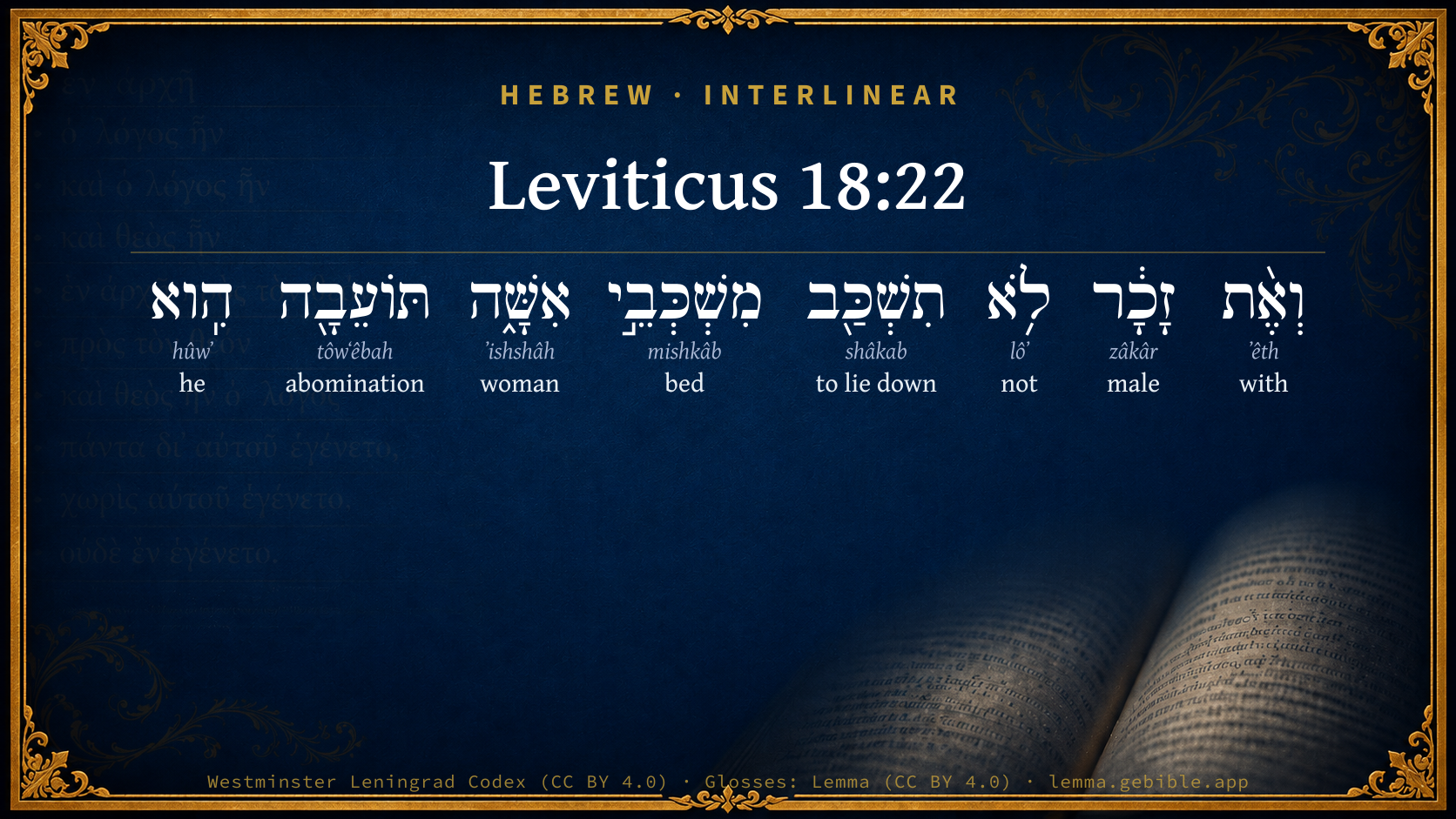
Hebrew (Westminster Leningrad Codex) Leviticus 18:22 appears in the Hebrew Old Testament. The text above is from the Westminster Leningrad Codex. Each word links to its Strong’s number, a concise gloss, and parsing drawn from the Open Scriptures Hebrew Bible morphology. Click any word for its full Brown-Driver-Briggs (BDB) entry.
Download image
Cite this verse

Leviticus 18:22 (World English Bible). Public Domain. Lemma interlinear Bible study tool, https://lemma.gebible.app/v/leviticus/18/22.

Show BibTeX & RIS
BibTeX
RIS
English Translation
"'You shall not lie with a man, as with a woman. That is detestible.
World English Bible · Public Domain
Download a study sheet

One document with this verse’s original text, its word-by-word gloss line, the meaning frame, cross-references with their text, attributed commentary, and full source and license credits — printable, and it pastes into notes with its structure intact.

This verse Autodidact and up

Study sheet (.html) Plain text (.txt)

A passage Seminary Student

Up to 50 verses in one chapter. A passage sheet keeps up to 6 commentary sources and 12 cross-references per verse, in the order this page ranks them, and says so on the sheet whenever that leaves anything out. Ask for a single verse and you get the Autodidact verse sheet above.

Everything on this page stays free to read, with no account — the sheet is a download of what is already on screen, not access to it.

Want to remove ads? Support Godless Engineer
Compare translations 3

The same verse in 3 English versions, stacked beneath the original-language interlinear above. Click any original word for its lexicon entry.

Each is an independent rendering of the whole verse — the interlinear is not word-aligned to these translations.

Highlighted words mark where these versions differ — a whole-verse word diff, not a word-by-word alignment.

  • World English Bible Public Domain
    "'You shall not lie with a man, as with a woman. That is detestible.
  • King James Version Public Domain
    Thou shalt not lie with mankind, as with womankind: it is abomination.
  • unfoldingWord Literal Text CC BY-SA 4.0
    And you shall not lie with a male the lyings of a woman. It is an abomination.

unfoldingWord Literal Text — © unfoldingWord, licensed CC BY-SA 4.0. Word-aligned USFM3 via Door43 (git.door43.org/unfoldingWord/en_ult).

Versions to compare (up to 4)

3 of 4 selected

Show all 18 translations

Every available English version of this verse, each an independent rendering of the whole verse.

  • World English Bible Public Domain
    "'You shall not lie with a man, as with a woman. That is detestible.
  • Berean Standard Bible Public Domain
    You must not lie with a man as with a woman; that is an abomination.
  • Majority Standard Bible Public Domain
    You must not lie with a man as with a woman; that is an abomination.
  • King James Version Public Domain
    Thou shalt not lie with mankind, as with womankind: it is abomination.
  • American Standard Version (1901) Public Domain
    Thou shalt not lie with mankind, as with womankind: it is abomination.
  • Revised Version (1885) Public Domain
    Thou shalt not lie with mankind, as with womankind: it is abomination.
  • Geneva Bible (1599) Public Domain
    Thou shalt not lie with ye male as one lieth with a woman: for it is abomination.
  • Douay-Rheims (1899) Public Domain
    Thou shalt not lie with mankind as with womankind, because it is an abomination.
  • Young's Literal Translation Public Domain
    `And with a male thou dost not lie as one lieth with a woman; abomination it `is'.
  • Literal Standard Version CC BY-SA 4.0
    And you do not lie with a male as one lies with a woman; it [is] an abomination.
  • Unlocked Literal Bible CC BY-SA 4.0
    Do not sleep with other men as with a woman. This would be wicked.
  • unfoldingWord Literal Text CC BY-SA 4.0
    And you shall not lie with a male the lyings of a woman. It is an abomination.
  • Darby Bible Public Domain
    And thou shalt not lie with mankind as one lieth with a woman: it is an abomination.
  • World Messianic Bible Public Domain
    “‘You shall not lie with a man as with a woman. That is detestable.
  • Webster's Bible Public Domain
    Thou shalt not lie with mankind, as with womankind: it is abomination.
  • Free Bible Version CC BY-SA 4.0
    Don't have sex with a man as with a woman. That is something disgusting.
  • Bible in Basic English Public Domain
    You may not have sex relations with men, as you do with women: it is a disgusting thing.
  • JPS Tanakh (1917) Public Domain
    Thou shalt not lie with mankind, as with womankind; it is abomination.

Literal Standard Version (2020), Covenant Press — licensed CC BY-SA 4.0. Text via the HelloAO Bible API (eBible.org). Unlocked Literal Bible (unfoldingWord) — licensed CC BY-SA 4.0. Text via the HelloAO Bible API (eBible.org). unfoldingWord Literal Text — © unfoldingWord, licensed CC BY-SA 4.0. Word-aligned USFM3 via Door43 (git.door43.org/unfoldingWord/en_ult). Free Bible Version, Dr. Jonathan Gallagher — licensed CC BY-SA 4.0. Text via the HelloAO Bible API (eBible.org).

Word by word

More ways to search: Search by grammar → Find every occurrence → Compare this word →

Practice this passage: Drill this verse → Learn its vocabulary →

About this verse

These counts appear in no published source. They are computed here, from the morphology-tagged text and Lemma’s own curated glosses. What Lemma adds →

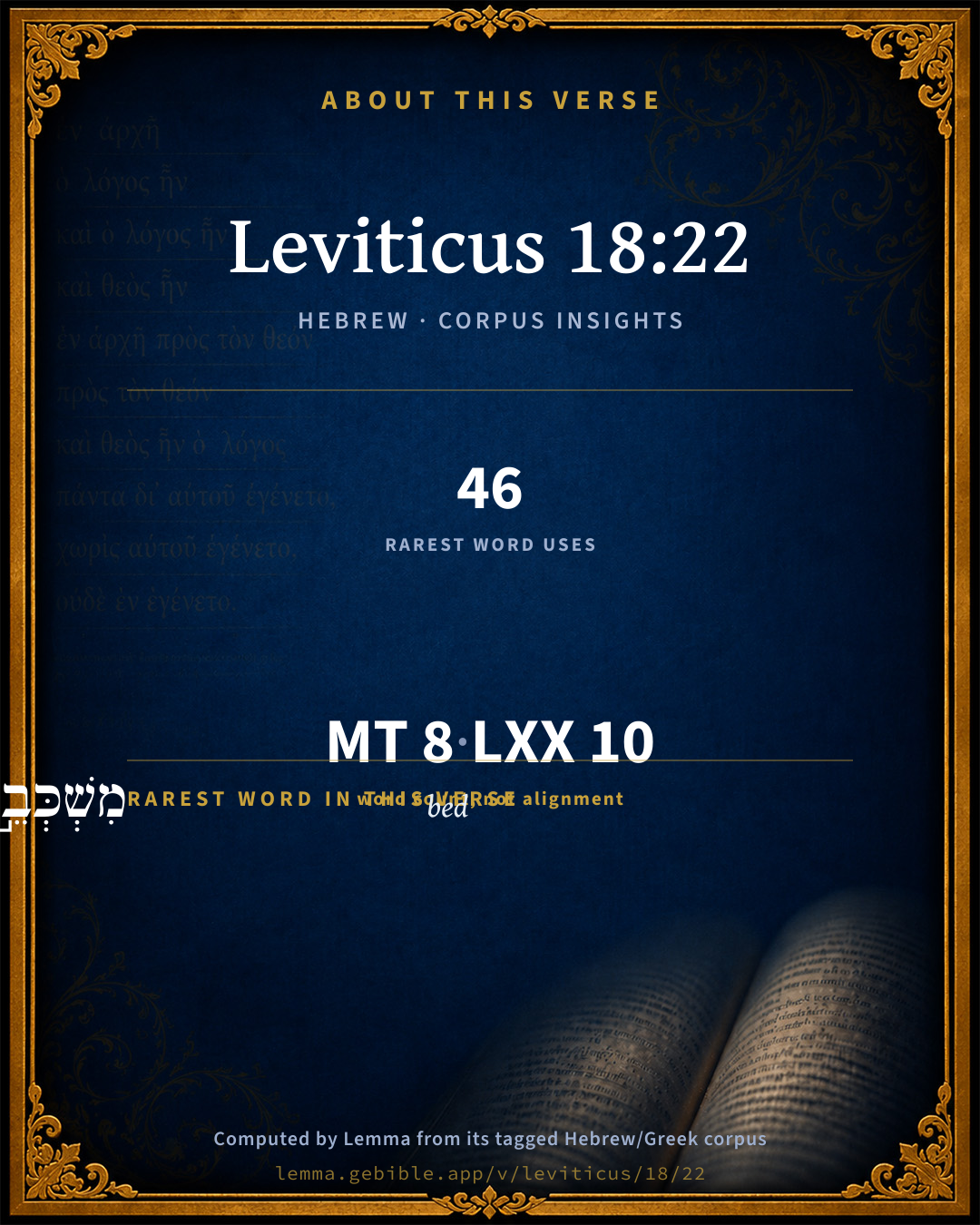
8
words
8
distinct lemmas
Pentateuch
section

Shared distinctive vocabulary

מִשְׁכְּבֵ֣י bed H4904 occurs in 44 verses of the Hebrew Bible. Also found in:

Grammatical profile

  • 1 verb
  • 3 nouns
  • 1 adjective
  • 1 pronoun
  • 1 preposition
  • 1 particle

Verb forms

  • תִשְׁכַּ֖ב Qal · Imperfect

Hebrew & Septuagint length

In English translation the verse runs 14 words from the Hebrew and 17 from the Septuagint (LXX English) — closely comparable.

A rough comparison of the two English renderings, which tokenize alike — not a word-level alignment.

Word counts can differ between the Hebrew and the Greek without any difference in meaning — e.g. the Hebrew direct-object marker אֵת has no separate Greek word, and Greek often adds the article ὁ.

In the original languages it is 8 Hebrew tokens and 10 Greek tokens — but the two are counted differently (Hebrew bundles its prefixes and suffixes into one token; the Greek is in lemma form), so that isn’t a like-for-like length.

Cross-references

9

Topical passages linked to Leviticus 18:22 in the Treasury of Scripture Knowledge — connected by theme and wording, ordered by reader-vote popularity; previews shown in the World English Bible.

  • Leviticus 20:13 If a man lies with a male, as with a woman, both of them have committed an abomination: they shall surely be put to death; their blood shall be upon them.
  • Romans 1:26–27 For this reason, God gave them up to vile passions. For their women changed the natural function into that which is against nature.
  • 1 Corinthians 6:9 Or don't you know that the unrighteous will not inherit the Kingdom of God? Don't be deceived. Neither the sexually immoral, nor idolaters, nor adulterers, nor male prostitutes, nor homosexuals,
  • 1 Timothy 1:10 for the sexually immoral, for homosexuals, for slave-traders, for liars, for perjurers, and for any other thing contrary to the sound doctrine;
  • Jude 1:7 Even as Sodom and Gomorrah, and the cities around them, having, in the same way as these, given themselves over to sexual immorality and gone after strange flesh, are set forth as an example, suffering the punishment of eternal fire.
  • 1 Kings 14:24 and there were also sodomites in the land: they did according to all the abominations of the nations which Yahweh drove out before the children of Israel.
  • Deuteronomy 23:18 You shall not bring the hire of a prostitute, or the wages of a dog, into the house of Yahweh your God for any vow: for even both these are an abomination to Yahweh your God.
  • Judges 19:22 As they were making their hearts merry, behold, the men of the city, certain base fellows, beset the house round about, beating at the door; and they spoke to the master of the house, the old man, saying, Bring forth the man who came into your house, that we may know him.
  • Genesis 19:5 They called to Lot, and said to him, "Where are the men who came in to you this night? Bring them out to us, that we may have sex with them."

Cross-references courtesy of OpenBible.info (CC BY 4.0).

Hebrew and Greek witnesses Masoretic Hebrew ↔ Greek Septuagint

The same verse in the two great witnesses to the Old Testament, shown verse-for-verse.

These are two independent witnesses, not word-aligned to each other, and the Septuagint is shown in lemma (dictionary) form.

Hebrew Leviticus 18:22 Masoretic · Westminster Leningrad Codex

וְאֶ֨ת זָכָ֔ר לֹ֥א תִשְׁכַּ֖ב מִשְׁכְּבֵ֣י אִשָּׁ֑ה תּוֹעֵבָ֖ה הִֽוא

"'You shall not lie with a man, as with a woman. That is detestible.

World English Bible · Public Domain

Greek LXX Leviticus 18:22 Septuagint · lemma form

καί μετά ἄρσην οὐ κοιμάω κοίτη γυνή βδέλυγμα γάρ εἰμί

And you shall not lie with a man as with a woman, for it is an abomination.

LXX2012 (modern English Septuagint) · Public Domain

Hebrew: Westminster Leningrad Codex (CC BY 4.0). Greek: Septuagint (public domain); English from LXX2012 (modern English Septuagint) (Public Domain). How the Septuagint differs from the Hebrew →

Targum (Aramaic paraphrase)

2

The Targum is the ancient Jewish Aramaic paraphrase of the Hebrew Scriptures — an interpretive translation, not the Hebrew text itself. Onkelos (literal) and Pseudo-Jonathan (expansive) render the Torah, and Jonathan the Prophets. Coverage is partial: where no permissively-licensed English translation exists for a verse, only the Aramaic is shown. This is verse-level text, not a word-by-word alignment to the Hebrew.

  1. Targum Onkelos Torah (Genesis–Deuteronomy)
    וְעִם דְכוּרָא לָא תִשְׁכּוּב מִשְׁכְּבֵי אִתְּתָא תּוֹעֶבְתָּא הִיא

    (no public-domain English translation for this verse)

    Targum Onkelos — Aramaic: “Onkelos Genesis” (public domain); “Onkelos Exodus” (public domain); “Onkelos Leviticus” (public domain); “Onkelos Numbers” (public domain); “Onkelos Deuteronomy” (public domain). English: “Sefaria Community Translation” (CC0 1.0 (public-domain dedication)); “J.W. Etheridge. The Targums of Onkelos and Jonathan Ben Uzziel on the Pentateuch. London: Longmans, Green, 1862” (public domain). Text via Sefaria.

  2. Targum Pseudo-Jonathan Torah (Genesis–Deuteronomy)
    וְעִם דְכוּרֵי לָא תִשְׁכּוּב בְּתַשְׁמִישַׁיָא דְאִתְּתָא מְרַחְקָא הִיא

    Nor with a male person shalt thou lie as with a woman; it is an abhorrent thing.

    Targum Pseudo-Jonathan — Aramaic: “Targum Jonathan on Genesis” (public domain); “Targum Jonathan on Exodus” (public domain); “Targum Jonathan on Leviticus” (public domain); “Targum Jonathan on Numbers” (public domain); “Targum Jonathan on Deuteronomy” (public domain). English: “The Targum of Jonathan ben Uzziel, trans. J. W. Etheridge, London, 1862” (public domain). Text via Sefaria.

Commentary

Notes on Leviticus 18:22 from classic Christian and Jewish commentators (each source and its license shown beneath its notes). The classic Christian expositions comment on the surrounding passage and are grouped to its opening verse, so a note may address several verses; the Jewish commentaries on the Tanakh (Rashi and others) are per-verse, so they appear only where the commentator wrote on this verse.

Lemma curates 59 commentaries, every one of them public domain or Creative Commons licensed, each selected and text-cleaned for this edition rather than reprinted as found. About our sources →

Trapp's Complete Commentary

John Trapp

Lev 18:22 Thou shalt not lie with mankind, as with womankind: it [is] abomination.

Ver. 22. Thou shalt not lie with mankind.] The Sodomites’ sin. {Gen 19:5} {See Trapp on "Gen 19:5"} This, say the Hebrews, was Ishmael’s sporting with Isaac: and this, say others, was the sin of Joseph’s brethren, the evil report whereof he brought to his father. A sad report it was surely to our King Henry I, that was brought him concerning his eldest son, William, who, crossing the seas from France to England, was with many other gallants cast away by shipwreck, being Sodomitica labe infecti fere omnes, saith Guliel. Parisiensis, almost all of them infected with this abomination of going after strange flesh. {Jdg 1:7-8}

John Trapp, A Commentary or Exposition upon All the Books of the Old and New Testament (1647–1656) — public domain. Text from a community e-Sword module.

Tyndale Open Study Notes

Tyndale Open Resources

18:22 In Gen 1:31, God pronounced all things good. This yielded a theology of the created order where good is defined by what God created and by the way he intended it to function. Part of this “good” was the creation of woman as man’s companion (Gen 2:22-24). Marriage forms a microcosm of the human race, which stands as the corporate bearer of God’s image. Sin, introduced by the Fall (Gen 3), disrupted the created order. Homosexuality is but one example of sinful violation of God’s order; it is tied to the rejection of God by fallen humanity (Rom 1:25-32). • The Hebrew word translated detestable (to‘ebah) indicates strong disapproval and disgust (Lev 20:13; see also 18:26-30).

Tyndale Open Study Notes — © Tyndale Open Resources, licensed CC BY-SA 4.0. Text via the HelloAO Bible API.

Adam Clarke's Commentary

Verse 22. With mankind] This abominable crime, frequent among the Greeks and Romans as well as the Canaanites, may be punished with death in this country.

Adam Clarke's Commentary on the Bible (1810–1826) — public domain. Text from a community e-Sword/MySword module.

Ellicott's Commentary for English Readers

(22) As with womankind.—This was the sin of Sodom (Gen_19:5), whence it derived its name, and in spite of the penalty of death enacted by the Law against those who were found guilty of it (see Lev_20:13), the Israelites did not quite relinquish this abominable vice (Jdg_19:22; 1Ki_14:24), to which the surrounding nations were addicted and which was so prevalent in the time of the Apostles (Rom_1:27; 1Co_6:9; Gal_5:19; 1Ti_1:10). By the law of Christ those who are guilty of this sin are excluded from the kingdom of God (1Co_6:9-10), whilst the laws of civilised Europe rightly inflict the severest penalties upon offenders of this kind.

A Bible Commentary for English Readers, edited by Charles John Ellicott (1878–1897) — public domain. Text from a community e-Sword module.

John Gill's Exposition

Thou shall not lie with mankind as with womankind,.... By carnal knowledge of them, and carnal copulation with them, and mixing bodies in like manner: this is the sin commonly called sodomy, from the inhabitants of Sodom, greatly addicted to it, for which their city was destroyed by fire: those that are guilty of this sin, are, by the apostle, called "abusers of themselves with mankind", Co1 6:9,

it is abomination; it is so to God, as the above instance of his vengeance shows, and ought to be abominable to men, as being not only contrary to the law of God, but even contrary to nature itself, and what is never to be observed among brute creatures.

John Gill's Exposition of the Whole Bible (1746–1763) — public domain (CC PDM 1.0). Text via the HelloAO Bible API.

Haydock's Catholic Bible Commentary

Abomination, punished so severely in the Sodomites, Genesis xix. Yet, even the philosophers of Greece were not at all ashamed of it. Bardesanes assures us, that the eastern nations punished it with death, and would not allow the guilty the honours of burial. Those beyond the Euphrates were so shocked at it, that they would kill themselves if they were only accused of such a crime. (Ap. Eusebius, præp. vi. 10.)

George Leo Haydock (1774–1849), Haydock's Catholic Family Bible and Commentary, 1859 edition — public domain. Excludes Psalms (Douay-Rheims chapter numbering differs from Protestant) and Deuterocanonical books (Catholic canon only).

Whedon's Commentary on the Bible

Daniel D. Whedon

22. Lie with mankind, as with womankind — The whole heathen world, according to St. Paul, (Rom_1:27, note,) corroborated by the ancient historians and all modern travellers, was more or less addicted to the disgusting vice of paederastia, or boy love, a crime against nature, “male on male performing the unseemliness,” which Christianity has banished. To this loathsome form of sensuality Roman poets once unblushingly sung praises. Read Virgil’s Second Eclogue.

Abomination — The Hebrew word occurs one hundred and sixteen times, and always expresses the loathsome and disgusting aspects of crimes and criminals.

Daniel D. Whedon (gen. ed.), Commentary on the Old and New Testaments (1874–1909) — public domain. Text from a community e-Sword module.

The Pulpit Commentary

The fourth prohibition forbids the sin of Sodom. (see Gen_19:5 Jud_1:11:22 Rom_1:27 1Co_6:9 1Ti_1:10) The penalty is death. (Lev_20:13)

The Pulpit Commentary (1880–1919), ed. H.D.M. Spence-Jones & Joseph S. Exell — public domain. Text from a community e-Sword module.

unfoldingWord translationNotes

Door43 World Missions Community

This would be perversion

Here "perversion" refers to a violation of the natural order of things as Yahweh intended them to be.

translationWords

had relations with

evil

unfoldingWord translationNotes — © Distant Shores Media and the Door43 World Missions Community, licensed CC BY-SA 4.0. Source: git.door43.org/Door43/en_tn.

Ramban (Nachmanides)

Rabbi Moshe ben Nachman (Ramban / Nachmanides)

Now the reason for the prohibitions against lying carnally with a male, or an animal, is well-known, as it is an abominable act and is not for the preservation of the human species, because [the copulation] of [male and male or of] man and animal will not beget offspring. And Rabbi Abraham ibn Ezra commented: “Since we find [Lot’s daughter using] the expression, Behold, ‘shachavti’ (I lay) yesternight with my father, [and she did not say, nishkavti, in the passive, or “Behold, shachav imi avi, — my father lay with me,” this shows that the term shachav, although in the active form, refers to the person who commits that act as well as the passive partner who permits herself or himself to be thus abused]; thus it follows that the verse, And with a male ‘lo thishkav’ (thou shalt not lie), constitutes a prohibition both against the one who actively commits pederasty, and against the one who permits himself to be thus abused.” [Thus far are the words of Ibn Ezra.] But if it be as Ibn Ezra said, why is the woman not included in the verse, And thou shalt not lie with any beast, [and it is clear that she is not so included from the fact that Scripture had to continue, Neither shall any woman stand before a beast, to lie down thereto], for women are included in all admonitions of the Torah? Rather, the use of the expression, Behold, ‘shachavti’ (I lay) yesternight with my father is due to the fact that it was Lot’s daughters who, through lying with him, [were instrumental in that affair] in order to beget seed of him. As is known, the seed comes either from the movement of the whole body, just as foam is formed in the mouths of galloping horses, or it is brought forth in the veins nearby [the sexual organ], where it gathers by the continuing motion thereof until it is emitted. Were they then not to have lain with Lot, his seed would not have come forth, for in his drunkenness he was like a silent stone.

Ramban (Nachmanides) on the Tanakh — English translation: “Commentary on the Torah by Ramban (Nachmanides). Translated and annotated by Charles B. Chavel. New York, Shilo Pub. House, 1971-1976” (CC BY 4.0). Text via Sefaria.

Lesson kit

Teaching starters — assembled from the data on this page, not authored interpretation. Every prompt links to the verse data it draws on. Edit before teaching.

Leviticus, in the Pentateuch, opens this verse with 8 words (8 distinct Hebrew lemmas). Its most distinctive word is mishkâb (“bed”). A historical commentator’s framing appears above. Read the whole chapter for the surrounding context.

Discussion questions

  1. What does “bed” (mishkâb) contribute to the verse as a whole?
  2. How does Genesis 49:4, which shares the word «bed», read alongside this verse?
  3. These translations render this verse differently. What is at stake in choosing one wording over another?
  4. «תִשְׁכַּ֖ב» is a Qal Imperfect verb. How does that grammatical form shape the action described?
  5. Compare how Trapp's Complete Commentary and Tyndale Open Study Notes read this verse. Where do they agree or differ?

Things to notice

Reading settings

Reading text

Shown beneath each verse's original-language words.

Old Testament
Old Testament edition

Read the OT as the Masoretic Hebrew (MT) or the Greek Septuagint (LXX).

English shown for the Greek Septuagint (in the Hebrew ↔ Greek comparison).

Comparing translations? Open the Compare panel on any verse page to stack up to four side by side.