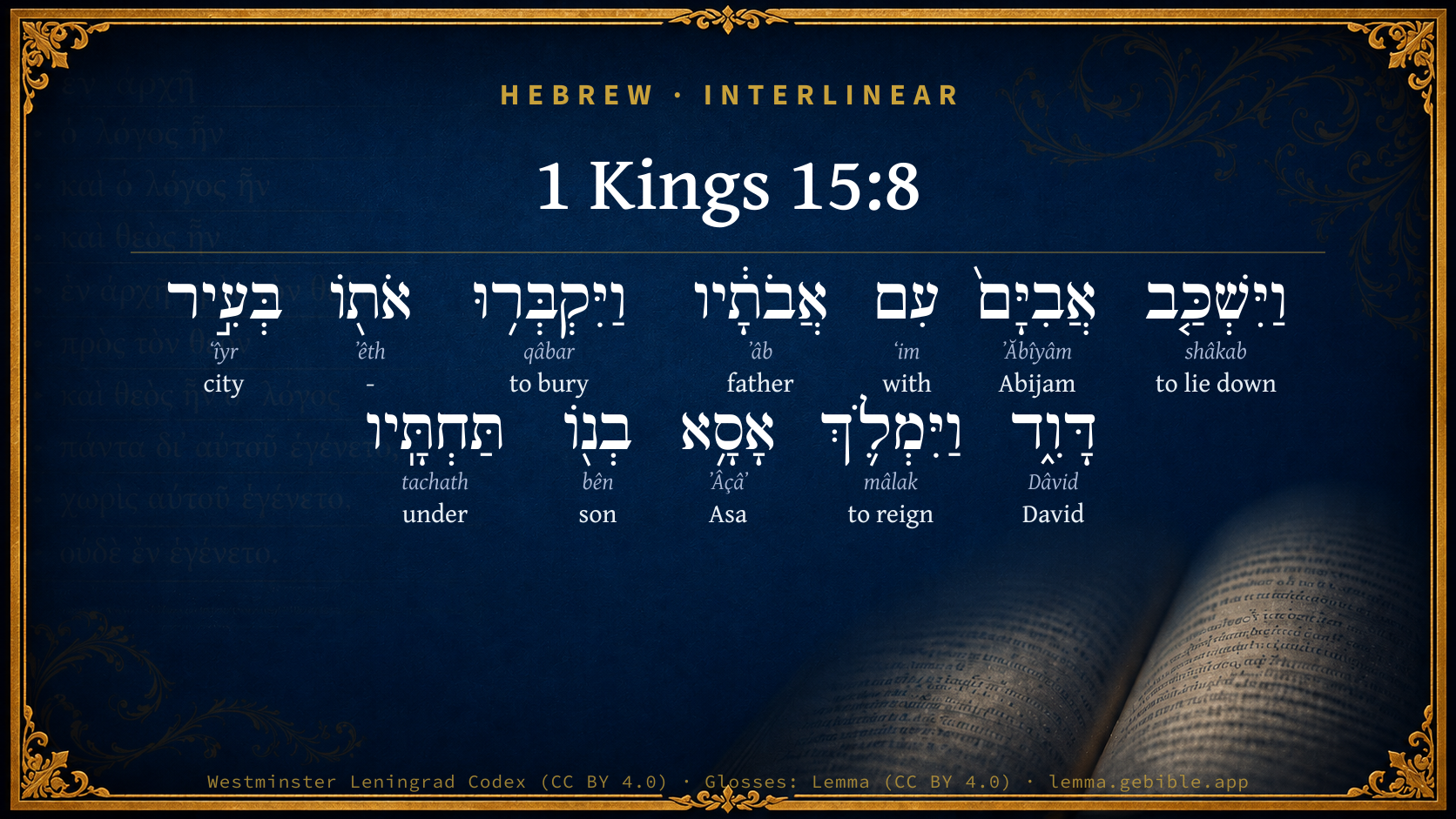
1 Kings 15:8

Hebrew (Westminster Leningrad Codex) 1 Kings 15:8 appears in the Hebrew Old Testament. The text above is from the Westminster Leningrad Codex. Each word links to its Strong’s number, a concise gloss, and parsing drawn from the Open Scriptures Hebrew Bible morphology. Click any word for its full Brown-Driver-Briggs (BDB) entry.
Download image
Cite this verse

1 Kings 15:8 (World English Bible). Public Domain. Lemma interlinear Bible study tool, https://lemma.gebible.app/v/1-kings/15/8.

Show BibTeX & RIS
BibTeX
RIS
English Translation
Abijam slept with his fathers; and they buried him in the city of David: and Asa his son reigned in his place.
World English Bible · Public Domain
Highlights Full analysis ↓
Download a study sheet

One document with this verse’s original text, its word-by-word gloss line, the meaning frame, cross-references with their text, attributed commentary, and full source and license credits — printable, and it pastes into notes with its structure intact.

This verse Autodidact and up

Study sheet (.html) Plain text (.txt)

A passage Seminary Student

Up to 50 verses in one chapter. A passage sheet keeps up to 6 commentary sources and 12 cross-references per verse, in the order this page ranks them, and says so on the sheet whenever that leaves anything out. Ask for a single verse and you get the Autodidact verse sheet above.

Everything on this page stays free to read, with no account — the sheet is a download of what is already on screen, not access to it.

Want to remove ads? Support Godless Engineer
Compare translations 3

The same verse in 3 English versions, stacked beneath the original-language interlinear above. Click any original word for its lexicon entry.

Each is an independent rendering of the whole verse — the interlinear is not word-aligned to these translations.

Highlighted words mark where these versions differ — a whole-verse word diff, not a word-by-word alignment.

  • World English Bible Public Domain
    Abijam slept with his fathers; and they buried him in the city of David: and Asa his son reigned in his place.
  • King James Version Public Domain
    And Abijam slept with his fathers; and they buried him in the city of David: and Asa his son reigned in his stead.
  • unfoldingWord Literal Text CC BY-SA 4.0
    And Abijam lay down with his fathers, and they buried him in the City of David. And Asa his son reigned in his place.

unfoldingWord Literal Text — © unfoldingWord, licensed CC BY-SA 4.0. Word-aligned USFM3 via Door43 (git.door43.org/unfoldingWord/en_ult).

Versions to compare (up to 4)

3 of 4 selected

Show all 18 translations

Every available English version of this verse, each an independent rendering of the whole verse.

  • World English Bible Public Domain
    Abijam slept with his fathers; and they buried him in the city of David: and Asa his son reigned in his place.
  • Berean Standard Bible Public Domain
    And Abijam rested with his fathers and was buried in the City of David, and his son Asa reigned in his place.
  • Majority Standard Bible Public Domain
    And Abijam rested with his fathers and was buried in the City of David, and his son Asa reigned in his place.
  • King James Version Public Domain
    And Abijam slept with his fathers; and they buried him in the city of David: and Asa his son reigned in his stead.
  • American Standard Version (1901) Public Domain
    And Abijam slept with his fathers; and they buried him in the city of David: and Asa his son reigned in his stead.
  • Revised Version (1885) Public Domain
    And Abijam slept with his fathers; and they buried him in the city of David: and Asa his son reigned in his stead.
  • Geneva Bible (1599) Public Domain
    And Abiiam slept with his fathers, and they buried him in the citie of Dauid: and Asa his sonne reigned in his steade.
  • Douay-Rheims (1899) Public Domain
    And Abiam slept with his fathers, and they buried him in the city of David, and Asa his son reigned in his stead.
  • Young's Literal Translation Public Domain
    and Abijam lieth with his fathers, and they bury him in the city of David, and reign doth Asa his son in his stead.
  • Literal Standard Version CC BY-SA 4.0
    and Abijam lies with his fathers, and they bury him in the City of David, and his son Asa reigns in his stead.
  • Unlocked Literal Bible CC BY-SA 4.0
    Abijah slept with his ancestors, and they buried him in the city of David. Asa his son became king in his place.
  • unfoldingWord Literal Text CC BY-SA 4.0
    And Abijam lay down with his fathers, and they buried him in the City of David. And Asa his son reigned in his place.
  • Darby Bible Public Domain
    And Abijam slept with his fathers; and they buried him in the city of David. And Asa his son reigned in his stead.
  • World Messianic Bible Public Domain
    Abijam slept with his fathers, and they buried him in David’s city; and Asa his son reigned in his place.
  • Webster's Bible Public Domain
    And Abijam slept with his fathers; and they buried him in the city of David: and Asa his son reigned in his stead.
  • Free Bible Version CC BY-SA 4.0
    Abijam died and was buried in the City of David. His son Asa succeeded him as king.
  • Bible in Basic English Public Domain
    Then Abijam went to rest with his fathers, and they put him into the earth in the town of David: and Asa his son became king in his place.
  • JPS Tanakh (1917) Public Domain
    And Abijam slept with his fathers; and they buried him in the city of David; and Asa his son reigned in his stead.

Literal Standard Version (2020), Covenant Press — licensed CC BY-SA 4.0. Text via the HelloAO Bible API (eBible.org). Unlocked Literal Bible (unfoldingWord) — licensed CC BY-SA 4.0. Text via the HelloAO Bible API (eBible.org). unfoldingWord Literal Text — © unfoldingWord, licensed CC BY-SA 4.0. Word-aligned USFM3 via Door43 (git.door43.org/unfoldingWord/en_ult). Free Bible Version, Dr. Jonathan Gallagher — licensed CC BY-SA 4.0. Text via the HelloAO Bible API (eBible.org).

Word by word

More ways to search: Search by grammar → Find every occurrence → Compare this word →

Practice this passage: Drill this verse → Learn its vocabulary →

אֲבִיָּם֙
ʼĂbîyâm
H38
“Abijam”
Noun, Proper
Part of Speech
Noun
Type
Proper
Full BDB Definition

Origin: from H1 and H3220

TWOT: None

Abijam = "my father is the sea" or " Yah(u) is (my) father" - king of Judah, son and successor of Rehoboam
  1. וַיִּשְׁכַּ֤ב shâkab H7901 “and · to lie down” Conjunction + Verb, Qal, Sequential Imperfect, 3rd Person, Masculine, Singular
  2. עִם ʻim H5973 “with” Preposition
  3. אֲבֹתָ֔יו ʼâb H1 “fathers · his” Noun, Common, Masculine, Plural, Construct + Suffix, Personal, 3rd Person, Masculine, Singular
  4. וַיִּקְבְּר֥וּ qâbar H6912 “and · to bury” Conjunction + Verb, Qal, Sequential Imperfect, 3rd Person, Masculine, Plural
  5. אֹת֖וֹ ʼêth H853 “- · him” Particle, Direct Object + Suffix, Personal, 3rd Person, Masculine, Singular
  6. בְּעִ֣יר ʻîyr H5892 “in/at · city of” Preposition + Noun, Common, Feminine, Singular, Construct
  7. דָּוִ֑ד Dâvid H1732 “David” Noun, Proper
  8. וַיִּמְלֹ֛ךְ mâlak H4427 “and · to reign” Conjunction + Verb, Qal, Sequential Imperfect, 3rd Person, Masculine, Singular
  9. אָסָ֥א ʼÂçâʼ H609 “Asa” Noun, Proper
  10. בְנ֖וֹ bên H1121 “son · his” Noun, Common, Masculine, Singular, Construct + Suffix, Personal, 3rd Person, Masculine, Singular
  11. תַּחְתָּֽיו tachath H8478 “under · him” Preposition + Suffix, Personal, 3rd Person, Masculine, Singular

About this verse

These counts appear in no published source. They are computed here, from the morphology-tagged text and Lemma’s own curated glosses. What Lemma adds →

12
words
12
distinct lemmas
Historical
section

Notable vocabulary

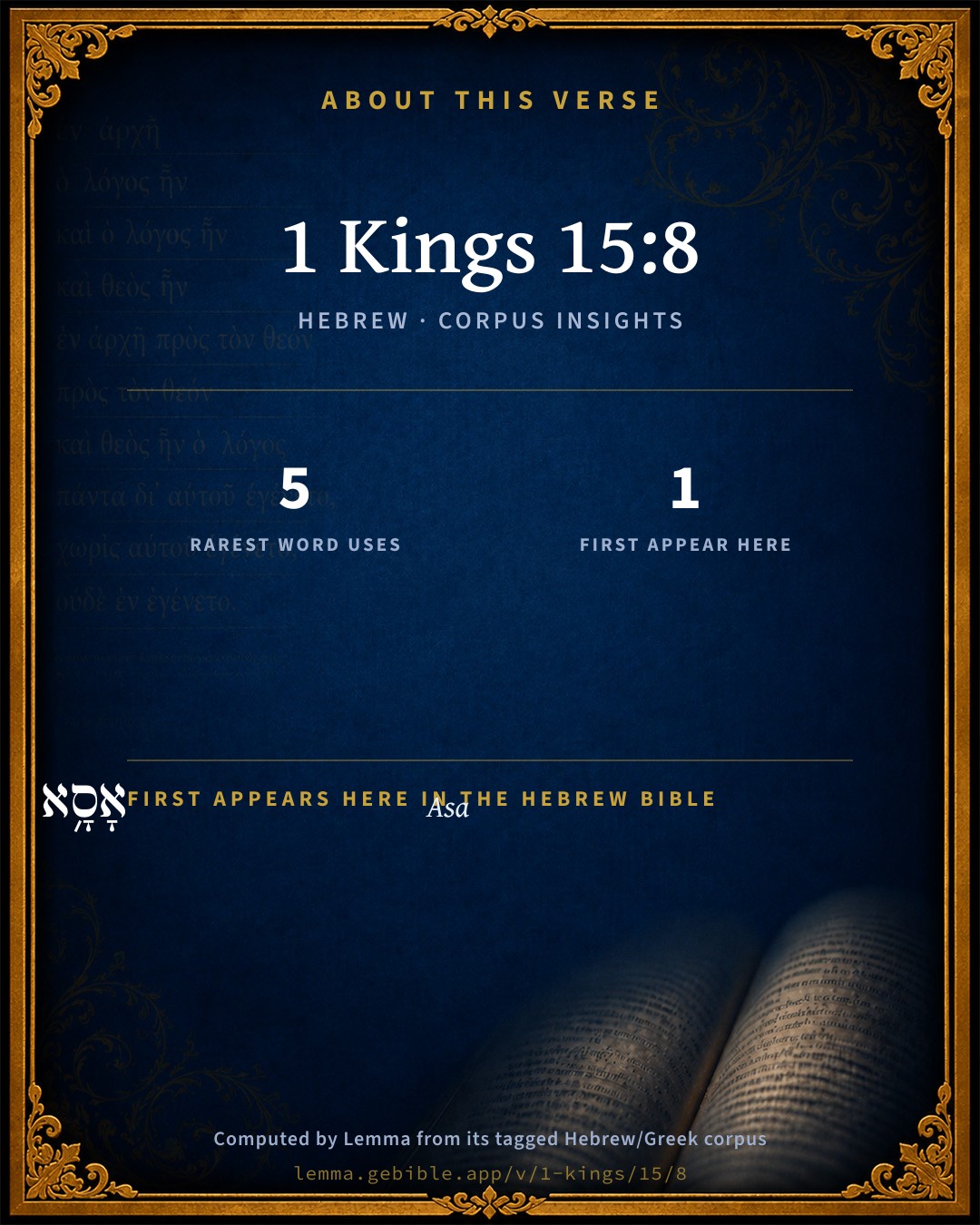
The rarest word here is אֲבִיָּם֙ Abijam H38 — appearing just 5 times in the whole Hebrew Bible.

First appearance in Scripture

This word makes its first canonical appearance in the Hebrew Bible here:

  • אָסָ֥א Asa H609

Shared distinctive vocabulary

אֲבִיָּם֙ Abijam H38 occurs in 4 verses of the Hebrew Bible. Also found in:

Grammatical profile

  • 3 verbs
  • 6 nouns
  • 2 prepositions
  • 1 particle

Verb forms

  • וַיִּשְׁכַּ֤ב Qal · Sequential Imperfect
  • וַיִּקְבְּר֥וּ Qal · Sequential Imperfect
  • וַיִּמְלֹ֛ךְ Qal · Sequential Imperfect

Hebrew & Septuagint length

In English translation the verse runs 22 words from the Hebrew and 32 from the Septuagint (LXX English) — the Septuagint runs noticeably longer here. See the side-by-side →

A rough comparison of the two English renderings, which tokenize alike — not a word-level alignment.

Word counts can differ between the Hebrew and the Greek without any difference in meaning — e.g. the Hebrew direct-object marker אֵת has no separate Greek word, and Greek often adds the article ὁ.

Cross-references

5

Topical passages linked to 1 Kings 15:8 in the Treasury of Scripture Knowledge — connected by theme and wording, ordered by reader-vote popularity; previews shown in the World English Bible.

  • 2 Chronicles 14:1 So Abijah slept with his fathers, and they buried him in the city of David; and Asa his son reigned in his place. In his days the land was quiet ten years.
  • 1 Kings 14:31 Rehoboam slept with his fathers, and was buried with his fathers in the city of David: and his mother's name was Naamah the Ammonitess. Abijam his son reigned in his place.
  • 1 Kings 14:1 At that time Abijah the son of Jeroboam fell sick.
  • 1 Chronicles 3:9 All these were the sons of David, besides the sons of the concubines; and Tamar was their sister.
  • Matthew 1:7–8 Solomon became the father of Rehoboam. Rehoboam became the father of Abijah. Abijah became the father of Asa.

Cross-references courtesy of OpenBible.info (CC BY 4.0).

Hebrew and Greek witnesses Masoretic Hebrew ↔ Greek Septuagint

The same verse in the two great witnesses to the Old Testament, shown verse-for-verse.

Here the Septuagint runs noticeably longer than the Hebrew — LXX2012 (modern English Septuagint) 32 words vs World English Bible 22. A rough length comparison of the two English translations, not a word-level alignment — read both below.

These are two independent witnesses, not word-aligned to each other, and the Septuagint is shown in lemma (dictionary) form.

Hebrew 1 Kings 15:8 Masoretic · Westminster Leningrad Codex

וַיִּשְׁכַּ֤ב אֲבִיָּם֙ עִם אֲבֹתָ֔יו וַיִּקְבְּר֥וּ אֹת֖וֹ בְּעִ֣יר דָּוִ֑ד וַיִּמְלֹ֛ךְ אָסָ֥א בְנ֖וֹ תַּחְתָּֽיו

Abijam slept with his fathers; and they buried him in the city of David: and Asa his son reigned in his place.

World English Bible · Public Domain

Greek LXX 1 Kings 15:8 Septuagint · lemma form

καί κοιμάω αβιου μετά ὁ πατήρ αὐτός ἐν ὁ εἰκοστός καί τέταρτος ἔτος ὁ ιεροβοαμ καί θάπτω μετά ὁ πατήρ αὐτός ἐν πόλις δαυίδ καί βασιλεύω ασα υἱός αὐτός ἀντί αὐτός

And Abiu slept with his fathers in the twenty-fourth year of Jeroboam; and he is buried with his fathers in the city of David: And Asa his son reigns in his stead.

LXX2012 (modern English Septuagint) · Public Domain

On this verse, The Cambridge Bible for Schools and Colleges discusses the Septuagint’s reading. Read the note in Commentary ↓

Hebrew: Westminster Leningrad Codex (CC BY 4.0). Greek: Septuagint (public domain); English from LXX2012 (modern English Septuagint) (Public Domain). How the Septuagint differs from the Hebrew →

Targum (Aramaic paraphrase)

1

The Targum is the ancient Jewish Aramaic paraphrase of the Hebrew Scriptures — an interpretive translation, not the Hebrew text itself. Onkelos (literal) and Pseudo-Jonathan (expansive) render the Torah, and Jonathan the Prophets. Coverage is partial: where no permissively-licensed English translation exists for a verse, only the Aramaic is shown. This is verse-level text, not a word-by-word alignment to the Hebrew.

  1. Targum Jonathan Prophets (Joshua–Malachi)
    וּשְׁכִיב אֲבִיָם עִם אֲבָהָתוֹהִי וּקְבָרוּ יָתֵיהּ בְּקַרְתָּא דְדָוִד וּמְלַךְ אָסָא בְּרֵיהּ תְּחוֹתוֹהִי:

    (no public-domain English translation for this verse)

    Targum Jonathan — Aramaic: “Mikraot Gedolot” (public domain). English: “Sefaria Community Translation” (CC0 1.0 (public-domain dedication)); “London "Chaldee Paraphrase," 1871” (public domain). Text via Sefaria.

Commentary

Notes on 1 Kings 15:8 from classic Christian and Jewish commentators (each source and its license shown beneath its notes). The classic Christian expositions comment on the surrounding passage and are grouped to its opening verse, so a note may address several verses; the Jewish commentaries on the Tanakh (Rashi and others) are per-verse, so they appear only where the commentator wrote on this verse.

Lemma curates 59 commentaries, every one of them public domain or Creative Commons licensed, each selected and text-cleaned for this edition rather than reprinted as found. About our sources →

Trapp's Complete Commentary

John Trapp

1Ki 15:8 And Abijam slept with his fathers; and they buried him in the city of David: and Asa his son reigned in his stead.

Ver. 8. And Asa his son reigned.] This was a good king. But it is wonder how he should be good, of the seed of Abijam, of the soil of Maachah, both wicked, both idolatrous. Thus we have seen, saith a reverend man, a fair flower spring out of dung, and a well-fruited tree rise out of a sour stock.

John Trapp, A Commentary or Exposition upon All the Books of the Old and New Testament (1647–1656) — public domain. Text from a community e-Sword module.

The Cambridge Bible for Schools and Colleges

gen. ed. J. J. S. Perowne

8. And Abijam slept with his fathers] To this the LXX. adds ‘in the twenty-fourth year of Jeroboam.’ This statement does not quite agree with the chronology given in 1Ki_15:1-2 of this chapter, and repeated in 2Ch_13:1-2. If Abijam came to the throne in the 18th year of Jeroboam and reigned 3 years, his death would fall in the twenty-first year of Jeroboam, or if the three years of his reign were incomplete at the beginning and end it might occur, as is said immediately in 1Ki_15:9, in the 20th year of Jeroboam.

The Cambridge Bible for Schools and Colleges (gen. ed. J. J. S. Perowne; Cambridge University Press, 1878–1918) — public domain. Text from a community e-Sword module.

John Gill's Exposition

And Asa did that which was right in the eyes of the Lord, as did David his father. In his personal walk and conversation, in his government of the nation, and especially in the matters of his God, and of religion, he made David his pattern and example to copy after.

And Asa did that which was right in the eyes of the Lord, as did David his father. In his personal walk and conversation, in his government of the nation, and especially in the matters of his God, and of religion, he made David his pattern and example to copy after.

1 Kings 15:12

kg1 15:12

kg1 15:12

kg1 15:12And he took away the Sodomites out of the land,.... Which were in the times of Rehoboam, Kg1 14:24, and continued in his father's reign; those he took away, either by driving them out of the land, or by putting them to death according to the law of God, Lev 20:13 even as many of them as he had knowledge of, for some remained, see Kg1 22:46,

and removed all the idols that his fathers had made; or suffered to be made, as Solomon, Rehoboam, and Abijam, see Kg1 11:7.

John Gill's Exposition of the Whole Bible (1746–1763) — public domain (CC PDM 1.0). Text via the HelloAO Bible API.

The Pulpit Commentary

And Abijam slept with his fathers; and they buried him in the city of David This fact alone should negative Lightfoot"s theory as to his name; (see note on 1Ki_14:31) and Ass his son reigned in his stead.

The Pulpit Commentary (1880–1919), ed. H.D.M. Spence-Jones & Joseph S. Exell — public domain. Text from a community e-Sword module.

Lesson kit

Teaching starters — assembled from the data on this page, not authored interpretation. Every prompt links to the verse data it draws on. Edit before teaching.

1 Kings, in the Historical, opens this verse with 12 words (12 distinct Hebrew lemmas). Its most distinctive word is ʼĂbîyâm (“Abijam”). The Greek Septuagint runs longer here. A historical commentator’s framing appears above. Read the whole chapter for the surrounding context.

Discussion questions

  1. How does “Abijam” (ʼĂbîyâm) shape what this verse is saying?
  2. This is the first place “Asa” appears in Scripture (first appears here). What does its debut here establish?
  3. How does 1 Kings 14:31, which shares the word «Abijam», read alongside this verse?
  4. The Septuagint runs longer here than the Hebrew. What might account for the difference?
  5. The translations on this page render this verse differently — a whole-verse word diff, not a word-by-word alignment. What might account for the different wordings?
  6. «וַיִּשְׁכַּ֤ב» is a Qal Sequential Imperfect verb. How does that grammatical form shape the action described?
  7. Compare how Trapp's Complete Commentary and The Cambridge Bible for Schools and Colleges read this verse. Where do they agree or differ?

Things to notice

  • 1 word makes its first canonical appearance in Scripture here.
  • These translations choose different wording for 5 words in this verse.
  • 12 distinct Hebrew lemmas span 12 words in this verse.

Reading settings

Reading text

Shown beneath each verse's original-language words.

Old Testament
Old Testament edition

Read the OT as the Masoretic Hebrew (MT) or the Greek Septuagint (LXX).

English shown for the Greek Septuagint (in the Hebrew ↔ Greek comparison).

Comparing translations? Open the Compare panel on any verse page to stack up to four side by side.