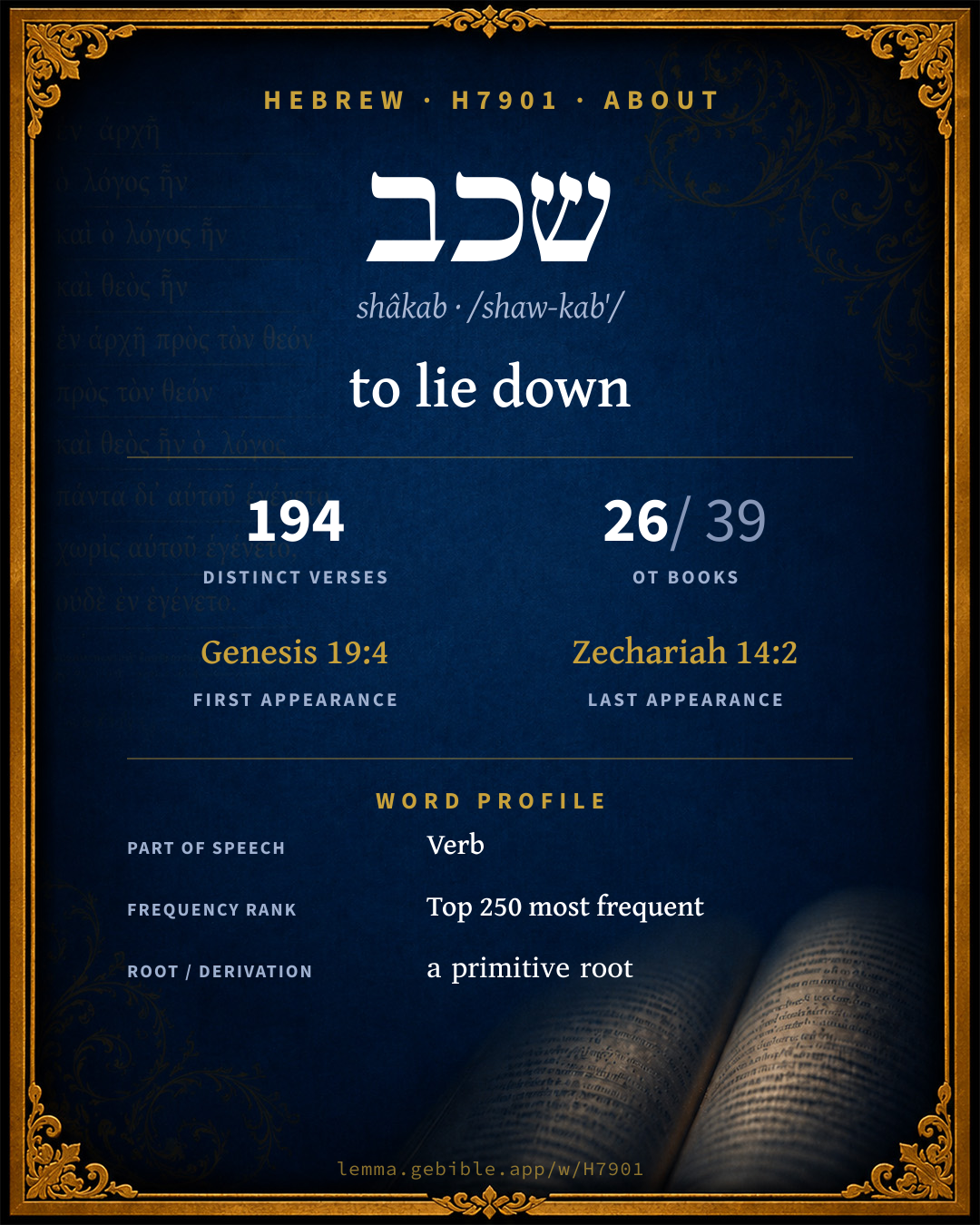
שָׁכַב
to lie down
‘to lie down’ is one of 5 main senses fuller range ↓
Full lexicon entry — Brown-Driver-Briggs (BDB)
From Brown-Driver-Briggs (BDB)
Where this word appears
Grammar key — what these labels mean
Part of speech
- Verb
- An action or state-of-being word.
Stem
- Qal
- The basic, simple active stem — the plain form of the verb (“he wrote”).
- Hiphil
- The causative active stem (“he caused / brought about”).
- Niphal
- Usually the simple passive or reflexive of the Qal (“he was written”).
- Hophal
- The passive counterpart of the Hiphil (“he was caused to…”).
- Pual
- The passive counterpart of the Piel.
Form
- Sequential Imperfect
- An imperfect with prefixed waw — the standard past-narrative form (waw-consecutive imperfect).
- Imperfect
- An incomplete, ongoing, or future action (“he will / would write”).
- Participle Active
- A verbal adjective expressing ongoing or characteristic action (“writing / one who writes”).
- Perfect
- A completed action or state — Hebrew marks aspect (completeness) more than strict tense (“he wrote”).
- Infinitive Construct
- A bound verbal noun, frequently with prepositions (“to write / in writing”).
- Sequential Perfect
- A perfect with prefixed waw continuing a preceding imperfect or command (waw-consecutive perfect).
- Imperative
- A direct command (“write!”).
- Cohortative
- A first-person volitional form expressing wish or resolve (“let me / let us write”).
- Participle Passive
- A verbal adjective expressing action received (“written”).
- Infinitive Absolute
- An unbound verbal noun, often intensifying or standing in for a finite verb.
State
- Absolute
- The independent form of a noun, not bound to a following word.
- Construct
- A noun bound to a following noun in a possessive / “of” relationship (the construct chain).
Person
- 3rd Person
- The one spoken about (“he / she / it / they”).
- 2nd Person
- The one addressed (“you”).
- 1st Person
- The speaker (“I / we”).
Gender
- Masculine
- Grammatically masculine.
- Common
- Either gender — not distinguished for this form.
- Feminine
- Grammatically feminine.
Number
- Singular
- One.
- Plural
- More than one (in Hebrew, generally three or more).
Every verse where H7901 appears in the Book of Genesis — 18 distinct verses. Click any verse to open its interlinear word-by-word view. Verse text shown in the World English Bible for context — . Each verse’s Hebrew form is shown with its reference; the English is not keyword-highlighted, since the data carries no word-level English alignment. Use “Compare translations” on any verse to read it across multiple English versions. This concordance covers the Hebrew Bible; Septuagint (Greek Old Testament) occurrences are not indexed here.
Genesis
- Genesis 19:4 יִשְׁכָּבוּ֒ Qal impf 3mp But before they lay down, the men of the city, the men of Sodom, surrounded the house, both young and old, all the people from every quarter.
- Genesis 19:32 וְ/נִשְׁכְּבָ֣ה conj + Qal coh 1cp Come, let's make our father drink wine, and we will lie with him, that we may preserve our father's seed."
- Genesis 19:33 וַ/תִּשְׁכַּ֣ב בְּ/שִׁכְבָ֖/הּ conj + Qal wimpf 3fs prep + Qal inf.cs + sfx pers 3fs They made their father drink wine that night: and the firstborn went in, and lay with her father. He didn't know when she lay down, nor when she arose.
- Genesis 19:34 שָׁכַ֥בְתִּי שִׁכְבִ֣י Qal pf 1cs Qal impv 2fs It came to pass on the next day, that the firstborn said to the younger, "Behold, I lay last night with my father. Let us make him drink wine again, tonight. You go in, and lie with him, that we may preserve our father's seed."
- Genesis 19:35 וַ/תִּשְׁכַּ֣ב בְּ/שִׁכְבָ֖/הּ conj + Qal wimpf 3fs prep + Qal inf.cs + sfx pers 3fs They made their father drink wine that night also. The younger arose, and lay with him. He didn't know when she lay down, nor when she arose.
- Genesis 26:10 שָׁכַ֞ב Qal pf 3ms Abimelech said, "What is this you have done to us? One of the people might easily have lain with your wife, and you would have brought guilt on us!"
- Genesis 28:11 וַ/יִּשְׁכַּ֖ב conj + Qal wimpf 3ms He came to a certain place, and stayed there all night, because the sun had set. He took one of the stones of the place, and put it under his head, and lay down in that place to sleep.
- Genesis 28:13 שֹׁכֵ֣ב Qal ptcp.act ms Behold, Yahweh stood above it, and said, "I am Yahweh, the God of Abraham your father, and the God of Isaac. The land whereon you lie, to you will I give it, and to your seed.
- Genesis 30:15 יִשְׁכַּ֤ב Qal impf 3ms She said to her, "Is it a small matter that you have taken away my husband? Would you take away my son's mandrakes, also?" Rachel said, "Therefore he will lie with you tonight for your son's mandrakes."
- Genesis 30:16 וַ/יִּשְׁכַּ֥ב conj + Qal wimpf 3ms Jacob came from the field in the evening, and Leah went out to meet him, and said, "You must come in to me; for I have surely hired you with my son's mandrakes." He lay with her that night.
- Genesis 34:2 וַ/יִּשְׁכַּ֥ב conj + Qal wimpf 3ms Shechem the son of Hamor the Hivite, the prince of the land, saw her. He took her, lay with her, and humbled her.
- Genesis 34:7 לִ/שְׁכַּב֙ prep + Qal inf.cs The sons of Jacob came in from the field when they heard it. The men were grieved, and they were very angry, because he had done folly in Israel in lying with Jacob's daughter; which thing ought not to be done.
- Genesis 35:22 וַ/יִּשְׁכַּב֙ conj + Qal wimpf 3ms It happened, while Israel lived in that land, that Reuben went and lay with Bilhah, his father's concubine, and Israel heard of it. Now the sons of Jacob were twelve.
- Genesis 39:7 שִׁכְבָ֥/ה Qal impv 2ms + sfx h It happened after these things, that his master's wife cast her eyes on Joseph; and she said, "Lie with me."
- Genesis 39:10 לִ/שְׁכַּ֥ב prep + Qal inf.cs It happened that as she spoke to Joseph day by day, that he didn't listen to her, to lie by her, or to be with her.
- Genesis 39:12 שִׁכְבָ֣/ה Qal impv 2ms + sfx h She caught him by his garment, saying, "Lie with me!" He left his garment in her hand, and ran outside.
- Genesis 39:14 לִ/שְׁכַּ֣ב prep + Qal inf.cs that she called to the men of her house, and spoke to them, saying, "Behold, he has brought in a Hebrew to us to mock us. He came in to me to lie with me, and I cried with a loud voice.
- Genesis 47:30 וְ/שָֽׁכַבְתִּי֙ conj + Qal wpf 1cs but when I sleep with my fathers, you shall carry me out of Egypt, and bury me in their burying place." He said, "I will do as you have said."
About this entry
At a glance — auto-summarized from this page’s data, not written by a person. Every figure links to its source below. This summary describes the numbers; it doesn’t interpret them.
“to lie down” is the headline sense of the Hebrew verb שכב (shâkab). Where the King James Version says “slept,” newer translations reach for “rested” (Berean Standard Bible) and “and” (unfoldingWord Literal Text); the renderings breakdown has the detail. The Hebrew Bible uses it across 194 verses — common. First canonically at Genesis 19:4, it enters the text early. Carrying more than one sense, it rewards its full sense range. The sections below give every sense, occurrence, and version rendering.
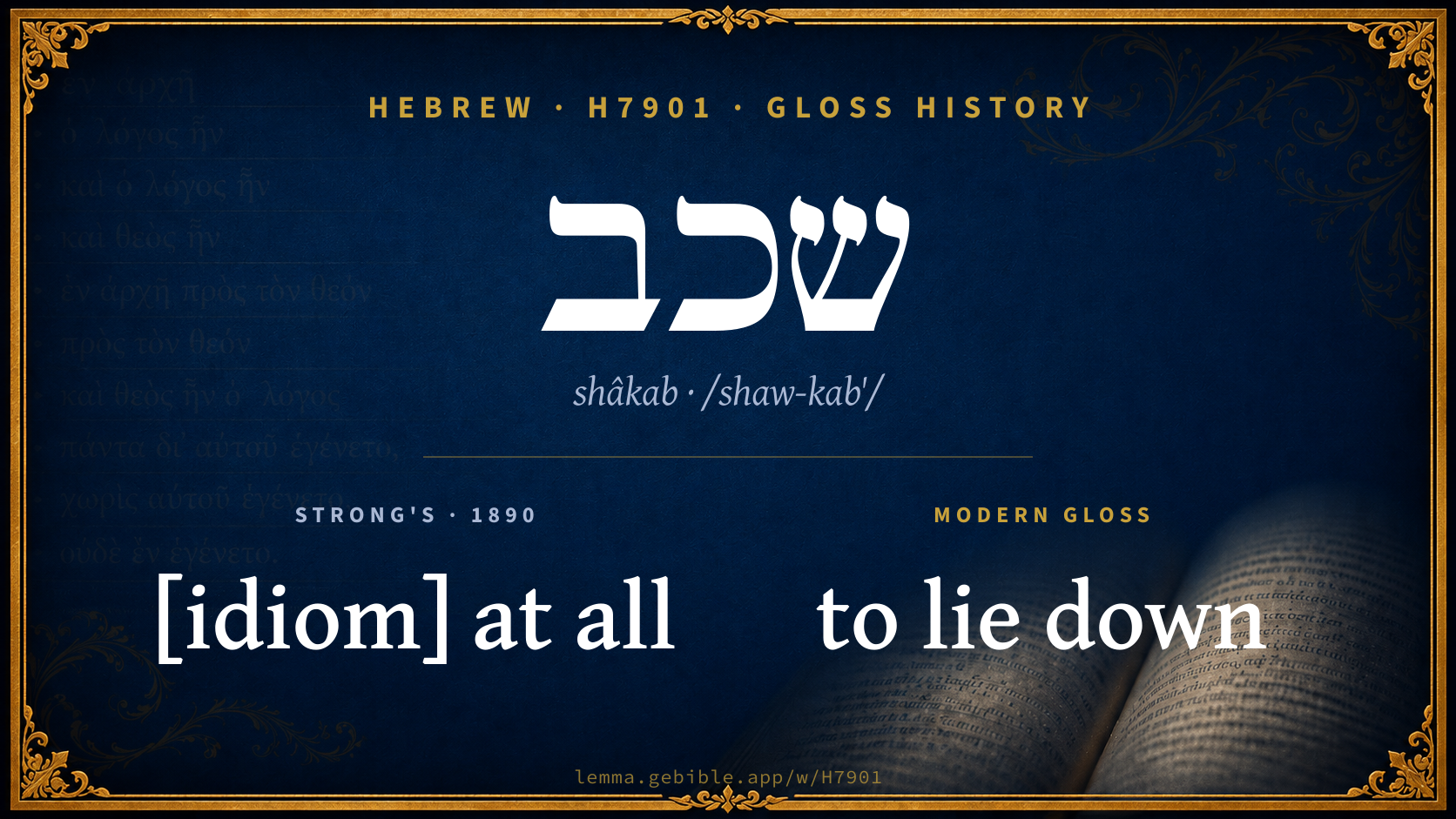
Gloss history
Strong's 1890 vs modern scholarship
About this word
Strong's H7901 catalogs a Hebrew word from the Hebrew Old Testament.
These counts are not copied from any lexicon or concordance. They are computed here, from the morphology-tagged Hebrew Old Testament. What Lemma adds →
- 194
- distinct verses
- The word appears in 194 distinct verses.
- 26 / 39
- OT books
- The word appears in 26 of 39 Old Testament books.
- #225
- by frequency
- Top 250 most frequent Hebrew words (rank 225 of 8,640 Hebrew words by occurrence).
View all 194 occurrences in the concordance →
By section of the Old Testament
By traditional corpus
Conventional, traditional groupings — biblical authorship is debated, so this is a traditional corpus grouping, not an authorship claim. Each share is this word’s portion of its verses in that division of the Hebrew canon. Each figure is a share of the word’s 194 distinct verses.
- Prophets (Nevi'im) 96 verses · 49%
- Torah (Pentateuch) 55 verses · 28%
- Writings (Ketuvim) 43 verses · 22%
How translations render this word
Counts come from each version’s own published word-to-Strong’s tagging or interlinear alignment — an approximate guide to how each version renders this word, not a word-level alignment the data otherwise carries. Because each total is that version’s own tagged count, the per-version totals vary from one another and need not match the appearance or distinct-verse counts above. These counts may also differ from a printed concordance because Lemma counts each distinctly tagged rendering and does not collapse phrase taggings into a single head-word total. This is a fixed set of word-tagged versions (KJV, ASV, BSB, ULT) and does not change with the reading translation you choose elsewhere. Each version’s license is shown beside its name below (and on Sources).
- King James Version: Slept 36×, Lay 23×, Lie 21×
- American Standard Version: Slept 36×, Lay 16×, Lie 10×
- Berean Standard Bible: Rested 33×, Lie down 18×, Lies 12×
- unfoldingWord Literal Text: And 34×, Lay down 31×, Lie down 17×
King James Version Public Domain
Renders H7901 across 212 tagged occurrences — most commonly:
Plus other, less common renderings. Plus 69 renderings that appear only once — usually multi-word phrases or single function words the recovered tagging swept in, not distinct renderings. Not rendered by a distinct English word in 1 further occurrence.
American Standard Version Public Domain
Renders H7901 across 211 tagged occurrences — most commonly:
Plus other, less common renderings. Plus 85 renderings that appear only once — usually multi-word phrases or single function words the recovered tagging swept in, not distinct renderings.
Berean Standard Bible Public Domain
Renders H7901 across 207 tagged occurrences — most commonly:
Plus other, less common renderings. Plus 57 renderings that appear only once — usually multi-word phrases or single function words the recovered tagging swept in, not distinct renderings. Not rendered by a distinct English word in 1 further occurrence.
unfoldingWord Literal Text CC BY-SA 4.0
Renders H7901 across 255 tagged occurrences — most commonly:
Plus other, less common renderings. Plus 56 renderings that appear only once — usually multi-word phrases or single function words the recovered tagging swept in, not distinct renderings.
12 senses and sub-senses in the full BDB
What do BDB’s symbols mean?
BDB uses these scholarly abbreviations:
| Symbol | Meaning |
|---|---|
| 𝔊 | the Septuagint (the ancient Greek translation, LXX) |
| 𝔙 | the Vulgate (the Latin translation) |
| 𝔖 | the Syriac version (the Peshitta) |
| 𝔗 | the Targum (the Aramaic translation) |
| ψ | the Psalms |
| √ | root (the underlying root or stem) |
| ‖ | parallel passage (a synonymous or contrasted parallel) |
| † | the dagger: every passage where the word occurs is cited |
The 12 senses and sub-senses the full Brown-Driver-Briggs lexicon distinguishes for this word, in lexicon order (not ranked by frequency), with BDB’s own verbatim wording and sub-sense lettering. Shown in Hebrew script with BDB’s own scholarly abbreviations. The condensed entry is in the Lexicon Entry tab. See also the Forms in the corpus table below.
- 1. lie down (sometimes opp. קוּם, הֵקִיץ):
- a. Ju 5:27 (prostrated by blow, + כָּרַע, נָפַל). e.g. Judges 5:27
- b. to sleep, Gn 19:4 (J), 28:11 (E), 1 S 3:5; Dt 7:7; Pr 6:22 + often; read וַיִּשְׁכַּב) also (for וַיַּשְׁכֵּם 1 S 9:26 𝔊 Th We Dr and mod.; שׁ׳ + יָשֵׁן sleep 1 K 19:5 ψ 3:6; 4:9, cf. Pr 3:24(×2), + נִרְדָּם Jon 1:5; = be lying 1 S 3:2, 3; 26:5 (all בְּ loc.), v 7 4:5 (acc. cogn. noon-repose), 2 S 13:8, cf. שֹׁכֵב בְּלֶב־יָם Pr 23:34, of two lying (together, for warmth) Ec 4:11; + be sleeping 1 S 26:7; = keep lying, c. עַד Ju 16:3; 1 S 3:15; Ru 3:13; Pr 6:9; emphasis on resting, Lv 26:6 (H), Jb 11:18; token of mourning, וְשָׁכַב אָ֑רְצָה (וְלָן) 2 S 12:16, cf. 13:21, שׁ׳ בַּשָּׂק 1 K 21:27, שׁ׳ בֵּין שְׁפַתָּ֑יִם ψ 68:14 (of indolence?); fig. of prostration by disease 41:9 among foes 57:5; of humiliation Je 3:25; c. עַל rei: land Gn 28:13 (J), usually bed 2 S 13:5; 1 K 21:4; Lv 15:4, 24, 26, cf. v 20, for midday repose 2 S 4:7. e.g. Genesis 19:4
- c. lie on (עַל) one’s side Ez 4:4(×2), 6, 9 (symbol.). e.g. Ezekiel 4:4
- d. lie, עַל pers. 1 K 3:19 (fatally), 2 K 4:34 (to revive). e.g. 1 Kings 3:19
- e. lie בְּחֵיק, of lamb (i.e. be cherished) 2 S 12:3, of woman Mi 7:5 (intimacy), 1 K 1:2 (vital warmth); lie down for copulation Gn 19:33, 35 (of woman, v. 3 infr.; both opp. קוּם). e.g. 2 Samuel 12:3
- 2. = lodge (for night), (שָׁ֫מָּה) שׁ׳ Jos 2:1 (E), 2 K 4:11, cf. 9:16 (yet perhaps = lie ill), Lv 14:47 (בְּ loc.). e.g. Joshua 2:1
- 3. of sexual relations, lie with: subj. man, c. עִם Gn 30:15, 16; 39:7, 12, 14 (J), Ex 22:15 (E), Dt 22:22 + 8 times Dt., 2 S 11:4, 11; 12:11, 24 Lv 15:33; c. אֶת fem. with (MT אֹתָהּ, etc., orig. אִתָּהּ, etc., v. Dr 2 S 13:14 and II. אֵת, p. 85a supra), Gn 26:10; 34:2, 7; 35:22 (all J), 1 S 2:22 (om. 𝔊 and mod.), 2 S 13:14; Ez 23:8 (fig.), Lv 15:24 (שָׁכֹב יִשְׁכַּב), Nu 5:19, also (c. acc. cogn. שִׁכְבַת־זֶרַע) v 13 Lv 15:18; 19:20; c. acc. (sf.) fem. Dt 28:30 Kt (v. [שָׁגֵל]); c. אֵצֶל fem. Gn 39:10 (J); c. אֵת vir. (sodomy), Lv 18:22; 20:13 (both H; c. acc. cogn. מִשְׁכְּבֵי אִשָּׁח); c. עִם־בְּהֵמָה Dt 27:21; Ex 22:18 (E); subj. woman, c. עִם vir. Gn 19:32, 34, 35 (J) 2 S 13:11; אֵת vir. Gn 19:33, 34 (cf. 1 e supra). e.g. Genesis 30:15
- 4.
- a. lie down in death, Is 14:8; 43:17 (opp. קוּם), Ez 31:18; 32:27, 28, 29, 30; Jb 14:12 (opp. קוּם, הֵקִיץ), שׁ׳ וְאֶשְׁקוֹט 3:13; be lying (dead) Is 51:20; La 2:21. e.g. Isaiah 14:8
- b. especially in phr. שׁ׳ עִם אֲבוֹתָיו lie down with his fathers, of kings 1 K 1:21; 2:10 + 35 times K Ch, cf. Gn 47:30 (J), Dt 31:16, and (c. אֵת) 2 S 7:12. e.g. 1 Kings 1:21
- c. in grave, בְּבֵיתוֹ Is 14:18 (opp. מִקִּבְרְךָ), שֹׁכְבֵי קֶבֶר ψ 88:6; לֶעָפָר Jb 7:21, עַל־ע׳ 20:11; 21:26; in She’ôl Ez 32:21; in Gehenna (?) Is 50:11. e.g. Isaiah 14:18
- 5. fig. = relax: Jb 30:17 my gnawing pains do not sleep; = have rest, לֹא שׁ׳ לִבּוֹ Ec 2:23. †Niph.Pu. = be lain with (sexually; subj. woman), only as Qr for Kt [שָׁגֵל] Niph.Pu. q.v. †Hiph. lay, Pf. 3 fs. הִשְׁכִּיבָה c. acc. puer. + בְּחֵיק 1 K 3:20, so Impf. 3 fs. sf. וַתַּשְׁכִּיבֵהוּ v 20, cf. (עַל־מִטָּה) 17:19 2 K 4:21; Inf. abs. הַשְׁכֵּב אוֹתָם אַ֫רְצָה 2 S 8:2 making them lie down on ground; Impf. also lay בַּמִּשְׁכָּב 2 Ch 16:14 (of burial); נִבְלֵי שָׁמַיִם מִי יַשְׁכִּיב Jb 38:37 i.e. tip them so that contents may flow out (cf. Arabic سَكَبَ supra). †Hoph. Pt. מֻשְׁכָּב 2 K 4:32 laid עַל־מִטָּה; Pf. consec. וְהֻשְׁכַּב Ez 32:32 shall be laid (in death), c. בְּתוֹךְ et אֵת pers. (with); so Imv. ms. הָשְׁכְּבָה v 19 (c. אֵת pers. only). e.g. Job 30:17
Senses from the full Brown-Driver-Briggs lexicon (Brown, Driver, Briggs; Oxford 1906 — public domain), digitized via Sefaria, supplemented by the OpenScriptures HebrewLexicon (CC BY 4.0). Full attribution on Sources.
Word origin
(LagBN 63)212 vb. lie down (NH = BH; שכב Ecclus 47:23 (in death), משכב bed 40:5; 47:20 d, = death bed 46:19; Ph. שכב, משכב (v. מ׳ 1 infr.), Lzb375; Ethiopic ሰከበ lie, so Aramaic שְׁכַב, ܫܟܶܒ; Nab. משכבא couch; Arabic سَكَبَ only pour out (water, tears), be poured out (cf. Hiph. infr., and LagBN 63));—Qal Pf. 3 ms. שׁ׳ Gn 26:10 +, etc.; Impf. יִשְׁכַּב Gn 30:15 +, 3 mpl. יִשְׁכְּבֻן 1 S 2:22, יִשְׁכָּב֑וּן Jos 2:8 Jb 30:17, etc.; Imv. ms. שְׁכַב 2 S 13:5 Ez 4:4, שִׁכְבָה Gn 39:7, 12, etc.; Inf. abs. שָׁכֹב Lv 15:24; cstr. שְׁכַב 1 K 1:21 +, sf. שָׁכְבוֹ Ru 3:4, שִׁכְבָהּ Gn 19:33, 35, שָׁכְבְּךָ Dt 6:7 + 2 times; Pt. שֹׁכֵב Gn 28:13 +, f. שֹׁכֶ֫בֶת Mi 7:5; Ru 3:8, etc.;—
— Brown-Driver-Briggs (Oxford 1906, public domain), digitized via Sefaria, supplemented by the OpenScriptures HebrewLexicon (CC BY 4.0). See Sources.
Origin: a primitive root
Jastrow Dictionary
A second Hebrew/Aramaic lexicon for comparison, covering Aramaic and post-biblical (Talmudic, Targumic, Midrashic) usage that the biblical-Hebrew BDB does not. Matched by lemma rather than by Strong’s number, so a lemma may carry more than one Jastrow headword (shown separately below), and the entries cover usage well beyond the Bible.
שָׁכַב
- (b. h.) to incline; to lie down, lie, sleep. Bekh. VII, 2, a. e. גביניו שׁוֹכְבִין, v. גְּבִין II. Gen. R. s. 96 (ref. to Gen. XLVII, 28 sq.) אתה שׁוֹכֵב ואין אתה מת thou shalt lie (in the grave) but not be dead (forever). Ber. I, 3 (ref. to Deut. VI, 9) בשעה … שׁוֹכְבִים וכ׳ (you must read the Sh’mʿa) at the time of the day when people lie down, and when people get up. Ib. 62ᵇ על כל משכב שְׁכַב וכ׳ lie on any couch, only not on the bare ground; a. v. fr.—Part. pass. שָׁכוּב. Mekh. B’shall., Vayassʿa, s. 3 תפלתם … שהיו שְׁכוּבִים בעפר the prayer of our fathers who were asleep in the ground; Yalk. Ex. 260 שוכבין. e.g. Genesis 47:28
- 1. to cause to lie down. Ber. 60ᵇ (in a night prayer) שתַּשְׁכִּיבֵנִי לשלום וכ׳ that thou make me to lie down for peace and to rise for peace &c. Ber. 4ᵇ הַשְׁכִּיבֵנוּ (cause us to lie down,) hashkibenu, a section of the evening prayers, inserted between G’ullah and T’fillah (v. גְּאוּלָּה). Ib. 9ᵇ; a. fr.
- 2. to let lie with, to allow sodomy. Ker. 3ᵃ (ref. to Lev. XVIII, 22) קרי ביה לא תַשְׁכִּיב read it as lo thashkib, do not allow &c.; Snh. 54ᵇ לא תַשְׁכֵּב (or תִשָּׁכֵב Nif.); a. e. e.g. Leviticus 18:22
- to be lain with, esp. to be the subject of sodomy. Ib. אזהרה לנִשְׁכָּב מנין whence do we derive the warning (אַזְהָרָה) for the person that allows sodomy? Ib. [read:] לר׳ ישמעאל אזהרה לנ׳ לבהמה וכ׳ (v. Rabb. D. S. a. l. note 200, a. Yalk. Lev. 599) according to R. Yishmael’s interpretation, whence do we derive the warning for the person that is made the subject of coupling with a beast? Ib. לא תִשָּׁכֵב, v. supra; a. fr.
שְׁכֵב
- , to lie down; to die; to lie with. Targ. O. Deut. XXIV, 12, sq. Targ. Gen. XXVI, 10. Targ. O. Lev. XV, 24. Targ. O. Deut. XXVIII, 30; a. fr.—Part. pass. שָׁכִיב. Targ. Ezek. IV, 9; a. fr.—V. שָׁכִיב.—Yeb. 46ᵃ איכו שְׁכִיבִי לא וכ׳ I might have died without telling you this thing; B. Mets. 73ᵇ השתא איכו שְׁכִיבְנָא (not שכיבא); Ab. Zar. 55ᵃ (corr. acc.; v. Rabb. D. S. a. l. note 10). Yeb. 24ᵇ, a. e. כי ניים ושָׁכִיב, v. נוּם ch. B. Mets. 85ᵃ לא ש׳ אינש וכ׳ no one died before his time. B. Kam. 91ᵇ; B. Bath. 26ᵃ לא ש׳ וכ׳ my son Shikhḥat died (early) for no other sin than that he cut down a fig tree before its time; a. fr.
- to be lain with, be ravished. Targ. Zech. XIV, 2. Targ. Is. XIII, 16.
שֶׁכֶב
- (preced.) the lower millstone, opp. רֶכֶב. B. Bath. II, 1, v. רֶכֶב; Tosef. ib. I, 3.
A Dictionary of the Targumim, the Talmud Babli and Yerushalmi, and the Midrashic Literature (Marcus Jastrow; London, Luzac, 1903) — Public Domain. Digitized via Sefaria. Digitized via Sefaria. Full attribution on Sources.
Forms in the corpus
The 132 distinct written forms H7901 takes in the Hebrew Bible, most frequent first — each parse links to that stem’s occurrences in the concordance. Hebrew forms include their vowel points and cantillation, so a single lemma takes many written forms.
The 60 most common forms are shown; 72 rarer forms follow in the full concordance.
Same root — word family
Other BDB entries built from the same root as H7901, grouped by Strong’s listed origin. These share a root / origin per the lexicon — not necessarily a shared meaning. Each links to that word’s own entry.
Derived from this word
- משכב mishkâb H4904 bed
- שכבה shᵉkâbâh H7902 layer
- שכבת shᵉkôbeth H7903 copulation
- שכן shâkan H7931 to dwell
Compare all same-root words → Showing 4 of 5 — not the complete family. They share a root, not necessarily a meaning.
Septuagint verse parallels
This word appears in 189 verses that also exist in the Greek Old Testament (Septuagint), out of the 194 Hebrew verses it occurs in. You can read those verses in Greek by switching the Old Testament edition to the Septuagint.
Read these verses in the Septuagint
- Genesis 19:4
- Exodus 22:16
- Leviticus 14:47
- Numbers 5:13
- Deuteronomy 6:7
- Joshua 2:1
- Judges 5:27
- Ruth 3:4
- 1 Samuel 2:22
- 2 Samuel 4:5
- 1 Kings 1:2
- 2 Kings 4:11
This is a verse-level parallel only — the same verses exist in both the Hebrew and Greek Old Testaments. No word-level Hebrew↔Greek correspondence is claimed: the data carries no such alignment, so no Greek word is shown as this Hebrew word’s translation. Coverage is not total — the Septuagint omits the deuterocanon and renumbers the Psalms, so some Hebrew verses have no direct Greek parallel.