
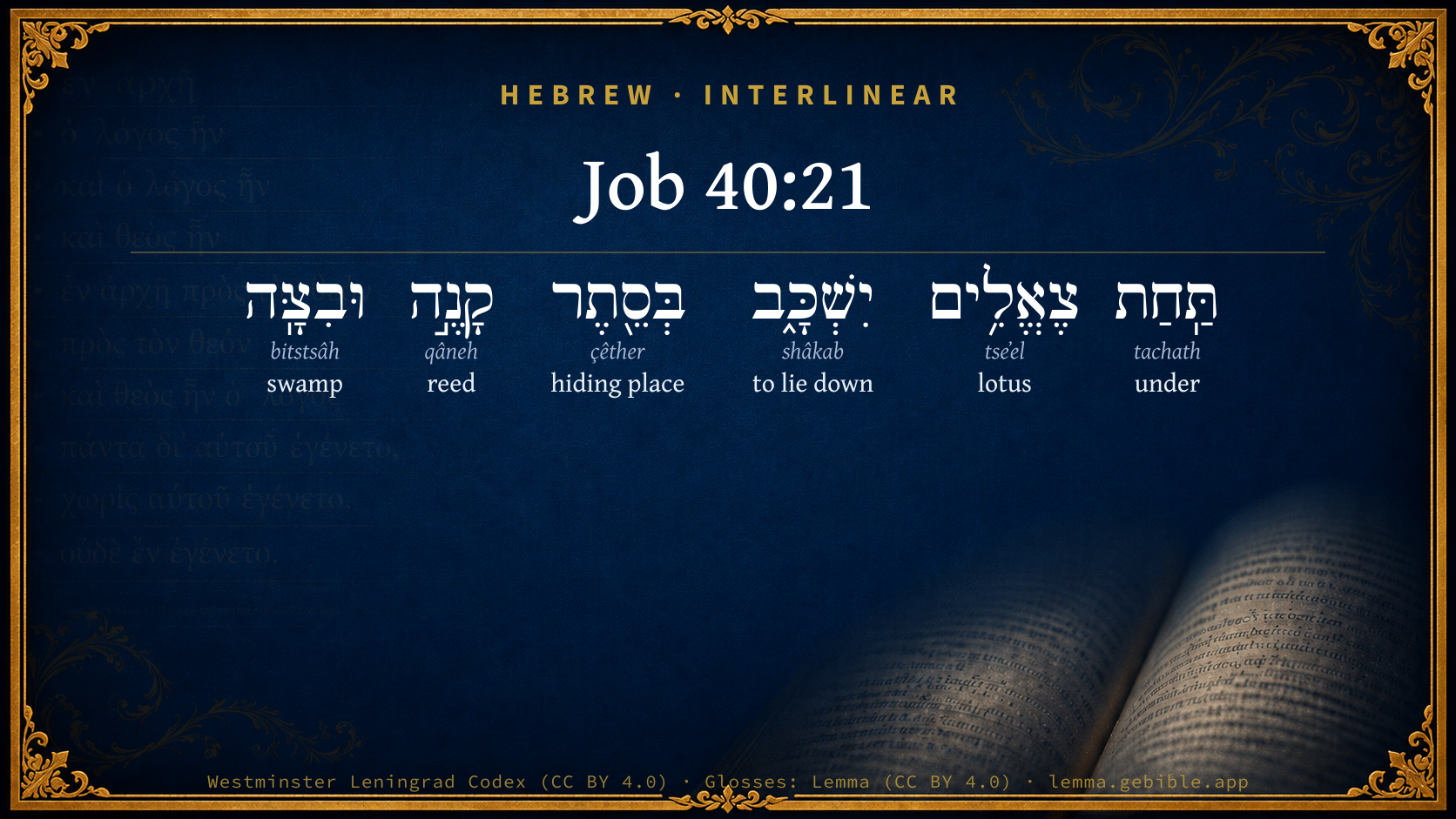
Job 40:21

Hebrew (Westminster Leningrad Codex) Job 40:21 appears in the Hebrew Old Testament. The text above is from the Westminster Leningrad Codex. Each word links to its Strong’s number, a concise gloss, and parsing drawn from the Open Scriptures Hebrew Bible morphology. Click any word for its full Brown-Driver-Briggs (BDB) entry.
Download image
Cite this verse

Job 40:21 (World English Bible). Public Domain. Lemma interlinear Bible study tool, https://lemma.gebible.app/v/job/40/21.

Show BibTeX & RIS
BibTeX
RIS
English Translation
He lies under the lotus trees, In the covert of the reed, and the marsh.
World English Bible · Public Domain
Highlights
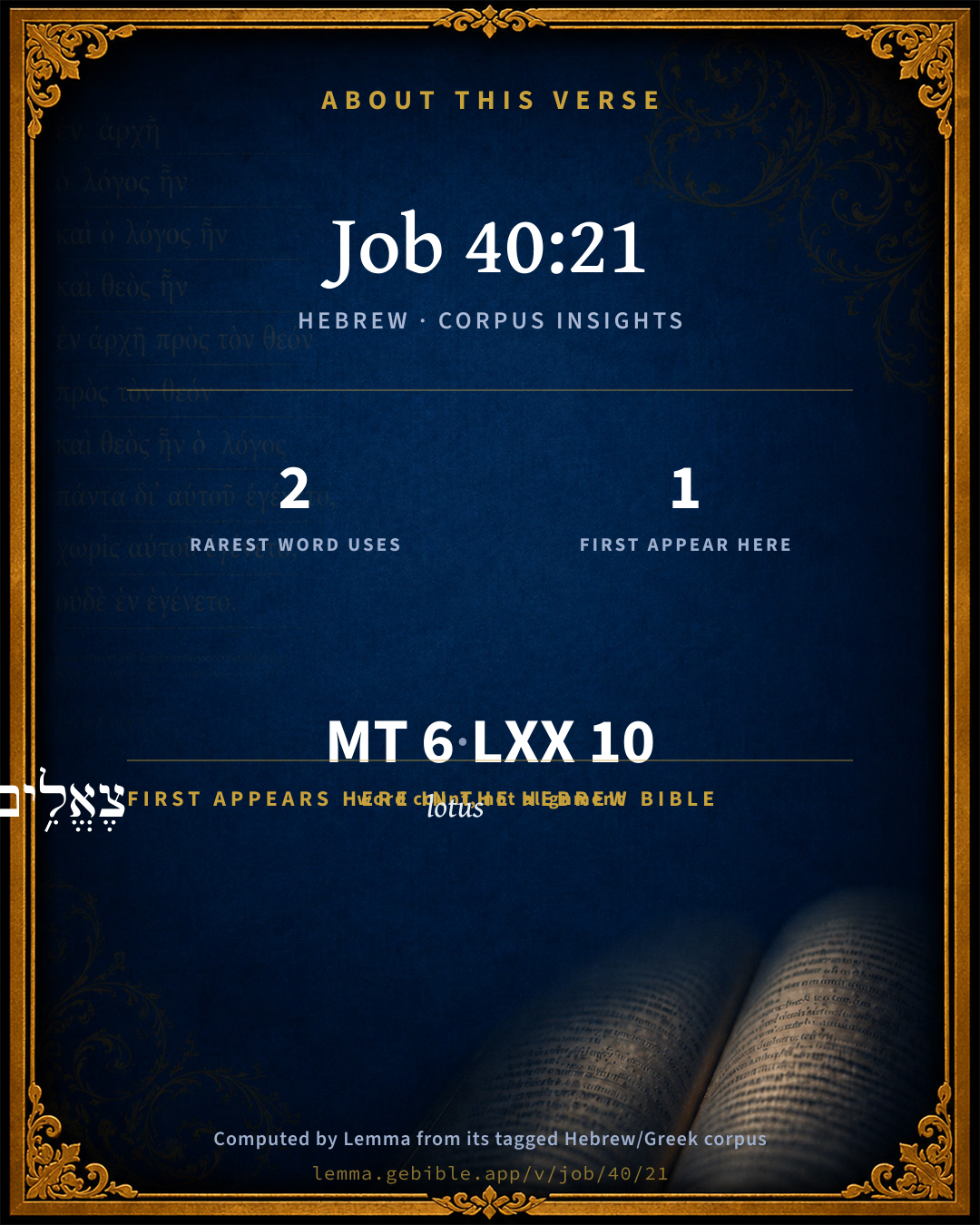
  • 1 first appearance in the Hebrew Bible
Full analysis ↓
Download a study sheet

One document with this verse’s original text, its word-by-word gloss line, the meaning frame, cross-references with their text, attributed commentary, and full source and license credits — printable, and it pastes into notes with its structure intact.

This verse Autodidact and up

Study sheet (.html) Plain text (.txt)

A passage Seminary Student

Up to 50 verses in one chapter. A passage sheet keeps up to 6 commentary sources and 12 cross-references per verse, in the order this page ranks them, and says so on the sheet whenever that leaves anything out. Ask for a single verse and you get the Autodidact verse sheet above.

Everything on this page stays free to read, with no account — the sheet is a download of what is already on screen, not access to it.

Want to remove ads? Support Godless Engineer
Compare translations 3

The same verse in 3 English versions, stacked beneath the original-language interlinear above. Click any original word for its lexicon entry.

Each is an independent rendering of the whole verse — the interlinear is not word-aligned to these translations.

Highlighted words mark where these versions differ — a whole-verse word diff, not a word-by-word alignment.

  • World English Bible Public Domain
    He lies under the lotus trees, In the covert of the reed, and the marsh.
  • King James Version Public Domain
    He lieth under the shady trees, in the covert of the reed, and fens.
  • unfoldingWord Literal Text CC BY-SA 4.0
    It lies beneath lotus trees, in the covering of the reed and the marsh.

unfoldingWord Literal Text — © unfoldingWord, licensed CC BY-SA 4.0. Word-aligned USFM3 via Door43 (git.door43.org/unfoldingWord/en_ult).

Versions to compare (up to 4)

3 of 4 selected

Show all 18 translations

Every available English version of this verse, each an independent rendering of the whole verse.

  • World English Bible Public Domain
    He lies under the lotus trees, In the covert of the reed, and the marsh.
  • Berean Standard Bible Public Domain
    He lies under the lotus plants, hidden among the reeds of the marsh.
  • Majority Standard Bible Public Domain
    He lies under the lotus plants, hidden among the reeds of the marsh.
  • King James Version Public Domain
    He lieth under the shady trees, in the covert of the reed, and fens.
  • American Standard Version (1901) Public Domain
    He lieth under the lotus-trees, In the covert of the reed, and the fen.
  • Revised Version (1885) Public Domain
    He lieth under the lotus trees, in the covert of the reed, and the fen.
  • Geneva Bible (1599) Public Domain
    Canst thou cast an hooke into his nose? canst thou perce his iawes with an angle?
  • Douay-Rheims (1899) Public Domain
    Canst thou put a ring in his nose, or bore through his jaw with a buckle?
  • Young's Literal Translation Public Domain
    Under shades he lieth down, In a secret place of reed and mire.
  • Literal Standard Version CC BY-SA 4.0
    He lies down under shades, || In a secret place of reed and marsh.
  • Unlocked Literal Bible CC BY-SA 4.0
    He lies under the lotus plants in the shelter of the reeds, in the marshes.
  • unfoldingWord Literal Text CC BY-SA 4.0
    It lies beneath lotus trees, in the covering of the reed and the marsh.
  • Darby Bible Public Domain
    He lieth under lotus-bushes, in the covert of the reed and fen:
  • World Messianic Bible Public Domain
    He lies under the lotus trees, in the covert of the reed, and the marsh.
  • Webster's Bible Public Domain
    \\41:2\\Canst thou put a hook into his nose? or bore his jaw through with a thorn?
  • Free Bible Version CC BY-SA 4.0
    It lies under the lotus; it hides in the reeds of the marsh.
  • Bible in Basic English Public Domain
    Will you put a cord into his nose, or take him away with a cord round his tongue?
  • JPS Tanakh (1917) Public Domain
    He lieth under the lotus-trees, in the covert of the reed, and fens.

Literal Standard Version (2020), Covenant Press — licensed CC BY-SA 4.0. Text via the HelloAO Bible API (eBible.org). Unlocked Literal Bible (unfoldingWord) — licensed CC BY-SA 4.0. Text via the HelloAO Bible API (eBible.org). unfoldingWord Literal Text — © unfoldingWord, licensed CC BY-SA 4.0. Word-aligned USFM3 via Door43 (git.door43.org/unfoldingWord/en_ult). Free Bible Version, Dr. Jonathan Gallagher — licensed CC BY-SA 4.0. Text via the HelloAO Bible API (eBible.org).

Word by word

More ways to search: Search by grammar → Find every occurrence → Compare this word →

Practice this passage: Drill this verse → Learn its vocabulary →

About this verse

These counts appear in no published source. They are computed here, from the morphology-tagged text and Lemma’s own curated glosses. What Lemma adds →

6
words
6
distinct lemmas
Wisdom
section

Notable vocabulary

The rarest word here is צֶאֱלִ֥ים lotus H6628 — appearing just 2 times in the whole Hebrew Bible.

First appearance in Scripture

This word makes its first canonical appearance in the Hebrew Bible here:

  • צֶאֱלִ֥ים lotus H6628

Shared distinctive vocabulary

צֶאֱלִ֥ים lotus H6628 occurs in 2 verses of the Hebrew Bible. Also found in:

Grammatical profile

  • 1 verb
  • 4 nouns
  • 1 preposition

Verb forms

  • יִשְׁכָּ֑ב Qal · Imperfect

Hebrew & Septuagint length

In English translation the verse runs 15 words from the Hebrew and 16 from the Septuagint (LXX English) — closely comparable.

A rough comparison of the two English renderings, which tokenize alike — not a word-level alignment.

Word counts can differ between the Hebrew and the Greek without any difference in meaning — e.g. the Hebrew direct-object marker אֵת has no separate Greek word, and Greek often adds the article ὁ.

In the original languages it is 6 Hebrew tokens and 10 Greek tokens — but the two are counted differently (Hebrew bundles its prefixes and suffixes into one token; the Greek is in lemma form), so that isn’t a like-for-like length.

Cross-references

2

Topical passages linked to Job 40:21 in the Treasury of Scripture Knowledge — connected by theme and wording, ordered by reader-vote popularity; previews shown in the World English Bible.

  • Isaiah 19:6–7 The rivers shall become foul; the streams of Egypt shall be diminished and dried up; the reeds and flags shall wither away.
  • Isaiah 35:7 The glowing sand shall become a pool, and the thirsty ground springs of water: in the habitation of jackals, where they lay, shall be grass with reeds and rushes.

Cross-references courtesy of OpenBible.info (CC BY 4.0).

Hebrew and Greek witnesses Masoretic Hebrew ↔ Greek Septuagint

The same verse in the two great witnesses to the Old Testament, shown verse-for-verse.

These are two independent witnesses, not word-aligned to each other, and the Septuagint is shown in lemma (dictionary) form.

Hebrew Job 40:21 Masoretic · Westminster Leningrad Codex

תַּֽחַת צֶאֱלִ֥ים יִשְׁכָּ֑ב בְּסֵ֖תֶר קָנֶ֣ה וּבִצָּֽה

He lies under the lotus trees, In the covert of the reed, and the marsh.

World English Bible · Public Domain

Greek LXX Job 40:21 Septuagint · lemma form

ὑπό παντοδαπός δένδρον κοιμάω παρά πάπυρος καί κάλαμος καί βούτομον

Or will you fasten a ring in his nostril, and bore his lip with a clasp?

LXX2012 (modern English Septuagint) · Public Domain

Hebrew: Westminster Leningrad Codex (CC BY 4.0). Greek: Septuagint (public domain); English from LXX2012 (modern English Septuagint) (Public Domain). How the Septuagint differs from the Hebrew →

Commentary

Notes on Job 40:21 from classic Christian and Jewish commentators (each source and its license shown beneath its notes). The classic Christian expositions comment on the surrounding passage and are grouped to its opening verse, so a note may address several verses; the Jewish commentaries on the Tanakh (Rashi and others) are per-verse, so they appear only where the commentator wrote on this verse.

Lemma curates 59 commentaries, every one of them public domain or Creative Commons licensed, each selected and text-cleaned for this edition rather than reprinted as found. About our sources →

John Gill's Exposition

The shady trees cover him with their shadow,.... Under which it lies, as in Job 40:21; which is thought not so well to agree with the elephant, since, according to Aelianus (h) and other writers, it lies not down, at least but rarely, but sleeps standing; it being very troublesome to it to lie down and rise up again; and besides it is represented by some authors (i) as higher than the trees, and therefore this is supposed to agree better with the river horse; especially since it follows,

the willows of the brook compass him about; or the willows of the Nile, as some choose to render it; which would put it out of all doubt that the river horse is intended, if it could be established, it being an inhabitant of that river; and yet the above writer (k) speaks of elephants, when grown old, seeking large thick and shady woods to take up their abode in.

(h) Ibid. (Aelian. de Animal.) c. 31. (i) Ibid. l. 7. c. 6. (k) Ibid. c. 2.

John Gill's Exposition of the Whole Bible (1746–1763) — public domain (CC PDM 1.0). Text via the HelloAO Bible API.

Trapp's Complete Commentary

John Trapp

Job 40:21 He lieth under the shady trees, in the covert of the reed, and fens.

Ver. 21. He lieth under the shady trees] Vatablus readeth the words questioning thus, Lieth he under the shady trees, in the covert of the reeds and fens? No such matter, he is too big to be shaded by trees; neither can reeds and fens cover him (So R. Levi, and Kimchi). But Aristotle tells us, That he loves to lie by the banks of rivers beset with trees, as being naturally hot, and bred in hot countries; and yet he is impatient with cold and winter (De Hist. Anim. l. 9, c. 46). And therefore when Hannibal brought many elephants out of Africa into italy, they all perished in the cold Alps, except only that one whereupon Hannibal himself rode (Pliny lib. 8, c. 10).

In the covert of the reed, and fens] Hence Cardinus saith, That the elephant is of a swinish nature, delighted with mud and mire, Ad calorem frangendum crasso coeno perfunduntur (Plin.). And Gulielmus Parisiensis applieth Behemoth in the fens, to the devil in sensual hearts. He sleepeth in moist places, saith he; that is, in those that lie melting in sinful pleasures and delights; therefore, Luk 11:24, it is said that he walketh in dry places, seeking rest, but finding none; and, Eze 47:11, when the waters of the sanctuary overflowed, the miry places could not be healed.

John Trapp, A Commentary or Exposition upon All the Books of the Old and New Testament (1647–1656) — public domain. Text from a community e-Sword module.

Joseph Benson's Commentary

Job 40:21-22. He lieth under the shady trees, &c. — Or, He lieth down secretly between the shady trees, under the covert of the reed, and in the fens, Houbigant and Heath. The shady trees cover him — The Hebrew, literally translated, is, The shady trees, (צללו, tzillo,) his shadow, cover him, or, are his arbour: the willows of the brook, or, as נחל, nachal, is often rendered, of the river, compass him about. Bochart argues, that the elephant is not described here, because he rarely lies down, sed rectus dormit, sleeps standing upright. And he quotes a passage from Marcellinus, exactly parallel to this, to show that it is perfectly applicable to the river-horse, which inter arundines celsas et squalentes nimia densitate cubilia ponit, makes his bed among the lofty reeds and in muddy fens.

Joseph Benson's Commentary on the Old and New Testaments (1811–1818) — public domain. Text from a community e-Sword module.

Geneva Bible (1599)

Geneva Bible translators

Because he feareth lest thou shouldest take him.

Geneva Bible (1599) marginal notes — public domain. Text via Bolls.life.

Jamieson, Fausset & Brown

Robert Jamieson, A. R. Fausset & David Brown

lieth--He leads an inactive life.

shady trees--rather, "lotus bushes"; as Job 40:22 requires.

Jamieson, Fausset & Brown — Commentary Critical and Explanatory on the Whole Bible (1871) — public domain (CC PDM 1.0). Text via the HelloAO Bible API.

Adam Clarke's Commentary

Verse 21. He lieth under the shady trees] This and the following verses refer to certain habits of the behemoth, with which we are and must be unacquainted,

Adam Clarke's Commentary on the Bible (1810–1826) — public domain. Text from a community e-Sword/MySword module.

Ellicott's Commentary for English Readers

(21) He lieth under the shady trees.—If this description applies to any one animal, it seems on the whole more appropriate to the elephant than the hippopotamus. No doubt the judgment of critics has been biased by their pre-conceived notions about the circumstances under which they suppose the Book of Job to have been written; and the author was more likely, it is thought, to have been acquainted with the river-horse of Egypt than with the elephant of India, though, to be sure, elephants abound also in Africa, and may very well have been known to the writer of Job from that quarter, if the other is less likely.

A Bible Commentary for English Readers, edited by Charles John Ellicott (1878–1897) — public domain. Text from a community e-Sword module.

The Cambridge Bible for Schools and Colleges

gen. ed. J. J. S. Perowne

21. the shady trees] Rather, the lotus trees. And so in Job_40:22.

The Cambridge Bible for Schools and Colleges (gen. ed. J. J. S. Perowne; Cambridge University Press, 1878–1918) — public domain. Text from a community e-Sword module.

Albert Barnes' Notes on the Bible

He lieth under the shady trees - Referring to his usually inactive and lazy life. He is disposed to lie down in the shade, and especially in the vegetable growth in marshy places on the banks of lakes and rivers, rather than to dwell in the open field or in the upland forest. This account agrees well with the habits of the hippopotamus. The word here and in Job 40:22 rendered “shady trees” (צאלים tse'eliym), is by Gesenius, Noyes, Prof. Lee, and Schultens, translated “lotus,” and “wild lotus.” The Vulgate, Syriac, Rosenmuller, Aben-Ezra, and others, render it “shady trees.” It occurs nowhere else in the Scriptures, and it is difficult, therefore, to determine its meaning. According to Schultens and Gesenius, it is derived from the obsolete word צאל tsā'al, “to be thin, slender;” and hence, in Arabic it is applied to the “wild lotus” - a plant that grows abundantly on the banks of the Nile, and that often serves the wild beasts of the desert for a place of retreat. It is not very important whether it be rendered the “lotus,” or “shades,” though the probable derivation of the word seems to favor the former.

In the covert of the reed - It is well known that reeds abounded on the banks of the Nile. These would furnish a convenient and a natural retreat for the hippopotamus.

And fens - בצה bitstsâh - “marsh, marshy places.” This passage proves that the elephant is not here referred to. He is never found in such places.

Albert Barnes' Notes on the Bible (1834–1885) — public domain. Text from a community e-Sword/MySword module.

Haydock's Catholic Bible Commentary

Buckle. Literally, "bracelet," (armilla.; Haydock) or ring. Horses were thus ornamented, (Virgil vii. 7.) and other beasts led about. But this fierce animal could not be tamed. Hebrew, "Wilt thou put a rush through its gills, or nose, or pierce its jaw with a thorn?" like those little fishes which are thus brought fresh to market. (Calmet)

George Leo Haydock (1774–1849), Haydock's Catholic Family Bible and Commentary, 1859 edition — public domain. Excludes Psalms (Douay-Rheims chapter numbering differs from Protestant) and Deuterocanonical books (Catholic canon only).

Matthew Poole's English Annotations

The elephant lies down to rest himself; and it is but fabulous which some writers affirm, that they have no joints in their legs, and so cannot lie down, but sleep or rest themselves standing or leaning against a tree; which is denied and confuted by Aristotle in his History of Living Creatures, 2, 4. and by later writers. For the elephant, being a creature naturally hot, and living generally in hot countries, diligently seeks for and delights in shady and waterish places, as is noted by Aristotle, and after him by Pliny and Ælian.

Matthew Poole's English Annotations on the Holy Bible (1683–1685) — public domain. Text from a community e-Sword/MySword module.

Whedon's Commentary on the Bible

Daniel D. Whedon

21. Shady trees — Lotus trees. The lotus silvestris, a thorny shrub, bearing fruit-like plumes, growing abundantly in Syria, Arabia, and along the banks of the upper Nile.

The reed — Hebrews, kaneh; Greek and Latin, canna, from which probably comes our own word cane. It is a shrub plant, with a knotty root, out of which spring many long, hollow stems; the arundo donax of Linnaeus, which was common on the banks of the Nile. Several species of reed still grow along the Jordan as well as the Nile. According to Rosenmuller, (Biblical Botany, p. 185,) the Hebrews used the word kaneh for reeds in general, and agmon for rushes, as in Job_41:2, which see; also Job_41:20.

And fens — Bitsah, rendered mire in Job_8:11. Wilkinson gives a pictorial representation from the monuments, of this animal lying among tall reeds and beneath the shade of the lotus. (Ancient Egyptians, 3:71.)

Daniel D. Whedon (gen. ed.), Commentary on the Old and New Testaments (1874–1909) — public domain. Text from a community e-Sword module.

The Pulpit Commentary

He listh under the shady trees; or, under the lotus trees (Revised Version). The Lotus sylvestris" or Lotus Cyrenaiea" "grows abundantly on the hot banks of the Upper Nile" (Cook). and is thought to be the tree here intended (Schultens. Cook, Houghton, and others). But the identification is very doubtful. The dense shade of trees is sought alike by the hippopotamus and the elephant. In the covert of the reed, and fens. This is exactly descriptive of the hippopotamus; far less so of the elephant. Gordon Cumming says, "At every turn there occurred deep still pools, and occasional sandy islands, densely clad with lofty reeds Above and beyond these reeds stood trees of immense age. beneath which grew a rank kind of grass, on which the sea-cow (hippopotamus) delights to pasture" ("Lion-Hunter of South Africa," p. 297).

The Pulpit Commentary (1880–1919), ed. H.D.M. Spence-Jones & Joseph S. Exell — public domain. Text from a community e-Sword module.

Rashi

Rabbi Shlomo Yitzchaki (Rashi)

the shadows the shades of trees.

Rashi on the Tanakh — English translations: “The Judaica Press complete Tanach with Rashi, translated by A. J. Rosenberg” (CC BY 4.0); “Pentateuch with Rashi's commentary by M. Rosenbaum and A.M. Silbermann, 1929-1934” (public domain); “The Metsudah Tanach series, Lakewood, N.J” (CC BY 4.0); and “The Book of Joshua, Metsudah Publications, 1997” (CC BY 4.0). Text via Sefaria.

Lesson kit

Teaching starters — assembled from the data on this page, not authored interpretation. Every prompt links to the verse data it draws on. Edit before teaching.

Job, in the Wisdom, opens this verse with 6 words (6 distinct Hebrew lemmas). Its most distinctive word is tseʼel (“lotus”). A historical commentator’s framing appears above. Read the whole chapter for the surrounding context.

Discussion questions

  1. How does “lotus” (tseʼel) shape what this verse is saying?
  2. The word “lotus” first appears here in Scripture. What is being introduced at this debut?
  3. Job 40:22 shares the word «lotus» with this verse. How do the two illuminate each other?
  4. These translations render this verse differently. What is at stake in choosing one wording over another?
  5. The verb «יִשְׁכָּ֑ב» is Qal Imperfect. How does its form color the action?
  6. Reading how John Gill's Exposition and Trapp's Complete Commentary read this verse, where do the two commentators agree and where do they part?

Things to notice

Reading settings

Reading text

Shown beneath each verse's original-language words.

Old Testament
Old Testament edition

Read the OT as the Masoretic Hebrew (MT) or the Greek Septuagint (LXX).

English shown for the Greek Septuagint (in the Hebrew ↔ Greek comparison).

Comparing translations? Open the Compare panel on any verse page to stack up to four side by side.