
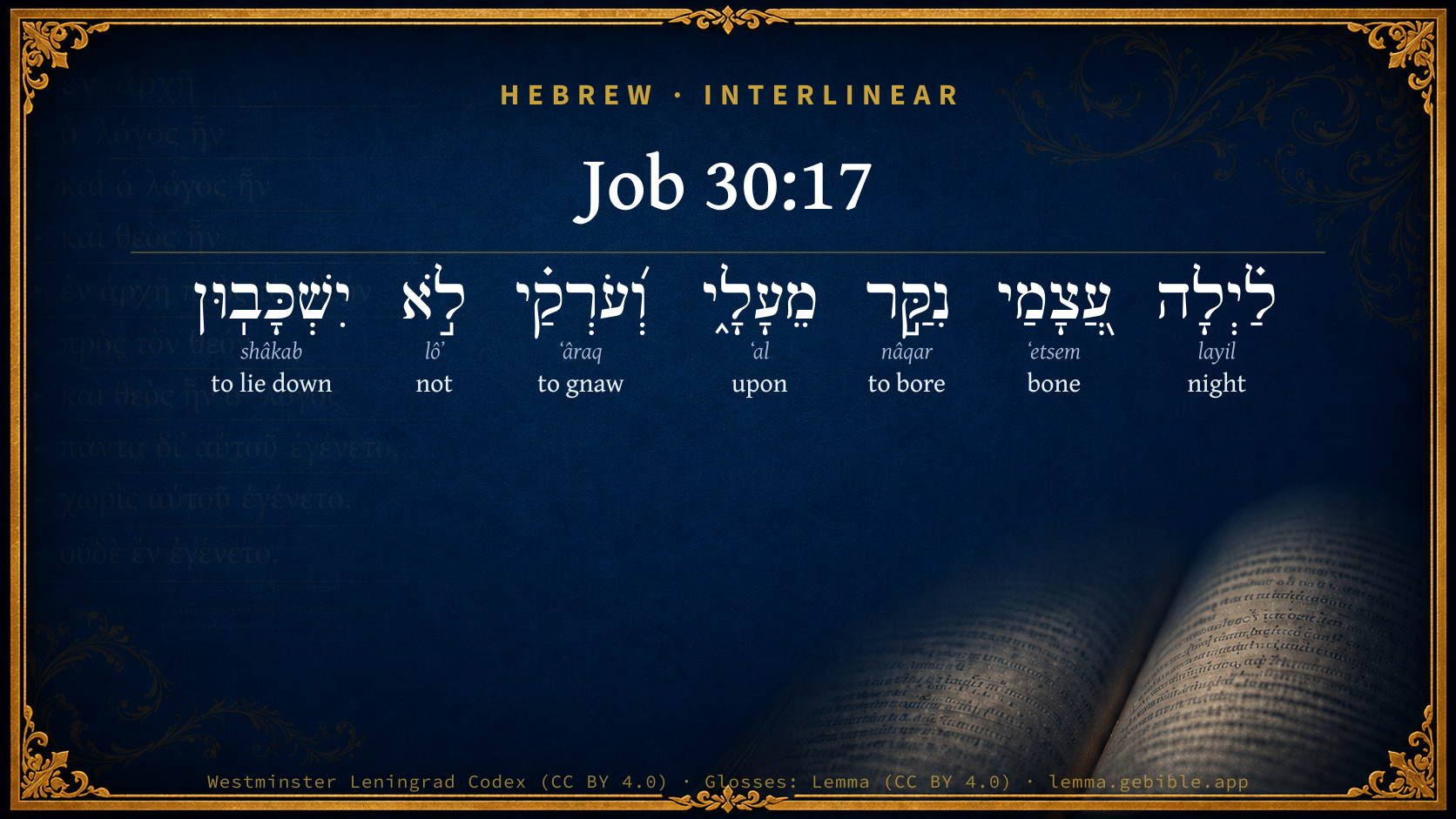
Job 30:17

Hebrew (Westminster Leningrad Codex) Job 30:17 appears in the Hebrew Old Testament. The text above is from the Westminster Leningrad Codex. Each word links to its Strong’s number, a concise gloss, and parsing drawn from the Open Scriptures Hebrew Bible morphology. Click any word for its full Brown-Driver-Briggs (BDB) entry.
Download image
Cite this verse

Job 30:17 (World English Bible). Public Domain. Lemma interlinear Bible study tool, https://lemma.gebible.app/v/job/30/17.

Show BibTeX & RIS
BibTeX
RIS
English Translation
In the night season my bones are pierced in me, And the pains that gnaw me take no rest.
World English Bible · Public Domain
Download a study sheet

One document with this verse’s original text, its word-by-word gloss line, the meaning frame, cross-references with their text, attributed commentary, and full source and license credits — printable, and it pastes into notes with its structure intact.

This verse Autodidact and up

Study sheet (.html) Plain text (.txt)

A passage Seminary Student

Up to 50 verses in one chapter. A passage sheet keeps up to 6 commentary sources and 12 cross-references per verse, in the order this page ranks them, and says so on the sheet whenever that leaves anything out. Ask for a single verse and you get the Autodidact verse sheet above.

Everything on this page stays free to read, with no account — the sheet is a download of what is already on screen, not access to it.

Want to remove ads? Support Godless Engineer
Compare translations 3

The same verse in 3 English versions, stacked beneath the original-language interlinear above. Click any original word for its lexicon entry.

Each is an independent rendering of the whole verse — the interlinear is not word-aligned to these translations.

Highlighted words mark where these versions differ — a whole-verse word diff, not a word-by-word alignment.

  • World English Bible Public Domain
    In the night season my bones are pierced in me, And the pains that gnaw me take no rest.
  • King James Version Public Domain
    My bones are pierced in me in the night season: and my sinews take no rest.
  • unfoldingWord Literal Text CC BY-SA 4.0
    Night pierces my bones from upon me, and the ones gnawing me do not rest.

unfoldingWord Literal Text — © unfoldingWord, licensed CC BY-SA 4.0. Word-aligned USFM3 via Door43 (git.door43.org/unfoldingWord/en_ult).

Versions to compare (up to 4)

3 of 4 selected

Show all 18 translations

Every available English version of this verse, each an independent rendering of the whole verse.

  • World English Bible Public Domain
    In the night season my bones are pierced in me, And the pains that gnaw me take no rest.
  • Berean Standard Bible Public Domain
    Night pierces my bones, and my gnawing pains never rest.
  • Majority Standard Bible Public Domain
    Night pierces my bones, and my gnawing pains never rest.
  • King James Version Public Domain
    My bones are pierced in me in the night season: and my sinews take no rest.
  • American Standard Version (1901) Public Domain
    In the night season my bones are pierced in me, And the `pains' that gnaw me take no rest.
  • Revised Version (1885) Public Domain
    In the night season my bones are pierced in me, and the pains that gnaw me take no rest.
  • Geneva Bible (1599) Public Domain
    It pearceth my bones in the night, and my sinewes take no rest.
  • Douay-Rheims (1899) Public Domain
    In the night my bone is pierced with sorrows: and they that feed upon me, do not sleep.
  • Young's Literal Translation Public Domain
    At night my bone hath been pierced in me, And mine eyelids do not lie down.
  • Literal Standard Version CC BY-SA 4.0
    [At] night my bone has been pierced in me, || And my gnawing [pain] does not lie down.
  • Unlocked Literal Bible CC BY-SA 4.0
    In the night my bones in me are pierced; the pains that gnaw at me take no rest.
  • unfoldingWord Literal Text CC BY-SA 4.0
    Night pierces my bones from upon me, and the ones gnawing me do not rest.
  • Darby Bible Public Domain
    The night pierceth through my bones [and detacheth them] from me, and my gnawing pains take no rest:
  • World Messianic Bible Public Domain
    In the night season my bones are pierced in me, and the pains that gnaw me take no rest.
  • Webster's Bible Public Domain
    My bones are pierced in me in the night season: and my sinews take no rest.
  • Free Bible Version CC BY-SA 4.0
    At night my bones are in agony; the pain gnaws at me and never stops.
  • Bible in Basic English Public Domain
    The flesh is gone from my bones, and they give me no rest; there is no end to my pains.
  • JPS Tanakh (1917) Public Domain
    In the night my bones are pierced, and fall from me, and my sinews take no rest.

Literal Standard Version (2020), Covenant Press — licensed CC BY-SA 4.0. Text via the HelloAO Bible API (eBible.org). Unlocked Literal Bible (unfoldingWord) — licensed CC BY-SA 4.0. Text via the HelloAO Bible API (eBible.org). unfoldingWord Literal Text — © unfoldingWord, licensed CC BY-SA 4.0. Word-aligned USFM3 via Door43 (git.door43.org/unfoldingWord/en_ult). Free Bible Version, Dr. Jonathan Gallagher — licensed CC BY-SA 4.0. Text via the HelloAO Bible API (eBible.org).

Word by word

More ways to search: Search by grammar → Find every occurrence → Compare this word →

Practice this passage: Drill this verse → Learn its vocabulary →

About this verse

These counts appear in no published source. They are computed here, from the morphology-tagged text and Lemma’s own curated glosses. What Lemma adds →

7
words
7
distinct lemmas
Wisdom
section

Notable vocabulary

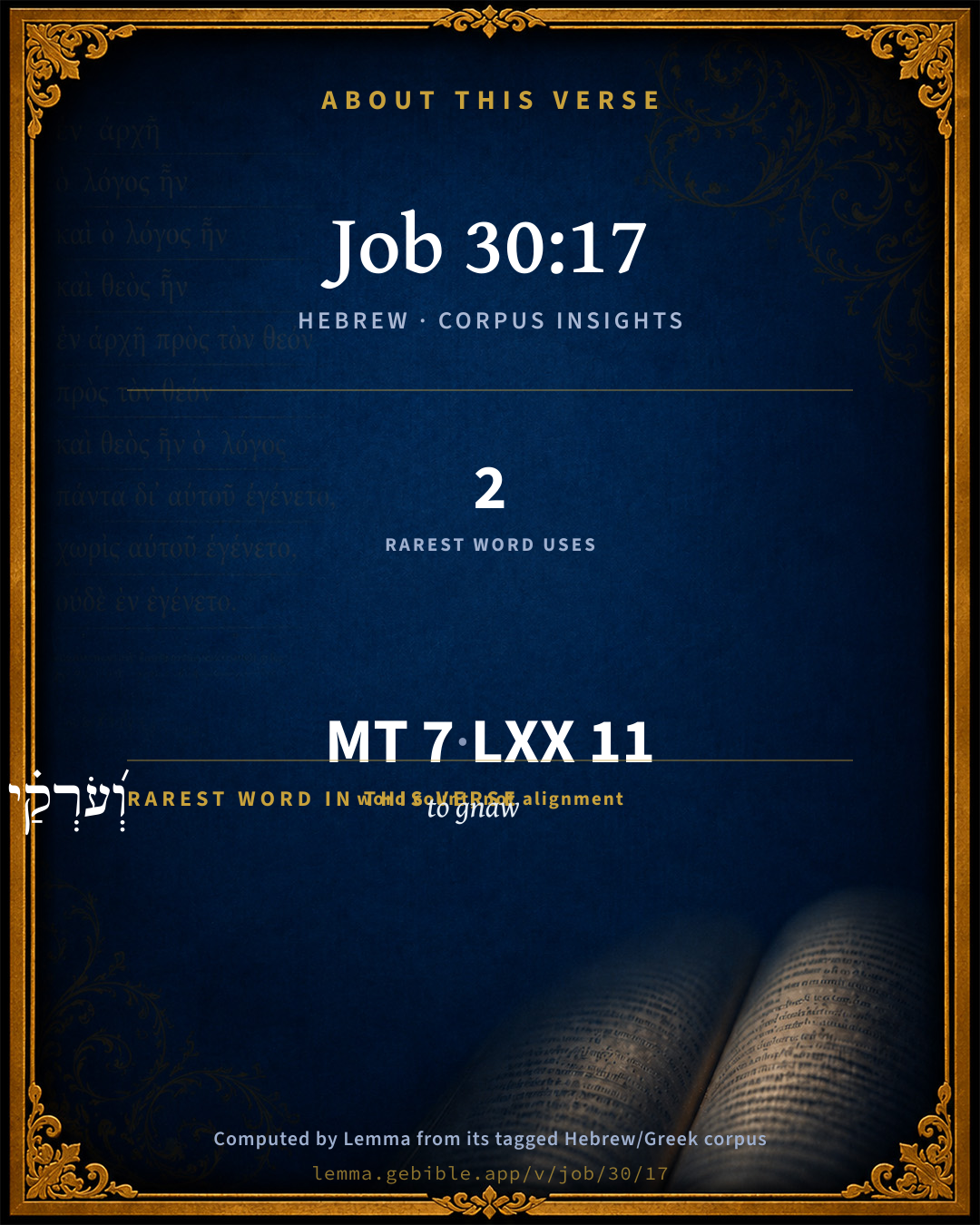
The rarest word here is וְ֝עֹרְקַ֗י to gnaw H6207 — appearing just 2 times in the whole Hebrew Bible.

Shared distinctive vocabulary

וְ֝עֹרְקַ֗י to gnaw H6207 occurs in 2 verses of the Hebrew Bible. Also found in:

Grammatical profile

  • 3 verbs
  • 2 nouns
  • 1 preposition
  • 1 particle

Verb forms

  • נִקַּ֣ר Piel · Perfect
  • וְ֝עֹרְקַ֗י Qal · Participle Active
  • יִשְׁכָּבֽוּן Qal · Imperfect

Hebrew & Septuagint length

In English translation the verse runs 19 words from the Hebrew and 12 from the Septuagint (LXX English) — the Septuagint runs noticeably shorter here. See the side-by-side →

A rough comparison of the two English renderings, which tokenize alike — not a word-level alignment.

Word counts can differ between the Hebrew and the Greek without any difference in meaning — e.g. the Hebrew direct-object marker אֵת has no separate Greek word, and Greek often adds the article ὁ.

In the original languages it is 7 Hebrew tokens and 11 Greek tokens — but the two are counted differently (Hebrew bundles its prefixes and suffixes into one token; the Greek is in lemma form), so that isn’t a like-for-like length.

Cross-references

6

Topical passages linked to Job 30:17 in the Treasury of Scripture Knowledge — connected by theme and wording, ordered by reader-vote popularity; previews shown in the World English Bible.

  • Job 7:4 When I lie down, I say, 'When shall I arise, and the night be gone?' I toss and turn until the dawning of the day.
  • Job 33:19–21 He is chastened also with pain on his bed, With continual strife in his bones;
  • Psalms 6:2–6 Have mercy on me, Yahweh, for I am faint. Yahweh, heal me, for my bones are troubled.
  • Psalms 22:2 My God, I cry in the daytime, but you don't answer; In the night season, and am not silent.
  • Isaiah 38:13 I quieted [myself] until morning; as a lion, so he breaks all my bones: From day even to night will you make an end of me.
  • Psalms 38:2–8 For your arrows have pierced me, Your hand presses hard on me.

Cross-references courtesy of OpenBible.info (CC BY 4.0).

Hebrew and Greek witnesses Masoretic Hebrew ↔ Greek Septuagint

The same verse in the two great witnesses to the Old Testament, shown verse-for-verse.

Here the Septuagint runs noticeably shorter than the Hebrew — LXX2012 (modern English Septuagint) 12 words vs World English Bible 19. A rough length comparison of the two English translations, not a word-level alignment — read both below.

These are two independent witnesses, not word-aligned to each other, and the Septuagint is shown in lemma (dictionary) form.

Hebrew Job 30:17 Masoretic · Westminster Leningrad Codex

לַ֗יְלָה עֲ֭צָמַי נִקַּ֣ר מֵעָלָ֑י וְ֝עֹרְקַ֗י לֹ֣א יִשְׁכָּבֽוּן

In the night season my bones are pierced in me, And the pains that gnaw me take no rest.

World English Bible · Public Domain

Greek LXX Job 30:17 Septuagint · lemma form

νύξ δέ ἐγώ ὁ ὀστέον συνκαίω ὁ δέ νεῦρον ἐγώ διαλύω

And by night my bones are confounded; and my sinews are relaxed.

LXX2012 (modern English Septuagint) · Public Domain

On this verse, Albert Barnes' Notes on the Bible discusses the Septuagint’s reading. Read the note in Commentary ↓

Hebrew: Westminster Leningrad Codex (CC BY 4.0). Greek: Septuagint (public domain); English from LXX2012 (modern English Septuagint) (Public Domain). How the Septuagint differs from the Hebrew →

Commentary

Notes on Job 30:17 from classic Christian and Jewish commentators (each source and its license shown beneath its notes). The classic Christian expositions comment on the surrounding passage and are grouped to its opening verse, so a note may address several verses; the Jewish commentaries on the Tanakh (Rashi and others) are per-verse, so they appear only where the commentator wrote on this verse.

Lemma curates 59 commentaries, every one of them public domain or Creative Commons licensed, each selected and text-cleaned for this edition rather than reprinted as found. About our sources →

Trapp's Complete Commentary

John Trapp

Job 30:17 My bones are pierced in me in the night season: and my sinews take no rest.

Ver. 17. My bones are pierced in me in the night season] Sleep is the nurse of nature, and the sweet parenthesis of men’s griefs and cares. But Job had so many aches and ailments in his body (over and above the terrors and troubles of his mind), that rest he could take none at all in the night season, when all creatures are wont to be at quiet. For for what reason? the very marrow of his bones raged through intolerable pain; as if it had been run through with a tuck. Nay more,

And my sinews (or, my pulses) take no rest] Heb. Sleep not; my sinews or arteries are racked with the cramp; and my pulses, by the force of fever, beat excessively, and pant without intermission; Qui tamen minui deberent, quia calor retrahitur in partem interiorem; which yet should move more slowly by night, because then the heat is drawn into the internal parts (Vatablus).

John Trapp, A Commentary or Exposition upon All the Books of the Old and New Testament (1647–1656) — public domain. Text from a community e-Sword module.

Geneva Bible (1599)

Geneva Bible translators

Meaning, sorrow.

Geneva Bible (1599) marginal notes — public domain. Text via Bolls.life.

Jamieson, Fausset & Brown

Robert Jamieson, A. R. Fausset & David Brown

In the Hebrew, night is poetically personified, as in Job 3:3 : "night pierceth my bones (so that they fall) from me" (not as English Version, "in me"; see Job 30:30).

sinews--so the Arabic, "veins," akin to the Hebrew; rather, "gnawers" (see on Job 30:3), namely, my gnawing pains never cease. Effects of elephantiasis.

Jamieson, Fausset & Brown — Commentary Critical and Explanatory on the Whole Bible (1871) — public domain (CC PDM 1.0). Text via the HelloAO Bible API.

The Cambridge Bible for Schools and Colleges

gen. ed. J. J. S. Perowne

17. His tormenting pains.

In the night season my bones are pierced (and fall) off from me,

And my gnawing pains take no rest.

The first clause refers to his tormenting pains, severest in the night, under which his bones seem pierced and his limbs to be wrenched from him. “My gnawing pains” is lit. my gnawers.

The Cambridge Bible for Schools and Colleges (gen. ed. J. J. S. Perowne; Cambridge University Press, 1878–1918) — public domain. Text from a community e-Sword module.

John Gill's Exposition

My bones are pierced in me in the night season,.... Such was the force of his disease, that it pierced and penetrated even into his bones, and the marrow of them; and such the pain that he endured in the muscles and tendons about them, and especially in the joints of them, that it was as if all his bones were piercing and breaking to pieces; he was in a like condition the sick man is described in Job 33:19; and as David and Hezekiah were, Psa 6:2; and what aggravated his case was, that this was "in the night season", when he should have got some sleep and rest, but could not for his pain: some render the words by supplying them thus; God, or the disease, or the pain, pierced my bones in the night season; or "the night pierced my bones from me"; so Mr. Broughton; but rather they may be rendered, and the sense be,

"in the night season everyone of my bones pierce "the flesh" that is upon me:''

his flesh was almost wasted and consumed, through the boil and ulcers on him, and he was reduced to a mere skeleton; and when he laid himself down on his bed, these pierced through his skin, and stuck out, and gave him exquisite pain:

and my sinews take no rest; being contracted; or his nerves, as the word in the Arabic language signifies, as is observed by Aben Ezra, Jarchi, Donesh, and others; which were loosened, and the animal spirits were sunk, and he so low and dispirited, that he could get no rest: or the pulsatile veins and arteries, as Ben Gersom and Elias Levita (a), in which the pulse beats, and which beats with less strength when persons are asleep than when awake; but such was the force of Job's disease, that it beat even in the night, when on his bed, so strongly, that he could take no rest for it; the pulse beats, as physicians say (b), sixty times in a minute, and double the number in a burning fever, and which might be Job's case. Some take the word in the sense of fleeing or gnawing (c), as it is used Job 30:3; and interpret it either of his enemies, who pursued after him, and had no rest in their beds, but went out in the night to inquire and hear what they could learn concerning him and his illness, whether it was become greater (d); or who devoured him by their calumnies and detractions, and could not sleep unless they did mischief to him; see Pro 4:16; or of the worms with which his body was covered, and which were continually gnawing, never rested, nor suffered him to take any rest; the Targum is, they that gnash at me rest not.

(a) In Tishbi, p. 67. So Lud. Capellus in loc. (b) Scheuchzer. Physic. Sacr. vol. 4. p 764. (c) "et rodentia mea", Schultens; "fugientia membra mea", so some in Michaelis. (d) Vid. Bar Tzemach in loc.

John Gill's Exposition of the Whole Bible (1746–1763) — public domain (CC PDM 1.0). Text via the HelloAO Bible API.

Albert Barnes' Notes on the Bible

My bones are pierced in me - The bones are often represented in the Scriptures as the seat of acute pain; Psa 6:2; Psa 22:14; Psa 31:10; Psa 38:3; Psa 42:10; Pro 14:30; compare Job 20:11. The meaning here is, that he had had shooting or piercing pains in the night, which disturbed and prevented his rest. It is mentioned as a special aggravation of his sufferings that they were “in the night” - a time when we expect repose.

And my sinews take no rest - See the word here rendered sinews explained in the note at ver. 3. The word literally means gnawers, and hence, the teeth. The Vulgate renders it, qui me comedunt, non dormiunt, “they who devour me do not slumber.” The Septuagint, νευρά μον neura mou - my sinews, or arteries. Schleusner. Luther, “They who gnaw me.” Coverdale, Sinews. I see no reason to doubt that the teeth or the jaws are meant, and that Job refers to the violent pain in the tooth, among the acutest pains to which the body is subject. The idea is, that every part of the body was diseased and filled with pain.

Albert Barnes' Notes on the Bible (1834–1885) — public domain. Text from a community e-Sword/MySword module.

Haydock's Catholic Bible Commentary

They that. Heberw, "my sinews take no rest." Septuagint, "are dissolved." (Haydock) --- The worms prey upon me, and I am like one in a raging fever. (Calmet)

George Leo Haydock (1774–1849), Haydock's Catholic Family Bible and Commentary, 1859 edition — public domain. Excludes Psalms (Douay-Rheims chapter numbering differs from Protestant) and Deuterocanonical books (Catholic canon only).

Matthew Poole's English Annotations

My bones are pierced: Heb. It, to wit, the terror or affliction last mentioned; or, He, i.e. God, hath pierced my bones. This is no slight and superficial, but a most deep wound, that reacheth to my very heart, and bones, and marrow. Nothing in me is so secret but it reacheth it, nothing so hard and solid but it feels the weight and burden of it.

In me, Heb. from above me, by an arrow shot from Heaven, whence my calamities come, and that in a singular and eminent manner. Or, by that which is upon me: the sores which are upon my skin, or outward flesh, do pierce and pain me even to the bones. For now he is come from describing the terrors of his mind, to express the torments of his body.

In the night season; when others do, and I should, receive some rest and refreshment.

My sinews; and the flesh of my body which covereth the sinews, and is mixed with them, and may seem to be synecdochically expressed by the sinews, which are the strength and support of the flesh. So he signifies that neither his bones nor his flesh resteth. Or, and my veins or arteries, which rest or move slowly when the mind and body are well composed; but in Job did move vehemently and restlessly, by reason of his great heat, and pain, and passion.

Matthew Poole's English Annotations on the Holy Bible (1683–1685) — public domain. Text from a community e-Sword/MySword module.

Whedon's Commentary on the Bible

Daniel D. Whedon

17. My bones are pierced — According to many, night is here personified, thus: The night pierces my bones. Night intensifies pain and sorrow. Job attributes to night, as an agent, the work done in the night. See note Job_3:3. Herder calls Job the brother of Ossian in personification.

In me — Literally, From upon me. So that they (the bones) are detached from him. It is possible that Job was already maimed by this “maiming disease.” See note Job_2:7, and below Job_30:30. Sinews — Same as in Job_30:3, gnawers, that is, the gnawing disease or gnawing pains; possibly worms, the maggots in his ulcers, Job_7:5.

Daniel D. Whedon (gen. ed.), Commentary on the Old and New Testaments (1874–1909) — public domain. Text from a community e-Sword module.

The Pulpit Commentary

My bones are pierced in me in the night season. In Elephantiasis anaesthetics" says Dr. Erasmus Wilson, "when the integument is insensible, there are deep-seated burning pains, sometimes of a bone or joint, and sometimes of the vertebral column. These pains are greatest at night; they prevent sleep, and give rise to restlessless and frightful dreams" (Quain"s "Dictionary of Medicine," vol. 1. p. 817). And my sinews take no rest; rather, my gnawings, or my gnawing pains (see the Revised Version; and comp. ver. 3, where the same word is properly rendered by "gnawing the wilderness").

The Pulpit Commentary (1880–1919), ed. H.D.M. Spence-Jones & Joseph S. Exell — public domain. Text from a community e-Sword module.

Rashi

Rabbi Shlomo Yitzchaki (Rashi)

are picked off Heb. נקר, like (Num. 16:14), “will you put out (תנקר) the eyes of those people?” (forer in French, to bore). The worms pick my flesh off my bones.

my sinews Heb. עֹרְקַי. My sinews have no rest. Sinew in Arabic is “orek.” So did Dunash explain it (Teshuvoth Dunash p.85). Another explanation: עֹרְקַי, my pursuers who cause me to flee. (Machbereth Menachem p. 139)

Rashi on the Tanakh — English translations: “The Judaica Press complete Tanach with Rashi, translated by A. J. Rosenberg” (CC BY 4.0); “Pentateuch with Rashi's commentary by M. Rosenbaum and A.M. Silbermann, 1929-1934” (public domain); “The Metsudah Tanach series, Lakewood, N.J” (CC BY 4.0); and “The Book of Joshua, Metsudah Publications, 1997” (CC BY 4.0). Text via Sefaria.

Lesson kit

Teaching starters — assembled from the data on this page, not authored interpretation. Every prompt links to the verse data it draws on. Edit before teaching.

Job, in the Wisdom, opens this verse with 7 words (7 distinct Hebrew lemmas). Its most distinctive word is ʻâraq (“to gnaw”). The Greek Septuagint runs shorter here. A historical commentator’s framing appears above. Read the whole chapter for the surrounding context.

Discussion questions

  1. The word ʻâraq carries the sense “to gnaw.” How does it shape the verse?
  2. Job 30:3 shares the word «to gnaw» with this verse. How do the two illuminate each other?
  3. Compared with the Hebrew, the Septuagint runs shorter here. What questions does that raise?
  4. The translations on this page render this verse differently — a whole-verse word diff, not a word-by-word alignment. What might account for the different wordings?
  5. The verb «נִקַּ֣ר» is Piel Perfect. How does its form color the action?
  6. Reading how Trapp's Complete Commentary and Geneva Bible (1599) read this verse, where do the two commentators agree and where do they part?

Things to notice

Reading settings

Reading text

Shown beneath each verse's original-language words.

Old Testament
Old Testament edition

Read the OT as the Masoretic Hebrew (MT) or the Greek Septuagint (LXX).

English shown for the Greek Septuagint (in the Hebrew ↔ Greek comparison).

Comparing translations? Open the Compare panel on any verse page to stack up to four side by side.