Isaiah 51:20

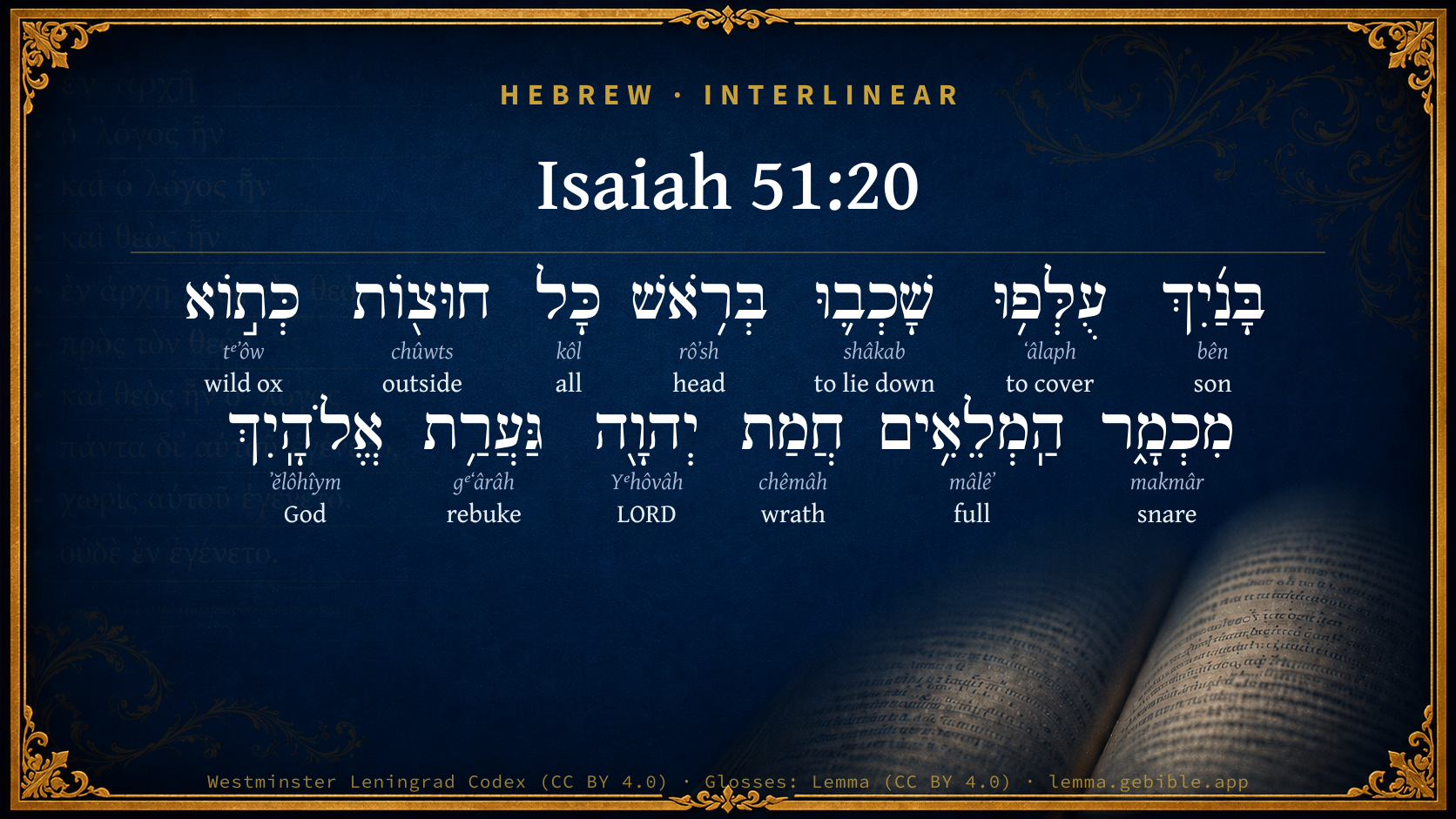
Hebrew (Westminster Leningrad Codex) Isaiah 51:20 appears in the Hebrew Old Testament. The text above is from the Westminster Leningrad Codex. Each word links to its Strong’s number, a concise gloss, and parsing drawn from the Open Scriptures Hebrew Bible morphology. Click any word for its full Brown-Driver-Briggs (BDB) entry.
Download image
Cite this verse

Isaiah 51:20 (World English Bible). Public Domain. Lemma interlinear Bible study tool, https://lemma.gebible.app/v/isaiah/51/20.

Show BibTeX & RIS
BibTeX
RIS
English Translation
Your sons have fainted, they lie at the head of all the streets, as an antelope in a net; they are full of the wrath of Yahweh, the rebuke of your God.
World English Bible · Public Domain
Download a study sheet

One document with this verse’s original text, its word-by-word gloss line, the meaning frame, cross-references with their text, attributed commentary, and full source and license credits — printable, and it pastes into notes with its structure intact.

This verse Autodidact and up

Study sheet (.html) Plain text (.txt)

A passage Seminary Student

Up to 50 verses in one chapter. A passage sheet keeps up to 6 commentary sources and 12 cross-references per verse, in the order this page ranks them, and says so on the sheet whenever that leaves anything out. Ask for a single verse and you get the Autodidact verse sheet above.

Everything on this page stays free to read, with no account — the sheet is a download of what is already on screen, not access to it.

Want to remove ads? Support Godless Engineer
Compare translations 3

The same verse in 3 English versions, stacked beneath the original-language interlinear above. Click any original word for its lexicon entry.

Each is an independent rendering of the whole verse — the interlinear is not word-aligned to these translations.

Highlighted words mark where these versions differ — a whole-verse word diff, not a word-by-word alignment.

  • World English Bible Public Domain
    Your sons have fainted, they lie at the head of all the streets, as an antelope in a net; they are full of the wrath of Yahweh, the rebuke of your God.
  • King James Version Public Domain
    Thy sons have fainted, they lie at the head of all the streets, as a wild bull in a net: they are full of the fury of the LORD, the rebuke of thy God.
  • unfoldingWord Literal Text CC BY-SA 4.0
    Your sons are enwrapped; they lie at the head of all of the streets like an antelope a net, being full the heat of Yahweh, the rebuke of your God.

unfoldingWord Literal Text — © unfoldingWord, licensed CC BY-SA 4.0. Word-aligned USFM3 via Door43 (git.door43.org/unfoldingWord/en_ult).

Versions to compare (up to 4)

3 of 4 selected

Show all 18 translations

Every available English version of this verse, each an independent rendering of the whole verse.

  • World English Bible Public Domain
    Your sons have fainted, they lie at the head of all the streets, as an antelope in a net; they are full of the wrath of Yahweh, the rebuke of your God.
  • Berean Standard Bible Public Domain
    Your sons have fainted; they lie at the head of every street, like an antelope in a net. They are full of the wrath of the LORD, the rebuke of your God.
  • Majority Standard Bible Public Domain
    Your sons have fainted; they lie at the head of every street, like an antelope in a net. They are full of the wrath of the LORD, the rebuke of your God.
  • King James Version Public Domain
    Thy sons have fainted, they lie at the head of all the streets, as a wild bull in a net: they are full of the fury of the LORD, the rebuke of thy God.
  • American Standard Version (1901) Public Domain
    Thy sons have fainted, they lie at the head of all the streets, as an antelope in a net; they are full of the wrath of Jehovah, the rebuke of thy God.
  • Revised Version (1885) Public Domain
    Thy sons have fainted, they lie at the top of all the streets, as an antelope in a net; they are full of the fury of the LORD, the rebuke of thy God.
  • Geneva Bible (1599) Public Domain
    Thy sonnes haue fainted, and lye at the head of all the streetes as a wilde bull in a nette, and are full of the wrath of the Lord, and rebuke of thy God.
  • Douay-Rheims (1899) Public Domain
    Thy children are cast forth, they have slept at the head of all the ways, as the wild ox that is snared: full of the indignation of the Lord, of the rebuke of thy God.
  • Young's Literal Translation Public Domain
    Thy sons have been wrapt up, they have lain down, At the head of all out places, as a wild ox `in' a net, They are full of the fury of Jehovah, The rebuke of Thy God.
  • Literal Standard Version CC BY-SA 4.0
    Your sons have been wrapped up, they have lain down, || At the head of all out places, as an antelope [in] a dragnet, || They are full of the fury of YHWH, || The rebuke of Your God.
  • Unlocked Literal Bible CC BY-SA 4.0
    Your sons have fainted; they lie at every street corner, like an antelope in a net; they are filled with the anger of Yahweh, the rebuke of your God.
  • unfoldingWord Literal Text CC BY-SA 4.0
    Your sons are enwrapped; they lie at the head of all of the streets like an antelope a net, being full the heat of Yahweh, the rebuke of your God.
  • Darby Bible Public Domain
    Thy children have fainted, they lie at the head of all the streets, as an oryx in a net: they are full of the fury of Jehovah, the rebuke of thy God.
  • World Messianic Bible Public Domain
    Your sons have fainted. They lie at the head of all the streets, like an antelope in a net. They are full of the LORD’s wrath, the rebuke of your God.
  • Webster's Bible Public Domain
    Thy sons have fainted, they lie at the head of all the streets, as a wild bull in a net: they are full of the fury of the LORD, the rebuke of thy God.
  • Free Bible Version CC BY-SA 4.0
    Your children have collapsed, lying in every street like antelopes caught in a trap. They experienced the full anger of the Lord, the condemnation of your God.
  • Bible in Basic English Public Domain
    Your sons are overcome, like a roe in a net; they are full of the wrath of the Lord, the punishment of your God.
  • JPS Tanakh (1917) Public Domain
    Thy sons have fainted, they lie at the head of all the streets, as an antelope in a net; they are full of the fury of the LORD, the rebuke of thy God.

Literal Standard Version (2020), Covenant Press — licensed CC BY-SA 4.0. Text via the HelloAO Bible API (eBible.org). Unlocked Literal Bible (unfoldingWord) — licensed CC BY-SA 4.0. Text via the HelloAO Bible API (eBible.org). unfoldingWord Literal Text — © unfoldingWord, licensed CC BY-SA 4.0. Word-aligned USFM3 via Door43 (git.door43.org/unfoldingWord/en_ult). Free Bible Version, Dr. Jonathan Gallagher — licensed CC BY-SA 4.0. Text via the HelloAO Bible API (eBible.org).

Word by word

More ways to search: Search by grammar → Find every occurrence → Compare this word →

Practice this passage: Drill this verse → Learn its vocabulary →

כְּת֣וֹא
tᵉʼôw
H8377
“like/as · wild ox of”
Preposition + Noun, Common, Masculine, Singular, Construct
Part of Speech
Preposition + Noun
Type
Common
Gender
Masculine
Number
Singular
State
Construct
Full BDB Definition

Origin: from H8376

TWOT: 2488

wild ox, antelope, oryx - perhaps an extinct animal, exact meaning unknown
  1. בָּנַ֜יִךְ bên H1121 “sons · your” Noun, Common, Masculine, Plural, Construct + Suffix, Personal, 2nd Person, Feminine, Singular
  2. עֻלְּפ֥וּ ʻâlaph H5968 “to cover” Verb, Pual, Perfect, 3rd Person, Common, Plural
  3. שָׁכְב֛וּ shâkab H7901 “to lie down” Verb, Qal, Perfect, 3rd Person, Common, Plural
  4. בְּרֹ֥אשׁ rôʼsh H7218 “in/at · head of” Preposition + Noun, Common, Masculine, Singular, Construct
  5. כָּל kôl H3605 “all of” Noun, Common, Masculine, Singular, Construct
  6. חוּצ֖וֹת chûwts H2351 “streets” Noun, Common, Masculine, Plural, Absolute
  7. מִכְמָ֑ר makmâr H4364 “snare” Noun, Common, Masculine, Singular, Absolute
  8. הַֽמְלֵאִ֥ים mâlêʼ H4392 “the · full” Particle, Definite Article + Adjective, Adjective, Masculine, Plural, Absolute
  9. חֲמַת chêmâh H2534 “wrath of” Noun, Common, Feminine, Singular, Construct
  10. יְהוָ֖ה Yᵉhôvâh H3068 “LORD” Noun, Proper
  11. גַּעֲרַ֥ת gᵉʻârâh H1606 “rebuke of” Noun, Common, Feminine, Singular, Construct
  12. אֱלֹהָֽיִךְ ʼĕlôhîym H430 “God(s) · your” Noun, Common, Masculine, Plural, Construct + Suffix, Personal, 2nd Person, Feminine, Singular

About this verse

These counts appear in no published source. They are computed here, from the morphology-tagged text and Lemma’s own curated glosses. What Lemma adds →

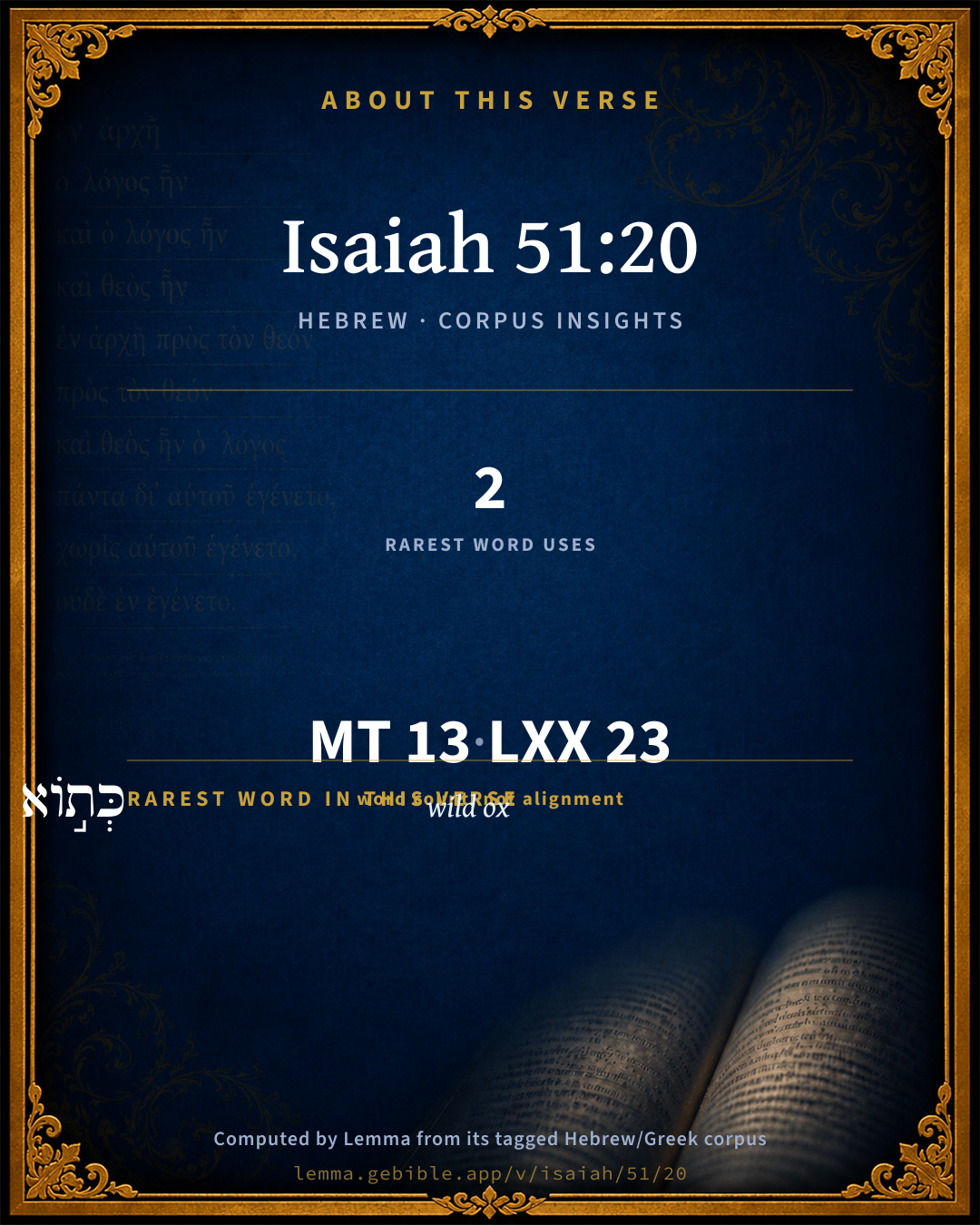
13
words
13
distinct lemmas
Prophets
section

Notable vocabulary

The rarest word here is כְּת֣וֹא wild ox H8377 — appearing just 2 times in the whole Hebrew Bible.

Shared distinctive vocabulary

כְּת֣וֹא wild ox H8377 occurs in 2 verses of the Hebrew Bible. Also found in:

Grammatical profile

  • 2 verbs
  • 10 nouns
  • 1 adjective

Verb forms

  • עֻלְּפ֥וּ Pual · Perfect
  • שָׁכְב֛וּ Qal · Perfect

Hebrew & Septuagint length

In English translation the verse runs 32 words from the Hebrew and 35 from the Septuagint (LXX English) — closely comparable.

A rough comparison of the two English renderings, which tokenize alike — not a word-level alignment.

Word counts can differ between the Hebrew and the Greek without any difference in meaning — e.g. the Hebrew direct-object marker אֵת has no separate Greek word, and Greek often adds the article ὁ.

In the original languages it is 13 Hebrew tokens and 23 Greek tokens — but the two are counted differently (Hebrew bundles its prefixes and suffixes into one token; the Greek is in lemma form), so that isn’t a like-for-like length.

Cross-references

23

Topical passages linked to Isaiah 51:20 in the Treasury of Scripture Knowledge — connected by theme and wording, ordered by reader-vote popularity; previews shown in the World English Bible.

  • Lamentations 2:11–12 My eyes do fail with tears, my heart is troubled; My liver is poured on the earth, because of the destruction of the daughter of my people, Because the young children and the infants swoon in the streets of the city.
  • Revelation 16:9–11 People were scorched with great heat, and people blasphemed the name of God who has the power over these plagues. They didn't repent and give him glory.
  • Deuteronomy 14:5 the hart, and the gazelle, and the roebuck, and the wild goat, and the ibex, and the antelope, and the chamois.
  • Psalms 88:15–16 I am afflicted and ready to die from my youth up. While I suffer your terrors, I am distracted.
  • Isaiah 5:25 Therefore Yahweh's anger burns against his people, And he has stretched out his hand against them, and has struck them. The mountains tremble, And their dead bodies are as refuse in the midst of the streets. For all this, his anger is not turned away, But his hand is still stretched out.
  • Isaiah 8:21 They shall pass through it, sore distressed and hungry; and it shall happen that when they shall be hungry, they shall fret themselves, and curse by their king and by their God, and turn their faces upward:
  • Isaiah 9:19–21 Through the wrath of Yahweh of hosts is the land burnt up; and the people are as the fuel of fire: no man spares his brother.
  • Isaiah 29:9 Stay you and wonder; take your pleasure and be blind: they are drunken, but not with wine; they stagger, but not with strong drink.
  • Isaiah 49:26 I will feed those who oppress you with their own flesh; and they shall be drunken with their own blood, as with sweet wine: and all flesh shall know that I, Yahweh, am your Savior, and your Redeemer, the Mighty One of Jacob.
  • Isaiah 51:17 Awake, awake, stand up, Jerusalem, that have drunk at the hand of Yahweh the cup of his wrath; you have drunken the bowl of the cup of staggering, and drained it.
  • Isaiah 51:21 Therefore hear now this, you afflicted, and drunken, but now with wine:
  • Jeremiah 14:16 The people to whom they prophesy shall be cast out in the streets of Jerusalem because of the famine and the sword; and they shall have none to bury them-them, their wives, nor their sons, nor their daughters: for I will pour their wickedness on them.
  • Jeremiah 14:18 If I go forth into the field, then, behold, the slain with the sword! and if I enter into the city, then, behold, those who are sick with famine! for both the prophet and the priest go about in the land, and have no knowledge.
  • Lamentations 1:15 The Lord has set at nothing all my mighty men in the midst of me; He has called a solemn assembly against me to crush my young men: The Lord has trodden as in a winepress the virgin daughter of Judah.
  • Lamentations 1:19 I called for my lovers, [but] they deceived me: My priests and my elders gave up the spirit in the city, While they sought them food to refresh their souls.
  • Lamentations 3:15–16 He has filled me with bitterness, he has sated me with wormwood.
  • Lamentations 4:2 The precious sons of Zion, comparable to fine gold, How are they esteemed as earthen pitchers, the work of the hands of the potter!
  • Lamentations 5:13 The young men bare the mill; The children stumbled under the wood.
  • Ezekiel 12:13 My net also will I spread on him, and he shall be taken in my snare; and I will bring him to Babylon to the land of the Chaldeans; yet shall he not see it, though he shall die there.
  • Ezekiel 17:20 I will spread my net on him, and he shall be taken in my snare, and I will bring him to Babylon, and will enter into judgment with him there for his trespass that he has trespassed against me.
  • Ezekiel 39:19 You shall eat fat until you be full, and drink blood until you be drunken, of my sacrifice which I have sacrificed for you.
  • Revelation 14:10 he also will drink of the wine of the wrath of God, which is prepared unmixed in the cup of his anger. He will be tormented with fire and sulfur in the presence of the holy angels, and in the presence of the Lamb.
  • Isaiah 40:30 Even the youths shall faint and be weary, and the young men shall utterly fall:

Cross-references courtesy of OpenBible.info (CC BY 4.0).

Hebrew and Greek witnesses Masoretic Hebrew ↔ Greek Septuagint

The same verse in the two great witnesses to the Old Testament, shown verse-for-verse.

These are two independent witnesses, not word-aligned to each other, and the Septuagint is shown in lemma (dictionary) form.

Hebrew Isaiah 51:20 Masoretic · Westminster Leningrad Codex

בָּנַ֜יִךְ עֻלְּפ֥וּ שָׁכְב֛וּ בְּרֹ֥אשׁ כָּל חוּצ֖וֹת כְּת֣וֹא מִכְמָ֑ר הַֽמְלֵאִ֥ים חֲמַת יְהוָ֖ה גַּעֲרַ֥ת אֱלֹהָֽיִךְ

Your sons have fainted, they lie at the head of all the streets, as an antelope in a net; they are full of the wrath of Yahweh, the rebuke of your God.

World English Bible · Public Domain

Greek LXX Isaiah 51:20 Septuagint · lemma form

ὁ υἱός σύ ὁ ἀπορέω ὁ καταεὕδω ἐπί ἄκρος πᾶς ἔξοδος ὡς σευτλίον ἡμίεφθος ὁ πλήρης θυμός κύριος ἐκλύω διά κύριος ὁ θεός

Your sons are the perplexed ones, that sleep at the top of every street as a half-boiled beet; they that are full of the anger of the Lord, caused to faint by the Lord God.

LXX2012 (modern English Septuagint) · Public Domain

On this verse, John Gill's Exposition discusses the Septuagint’s reading. Read the note in Commentary ↓

Hebrew: Westminster Leningrad Codex (CC BY 4.0). Greek: Septuagint (public domain); English from LXX2012 (modern English Septuagint) (Public Domain). How the Septuagint differs from the Hebrew →

Targum (Aramaic paraphrase)

1

The Targum is the ancient Jewish Aramaic paraphrase of the Hebrew Scriptures — an interpretive translation, not the Hebrew text itself. Onkelos (literal) and Pseudo-Jonathan (expansive) render the Torah, and Jonathan the Prophets. Coverage is partial: where no permissively-licensed English translation exists for a verse, only the Aramaic is shown. This is verse-level text, not a word-by-word alignment to the Hebrew.

  1. Targum Jonathan Prophets (Joshua–Malachi)
    בְּנַיִךְ יְהוֹן מִטָרְפִין רָמָן בְּרֵישׁ כָּל שׁוּקַיָא כְּמִזְרָקֵי מְצַדָן מְלַן חֵימְתָא מִן קֳדָם יְיָ מְזוֹפִיתָא מִן קֳדָם אֱלָהָיִךְ:

    Thy children shall be torn in pieces, they shall be cast at the head of all the streets as broken vials: they are full of the fury of the Lord, and of the rebuke of thy God.

    Targum Jonathan — Aramaic: “Mikraot Gedolot” (public domain). English: “Sefaria Community Translation” (CC0 1.0 (public-domain dedication)); “London "Chaldee Paraphrase," 1871” (public domain). Text via Sefaria.

Commentary

Notes on Isaiah 51:20 from classic Christian and Jewish commentators (each source and its license shown beneath its notes). The classic Christian expositions comment on the surrounding passage and are grouped to its opening verse, so a note may address several verses; the Jewish commentaries on the Tanakh (Rashi and others) are per-verse, so they appear only where the commentator wrote on this verse.

Lemma curates 59 commentaries, every one of them public domain or Creative Commons licensed, each selected and text-cleaned for this edition rather than reprinted as found. About our sources →

Trapp's Complete Commentary

John Trapp

Isa 51:20 Thy sons have fainted, they lie at the head of all the streets, as a wild bull in a net: they are full of the fury of the LORD, the rebuke of thy God.

Ver. 20. Thy sons have fainted.] Fame, macie, tabe, vulnere, utterly disabled to relieve thee. {Isa 51:18}

As a wild bull in a net.] Taken in a toil, where he struggles and strives, foams and fumes, but cannot get out.

John Trapp, A Commentary or Exposition upon All the Books of the Old and New Testament (1647–1656) — public domain. Text from a community e-Sword module.

The Preacher's Complete Homiletical Commentary

Joseph S. Exell (gen. ed.)

JEHOVAH’S ANGER

Isa_51:17; Isa_51:20; Isa_51:22. The fury of the Lord, &c. [1587]

[1587] See vol. i. pp. 284–286, and H. E. I. 2288–2294. God’s anger must, of course, be understood in a manner in accordance with the Divine nature; and we are not to suppose that precisely the same passions or the same feelings are referred to when this language is used of God which is implied when it is used of men. It means that His nature, His laws, His government, His feelings, are all arrayed against the wicked; that He cannot regard the conduct of the wicked with favour; that He will punish them. He is angry with the wicked continually, constantly, always. It is not excitement, it is not a temporary passion, such as we see in men. It is not sudden emotion, soon to be succeeded by a different feeling when the passion passes off. It is the steady and uniform attribute of His unchanging nature to be always opposed to the wicked,—to all forms of sin; and in Him, in this respect, there will be no change. The wicked will find Him no more favourable to their character and course of life to-morrow than He is to-day; no more beyond the grave than this side of the tomb.… This is a fearful truth in regard to the sinner, and should make him tremble:—(1.) that God is angry with him—that all His character, and all the principles of His government and law, are and must be arrayed against him; and (2.), that in this respect there is to be no change; that if he continues to be wicked, as he is now, he will every day and always—this side the grave and beyond—find all the attributes of God engaged against him, and pledged to punish him. God has no attribute that can take part with sin or the sinner.—A. Barnes, D.D.

The wrath of God is like great waters that are dammed for the present; they increase more and more, and rise higher and higher, till an outlet is given; and the higher the stream is stopped, the more rapid and mighty is its course when once it is let loose. If God should only withdraw His hand from the floodgate, it would immediately fly open, and the fiery floods of the fierceness and wrath of God would rush forth with inconceivable fury, and would come upon you with omnipotent power; and if your strength were ten thousand times greater than it is, yea, ten thousand times greater than the strength of the stoutest, sturdiest devil in hell, it would be nothing to withstand or endure it.—Jonathan Edwards.

I. It is real. There is such a thing as anger in God. Many are the expressions used concerning it—jealousy, vengeance, fury, wrath; all to indicate its existence, and to show us that the human theories of Divine universal benevolence are not true, being got up for a purpose, and that purpose to persuade the sinner’s own conscience that he need not be alarmed because of his guilt; and that no one need dread the infliction of punishment, except perhaps a few of the most wicked of our race. But God’s words are not exaggerations, nor words of course. There is a terrible truth contained in these oft-repeated words of Scripture, “His anger was kindled.” Loving and gracious as Jehovah is, His anger is real. When Jesus comes the second time, He comes to “take vengeance.”

II. It is righteous. It is not the rage of selfishness, or passion, or affront. It is judicial anger; the anger of the righteous judge. It is anger against sin, against the sinner, anger because of insulted law and dishonoured righteousness. Nothing in it is unjust, or cruel, or arbitrary. Then the condemned soul will be compelled hereafter to say, “It is all right and just,” it shall be right and just to all eternity.”

III. It is terrible. Though calm, it is unutterably awful; nay, overwhelming. No power and no numbers shall be able to stand before it. It shall sweep everything before it like a whirlwind. The expulsion from paradise, the Deluge, the ruin of Sodom, are specimens of its terribleness. The lost soul shall be utterly overwhelmed. (β)

IV. It is inexorable. Nothing but genuine repentance shall turn it aside, or soften it when once it is kindled. “The vengeance of eternal fire,” the “everlasting burning,” the “worm that dieth not,” these are awful words, and however figurative they may be, they represent terrible realities (H. E. I. 2804).—Horatius Bonar, D.D.: Light and Truth, Old Testament, p. 345.

THE MEMORIAL NAME

Isa_51:22. Thy LORD the LORD, and thy God.

The history, which includes the textual statement. Consider—

1. The character which God here claims for Himself.

1. Independent and self-existent in Being, and therefore—Infinite—fills all space; everlasting—fills all time; the source of all being.

2. Unlimited in perfection. All perfections. Infinite in each.

3. Unlimited in sovereignty. He does according to His will. His will the highest reason. None can counsel Him.

4. Unlimited in the extent of His government. None are exempted from it.

5. Himself the end of all things. Everything originates with Him. Everything terminates in Him.

II. The limitations which men put upon the claim which is thus made by God. They put limits upon,

1. His being. The having and worshipping false gods. That is not God which is not self-existent; and two self-existent Gods cannot be conceived.

2. His perfections. The conceptions which men form and express. The preference which man gives to the creature. The silence of man in His praise. The little imitation there is of Him. The manner in which men expect to recommend themselves to His favour. The manner in which His servants are treated.

3. On His absolute sovereignty. Confining our attention to systems of doctrine called Christian, men question God’s absolute sovereignty, in the election, calling, justification, and perseverance of His people.

4. On the extent of His government. Some exclude Him from creation, providence, in prayer, conversation, conduct, civil authority, the government of the Church, and conscience.

5. As the end of all things. Men make themselves the end.

CONCLUSION.—He is not, and cannot be limited. In acting, He disregards the limits of men. He punishes the pride and insolence of man for limiting Him. He calls the notice of His people to the vindication of His glory.—James Stewart: Outlines of Discourses, pp. 2–4.

THE STRENGTH AND WEAKNESS OF THE CHURCH

(Preached before a Presbyterian General Assembly.)

Isa_52:1. Awake, awake; put on thy strength, O Zion.

This language is a direct address from God to His ancient Church. The image which it presents is that of a sleeping giant. The Church of God had been a giant power in the world; but at the time in which God speaks it had relapsed into slumber—had put off its strength, and, being beset with enemies, this position of torpor and inaction was one of peril. Hence this arousing note of alarm, “Awake, awake!” The slumbering giant is not only summoned to arouse to consciousness, but to put on and put forth his strength for conflict and for victory.

The text is a forcible reminder of the mysterious and discouraging fact that the Church of God, in all ages, may have its times of weakness, as well as its times of power. When the Church first went forth from Jerusalem, a little flock, scattered hither and thither by the storm of persecution, it was a time of power. It was then but an infant of days, but it “lifted empires off their hinges, and turned the stream of centuries out of its channel.”—(Richter.)

But a time of weakness followed this era of power—the dark night of the middle ages. Again there came a time of power when, on the morning of the Reformation, the Church heard the cry, “Awake, awake!” and, springing up with renewed youth, it put on its strength. The chill of formalism followed the track of the Reformation, and the Church sank into the coma of wide-spread paralysis; a disguised Romanism riveted her fetters; the Socinian apostasy spread its blight over Great Britain. But then came times of power, when the Church arose in quickened majesty; and still again, times of wondrous spiritual revival, when the call sounded by Wesley and Whitefield, like the voice of the prophet in the valley of vision, seemed to awake the dead.

I. Why these periods of weakness? If the Church is a giant begirt with power, and that power is divine; if it is commissioned to exercise the evil spirit from the world, and goes forth with the promise of help and victory, then why these times of weakness? Answer:—The power of the Church is divine, but it is also human. What man can do, he must do. To roll away the stone from the grave of Lazarus was something that man could do; hence our Lord commanded human hands to do it. This act of human strength must antecede the word of power which raises the dead. Divine power and human strength must work together, each in its appropriate sphere. Divine efficiency does not supersede human agency, but only supplements its weakness. If man’s part in the work or warfare of the Church is properly executed, God’s part will never fail. But, as the terror of the iron chariots of the enemy paralysed the strength of Judah—so that, the human part being wanting, the victory was lost (Jdg_1:19)—so, in the Church, if any cause supervenes to weaken, or render ineffective, the strength which God expects us to put forth, He will not depart from His plan, or interpose to save us from the result of our own weakness, or to hide us from the scorn and derision of the world.

II. What is the strength of the Church, and when is it put off?

1. The first element of power is the Gospel. This is the one element for our work, the one weapon for our warfare—it is the power of God. The astronomer looks at the heavens. These stars are to be counted; these constellations are to be mapped; the orbits of these planets are to be observed. Here is a vast and complicated work; but how is it to be done? By the telescope. He has this, and nothing else. All the great results of astronomy must spring, first of all, from this single instrument. Just so the Church looks out upon its work. It is commissioned to bring this world in captivity to the obedience of Christ. A mighty and multiform work; how is it to be achieved? By the Gospel. God has given us this, and nothing else, to save the world. It is the “power of God unto salvation to every one that believeth.” “It pleased God, by the foolishness of preaching, to save them that believe.” Moses was commanded to smite the rock at Horeb, and bring from its bosom streams of water. How? He was given but one instrument—the slender rod that he held in his hand. To human view the rock would be more likely to break the rod than the rod to rend the rock; but that fragile rod was God’s ordained instrument of power; and, when it smote, the riven rock gushed with the living waters. Just so, the Word of God is the rod of power. We are commanded to smite with it alone, for by nothing else can the stony heart be broken. For every work which the Church is sent to do, this is the instrument of power.

This being so, we can readily see from this standpoint how this strength may be put off, and power give place to weakness. To neglect, to withhold, to minimise, to obscure in any manner the truth of God, is to put off this element of power, and to bring in a time of weakness.

This may occur

(1.) When the truth is depreciated, or its necessity not clearly recognised. Thus, for example, some say, “Preach morality; let us hear more about the duties of life, and less about the doctrines of the Cross.” Morality, without principle, is a sham; it is tinselled fruit tied upon a Christmas-tree—the only connection is the tape that ties it. Morality is the fruit of principle, but principle is doctrine—and the only doctrine that bears this fruit is the doctrine of the Cross.

(2.) Whenever the Gospel is subordinated to human themes. If the Church dispenses essays upon history, antiquities, philosophy, politics, science, or reflects the light of the secular press, &c., it will be no marvel if it sinks into imbecility.

(3.) Our strength is crippled when the Gospel is caricatured by sensational themes, discussions, illustrations and expedients, which attract attention, indeed, but which belittle the sacred doctrine of the Cross.

But whilst causes like these paralyse our power, there are others which produce simply an abatement of strength. For example, the Church can only put forth half its strength when the Gospel is but half told. If it sets out in full light the Divine love, whilst it keeps back Divine justice under the shadow of a dark eclipse; if it tells of Christ’s teachings, and is silent about Christ’s sacrifice; if it points to Christ’s life, and not to Christ’s blood, as the centre of saving efficiency; if it sets out the freedom of man, and holds in abeyance Divine sovereignty and efficacious grace; or if it minimises the Gospel in the one sentence, “Come to Jesus;” or if it lays Christ as a humble suppliant at the feet of men until proud sinners imagine that it is a stoop of condescension to permit Jesus to save them—then, surely, it is no marvel that men turn away from a belittled Gospel and a belittled Saviour, and that the Church sits in weakness.

2. The second element is the ministry. Let us not lose sight of the figure of the text. The Church is a giant; the Gospel is the instrument of his work—the weapon of his warfare. But what wields the weapon? The giant’s arm—this is the ministry. It is the arm or the agent of the Church’s power. The symbol of the Gospel is a hammer, a word; but a hammer is powerless without a strong hand to use it; the sword is ineffective without a skilful arm to wield it. This arm, this sword, this agent of strength and skill, is the ministry.

This figure seems to describe accurately the kind of power with which the ministry is invested. It is not an original power inherent in itself, but a delegated power. It is the power of an agent, and it has an instrument of power put into its hands. It is not a power to infuse grace, or to forgive sins, or to bind the conscience, but simply an administrative power. It is a power of vocation to utter the Gospel call, to summon God’s sons from afar, and His daughters from the ends of the earth. A teaching power—go teach all nations; preach the Gospel to every creature. A dispensing power to break the Bread of Life, and to distribute, with a liberal hand, to all God’s children, giving to each a portion in due season. A power to reprove, rebuke, and exhort with all long-suffering and doctrine.

We may readily see when this strength is put on, and when it is put off. Whatever cripples or weakens or interferes with the right use and proper functions of a giant’s arm, weakens and abates the effectiveness of the giant himself; so whatever weakens the ministry, or hinders its effectiveness, puts off to that extent the strength of the Church, and introduces a time of weakness and defeat.

(1.) The ministry, as an arm of power, may be withered by a perfunctory education. Ministers may be taught to know about God, but not to know God. They may learn to explain and defend the Gospel, without having ever felt that a single Gospel truth has been riveted as a living, burning power in their own souls. A minister who knows what it is to be a saved sinner, can tell of it with such power as to make others feel that there is nothing between them and eternal death but the blood of Jesus. But, without this experience, the minister will be a perfunctory drone, stepping in a treadmill, or doing out his lifeless essay whilst sinners are slipping through his fingers into perdition.

(2.) The ministry must be a source of weakness instead of power to the Church, if it is not in sympathy with the hearts of the people, and the souls of perishing men. He who was once lost but is found again, will know how to feel for the lost, and the lost will listen to him who once was lost himself. This is the natural power of the minister, the link of sympathy that binds him to the hearts of the people and the souls of men. If this be lost the ministry is powerless.

3. The third and principal element of the Church’s power is the Holy Ghost. The implement of the Church’s work is the Word; the arm of the Church’s power is the ministry; but the power itself is the Holy Ghost. As He causeth the earth to bring forth and bud by showers from heaven, so He causes His Church to abound in the fruits of righteousness by times of refreshing from on high. A revival is a day of the Spirit’s power, when the enemy is repulsed; when sinners are made willing; when doubt and unbelief are dissipated. If such a day of power were granted to us now, you would see rationalism, scepticism, and infidelity driven like smoke before the wind.

III. Such being the elements of the Church’s power, and the causes which convert its strength into weakness, let us now listen to God’s call to the Church to put on and put forth her strength. “Awake, awake; put on thy strength, O Zion!” An army puts on its strength when it goes forth to battle, but this is strength to destroy. A fireman puts on his strength when he enters a burning dwelling, and plucks its sleeping inmates from the flames. This is strength to save. Oh, it is a glorious thing to put on strength to save! How, then, shall we put on this strength?

Physical strength is put on in one way, and spiritual strength in another. Some seem to imagine that they have only to arouse and stir themselves into an agony of effort. Samson arose and shook himself, and thought he would go forth and smite the Philistines, as aforetime; but, alas! the strength was not there—it had departed from him. So the Church may shake herself and advance to the conflict, but the strength is not there; the Philistines are upon her, and she wists not that the Lord has departed. This is not the way! One who is physically strong is conscious of his strength, but one who is spiritually strong is conscious of nothing but weakness. Spiritual power, in its first element, is the sense of our own weakness.

No man ever puts on spiritual strength except on his knees. It was there that the apostles found it. When Peter stood forth and preached to the multitude, that day of Pentecost was a day of power; it was the Spirit’s power; but how did the apostles put it on? Upon their knees; in those days of prayer, in the upper chamber in Jerusalem. It is upon our knees that the Church must put on its strength! Then shall our work be “mighty, through God, to the pulling down of strongholds.”—W. M. Paxton, D.D.

The Preacher's Complete Homiletical Commentary (gen. ed. Joseph S. Exell; Funk & Wagnalls, c. 1892) — public domain (pre-1929). A full-Bible homiletical/sermon-outline anthology covering 65 of 66 books (2 John is absent from the source module). Text from a community e-Sword module.

Tyndale Open Study Notes

Tyndale Open Resources

51:20 children have fainted: A sad commentary on Jerusalem’s desolation is provided in Lamentations 1:13, 22; 2:11-12, 19.

Tyndale Open Study Notes — © Tyndale Open Resources, licensed CC BY-SA 4.0. Text via the HelloAO Bible API.

Jamieson, Fausset & Brown

Robert Jamieson, A. R. Fausset & David Brown

head of all . . . streets-- (Lam 2:19; Lam 4:1).

wild bull--rather, "oryx" [JEROME], or gazelle [GESENIUS], or wild goat [BOCHART]; commonly in the East taken in a net, of a wide sweep, into which the beasts were hunted together. The streets of cities in the East often have gates, which are closed at night; a person wishing to escape would be stopped by them and caught, as a wild animal in a net.

Jamieson, Fausset & Brown — Commentary Critical and Explanatory on the Whole Bible (1871) — public domain (CC PDM 1.0). Text via the HelloAO Bible API.

Adam Clarke's Commentary

Verse 20. As a wild bull in a net: they are full, c. - "Like the oryx taken in the toils drenched to the full"] "Perhaps מכמרה מלאים michmerah meleim." SECKER. The demonstrative ה he, prefixed to מלאים meleim, full, seems improper in this place.

Adam Clarke's Commentary on the Bible (1810–1826) — public domain. Text from a community e-Sword/MySword module.

Ellicott's Commentary for English Readers

(20) As a wild bull . . .—Better, as an antelope. The picture explains that of Isa_51:17. The sons cannot help the mother, for they, too, have drunk of the same cup of fury, and lie like corpses in the open places of the city. (Comp. Lam_2:12.)

A Bible Commentary for English Readers, edited by Charles John Ellicott (1878–1897) — public domain. Text from a community e-Sword module.

The Cambridge Bible for Schools and Colleges

gen. ed. J. J. S. Perowne

20. Thy sons have swooned] lit. “were shrouded,”—a usual oriental metaphor (Amo_8:13; Jon_4:8; Nah_3:11). For the idea cf. Lam_2:11; Lam_2:19; Lam_2:21. at the head of all the streets] Lam_2:19; Lam_4:1.

as a wild bull in a net] R.V., rightly, as an antelope (Deu_14:5) in a net, exhausted by its vain struggles to get free.

they are full of the fury &c.] The children have drunk of the same cup as their mother.

The Cambridge Bible for Schools and Colleges (gen. ed. J. J. S. Perowne; Cambridge University Press, 1878–1918) — public domain. Text from a community e-Sword module.

John Gill's Exposition

Thy sons have fainted,.... Through want of food, or at the desolation made, and have no spirit in them to appear in the interest of true religion:

they lie at the head of all the streets; emaciated by famine, and not able to walk, but drop down in the streets, and there lie panting and pining away; or slain by the enemy; or with the famine, and the sword, as Aben Ezra, and none to bury them; so the dead bodies of the witnesses shall lie in the street of the great city unburied, Rev 11:8.

as a wild bull in a net; that is slain, being taken; or, if alive, however it flings about and struggles, cannot extricate itself: so it may denote such that survive the calamity, yet held under the power of the enemy; and though inwardly fretting, and very impatient, cannot help themselves, no more than such a creature taken in a toil or net; which Aben Ezra takes to be a fowl, to which a net best agrees; and the Vulgate Latin version renders it, "as the oryx snared"; which Drusius says is the name of a bird; though it is used for a wild goat. So Aristotle (w) makes mention of it as of the goat kind, and says it has two hoofs, or is cloven footed, and has one horn; and Bochart (x) takes it to be the same with the unicorn of the Scriptures, or the "monoceros"; and, according to some writers (y), it is a very fierce and bold creature, and not easily taken; and therefore it is no wonder, when it is in the net, that it strives, though in vain, and till it is weary, to get out of it, and yet is obliged to lie there. But Kimchi says the word here used signifies a wild ox or bull (z), as we render it: in Hebrew it is called "tho" or "thoa", and very probably is the same with the "thoos" mentioned by Aristotle (a) and Pliny (b), and is rendered a wild ox in Deu 14:5, where it is reckoned among sheep, goats, and deer. It is strange that the Septuagint should render it, "as beet half boiled"; or flaccid and withering, as the Syriac and Arabic versions, taking it for an herb: and as much out of the way is the Targum, which renders it,

"as broken bottles:''

they are full of the fury of the Lord, the rebuke of thy God; that is, Jerusalem's sons, the members of the church of God, professors of religion, now full of calamities, which may seem to flow from the wrath of God, and be rebukes in fury, when they are only in love, Rev 3:19 and from whence they shall be delivered, and their enemies punished, as follows.

(w) Hist. Animal. l. 2. c. 1. (x) Hierozoic. l. 3. c. 27, 28. (y) Oppian. de Cyneget. l. 2. apud Gataker. & Sanctium in loc. "saevus oryx", Martial. l. 13. Epigr. 95. (z) And so it is explained in Gloss. in T. Bab. Bava Kama, fol. 117. 1. (a) Hist. Animal. l. 2. c. 17. (b) Nat. Hist. l. 8. c. 34.

John Gill's Exposition of the Whole Bible (1746–1763) — public domain (CC PDM 1.0). Text via the HelloAO Bible API.

Albert Barnes' Notes on the Bible

Thy sons - Jerusalem is here represented as a mother. Her sons, that is, her inhabitants, had become weak and prostrate everywhere, and were unable to afford consolation.

They lie at the head of all the streets - The ‘head’ of the streets is the same which in Lam 2:19; Lam 4:1, is denominated ‘the top of the streets.’ The head or top of the streets denotes, doubtless, the beginning of a way or street; the corner from which other streets diverge. These would be public places, where many would be naturally assembled, and where, in time of a siege, they would be driven together. This is a description of the state produced by famine. Weak, pale, and emaciated, the inhabitants of Jerusalem, in the places of public concourse, would lie prostrate and inefficient, and unable to meet and repel their foes. They would be overpowered with famine, as a wild bull is insnared in a net, and rendered incapable of any effort. This reters undoubtedly to the famine that would be produced during the siege of the Babylonians. The state of things under the siege has been also described by Jeremiah:

Arise, cry out in the night;

In the beginning of the watches pour out thine heart before the Lord;

Lift up thy hands toward him for the life of thy young children,

That faint for hunger at the top of every street.

The young and old lie on the ground in the streets,

My virgins and my young men are fallen by the sword;

Thou hast slain them in the day of thy anger;

Thou hast killed, and not pitied.

- Lam 2:19-21

The tongue of the sucking child cleaveth to the roof of

His mouth for thirst;

The young children ask bread, and no man breaketh it unto them;

They that did feed delicately are desolate in the streets;

They that were brought up in scarlet embrace dunghills.

- Lam 4:4-5

As a wild bull in a net - The word rendered here ‘wild bull’ is תוא tô'. Gesenius supposes it is the same as תאו t'ô, a species of gazelle, so called from its swiftness. Aquila, Symm. and Theod. render it here, Ὀρυξ Oruch - ‘Oryx;’ Jerome also renders it, Oryx - ‘A wild goat’ or stag. The Septuagint renders it, Σευτλίον ἡμίεφθον Seutlion hēmiephthon - ‘A parboiled beet!’ The Chaldee, ‘As broken bottles.’ Bochart (Hieroz. i. 3. 28), supposes it means a species of mountain-goat, and demonstratos that it is common in the East to take such animals in a net. Lowth renders it, ‘Oryx.’ The streets of Hebrew towns, like those of ancient Babylon, and of most modern Oriental cities, had gates which were closed at night, and on some occasions of broil and danger. A person then wishing to escape would be arrested by the closed gate and if he was pursued, would be taken somewhat like a wild bull in a net. It was formerly the custom, as it is now in Oriental countries, to take wild animals in this manner. A space of ground of considerable extent - usually in the vicinity of springs and brooks, where the animals were in the habit of repairing morning and evening - was enclosed by nets into which the animals were driven by horsemen and hounds, and when there enclosed, they were easily taken. Such scenes are still represented in Egyptian paintings (see Wilkinson’s Ancient Egyptians, vol. iii. pp. 2-36), and such a custom prevailed among the Romans. Virgil represents AEneas and Dido as repairing to a wood for the purpose of hunting at break of day, and the attendants as surrounding the grove with nets or toils.

Venatum AEneas, unaque miscrrima Dido,

In nemus ire parant, ubi primos crastinus ortus

Extulerit Titan, radusque retexerit orbem.

His ego nigrantem conmixta grandine nimbum,

Dum trepidant alae, saltusque indagine cingunt,

Desuper infundam, et tonitru coelum omne ciebo.

AEn. iv. 117ff.

The idea here is plain. It is, that as a wild animal is secured by the toils of the hunter, and rendered unable to escape, so it was with the inhabitants of Jerusalem suffering under the wrath of God. They were humbled, and prostrate, and powerless, and were, like the stag that was caught, entirely at the disposal of him who had thus insnared them.

Albert Barnes' Notes on the Bible (1834–1885) — public domain. Text from a community e-Sword/MySword module.

Haydock's Catholic Bible Commentary

Ox, oryx. Hebrew Thua, Deuteronomy xiv. 5. (Haydock) --- Many accounts respecting it are fabulous. Some understand a sort of wolf, mentioned by Pliny, [Natural History?] viii. 34. Septuagint, "like beet half boiled."

George Leo Haydock (1774–1849), Haydock's Catholic Family Bible and Commentary, 1859 edition — public domain. Excludes Psalms (Douay-Rheims chapter numbering differs from Protestant) and Deuterocanonical books (Catholic canon only).

Matthew Poole's English Annotations

Thy sons have fainted; they are so far from being able to comfort thee, as was said, Isa 51:18, that they themselves faint away for want of comfort, and through famine.

They lie dead by famine, or the sword of the enemy,

at the head of all the streets; where men enter in or go out of the streets, where the enemy found them either opposing their entrance, or running out of them to make an escape.

As a wild bull in a net: those of them who are not slain are struggling for life; and although they murmur at God, and fight with men, yet they cannot prevail or escape.

Matthew Poole's English Annotations on the Holy Bible (1683–1685) — public domain. Text from a community e-Sword/MySword module.

The Pulpit Commentary

Thy sons have fainted, they lie; rather, thy sons fainted; they lay. The prophet describes the siege and capture of Jerusalem as past, because his standpoint is the time of the Captivity. He depicts tile inhabitants of Jerusalem as "faint" through famine, and so weak that they lie prostrate about the streets. As a wild bull in a net; rather, like a gazelle in a net panting, exhausted, incapable of the hast resistance. They are full of the fury of the Lord; i.e. the fury of the Lord has been fully poured out upon them.

The Pulpit Commentary (1880–1919), ed. H.D.M. Spence-Jones & Joseph S. Exell — public domain. Text from a community e-Sword module.

John Wesley's Explanatory Notes

Fainted - They are so far from being able to comfort thee, that they themselves faint away. They lie - Dead by famine or the sword. As a bull - Those of them who are not slain are struggling for life.

John Wesley, Explanatory Notes Upon the Whole Bible (1754–1765) — public domain. Text via the GEBible commentary corpus.

J. A. Alexander on Isaiah

Joseph Addison Alexander

“Thy sons were faint (or helpless). This explains why they did not come to her assistance. They lie at the head of all the streets.” A conspicuous place is evidently meant, but whether the corners or the higher part of an uneven street, is a question of small moment. “Like a wild bull in a net,” (i.e., utterly unable to exert their strength). The true cause of their lying thus is given in the last clause. “Filled with the wrath of Jehovah, the rebuke of thy God.” The expression ‘thy God’ is emphatic, and suggests that her sufferings proceeded from the alienation of her own divine protector. This verse is a figurative representation of the helplessness of Zion or the Church when partially forsaken for a time by her offended Head.

Joseph Addison Alexander, The Prophecies of Isaiah (1846–1847; New York: Scribner, 1870–1878) — public domain. Text from a community e-Sword module.

Rashi

Rabbi Shlomo Yitzchaki (Rashi)

fainted Heb. עֻלְּפוּ. An expression of faintness. Comp. (Amos 8:13) “The...virgins shall faint (תִּתְעַלַּפְנָה) from thirst.” Pasmer in O.F., (pamer in Modern French).

like a wild ox in a net Abandoned like this wild ox that falls into a net. Comp. (Deut. 14:5) “And the wild ox (וּתְאוֹ) and the giraffe.”

Rashi on the Tanakh — English translations: “The Judaica Press complete Tanach with Rashi, translated by A. J. Rosenberg” (CC BY 4.0); “Pentateuch with Rashi's commentary by M. Rosenbaum and A.M. Silbermann, 1929-1934” (public domain); “The Metsudah Tanach series, Lakewood, N.J” (CC BY 4.0); and “The Book of Joshua, Metsudah Publications, 1997” (CC BY 4.0). Text via Sefaria.

Ibn Ezra

Rabbi Abraham ibn Ezra

עולפו Have fainted. Comp. ויתעלף and he fainted (Jon. 4:8).

They lie. They are killed by famine and sword.

תוא A bird. It is hap. leg. כתוא מכמר As the bird of the net, that is, the bird caught in a net. מכמר Net. Comp. מכמוריו their own nets (Ps. 141:10).

The rebuke of thy God. This is the explanation of the preceding, the fury of the Lord.

Ibn Ezra on the Tanakh — English translations: “Sefaria Community Translation” (CC0 1.0 (public-domain dedication)); “Yalkut, Sifsei Chachomim Chumash, Metsudah Publications, 2009” (CC BY 4.0); and “Commentary of Ibn Ezra on Isaiah - trans. by M. Friedlander, 1873” (public domain). Text via Sefaria.

Lesson kit

Teaching starters — assembled from the data on this page, not authored interpretation. Every prompt links to the verse data it draws on. Edit before teaching.

Isaiah, in the Prophets, opens this verse with 13 words (13 distinct Hebrew lemmas). Its most distinctive word is tᵉʼôw (“wild ox”). A historical commentator’s framing appears above. Read the whole chapter for the surrounding context.

Discussion questions

  1. The word tᵉʼôw carries the sense “wild ox.” How does it shape the verse?
  2. How does Deuteronomy 14:5, which shares the word «wild ox», read alongside this verse?
  3. The translations on this page render this verse differently — a whole-verse word diff, not a word-by-word alignment. What might account for the different wordings?
  4. «עֻלְּפ֥וּ» is a Pual Perfect verb. How does that grammatical form shape the action described?
  5. Compare how Trapp's Complete Commentary and The Preacher's Complete Homiletical Commentary read this verse. Where do they agree or differ?

Things to notice

Reading settings

Reading text

Shown beneath each verse's original-language words.

Old Testament
Old Testament edition

Read the OT as the Masoretic Hebrew (MT) or the Greek Septuagint (LXX).

English shown for the Greek Septuagint (in the Hebrew ↔ Greek comparison).

Comparing translations? Open the Compare panel on any verse page to stack up to four side by side.