
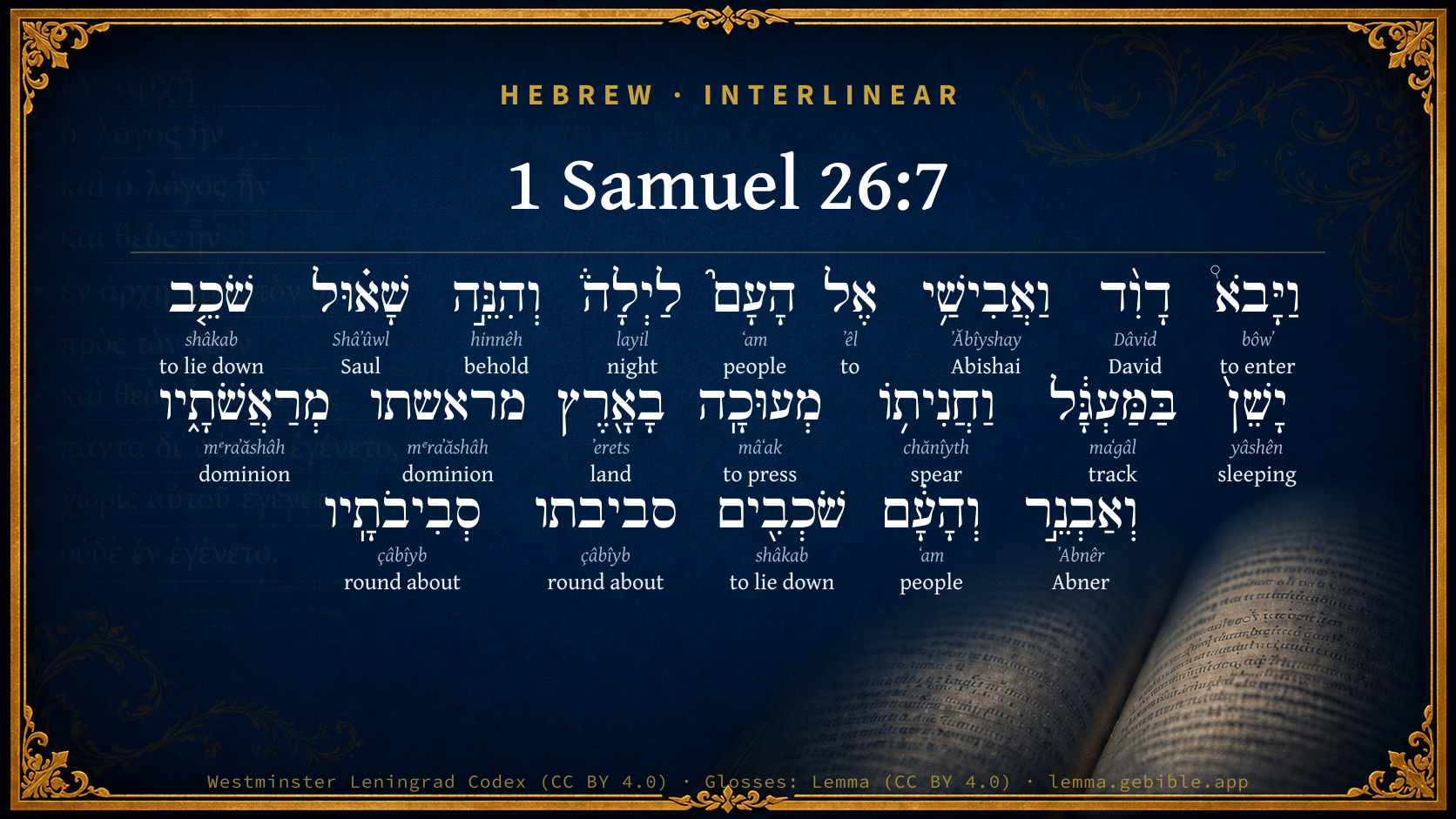
1 Samuel 26:7

Hebrew (Westminster Leningrad Codex) 1 Samuel 26:7 appears in the Hebrew Old Testament. The text above is from the Westminster Leningrad Codex. Each word links to its Strong’s number, a concise gloss, and parsing drawn from the Open Scriptures Hebrew Bible morphology. Click any word for its full Brown-Driver-Briggs (BDB) entry.
Download image
Cite this verse

1 Samuel 26:7 (World English Bible). Public Domain. Lemma interlinear Bible study tool, https://lemma.gebible.app/v/1-samuel/26/7.

Show BibTeX & RIS
BibTeX
RIS
English Translation
So David and Abishai came to the people by night: and, behold, Saul lay sleeping within the place of the wagons, with his spear stuck in the ground at his head; and Abner and the people lay round about him.
World English Bible · Public Domain
Highlights
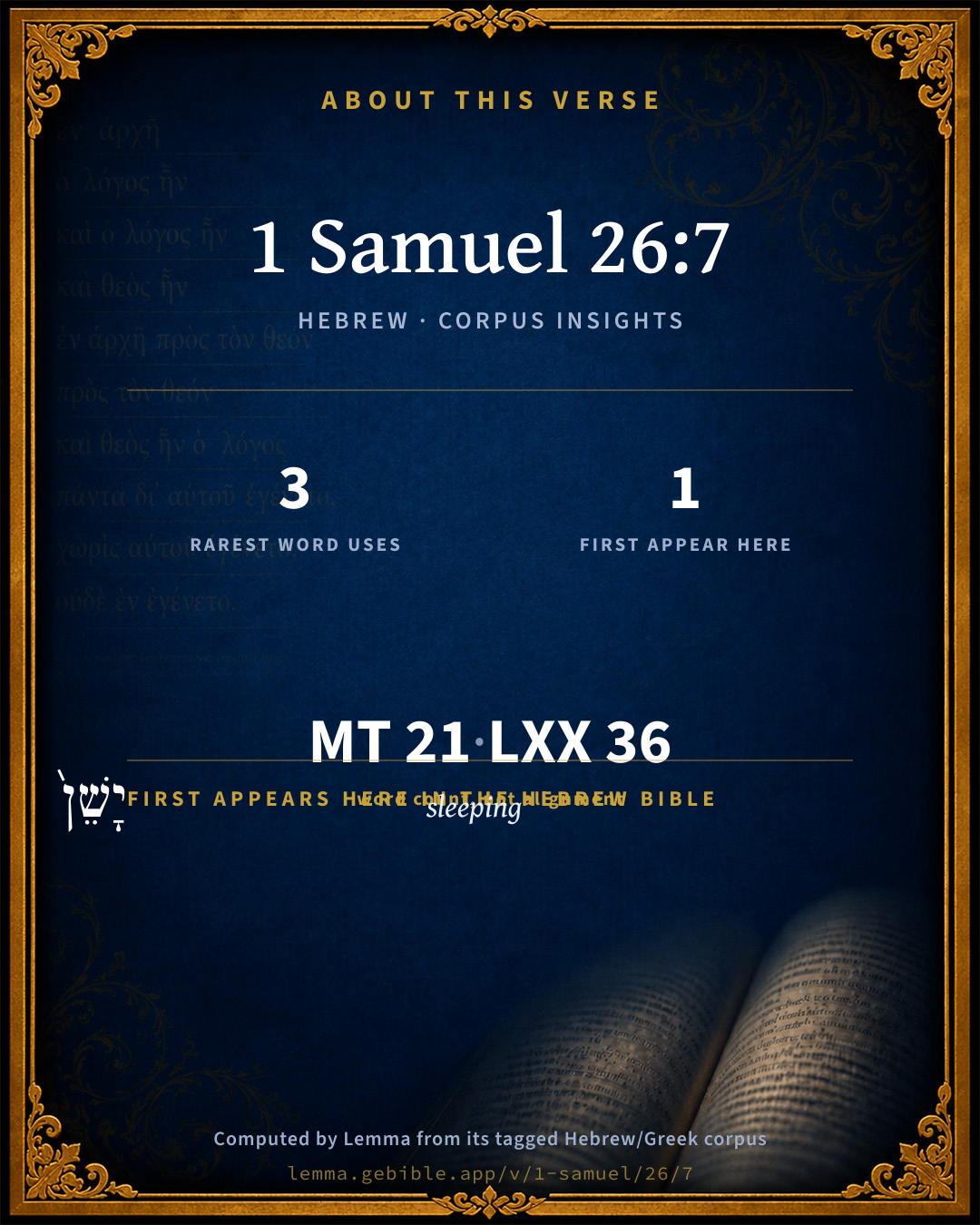
  • 1 first appearance in the Hebrew Bible
Full analysis ↓
Download a study sheet

One document with this verse’s original text, its word-by-word gloss line, the meaning frame, cross-references with their text, attributed commentary, and full source and license credits — printable, and it pastes into notes with its structure intact.

This verse Autodidact and up

Study sheet (.html) Plain text (.txt)

A passage Seminary Student

Up to 50 verses in one chapter. A passage sheet keeps up to 6 commentary sources and 12 cross-references per verse, in the order this page ranks them, and says so on the sheet whenever that leaves anything out. Ask for a single verse and you get the Autodidact verse sheet above.

Everything on this page stays free to read, with no account — the sheet is a download of what is already on screen, not access to it.

Want to remove ads? Support Godless Engineer
Compare translations 3

The same verse in 3 English versions, stacked beneath the original-language interlinear above. Click any original word for its lexicon entry.

Each is an independent rendering of the whole verse — the interlinear is not word-aligned to these translations.

Highlighted words mark where these versions differ — a whole-verse word diff, not a word-by-word alignment.

  • World English Bible Public Domain
    So David and Abishai came to the people by night: and, behold, Saul lay sleeping within the place of the wagons, with his spear stuck in the ground at his head; and Abner and the people lay round about him.
  • King James Version Public Domain
    So David and Abishai came to the people by night: and, behold, Saul lay sleeping within the trench, and his spear stuck in the ground at his bolster: but Abner and the people lay round about him.
  • unfoldingWord Literal Text CC BY-SA 4.0
    And David and Abishai came to the people night. And behold, Saul was lying asleep in the wagon-track, and his spear was pressed into the ground by his head. And Abner and the people were lying around him.

unfoldingWord Literal Text — © unfoldingWord, licensed CC BY-SA 4.0. Word-aligned USFM3 via Door43 (git.door43.org/unfoldingWord/en_ult).

Versions to compare (up to 4)

3 of 4 selected

Show all 18 translations

Every available English version of this verse, each an independent rendering of the whole verse.

  • World English Bible Public Domain
    So David and Abishai came to the people by night: and, behold, Saul lay sleeping within the place of the wagons, with his spear stuck in the ground at his head; and Abner and the people lay round about him.
  • Berean Standard Bible Public Domain
    That night David and Abishai came to the troops, and Saul was lying there asleep in the inner circle of the camp, with his spear stuck in the ground by his head. And Abner and the troops were lying around him.
  • Majority Standard Bible Public Domain
    That night David and Abishai came to the troops, and Saul was lying there asleep in the inner circle of the camp, with his spear stuck in the ground by his head. And Abner and the troops were lying around him.
  • King James Version Public Domain
    So David and Abishai came to the people by night: and, behold, Saul lay sleeping within the trench, and his spear stuck in the ground at his bolster: but Abner and the people lay round about him.
  • American Standard Version (1901) Public Domain
    So David and Abishai came to the people by night: and, behold, Saul lay sleeping within the place of the wagons, with his spear stuck in the ground at his head; and Abner and the people lay round about him.
  • Revised Version (1885) Public Domain
    So David and Abishai came to the people by night: and, behold, Saul lay sleeping within the place of the wagons, with his spear stuck in the ground at his head: and Abner and the people lay round about him.
  • Geneva Bible (1599) Public Domain
    So Dauid and Abishai came downe to the people by night: and beholde, Saul lay sleeping within the fort, and his speare did sticke in the ground at his head: and Abner and the people lay round about him.
  • Douay-Rheims (1899) Public Domain
    So David and Abisai came to the people by night, and found Saul lying and sleeping in the tent, and his spear fixed in the ground at his head: and Abner and the people sleeping round about him.
  • Young's Literal Translation Public Domain
    And David cometh -- and Abishai -- unto the people by night, and lo, Saul is lying sleeping in the path, and his spear struck into the earth at his pillow, and abner and the people are lying round about him.
  • Literal Standard Version CC BY-SA 4.0
    And David comes—and Abishai—by night to the people, and behold, Saul is lying sleeping in the path, and his spear is pressed into the earth by his pillow, and Abner and the people are lying around him.
  • Unlocked Literal Bible CC BY-SA 4.0
    So David and Abishai went to the army by night. Saul was there sleeping inside the camp with his spear stuck in the ground beside his head. Abner and his soldiers lay around him.
  • unfoldingWord Literal Text CC BY-SA 4.0
    And David and Abishai came to the people night. And behold, Saul was lying asleep in the wagon-track, and his spear was pressed into the ground by his head. And Abner and the people were lying around him.
  • Darby Bible Public Domain
    And David and Abishai came to the people by night, and behold, Saul lay sleeping within the wagon-defence, and his spear stuck in the ground at his head; and Abner and the people lay round about him.
  • World Messianic Bible Public Domain
    So David and Abishai came to the people by night; and, behold, Saul lay sleeping within the place of the wagons, with his spear stuck in the ground at his head; and Abner and the people lay around him.
  • Webster's Bible Public Domain
    So David and Abishai came to the people by night, and behold, Saul lay sleeping within the trench, and his spear stuck in the ground at his bolster: but Abner and the people lay about him.
  • Free Bible Version CC BY-SA 4.0
    So David and Abishai went to the army camp at night. Saul was sleeping there in the camp with his spear stuck in the ground beside his head, with Abner and his men sleeping around him.
  • Bible in Basic English Public Domain
    So David and Abishai came down to the army by night: and Saul was sleeping inside the ring of carts with his spear planted in the earth by his head: and Abner and the people were sleeping round him.
  • JPS Tanakh (1917) Public Domain
    So David and Abishai came to the people by night; and, behold, Saul lay sleeping within the barricade, with his spear stuck in the ground at his head; and Abner and the people lay round about him.

Literal Standard Version (2020), Covenant Press — licensed CC BY-SA 4.0. Text via the HelloAO Bible API (eBible.org). Unlocked Literal Bible (unfoldingWord) — licensed CC BY-SA 4.0. Text via the HelloAO Bible API (eBible.org). unfoldingWord Literal Text — © unfoldingWord, licensed CC BY-SA 4.0. Word-aligned USFM3 via Door43 (git.door43.org/unfoldingWord/en_ult). Free Bible Version, Dr. Jonathan Gallagher — licensed CC BY-SA 4.0. Text via the HelloAO Bible API (eBible.org).

Word by word

More ways to search: Search by grammar → Find every occurrence → Compare this word →

Practice this passage: Drill this verse → Learn its vocabulary →

מְעוּכָֽה
mâʻak
H4600
“pressed”
Verb, Qal, Participle Passive, Feminine, Singular, Absolute
Part of Speech
Verb
Stem
Qal
Form
Participle Passive
Gender
Feminine
Number
Singular
State
Absolute
Full BDB Definition

Origin: a primitive root

TWOT: 1229

to press, squeeze - (Qal) to be crushed - (Pual) to be handled, be pressed
  1. וַיָּבֹא֩ bôwʼ H935 “and · to enter” Conjunction + Verb, Qal, Sequential Imperfect, 3rd Person, Masculine, Singular
  2. דָוִ֨ד Dâvid H1732 “David” Noun, Proper
  3. וַאֲבִישַׁ֥י ʼĂbîyshay H52 “and · Abishai” Conjunction + Noun, Proper
  4. אֶל ʼêl H413 “to” Preposition
  5. הָעָם֮ ʻam H5971 “the · people” Particle, Definite Article + Noun, Common, Masculine, Singular, Absolute
  6. לַיְלָה֒ layil H3915 “night” Noun, Common, Masculine, Singular, Absolute
  7. וְהִנֵּ֣ה hinnêh H2009 “and · behold” Conjunction + Particle, Demonstrative
  8. שָׁא֗וּל Shâʼûwl H7586 “Saul” Noun, Proper
  9. שֹׁכֵ֤ב shâkab H7901 “lying down” Verb, Qal, Participle Active, Masculine, Singular, Absolute
  10. יָשֵׁן֙ yâshên H3463 “sleeping” Adjective, Adjective, Masculine, Singular, Absolute
  11. בַּמַּעְגָּ֔ל maʻgâl H4570 “in/at the · track” Preposition, Determined + Noun, Common, Masculine, Singular, Absolute
  12. וַחֲנִית֥וֹ chănîyth H2595 “and · spear · his” Conjunction + Noun, Common, Feminine, Singular, Construct + Suffix, Personal, 3rd Person, Masculine, Singular
  13. בָאָ֖רֶץ ʼerets H776 “in/at the · land” Preposition, Determined + Noun, Common, Both, Singular, Absolute
  14. מראשתו mᵉraʼăshâh H4763 “head place · his” Noun, Common, Feminine, Plural, Construct + Suffix, Personal, 3rd Person, Masculine, Singular
  15. מְרַאֲשֹׁתָ֑יו mᵉraʼăshâh H4763 “head place · his” Noun, Common, Feminine, Plural, Construct + Suffix, Personal, 3rd Person, Masculine, Singular
  16. וְאַבְנֵ֣ר ʼAbnêr H74 “and · Abner” Conjunction + Noun, Proper
  17. וְהָעָ֔ם ʻam H5971 “and · the · people” Conjunction + Particle, Definite Article + Noun, Common, Masculine, Singular, Absolute
  18. שֹׁכְבִ֖ים shâkab H7901 “lying down” Verb, Qal, Participle Active, Masculine, Plural, Absolute
  19. סביבתו çâbîyb H5439 “round about · his” Noun, Common, Both, Singular, Construct + Suffix, Personal, 3rd Person, Masculine, Singular
  20. סְבִיבֹתָֽיו çâbîyb H5439 “surroundings · his” Noun, Common, Both, Plural, Construct + Suffix, Personal, 3rd Person, Masculine, Singular

About this verse

These counts appear in no published source. They are computed here, from the morphology-tagged text and Lemma’s own curated glosses. What Lemma adds →

21
words
17
distinct lemmas
Historical
section

Notable vocabulary

The rarest word here is מְעוּכָֽה to press H4600 — appearing just 3 times in the whole Hebrew Bible.

First appearance in Scripture

This word makes its first canonical appearance in the Hebrew Bible here:

  • יָשֵׁן֙ sleeping H3463

Shared distinctive vocabulary

מְעוּכָֽה to press H4600 occurs in 3 verses of the Hebrew Bible. Also found in:

Grammatical profile

  • 4 verbs
  • 14 nouns
  • 1 adjective
  • 1 preposition
  • 1 particle

Verb forms

  • וַיָּבֹא֩ Qal · Sequential Imperfect
  • שֹׁכֵ֤ב Qal · Participle Active
  • מְעוּכָֽה Qal · Participle Passive
  • שֹׁכְבִ֖ים Qal · Participle Active

Repetition

Words recur within this verse — often emphatic in Hebrew:

  • הָעָם֮ people H5971 ×2
  • שֹׁכֵ֤ב to lie down H7901 ×2
  • מראשתו dominion H4763 ×2
  • סביבתו round about H5439 ×2

Hebrew & Septuagint length

In English translation the verse runs 40 words from the Hebrew and 40 from the Septuagint (LXX English) — the same length.

A rough comparison of the two English renderings, which tokenize alike — not a word-level alignment.

Word counts can differ between the Hebrew and the Greek without any difference in meaning — e.g. the Hebrew direct-object marker אֵת has no separate Greek word, and Greek often adds the article ὁ.

In the original languages it is 21 Hebrew tokens and 36 Greek tokens — but the two are counted differently (Hebrew bundles its prefixes and suffixes into one token; the Greek is in lemma form), so that isn’t a like-for-like length.

Cross-references

1

Topical passages linked to 1 Samuel 26:7 in the Treasury of Scripture Knowledge — connected by theme and wording, ordered by reader-vote popularity; previews shown in the World English Bible.

Cross-references courtesy of OpenBible.info (CC BY 4.0).

Hebrew and Greek witnesses Masoretic Hebrew ↔ Greek Septuagint

The same verse in the two great witnesses to the Old Testament, shown verse-for-verse.

These are two independent witnesses, not word-aligned to each other, and the Septuagint is shown in lemma (dictionary) form.

Hebrew 1 Samuel 26:7 Masoretic · Westminster Leningrad Codex

וַיָּבֹא֩ דָוִ֨ד וַאֲבִישַׁ֥י אֶל הָעָם֮ לַיְלָה֒ וְהִנֵּ֣ה שָׁא֗וּל שֹׁכֵ֤ב יָשֵׁן֙ בַּמַּעְגָּ֔ל וַחֲנִית֥וֹ מְעוּכָֽה בָאָ֖רֶץ מראשתו מְרַאֲשֹׁתָ֑יו וְאַבְנֵ֣ר וְהָעָ֔ם שֹׁכְבִ֖ים סביבתו סְבִיבֹתָֽיו

So David and Abishai came to the people by night: and, behold, Saul lay sleeping within the place of the wagons, with his spear stuck in the ground at his head; and Abner and the people lay round about him.

World English Bible · Public Domain

Greek LXX 1 Samuel 26:7 Septuagint · lemma form

καί εἰςπορεύομαι δαυίδ καί αβεσσα εἰς ὁ λαός ὁ νύξ καί ἰδού σαούλ καταεὕδω ὕπνος ἐν λαμπήνη καί ὁ δόρυ ἐνπήγνυμι εἰς ὁ γῆ πρός κεφαλή αὐτός καί αβεννηρ καί ὁ λαός αὐτός καταεὔδω κύκλος αὐτός

So David and Abessa go in among the people by night: and behold, Saul was fast asleep in the chariot, and his spear was stuck in the ground near his head, and Abenner and his people slept round about him.

LXX2012 (modern English Septuagint) · Public Domain

Hebrew: Westminster Leningrad Codex (CC BY 4.0). Greek: Septuagint (public domain); English from LXX2012 (modern English Septuagint) (Public Domain). How the Septuagint differs from the Hebrew →

Targum (Aramaic paraphrase)

1

The Targum is the ancient Jewish Aramaic paraphrase of the Hebrew Scriptures — an interpretive translation, not the Hebrew text itself. Onkelos (literal) and Pseudo-Jonathan (expansive) render the Torah, and Jonathan the Prophets. Coverage is partial: where no permissively-licensed English translation exists for a verse, only the Aramaic is shown. This is verse-level text, not a word-by-word alignment to the Hebrew.

  1. Targum Jonathan Prophets (Joshua–Malachi)
    וַאֲתָא דָוִד וַאֲבִישַׁי לְוַת עַמָא בְּלֵיְלְיָא וְהָא שָׁאוּל שְׁכִיב דְמוּךְ בְּכַרְכּוּמָא וּמוּרְנִיתֵיהּ נְעִיצָא בְאַרְעָא אִיסָדוֹהִי וְאַבְנֵר וְעַמָא שָׁרָן סַחֲרָנוֹהִי:

    (no public-domain English translation for this verse)

    Targum Jonathan — Aramaic: “Mikraot Gedolot” (public domain). English: “Sefaria Community Translation” (CC0 1.0 (public-domain dedication)); “London "Chaldee Paraphrase," 1871” (public domain). Text via Sefaria.

Commentary

Notes on 1 Samuel 26:7 from classic Christian and Jewish commentators (each source and its license shown beneath its notes). The classic Christian expositions comment on the surrounding passage and are grouped to its opening verse, so a note may address several verses; the Jewish commentaries on the Tanakh (Rashi and others) are per-verse, so they appear only where the commentator wrote on this verse.

Lemma curates 59 commentaries, every one of them public domain or Creative Commons licensed, each selected and text-cleaned for this edition rather than reprinted as found. About our sources →

Trapp's Complete Commentary

John Trapp

1Sa 26:7 So David and Abishai came to the people by night: and, behold, Saul lay sleeping within the trench, and his spear stuck in the ground at his bolster: but Abner and the people lay round about him.

Ver. 7. So David and Abishai came.] Ahimelech belike durst not venture, or else David was willing to have but only one with him, for secrecy sake.

But Abner and the people lay round about him.] See on 1Sa 26:5.

John Trapp, A Commentary or Exposition upon All the Books of the Old and New Testament (1647–1656) — public domain. Text from a community e-Sword module.

The Biblical Illustrator

Joseph S. Exell

1Sa_26:7

Saul lay sleeping within the trench.

The danger of spiritual lethargy

The circumstances of Saul, and the manner in which he was treated by David, may have a warning voice to unbelievers, careless, thoughtless, and slumbering in their sins. The King of Israel was bound to David by every tie of gratitude, as to the man who had saved his life and kingdom. Yet with all unthankfulness the most flagrant did he aim if possible to destroy him. With this unrighteous purpose, he had followed David into the wilderness of Ziph, and every malignant feeling was arrayed against the man after Gods own heart. And what is the unbelievers state in reference to God? Hath not the Most High visited him with providential and spiritual mercies? Look how eternal love is manifested, in that Christ hath died for him, the just for the unjust, that He might bring him to God. What is the result? Hath this flow of goodness softened and melted him into deep repentance, adoring gratitude, and holy reconciliation? No; look how the offender is pursuing the Lord to dishonour Him--mark how the carnal mind is enmity against God. The lips, to which God hath given language, ere opened to blaspheme Him. The feet, to which He hath given motion, walk in the way of scorners. In prosecution of his unrighteous purpose, Saul had pitched in the hill of Hachilah, whither David and Abishai his sisters son followed him. And when they came, behold Saul lay sleeping within the trench, and the spear stuck in the ground at his bolster; but Abner, the captain of his host, and the people lay round about him. His army, confident and well appointed, were at his bidding and hard at hand; he looked for no resistance, but expected soon and safely to possess and destroy his enemy, and he fell asleep in the fulness of security. In that warfare which the rebellious sinner wages with his offended Maker, how often doth self-confidence lull his soul to sleep in the trench! His heart is lulled to sleep by the deceitfulness of sin. The very forbearance he hath received serves to deepen his lethargy. Satan leads him blindfold into danger. Jonah slept in the storm; Samson slept in the lap of Delilah, while the Philistines were upon him; Sisera slept in the tent of Jael the Kenite; and thus doth the soul without Christ sleep amidst the terrors of impending wrath. A deep sleep had fallen upon Saul from the Lord. O tremble, lest, while ye are wrapped up in this insensibility, an offended God should continue and deepen the spirit of slumber upon you in judgment. Saul slept securely, but he was in the power of his enemies. David had good reason to regard him as a foe; and how shall God regard you who depart from him? Abishai said unto David, God hath delivered thine enemy into thy hand this day. Is your spiritual slumber so deep that ye cannot hear Satan express a similar desire? Doth he not long to put, forth his hand for a first and final stroke against your lives? (R. P. Buddicom, M. A.)

The Biblical Illustrator, edited by Joseph S. Exell (c. 1880s–1900s) — public domain. Text from a community e-Sword module.

Geneva Bible (1599)

Geneva Bible translators

Or, bolster.

Geneva Bible (1599) marginal notes — public domain. Text via Bolls.life.

Ellicott's Commentary for English Readers

(7) Within the trench.—As above, in 1Sa_26:5, “within the barrier of the wagons.”

His spear . . . at his bolster.—“Bolster,” literally, the place where his head is, better rendered at his head; and so in 1Sa_26:11-12; 1Sa_26:16. The same Hebrew word occurs in the narration of Jacob’s dream (Gen_28:11); it is there rendered in our English Version, “his pillows.” It was the tall spear which ever seems to have been in Saul’s hand, or placed close to him. We read of it in battle in his hand, and in the council chamber and at the state banquet it was within his reach, and now it was evidently reared upright beside the sleeping king. “I noticed at all the encampments which we passed that the sheik’s tent was distinguished from the rest by a tall spear stuck upright in the ground in front of it; and it is the custom when a party set out on an excursion for robbery or for war, that when they halt to rest the spot where the chief reclines or rests is thus designated”—Thomson, Land and the Book.

A Bible Commentary for English Readers, edited by Charles John Ellicott (1878–1897) — public domain. Text from a community e-Sword module.

The Cambridge Bible for Schools and Colleges

gen. ed. J. J. S. Perowne

7. to the people] i.e. to Saul’s army. Cp. 1Sa_14:45.

his spear] See on 1Sa_18:10.

at his bolster] At his head; and so in 1Sa_26:11; 1Sa_26:16. Cp. 1Sa_19:13.

The Cambridge Bible for Schools and Colleges (gen. ed. J. J. S. Perowne; Cambridge University Press, 1878–1918) — public domain. Text from a community e-Sword module.

John Gill's Exposition

So David and Abishai came to the people by night,.... Josephus (l) wrongly says, that he took with him both Abishai and Ahimelech; he chose to have but one, for the greater secrecy. This was a bold enterprise, for two men to go into a camp of three thousand men, though it was in the night; when though they might suppose the greater part of them were asleep, yet they could not well suppose this of all, and especially of the guards or sentinels; but no doubt David was moved to this, not merely by the dint of his natural courage, but by the Spirit of God, by whom he might be assured of protection, and that Saul and the people were cast into a deep sleep by the Lord, as they were, Sa1 26:12; and this the Lord moved him to, that he might have an opportunity a second time to convince Saul of his innocence, and that he had no design upon his life:

and, behold, Saul lay sleeping within the trench; See Gill on Sa1 26:5,

and his spear stuck in the ground at his bolster; ready to take up and defend himself, should he be surprised; or this was his sceptre, which he always carried about with him, as an ensign of royalty, and by which very probably David knew which was Saul's tent or couch, where he slept:

but Abner and the people lay round about him; as in Sa1 26:5.

(l) Antiqu. l. 6. c. 13. sect. 9.

John Gill's Exposition of the Whole Bible (1746–1763) — public domain (CC PDM 1.0). Text via the HelloAO Bible API.

Matthew Poole's English Annotations

To the people, i. e. to Saul’s host and camp. It might seem a bold and strange attempt; but many things are to be considered:

1. That heroical persons have oft attempted things of no less difficulty and danger than this was; as many credible historians relate.

2. That David did and might easily perceive that they were all fast asleep.

3. That David had a particular assurance that God would preserve him to the kingdom.

4. That he had a special instinct from God to this work; and possibly God might inform him that he had cast them into a dead sleep, that he might have this second opportunity of manifesting his innocency towards Saul, and the justice of his cause.

Matthew Poole's English Annotations on the Holy Bible (1683–1685) — public domain. Text from a community e-Sword/MySword module.

Whedon's Commentary on the Bible

Daniel D. Whedon

7. Spear… at his bolster — Or, at his head, as we have rendered the Hebrew at 1Sa_19:13. “I noticed at all the encampments which we passed,” says Dr. Thomson, “that the sheik’s tent was distinguished from the rest by a tall spear stuck upright in the ground in front of it; and it is the custom, when a party is out on an excursion for robbery or for war, that when they halt to rest, the spot where the chief reclines or sleeps is thus designated.”

Daniel D. Whedon (gen. ed.), Commentary on the Old and New Testaments (1874–1909) — public domain. Text from a community e-Sword module.

The Pulpit Commentary

Vers. 7, 8. The two accordingly go by night, or "at night," as soon as night came on, and find Saul asleep within the trench, i.e. inside the wagon rampart, as in ver. 5, and his spear, the sign of his royal authority, stuck in the ground; not at his bolster, but "at his head; and so in vers. 11, 12, 16. The word literally signifies "the place where the head is." Like David"s men in 1Sa_24:4, Abishai sees in Saul"s defenceless condition a proof that it was God"s will that he should die, but there is a difference of language in the Hebrew which the A.V does not represent. There the word rendered deliver is really give; here it is "hath locked up." At once. Hebrew, "once." Abishai would pierce him through with a single stroke so thoroughly that no second blow would be necessary. The purpose of this would be to prevent an outcry.

The Pulpit Commentary (1880–1919), ed. H.D.M. Spence-Jones & Joseph S. Exell — public domain. Text from a community e-Sword module.

John Wesley's Explanatory Notes

Came - That is, to Saul's host. It might seem a bold and strange attempt; but it may be considered:

1. That David had a particular assurance that God would preserve him to the kingdom.

2. That he had a special instinct from God, to this work; and possibly God might inform him, that he had cast them into a deep sleep, that he might have this second opportunity of manifesting his innocency towards Saul.

John Wesley, Explanatory Notes Upon the Whole Bible (1754–1765) — public domain. Text via the GEBible commentary corpus.

Rashi

Rabbi Shlomo Yitzchaki (Rashi)

Stuck. Thrust.

Rashi on the Tanakh — English translations: “The Judaica Press complete Tanach with Rashi, translated by A. J. Rosenberg” (CC BY 4.0); “Pentateuch with Rashi's commentary by M. Rosenbaum and A.M. Silbermann, 1929-1934” (public domain); “The Metsudah Tanach series, Lakewood, N.J” (CC BY 4.0); and “The Book of Joshua, Metsudah Publications, 1997” (CC BY 4.0). Text via Sefaria.

Lesson kit

Teaching starters — assembled from the data on this page, not authored interpretation. Every prompt links to the verse data it draws on. Edit before teaching.

1 Samuel, in the Historical, opens this verse with 21 words (17 distinct Hebrew lemmas). Its most distinctive word is mâʻak (“to press”). A historical commentator’s framing appears above. Read the whole chapter for the surrounding context.

Discussion questions

  1. How does “to press” (mâʻak) shape what this verse is saying?
  2. This is the first place “sleeping” appears in Scripture (first appears here). What does its debut here establish?
  3. How does Leviticus 22:24, which shares the word «to press», read alongside this verse?
  4. What does the repetition of “people” (2× in this one verse) do in this verse?
  5. These translations render this verse differently. What is at stake in choosing one wording over another?
  6. «וַיָּבֹא֩» is a Qal Sequential Imperfect verb. How does that grammatical form shape the action described?
  7. Compare how Trapp's Complete Commentary and The Biblical Illustrator read this verse. Where do they agree or differ?

Things to notice

Reading settings

Reading text

Shown beneath each verse's original-language words.

Old Testament
Old Testament edition

Read the OT as the Masoretic Hebrew (MT) or the Greek Septuagint (LXX).

English shown for the Greek Septuagint (in the Hebrew ↔ Greek comparison).

Comparing translations? Open the Compare panel on any verse page to stack up to four side by side.