
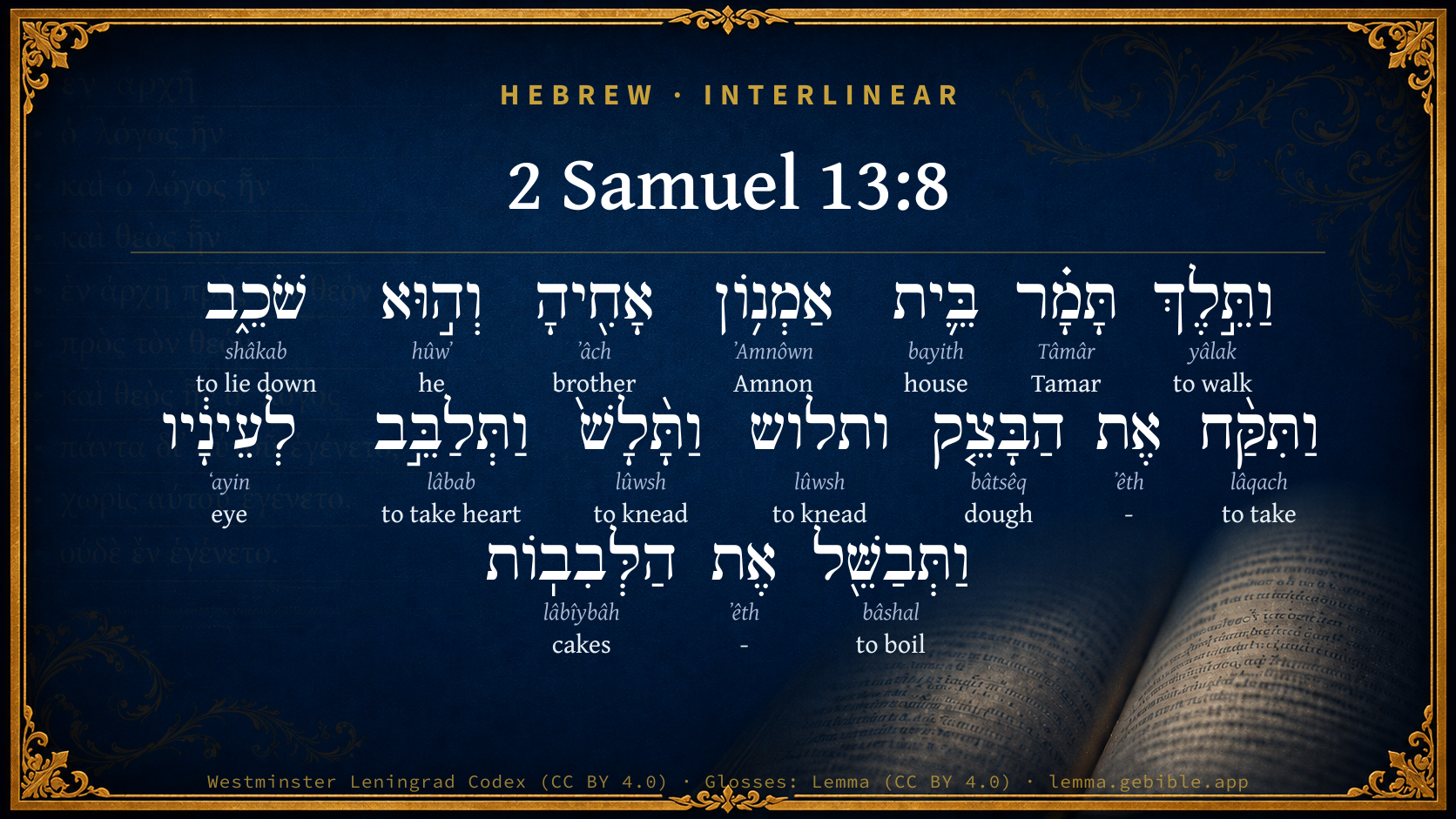
2 Samuel 13:8

Hebrew (Westminster Leningrad Codex) 2 Samuel 13:8 appears in the Hebrew Old Testament. The text above is from the Westminster Leningrad Codex. Each word links to its Strong’s number, a concise gloss, and parsing drawn from the Open Scriptures Hebrew Bible morphology. Click any word for its full Brown-Driver-Briggs (BDB) entry.
Download image
Cite this verse

2 Samuel 13:8 (World English Bible). Public Domain. Lemma interlinear Bible study tool, https://lemma.gebible.app/v/2-samuel/13/8.

Show BibTeX & RIS
BibTeX
RIS
English Translation
So Tamar went to her brother Amnon's house; and he was laid down. She took dough, and kneaded it, and made cakes in his sight, and did bake the cakes.
World English Bible · Public Domain
Download a study sheet

One document with this verse’s original text, its word-by-word gloss line, the meaning frame, cross-references with their text, attributed commentary, and full source and license credits — printable, and it pastes into notes with its structure intact.

This verse Autodidact and up

Study sheet (.html) Plain text (.txt)

A passage Seminary Student

Up to 50 verses in one chapter. A passage sheet keeps up to 6 commentary sources and 12 cross-references per verse, in the order this page ranks them, and says so on the sheet whenever that leaves anything out. Ask for a single verse and you get the Autodidact verse sheet above.

Everything on this page stays free to read, with no account — the sheet is a download of what is already on screen, not access to it.

Want to remove ads? Support Godless Engineer
Compare translations 3

The same verse in 3 English versions, stacked beneath the original-language interlinear above. Click any original word for its lexicon entry.

Each is an independent rendering of the whole verse — the interlinear is not word-aligned to these translations.

Highlighted words mark where these versions differ — a whole-verse word diff, not a word-by-word alignment.

  • World English Bible Public Domain
    So Tamar went to her brother Amnon's house; and he was laid down. She took dough, and kneaded it, and made cakes in his sight, and did bake the cakes.
  • King James Version Public Domain
    So Tamar went to her brother Amnon's house; and he was laid down. And she took flour, and kneaded it, and made cakes in his sight, and did bake the cakes.
  • unfoldingWord Literal Text CC BY-SA 4.0
    So Tamar went the house of Amnon her brother, and he was lying down. And she took the dough, and she kneaded, and she made pancakes to his eyes, and she cooked the pancakes.

unfoldingWord Literal Text — © unfoldingWord, licensed CC BY-SA 4.0. Word-aligned USFM3 via Door43 (git.door43.org/unfoldingWord/en_ult).

Versions to compare (up to 4)

3 of 4 selected

Show all 18 translations

Every available English version of this verse, each an independent rendering of the whole verse.

  • World English Bible Public Domain
    So Tamar went to her brother Amnon's house; and he was laid down. She took dough, and kneaded it, and made cakes in his sight, and did bake the cakes.
  • Berean Standard Bible Public Domain
    So Tamar went to the house of her brother Amnon, who was lying down. She took some dough, kneaded it, made cakes in his sight, and baked them.
  • Majority Standard Bible Public Domain
    So Tamar went to the house of her brother Amnon, who was lying down. She took some dough, kneaded it, made cakes in his sight, and baked them.
  • King James Version Public Domain
    So Tamar went to her brother Amnon's house; and he was laid down. And she took flour, and kneaded it, and made cakes in his sight, and did bake the cakes.
  • American Standard Version (1901) Public Domain
    So Tamar went to her brother Amnon's house; and he was laid down. And she took dough, and kneaded it, and made cakes in his sight, and did bake the cakes.
  • Revised Version (1885) Public Domain
    So Tamar went to her brother Amnon’s house; and he was laid down. And she took dough, and kneaded it, and made cakes in his sight, and did bake the cakes.
  • Geneva Bible (1599) Public Domain
    So Tamar went to her brother Amnons house, and he lay downe: and she tooke floure, and knead it, and made cakes in his sight, and did bake the cakes.
  • Douay-Rheims (1899) Public Domain
    And Thamar came to the house of Amnon her brother: but he was laid down: and she took meal and tempered it: and dissolving it in his sight she made little messes.
  • Young's Literal Translation Public Domain
    And Tamar goeth to the house of Amnon her brother, and he is lying down, and she taketh the dough, and kneadeth, and maketh cakes before his eyes, and cooketh the cakes,
  • Literal Standard Version CC BY-SA 4.0
    And Tamar goes to the house of her brother Amnon, and he is lying down, and she takes the dough, and kneads, and makes cakes before his eyes, and cooks the cakes,
  • Unlocked Literal Bible CC BY-SA 4.0
    So Tamar went to her brother Amnon's house where he was lying down. She took dough and kneaded it and formed bread in his sight, and then she baked it.
  • unfoldingWord Literal Text CC BY-SA 4.0
    So Tamar went the house of Amnon her brother, and he was lying down. And she took the dough, and she kneaded, and she made pancakes to his eyes, and she cooked the pancakes.
  • Darby Bible Public Domain
    And Tamar went to her brother Amnon's house; and he had lain down. And she took flour and kneaded it, and made cakes in his sight, and baked the cakes.
  • World Messianic Bible Public Domain
    So Tamar went to her brother Amnon’s house; and he was lying down. She took dough, kneaded it, made cakes in his sight, and baked the cakes.
  • Webster's Bible Public Domain
    So Tamar went to her brother Amnon's house; and he was laid down. And she took flour, and kneaded it, and made cakes in his sight, and baked the cakes.
  • Free Bible Version CC BY-SA 4.0
    So Tamar went to the house of her brother Amnon to where he was lying down. She took some dough, kneaded it, and cooked the pancakes as he watched.
  • Bible in Basic English Public Domain
    So Tamar went to her brother Amnon's house; and he was in bed. And she took paste and made cakes before his eyes, cooking them over the fire.
  • JPS Tanakh (1917) Public Domain
    So Tamar went to her brother Amnon's house; and he was lying down. And she took dough, and kneaded it, and made cakes in his sight, and did bake the cakes.

Literal Standard Version (2020), Covenant Press — licensed CC BY-SA 4.0. Text via the HelloAO Bible API (eBible.org). Unlocked Literal Bible (unfoldingWord) — licensed CC BY-SA 4.0. Text via the HelloAO Bible API (eBible.org). unfoldingWord Literal Text — © unfoldingWord, licensed CC BY-SA 4.0. Word-aligned USFM3 via Door43 (git.door43.org/unfoldingWord/en_ult). Free Bible Version, Dr. Jonathan Gallagher — licensed CC BY-SA 4.0. Text via the HelloAO Bible API (eBible.org).

Word by word

More ways to search: Search by grammar → Find every occurrence → Compare this word →

Practice this passage: Drill this verse → Learn its vocabulary →

הַלְּבִבֽוֹת
lâbîybâh
H3834
“the · cakes”
Particle, Definite Article + Noun, Common, Feminine, Plural, Absolute
Part of Speech
Particle + Noun
Type
Common
Gender
Feminine
Number
Plural
State
Absolute
Full BDB Definition

Origin: from H3823 in its original sense of fatness (or perhaps of folding) TWOT - H1071 c

TWOT: n f

cakes, bread
  1. וַתֵּ֣לֶךְ yâlak H3212 “and · to walk” Conjunction + Verb, Qal, Sequential Imperfect, 3rd Person, Feminine, Singular
  2. תָּמָ֗ר Tâmâr H8559 “Tamar” Noun, Proper
  3. בֵּ֛ית bayith H1004 “house of” Noun, Common, Masculine, Singular, Construct
  4. אַמְנ֥וֹן ʼAmnôwn H550 “Amnon” Noun, Proper
  5. אָחִ֖יהָ ʼâch H251 “brother · her” Noun, Common, Masculine, Singular, Construct + Suffix, Personal, 3rd Person, Feminine, Singular
  6. וְה֣וּא hûwʼ H1931 “and · he” Conjunction + Pronoun, Personal, 3rd Person, Masculine, Singular
  7. שֹׁכֵ֑ב shâkab H7901 “lying down” Verb, Qal, Participle Active, Masculine, Singular, Absolute
  8. וַתִּקַּ֨ח lâqach H3947 “and · to take” Conjunction + Verb, Qal, Sequential Imperfect, 3rd Person, Feminine, Singular
  9. אֶת ʼêth H853 “-” Particle, Direct Object
  10. הַבָּצֵ֤ק bâtsêq H1217 “the · dough” Particle, Definite Article + Noun, Common, Masculine, Singular, Absolute
  11. ותלוש lûwsh H3888 “and · to knead” Conjunction + Verb, Qal, Sequential Imperfect, 3rd Person, Feminine, Singular
  12. וַתָּ֨לָשׁ֙ lûwsh H3888 “and · to knead” Conjunction + Verb, Qal, Sequential Imperfect, 3rd Person, Feminine, Singular
  13. וַתְּלַבֵּ֣ב lâbab H3823 “and · to take heart” Conjunction + Verb, Piel, Sequential Imperfect, 3rd Person, Feminine, Singular
  14. לְעֵינָ֔יו ʻayin H5869 “to/for · eyes · his” Preposition + Noun, Common, Both, Dual, Construct + Suffix, Personal, 3rd Person, Masculine, Singular
  15. וַתְּבַשֵּׁ֖ל bâshal H1310 “and · to boil” Conjunction + Verb, Piel, Sequential Imperfect, 3rd Person, Feminine, Singular
  16. אֶת ʼêth H853 “-” Particle, Direct Object

About this verse

These counts appear in no published source. They are computed here, from the morphology-tagged text and Lemma’s own curated glosses. What Lemma adds →

17
words
15
distinct lemmas
Historical
section

Notable vocabulary

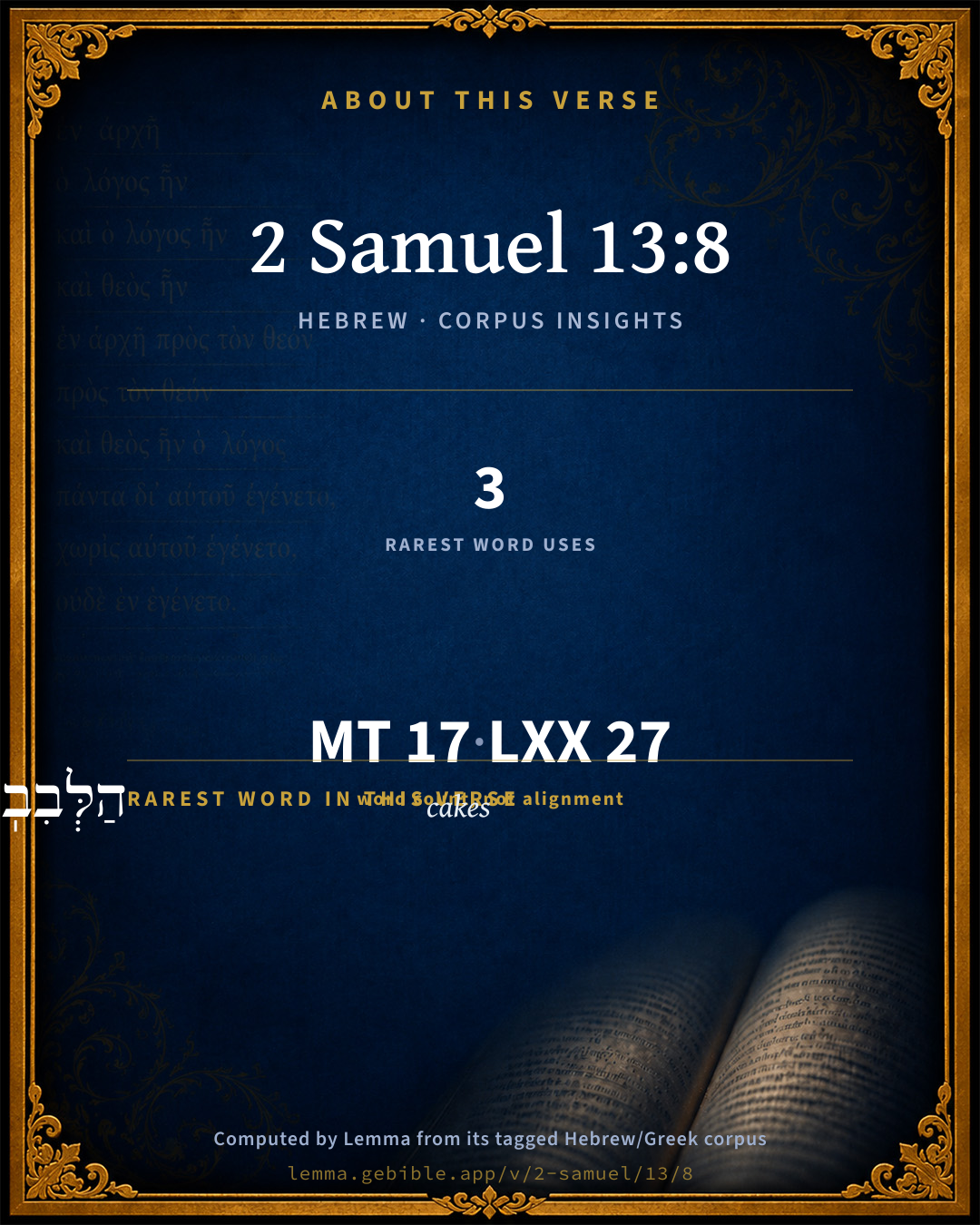
The rarest word here is הַלְּבִבֽוֹת cakes H3834 — appearing just 3 times in the whole Hebrew Bible.

Shared distinctive vocabulary

הַלְּבִבֽוֹת cakes H3834 occurs in 3 verses of the Hebrew Bible. Also found in:

Grammatical profile

  • 7 verbs
  • 7 nouns
  • 1 pronoun
  • 2 particles

Verb forms

  • וַתֵּ֣לֶךְ Qal · Sequential Imperfect
  • שֹׁכֵ֑ב Qal · Participle Active
  • וַתִּקַּ֨ח Qal · Sequential Imperfect
  • ותלוש Qal · Sequential Imperfect
  • וַתָּ֨לָשׁ֙ Qal · Sequential Imperfect
  • וַתְּלַבֵּ֣ב Piel · Sequential Imperfect
  • וַתְּבַשֵּׁ֖ל Piel · Sequential Imperfect

Repetition

A word recurs within this verse — often emphatic in Hebrew:

  • ותלוש to knead H3888 ×2

Hebrew & Septuagint length

In English translation the verse runs 30 words from the Hebrew and 33 from the Septuagint (LXX English) — closely comparable.

A rough comparison of the two English renderings, which tokenize alike — not a word-level alignment.

Word counts can differ between the Hebrew and the Greek without any difference in meaning — e.g. the Hebrew direct-object marker אֵת has no separate Greek word, and Greek often adds the article ὁ.

In the original languages it is 17 Hebrew tokens and 27 Greek tokens — but the two are counted differently (Hebrew bundles its prefixes and suffixes into one token; the Greek is in lemma form), so that isn’t a like-for-like length.

Hebrew and Greek witnesses Masoretic Hebrew ↔ Greek Septuagint

The same verse in the two great witnesses to the Old Testament, shown verse-for-verse.

These are two independent witnesses, not word-aligned to each other, and the Septuagint is shown in lemma (dictionary) form.

Hebrew 2 Samuel 13:8 Masoretic · Westminster Leningrad Codex

וַתֵּ֣לֶךְ תָּמָ֗ר בֵּ֛ית אַמְנ֥וֹן אָחִ֖יהָ וְה֣וּא שֹׁכֵ֑ב וַתִּקַּ֨ח אֶת הַבָּצֵ֤ק ותלוש וַתָּ֨לָשׁ֙ וַתְּלַבֵּ֣ב לְעֵינָ֔יו וַתְּבַשֵּׁ֖ל אֶת הַלְּבִבֽוֹת

So Tamar went to her brother Amnon's house; and he was laid down. She took dough, and kneaded it, and made cakes in his sight, and did bake the cakes.

World English Bible · Public Domain

Greek LXX 2 Samuel 13:8 Septuagint · lemma form

καί πορεύομαι θημαρ εἰς ὁ οἶκος αμνων ἀδελφός αὐτός καί αὐτός κοιμάω καί λαμβάνω ὁ σταῖς καί φυράω καί κολλυρίζω κατά ὀφθαλμός αὐτός καί ἕψω ὁ κολλυρίς

And Themar went to the house of her brother Amnon, and he was lying down: and she took the dough and kneaded it, and made cakes in his sight, and baked the cakes.

LXX2012 (modern English Septuagint) · Public Domain

Hebrew: Westminster Leningrad Codex (CC BY 4.0). Greek: Septuagint (public domain); English from LXX2012 (modern English Septuagint) (Public Domain). How the Septuagint differs from the Hebrew →

Targum (Aramaic paraphrase)

1

The Targum is the ancient Jewish Aramaic paraphrase of the Hebrew Scriptures — an interpretive translation, not the Hebrew text itself. Onkelos (literal) and Pseudo-Jonathan (expansive) render the Torah, and Jonathan the Prophets. Coverage is partial: where no permissively-licensed English translation exists for a verse, only the Aramaic is shown. This is verse-level text, not a word-by-word alignment to the Hebrew.

  1. Targum Jonathan Prophets (Joshua–Malachi)
    וַאֲזַלַת תָּמָר בֵּית אַמְנוֹן אֲחוּהָא וְהוּא שְׁכִיב וּנְסִיבַת יַת לִישָׁא וְלָשַׁת וַחֲלָטַת לְעֵינוֹהִי וּבַשִׁילַת יַת חֲלִיטָתָא:

    (no public-domain English translation for this verse)

    Targum Jonathan — Aramaic: “Mikraot Gedolot” (public domain). English: “Sefaria Community Translation” (CC0 1.0 (public-domain dedication)); “London "Chaldee Paraphrase," 1871” (public domain). Text via Sefaria.

Commentary

Notes on 2 Samuel 13:8 from classic Christian and Jewish commentators (each source and its license shown beneath its notes). The classic Christian expositions comment on the surrounding passage and are grouped to its opening verse, so a note may address several verses; the Jewish commentaries on the Tanakh (Rashi and others) are per-verse, so they appear only where the commentator wrote on this verse.

Lemma curates 59 commentaries, every one of them public domain or Creative Commons licensed, each selected and text-cleaned for this edition rather than reprinted as found. About our sources →

Trapp's Complete Commentary

John Trapp

2Sa 13:8 So Tamar went to her brother Amnon’s house; and he was laid down. And she took flour, and kneaded [it], and made cakes in his sight, and did bake the cakes.

Ver. 8. So Tamar went to her brother Amnon’s house.] As an ox to the butcher, or as an innocent sheep to the ravenous wolf.

And she took flour, and kneaded it.] This she disdained not to do, though a king’s daughter; neither was she unused to such employments. Rebekah was a dainty cook; so was Sarah before her. Augustus wore no garments but what his wife and daughters made him. Our Queen Katharine, and her successor Anne Boleyn, are famous for their good housewifery; not taking leisure to follow such pastimes as are usual in princes’ courts.

John Trapp, A Commentary or Exposition upon All the Books of the Old and New Testament (1647–1656) — public domain. Text from a community e-Sword module.

Geneva Bible (1599)

Geneva Bible translators

Or, past.

Geneva Bible (1599) marginal notes — public domain. Text via Bolls.life.

The Cambridge Bible for Schools and Colleges

gen. ed. J. J. S. Perowne

8. flour] The dough.

The Cambridge Bible for Schools and Colleges (gen. ed. J. J. S. Perowne; Cambridge University Press, 1878–1918) — public domain. Text from a community e-Sword module.

John Gill's Exposition

So Tamar went to her brother Amnon's house,.... In obedience to the king's commands, and in affection to her brother, with an innocent breast, having no suspicion of any design upon her chastity:

(and he was laid down); upon a couch or bed in his chamber, as being sick as was pretended, into which she was introduced:

and she took flour, and kneaded it; made it into a paste:

and made cakes in his sight; a kind of fritters of them, as in the Talmud (y):

and did bake the cakes: or fried them in a frying pan, in oil.

(y) T. Bab. Sanhedrin, fol. 21. 1.

John Gill's Exposition of the Whole Bible (1746–1763) — public domain (CC PDM 1.0). Text via the HelloAO Bible API.

Matthew Poole's English Annotations

He was laid down upon his bed, or rather his couch.

Matthew Poole's English Annotations on the Holy Bible (1683–1685) — public domain. Text from a community e-Sword/MySword module.

Whedon's Commentary on the Bible

Daniel D. Whedon

8. Amnon’s house — It appears that each of the king’s sons had a separate establishment of his own.

Flour — Margin, more correctly, paste, or dough. Here we observe that in that more simple age kings’ daughters were accustomed to the arts and practices of cookery.

Daniel D. Whedon (gen. ed.), Commentary on the Old and New Testaments (1874–1909) — public domain. Text from a community e-Sword module.

Rashi

Rabbi Shlomo Yitzchaki (Rashi)

She made a paste. She made a paste of flour mixed [it] first into boiling water and afterwords in oil.

Rashi on the Tanakh — English translations: “The Judaica Press complete Tanach with Rashi, translated by A. J. Rosenberg” (CC BY 4.0); “Pentateuch with Rashi's commentary by M. Rosenbaum and A.M. Silbermann, 1929-1934” (public domain); “The Metsudah Tanach series, Lakewood, N.J” (CC BY 4.0); and “The Book of Joshua, Metsudah Publications, 1997” (CC BY 4.0). Text via Sefaria.

Lesson kit

Teaching starters — assembled from the data on this page, not authored interpretation. Every prompt links to the verse data it draws on. Edit before teaching.

2 Samuel, in the Historical, opens this verse with 17 words (15 distinct Hebrew lemmas). Its most distinctive word is lâbîybâh (“cakes”). A historical commentator’s framing appears above. Read the whole chapter for the surrounding context.

Discussion questions

  1. The word lâbîybâh carries the sense “cakes.” How does it shape the verse?
  2. How does 2 Samuel 13:6, which shares the word «cakes», read alongside this verse?
  3. What does the repetition of “to knead” (2× in this one verse) do in this verse?
  4. These translations render this verse differently. What is at stake in choosing one wording over another?
  5. «וַתֵּ֣לֶךְ» is a Qal Sequential Imperfect verb. How does that grammatical form shape the action described?
  6. Compare how Trapp's Complete Commentary and Geneva Bible (1599) read this verse. Where do they agree or differ?

Things to notice

Reading settings

Reading text

Shown beneath each verse's original-language words.

Old Testament
Old Testament edition

Read the OT as the Masoretic Hebrew (MT) or the Greek Septuagint (LXX).

English shown for the Greek Septuagint (in the Hebrew ↔ Greek comparison).

Comparing translations? Open the Compare panel on any verse page to stack up to four side by side.