
Job 38:37

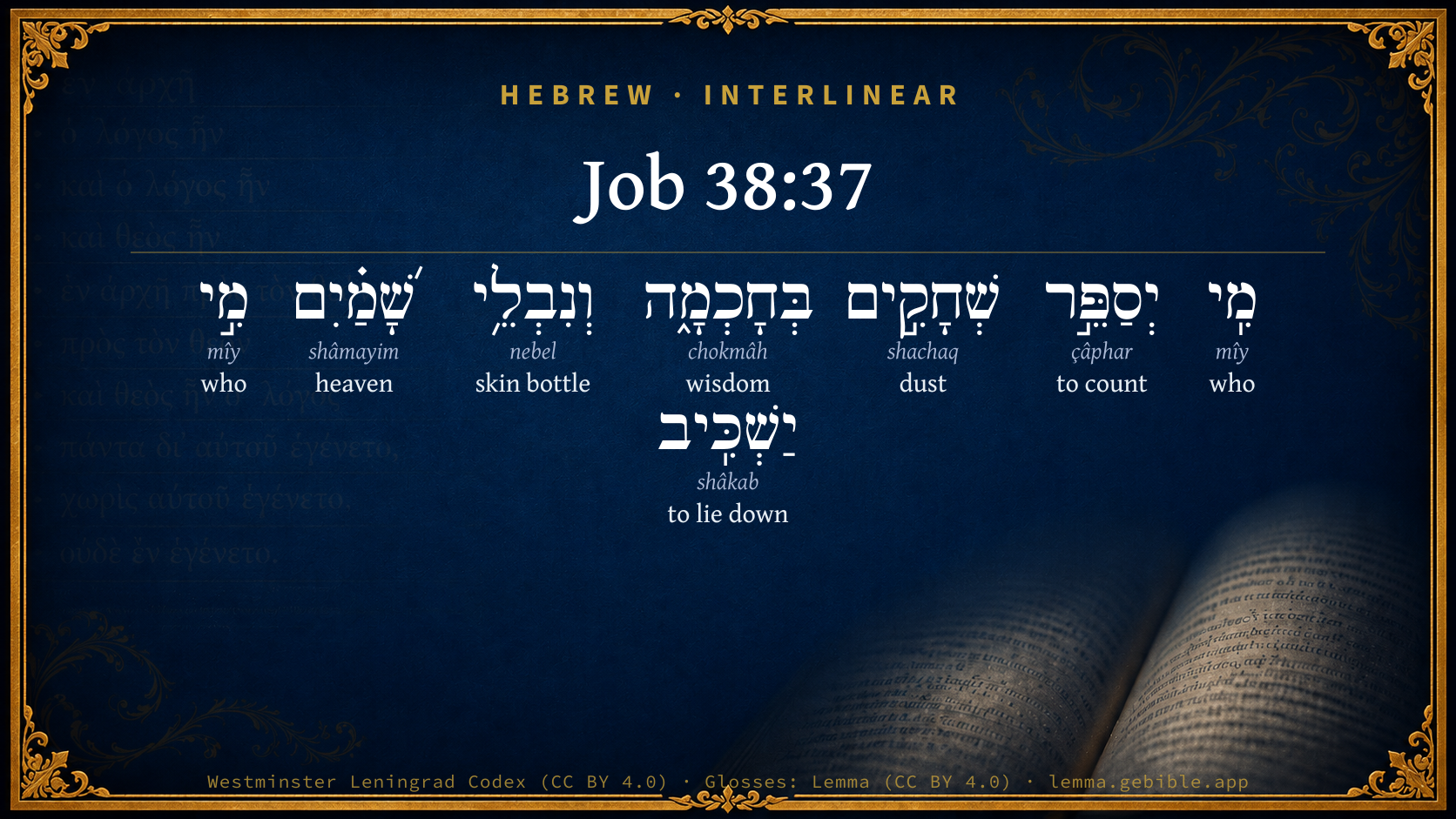
Hebrew (Westminster Leningrad Codex) Job 38:37 appears in the Hebrew Old Testament. The text above is from the Westminster Leningrad Codex. Each word links to its Strong’s number, a concise gloss, and parsing drawn from the Open Scriptures Hebrew Bible morphology. Click any word for its full Brown-Driver-Briggs (BDB) entry.
Download image
Cite this verse

Job 38:37 (World English Bible). Public Domain. Lemma interlinear Bible study tool, https://lemma.gebible.app/v/job/38/37.

Show BibTeX & RIS
BibTeX
RIS
English Translation
Who can number the clouds by wisdom? Or who can pour out the bottles of the sky,
World English Bible · Public Domain
Download a study sheet

One document with this verse’s original text, its word-by-word gloss line, the meaning frame, cross-references with their text, attributed commentary, and full source and license credits — printable, and it pastes into notes with its structure intact.

This verse Autodidact and up

Study sheet (.html) Plain text (.txt)

A passage Seminary Student

Up to 50 verses in one chapter. A passage sheet keeps up to 6 commentary sources and 12 cross-references per verse, in the order this page ranks them, and says so on the sheet whenever that leaves anything out. Ask for a single verse and you get the Autodidact verse sheet above.

Everything on this page stays free to read, with no account — the sheet is a download of what is already on screen, not access to it.

Want to remove ads? Support Godless Engineer
Compare translations 3

The same verse in 3 English versions, stacked beneath the original-language interlinear above. Click any original word for its lexicon entry.

Each is an independent rendering of the whole verse — the interlinear is not word-aligned to these translations.

Highlighted words mark where these versions differ — a whole-verse word diff, not a word-by-word alignment.

  • World English Bible Public Domain
    Who can number the clouds by wisdom? Or who can pour out the bottles of the sky,
  • King James Version Public Domain
    Who can number the clouds in wisdom? or who can stay the bottles of heaven,
  • unfoldingWord Literal Text CC BY-SA 4.0
    Who by wisdom will number the clouds? Or the water skins of the skies, who will tilt

unfoldingWord Literal Text — © unfoldingWord, licensed CC BY-SA 4.0. Word-aligned USFM3 via Door43 (git.door43.org/unfoldingWord/en_ult).

Versions to compare (up to 4)

3 of 4 selected

Show all 18 translations

Every available English version of this verse, each an independent rendering of the whole verse.

  • World English Bible Public Domain
    Who can number the clouds by wisdom? Or who can pour out the bottles of the sky,
  • Berean Standard Bible Public Domain
    Who has the wisdom to count the clouds? Or who can tilt the water jars of the heavens
  • Majority Standard Bible Public Domain
    Who has the wisdom to count the clouds? Or who can tilt the water jars of the heavens
  • King James Version Public Domain
    Who can number the clouds in wisdom? or who can stay the bottles of heaven,
  • American Standard Version (1901) Public Domain
    Who can number the clouds by wisdom? Or who can pour out the bottles of heaven,
  • Revised Version (1885) Public Domain
    Who can number the clouds by wisdom? or who can pour out the bottles of heaven,
  • Geneva Bible (1599) Public Domain
    Who can nomber cloudes by wisedome? or who can cause to cease the bottels of heaue,
  • Douay-Rheims (1899) Public Domain
    Who can declare the order of the heavens, or who can make the harmony of heaven to sleep?
  • Young's Literal Translation Public Domain
    Who doth number the clouds by wisdom? And the bottles of the heavens, Who doth cause to lie down,
  • Literal Standard Version CC BY-SA 4.0
    Who numbers the clouds by wisdom? And the bottles of the heavens, || Who causes to lie down,
  • Unlocked Literal Bible CC BY-SA 4.0
    Who can number the clouds by his skill? Who can pour out the water skins of the sky
  • unfoldingWord Literal Text CC BY-SA 4.0
    Who by wisdom will number the clouds? Or the water skins of the skies, who will tilt
  • Darby Bible Public Domain
    Who numbereth the clouds with wisdom? or who poureth out the bottles of the heavens,
  • World Messianic Bible Public Domain
    Who can count the clouds by wisdom? Or who can pour out the containers of the sky,
  • Webster's Bible Public Domain
    Who can number the clouds in wisdom? or who can stay the bottles of heaven,
  • Free Bible Version CC BY-SA 4.0
    Who is clever enough to count the clouds? Who can turn heaven's water jars on their sides
  • Bible in Basic English Public Domain
    By whose wisdom are the clouds numbered, or the water-skins of the heavens turned to the earth,
  • JPS Tanakh (1917) Public Domain
    Who can number the clouds by wisdom? Or who can pour out the bottles of heaven,

Literal Standard Version (2020), Covenant Press — licensed CC BY-SA 4.0. Text via the HelloAO Bible API (eBible.org). Unlocked Literal Bible (unfoldingWord) — licensed CC BY-SA 4.0. Text via the HelloAO Bible API (eBible.org). unfoldingWord Literal Text — © unfoldingWord, licensed CC BY-SA 4.0. Word-aligned USFM3 via Door43 (git.door43.org/unfoldingWord/en_ult). Free Bible Version, Dr. Jonathan Gallagher — licensed CC BY-SA 4.0. Text via the HelloAO Bible API (eBible.org).

Word by word

More ways to search: Search by grammar → Find every occurrence → Compare this word →

Practice this passage: Drill this verse → Learn its vocabulary →

About this verse

These counts appear in no published source. They are computed here, from the morphology-tagged text and Lemma’s own curated glosses. What Lemma adds →

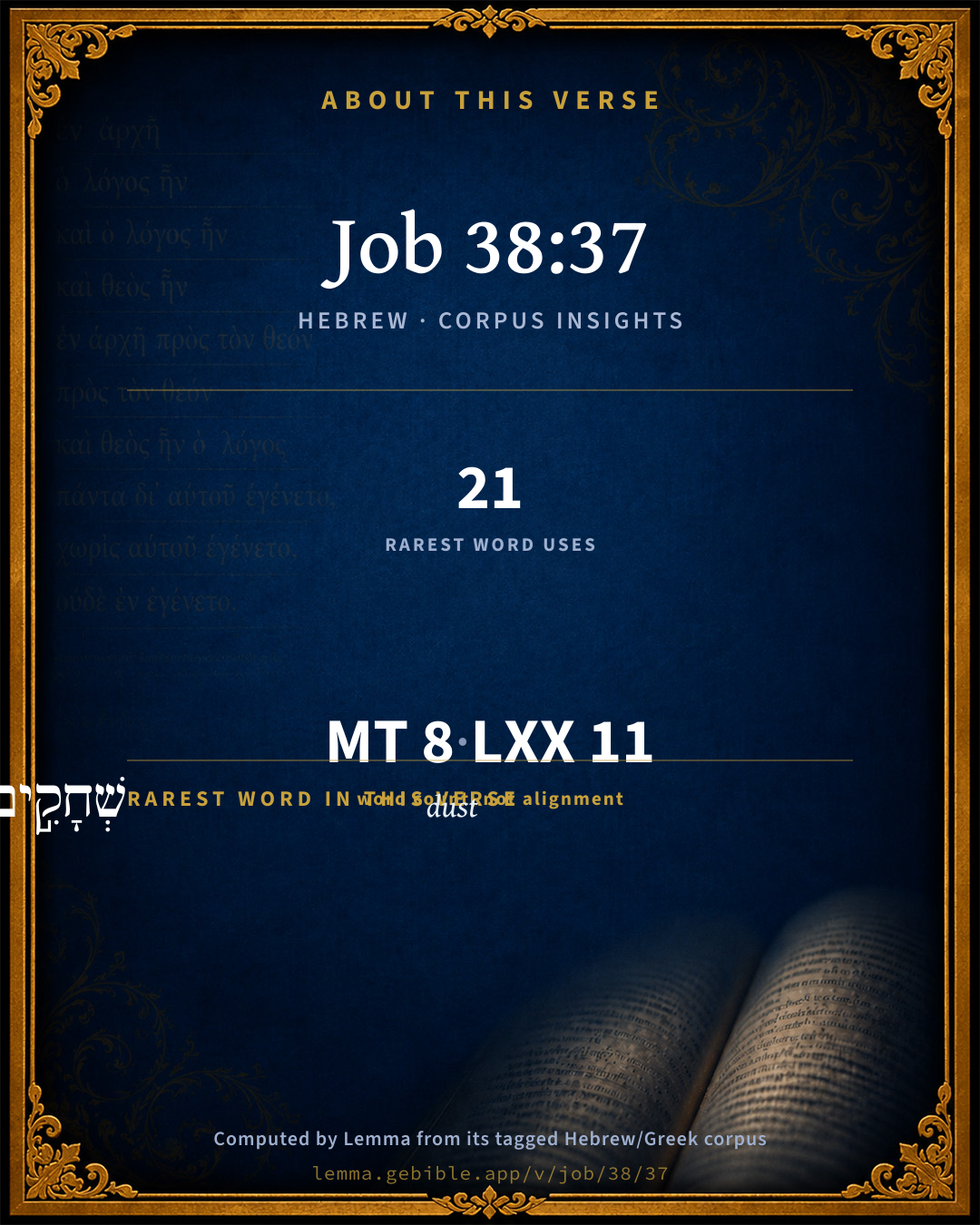
8
words
7
distinct lemmas
Wisdom
section

Notable vocabulary

The rarest word here is שְׁחָקִ֣ים dust H7834 — appearing just 21 times in the whole Hebrew Bible.

Shared distinctive vocabulary

שְׁחָקִ֣ים dust H7834 occurs in 21 verses of the Hebrew Bible. Also found in:

Grammatical profile

  • 2 verbs
  • 4 nouns
  • 2 particles

Verb forms

  • יְסַפֵּ֣ר Piel · Imperfect
  • יַשְׁכִּֽיב Hiphil · Imperfect

Repetition

A word recurs within this verse — often emphatic in Hebrew:

Hebrew & Septuagint length

In English translation the verse runs 17 words from the Hebrew and 19 from the Septuagint (LXX English) — closely comparable.

A rough comparison of the two English renderings, which tokenize alike — not a word-level alignment.

Word counts can differ between the Hebrew and the Greek without any difference in meaning — e.g. the Hebrew direct-object marker אֵת has no separate Greek word, and Greek often adds the article ὁ.

In the original languages it is 8 Hebrew tokens and 11 Greek tokens — but the two are counted differently (Hebrew bundles its prefixes and suffixes into one token; the Greek is in lemma form), so that isn’t a like-for-like length.

Cross-references

4

Topical passages linked to Job 38:37 in the Treasury of Scripture Knowledge — connected by theme and wording, ordered by reader-vote popularity; previews shown in the World English Bible.

  • Psalms 147:4 He counts the number of the stars. He calls them all by their names.
  • Genesis 8:1 God remembered Noah, all the animals, and all the cattle that were with him in the ark; and God made a wind to pass over the earth. The waters subsided.
  • Genesis 9:15 and I will remember my covenant, which is between me and you and every living creature of all flesh, and the waters will no more become a flood to destroy all flesh.
  • Genesis 15:5 Yahweh brought him outside, and said, "Look now toward the sky, and count the stars, if you are able to count them." He said to Abram, "So shall your seed be."

Cross-references courtesy of OpenBible.info (CC BY 4.0).

Hebrew and Greek witnesses Masoretic Hebrew ↔ Greek Septuagint

The same verse in the two great witnesses to the Old Testament, shown verse-for-verse.

These are two independent witnesses, not word-aligned to each other, and the Septuagint is shown in lemma (dictionary) form.

Hebrew Job 38:37 Masoretic · Westminster Leningrad Codex

מִֽי יְסַפֵּ֣ר שְׁחָקִ֣ים בְּחָכְמָ֑ה וְנִבְלֵ֥י שָׁ֝מַ֗יִם מִ֣י יַשְׁכִּֽיב

Who can number the clouds by wisdom? Or who can pour out the bottles of the sky,

World English Bible · Public Domain

Greek LXX Job 38:37 Septuagint · lemma form

τίς δέ ὁ ἀριθμέω νέφος σοφία οὐρανός δέ εἰς γῆ κλίνω

And who is he that numbers the clouds in wisdom, and has bowed the heaven down to the earth?

LXX2012 (modern English Septuagint) · Public Domain

On this verse, Haydock's Catholic Bible Commentary discusses the Septuagint’s reading. Read the note in Commentary ↓

Hebrew: Westminster Leningrad Codex (CC BY 4.0). Greek: Septuagint (public domain); English from LXX2012 (modern English Septuagint) (Public Domain). How the Septuagint differs from the Hebrew →

Commentary

Notes on Job 38:37 from classic Christian and Jewish commentators (each source and its license shown beneath its notes). The classic Christian expositions comment on the surrounding passage and are grouped to its opening verse, so a note may address several verses; the Jewish commentaries on the Tanakh (Rashi and others) are per-verse, so they appear only where the commentator wrote on this verse.

Lemma curates 59 commentaries, every one of them public domain or Creative Commons licensed, each selected and text-cleaned for this edition rather than reprinted as found. About our sources →

Trapp's Complete Commentary

John Trapp

Job 38:37 Who can number the clouds in wisdom? or who can stay the bottles of heaven,

Ver. 37. Who can number the clouds in wisdom?] Quis sapphirinas efficit nubes? Who can make the clouds like sapphire, that is bright and clear? so some read it. Others, Who can declare the clouds? sc. their number, nature, and uses?

Or who can stay the bottles of heaven?] i.e. The clouds, fitly compared to bottles, as those vessels that hold the rain, and pour it out on the earth, when God pleaseth to turn the mouths of those bottles downward. This is a great miracle, saith Lavater, that whereas water is fluid, and beareth downward, yet it abideth in the lofty and soft air, nor can fall but where and when God appointeth.

John Trapp, A Commentary or Exposition upon All the Books of the Old and New Testament (1647–1656) — public domain. Text from a community e-Sword module.

Joseph Benson's Commentary

Job 38:37-38. Who can number the clouds in wisdom? — Who can wisely search, and exactly find out, the number of the clouds? which are indeed numberless, and filled with water as the next clause implies. Or who can stay the bottles of heaven? — Can prevent the rain from being poured upon the earth out of the clouds, in which it is kept as in bottles; when the dust groweth into hardness — When the earth grows very hard, in the time of a great drought; and the clods cleave fast together — Become close and compact. Or the condition of the earth may be intended presently after a fall of rain, when the ground, which in the time of drought was much of it dissolved into dust, is now, by the rain, cemented or united together.

Joseph Benson's Commentary on the Old and New Testaments (1811–1818) — public domain. Text from a community e-Sword module.

Geneva Bible (1599)

Geneva Bible translators

That is, the clouds wherein the water is contained as in bottles.

Geneva Bible (1599) marginal notes — public domain. Text via Bolls.life.

Jamieson, Fausset & Brown

Robert Jamieson, A. R. Fausset & David Brown

Who appoints by his wisdom the due measure of the clouds?

stay--rather, "empty"; literally, "lay down" or "incline" so as to pour out.

bottles of heaven--rain-filled clouds.

Jamieson, Fausset & Brown — Commentary Critical and Explanatory on the Whole Bible (1871) — public domain (CC PDM 1.0). Text via the HelloAO Bible API.

Adam Clarke's Commentary

Verse 37. Who can number the clouds] Perhaps the word ספר saphar, which is commonly rendered to number, may here mean, as in Arabic, to irradiate, as Mr. Good contends; and may refer to those celestial and inimitable tinges which we sometimes behold in the sky.

Bottles of heaven] The clouds: it is an allusion to the girbahs, or bottles made of skin, in which they are accustomed to carry their water from wells and tanks.

Adam Clarke's Commentary on the Bible (1810–1826) — public domain. Text from a community e-Sword/MySword module.

Ellicott's Commentary for English Readers

(37) Who can stay the bottles of heaven?—This is understood in two opposite senses—of pouring out the bottles or of laying them up in store. It is not easy to decide which is most in accordance with the context, for the context also is somewhat uncertain, according as we interpret the solid mass of thick mud or of hard, dry soil. The survey of physical phenomena ends with this verse.

A Bible Commentary for English Readers, edited by Charles John Ellicott (1878–1897) — public domain. Text from a community e-Sword module.

The Cambridge Bible for Schools and Colleges

gen. ed. J. J. S. Perowne

37. The verse carries on the thought of the preceding.

who can number] Or, who numbereth in wisdom? Who musters or counts off the clouds, that they be sufficient and not in excess for the purpose required of them?

The second clause means,

Or who poureth out the bottles of the heavens?

The Cambridge Bible for Schools and Colleges (gen. ed. J. J. S. Perowne; Cambridge University Press, 1878–1918) — public domain. Text from a community e-Sword module.

John Gill's Exposition

When they couch in their dens, and abide in the covert to lie in wait? Which some understand of old lions, who, for want of strength, lie couchant in their dens, or in some covert place, waiting for any prey that passes by, to seize upon it. But the same pasture and places are used by younger lions, as well as old ones; who are emblems of wicked men, cruel persecutors, and bloodthirsty tyrants, who fill their palaces and kingdoms with murder and rapine; see Psa 10:8, Nah 2:11.

Job 38:41

John Gill's Exposition of the Whole Bible (1746–1763) — public domain (CC PDM 1.0). Text via the HelloAO Bible API.

Albert Barnes' Notes on the Bible

Who can number the clouds? - The word here rendered “clouds” (שׁחקים shachaqiym) is applied to the clouds as made up of “small particles” - as if they were composed of fine dust, and hence, the word number is applied to them, not as meaning that the clouds themselves were innumerable, but that no one could estimate the number of particles which enter into their formation.

In wisdom - By his wisdom. Who has sufficient intelligence to do it?

Or who can stay the bottles of heaven? - Margin, as in Hebrew “cause to lie down.” The clouds are here compared with bottles, as if they held the water in the same manner; compare the notes at Job 26:8. The word rendered “stay” in the text, and in the margin “cause to lie down,” is rendered by Umbreit, “pour out,” from an Arabic signification of the word. Gesenius supposes that the meaning to “pour out” is derived from the idea of “causing to lie down,” from the fact that a bottle or vessel was made to lie down or was inclined to one side when its contents were poured out. This explanation seems probable, though there is no other place in the Hebrew where the word is used in this signification. The sense of pouring out agrees well with the connection.

Albert Barnes' Notes on the Bible (1834–1885) — public domain. Text from a community e-Sword/MySword module.

Haydock's Catholic Bible Commentary

Sleep. The ancients have celebrated this harmony. (Cic.[Cicero?] Somn. Scip.) --- Septuagint, "Who numbereth the clouds in wisdom, or hath bent the sky down to the earth?" Protestants, "or who can stay the bottles of heaven?" (Haydock) --- Canst thou cause it to rain, or to be fair? (Calmet) or make the celestial bodies (Haydock) rest from motion? (Worthington)

George Leo Haydock (1774–1849), Haydock's Catholic Family Bible and Commentary, 1859 edition — public domain. Excludes Psalms (Douay-Rheims chapter numbering differs from Protestant) and Deuterocanonical books (Catholic canon only).

Matthew Poole's English Annotations

Who can wisely search out and exactly find the number of the clouds? They are numberless, and filled with water, as the next clause implies.

Who can stay the bottles of heaven, to wit, the clouds? in which the rain is kept as in bottles, out of which God poureth it when he sees fit.

Matthew Poole's English Annotations on the Holy Bible (1683–1685) — public domain. Text from a community e-Sword/MySword module.

Whedon's Commentary on the Bible

Daniel D. Whedon

37. Number the clouds — A metaphor taken from a military enrolment — same word as in 2Sa_24:10.

Who can stay the bottles of heaven — Rather, the bottles of heaven, who inclines them? as in the margin, with the meaning, “As water is poured from a bottle when inclined, so when the clouds are full of rain they empty themselves upon the earth.”

Ecc_11:3. Sir J. Herschel’s explanation of the formation and descent of rain is as good, perhaps, as any yet proposed. “In whatever part of a cloud the original ascensional movement of the vapour ceases, the elementary globules of which it consists being abandoned to the action of gravity, begin to fall. By the theory of the resistance of fluids, the velocity of descent in air of a given density is as the square root of the diameter of the globule. The larger globules, therefore, fall fastest, and if (as must happen) they overtake the slower ones they incorporate, and, the diameter being thereby increased, the descent becomes more rapid, and the encounters more frequent, till at length the globule emerges from the lower surface of the cloud at the ‘vapour plain,’ as a drop of rain; the size of the drops depending on the thickness of the cloud stratum and its density.” — Meteorology, s.v.

Bottles of heaven — “This phrase,” says Dr. Good, “is a direct Arabism for the clouds, and is to be found in every poet.” Among the citations Schultens makes from the Arabic poets is the following translation: —

A broad, deep cloud, that fed the rest, was nigh,

And burst its bottle ‘mid the warring sky.

A figure of the south wind adorns the Temple of Winds at Athens, holding a kind of pitcher (a swelling urceus) in his bared arms, as if it would deluge the earth. (See Wordsworth’s Athens and Attica, p. 153.) Scott observes that this image is similar to the inclined urn which the heathen poets place in the hand of a river god; the urn represents the fountain from which the river flows, and what fountains are to rivers the clouds are to rain. Dr. Hutchinson thinks that there is an allusion to the working of a Persian wheel, “the pitchers or bottles of which, as they come up, lie down or along, and so discharge their contents. As this discharge can only take place at a particular moment, and in consequence of the proper working of the wheel, so the discharge from the clouds can only take place at the proper moment, when allowed by the Creator.”

Daniel D. Whedon (gen. ed.), Commentary on the Old and New Testaments (1874–1909) — public domain. Text from a community e-Sword module.

The Pulpit Commentary

Who can number the clouds in wisdom? i.e. Who is wise enough to number the clouds, and say how many they are? Or who can stay the bottles of heaven! rather, Who can pour out? (see the Revised Version). The "bottles," or "water-skins," of heaven are the dense clouds heavy with rain, which alternately hold the moisture like a reservoir, and pour it out upon the earth. God alone can determine when the rain shall fall.

The Pulpit Commentary (1880–1919), ed. H.D.M. Spence-Jones & Joseph S. Exell — public domain. Text from a community e-Sword module.

Rashi

Rabbi Shlomo Yitzchaki (Rashi)

charges Heb. יספר, will speak and charge with their mission.

the bottles Made like bottles in which the rains are collected, as in (I Sam. 1:24), “and an earthenware jug (ונבל) of wine.”

Rashi on the Tanakh — English translations: “The Judaica Press complete Tanach with Rashi, translated by A. J. Rosenberg” (CC BY 4.0); “Pentateuch with Rashi's commentary by M. Rosenbaum and A.M. Silbermann, 1929-1934” (public domain); “The Metsudah Tanach series, Lakewood, N.J” (CC BY 4.0); and “The Book of Joshua, Metsudah Publications, 1997” (CC BY 4.0). Text via Sefaria.

Lesson kit

Teaching starters — assembled from the data on this page, not authored interpretation. Every prompt links to the verse data it draws on. Edit before teaching.

Job, in the Wisdom, opens this verse with 8 words (7 distinct Hebrew lemmas). Its most distinctive word is shachaq (“dust”). A historical commentator’s framing appears above. Read the whole chapter for the surrounding context.

Discussion questions

  1. The word shachaq carries the sense “dust.” How does it shape the verse?
  2. Deuteronomy 33:26 shares the word «dust» with this verse. How do the two illuminate each other?
  3. “who” occurs 2× in this one verse. What is the effect of the repetition?
  4. These translations render this verse differently; the difference is in the English rendering, not the original. What questions does that raise?
  5. The verb «יְסַפֵּ֣ר» is Piel Imperfect. How does its form color the action?
  6. Reading how Trapp's Complete Commentary and Joseph Benson's Commentary read this verse, where do the two commentators agree and where do they part?

Things to notice

Reading settings

Reading text

Shown beneath each verse's original-language words.

Old Testament
Old Testament edition

Read the OT as the Masoretic Hebrew (MT) or the Greek Septuagint (LXX).

English shown for the Greek Septuagint (in the Hebrew ↔ Greek comparison).

Comparing translations? Open the Compare panel on any verse page to stack up to four side by side.