
Ezekiel 32:30

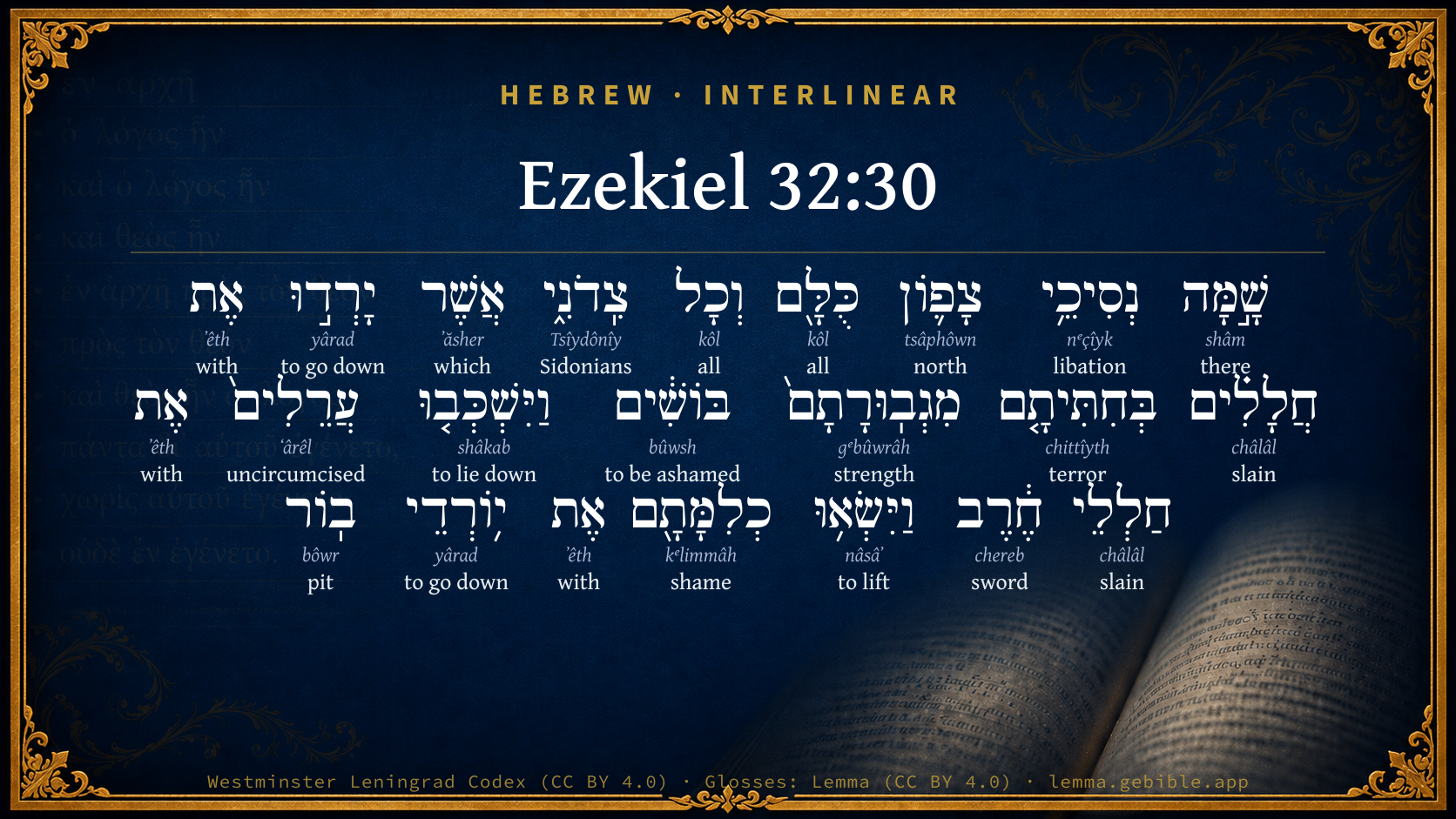
Hebrew (Westminster Leningrad Codex) Ezekiel 32:30 appears in the Hebrew Old Testament. The text above is from the Westminster Leningrad Codex. Each word links to its Strong’s number, a concise gloss, and parsing drawn from the Open Scriptures Hebrew Bible morphology. Click any word for its full Brown-Driver-Briggs (BDB) entry.
Download image
Cite this verse

Ezekiel 32:30 (World English Bible). Public Domain. Lemma interlinear Bible study tool, https://lemma.gebible.app/v/ezekiel/32/30.

Show BibTeX & RIS
BibTeX
RIS
English Translation
There are the princes of the north, all of them, and all the Sidonians, who are gone down with the slain; in the terror which they caused by their might they are put to shame; and they lie uncircumcised with those who are slain by the sword, and bear their shame with those who go down to the pit.
World English Bible · Public Domain
Download a study sheet

One document with this verse’s original text, its word-by-word gloss line, the meaning frame, cross-references with their text, attributed commentary, and full source and license credits — printable, and it pastes into notes with its structure intact.

This verse Autodidact and up

Study sheet (.html) Plain text (.txt)

A passage Seminary Student

Up to 50 verses in one chapter. A passage sheet keeps up to 6 commentary sources and 12 cross-references per verse, in the order this page ranks them, and says so on the sheet whenever that leaves anything out. Ask for a single verse and you get the Autodidact verse sheet above.

Everything on this page stays free to read, with no account — the sheet is a download of what is already on screen, not access to it.

Want to remove ads? Support Godless Engineer
Compare translations 3

The same verse in 3 English versions, stacked beneath the original-language interlinear above. Click any original word for its lexicon entry.

Each is an independent rendering of the whole verse — the interlinear is not word-aligned to these translations.

Highlighted words mark where these versions differ — a whole-verse word diff, not a word-by-word alignment.

  • World English Bible Public Domain
    There are the princes of the north, all of them, and all the Sidonians, who are gone down with the slain; in the terror which they caused by their might they are put to shame; and they lie uncircumcised with those who are slain by the sword, and bear their shame with those who go down to the pit.
  • King James Version Public Domain
    There be the princes of the north, all of them, and all the Zidonians, which are gone down with the slain; with their terror they are ashamed of their might; and they lie uncircumcised with them that be slain by the sword, and bear their shame with them that go down to the pit.
  • unfoldingWord Literal Text CC BY-SA 4.0
    The princes of the north are there—all of them and all the Sidonians who went down with the ones who had been pierced. They were powerful and made others to be afraid, but now they are there in shame, uncircumcised with those who were pierced by the sword. They carry their own shame, together with the ones going down to the pit.

unfoldingWord Literal Text — © unfoldingWord, licensed CC BY-SA 4.0. Word-aligned USFM3 via Door43 (git.door43.org/unfoldingWord/en_ult).

Versions to compare (up to 4)

3 of 4 selected

Show all 18 translations

Every available English version of this verse, each an independent rendering of the whole verse.

  • World English Bible Public Domain
    There are the princes of the north, all of them, and all the Sidonians, who are gone down with the slain; in the terror which they caused by their might they are put to shame; and they lie uncircumcised with those who are slain by the sword, and bear their shame with those who go down to the pit.
  • Berean Standard Bible Public Domain
    All the leaders of the north and all the Sidonians are there; they went down in disgrace with the slain, despite the terror of their might. They lie uncircumcised with those slain by the sword and bear their shame with those who descend to the Pit.
  • Majority Standard Bible Public Domain
    All the leaders of the north and all the Sidonians are there; they went down in disgrace with the slain, despite the terror of their might. They lie uncircumcised with those slain by the sword and bear their shame with those who descend to the Pit.
  • King James Version Public Domain
    There be the princes of the north, all of them, and all the Zidonians, which are gone down with the slain; with their terror they are ashamed of their might; and they lie uncircumcised with them that be slain by the sword, and bear their shame with them that go down to the pit.
  • American Standard Version (1901) Public Domain
    There are the princes of the north, all of them, and all the Sidonians, who are gone down with the slain; in the terror which they caused by their might they are put to shame; and they lie uncircumcised with them that are slain by the sword, and bear their shame with them that go down to the pit.
  • Revised Version (1885) Public Domain
    There be the princes of the north, all of them, and all the Zidonians, which are gone down with the slain; in the terror which they caused by their might they are ashamed; and they lie uncircumcised with them that are slain by the sword, and bear their shame with them that go down to the pit.
  • Geneva Bible (1599) Public Domain
    There be al the princes of the North, with al the Zidonians, which are gone downe with the slaine, with their feare: they are ashamed of their strength, and the vncircumcised sleepe with them that be slaine by the sword, and beare their shame with them that goe downe to the pit.
  • Douay-Rheims (1899) Public Domain
    There are all the princes of the north, and all the hunters: who were brought down with the slain, fearing, and con- founded in their strength: who slept uncircumcised with them that are slain by the sword, and have borne their shame with them that go down into the pit.
  • Young's Literal Translation Public Domain
    There `are' princes of the north, All of them, and every Zidonian, Who have gone down with the pierced in their terror, Of their might they are ashamed, And they lie uncircumcised with the pierced of the sword, And they bear their shame with those going down to the pit.
  • Literal Standard Version CC BY-SA 4.0
    There [are] princes of the north, || All of them, and every Zidonian, || Who have gone down with the pierced in their terror, || They are ashamed of their might, || And they lie uncircumcised with the pierced of the sword, || And they bear their shame with those going down to the pit.
  • Unlocked Literal Bible CC BY-SA 4.0
    The princes of the north are there—all of them and all the Sidonians who went down with the ones who had been pierced. They were powerful and made others to be afraid, but now they are there in shame, uncircumcised with those who were pierced by the sword. They carry their own shame, together with the ones going down to the pit.
  • unfoldingWord Literal Text CC BY-SA 4.0
    The princes of the north are there—all of them and all the Sidonians who went down with the ones who had been pierced. They were powerful and made others to be afraid, but now they are there in shame, uncircumcised with those who were pierced by the sword. They carry their own shame, together with the ones going down to the pit.
  • Darby Bible Public Domain
    There are the princes of the north, all of them, and all the Zidonians, that are gone down with the slain -- ashamed of the terror which they caused through their might; and they lie uncircumcised with them that are slain by the sword, and bear their confusion with them that go down to the pit.
  • World Messianic Bible Public Domain
    “There are the princes of the north, all of them, and all the Sidonians, who have gone down with the slain. They are put to shame in the terror which they caused by their might. They lie uncircumcised with those who are slain by the sword, and bear their shame with those who go down to the pit.
  • Webster's Bible Public Domain
    There are the princes of the north, all of them, and all the Zidonians, who are gone down with the slain; with their terror they are ashamed of their might; and they lie uncircumcised with them that are slain by the sword, and bear their shame with them that go down to the pit.
  • Free Bible Version CC BY-SA 4.0
    All the leaders from the north, and all the people of Sidon are there too. They also are disgraced, going down with those who were killed, in spite of their formidable power. They are heathen, lying there with those killed by the sword, and have the disgrace of those who go down into the grave.
  • Bible in Basic English Public Domain
    There are the chiefs of the north, all of them, and all the Zidonians, who have gone down with those who have been put to the sword: they are shamed on account of all the fear caused by their strength; they are resting there without circumcision, among those who have been put to the sword, and are put to shame with those who go down to the underworld.
  • JPS Tanakh (1917) Public Domain
    There are the princes of the north, all of them, and all the Zidonians, who are gone down with the slain, ashamed for all the terror which they caused by their might, and they lie uncircumcised with them that are slain by the sword, and bear their shame with them that go down to the pit.

Literal Standard Version (2020), Covenant Press — licensed CC BY-SA 4.0. Text via the HelloAO Bible API (eBible.org). Unlocked Literal Bible (unfoldingWord) — licensed CC BY-SA 4.0. Text via the HelloAO Bible API (eBible.org). unfoldingWord Literal Text — © unfoldingWord, licensed CC BY-SA 4.0. Word-aligned USFM3 via Door43 (git.door43.org/unfoldingWord/en_ult). Free Bible Version, Dr. Jonathan Gallagher — licensed CC BY-SA 4.0. Text via the HelloAO Bible API (eBible.org).

Word by word

More ways to search: Search by grammar → Find every occurrence → Compare this word →

Practice this passage: Drill this verse → Learn its vocabulary →

נְסִיכֵ֥י
nᵉçîyk
H5257
“princes of”
Noun, Common, Masculine, Plural, Construct
Part of Speech
Noun
Type
Common
Gender
Masculine
Number
Plural
State
Construct
Full BDB Definition

Origin: from H5258

TWOT: 1375b , 1377a

poured out, libation, molten image, one anointed - libation, drink-offering - molten image - prince, anointed one
  1. שָׁ֣מָּה shâm H8033 “there · toward” Adverb + Suffix, Demonstrative
  2. צָפ֛וֹן tsâphôwn H6828 “north” Noun, Common, Feminine, Singular, Absolute
  3. כֻּלָּ֖ם kôl H3605 “all · their” Noun, Common, Masculine, Singular, Construct + Suffix, Personal, 3rd Person, Masculine, Plural
  4. וְכָל kôl H3605 “and · all of” Conjunction + Noun, Common, Masculine, Singular, Construct
  5. צִֽדֹנִ֑י Tsîydônîy H6722 “Sidonians” Noun, Gentilic, Masculine, Singular, Absolute
  6. אֲשֶׁר ʼăsher H834 “which” Particle, Relative
  7. יָרְד֣וּ yârad H3381 “to go down” Verb, Qal, Perfect, 3rd Person, Common, Plural
  8. אֶת ʼêth H854 “with” Preposition
  9. חֲלָלִ֗ים châlâl H2491 “slain” Adjective, Adjective, Masculine, Plural, Absolute
  10. בְּחִתִּיתָ֤ם chittîyth H2851 “in/at · terror · their” Preposition + Noun, Common, Feminine, Singular, Construct + Suffix, Personal, 3rd Person, Masculine, Plural
  11. מִגְבֽוּרָתָם֙ gᵉbûwrâh H1369 “from · strength · their” Preposition + Noun, Common, Feminine, Singular, Construct + Suffix, Personal, 3rd Person, Masculine, Plural
  12. בּוֹשִׁ֔ים bûwsh H954 “being ashamed” Verb, Qal, Participle Active, Masculine, Plural, Absolute
  13. וַיִּשְׁכְּב֤וּ shâkab H7901 “and · to lie down” Conjunction + Verb, Qal, Sequential Imperfect, 3rd Person, Masculine, Plural
  14. עֲרֵלִים֙ ʻârêl H6189 “uncircumcised” Adjective, Adjective, Masculine, Plural, Absolute
  15. אֶת ʼêth H854 “with” Preposition
  16. חַלְלֵי châlâl H2491 “slain of” Adjective, Adjective, Masculine, Plural, Construct
  17. חֶ֔רֶב chereb H2719 “sword” Noun, Common, Feminine, Singular, Absolute
  18. וַיִּשְׂא֥וּ nâsâʼ H5375 “and · to lift” Conjunction + Verb, Qal, Sequential Imperfect, 3rd Person, Masculine, Plural
  19. כְלִמָּתָ֖ם kᵉlimmâh H3639 “shame · their” Noun, Common, Feminine, Singular, Construct + Suffix, Personal, 3rd Person, Masculine, Plural
  20. אֶת ʼêth H854 “with” Preposition
  21. י֥וֹרְדֵי yârad H3381 “going down” Verb, Qal, Participle Active, Masculine, Plural, Construct
  22. בֽוֹר bôwr H953 “pit” Noun, Common, Masculine, Singular, Absolute

About this verse

These counts appear in no published source. They are computed here, from the morphology-tagged text and Lemma’s own curated glosses. What Lemma adds →

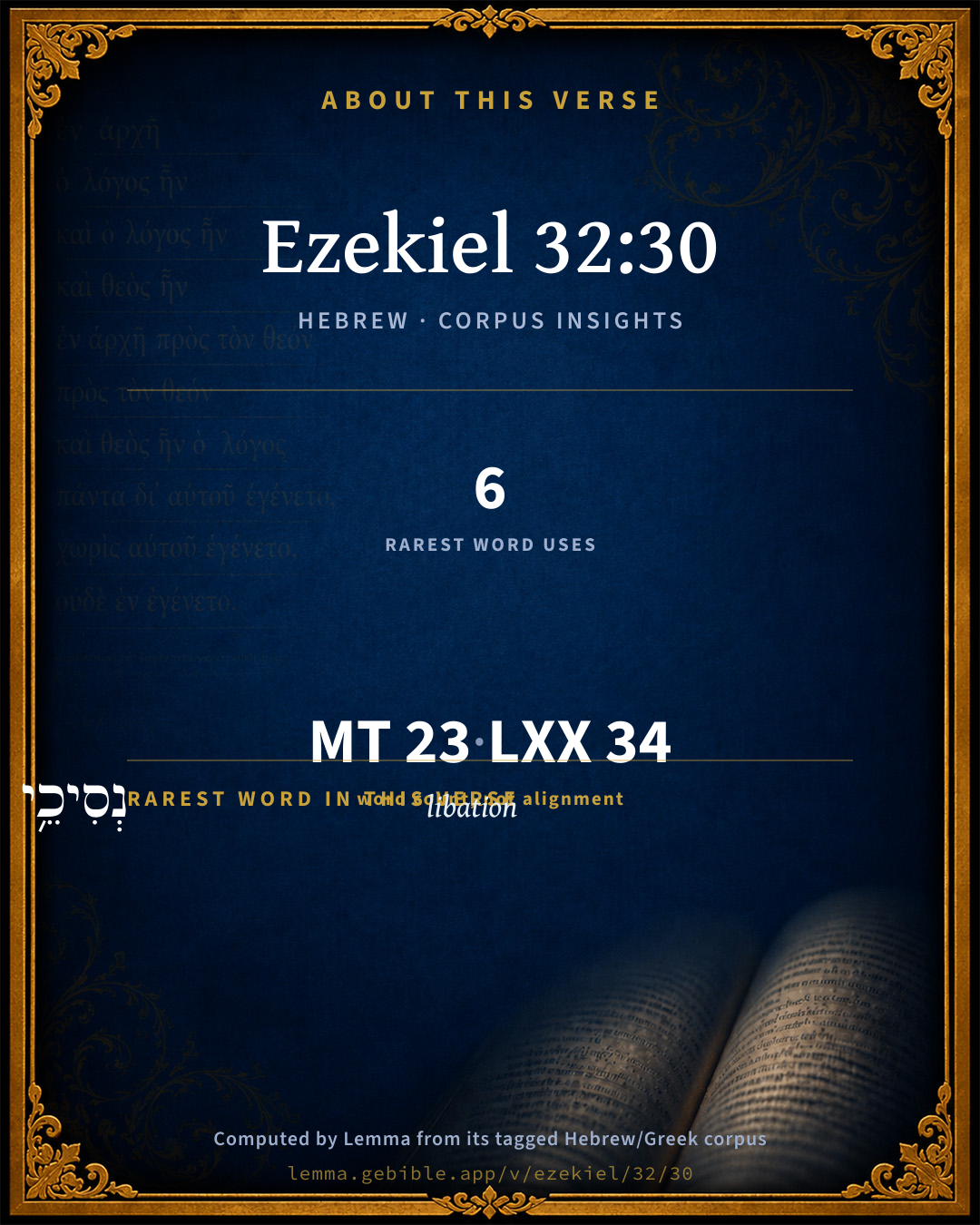
23
words
18
distinct lemmas
Prophets
section

Notable vocabulary

The rarest word here is נְסִיכֵ֥י libation H5257 — appearing just 6 times in the whole Hebrew Bible.

Shared distinctive vocabulary

נְסִיכֵ֥י libation H5257 occurs in 6 verses of the Hebrew Bible. Also found in:

Grammatical profile

  • 5 verbs
  • 10 nouns
  • 3 adjectives
  • 3 prepositions
  • 1 adverb
  • 1 particle

Verb forms

  • יָרְד֣וּ Qal · Perfect
  • בּוֹשִׁ֔ים Qal · Participle Active
  • וַיִּשְׁכְּב֤וּ Qal · Sequential Imperfect
  • וַיִּשְׂא֥וּ Qal · Sequential Imperfect
  • י֥וֹרְדֵי Qal · Participle Active

Repetition

Words recur within this verse — often emphatic in Hebrew:

  • כֻּלָּ֖ם all H3605 ×2
  • יָרְד֣וּ to go down H3381 ×2
  • חֲלָלִ֗ים slain H2491 ×2
  • אֶת with H854 ×3

Hebrew & Septuagint length

In English translation the verse runs 59 words from the Hebrew and 49 from the Septuagint (LXX English) — closely comparable.

A rough comparison of the two English renderings, which tokenize alike — not a word-level alignment.

Word counts can differ between the Hebrew and the Greek without any difference in meaning — e.g. the Hebrew direct-object marker אֵת has no separate Greek word, and Greek often adds the article ὁ.

In the original languages it is 23 Hebrew tokens and 34 Greek tokens — but the two are counted differently (Hebrew bundles its prefixes and suffixes into one token; the Greek is in lemma form), so that isn’t a like-for-like length.

Cross-references

7

Topical passages linked to Ezekiel 32:30 in the Treasury of Scripture Knowledge — connected by theme and wording, ordered by reader-vote popularity; previews shown in the World English Bible.

  • Ezekiel 38:6 Gomer, and all his hordes; the house of Togarmah in the uttermost parts of the north, and all his hordes; even many peoples with you.
  • Ezekiel 28:21 Son of man, set your face toward Sidon, and prophesy against it,
  • Ezekiel 38:15 You shall come from your place out of the uttermost parts of the north, you, and many peoples with you, all of them riding on horses, a great company and a mighty army;
  • Ezekiel 39:2 and I will turn you about, and will lead you on, and will cause you to come up from the uttermost parts of the north; and I will bring you on the mountains of Israel;
  • Jeremiah 25:22 and all the kings of Tyre, and all the kings of Sidon, and the kings of the isle which is beyond the sea;
  • Jeremiah 25:26 and all the kings of the north, far and near, one with another; and all the kingdoms of the world, which are on the surface of the earth: and the king of Sheshach shall drink after them.
  • Ezekiel 32:24–25 There is Elam and all her multitude round about her grave; all of them slain, fallen by the sword, who are gone down uncircumcised into the lower parts of the earth, who caused their terror in the land of the living, and have borne their shame with those who go down to the pit.

Cross-references courtesy of OpenBible.info (CC BY 4.0).

Hebrew and Greek witnesses Masoretic Hebrew ↔ Greek Septuagint

The same verse in the two great witnesses to the Old Testament, shown verse-for-verse.

These are two independent witnesses, not word-aligned to each other, and the Septuagint is shown in lemma (dictionary) form.

Hebrew Ezekiel 32:30 Masoretic · Westminster Leningrad Codex

שָׁ֣מָּה נְסִיכֵ֥י צָפ֛וֹן כֻּלָּ֖ם וְכָל צִֽדֹנִ֑י אֲשֶׁר יָרְד֣וּ אֶת חֲלָלִ֗ים בְּחִתִּיתָ֤ם מִגְבֽוּרָתָם֙ בּוֹשִׁ֔ים וַיִּשְׁכְּב֤וּ עֲרֵלִים֙ אֶת חַלְלֵי חֶ֔רֶב וַיִּשְׂא֥וּ כְלִמָּתָ֖ם אֶת י֥וֹרְדֵי בֽוֹר

There are the princes of the north, all of them, and all the Sidonians, who are gone down with the slain; in the terror which they caused by their might they are put to shame; and they lie uncircumcised with those who are slain by the sword, and bear their shame with those who go down to the pit.

World English Bible · Public Domain

Greek LXX Ezekiel 32:30 Septuagint · lemma form

ἐκεῖ ὁ ἄρχων ὁ βορέας πᾶς στρατηγός ασσουρ ὁ καταβαίνω τραυματίας σύν ὁ φόβος αὐτός καί ὁ ἰσχύς αὐτός κοιμάω ἀπερίτμητος μετά τραυματίας μάχαιρα καί ἀποφέρω ὁ βάσανος αὐτός μετά ὁ καταβαίνω εἰς βόθρος

There are the princes of the north, even all the captains of Assur, who go down slain to Hades: they lie uncircumcised among the slain with the sword together with their terror and their strength, and they have received their punishment with them that go down to the pit.

LXX2012 (modern English Septuagint) · Public Domain

On this verse, The Cambridge Bible for Schools and Colleges discusses the Septuagint’s reading. Read the note in Commentary ↓

Hebrew: Westminster Leningrad Codex (CC BY 4.0). Greek: Septuagint (public domain); English from LXX2012 (modern English Septuagint) (Public Domain). How the Septuagint differs from the Hebrew →

Targum (Aramaic paraphrase)

1

The Targum is the ancient Jewish Aramaic paraphrase of the Hebrew Scriptures — an interpretive translation, not the Hebrew text itself. Onkelos (literal) and Pseudo-Jonathan (expansive) render the Torah, and Jonathan the Prophets. Coverage is partial: where no permissively-licensed English translation exists for a verse, only the Aramaic is shown. This is verse-level text, not a word-by-word alignment to the Hebrew.

  1. Targum Jonathan Prophets (Joshua–Malachi)
    תַּמָן רַבְרְבֵי צִפּוּנָא כּוּלְהוֹן וְכָל צִידוֹנָאֵי דְאִתְּחָתוּ עִם קָטִילַיָא בְּאִתְבָּרוּתְהוֹן מִגְבוּרַתְהוֹן בָּהֲתִין וּשְׁכִיבוּ חַיָבַיָא עִם קְטִילֵי חַרְבָּא וְקַבִּילוּ אִתְכְּנָעוּתְהוֹן עִם נַחְתֵי גוּב בֵּית אַבְדָנָא:

    (no public-domain English translation for this verse)

    Targum Jonathan — Aramaic: “Mikraot Gedolot” (public domain). English: “Sefaria Community Translation” (CC0 1.0 (public-domain dedication)); “London "Chaldee Paraphrase," 1871” (public domain). Text via Sefaria.

Commentary

Notes on Ezekiel 32:30 from classic Christian and Jewish commentators (each source and its license shown beneath its notes). The classic Christian expositions comment on the surrounding passage and are grouped to its opening verse, so a note may address several verses; the Jewish commentaries on the Tanakh (Rashi and others) are per-verse, so they appear only where the commentator wrote on this verse.

Lemma curates 59 commentaries, every one of them public domain or Creative Commons licensed, each selected and text-cleaned for this edition rather than reprinted as found. About our sources →

Trapp's Complete Commentary

John Trapp

Eze 32:30 There [be] the princes of the north, all of them, and all the Zidonians, which are gone down with the slain; with their terror they are ashamed of their might; and they lie uncircumcised with [them that be] slain by the sword, and bear their shame with them that go down to the pit.

Ver. 30. There be the princes of the north,] i.e., Saith Junius, The Syrians, Tyrians, and others.

And all the Zidonians.] All the hunters, saith the Vulgate, taking the word appellatively.

Which are gone down.] The same again, ad maius pathos.

John Trapp, A Commentary or Exposition upon All the Books of the Old and New Testament (1647–1656) — public domain. Text from a community e-Sword module.

Geneva Bible (1599)

Geneva Bible translators

The Kings of Babylon.

Geneva Bible (1599) marginal notes — public domain. Text via Bolls.life.

Jamieson, Fausset & Brown

Robert Jamieson, A. R. Fausset & David Brown

princes of the north--Syria, which is still called by the Arabs the north; or the Tyrians, north of Palestine, conquered by Nebuchadnezzar (Eze. 26:1-28:26), [GROTIUS].

Zidonians--who shared the fate of Tyre (Eze 28:21).

with their terror they are ashamed of their might--that is, notwithstanding the terror which they inspired in their contemporaries. "Might" is connected by MAURER thus, "Notwithstanding the terror which resulted from their might."

Jamieson, Fausset & Brown — Commentary Critical and Explanatory on the Whole Bible (1871) — public domain (CC PDM 1.0). Text via the HelloAO Bible API.

Adam Clarke's Commentary

Verse 30. There be the princes of the north] The kings of Media and Assyria, and all the Zidonians-the kings of Tyre, Sidon, and Damascus. See Calmet.

Adam Clarke's Commentary on the Bible (1810–1826) — public domain. Text from a community e-Sword/MySword module.

Ellicott's Commentary for English Readers

(30) The princes of the north.—The word is not the same as that used for the princes of Edom in Eze_32:29. That refers to the heads of the Edomite tribes, but this is thought to imply enfeoffed or vassal princes. However this may be, from the connection with the Zidonians it is clear that not the far north is intended, but perhaps chieftains of Syria, Damascus, and the like.

The Zidonians.—With the rise of Tyre, Zidon had long since lost its pre-eminence among the Phœnician cities; but it was still an important and an independent city, and was doomed to far greater humiliation in the future.

A Bible Commentary for English Readers, edited by Charles John Ellicott (1878–1897) — public domain. Text from a community e-Sword module.

The Cambridge Bible for Schools and Colleges

gen. ed. J. J. S. Perowne

30. The princes of the North and the Sidonians. The former are probably those of the Syrian states, and the Sidonians represent the Phœnician principalities in general.

with their terror] Rather, in close connexion with the preceding, gone down with the slain, because of (notwithstanding) their terror (coming) from their might (they are) ashamed. The term “ashamed” is wanting in LXX., and it occurs only here.

The Cambridge Bible for Schools and Colleges (gen. ed. J. J. S. Perowne; Cambridge University Press, 1878–1918) — public domain. Text from a community e-Sword module.

John Gill's Exposition

There be the princes of the north,..... The kings of Babylon, according to Kimchi, which lay north of Judea; or the princes of Syria, Damascus, and Tyre, especially the latter, which commonly goes along with Zidon, being near it, as follows:

and all the Zidonians. The Vulgate Latin version renders it, "and all the hunters"; but wrongly; as also the Septuagint and Arabic versions, which read the princes or soldiers of Assyria. The Zidonians or inhabitants of Zidon are meant as the Targum; a famous maritime city, as Tyre also was, in Phoenicia:

which are gone down with the slain; into the grave, being conquered and destroyed by Nebuchadnezzar; see Eze 28:21,

with their terror they are ashamed of their might, the number and strength of their armies, the valour and courage of their soldiers, and the fortifications of their cities, in which they trusted, and of which they boasted; but yet could not preserve them from ruin:

and they lie uncircumcised with them that be slain by the sword; in common with other profane and wicked persons that have fallen by the sword as they have done:

and bear their shame with them that go down to the pit; See Gill on Eze 32:24.

John Gill's Exposition of the Whole Bible (1746–1763) — public domain (CC PDM 1.0). Text via the HelloAO Bible API.

Albert Barnes' Notes on the Bible

The princes of the north - i. e., north of Palestine - The Tyrians and the Syrians.

With their terror they are ashamed of their might - i. e., “When their might and power were terrible to all, they were shorn of their power and delivered over to shame and confusion.” There are here six nations, Asshur, Elam, Meshech, Tubal, Edom, Zidon, which added to Egypt make up seven (see the Eze 25:1 note). The section which contains the prophecies against the pagan, closing with this description of the kings who had gone down to the grave, accords with the general purport of the whole section, namely,: the declaration that all the powers of the world shall be annihilated to make way for the kingdom of God.

Albert Barnes' Notes on the Bible (1834–1885) — public domain. Text from a community e-Sword/MySword module.

Haydock's Catholic Bible Commentary

Hunters of men, like Nimrod, the first king of Assyria. (Haydock)

George Leo Haydock (1774–1849), Haydock's Catholic Family Bible and Commentary, 1859 edition — public domain. Excludes Psalms (Douay-Rheims chapter numbering differs from Protestant) and Deuterocanonical books (Catholic canon only).

Matthew Poole's English Annotations

Of the north; of all those countries, Tyrians, Zidonia Assyrians, and Syrians, &c., which lay northward from Judea, now swallowed up by the Babylonian. With the slain conquered and slain.

With their terror; their terror buried with them.

Ashamed of their might; when it appeared a vain confidence, and too weak to resist the enemy and save themselves.

Uncircumcised; scorned and cast out, as profane and loathsome.

By the sword of their conquering enemy.

Bear their shame; they lie under shameful fall, from a seeming glory to a real ignominy.

Matthew Poole's English Annotations on the Holy Bible (1683–1685) — public domain. Text from a community e-Sword/MySword module.

The Pulpit Commentary

There be the princes of the north. The noun for "princes" is different from that of Ver. 29, and has the sense of "vassal rulers," as in Jos_13:21; Mic_5:4. So we have the "kings of the north" in Jer_25:26. The fact that they are coupled with the Zidonians (it is suggestive that Ezekiel names these rather than the Tyrians) points in the direction of Northern Syria, including cities like Damascus, Hamath, Arpad, and others.

The Pulpit Commentary (1880–1919), ed. H.D.M. Spence-Jones & Joseph S. Exell — public domain. Text from a community e-Sword module.

John Wesley's Explanatory Notes

Of the north - Tyrians, Assyrians, and Syrians, who lay northward from Judea, now swallowed up by the Babylonian. Of their might - When it appeared too weak to resist the enemy. Uncircumcised - Scorned, and cast out as profane and loathsome.

John Wesley, Explanatory Notes Upon the Whole Bible (1754–1765) — public domain. Text via the GEBible commentary corpus.

unfoldingWord translationNotes

Door43 World Missions Community

The princes of the north

"The princes who ruled nations in the north"

are there

"are in Sheol"

went down

"went down to Sheol"

had been pierced

The word "pierced" here is a metonym for "killed." This can be translated in active form. See how you translated similar words in Ezekiel 32:25. AT: "whom enemies had killed with swords" (See: Metonymy)

by the sword

This represents being in warfare. AT: "in battle" (See: Metonymy)

They carry their own shame

Shame is spoken of as if it were an object that one could carry where he goes. See how you translated this in Ezekiel 32:25. AT: "who feel ashamed" or "who are now disgraced" (See: Metaphor)

the pit

"The pit" refers to the grave; because the grave was thought to be the entrance to the world of the dead, the pit also represents that world. See how you translated this in Ezekiel 32:29.

translationWords

prince

Sidon

fear

shame

circumcise

unfoldingWord translationNotes — © Distant Shores Media and the Door43 World Missions Community, licensed CC BY-SA 4.0. Source: git.door43.org/Door43/en_tn.

Rashi

Rabbi Shlomo Yitzchaki (Rashi)

ashamed when they are destroyed in spite of their might [Jonathan renders:] When they are broken in spite of their might, they are ashamed.

Rashi on the Tanakh — English translations: “The Judaica Press complete Tanach with Rashi, translated by A. J. Rosenberg” (CC BY 4.0); “Pentateuch with Rashi's commentary by M. Rosenbaum and A.M. Silbermann, 1929-1934” (public domain); “The Metsudah Tanach series, Lakewood, N.J” (CC BY 4.0); and “The Book of Joshua, Metsudah Publications, 1997” (CC BY 4.0). Text via Sefaria.

Lesson kit

Teaching starters — assembled from the data on this page, not authored interpretation. Every prompt links to the verse data it draws on. Edit before teaching.

Ezekiel, in the Prophets, opens this verse with 23 words (18 distinct Hebrew lemmas). Its most distinctive word is nᵉçîyk (“libation”). A historical commentator’s framing appears above. Read the whole chapter for the surrounding context.

Discussion questions

  1. How does “libation” (nᵉçîyk) shape what this verse is saying?
  2. How does Deuteronomy 32:38, which shares the word «libation», read alongside this verse?
  3. What does the repetition of “all” (2× in this one verse) do in this verse?
  4. The translations on this page render this verse differently — a whole-verse word diff, not a word-by-word alignment. What might account for the different wordings?
  5. «יָרְד֣וּ» is a Qal Perfect verb. How does that grammatical form shape the action described?
  6. Compare how Trapp's Complete Commentary and Geneva Bible (1599) read this verse. Where do they agree or differ?

Things to notice

Reading settings

Reading text

Shown beneath each verse's original-language words.

Old Testament
Old Testament edition

Read the OT as the Masoretic Hebrew (MT) or the Greek Septuagint (LXX).

English shown for the Greek Septuagint (in the Hebrew ↔ Greek comparison).

Comparing translations? Open the Compare panel on any verse page to stack up to four side by side.