Ruth 3:8

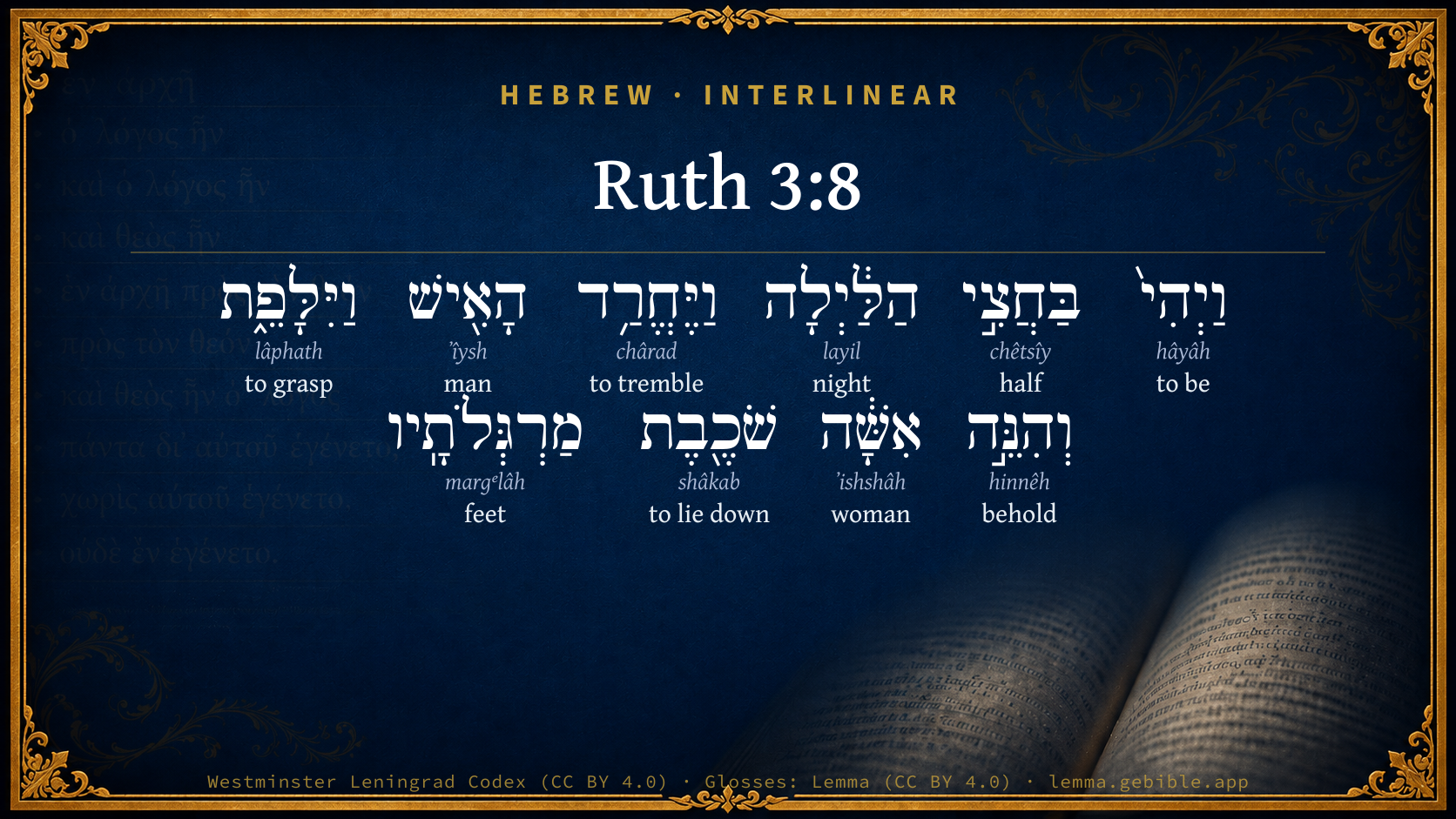
Hebrew (Westminster Leningrad Codex) Ruth 3:8 appears in the Hebrew Old Testament. The text above is from the Westminster Leningrad Codex. Each word links to its Strong’s number, a concise gloss, and parsing drawn from the Open Scriptures Hebrew Bible morphology. Click any word for its full Brown-Driver-Briggs (BDB) entry.
Download image
Cite this verse

Ruth 3:8 (World English Bible). Public Domain. Lemma interlinear Bible study tool, https://lemma.gebible.app/v/ruth/3/8.

Show BibTeX & RIS
BibTeX
RIS
English Translation
It happened at midnight, that the man was afraid, and turned himself; and, behold, a woman lay at his feet.
World English Bible · Public Domain
Download a study sheet

One document with this verse’s original text, its word-by-word gloss line, the meaning frame, cross-references with their text, attributed commentary, and full source and license credits — printable, and it pastes into notes with its structure intact.

This verse Autodidact and up

Study sheet (.html) Plain text (.txt)

A passage Seminary Student

Up to 50 verses in one chapter. A passage sheet keeps up to 6 commentary sources and 12 cross-references per verse, in the order this page ranks them, and says so on the sheet whenever that leaves anything out. Ask for a single verse and you get the Autodidact verse sheet above.

Everything on this page stays free to read, with no account — the sheet is a download of what is already on screen, not access to it.

Want to remove ads? Support Godless Engineer
Compare translations 3

The same verse in 3 English versions, stacked beneath the original-language interlinear above. Click any original word for its lexicon entry.

Each is an independent rendering of the whole verse — the interlinear is not word-aligned to these translations.

Highlighted words mark where these versions differ — a whole-verse word diff, not a word-by-word alignment.

  • World English Bible Public Domain
    It happened at midnight, that the man was afraid, and turned himself; and, behold, a woman lay at his feet.
  • King James Version Public Domain
    And it came to pass at midnight, that the man was afraid, and turned himself: and, behold, a woman lay at his feet.
  • unfoldingWord Literal Text CC BY-SA 4.0
    Then it happened in the middle of the night that the man was startled and turned over. And behold, a woman was lying at his feet!

unfoldingWord Literal Text — © unfoldingWord, licensed CC BY-SA 4.0. Word-aligned USFM3 via Door43 (git.door43.org/unfoldingWord/en_ult).

Versions to compare (up to 4)

3 of 4 selected

Show all 18 translations

Every available English version of this verse, each an independent rendering of the whole verse.

  • World English Bible Public Domain
    It happened at midnight, that the man was afraid, and turned himself; and, behold, a woman lay at his feet.
  • Berean Standard Bible Public Domain
    At midnight, Boaz was startled, turned over, and there lying at his feet was a woman!
  • Majority Standard Bible Public Domain
    At midnight, Boaz was startled, turned over, and there lying at his feet was a woman!
  • King James Version Public Domain
    And it came to pass at midnight, that the man was afraid, and turned himself: and, behold, a woman lay at his feet.
  • American Standard Version (1901) Public Domain
    And it came to pass at midnight, that the man was afraid, and turned himself; and, behold, a woman lay at his feet.
  • Revised Version (1885) Public Domain
    And it came to pass at midnight, that the man was afraid, and turned himself: and, behold, a woman lay at his feet.
  • Geneva Bible (1599) Public Domain
    And at midnight the man was afraide and caught holde: and loe, a woman lay at his feete.
  • Douay-Rheims (1899) Public Domain
    And behold, when it was now midnight the man was afraid, and troubled: and he saw a woman lying at his feet,
  • Young's Literal Translation Public Domain
    And it cometh to pass, at the middle of the night, that the man trembleth, and turneth himself, and lo, a woman is lying at his feet.
  • Literal Standard Version CC BY-SA 4.0
    And it comes to pass, at the middle of the night, that the man trembles, and turns himself, and behold, a woman is lying at his feet.
  • Unlocked Literal Bible CC BY-SA 4.0
    It came about at midnight that the man was startled. He turned over, and right there a woman was lying at his feet!
  • unfoldingWord Literal Text CC BY-SA 4.0
    Then it happened in the middle of the night that the man was startled and turned over. And behold, a woman was lying at his feet!
  • Darby Bible Public Domain
    And it came to pass at midnight, that the man was startled, and turned himself; and behold, a woman lay at his feet.
  • World Messianic Bible Public Domain
    At midnight, the man was startled and turned himself; and behold, a woman lay at his feet.
  • Webster's Bible Public Domain
    And it came to pass at midnight, that the man was afraid, and turned himself: and behold, a woman lay at his feet.
  • Free Bible Version CC BY-SA 4.0
    Around midnight Boaz suddenly woke up. Bending forward he was surprised to see a woman lying at his feet.
  • Bible in Basic English Public Domain
    Now in the middle of the night, the man awaking from his sleep in fear, and lifting himself up, saw a woman stretched at his feet.
  • JPS Tanakh (1917) Public Domain
    And it came to pass at midnight, that the man was startled, and turned himself; and, behold, a woman lay at his feet.

Literal Standard Version (2020), Covenant Press — licensed CC BY-SA 4.0. Text via the HelloAO Bible API (eBible.org). Unlocked Literal Bible (unfoldingWord) — licensed CC BY-SA 4.0. Text via the HelloAO Bible API (eBible.org). unfoldingWord Literal Text — © unfoldingWord, licensed CC BY-SA 4.0. Word-aligned USFM3 via Door43 (git.door43.org/unfoldingWord/en_ult). Free Bible Version, Dr. Jonathan Gallagher — licensed CC BY-SA 4.0. Text via the HelloAO Bible API (eBible.org).

Word by word

More ways to search: Search by grammar → Find every occurrence → Compare this word →

Practice this passage: Drill this verse → Learn its vocabulary →

וַיִּלָּפֵ֑ת
lâphath
H3943
“and · to grasp”
Conjunction + Verb, Niphal, Sequential Imperfect, 3rd Person, Masculine, Singular
Part of Speech
Conjunction + Verb
Stem
Niphal
Form
Sequential Imperfect
Person
3rd Person
Gender
Masculine
Number
Singular
Full BDB Definition

Origin: a primitive root

TWOT: 1123

to twist, grasp, turn, grasp with a twisting motion - (Qal) to grasp - (Niphal) to twist, weave, wind
  1. וַיְהִי֙ hâyâh H1961 “and · to be” Conjunction + Verb, Qal, Sequential Imperfect, 3rd Person, Masculine, Singular
  2. בַּחֲצִ֣י chêtsîy H2677 “in/at · half of” Preposition + Noun, Common, Masculine, Singular, Construct
  3. הַלַּ֔יְלָה layil H3915 “the · night” Particle, Definite Article + Noun, Common, Masculine, Singular, Absolute
  4. וַיֶּחֱרַ֥ד chârad H2729 “and · to tremble” Conjunction + Verb, Qal, Sequential Imperfect, 3rd Person, Masculine, Singular
  5. הָאִ֖ישׁ ʼîysh H376 “the · man” Particle, Definite Article + Noun, Common, Masculine, Singular, Absolute
  6. וְהִנֵּ֣ה hinnêh H2009 “and · behold” Conjunction + Particle, Demonstrative
  7. אִשָּׁ֔ה ʼishshâh H802 “woman” Noun, Common, Feminine, Singular, Absolute
  8. שֹׁכֶ֖בֶת shâkab H7901 “lying down” Verb, Qal, Participle Active, Feminine, Singular, Absolute
  9. מַרְגְּלֹתָֽיו margᵉlâh H4772 “feet · his” Noun, Common, Feminine, Plural, Construct + Suffix, Personal, 3rd Person, Masculine, Singular

About this verse

These counts appear in no published source. They are computed here, from the morphology-tagged text and Lemma’s own curated glosses. What Lemma adds →

10
words
10
distinct lemmas
Historical
section

Notable vocabulary

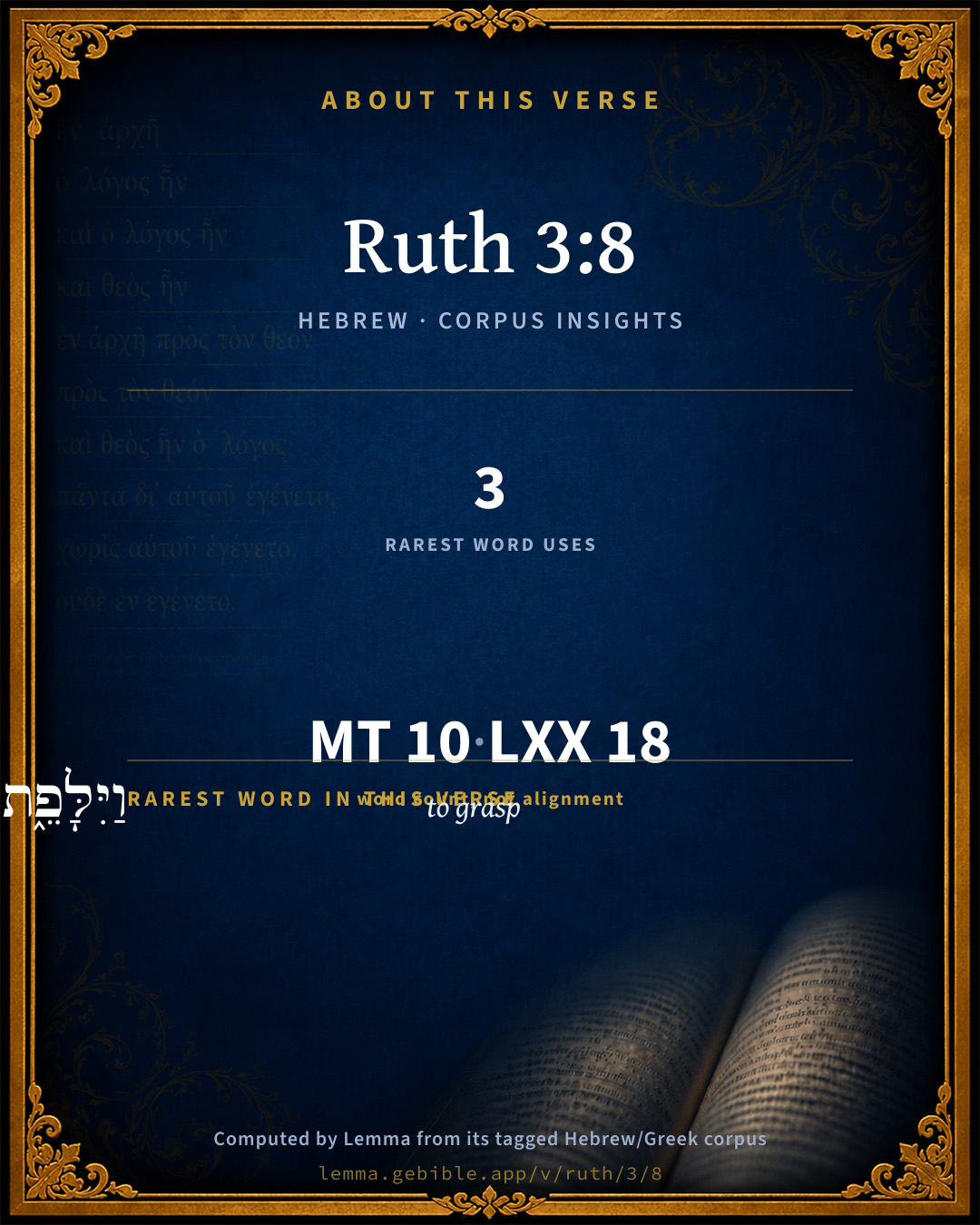
The rarest word here is וַיִּלָּפֵ֑ת to grasp H3943 — appearing just 3 times in the whole Hebrew Bible.

Shared distinctive vocabulary

וַיִּלָּפֵ֑ת to grasp H3943 occurs in 3 verses of the Hebrew Bible. Also found in:

Grammatical profile

  • 4 verbs
  • 5 nouns
  • 1 particle

Verb forms

  • וַיְהִי֙ Qal · Sequential Imperfect
  • וַיֶּחֱרַ֥ד Qal · Sequential Imperfect
  • וַיִּלָּפֵ֑ת Niphal · Sequential Imperfect
  • שֹׁכֶ֖בֶת Qal · Participle Active

Hebrew & Septuagint length

In English translation the verse runs 20 words from the Hebrew and 22 from the Septuagint (LXX English) — closely comparable.

A rough comparison of the two English renderings, which tokenize alike — not a word-level alignment.

Word counts can differ between the Hebrew and the Greek without any difference in meaning — e.g. the Hebrew direct-object marker אֵת has no separate Greek word, and Greek often adds the article ὁ.

In the original languages it is 10 Hebrew tokens and 18 Greek tokens — but the two are counted differently (Hebrew bundles its prefixes and suffixes into one token; the Greek is in lemma form), so that isn’t a like-for-like length.

Hebrew and Greek witnesses Masoretic Hebrew ↔ Greek Septuagint

The same verse in the two great witnesses to the Old Testament, shown verse-for-verse.

These are two independent witnesses, not word-aligned to each other, and the Septuagint is shown in lemma (dictionary) form.

Hebrew Ruth 3:8 Masoretic · Westminster Leningrad Codex

וַיְהִי֙ בַּחֲצִ֣י הַלַּ֔יְלָה וַיֶּחֱרַ֥ד הָאִ֖ישׁ וַיִּלָּפֵ֑ת וְהִנֵּ֣ה אִשָּׁ֔ה שֹׁכֶ֖בֶת מַרְגְּלֹתָֽיו

It happened at midnight, that the man was afraid, and turned himself; and, behold, a woman lay at his feet.

World English Bible · Public Domain

Greek LXX Ruth 3:8 Septuagint · lemma form

γίγνομαι δέ ἐν ὁ μεσονύκτιον καί ἐκἵστημι ὁ ἀνήρ καί ταράσσω καί ἰδού γυνή κοιμάω πρός πούς αὐτός

And it came to pass at midnight that the man was amazed, and troubled, and behold, a woman lay at his feet.

LXX2012 (modern English Septuagint) · Public Domain

Hebrew: Westminster Leningrad Codex (CC BY 4.0). Greek: Septuagint (public domain); English from LXX2012 (modern English Septuagint) (Public Domain). How the Septuagint differs from the Hebrew →

Commentary

Notes on Ruth 3:8 from classic Christian and Jewish commentators (each source and its license shown beneath its notes). The classic Christian expositions comment on the surrounding passage and are grouped to its opening verse, so a note may address several verses; the Jewish commentaries on the Tanakh (Rashi and others) are per-verse, so they appear only where the commentator wrote on this verse.

Lemma curates 59 commentaries, every one of them public domain or Creative Commons licensed, each selected and text-cleaned for this edition rather than reprinted as found. About our sources →

Trapp's Complete Commentary

John Trapp

Rth 3:8 And it came to pass at midnight, that the man was afraid, and turned himself: and, behold, a woman lay at his feet.

Ver. 8. That the man was afraid.] Timor est constrictio cordis ex sensu mali instantis. Fear is a passion of the soul, shrinking in itself from some imminent evil. The Greeks call it δειμα, quasi ligamentum, a bond: quasi gelu astringit, saith Nazianzen, it binds up the heart as a frost doth the earth. Boaz might possibly fear that it was some evil spirit that had assumed a body, and got to bed to him. Alexander from Alexandria {a} telleth of such things that have happened. And another writeth of a gallant, who meeting with a beautiful dame, and having enjoyed his fleshly desires of her, found her in the morning to be the dead body of one that he had formerly sinned with, which had been acted by the devil all night, and left dead again in the morning.

And turned himself.] Or, Took hold on: sc., her clothes, or her headgear; whereby he perceived that it was a woman. But he was a mortified man, and an elder, πρεσβυτης, that is, one in whom the fire of lust was put out.

{a} Lib. ii. cap. 9; lib. iv. cap. 19.

John Trapp, A Commentary or Exposition upon All the Books of the Old and New Testament (1647–1656) — public domain. Text from a community e-Sword module.

Joseph Benson's Commentary

Rth 3:8-9. At midnight — He did not discover her sooner; the man was afraid — Feeling something unusual at his feet. Behold a woman lay at his feet — He perceived by her clothes, and, when she spake, by her voice, that it was a woman. Spread therefore thy skirt over thy handmaid — A kind of proverbial expression, signifying, Take me to be thy wife, and perform the duty of a husband to me. From this answer of Ruth, and from what Boaz says in the two following verses, it is plain that she had no design of any thing but what was honest and lawful.

Joseph Benson's Commentary on the Old and New Testaments (1811–1818) — public domain. Text from a community e-Sword module.

Tyndale Open Study Notes

Tyndale Open Resources

3:8 He was surprised (literally He was terrified): Boaz knew that a woman lay at his feet, but he did not know who she was or why she was there.

Tyndale Open Study Notes — © Tyndale Open Resources, licensed CC BY-SA 4.0. Text via the HelloAO Bible API.

Geneva Bible (1599)

Geneva Bible translators

Or, turned himself from one side to another.

Geneva Bible (1599) marginal notes — public domain. Text via Bolls.life.

Adam Clarke's Commentary

Verse 8. The man was afraid, and turned himself] The verb ילפת yillapheth, which we render he turned himself, has puzzled even the Targumist, who translates the clause thus: "The man trembled, and his flesh became like a (boiled) turnip through fear." It is fully evident Boaz had no intimation of the present proceedings. To this verse the Targumist adds much; he says, "Boaz subdued his concupiscence, and acted towards her as Joseph did to the Egyptian wife of his master, and as Pelatiel, the son of Laish the pious, did to Michal, the daughter of Saul, the wife of David, who put a sword between Michal and himself, because he would not approach to her."

Adam Clarke's Commentary on the Bible (1810–1826) — public domain. Text from a community e-Sword/MySword module.

Ellicott's Commentary for English Readers

(8) Was afraid.—Was startled. See the use of the word in Gen_27:33.

Turned.—Literally, bent himself. (Comp. Jdg_16:29.) He wakes with a start, and in turning sees a woman at his feet.

A Bible Commentary for English Readers, edited by Charles John Ellicott (1878–1897) — public domain. Text from a community e-Sword module.

The Cambridge Bible for Schools and Colleges

gen. ed. J. J. S. Perowne

8. and turned himself] A reflexive from of the verb, which means ‘to grasp with a twisting motion’; the verb occurs again only in Jdg_16:29 (‘took hold of’), Job_6:18 (‘are turned aside’ mg.).

The Cambridge Bible for Schools and Colleges (gen. ed. J. J. S. Perowne; Cambridge University Press, 1878–1918) — public domain. Text from a community e-Sword module.

John Gill's Exposition

And it came to pass at midnight,.... So long Boaz slept without knowledge of any person being at his feet, and so long Ruth had lain there; but awaking, and perceiving something at his feet, which pressed them, it made him look about and feel, and so affected him:

that the man was afraid; though a man, and a man of spirit, he was afraid, a panic seized him, not knowing but it might be a spectre, a spirit, or a demon, as Jarchi; and such an instance we have in history (s) of an apparition, which seemed to put off clothes, and place itself in a bed where a man lay, &c.

and turned himself; to see who it was:

and, behold, a woman lay at his feet; which he knew by putting his hand upon her head, as Jarchi thinks, and so knew her by her headdress, or vail; or rather by her voice, as Aben Ezra, and who supposes the moon might shine, and he might be able to discern she had no beard, as well as also discover her by her clothes.

(s) Alex. ab Alex. Genial. Dier. l. 2. c. 9.

John Gill's Exposition of the Whole Bible (1746–1763) — public domain (CC PDM 1.0). Text via the HelloAO Bible API.

Albert Barnes' Notes on the Bible

Turned himself - Rather, “bent forward,” so as to feel what it was which was at his feet. The same word is translated “took hold of,” in Jdg 16:29.

Albert Barnes' Notes on the Bible (1834–1885) — public domain. Text from a community e-Sword/MySword module.

Haydock's Catholic Bible Commentary

Troubled. Hebrew may be rendered, "and turned himself, or felt," &c. (Calmet) --- He perceived something at his feet, when he awoke, and was in consternation, particularly when he perceived, through the glimmering light, a woman at his feet. (Haydock).

George Leo Haydock (1774–1849), Haydock's Catholic Family Bible and Commentary, 1859 edition — public domain. Excludes Psalms (Douay-Rheims chapter numbering differs from Protestant) and Deuterocanonical books (Catholic canon only).

Matthew Poole's English Annotations

At midnight; he did not discover her sooner, though she did not uncover his feet, being it seems in a deep sleep, as is usual after feasts, and she doing no more that her mother commanded her, and using no words or gestures which might provoke his lust; wherein she showed her temperance and modesty, and that what she did was only by her mother’s instigation and advice, which plainly appeared from her desire expressed, Rth 3:9, which he knew, she being a stranger, was unacquainted with. And this was the reason why Boaz was not in the least offended with her, but only commends her virtue, without any reflection upon her for this fact.

Turned himself; from the place where he lay, he raised and turned himself towards the feet, to learn who or what was there. Or, he was troubled, or afraid, or wondered; for the Hebrew word being but once used, is diversely rendered.

A woman lay at his feet; which he might understand, either by some glimmerings of light which were after midnight, which discovered her; or rather, by her voice, or out of her own mouth, who being asked, told him so much in general, before he made particular inquiry.

Matthew Poole's English Annotations on the Holy Bible (1683–1685) — public domain. Text from a community e-Sword/MySword module.

Whedon's Commentary on the Bible

Daniel D. Whedon

8. The man was afraid — Finding the covering of his feet removed, he feared that robbers might have entered his floor; but not knowing what was the matter he turned himself, that is, bent over or forward, to see and feel who or what the intruder was.

Daniel D. Whedon (gen. ed.), Commentary on the Old and New Testaments (1874–1909) — public domain. Text from a community e-Sword module.

The Pulpit Commentary

And it came to pass at midnight that the man started in a fright; and he bent himself over, and lo, a woman was lying at his feet. He had awaked, and, feeling something soft and warm at his feet, he was startled and affrighted. What could it be? In a moment or two he recovered his self-possession, and bending himself up and over, or "crooking himself, to see and to feel, lo, a woman was lying at his feet. The Chaldee Targumist tumbles into a ludicrous bathos of taste when endeavoring to emphasize the startle and shiver which Boas experienced. He says, "He trembled, and his flesh, became soft as a turnip from the agitation. How could the most peddling and paltering of Rabbis succeed in betraying himself into such a laughable puerility and absurdity? The explanation, though of course it is not the least atom of justification, lies in the fact that the Chaldee word for "turnip" is tpl while the verb that de notes "he bent himself" is the niphal of tpl. The use of the expression the man," in this and several of the adjoining verses, is apt to grate a little upon English ears. Let us explain and vindicate the term as we may, the grating is still felt. No matter though we know that the rank is but the guinea stamp," the grating is felt inevitably. It is a result of that peculiar growth in living language that splits generic terms into such as are specific or semi-specific. We have gentleman as well as man, and embarrassment is not infrequently the result of our linguistic wealth. In the verse before us, and in some of those that go before, we should be disposed, in our English idiom, to employ the proper name: And it came to pass at midnight that "Boaz" started in a fright.

When it is said that "the man was afraid, and turned himself," the meaning of the latter clause, as it stands in King James"s version, would require some modification. The idea is not that Boaz turned from one side to another. It is that, having started in a fright, in consequence of the presence, to his indistinct consciousness, of something unusual about his feet, he raised himself up and bent forward to feel what it was.

The Pulpit Commentary (1880–1919), ed. H.D.M. Spence-Jones & Joseph S. Exell — public domain. Text from a community e-Sword module.

John Wesley's Explanatory Notes

At midnight - He did not discover her sooner.

John Wesley, Explanatory Notes Upon the Whole Bible (1754–1765) — public domain. Text via the GEBible commentary corpus.

Keil & Delitzsch

C. F. Keil & F. Delitzsch

About midnight the man was startled, namely, because on awaking he observed that there was some one lying at his feet; and he "bent himself" forward, or on one side, to feel who was lying there, "and behold a woman was lying at his feet." מרגּלתיו is accus. loci.

Keil & Delitzsch — Biblical Commentary on the Old Testament (1861–1891) — public domain (CC PDM 1.0). Text via the HelloAO Bible API. (Old Testament only.)

unfoldingWord translationNotes

Door43 World Missions Community

It came about

This phrase is used here to mark an important event in the story. If your language has a way for doing this, you could consider using it here.

at midnight

"in the middle of the night"

was startled

It is not clear what startled Boaz. Perhaps he suddenly felt the cold air on his feet.

He turned over

He looked to see what startled him. (See: Idiom)

a woman was lying at his feet

The woman was Ruth, but Boaz could not recognize her in the darkness.

your female servant

Ruth spoke with humility to Boaz.

Spread your cloak over your female servant

This was a cultural idiom for marriage. AT: "Marry me" (See: Idiom)

near kinsman

a close relative with special responsibilities toward their extended family

translationWords

Ruth

servant

kin

unfoldingWord translationNotes — © Distant Shores Media and the Door43 World Missions Community, licensed CC BY-SA 4.0. Source: git.door43.org/Door43/en_tn.

Rashi

Rabbi Shlomo Yitzchaki (Rashi)

and the man quaked He thought it was a demon and attempted to scream, but she held him and enveloped him with her arms.

and was taken around Heb. וַיִלָפֵת, and he was seized, like (Jud. 16: 29): “And Samson seized (וַיִלָפֹת). “

and behold a woman He placed his hand on her head and recognized that she was a woman.

Rashi on the Tanakh — English translations: “The Judaica Press complete Tanach with Rashi, translated by A. J. Rosenberg” (CC BY 4.0); “Pentateuch with Rashi's commentary by M. Rosenbaum and A.M. Silbermann, 1929-1934” (public domain); “The Metsudah Tanach series, Lakewood, N.J” (CC BY 4.0); and “The Book of Joshua, Metsudah Publications, 1997” (CC BY 4.0). Text via Sefaria.

Ibn Ezra

Rabbi Abraham ibn Ezra

"וילפת (and turned over):" From the Nifal (passive) verb form, like in 'ילפתו ארחות דרכם' (their paths are twisted). The meaning is twisted or turned. Similarly, 'וילפת שמשון' (Samson turned). It does not mean joy. The idea is that he turned from one side to the other.

"והנה אשה (and behold, a woman):" It is possible that she said to him, 'Do not be afraid,' as a woman's voice is always recognizable; or the moonlight was bright, and he saw that she had no beard. He could also recognize her by her clothing.

Ibn Ezra on the Tanakh — English translations: “Sefaria Community Translation” (CC0 1.0 (public-domain dedication)); “Yalkut, Sifsei Chachomim Chumash, Metsudah Publications, 2009” (CC BY 4.0); and “Commentary of Ibn Ezra on Isaiah - trans. by M. Friedlander, 1873” (public domain). Text via Sefaria.

Lesson kit

Teaching starters — assembled from the data on this page, not authored interpretation. Every prompt links to the verse data it draws on. Edit before teaching.

Ruth, in the Historical, opens this verse with 10 words (10 distinct Hebrew lemmas). Its most distinctive word is lâphath (“to grasp”). A historical commentator’s framing appears above. Read the whole chapter for the surrounding context.

Discussion questions

  1. The word lâphath carries the sense “to grasp.” How does it shape the verse?
  2. Judges 16:29 shares the word «to grasp» with this verse. How do the two illuminate each other?
  3. The translations on this page render this verse differently — a whole-verse word diff, not a word-by-word alignment. What might account for the different wordings?
  4. The verb «וַיְהִי֙» is Qal Sequential Imperfect. How does its form color the action?
  5. Reading how Trapp's Complete Commentary and Joseph Benson's Commentary read this verse, where do the two commentators agree and where do they part?

Things to notice

Reading settings

Reading text

Shown beneath each verse's original-language words.

Old Testament
Old Testament edition

Read the OT as the Masoretic Hebrew (MT) or the Greek Septuagint (LXX).

English shown for the Greek Septuagint (in the Hebrew ↔ Greek comparison).

Comparing translations? Open the Compare panel on any verse page to stack up to four side by side.