Job 14:12

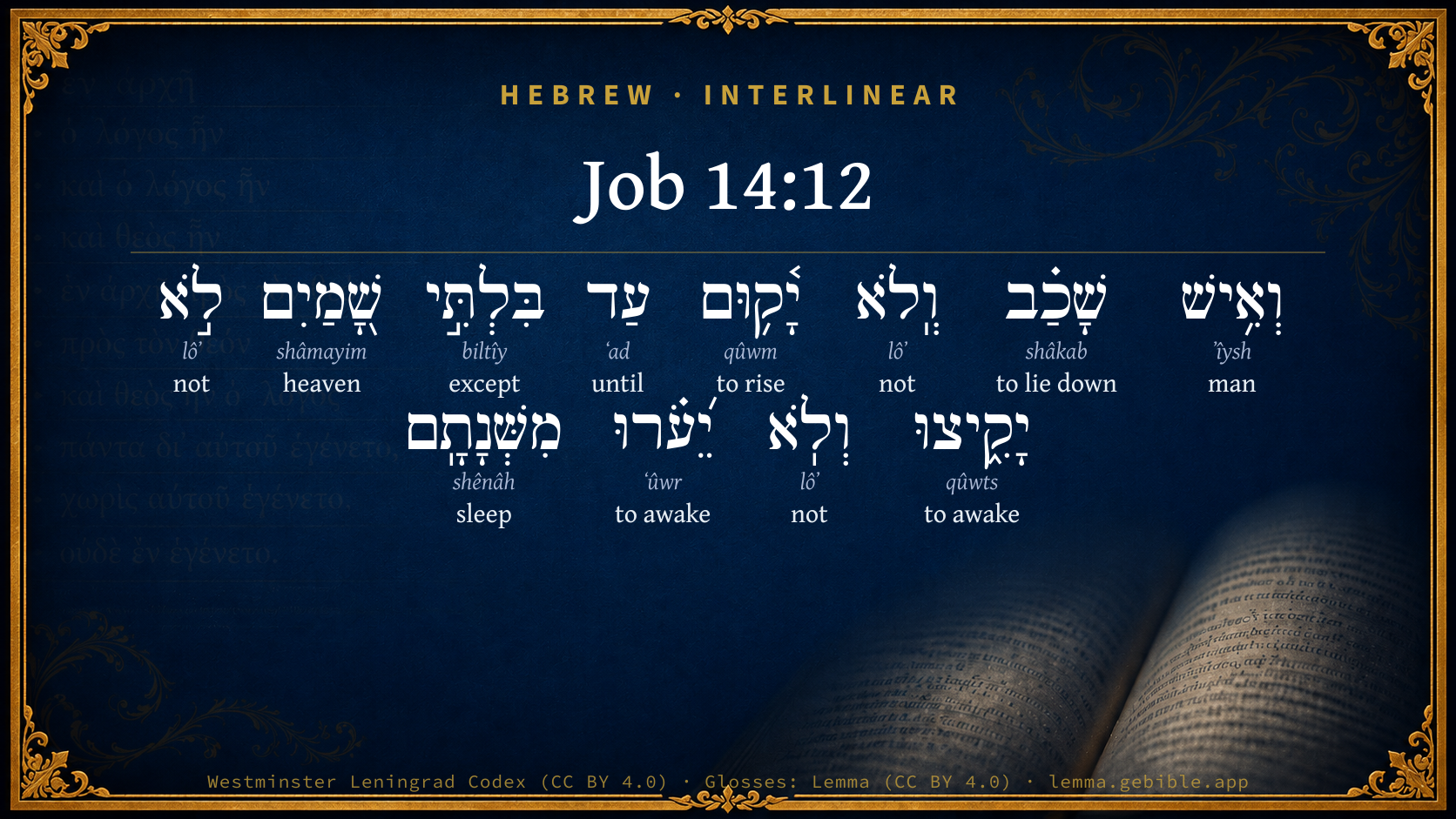
Hebrew (Westminster Leningrad Codex) Job 14:12 appears in the Hebrew Old Testament. The text above is from the Westminster Leningrad Codex. Each word links to its Strong’s number, a concise gloss, and parsing drawn from the Open Scriptures Hebrew Bible morphology. Click any word for its full Brown-Driver-Briggs (BDB) entry.
Download image
Cite this verse

Job 14:12 (World English Bible). Public Domain. Lemma interlinear Bible study tool, https://lemma.gebible.app/v/job/14/12.

Show BibTeX & RIS
BibTeX
RIS
English Translation
So man lies down and doesn't rise; Until the heavens are no more, they shall not awake, Nor be roused out of their sleep.
World English Bible · Public Domain
Download a study sheet

One document with this verse’s original text, its word-by-word gloss line, the meaning frame, cross-references with their text, attributed commentary, and full source and license credits — printable, and it pastes into notes with its structure intact.

This verse Autodidact and up

Study sheet (.html) Plain text (.txt)

A passage Seminary Student

Up to 50 verses in one chapter. A passage sheet keeps up to 6 commentary sources and 12 cross-references per verse, in the order this page ranks them, and says so on the sheet whenever that leaves anything out. Ask for a single verse and you get the Autodidact verse sheet above.

Everything on this page stays free to read, with no account — the sheet is a download of what is already on screen, not access to it.

Want to remove ads? Support Godless Engineer
Compare translations 3

The same verse in 3 English versions, stacked beneath the original-language interlinear above. Click any original word for its lexicon entry.

Each is an independent rendering of the whole verse — the interlinear is not word-aligned to these translations.

Highlighted words mark where these versions differ — a whole-verse word diff, not a word-by-word alignment.

  • World English Bible Public Domain
    So man lies down and doesn't rise; Until the heavens are no more, they shall not awake, Nor be roused out of their sleep.
  • King James Version Public Domain
    So man lieth down, and riseth not: till the heavens be no more, they shall not awake, nor be raised out of their sleep.
  • unfoldingWord Literal Text CC BY-SA 4.0
    and a man lies down and does not arise. Until the heavens no more, they will not awake and they will not be roused from their sleep.

unfoldingWord Literal Text — © unfoldingWord, licensed CC BY-SA 4.0. Word-aligned USFM3 via Door43 (git.door43.org/unfoldingWord/en_ult).

Versions to compare (up to 4)

3 of 4 selected

Show all 18 translations

Every available English version of this verse, each an independent rendering of the whole verse.

  • World English Bible Public Domain
    So man lies down and doesn't rise; Until the heavens are no more, they shall not awake, Nor be roused out of their sleep.
  • Berean Standard Bible Public Domain
    so a man lies down and does not rise. Until the heavens are no more, he will not be awakened or roused from sleep.
  • Majority Standard Bible Public Domain
    so a man lies down and does not rise. Until the heavens are no more, he will not be awakened or roused from sleep.
  • King James Version Public Domain
    So man lieth down, and riseth not: till the heavens be no more, they shall not awake, nor be raised out of their sleep.
  • American Standard Version (1901) Public Domain
    So man lieth down and riseth not: Till the heavens be no more, they shall not awake, Nor be roused out of their sleep.
  • Revised Version (1885) Public Domain
    So man lieth down and riseth not: till the heavens be no more, they shall not awake, nor be roused out of their sleep.
  • Geneva Bible (1599) Public Domain
    So man sleepeth and riseth not: for hee shall not wake againe, nor be raised from his sleepe till the heauen be no more.
  • Douay-Rheims (1899) Public Domain
    So man when he is fallen asleep shall not rise again; till the heavens be broken, he shall not awake, nor rise up out of his sleep.
  • Young's Literal Translation Public Domain
    And man hath lain down, and riseth not, Till the wearing out of the heavens they awake not, Nor are roused from their sleep.
  • Literal Standard Version CC BY-SA 4.0
    And man has lain down, and does not rise, || Until the wearing out of the heavens they do not awaken, || Nor are roused from their sleep.
  • Unlocked Literal Bible CC BY-SA 4.0
    so people lie down and do not rise again. Until the heavens are no more, they will not awake nor be roused out of their sleep.
  • unfoldingWord Literal Text CC BY-SA 4.0
    and a man lies down and does not arise. Until the heavens no more, they will not awake and they will not be roused from their sleep.
  • Darby Bible Public Domain
    So man lieth down, and riseth not again; till the heavens be no more, they do not awake, nor are raised out of their sleep.
  • World Messianic Bible Public Domain
    so man lies down and doesn’t rise. Until the heavens are no more, they will not awake, nor be roused out of their sleep.
  • Webster's Bible Public Domain
    So man lieth down, and riseth not: till the heavens shall be no more, they shall not awake, nor be raised out of their sleep.
  • Free Bible Version CC BY-SA 4.0
    so human beings lie down and don't get up again. Until the heavens cease to exist they will not awake from their sleep.
  • Bible in Basic English Public Domain
    So man goes down to his last resting-place and comes not again: till the heavens come to an end, they will not be awake or come out of their sleep.
  • JPS Tanakh (1917) Public Domain
    So man lieth down and riseth not; till the heavens be no more, they shall not awake, nor be roused out of their sleep.

Literal Standard Version (2020), Covenant Press — licensed CC BY-SA 4.0. Text via the HelloAO Bible API (eBible.org). Unlocked Literal Bible (unfoldingWord) — licensed CC BY-SA 4.0. Text via the HelloAO Bible API (eBible.org). unfoldingWord Literal Text — © unfoldingWord, licensed CC BY-SA 4.0. Word-aligned USFM3 via Door43 (git.door43.org/unfoldingWord/en_ult). Free Bible Version, Dr. Jonathan Gallagher — licensed CC BY-SA 4.0. Text via the HelloAO Bible API (eBible.org).

Word by word

More ways to search: Search by grammar → Find every occurrence → Compare this word →

Practice this passage: Drill this verse → Learn its vocabulary →

יָקִ֑יצוּ
qûwts
H6974
“to awake”
Verb, Hiphil, Imperfect, 3rd Person, Masculine, Plural
Part of Speech
Verb
Stem
Hiphil
Form
Imperfect
Person
3rd Person
Gender
Masculine
Number
Plural
Full BDB Definition

Origin: a primitive root [identical with H6972 through the idea of abruptness in starting up from sleep (compare H3364 )]

TWOT: 904a , 2019

to awake, wake up - (Hiphil) to awaken, arouse, show signs of waking, awake
  1. וְאִ֥ישׁ ʼîysh H376 “and · man” Conjunction + Noun, Common, Masculine, Singular, Absolute
  2. שָׁכַ֗ב shâkab H7901 “to lie down” Verb, Qal, Perfect, 3rd Person, Masculine, Singular
  3. וְֽלֹא lôʼ H3808 “and · not” Conjunction + Particle, Negative
  4. יָ֫ק֥וּם qûwm H6965 “to rise” Verb, Qal, Imperfect, 3rd Person, Masculine, Singular
  5. עַד ʻad H5704 “until” Preposition
  6. בִּלְתִּ֣י biltîy H1115 “except” Conjunction
  7. שָׁ֭מַיִם shâmayim H8064 “heaven(s)” Noun, Common, Masculine, Plural, Absolute
  8. לֹ֣א lôʼ H3808 “not” Particle, Negative
  9. וְלֹֽא lôʼ H3808 “and · not” Conjunction + Particle, Negative
  10. יֵ֝עֹ֗רוּ ʻûwr H5782 “to awake” Verb, Niphal, Imperfect, 3rd Person, Masculine, Plural
  11. מִשְּׁנָתָֽם shênâh H8142 “from · sleep · their” Preposition + Noun, Common, Feminine, Singular, Construct + Suffix, Personal, 3rd Person, Masculine, Plural

About this verse

These counts appear in no published source. They are computed here, from the morphology-tagged text and Lemma’s own curated glosses. What Lemma adds →

12
words
10
distinct lemmas
Wisdom
section

Notable vocabulary

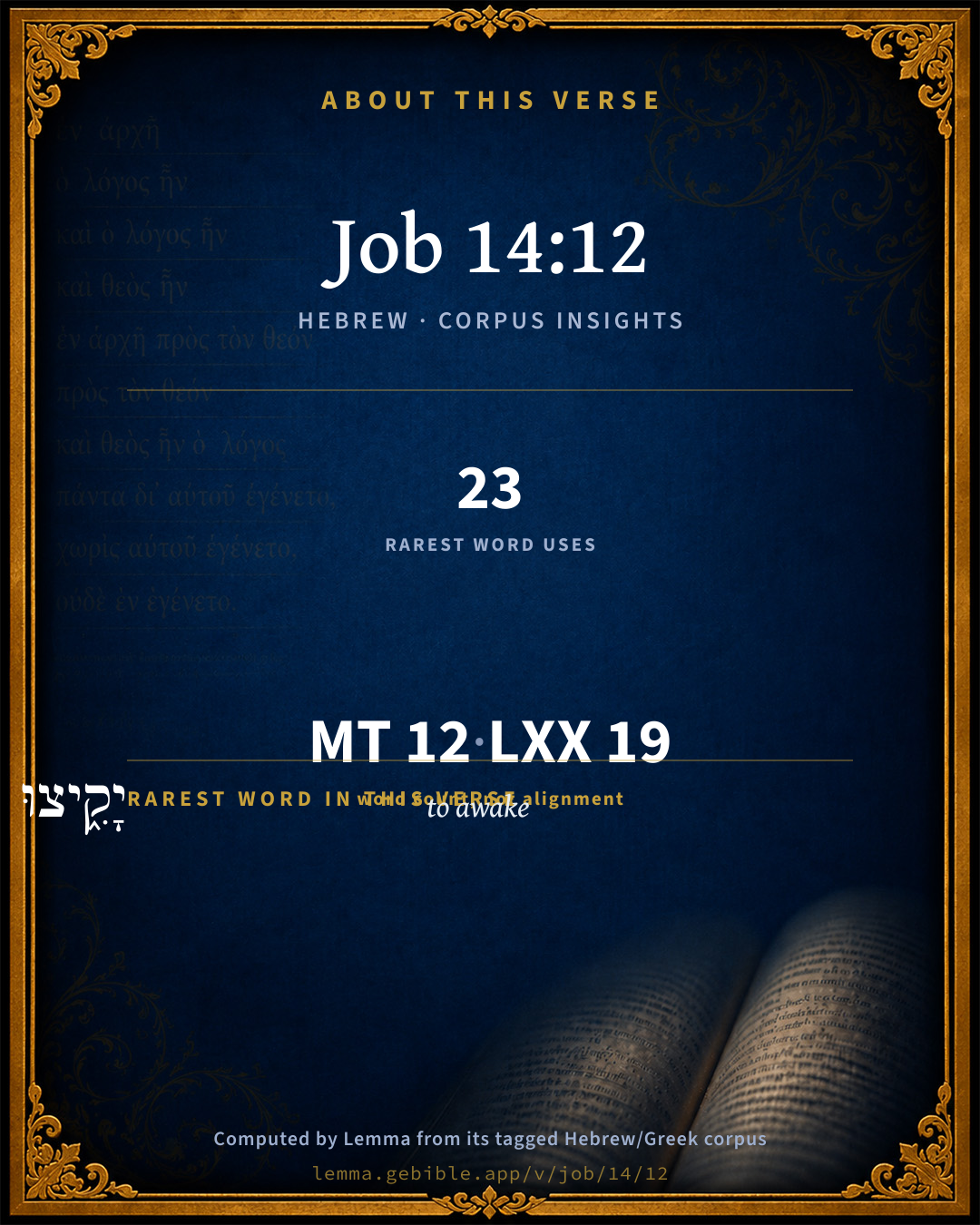
The rarest word here is יָקִ֑יצוּ to awake H6974 — appearing just 23 times in the whole Hebrew Bible.

Shared distinctive vocabulary

יָקִ֑יצוּ to awake H6974 occurs in 22 verses of the Hebrew Bible. Also found in:

Grammatical profile

  • 4 verbs
  • 3 nouns
  • 1 preposition
  • 1 conjunction
  • 3 particles

Verb forms

  • שָׁכַ֗ב Qal · Perfect
  • יָ֫ק֥וּם Qal · Imperfect
  • יָקִ֑יצוּ Hiphil · Imperfect
  • יֵ֝עֹ֗רוּ Niphal · Imperfect

Repetition

A word recurs within this verse — often emphatic in Hebrew:

  • וְֽלֹא not H3808 ×3

Hebrew & Septuagint length

In English translation the verse runs 24 words from the Hebrew and 26 from the Septuagint (LXX English) — closely comparable.

A rough comparison of the two English renderings, which tokenize alike — not a word-level alignment.

Word counts can differ between the Hebrew and the Greek without any difference in meaning — e.g. the Hebrew direct-object marker אֵת has no separate Greek word, and Greek often adds the article ὁ.

In the original languages it is 12 Hebrew tokens and 19 Greek tokens — but the two are counted differently (Hebrew bundles its prefixes and suffixes into one token; the Greek is in lemma form), so that isn’t a like-for-like length.

Cross-references

23

Topical passages linked to Job 14:12 in the Treasury of Scripture Knowledge — connected by theme and wording, ordered by reader-vote popularity; previews shown in the World English Bible.

  • Job 10:21–22 Before I go where I shall not return from, To the land of darkness and of the shadow of death;
  • Job 3:13 For now should I have lain down and been quiet. I should have slept, then I would have been at rest,
  • Ecclesiastes 3:19–21 For that which happens to the sons of men happens to animals. Even one thing happens to them. As the one dies, so the other dies. Yes, they have all one breath; and man has no advantage over the animals: for all is vanity.
  • Isaiah 26:19 Your dead shall live; my dead bodies shall arise. Awake and sing, you who dwell in the dust; for your dew is [as] the dew of herbs, and the earth shall cast forth the dead.
  • 2 Peter 3:10–13 But the day of the Lord will come as a thief in the night; in which the heavens will pass away with a great noise, and the elements will be dissolved with fervent heat, and the earth and the works that are in it will be burned up.
  • Job 30:23 For I know that you will bring me to death, To the house appointed for all living.
  • Job 7:21 Why do you not pardon my disobedience, and take away my iniquity? For now shall I lie down in the dust. You will seek me diligently, but I shall not be."
  • Job 19:25–27 But as for me, I know that my Redeemer lives. In the end, he will stand upon the earth.
  • Psalms 102:26 They will perish, but you will endure. Yes, all of them will wear out like a garment. You will change them like a cloak, and they will be changed.
  • Ecclesiastes 12:5 Yes, they shall be afraid of heights, And terrors will be in the way; And the almond tree shall blossom, And the grasshopper shall be a burden, And desire shall fail; Because man goes to his everlasting home, And the mourners go about the streets:
  • Isaiah 51:6 Lift up your eyes to the heavens, and look on the earth beneath; for the heavens shall vanish away like smoke, and the earth shall wax old like a garment; and those who dwell therein shall die in like manner: but my salvation shall be forever, and my righteousness shall not be abolished.
  • Isaiah 65:17 For, behold, I create new heavens and a new earth; and the former things shall not be remembered, nor come into mind.
  • Isaiah 66:22 For as the new heavens and the new earth, which I will make, shall remain before me, says Yahweh, so shall your seed and your name remain.
  • Daniel 12:2 Many of those who sleep in the dust of the earth shall awake, some to everlasting life, and some to shame and everlasting contempt.
  • Matthew 24:35 Heaven and earth will pass away, but my words will not pass away.
  • Acts 3:21 whom heaven must receive until the times of restoration of all things, which God spoke long ago by the mouth of his holy prophets.
  • Ephesians 5:14 Therefore he says, "Awake, you who sleep, and arise from the dead, and Christ will shine on you."
  • 1 Thessalonians 4:14–15 For if we believe that Jesus died and rose again, even so those who have fallen asleep in Jesus will God bring with him.
  • 2 Peter 3:7 But the heavens that now are, and the earth, by the same word have been stored up for fire, being reserved against the day of judgment and destruction of ungodly men.
  • Revelation 20:11 I saw a great white throne, and him who sat on it, from whose face the earth and the heaven fled away. There was found no place for them.
  • Revelation 21:1 I saw a new heaven and a new earth: for the first heaven and the first earth have passed away, and the sea is no more.
  • John 11:11–13 He said these things, and after that, he said to them, "Our friend, Lazarus, has fallen asleep, but I am going so that I may awake him out of sleep."
  • Romans 8:20 For the creation was subjected to vanity, not of its own will, but because of him who subjected it, in hope

Cross-references courtesy of OpenBible.info (CC BY 4.0).

Hebrew and Greek witnesses Masoretic Hebrew ↔ Greek Septuagint

The same verse in the two great witnesses to the Old Testament, shown verse-for-verse.

These are two independent witnesses, not word-aligned to each other, and the Septuagint is shown in lemma (dictionary) form.

Hebrew Job 14:12 Masoretic · Westminster Leningrad Codex

וְאִ֥ישׁ שָׁכַ֗ב וְֽלֹא יָ֫ק֥וּם עַד בִּלְתִּ֣י שָׁ֭מַיִם לֹ֣א יָקִ֑יצוּ וְלֹֽא יֵ֝עֹ֗רוּ מִשְּׁנָתָֽם

So man lies down and doesn't rise; Until the heavens are no more, they shall not awake, Nor be roused out of their sleep.

World English Bible · Public Domain

Greek LXX Job 14:12 Septuagint · lemma form

ἄνθρωπος δέ κοιμάω οὐ μή ἀναἵστημι ἕως ἄν ὁ οὐρανός οὐ μή συνῥάπτω καί οὐ ἐκὑπνίζω ἐκ ὕπνος αὐτός

And man that has lain down in death shall certainly not rise again till the heaven be dissolved, and they shall not awake from their sleep.

LXX2012 (modern English Septuagint) · Public Domain

On this verse, Whedon's Commentary on the Bible discusses the Septuagint’s reading. Read the note in Commentary ↓

Hebrew: Westminster Leningrad Codex (CC BY 4.0). Greek: Septuagint (public domain); English from LXX2012 (modern English Septuagint) (Public Domain). How the Septuagint differs from the Hebrew →

Commentary

Notes on Job 14:12 from classic Christian and Jewish commentators (each source and its license shown beneath its notes). The classic Christian expositions comment on the surrounding passage and are grouped to its opening verse, so a note may address several verses; the Jewish commentaries on the Tanakh (Rashi and others) are per-verse, so they appear only where the commentator wrote on this verse.

Lemma curates 59 commentaries, every one of them public domain or Creative Commons licensed, each selected and text-cleaned for this edition rather than reprinted as found. About our sources →

Trapp's Complete Commentary

John Trapp

Job 14:12 So man lieth down, and riseth not: till the heavens [be] no more, they shall not awake, nor be raised out of their sleep.

Ver. 12. So man lieth down] sc. In the dust of death, or in the bed of the grave; his dormitory, till the last day.

Ut somnus morris, sic lectus imago sepulchri.

And riseth not] sc. To live again among men. So, Psa 78:39, man is compared to a wind, which, when it is past, returneth not again. If it be objected, that we read of three in the Old Testament, and five in the New, raised from death to life; besides those many that arose and came out of the graves after Christ’s resurrection, and went into the holy city, and appeared unto many, Mat 27:52-53; it is answered, 1. These few raised by God’s extraordinary power do not infringe the truth of what the Scripture here and elsewhere affirmeth of all mankind according to the ordinary course of nature. 2. Even those men also afterwards died again, and vanished, no more to return or appear again in this world.

Till the heavens be no more] i.e. Never (say some interpreters), to wit, vi sua, by his own strength, and to a better condition in the land of the living; so the word "until" is used, 2Sa 6:13 Mat 5:26; Mat 1:25, ut pie credimus. How sound and clear Job was in the point of the resurrection we shall see, Job 19:26, and because he falls upon it in the words next following here, some understand these words thus: They shall not rise till the general resurrections, when these heavens shall be changed and renewed, Psa 102:25-26 Isa 65:17 2Pe 3:7; 2Pe 3:10-11 Rev 21:1.

They shall not awake] Out of the sleep of death;

nor be raised] viz. By the sound of the last trump, till the last day. But raised they shall be, and sleep no more, viz. when the heavens shall be no more. And till that time the bodies of the saints are laid in the grave, as in a bed of down, or of spices, to mellow and ripen. This is matter of joy and triumph, Isa 26:19 Dan 12:2, when they were to lose all: so Heb 11:35. The wicked also sleep in the grave, Dan 12:2, but shall awake to everlasting shame and contempt, ib.; their sick sleep shall have a woeful waking, for they shall be raised by virtue of Christ’s judiciary power, and by the curse of the law, to look upon him whom they have pierced, and to hear from him that dreadful Discedite, "Depart, ye cursed," &c.

John Trapp, A Commentary or Exposition upon All the Books of the Old and New Testament (1647–1656) — public domain. Text from a community e-Sword module.

The Biblical Illustrator

Joseph S. Exell

Job_14:12

Till the heavens be no more, they shall not awake, nor be raised out of their sleep.

The sleep of death

1. Death is like sleep in its outward appearance. This likeness should remind us, when we lie down to sleep, of that death which sleep resembles. It should teach us to look upon it without dismay.

2. Sleep and death are both a refuge from the ills and cares of this life, and a rest from its labour.

3. In both the soul is conscious still. The soul never sleeps, and hence the phenomena of dreams.

4. Each is followed by an awakening. The consideration that you must shortly sleep in the dust, and you know not how soon, should constrain you to seek for the pardon of your sins, and the removal of your iniquity, ere it be too late. (G. Cole.)

The Biblical Illustrator, edited by Joseph S. Exell (c. 1880s–1900s) — public domain. Text from a community e-Sword module.

Joseph Benson's Commentary

Job 14:12. So man lieth down — In his bed the grave, sleeping the sleep of death. And riseth not till the heavens be no more — That is, until the time of the general resurrection and restitution of all things, when these visible heavens shall pass away, and be no more, at least in the same form in which they are now. This whole paragraph is interpreted in a somewhat different way by a late writer. “After a tree is cut down, we see, nevertheless, the old stock flourish again, and send forth new branches; and shall man then, when he once expires, he extinct for ever? Is there no hope that he shall revive, and be raised again hereafter? Yes, there is, according to the doctrine delivered to us by our ancestors: but then they inform us, at the same time, that this resurrection shall not be but with the dissolution and renovation of the world, Job 14:11-12. The waters go off from the sea, and the flood (the river) will decay and dry up. And man lieth down and riseth not till the heavens be no more; (till then) they shall not awake nor be raised out of their sleep.” The meaning seems to be, that as we see every thing in flux, and subject to change, so the whole shall one day be changed. The sea itself will at length be quite absorbed; and the running rivers, which now flow perpetually, as if supplied by everlasting springs, will nevertheless, in time, quite cease and disappear. This visible frame of things shall be dissolved, and the present heavens themselves shall be no more: and then, and not before, comes the resurrection and general judgment.

Joseph Benson's Commentary on the Old and New Testaments (1811–1818) — public domain. Text from a community e-Sword module.

Tyndale Open Study Notes

Tyndale Open Resources

14:12 do not rise again: Job himself did not have even the minimal evidence of resurrection found in the Old Testament (2 Kgs 13:21; Isa 26:19; Dan 12:2; cp. Job 19:25). • Job was not focusing on the end of the universe when the heavens will be no more (Ps 102:25-26; Isa 34:4; 51:6; Heb 1:10-12) but on the eternity of the heavens (Ps 148:6; cp. Pss 72:5, 7, 17; 89:29, 37). His phrase refers to the permanency of death.

Tyndale Open Study Notes — © Tyndale Open Resources, licensed CC BY-SA 4.0. Text via the HelloAO Bible API.

Jamieson, Fausset & Brown

Robert Jamieson, A. R. Fausset & David Brown

heavens be no more--This only implies that Job had no hope of living again in the present order of the world, not that he had no hope of life again in a new order of things. Psa 102:26 proves that early under the Old Testament the dissolution of the present earth and heavens was expected (compare Gen 8:22). Enoch before Job had implied that the "saints shall live again" (Jde 1:14; Heb 11:13-16). Even if, by this phrase, Job meant "never" (Psa 89:29) in his gloomier state of feelings, yet the Holy Ghost has made him unconsciously (Pe1 1:11-12) use language expressing the truth, that the resurrection is to be preceded by the dissolution of the heavens. In Job 14:13-15 he plainly passes to brighter hopes of a world to come.

Jamieson, Fausset & Brown — Commentary Critical and Explanatory on the Whole Bible (1871) — public domain (CC PDM 1.0). Text via the HelloAO Bible API.

Adam Clarke's Commentary

Verse 12. So man lieth down] He falls asleep in his bed of earth.

And riseth not] Men shall not, like cut down trees and plants, reproduce their like; nor shall they arise till the heavens are no more, till the earth and all its works are burnt up, and the general resurrection of human beings shall take place. Surely it would be difficult to twist this passage to the denial of the resurrection of the body. Neither can these expressions be fairly understood as implying Job's belief in the materiality of the soul, and that the whole man sleeps from the day of his death to the morning of the resurrection. We have already seen that Job makes a distinction between the animal life and rational soul in man; and it is most certain that the doctrine of the materiality of the soul, and its sleep till the resurrection, has no place in the sacred records. There is a most beautiful passage to the same purpose, and with the same imagery, in Moschus's epitaph on the death of Bion: -

Αι, αι ται μαλαχαι μεν επαν κατα καπον ολωνται,

Η τα χλωρα σελινα, το τ' ευθαλες ουλον ανηθον,

Ὑστερον αυ ζωοντι, και εις ετος αλλο φυοντι·

Αμμες δ', οἱ μεγαλοι, και καρτεροι, η σοφοι ανδρες,

Ὁπποτε πρωτα θανωμες, ανακοοι εν χθονι κοιλα

Εὑδομες ευ μαλα μακρον, ατερμονα, νηγρετον ὑπνον.

Idyll. iii., ver. 100.

Alas! alas! the mallows, when they die,

Or garden herbs, and sweet Anethum's pride,

Blooming in vigour, wake again to life,

And flourish beauteous through another year:

But we, the great, the mighty, and the wise,

When once we die, unknown in earth's dark womb

Sleep long and drear, the endless sleep of death.

J. B. B. C.

A more cold and comfortless philosophy was never invented. The next verse shows that Job did not entertain this view of the subject.

Adam Clarke's Commentary on the Bible (1810–1826) — public domain. Text from a community e-Sword/MySword module.

The Cambridge Bible for Schools and Colleges

gen. ed. J. J. S. Perowne

12. till the heavens be no more] i. e. never; cf. Psa_72:7, Till there be no moon. The heavens are eternal, cf. Jer_31:35-36; Psa_89:29; Psa_89:36-37.

The Cambridge Bible for Schools and Colleges (gen. ed. J. J. S. Perowne; Cambridge University Press, 1878–1918) — public domain. Text from a community e-Sword module.

John Gill's Exposition

So man lieth down,.... Or "and", or "but man lieth down" (b); in the grave when he dies, as on a bed, and takes his rest from all his labours, toil and troubles, and lies asleep, and continues so till the resurrection morn:

and riseth not; from off his bed, or comes not out of his grave into this world, to the place where he was, and to be engaged in the affairs of life he was before, and never by his own power; and whenever he will rise, it will be by the power of God, and this not till the last day, when Christ shall appear in person to judge the world; and then the dead in Christ will rise first, at the beginning of the thousand years, and the wicked at the end of them:

till the heavens be no more, they shall not awake, nor be raised out of their sleep; for so the words are to be read, not in connection with those that go before, but with the last clauses; though the sense is much the same either way, which is, that those who are fallen asleep by death, and lie sleeping in their graves, and on their beds, these shall neither awake of themselves, nor be awaked by others, "till the heavens be no more"; that is, never, so as to awake and arise of themselves, and to this natural life, and to be concerned in the business of it; which sometimes seems to be the sense of this phrase, see Psa 89:29, Mat 5:18; or, as some render it, "till the heavens are wore out", or "waxen old" (c); as they will like a garment, and be folded up, and laid aside, as to their present use, Psa 102:26; or till they shall vanish away, and be no more, as to their present form, quality, and use, though they may exist as to substance; and when this will be the case, as it will be when the Judge shall appear, when Christ shall come a second time to judge the world; then the earth and heaven will flee away from his face, the earth and its works shall be burnt up, and the heavens shall pass away with great noise; and then, and not till then, will the dead, or those that are asleep in their graves, be awaked by the voice of the archangel, and the trump of God, and they shall be raised from their sleepy beds, awake and arise, some to everlasting life, and some to shame and everlasting contempt.

(b) "et vir", Pagninus, Montanus, Beza, Schmidt; "at vir", Cocceius. (c) "donec atteratur eoelum", V. L. so some in Bar Tzemach, though disapproved of by him as ungrammatical.

John Gill's Exposition of the Whole Bible (1746–1763) — public domain (CC PDM 1.0). Text via the HelloAO Bible API.

Albert Barnes' Notes on the Bible

So man lieth down, and riseth not - He lies down in the grave and does not rise again on the earth.

Till the heavens be no more - That is, never; for such is the fair interpretation of the passage, and this accords with its design. Job means to say, undoubtedly, that man would never appear again in the land of the living; that he would not spring up from the grave, as a sprout does from a fallen tree; and that when he dies, he goes away from the earth never to return. Whether he believed in a future state, or in the future resurrection, is another question, and one that cannot be determined from this passage. His complaint is, that the present life is short, and that man when he has once passed through it cannot return to enjoy it again, if it has been unhappy; and he asks, therefore, why, since it was so short, man might not be permitted to enjoy it without molestation. It does not follow from this passage that he believed that the heavens ever would be no more, or would pass away.

The heavens are the most permanent and enduring objects of which we have any knowledge, and are, therefore, used to denote permanency and eternity; see Psa 89:36-37. This verse, therefore, is simply a solemn declaration of the belief of Job that when man dies, he dies to live no more on the earth. Of the truth of this, no one can doubt - and the truth is as important and affecting as it is undoubted. If man could come back again, life would be a different thing. If he could revisit the earth to repair the evils of a wicked life, to repent of his errors, to make amends for his faults, and to make preparation for a future world, it would be a different thing to live, and a different thing to die. But when he travels over the road of life, he treads a path which is not to be traversed again. When he neglects an opportunity to do good, it cannot be recalled. When he commits an offence, he cannot come back to repair the evil. He falls, and dies, and lives no more. He enters on other scenes, and is amidst the retributions of another state. How important then to secure the passing moment, and to be prepared to go hence, to return no more! The idea here presented is one that is common with the poets. Thus, Horace says:

Nobis, cum semel occidit brevis lux,

Nox est perpetua una dormienda.

Albert Barnes' Notes on the Bible (1834–1885) — public domain. Text from a community e-Sword/MySword module.

Haydock's Catholic Bible Commentary

Till. At that time, the general resurrection will take place. (Vatable) (Scultet.) --- But people will never revive, according to the course of nature. In St. Matthew v. 18., and Psalm lxxi. 7., till is used in this sense. (Calmet)

George Leo Haydock (1774–1849), Haydock's Catholic Family Bible and Commentary, 1859 edition — public domain. Excludes Psalms (Douay-Rheims chapter numbering differs from Protestant) and Deuterocanonical books (Catholic canon only).

Matthew Poole's English Annotations

Man lieth down, to wit, in his bed, the grave, or to sleep the sleep of death, as this phrase is used, Gen 46:30; Deu 31:6; 2Sa 7:12; 1Ki 1:21.

Riseth not, to wit, to tills life; for he speaks not here of the life to come, nor of the resurrection of the belly after death by the Divine power; of his belief whereof he giveth sufficient evidences in divers places.

Till the heavens be no more, i.e. either,

1. Never; because the heavens, though they shall be changed in their qualities, yet shall never cease to be, as to the substance of them. And therefore everlasting and unchangeable things are expressed by the duration of the heavens; of which see Psa 72:5,7,17; 89:29,36,37; Mt 5:18; 24:35. Or,

2. Not until the time of the general resurrection, and the restitution of things, when these visible heavens shall pass away, and be no more, at least in the same form and manner as now they are; of which see Psa 102:26; Luk 21:33; 2Pe 3:7,10; Re 21:1.

Matthew Poole's English Annotations on the Holy Bible (1683–1685) — public domain. Text from a community e-Sword/MySword module.

Whedon's Commentary on the Bible

Daniel D. Whedon

12. Riseth not — Among the most ancient and universal beliefs was that of the transmigration of souls. It was man’s natural recoil from annihilation. He preferred to live in any mode, even in the grossest form of the brute, rather than that his being should be extinguished. Job is thought by some to have in view this false belief: he means rather to affirm that at death man ceases forever from this world. There is no root, shoot, bough, or form of being that can spring out of the man when once he is dead.

Till the heavens be no more — “That is, never. For things unchangeable and eternal are in Scripture compared in duration to the heavens.” Such is the view of Noyes and the German commentators. The passage really has respect to the restoration of present life in this world. The law that involves man in complete and hopeless destruction shall forever prevail, or, in Job’s language, “till the heavens be no more.” Of the same heavens of which Job speaks the psalmist says, (Psa_102:26,) “they shall perish;” (אֶבד the strong Hebrew word for “perish,” — used alike of men and animals.) Isaiah (Isa_51:6) also says of the heavens, “They shall vanish away like smoke,” נמלחו, literally, “be rubbed to pieces,” resolved into atoms like smoke. Compare Isa_65:17; 2Pe_3:10, etc. So that, many think, this dark passage has in it the germ of hope, or at least, that it falls into the category of unconscious foreshadowings of scripture truth. It is evident there was a very ancient belief that the heavens and earth should be destroyed. Ovid speaks of such a prediction (Met. 50:256), Esse quoque in fatis reminiscitur, etc. It was a common opinion of the Stoics that the whole world would catch fire, (Minucius Felix, 34:2,) and in its destruction “involve the very elements and the frame of the universe.” Compare Lucretius, lib. 5:97. The ancient Hindu held a similar belief. At the end of the last calpa the whole creation, nay, the host of gods themselves, will be overwhelmed in one common destruction. The sagas of the Scandinavian, and the old Runic mythology, confirm the great antiquity of this dogma, which may have had its origin in Egypt, (see PRITCHARD’S Mythology, pp. 181, 192,) or more probably in some primeval revelation. It does not appear improbable that such a tradition was in the mind of Job. If so, to say that the dead shall not be raised out of their sleep till the heavens be no more is equivalent to saying that when the heavens are no more the dead shall be raised out of their sleep. “And man that has lain down (in death) shall certainly not rise again till the heavens be dissolved.” — Septuagint.

Daniel D. Whedon (gen. ed.), Commentary on the Old and New Testaments (1874–1909) — public domain. Text from a community e-Sword module.

The Pulpit Commentary

So man lieth down, and riseth not. This is not an absolute denial of a final resurrection, since Job is speaking of the world as it lies before him, not of eventualities. Just as he sees the land encroach upon the sea, and remain land, and the river-courses, once dried up, remain dry, so he sees men descend into the grave and remain there, without rising up again. This is the established order of nature as it exists before his eyes. Till the heavens be no more, they shall not awake. This order of things, Job believes, rightly enough, will continue as long as the heavens and the earth endure. What will happen afterwards he does not so much as inquire. It is remarked, ingeniously, that Job"s words, though not intended in this sense, exactly "coincide with the declarations of the New Testament, which make the resurrection simultaneous with the breaking up of the visible universe" (Canon Cook). Nor be raised out of their sleep . If "the glimmer of a hope" of the resurrection appears anywhere in vers. 10-12, it is in the comparison of death to a sleep, which is inseparably connected in our minds with an awakening.

The Pulpit Commentary (1880–1919), ed. H.D.M. Spence-Jones & Joseph S. Exell — public domain. Text from a community e-Sword module.

John Wesley's Explanatory Notes

Lieth - In his bed, the grave. 'Till - Until the time of the general resurrection, when these visible heavens shall pass away.

John Wesley, Explanatory Notes Upon the Whole Bible (1754–1765) — public domain. Text via the GEBible commentary corpus.

Lesson kit

Teaching starters — assembled from the data on this page, not authored interpretation. Every prompt links to the verse data it draws on. Edit before teaching.

Job, in the Wisdom, opens this verse with 12 words (10 distinct Hebrew lemmas). Its most distinctive word is qûwts (“to awake”). A historical commentator’s framing appears above. Read the whole chapter for the surrounding context.

Discussion questions

  1. How does “to awake” (qûwts) shape what this verse is saying?
  2. How does 1 Samuel 26:12, which shares the word «to awake», read alongside this verse?
  3. What does the repetition of “not” (3× in this one verse) do in this verse?
  4. The translations on this page render this verse differently — a whole-verse word diff, not a word-by-word alignment. What might account for the different wordings?
  5. «שָׁכַ֗ב» is a Qal Perfect verb. How does that grammatical form shape the action described?
  6. Compare how Trapp's Complete Commentary and The Biblical Illustrator read this verse. Where do they agree or differ?

Things to notice

Reading settings

Reading text

Shown beneath each verse's original-language words.

Old Testament
Old Testament edition

Read the OT as the Masoretic Hebrew (MT) or the Greek Septuagint (LXX).

English shown for the Greek Septuagint (in the Hebrew ↔ Greek comparison).

Comparing translations? Open the Compare panel on any verse page to stack up to four side by side.