
Ezekiel 31:18

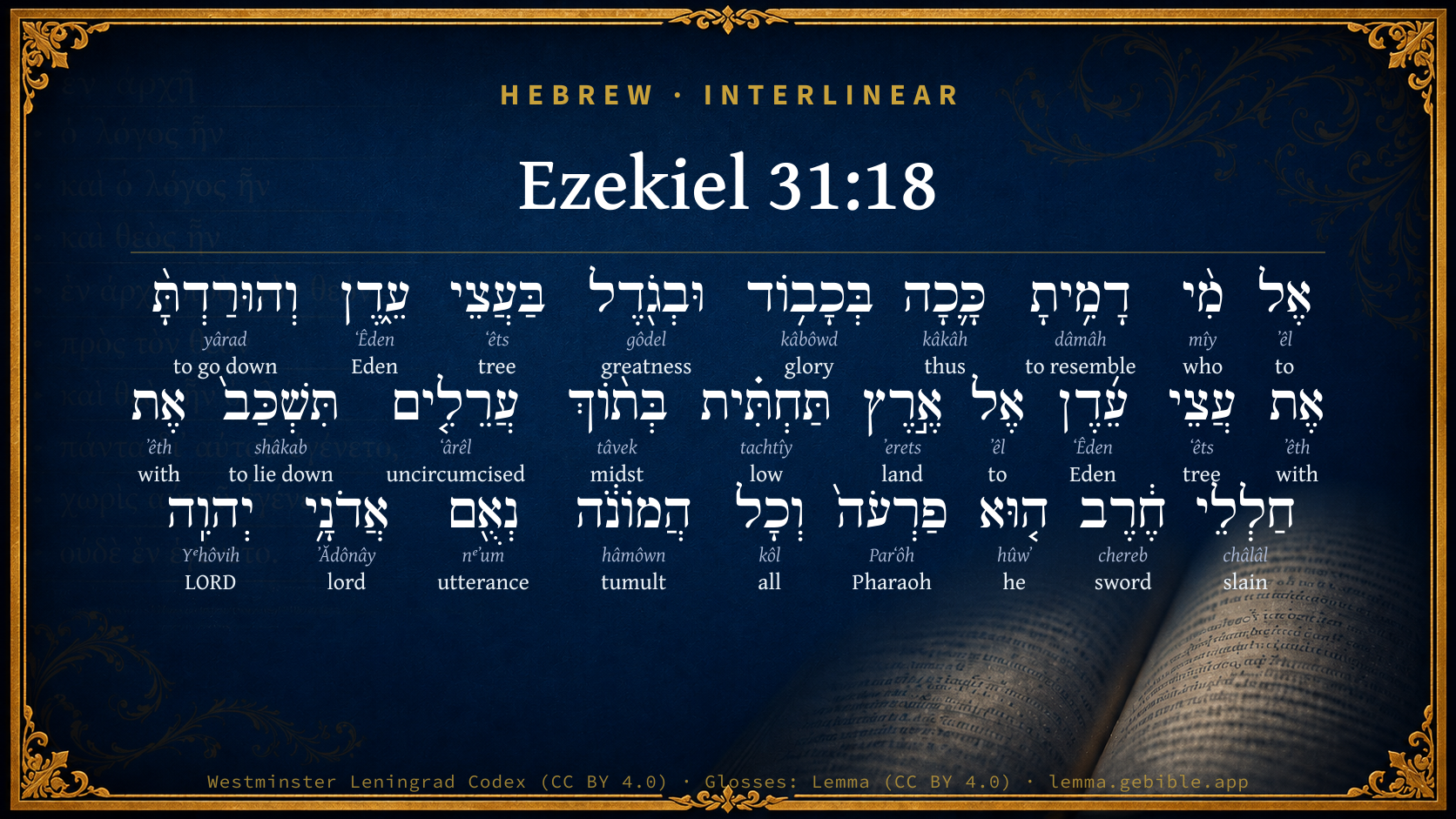
Hebrew (Westminster Leningrad Codex) Ezekiel 31:18 appears in the Hebrew Old Testament. The text above is from the Westminster Leningrad Codex. Each word links to its Strong’s number, a concise gloss, and parsing drawn from the Open Scriptures Hebrew Bible morphology. Click any word for its full Brown-Driver-Briggs (BDB) entry.
Download image
Cite this verse

Ezekiel 31:18 (World English Bible). Public Domain. Lemma interlinear Bible study tool, https://lemma.gebible.app/v/ezekiel/31/18.

Show BibTeX & RIS
BibTeX
RIS
English Translation
To whom are you thus like in glory and in greatness among the trees of Eden? yet shall you be brought down with the trees of Eden to the lower parts of the earth: you shall lie in the midst of the uncircumcised, with those who are slain by the sword. This is Pharaoh and all his multitude, says the Lord Yahweh.
World English Bible · Public Domain
Download a study sheet

One document with this verse’s original text, its word-by-word gloss line, the meaning frame, cross-references with their text, attributed commentary, and full source and license credits — printable, and it pastes into notes with its structure intact.

This verse Autodidact and up

Study sheet (.html) Plain text (.txt)

A passage Seminary Student

Up to 50 verses in one chapter. A passage sheet keeps up to 6 commentary sources and 12 cross-references per verse, in the order this page ranks them, and says so on the sheet whenever that leaves anything out. Ask for a single verse and you get the Autodidact verse sheet above.

Everything on this page stays free to read, with no account — the sheet is a download of what is already on screen, not access to it.

Want to remove ads? Support Godless Engineer
Compare translations 3

The same verse in 3 English versions, stacked beneath the original-language interlinear above. Click any original word for its lexicon entry.

Each is an independent rendering of the whole verse — the interlinear is not word-aligned to these translations.

Highlighted words mark where these versions differ — a whole-verse word diff, not a word-by-word alignment.

  • World English Bible Public Domain
    To whom are you thus like in glory and in greatness among the trees of Eden? yet shall you be brought down with the trees of Eden to the lower parts of the earth: you shall lie in the midst of the uncircumcised, with those who are slain by the sword. This is Pharaoh and all his multitude, says the Lord Yahweh.
  • King James Version Public Domain
    To whom art thou thus like in glory and in greatness among the trees of Eden? yet shalt thou be brought down with the trees of Eden unto the nether parts of the earth: thou shalt lie in the midst of the uncircumcised with them that be slain by the sword. This is Pharaoh and all his multitude, saith the Lord GOD.
  • unfoldingWord Literal Text CC BY-SA 4.0
    Which of the trees in Eden was your equal in glory and greatness? For you will be brought down with the trees of Eden to the lowest parts of the earth among the uncircumcised; you will live with those who were killed by the sword.’ This is Pharaoh and all of his multitudes—this is the Lord Yahweh’s declaration.”

unfoldingWord Literal Text — © unfoldingWord, licensed CC BY-SA 4.0. Word-aligned USFM3 via Door43 (git.door43.org/unfoldingWord/en_ult).

Versions to compare (up to 4)

3 of 4 selected

Show all 18 translations

Every available English version of this verse, each an independent rendering of the whole verse.

  • World English Bible Public Domain
    To whom are you thus like in glory and in greatness among the trees of Eden? yet shall you be brought down with the trees of Eden to the lower parts of the earth: you shall lie in the midst of the uncircumcised, with those who are slain by the sword. This is Pharaoh and all his multitude, says the Lord Yahweh.
  • Berean Standard Bible Public Domain
    Who then is like you in glory and greatness among the trees of Eden? You also will be brought down to the depths of the earth to be with the trees of Eden. You will lie among the uncircumcised, with those slain by the sword. This is Pharaoh and all his multitude, declares the Lord GOD.’”
  • Majority Standard Bible Public Domain
    Who then is like you in glory and greatness among the trees of Eden? You also will be brought down to the depths of the earth to be with the trees of Eden. You will lie among the uncircumcised, with those slain by the sword. This is Pharaoh and all his multitude, declares the Lord GOD.’”
  • King James Version Public Domain
    To whom art thou thus like in glory and in greatness among the trees of Eden? yet shalt thou be brought down with the trees of Eden unto the nether parts of the earth: thou shalt lie in the midst of the uncircumcised with them that be slain by the sword. This is Pharaoh and all his multitude, saith the Lord GOD.
  • American Standard Version (1901) Public Domain
    To whom art thou thus like in glory and in greatness among the trees of Eden? yet shalt thou be brought down with the trees of Eden unto the nether parts of the earth: thou shalt lie in the midst of the uncircumcised, with them that are slain by the sword. This is Pharaoh and all his multitude, saith the Lord Jehovah.
  • Revised Version (1885) Public Domain
    To whom art thou thus like in glory and in greatness among the trees of Eden? yet shalt thou be brought down with the trees of Eden unto the nether parts of the earth: thou shalt lie in the midst of the uncircumcised, with them that be slain by the sword. This is Pharaoh and all his multitude, saith the Lord GOD.
  • Geneva Bible (1599) Public Domain
    To whom art thou thus like in glorie and in greatnesse among the trees of Eden? yet thou shalt be cast downe with the trees of Eden vnto the nether partes of the earth: thou shalt sleepe in the middes of the vncircumcised, with them that be slaine by the sworde: this is Pharaoh and all his multitude, sayth the Lord God.
  • Douay-Rheims (1899) Public Domain
    To whom art thou like, O thou that art famous and lofty among the trees of pleasure? Behold, thou art brought down with the trees of pleasure to the lowest parts of the earth: thou shalt sleep in the midst of the uncircumcised, with them that are slain by the sword: this is Pharao, and all his multitude, saith the Lord God.
  • Young's Literal Translation Public Domain
    Unto whom hast thou been thus like, In honour and in greatness among the trees of Eden, And thou hast been brought down with the trees of Eden, Unto the earth -- the lower part, In the midst of the uncircumcised thou liest, With the pierced of the sword? It `is' Pharaoh, and all his multitude, An affirmation of the Lord Jehovah!'
  • Literal Standard Version CC BY-SA 4.0
    To whom have you been thus like, || In glory and in greatness among the trees of Eden? And you have been brought down with the trees of Eden, || To the lower earth, || You lie in the midst of the uncircumcised, || With the pierced of the sword. This [is] Pharaoh, and all his multitude, || A declaration of Lord YHWH!”
  • Unlocked Literal Bible CC BY-SA 4.0
    Which of the trees in Eden was your equal in glory and greatness? For you will be brought down with the trees of Eden to the lowest parts of the earth among the uncircumcised; you will live with those who were killed by the sword.' This is Pharaoh and all of his multitudes—this is the Lord Yahweh's declaration.”
  • unfoldingWord Literal Text CC BY-SA 4.0
    Which of the trees in Eden was your equal in glory and greatness? For you will be brought down with the trees of Eden to the lowest parts of the earth among the uncircumcised; you will live with those who were killed by the sword.’ This is Pharaoh and all of his multitudes—this is the Lord Yahweh’s declaration.”
  • Darby Bible Public Domain
    To whom art thou thus like in glory and in greatness among the trees of Eden? Yet shalt thou be brought down with the trees of Eden, unto the lower parts of the earth; thou shalt lie in the midst of the uncircumcised, with them that are slain by the sword. This is Pharaoh and all his multitude, saith the Lord Jehovah.
  • World Messianic Bible Public Domain
    “‘To whom are you thus like in glory and in greatness among the trees of Eden? Yet you will be brought down with the trees of Eden to the lower parts of the earth. You will lie in the middle of the uncircumcised, with those who are slain by the sword. “‘This is Pharaoh and all his multitude,’ says the Lord GOD.”
  • Webster's Bible Public Domain
    To whom art thou thus like in glory and in greatness among the trees of Eden? yet shalt thou be brought down with the trees of Eden to the nether parts of the earth: thou shalt lie in the midst of the uncircumcised with them that are slain by the sword. This is Pharaoh and all his multitude, saith the Lord GOD.
  • Free Bible Version CC BY-SA 4.0
    Who is as great and glorious as you among the trees of Eden? But you too will be brought down to the earth below to be with the trees of Eden. You will lie there with the heathen, with those killed by the sword. This is what will happen to Pharaoh and all his many people, declares the Lord God.”
  • Bible in Basic English Public Domain
    Whom then are you like? for you will be sent down with the trees of Eden into the lowest parts of the earth: there you will be stretched out among those without circumcision, with those who were put to the sword. This is Pharaoh and all his people, says the Lord.
  • JPS Tanakh (1917) Public Domain
    To whom art thou thus like in glory and in greatness among the trees of Eden? yet shall thou be brought down with the trees of Eden unto the nether parts of the earth; thou shalt lie in the midst of the uncircumcised, with them that are slain by the sword. This is Pharaoh and all his multitude, saith the Lord GOD.'

Literal Standard Version (2020), Covenant Press — licensed CC BY-SA 4.0. Text via the HelloAO Bible API (eBible.org). Unlocked Literal Bible (unfoldingWord) — licensed CC BY-SA 4.0. Text via the HelloAO Bible API (eBible.org). unfoldingWord Literal Text — © unfoldingWord, licensed CC BY-SA 4.0. Word-aligned USFM3 via Door43 (git.door43.org/unfoldingWord/en_ult). Free Bible Version, Dr. Jonathan Gallagher — licensed CC BY-SA 4.0. Text via the HelloAO Bible API (eBible.org).

Word by word

More ways to search: Search by grammar → Find every occurrence → Compare this word →

Practice this passage: Drill this verse → Learn its vocabulary →

וּבְגֹ֖דֶל
gôdel
H1433
“and · in/at · greatness”
Conjunction + Preposition + Noun, Common, Masculine, Singular, Absolute
Part of Speech
Conjunction + Preposition + Noun
Type
Common
Gender
Masculine
Number
Singular
State
Absolute
Full BDB Definition

Origin: from H1431

TWOT: 315b

greatness - greatness, magnitude - magnificence - pride, insolence (bad sense)
  1. אֶל ʼêl H413 “to” Preposition
  2. מִ֨י mîy H4310 “who” Particle, Interrogative
  3. דָמִ֥יתָ dâmâh H1819 “to resemble” Verb, Qal, Perfect, 2nd Person, Masculine, Singular
  4. כָּ֛כָה kâkâh H3602 “thus” Adverb
  5. בְּכָב֥וֹד kâbôwd H3519 “in/at · glory” Preposition + Noun, Common, Both, Singular, Absolute
  6. בַּעֲצֵי ʻêts H6086 “in/at · trees of” Preposition + Noun, Common, Masculine, Plural, Construct
  7. עֵ֑דֶן ʻÊden H5731 “Eden” Noun, Proper
  8. וְהוּרַדְתָּ֨ yârad H3381 “and · to go down” Conjunction + Verb, Hophal, Sequential Perfect, 2nd Person, Masculine, Singular
  9. אֶת ʼêth H854 “with” Preposition
  10. עֲצֵי ʻêts H6086 “trees of” Noun, Common, Masculine, Plural, Construct
  11. עֵ֜דֶן ʻÊden H5731 “Eden” Noun, Proper
  12. אֶל ʼêl H413 “to” Preposition
  13. אֶ֣רֶץ ʼerets H776 “land” Noun, Common, Both, Singular, Absolute
  14. תַּחְתִּ֗ית tachtîy H8482 “low” Adjective, Adjective, Feminine, Singular, Absolute
  15. בְּת֨וֹךְ tâvek H8432 “in/at · midst of” Preposition + Noun, Common, Masculine, Singular, Construct
  16. עֲרֵלִ֤ים ʻârêl H6189 “uncircumcised” Adjective, Adjective, Masculine, Plural, Absolute
  17. תִּשְׁכַּב֙ shâkab H7901 “to lie down” Verb, Qal, Imperfect, 2nd Person, Masculine, Singular
  18. אֶת ʼêth H854 “with” Preposition
  19. חַלְלֵי châlâl H2491 “slain of” Adjective, Adjective, Masculine, Plural, Construct
  20. חֶ֔רֶב chereb H2719 “sword” Noun, Common, Feminine, Singular, Absolute
  21. ה֤וּא hûwʼ H1931 “he” Pronoun, Personal, 3rd Person, Masculine, Singular
  22. פַרְעֹה֙ Parʻôh H6547 “Pharaoh” Noun, Proper
  23. וְכָל kôl H3605 “and · all of” Conjunction + Noun, Common, Masculine, Singular, Construct
  24. הֲמוֹנֹ֔ה hâmôwn H1995 “tumult · his” Noun, Common, Masculine, Singular, Construct + Suffix, Personal, 3rd Person, Masculine, Singular
  25. נְאֻ֖ם nᵉʼum H5002 “utterance of” Noun, Common, Masculine, Singular, Construct
  26. אֲדֹנָ֥י ʼĂdônây H136 “Lord · my” Noun, Common, Masculine, Plural, Construct + Suffix, Personal, 1st Person, Common, Singular
  27. יְהוִֽה Yᵉhôvih H3069 “LORD” Noun, Proper

About this verse

These counts appear in no published source. They are computed here, from the morphology-tagged text and Lemma’s own curated glosses. What Lemma adds →

28
words
24
distinct lemmas
Prophets
section

Notable vocabulary

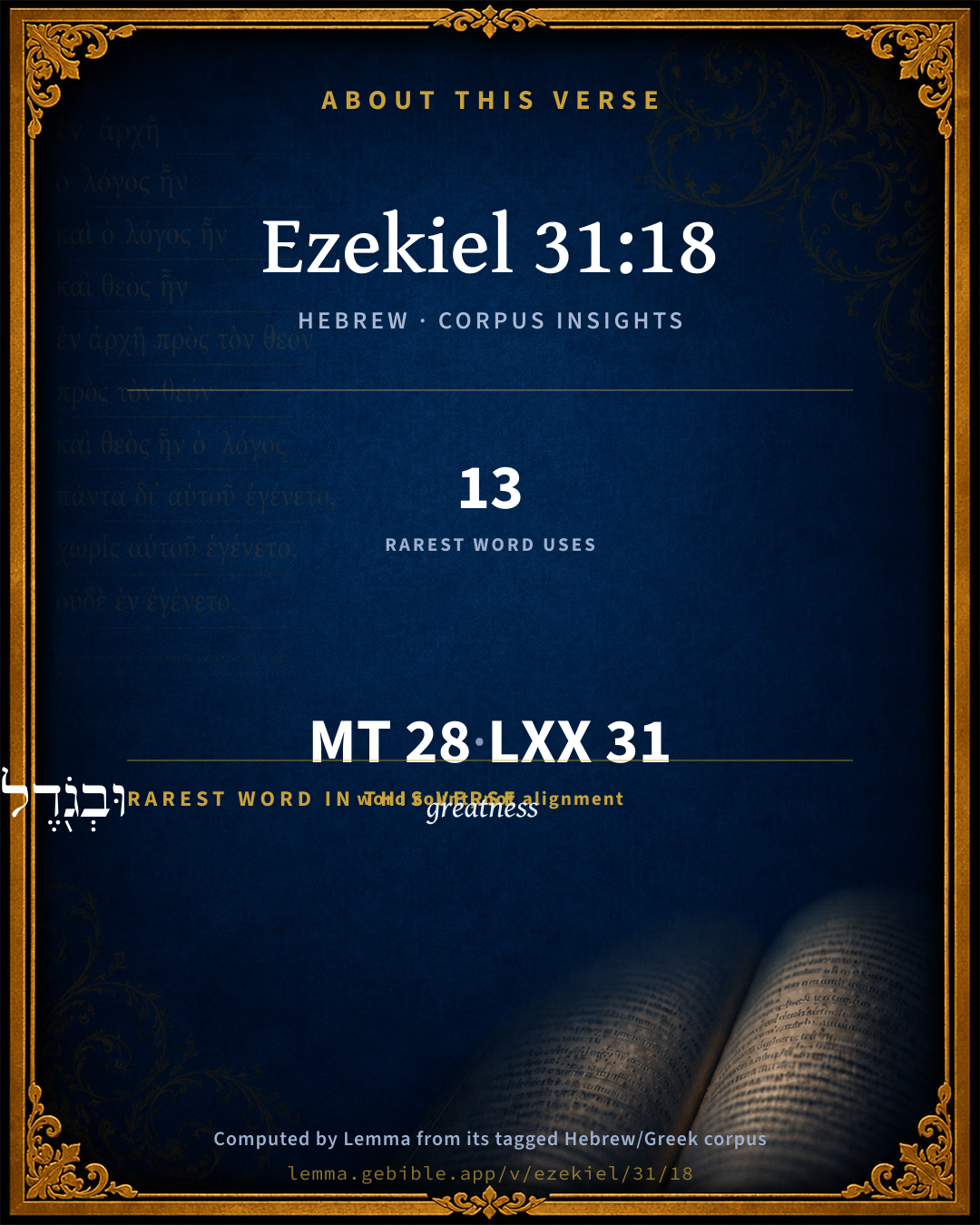
The rarest word here is וּבְגֹ֖דֶל greatness H1433 — appearing just 13 times in the whole Hebrew Bible.

Shared distinctive vocabulary

וּבְגֹ֖דֶל greatness H1433 occurs in 13 verses of the Hebrew Bible. Also found in:

Grammatical profile

  • 3 verbs
  • 15 nouns
  • 3 adjectives
  • 1 pronoun
  • 4 prepositions
  • 1 adverb
  • 1 particle

Verb forms

  • דָמִ֥יתָ Qal · Perfect
  • וְהוּרַדְתָּ֨ Hophal · Sequential Perfect
  • תִּשְׁכַּב֙ Qal · Imperfect

Repetition

Words recur within this verse — often emphatic in Hebrew:

  • בַּעֲצֵי tree H6086 ×2
  • עֵ֑דֶן Eden H5731 ×2
  • אֶל to H413 ×2
  • אֶת with H854 ×2

Hebrew & Septuagint length

In English translation the verse runs 62 words from the Hebrew and 52 from the Septuagint (LXX English) — closely comparable.

A rough comparison of the two English renderings, which tokenize alike — not a word-level alignment.

Word counts can differ between the Hebrew and the Greek without any difference in meaning — e.g. the Hebrew direct-object marker אֵת has no separate Greek word, and Greek often adds the article ὁ.

In the original languages it is 28 Hebrew tokens and 31 Greek tokens — but the two are counted differently (Hebrew bundles its prefixes and suffixes into one token; the Greek is in lemma form), so that isn’t a like-for-like length.

Cross-references

17

Topical passages linked to Ezekiel 31:18 in the Treasury of Scripture Knowledge — connected by theme and wording, ordered by reader-vote popularity; previews shown in the World English Bible.

  • Ezekiel 32:19 Whom do you pass in beauty? Go down, and be laid with the uncircumcised.
  • Ezekiel 28:10 You shall die the death of the uncircumcised by the hand of strangers: for I have spoken it, says the Lord Yahweh.
  • Ezekiel 32:21 The strong among the mighty shall speak to him out of the midst of Sheol with those who help him: they are gone down, they lie still, even the uncircumcised, slain by the sword.
  • Psalms 52:7 "Behold, this is the man who didn't make God his strength, But trusted in the abundance of his riches, And strengthened himself in his wickedness."
  • Jeremiah 9:25–26 Behold, the days come, says Yahweh, that I will punish all those who are circumcised in [their] uncircumcision:
  • Ezekiel 31:2 Son of man, tell Pharaoh king of Egypt, and to his multitude: Whom are you like in your greatness?
  • Ezekiel 31:16 I made the nations to shake at the sound of his fall, when I cast him down to Sheol with those who descend into the pit; and all the trees of Eden, the choice and best of Lebanon, all that drink water, were comforted in the lower parts of the earth.
  • Matthew 13:19 When anyone hears the word of the Kingdom, and doesn't understand it, the evil one comes, and snatches away that which has been sown in his heart. This is what was sown by the roadside.
  • 1 Samuel 17:26 David spoke to the men who stood by him, saying, What shall be done to the man who kills this Philistine, and takes away the reproach from Israel? for who is this uncircumcised Philistine, that he should defy the armies of the living God?
  • 1 Samuel 17:36 Your servant struck both the lion and the bear: and this uncircumcised Philistine shall be as one of them, seeing he has defied the armies of the living God.
  • 2 Samuel 1:20 Don't tell it in Gath, Don't publish it in the streets of Ashkelon; Lest the daughters of the Philistines rejoice, Lest the daughters of the uncircumcised triumph.
  • 2 Chronicles 28:22 In the time of his distress did he trespass yet more against Yahweh, this same king Ahaz.
  • Ezekiel 31:9 I made it beautiful by the multitude of its branches, so that all the trees of Eden, that were in the garden of God, envied it.
  • Ezekiel 32:10 Yes, I will make many peoples amazed at you, and their kings shall be horribly afraid for you, when I shall brandish my sword before them; and they shall tremble at every moment, every man for his own life, in the day of your fall.
  • Ezekiel 32:24–32 There is Elam and all her multitude round about her grave; all of them slain, fallen by the sword, who are gone down uncircumcised into the lower parts of the earth, who caused their terror in the land of the living, and have borne their shame with those who go down to the pit.
  • Matthew 26:26–28 As they were eating, Jesus took bread, gave thanks for it, and broke it. He gave to the disciples, and said, "Take, eat; this is my body."

Cross-references courtesy of OpenBible.info (CC BY 4.0).

Hebrew and Greek witnesses Masoretic Hebrew ↔ Greek Septuagint

The same verse in the two great witnesses to the Old Testament, shown verse-for-verse.

These are two independent witnesses, not word-aligned to each other, and the Septuagint is shown in lemma (dictionary) form.

Hebrew Ezekiel 31:18 Masoretic · Westminster Leningrad Codex

אֶל מִ֨י דָמִ֥יתָ כָּ֛כָה בְּכָב֥וֹד וּבְגֹ֖דֶל בַּעֲצֵי עֵ֑דֶן וְהוּרַדְתָּ֨ אֶת עֲצֵי עֵ֜דֶן אֶל אֶ֣רֶץ תַּחְתִּ֗ית בְּת֨וֹךְ עֲרֵלִ֤ים תִּשְׁכַּב֙ אֶת חַלְלֵי חֶ֔רֶב ה֤וּא פַרְעֹה֙ וְכָל הֲמוֹנֹ֔ה נְאֻ֖ם אֲדֹנָ֥י יְהוִֽה

To whom are you thus like in glory and in greatness among the trees of Eden? yet shall you be brought down with the trees of Eden to the lower parts of the earth: you shall lie in the midst of the uncircumcised, with those who are slain by the sword. This is Pharaoh and all his multitude, says the Lord Yahweh.

World English Bible · Public Domain

Greek LXX Ezekiel 31:18 Septuagint · lemma form

τίς ὁμοιόω καταβαίνω καί καταβιβάζω μετά ὁ ξύλον ὁ τρυφή εἰς γῆ βάθος ἐν μέσος ἀπερίτμητος κοιμάω μετά τραυματίας μάχαιρα οὕτως φαραώ καί ὁ πλῆθος ὁ ἰσχύς αὐτός λέγω κύριος κύριος

To whom are you compared? descend, and be you debased with the trees of paradise to the depth of the earth: you shall lie in the midst of the uncircumcised with them that are slain by the sword. Thus shall Pharao be, and the multitude of his host, says the Lord God.

LXX2012 (modern English Septuagint) · Public Domain

On this verse, The Cambridge Bible for Schools and Colleges discusses the Septuagint’s reading. Read the note in Commentary ↓

Hebrew: Westminster Leningrad Codex (CC BY 4.0). Greek: Septuagint (public domain); English from LXX2012 (modern English Septuagint) (Public Domain). How the Septuagint differs from the Hebrew →

Targum (Aramaic paraphrase)

1

The Targum is the ancient Jewish Aramaic paraphrase of the Hebrew Scriptures — an interpretive translation, not the Hebrew text itself. Onkelos (literal) and Pseudo-Jonathan (expansive) render the Torah, and Jonathan the Prophets. Coverage is partial: where no permissively-licensed English translation exists for a verse, only the Aramaic is shown. This is verse-level text, not a word-by-word alignment to the Hebrew.

  1. Targum Jonathan Prophets (Joshua–Malachi)
    לְמַן דַמְיֵתָא כְּדֵין בִּיקַר וּבִרְבוּ בְּמַלְכֵי קֶדֶם וְתִתְּחַת עִם מַלְכֵי קֶדֶם לְאַרְעָא אַרְעִיתָא בְּגוֹ חַיָבַיָא תִשְׁכַּב עִם קְטִילֵי חַרְבָּא הוּא פַרְעֹה וְכָל אִתְרְגוּשְׁתֵּיהּ אֲמַר יְיָ אֱלֹהִים:

    (no public-domain English translation for this verse)

    Targum Jonathan — Aramaic: “Mikraot Gedolot” (public domain). English: “Sefaria Community Translation” (CC0 1.0 (public-domain dedication)); “London "Chaldee Paraphrase," 1871” (public domain). Text via Sefaria.

Commentary

Notes on Ezekiel 31:18 from classic Christian and Jewish commentators (each source and its license shown beneath its notes). The classic Christian expositions comment on the surrounding passage and are grouped to its opening verse, so a note may address several verses; the Jewish commentaries on the Tanakh (Rashi and others) are per-verse, so they appear only where the commentator wrote on this verse.

Lemma curates 59 commentaries, every one of them public domain or Creative Commons licensed, each selected and text-cleaned for this edition rather than reprinted as found. About our sources →

Trapp's Complete Commentary

John Trapp

Eze 31:18 To whom art thou thus like in glory and in greatness among the trees of Eden? yet shalt thou be brought down with the trees of Eden unto the nether parts of the earth: thou shalt lie in the midst of the uncircumcised with [them that be] slain by the sword. This [is] Pharaoh and all his multitude, saith the Lord GOD.

Ver. 18. To whom art thou like?] He fitly returneth to Pharaoh, applying all this discourse to him.

In the midst of the uncircumcised.] Eze 28:10.

This is Pharaoh.] This is like that of the poet,

“ Hic finis Priami fatorum: hic exitus ilium

Sorte tulit. ” - Virg., Aeneid., lib. ii.

John Trapp, A Commentary or Exposition upon All the Books of the Old and New Testament (1647–1656) — public domain. Text from a community e-Sword module.

Joseph Benson's Commentary

Eze 31:18. To whom art thou thus like in glory? &c. — To whom, among the great princes of the world, canst thou, O king of Egypt, be so fitly compared, with all thy glory and greatness, as to this king of Assyria, since, like him, thou shalt be thrown down from all thy pomp and grandeur to the lowest state of humiliation and ruin. Thou shalt lie in the midst of the uncircumcised — Thou shalt be put among those of whom God makes no account. “Nations that admitted circumcision, held the uncircumcised in the utmost contempt. The Egyptians, at least the priests and the learned among them, were circumcised; but now they shall lie among the uncircumcised.” — Michaelis. This is Pharaoh and all his multitude, saith the Lord God — In this verse the latter part of Eze 31:2 is resumed, and the allegory, under which the Assyrian is represented, is applied to Pharaoh.

Joseph Benson's Commentary on the Old and New Testaments (1811–1818) — public domain. Text from a community e-Sword module.

Tyndale Open Study Notes

Tyndale Open Resources

31:18 The point of this extended analogy finally emerges. Although Egypt’s strength and glory were great, it would be destroyed just as Assyria had been, and it would be disgraced along with the other nations that trusted in themselves and in their own greatness.

Tyndale Open Study Notes — © Tyndale Open Resources, licensed CC BY-SA 4.0. Text via the HelloAO Bible API.

Geneva Bible (1599)

Geneva Bible translators

Meaning, that Pharaoh’s power was nothing so great as his was.

Read Ezek. 28:10.

Geneva Bible (1599) marginal notes — public domain. Text via Bolls.life.

Jamieson, Fausset & Brown

Robert Jamieson, A. R. Fausset & David Brown

Application of the parabolic description of Assyria to the parallel case of Egypt. "All that has been said of the Assyrian consider as said to thyself. To whom art thou so like, as thou art to the Assyrian? To none." The lesson on a gigantic scale of Eden-like privileges abused to pride and sin by the Assyrian, as in the case of the first man in Eden, ending in ruin, was to be repeated in Egypt's case. For the unchangeable God governs the world on the same unchangeable principles.

thou shall lie in . . . uncircumcised--As circumcision was an object of mocking to thee, thou shall lie in the midst of the uncircumcised, slain by their sword [GROTIUS]. Retribution in kind (Eze 28:10).

This is Pharaoh--Pharaoh's end shall be the same humiliating one as I have depicted the Assyrian's to have been. "This" is demonstrative, as if he were pointing with the finger to Pharaoh lying prostrate, a spectacle to all, as on the shore of the Red Sea (Exo 14:30-31).

Next: Ezekiel Chapter 32

Jamieson, Fausset & Brown — Commentary Critical and Explanatory on the Whole Bible (1871) — public domain (CC PDM 1.0). Text via the HelloAO Bible API.

Adam Clarke's Commentary

Verse 18. This is Pharaoh] All that I have spoken in this allegory of the lofty cedar refers to Pharaoh, king of Egypt, his princes, confederates, and people. Calmet understands the whole chapter of the king of Assyria, under which he allows that Egypt is adumbrated; and hence on this verse he quotes, -

Mutato nomine, de te fabula narratur.

What is said of Assyria belongs to thee, O Egypt.

Adam Clarke's Commentary on the Bible (1810–1826) — public domain. Text from a community e-Sword/MySword module.

Ellicott's Commentary for English Readers

(18) To whom art thou thus like.—In this closing verse the whole chapter is brought to a point. Egypt, like Assyria in glory, shall be like her in experience of the judgments of God. On “uncircumcised” comp. Note on Eze_28:10.

A Bible Commentary for English Readers, edited by Charles John Ellicott (1878–1897) — public domain. Text from a community e-Sword module.

The Cambridge Bible for Schools and Colleges

gen. ed. J. J. S. Perowne

18. The question implies that Pharaoh had no peers. Yet though incomparably greater than the other trees his fate shall be the same as theirs—he shall be brought down with them to the nether parts of the earth. LXX. reads the first half of the verse thus: To whom art thou like? Go down, and be brought down with the trees of Eden to the nether parts of the earth, cf. Eze_32:19.

midst of the uncircumcised] The term is applied to those slain with the sword, and buried indiscriminately with no funeral rites, ch. Eze_28:10; cf. Eze_32:19; Eze_32:21; Eze_32:24, &c.

The Cambridge Bible for Schools and Colleges (gen. ed. J. J. S. Perowne; Cambridge University Press, 1878–1918) — public domain. Text from a community e-Sword module.

John Gill's Exposition

To whom art thou thus like in glory and in greatness among the trees of Eden?.... Among all the kings and potentates of the earth; pitch on whom you will, say which of them all, even the greatest of them for majesty and glory, for wealth and riches, power and authority, and extent of dominion, you are equal to; name the king of Assyria, if you please, before described, though you are not equal to him; and if you were, this would not secure you from ruin; since, as great as he was, he fell, and so will you: this is said to Pharaoh king of Egypt, and is an application of the preceding parable to him; suggesting, that let him be as high as any ever was, or he could imagine himself to be:

yet shall thou be brought down with the trees of Eden unto the nether parts of the earth; the grave, and lie in the same depressed and humble state as the greatest monarchs that ever were on earth do:

thou shalt lie in the midst of the uncircumcised; the wicked, as the Targum; the uncircumcised in heart; who belong not to God, or his people, and have no communion with either, but are shut out of the kingdom of heaven, and have their portion with devils and damned spirits:

with them that be slain by the sword; in a way of judgment for their sins:

this is Pharaoh, and all his multitude, saith the Lord God; this account represents Pharaoh, his grandeur, his pride, and his ruin; this shows what will be the end of him, and of his numerous subjects. The Septuagint and Arabic versions render it, "so will be Pharaoh", &c. in like manner will he fall, and all his people with him; for the Lord God has said it, and it shall assuredly come to pass. The Targum is,

"to whom art thou like now in glory and greatness among the kings of the east? and thou shall be brought down with the kings of the east into the lower part of the earth; in the midst of sinners thou shalt sleep, with those that are slain by the sword; this is Pharaoh, and all his multitude, saith the Lord God.''

Next: Ezekiel Chapter 32

John Gill's Exposition of the Whole Bible (1746–1763) — public domain (CC PDM 1.0). Text via the HelloAO Bible API.

Albert Barnes' Notes on the Bible

Application to Pharaoh.

The uncircumcised - The Egyptians, at least their nobles, were circumcised. Pharaoh should thus be dishonored with those whom the Egyptians themselves deemed unclean.

Albert Barnes' Notes on the Bible (1834–1885) — public domain. Text from a community e-Sword/MySword module.

Haydock's Catholic Bible Commentary

Famous king of Assyria, or of Egypt. --- Pharao. (Calmet) --- Mutato nomine de te

Fabula narratur. (Horace, 1. Sat. 1.)

--- Though Egypt be like the most potent kingdoms, it shall likewise fall. (Worthington)

George Leo Haydock (1774–1849), Haydock's Catholic Family Bible and Commentary, 1859 edition — public domain. Excludes Psalms (Douay-Rheims chapter numbering differs from Protestant) and Deuterocanonical books (Catholic canon only).

Matthew Poole's English Annotations

The mightiest, richest, and longest-lived kingdom I have represented, saith God, overthrown and destroyed; a kingdom thou canst not pretend to equal; and if not like this, what king or kingdom art thou like, that thou shouldst be invincible? Whoever thou art like in height and power, thou shalt be like them in thy fall and ruin.

Shall lie in the midst of the uncirumcised; as unclean, despised, and loathsome in thy blood, like the slain with the sword, not to be known without an upbraiding inscription;

This is Pharaoh.

Matthew Poole's English Annotations on the Holy Bible (1683–1685) — public domain. Text from a community e-Sword/MySword module.

Whedon's Commentary on the Bible

Daniel D. Whedon

18. This is Pharaoh — The great prince, who was so great that he could be compared to no other, shall yet sink into the common pit with all the uncircumcised peoples (Eze_28:10) whom the Egyptians scorned. This is Pharaoh!

Daniel D. Whedon (gen. ed.), Commentary on the Old and New Testaments (1874–1909) — public domain. Text from a community e-Sword module.

The Pulpit Commentary

To whom art thou thus like, etc.? As in Ver. 10, the prophet passes from the past to the present, from the third person to the second, and as it were says to Hophra, "Thou art the man! all that I have said of Assyria is true of thee." This is Pharaoh and all his multitude. In the midst of thin uncircumcised. (see note on Eze_28:10) As a matter of fact, the Egyptians practiced circumcision, and Ezekiel must be thought of as using the term as simply an epithet of scorn.

The disappearance of Eden.

The downfall of Assyria is compared to the falling of a great cedar, and the shock that this event produces among the nations is likened to the shaking of neighboring trees when the cedar is laid low. The cedar disappears, as Eden has disappeared. The poetic image suggests more than that the tree lies prone on the ground. It pictures it sinking into the earth and passing out of sight, as it supposes the trees of Eden to have done before. This striking idea of the old Paradise going down into the depths of the earth like an enchanted garden that sinks at the magician"s wand, and leaves only a desolate wilderness on its site seems to be referred to by Ezekiel as a prevalent popular notion.

I EDEN HIS DISAPPEARED. According to the account in Genesis, man was expelled from the garden, but the garden itself was not laid waste or removed. On the contrary, flaming swords kept man from re-entering its coveted precincts. But we see no garden of Eden. Geographers search in vain for its situation on the map. The old Eden has vanished. This is not the only charm of the world"s childhood that has passed away. Primitive innocence has disappeared. The unfading flowers and unblighted fruit of the Eden of soul-purity have vanished from off the earth. The fresh strong imagination of the world"s childhood has passed away. Our later age produces no "Iliad.

II EDEN CANNOT BE RECOVERED. The fair garden that has descended into the earth will never rise again. Beneath the ground the miner finds vast remains of primeval forests. These Edens of the past have become coal-fields. Never again can they be green and fruitful gardens. Primitive innocence can never be restored. The child-mind, once lost, cannot be had back again. There are irreparable losses.

III THE KINGDOM OF HEAVEN IS BETTER THAN THE GARDEN OF EDEN. The original Paradise cannot be regained. But a better Paradise is created by Christ. The earthly Paradise had its serpent lurking in the grass. The heavenly is more safe, more fruitful, more beautiful. Yet, though it is heavenly, i.e. in its origin and in its character, it is for the earth it is planted in this world, and it is to be enjoyed in the present life. "The kingdom of God is within you". (Luk_17:21)

IV A STILL FAIRER EDEN IS RESERVED FOR THIS EARTH IN THE FUTURE. The New Testament promises a millennium. In our weary disappointments we are tempted to quench the hope of that glorious future. But if the rule and truth of Christ is to spread among all men, the blessed time must come. Then, indeed, the dead Eden itself will be forgotten and despised in the splendor of the reign of Christ.

V THERE IS A PARADISE FOR THE BLESSED DEAD. Jesus promised it for the crucified robber. "Today shalt thou be with me in Paradise". (Luk_23:43) Old Eden goes down. The beauty and pomp of earth descend. But the spirits of Christ"s people ascend. They do not go down to the grave with their bodies, and their Paradise is not beneath, but above. Heaven is the eternal Eden of souls.

There everlasting spring abides, And never-withering flowers.

Greatness no exemption from retribution.

The argument of Ezekiel is clear. His appeal is to Egypt. Having related the fall of Assyria the great, he turns to Pharaoh and to his people, and reminds them that the fate which overtook Assyria is not impossible to them. Greatness is manifestly no security against judgment. It is no sure defense against the arms of men, and no defense at all against the judgments of the almighty Ruler of mankind.

I GREATNESS MAY AND OFTEN DOES SECURE THE ADMIRATION AND EVEN THE ADULATION OF MEN.

II BUT EARTHLY GREATNESS IS AS NOTHING IN THE SIGHT OF GOD.

III IT IS NOT GREATNESS, BUT RIGHTEOUSNESS OF ACTION AND FAITHFULNESS TO ITS VOCATION, WHICH IS A NATION"S TRUE SECURITY.

IV A TIME OF PRORATION COMES TO EVERY NATION, WHEN UNFAITHFULNESS AND SELF-CONFIDENCE MEET WITH THEIR DESERTS IN CHASTISEMENT AND HUMILIATION.

APPLICATION. Greatness is best shown in

(1) subjection to the King of all, and

(2) service and help rendered to the feebler and less favored. T.

The Pulpit Commentary (1880–1919), ed. H.D.M. Spence-Jones & Joseph S. Exell — public domain. Text from a community e-Sword module.

John Wesley's Explanatory Notes

Yet - Thou shalt be like them in thy fall. Thou shalt lie - As unclean, despised, loathsome and under a curse. This is - This will be their end.

John Wesley, Explanatory Notes Upon the Whole Bible (1754–1765) — public domain. Text via the GEBible commentary corpus.

Rashi

Rabbi Shlomo Yitzchaki (Rashi)

To whom have you likened yourself so You, Pharaoh, to which of the trees of Eden have you likened yourself, who is as great as Assyria in glory and in greatness? Behold you have seen that I lowered him into the Grave, and you too will be lowered with the trees of Eden, with the other strong monarchs.

into the nether part of the earth Gehinnom.

Rashi on the Tanakh — English translations: “The Judaica Press complete Tanach with Rashi, translated by A. J. Rosenberg” (CC BY 4.0); “Pentateuch with Rashi's commentary by M. Rosenbaum and A.M. Silbermann, 1929-1934” (public domain); “The Metsudah Tanach series, Lakewood, N.J” (CC BY 4.0); and “The Book of Joshua, Metsudah Publications, 1997” (CC BY 4.0). Text via Sefaria.

Lesson kit

Teaching starters — assembled from the data on this page, not authored interpretation. Every prompt links to the verse data it draws on. Edit before teaching.

Ezekiel, in the Prophets, opens this verse with 28 words (24 distinct Hebrew lemmas). Its most distinctive word is gôdel (“greatness”). A historical commentator’s framing appears above. Read the whole chapter for the surrounding context.

Discussion questions

  1. What does “greatness” (gôdel) contribute to the verse as a whole?
  2. Numbers 14:19 shares the word «greatness» with this verse. How do the two illuminate each other?
  3. “tree” occurs 2× in this one verse. What is the effect of the repetition?
  4. These translations render this verse differently; the difference is in the English rendering, not the original. What questions does that raise?
  5. The verb «דָמִ֥יתָ» is Qal Perfect. How does its form color the action?
  6. Reading how Trapp's Complete Commentary and Joseph Benson's Commentary read this verse, where do the two commentators agree and where do they part?

Things to notice

Reading settings

Reading text

Shown beneath each verse's original-language words.

Old Testament
Old Testament edition

Read the OT as the Masoretic Hebrew (MT) or the Greek Septuagint (LXX).

English shown for the Greek Septuagint (in the Hebrew ↔ Greek comparison).

Comparing translations? Open the Compare panel on any verse page to stack up to four side by side.