

Deuteronomy 6:7

Hebrew (Westminster Leningrad Codex) Deuteronomy 6:7 appears in the Hebrew Old Testament. The text above is from the Westminster Leningrad Codex. Each word links to its Strong’s number, a concise gloss, and parsing drawn from the Open Scriptures Hebrew Bible morphology. Click any word for its full Brown-Driver-Briggs (BDB) entry.
Download image
Cite this verse

Deuteronomy 6:7 (World English Bible). Public Domain. Lemma interlinear Bible study tool, https://lemma.gebible.app/v/deuteronomy/6/7.

Show BibTeX & RIS
BibTeX
RIS
English Translation
and you shall teach them diligently to your children, and shall talk of them when you sit in your house, and when you walk by the way, and when you lie down, and when you rise up.
World English Bible · Public Domain
Highlights
  • 1 first appearance in the Hebrew Bible
Full analysis ↓
Download a study sheet

One document with this verse’s original text, its word-by-word gloss line, the meaning frame, cross-references with their text, attributed commentary, and full source and license credits — printable, and it pastes into notes with its structure intact.

This verse Autodidact and up

Study sheet (.html) Plain text (.txt)

A passage Seminary Student

Up to 50 verses in one chapter. A passage sheet keeps up to 6 commentary sources and 12 cross-references per verse, in the order this page ranks them, and says so on the sheet whenever that leaves anything out. Ask for a single verse and you get the Autodidact verse sheet above.

Everything on this page stays free to read, with no account — the sheet is a download of what is already on screen, not access to it.

Want to remove ads? Support Godless Engineer
Compare translations 3

The same verse in 3 English versions, stacked beneath the original-language interlinear above. Click any original word for its lexicon entry.

Each is an independent rendering of the whole verse — the interlinear is not word-aligned to these translations.

Highlighted words mark where these versions differ — a whole-verse word diff, not a word-by-word alignment.

  • World English Bible Public Domain
    and you shall teach them diligently to your children, and shall talk of them when you sit in your house, and when you walk by the way, and when you lie down, and when you rise up.
  • King James Version Public Domain
    And thou shalt teach them diligently unto thy children, and shalt talk of them when thou sittest in thine house, and when thou walkest by the way, and when thou liest down, and when thou risest up.
  • unfoldingWord Literal Text CC BY-SA 4.0
    And you shall diligently teach them to your sons and speak about them when you sit in your house and when you walk on the road and when you lie down and when you get up.

unfoldingWord Literal Text — © unfoldingWord, licensed CC BY-SA 4.0. Word-aligned USFM3 via Door43 (git.door43.org/unfoldingWord/en_ult).

Versions to compare (up to 4)

3 of 4 selected

Show all 18 translations

Every available English version of this verse, each an independent rendering of the whole verse.

  • World English Bible Public Domain
    and you shall teach them diligently to your children, and shall talk of them when you sit in your house, and when you walk by the way, and when you lie down, and when you rise up.
  • Berean Standard Bible Public Domain
    And you shall teach them diligently to your children and speak of them when you sit at home and when you walk along the road, when you lie down and when you get up.
  • Majority Standard Bible Public Domain
    And you shall teach them diligently to your children and speak of them when you sit at home and when you walk along the road, when you lie down and when you get up.
  • King James Version Public Domain
    And thou shalt teach them diligently unto thy children, and shalt talk of them when thou sittest in thine house, and when thou walkest by the way, and when thou liest down, and when thou risest up.
  • American Standard Version (1901) Public Domain
    and thou shalt teach them diligently unto thy children, and shalt talk of them when thou sittest in thy house, and when thou walkest by the way, and when thou liest down, and when thou risest up.
  • Revised Version (1885) Public Domain
    and thou shalt teach them diligently unto thy children, and shalt talk of them when thou sittest in thine house, and when thou walkest by the way, and when thou liest down, and when thou risest up.
  • Geneva Bible (1599) Public Domain
    And thou shalt rehearse them continually vnto thy children, and shalt talke of them when thou tariest in thine house, and as thou walkest by the way, and when thou liest downe, and when thou risest vp:
  • Douay-Rheims (1899) Public Domain
    And thou shalt tell them to thy children, and thou shalt meditate upon them sitting in thy house, and walking on thy journey, sleeping and rising.
  • Young's Literal Translation Public Domain
    and thou hast repeated them to thy sons, and spoken of them in thy sitting in thine house, and in thy walking in the way, and in thy lying down, and in thy rising up,
  • Literal Standard Version CC BY-SA 4.0
    and you have repeated them to your sons, and spoken of them in your sitting in your house, and in your walking in the way, and in your lying down, and in your rising up,
  • Unlocked Literal Bible CC BY-SA 4.0
    and you will diligently teach them to your children; you will talk about them when you sit in your house, when you walk on the road, when you lie down, and when you get up.
  • unfoldingWord Literal Text CC BY-SA 4.0
    And you shall diligently teach them to your sons and speak about them when you sit in your house and when you walk on the road and when you lie down and when you get up.
  • Darby Bible Public Domain
    and thou shalt impress them on thy sons, and shalt talk of them when thou sittest in thy house, and when thou goest on the way, and when thou liest down, and when thou risest up.
  • World Messianic Bible Public Domain
    and you shall teach them diligently to your children, and shall talk of them when you sit in your house, and when you walk by the way, and when you lie down, and when you rise up.
  • Webster's Bible Public Domain
    And thou shalt teach them diligently to thy children, and shalt talk of them when thou sittest in thy house, and when thou walkest by the way, and when thou liest down, and when thou risest up.
  • Free Bible Version CC BY-SA 4.0
    You are to explain them carefully to your children and talk about them when you're at home and when you're traveling, when you lie down and when you get up.
  • Bible in Basic English Public Domain
    Teaching them to your children with all care, talking of them when you are at rest in your house or walking by the way, when you go to sleep and when you get up.
  • JPS Tanakh (1917) Public Domain
    and thou shalt teach them diligently unto thy children, and shalt talk of them when thou sittest in thy house, and when thou walkest by the way, and when thou liest down, and when thou risest up.

Literal Standard Version (2020), Covenant Press — licensed CC BY-SA 4.0. Text via the HelloAO Bible API (eBible.org). Unlocked Literal Bible (unfoldingWord) — licensed CC BY-SA 4.0. Text via the HelloAO Bible API (eBible.org). unfoldingWord Literal Text — © unfoldingWord, licensed CC BY-SA 4.0. Word-aligned USFM3 via Door43 (git.door43.org/unfoldingWord/en_ult). Free Bible Version, Dr. Jonathan Gallagher — licensed CC BY-SA 4.0. Text via the HelloAO Bible API (eBible.org).

Word by word

More ways to search: Search by grammar → Find every occurrence → Compare this word →

Practice this passage: Drill this verse → Learn its vocabulary →

וְשִׁנַּנְתָּ֣ם
shânan
H8150
“and · to sharpen · them”
Conjunction + Verb, Piel, Sequential Perfect, 2nd Person, Masculine, Singular + Suffix, Personal, 3rd Person, Masculine, Plural
Part of Speech
Conjunction + Verb
Stem
Piel
Form
Sequential Perfect
Person
2nd Person
Gender
Masculine
Number
Singular
Full BDB Definition

Origin: a primitive root

TWOT: 2422

to sharpen, whet - (Qal) to whet, sharpen - (Piel) to sharpen, teach (incisively) - (Hithpolel) to be pierced
  1. לְבָנֶ֔יךָ bên H1121 “to/for · sons · your” Preposition + Noun, Common, Masculine, Plural, Construct + Suffix, Personal, 2nd Person, Masculine, Singular
  2. וְדִבַּרְתָּ֖ dâbar H1696 “and · to speak” Conjunction + Verb, Piel, Sequential Perfect, 2nd Person, Masculine, Singular
  3. בְּשִׁבְתְּךָ֤ yâshab H3427 “in/at · to dwell · you” Preposition + Verb, Qal, Infinitive Construct + Suffix, Personal, 2nd Person, Masculine, Singular
  4. בְּבֵיתֶ֨ךָ֙ bayith H1004 “in/at · house · your” Preposition + Noun, Common, Masculine, Singular, Construct + Suffix, Personal, 2nd Person, Masculine, Singular
  5. וּבְלֶכְתְּךָ֣ yâlak H3212 “and · in/at · to walk · you” Conjunction + Preposition + Verb, Qal, Infinitive Construct + Suffix, Personal, 2nd Person, Masculine, Singular
  6. בַדֶּ֔רֶךְ derek H1870 “in/at the · way” Preposition, Determined + Noun, Common, Both, Singular, Absolute
  7. וּֽבְשָׁכְבְּךָ֖ shâkab H7901 “and · in/at · to lie down · you” Conjunction + Preposition + Verb, Qal, Infinitive Construct + Suffix, Personal, 2nd Person, Masculine, Singular
  8. וּבְקוּמֶֽךָ qûwm H6965 “and · in/at · to rise · you” Conjunction + Preposition + Verb, Qal, Infinitive Construct + Suffix, Personal, 2nd Person, Masculine, Singular

About this verse

These counts appear in no published source. They are computed here, from the morphology-tagged text and Lemma’s own curated glosses. What Lemma adds →

10
words
9
distinct lemmas
Pentateuch
section

Notable vocabulary

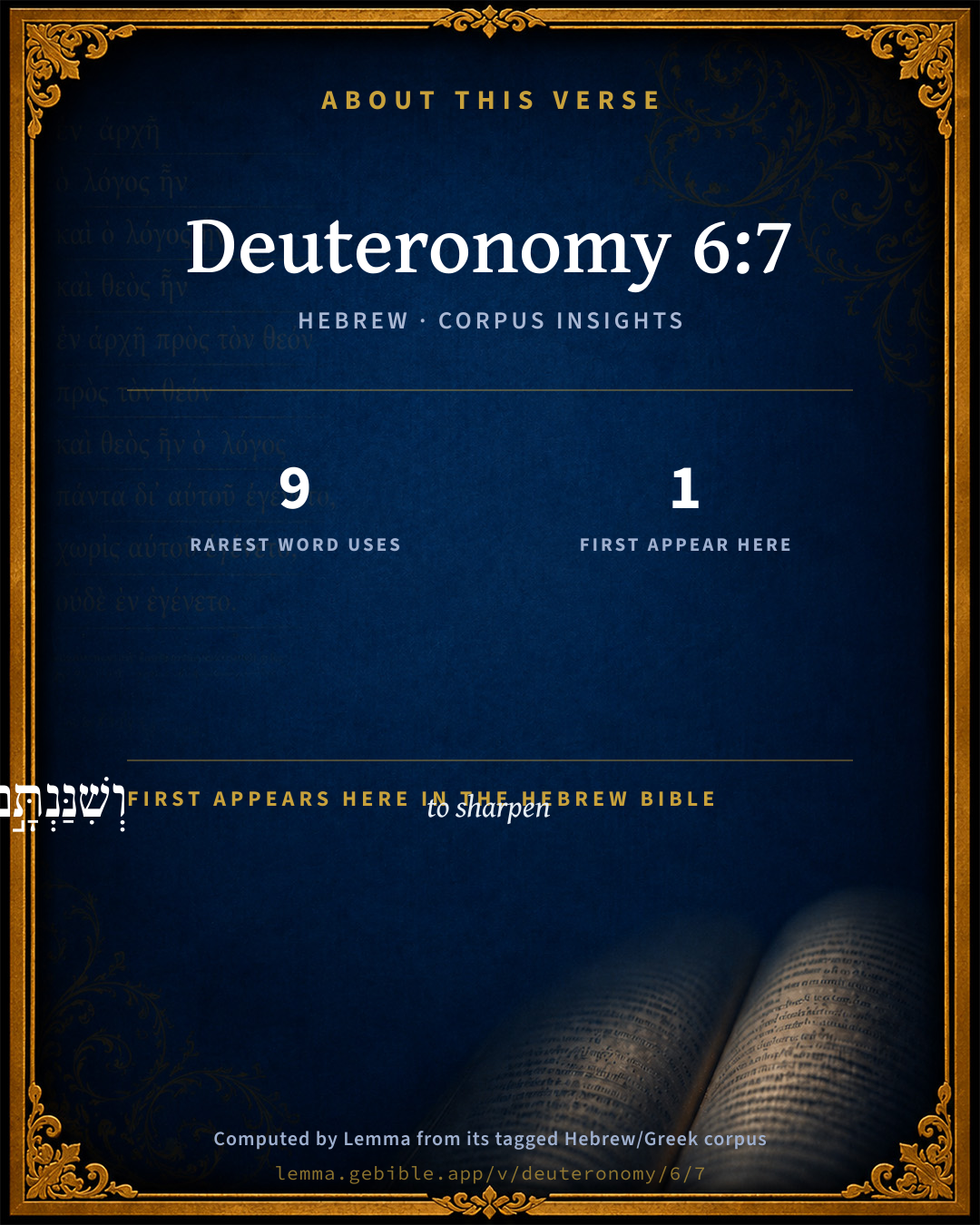
The rarest word here is וְשִׁנַּנְתָּ֣ם to sharpen H8150 — appearing just 9 times in the whole Hebrew Bible.

First appearance in Scripture

This word makes its first canonical appearance in the Hebrew Bible here:

  • וְשִׁנַּנְתָּ֣ם to sharpen H8150

Shared distinctive vocabulary

וְשִׁנַּנְתָּ֣ם to sharpen H8150 occurs in 9 verses of the Hebrew Bible. Also found in:

Grammatical profile

  • 6 verbs
  • 3 nouns
  • 1 preposition

Verb forms

  • וְשִׁנַּנְתָּ֣ם Piel · Sequential Perfect
  • וְדִבַּרְתָּ֖ Piel · Sequential Perfect
  • בְּשִׁבְתְּךָ֤ Qal · Infinitive Construct
  • וּבְלֶכְתְּךָ֣ Qal · Infinitive Construct
  • וּֽבְשָׁכְבְּךָ֖ Qal · Infinitive Construct
  • וּבְקוּמֶֽךָ Qal · Infinitive Construct

Hebrew & Septuagint length

In English translation the verse runs 37 words from the Hebrew and 29 from the Septuagint (LXX English) — closely comparable.

A rough comparison of the two English renderings, which tokenize alike — not a word-level alignment.

Word counts can differ between the Hebrew and the Greek without any difference in meaning — e.g. the Hebrew direct-object marker אֵת has no separate Greek word, and Greek often adds the article ὁ.

Cross-references

25

Topical passages linked to Deuteronomy 6:7 in the Treasury of Scripture Knowledge — connected by theme and wording, ordered by reader-vote popularity; previews shown in the World English Bible.

  • Deuteronomy 11:19 You shall teach them your children, talking of them, when you sit in your house, and when you walk by the way, and when you lie down, and when you rise up.
  • Ephesians 6:4 You fathers, don't provoke your children to wrath, but nurture them in the discipline and instruction of the Lord.
  • Psalms 78:4–6 We will not hide them from their children, Telling to the generation to come the praises of Yahweh, His strength, and his wondrous works that he has done.
  • 1 Peter 3:15 But sanctify the Lord God in your hearts; and always be ready to give an answer to everyone who asks you a reason concerning the hope that is in you, with humility and fear:
  • Deuteronomy 4:9–10 Only take heed to yourself, and keep your soul diligently, lest you forget the things which your eyes saw, and lest they depart from your heart all the days of your life; but make them known to your children and your children's children;
  • Deuteronomy 6:2 that you might fear Yahweh your God, to keep all his statutes and his commandments, which I command you, you, and your son, and your son's son, all the days of your life; and that your days may be prolonged.
  • Ephesians 4:29 Let no corrupt speech proceed out of your mouth, but such as is good for building up as the need may be, that it may give grace to those who hear.
  • Genesis 18:19 For I have known him, to the end that he may command his children and his household after him, that they may keep the way of Yahweh, to do righteousness and justice; to the end that Yahweh may bring on Abraham that which he has spoken of him."
  • Proverbs 6:22 When you walk, it will lead you. When you sleep, it will watch over you. When you awake, it will talk with you.
  • Exodus 12:26–27 It will happen, when your children ask you, 'What do you mean by this service?'
  • Luke 6:45 The good man out of the good treasure of his heart brings out that which is good, and the evil man out of the evil treasure of his heart brings out that which is evil, for out of the abundance of the heart, his mouth speaks.
  • Psalms 40:9–10 I have proclaimed glad news of righteousness in the great assembly. Behold, I will not seal my lips, Yahweh, you know.
  • Exodus 13:14–15 It shall be, when your son asks you in time to come, saying, 'What is this?' that you shall tell him, 'By strength of hand Yahweh brought us out from Egypt, from the house of bondage;
  • Matthew 12:35 The good man out of his good treasure brings out good things, and the evil man out of his evil treasure brings out evil things.
  • Proverbs 10:21 The lips of the righteous feed many, But the foolish die for lack of understanding.
  • Proverbs 15:2 The tongue of the wise commends knowledge, But the mouth of fools gush out folly.
  • Colossians 4:6 Let your speech always be with grace, seasoned with salt, that you may know how you ought to answer each one.
  • Psalms 119:46 I will also speak of your statutes before kings, And will not be disappointed.
  • Psalms 129:8 Neither do those who go by say, "The blessing of Yahweh be on you. We bless you in the name of Yahweh."
  • Proverbs 15:7 The lips of the wise spread knowledge; Not so with the heart of fools.
  • Ruth 4:11 All the people who were in the gate, and the elders, said, We are witnesses. Yahweh make the woman who has come into your house like Rachel and like Leah, which two built the house of Israel: and do you worthily in Ephrathah, and be famous in Bethlehem:
  • Psalms 37:30 The mouth of the righteous talks of wisdom. His tongue speaks justice.
  • Malachi 3:16 Then those who feared Yahweh spoke one with another; and Yahweh listened, and heard, and a book of memory was written before him, for those who feared Yahweh, and who honored his name.
  • Ruth 2:4 Behold, Boaz came from Bethlehem, and said to the reapers, Yahweh be with you. They answered him, Yahweh bless you.
  • Ruth 2:12 Yahweh recompense your work, and a full reward be given you of Yahweh, the God of Israel, under whose wings you are come to take refuge.

Cross-references courtesy of OpenBible.info (CC BY 4.0).

Hebrew and Greek witnesses Masoretic Hebrew ↔ Greek Septuagint

The same verse in the two great witnesses to the Old Testament, shown verse-for-verse.

These are two independent witnesses, not word-aligned to each other, and the Septuagint is shown in lemma (dictionary) form.

Hebrew Deuteronomy 6:7 Masoretic · Westminster Leningrad Codex

וְשִׁנַּנְתָּ֣ם לְבָנֶ֔יךָ וְדִבַּרְתָּ֖ בָּ֑ם בְּשִׁבְתְּךָ֤ בְּבֵיתֶ֨ךָ֙ וּבְלֶכְתְּךָ֣ בַדֶּ֔רֶךְ וּֽבְשָׁכְבְּךָ֖ וּבְקוּמֶֽךָ

and you shall teach them diligently to your children, and shall talk of them when you sit in your house, and when you walk by the way, and when you lie down, and when you rise up.

World English Bible · Public Domain

Greek LXX Deuteronomy 6:7 Septuagint · lemma form

καί προβιβάζω αὐτός ὁ υἱός σύ καί λαλέω ἐν αὐτός καταἧμαι ἐν οἶκος καί πορεύομαι ἐν ὁδός καί κοιτάζομαι καί δια ἀναἵστημι

And you shall teach them to your children, and you shall speak of them sitting in the house, and walking by the way, and lying down, and rising up.

LXX2012 (modern English Septuagint) · Public Domain

On this verse, The Cambridge Bible for Schools and Colleges discusses the Septuagint’s reading. Read the note in Commentary ↓

Hebrew: Westminster Leningrad Codex (CC BY 4.0). Greek: Septuagint (public domain); English from LXX2012 (modern English Septuagint) (Public Domain). How the Septuagint differs from the Hebrew →

Targum (Aramaic paraphrase)

2

The Targum is the ancient Jewish Aramaic paraphrase of the Hebrew Scriptures — an interpretive translation, not the Hebrew text itself. Onkelos (literal) and Pseudo-Jonathan (expansive) render the Torah, and Jonathan the Prophets. Coverage is partial: where no permissively-licensed English translation exists for a verse, only the Aramaic is shown. This is verse-level text, not a word-by-word alignment to the Hebrew.

  1. Targum Onkelos Torah (Genesis–Deuteronomy)
    וּתְתָנִנוּן לִבְנָיךְ וּתְמַלֵל בְּהוֹן בְּמִתְּבָךְ בְּבֵיתָךְ וּבִמְהָכָךְ בְּאָרְחָא וּבְמִשְׁכְּבָךְ וּבִמְקִימָךְ

    And you shall repeat them to your children and you shall speak with them when you are sitting in your house and when you go walking on the road and when you lie down and when you stand up.

    Targum Onkelos — Aramaic: “Onkelos Genesis” (public domain); “Onkelos Exodus” (public domain); “Onkelos Leviticus” (public domain); “Onkelos Numbers” (public domain); “Onkelos Deuteronomy” (public domain). English: “Sefaria Community Translation” (CC0 1.0 (public-domain dedication)); “J.W. Etheridge. The Targums of Onkelos and Jonathan Ben Uzziel on the Pentateuch. London: Longmans, Green, 1862” (public domain). Text via Sefaria.

  2. Targum Pseudo-Jonathan Torah (Genesis–Deuteronomy)
    וְתִגְמְרִינוּן לִבְנָךְ וְתֶהֶוְיַין הַנְיַין בְּהוֹן בְּמוֹתְבֵיכוֹן בְּבָתֵּיכוֹן בִּזְמַן מֵיעַסוּקְכוֹן בְּחִיתוּנְכוֹן וּבְמֵיהֲכוֹן בְּאוֹרְחֲכוֹן וּבְפַנְיָא סְמִיךְ לְמִשְׁכָּבֵיכוֹן וּבְצַפְרָא סְמִיךְ לְמִקְמֵיכוֹן

    And thou shalt unfold them to thy children, and meditate upon them when thou art sitting in your houses, at the time when you are occupied in secret chambers, or in journeying by the way; at evening when you lie down, and at morn when you arise.

    Targum Pseudo-Jonathan — Aramaic: “Targum Jonathan on Genesis” (public domain); “Targum Jonathan on Exodus” (public domain); “Targum Jonathan on Leviticus” (public domain); “Targum Jonathan on Numbers” (public domain); “Targum Jonathan on Deuteronomy” (public domain). English: “The Targum of Jonathan ben Uzziel, trans. J. W. Etheridge, London, 1862” (public domain). Text via Sefaria.

Commentary

Notes on Deuteronomy 6:7 from classic Christian and Jewish commentators (each source and its license shown beneath its notes). The classic Christian expositions comment on the surrounding passage and are grouped to its opening verse, so a note may address several verses; the Jewish commentaries on the Tanakh (Rashi and others) are per-verse, so they appear only where the commentator wrote on this verse.

Lemma curates 59 commentaries, every one of them public domain or Creative Commons licensed, each selected and text-cleaned for this edition rather than reprinted as found. About our sources →

Trapp's Complete Commentary

John Trapp

Deu 6:7 And thou shalt teach them diligently unto thy children, and shalt talk of them when thou sittest in thine house, and when thou walkest by the way, and when thou liest down, and when thou risest up.

Ver. 7. And thou shalt teach them diligently.] Heb., Thou shalt whet or sharpen them, as one would sharpen a stake when he drives it into the ground: or as one would set an edge upon a knife, by oft going over the whetstone. A learned Hebrician observes a near affinity between the word here used and another word that signifies to repeat, and inculcate the same thing. {a} Innuit studium et diligentiam, qua pueris praecepta Dei ineuleari debent, saith Vatablus. Children should be taught the principles that they understand not: (1.) That they might have occasion much to think of the things that are so much and commonly urged; (2.) That if any extremity should come, they might have certain seeds of comfort and direction to guide and support them; (3.) That their condemnation might be more just, if having these so much in their mouths, they should not get something of them into their hearts.

{a} Shanan, acuere, et Shanah, repetere, affines sunt.

John Trapp, A Commentary or Exposition upon All the Books of the Old and New Testament (1647–1656) — public domain. Text from a community e-Sword module.

Joseph Benson's Commentary

Deu 6:7. Thou shall teach them diligently — Hebrew, whet, or sharpen them, so as that they may pierce deeply into their hearts, This metaphor signifies the manner of instructing them, that it is to be done diligently, earnestly, frequently, discreetly. To thy children — They that love the Lord God themselves will do what they can to engage the affections of their children to him, and so preserve the entail of religion in their families from being cut off. Bishop Patrick well observes here, that Moses thought his law so very plain and easy, that every father might be able to instruct his sons in it, and every mother her daughters. That good thing which is committed to us, we must carefully transmit to those that come after us, that it may be perpetuated. Thou shalt talk of them — With due reverence and seriousness, for the benefit, not only of thy children, but of thy other domestics, thy friends, and companions. When thou sittest in thy house — At work, or at meat, or at rest. When thou walkest by the way — For air and exercise, for conversation, or on journeys. When thou liest down —

Art about to retire from thy family for sleep. And when thou risest up — Returnest again to thy family in the morning. Take all occasions to discourse with those about thee of divine things; not of unrevealed mysteries, or matters of doubtful disputation, but of the plain truths and laws of God, and the things belonging to their peace.

Joseph Benson's Commentary on the Old and New Testaments (1811–1818) — public domain. Text from a community e-Sword module.

Tyndale Open Study Notes

Tyndale Open Resources

6:7 Repeat them: The Hebrew verb (shanan) might suggest “engraving” a text into a medium that cannot be obliterated, or it might simply mean “repeat.” Either way, the teaching of the Shema was to be indelibly imparted to children by constant repetition so that it would never be forgotten.

Tyndale Open Study Notes — © Tyndale Open Resources, licensed CC BY-SA 4.0. Text via the HelloAO Bible API.

Geneva Bible (1599)

Geneva Bible translators

Some read, thou shalt whet them upon thy children: to wit, that they may print them more deeply in memory.

Geneva Bible (1599) marginal notes — public domain. Text via Bolls.life.

Adam Clarke's Commentary

Verse 7. Thou shalt teach them diligently] שננתם shinnantam, from שנן shanan, to repeat, iterate, or do a thing again and again; hence to whet or sharpen any instrument, which is done by reiterated friction or grinding. We see here the spirit of this Divine injunction. God's testimonies must be taught to our children, and the utmost diligence must be used to make them understand them. This is a most difficult task; and it requires much patience, much prudence, much judgment, and much piety in the parents, to enable them to do this good, this most important work, in the best and most effectual manner. See at the end of this chapter.

And shalt talk of them when thou sittest in thine house] Thou shalt have religion at home, as well as in the temple and tabernacle.

And when thou walkest by the way] Thou shalt be religious abroad as well as at home, and not be ashamed to own God wheresoever thou art.

When thou liest down, and when thou risest up.] Thou shalt begin and end the day with God, and thus religion will be the great business of thy life. O how good are these sayings, but how little regarded!

Adam Clarke's Commentary on the Bible (1810–1826) — public domain. Text from a community e-Sword/MySword module.

Ellicott's Commentary for English Readers

(7) And thou shalt teach them diligently.—The same Jewish commentator remarks that there should be no hesitation in answering anything that a man might ask. Had this system of education been carried on from the first, the history of Israel would hare been very different from what it is.

A Bible Commentary for English Readers, edited by Charles John Ellicott (1878–1897) — public domain. Text from a community e-Sword module.

The Cambridge Bible for Schools and Colleges

gen. ed. J. J. S. Perowne

7. teach them diligently] lit. whet or sharpen, Deu_32:41; make incisive and impress them on thy children; rub them in, Germ. einschärfen. The Eng. metaphorical use of ‘sharpen’ or ‘whet’ (‘whet on,’ ‘whet forward’) has usually for object the mind, not the material employed on it. Yet cp. Shakespeare’s

‘Thou hid’st a thousand daggers in thy thoughts,

Which thou hast whetted on thy stony heart

To stab at half-an-hour of my frail life.’

unto thy children] So not only in D, Deu_6:20, Deu_4:9, Deu_11:19, but also J, Exo_13:8,etc.

talk of them, etc.] Deu_11:19. With LXX and Sam. read the for thine before house.

The Cambridge Bible for Schools and Colleges (gen. ed. J. J. S. Perowne; Cambridge University Press, 1878–1918) — public domain. Text from a community e-Sword module.

John Gill's Exposition

And thou shall teach them diligently unto thy children,.... Care and diligence are to be used, and pains taken, to instruct children, as soon as they are capable, in the knowledge of God, and of his commandments; that they are to love him, fear him, serve, and worship him; this is to bring them up in the nurture and admonition of the Lord, Eph 6:4, it may be rendered "thou shalt whet or sharpen them" (s), the words or commandments; it is expressive of diligence and industry in teaching, by frequent repetition of things, by inculcating them continually into their minds, endeavouring to imprint them there, that they may be sharp, ready, and expert in them:

and shalt talk of them when thou sittest in thine house; at the time of meals, or at leisure hours, or even when employed in any business in the house which will admit of it; every opportunity should be taken to instil the knowledge of divine things into their tender minds:

and when thou walkest by the way; in a journey, and any of his children with him; or for diversion, in the garden, field, or vineyard; occasion may be taken on sight of any of the works of creation to lead into a discourse concerning God, his nature, perfections, and works, and the obligations his creatures lie under to love, fear, and serve him: and when thou liest down, and when thou risest up; at the time of going to bed, and rising from it; which, as they are seasons of prayer to God, may be improved in instruction of children.

(s) "et acues ea", Vatablus, Piscator.

John Gill's Exposition of the Whole Bible (1746–1763) — public domain (CC PDM 1.0). Text via the HelloAO Bible API.

Haydock's Catholic Bible Commentary

Tell. Hebrew, "thou shalt chew them" as nurses do bread for their little ones; or thou shalt "sharpen," like a razor, "explain clearly and often," these precepts, which are of the utmost importance. --- Meditate; speak of them to others, (Calmet) and entertain thyself with them in thy own heart. The mouth of the just man shall meditate wisdom, and (that is) his tongue shall speak judgment, Psalm xxxvi. 30., and Exodus xiii. 9. --- Sleeping. The spouse, in the canticle, (Canticle of Canticles v. 2,) says, I sleep, and my heart watcheth. If we carefully direct our intention, we may merit even when we are incapable of thinking. God will reward our good desires. Our last and first thoughts ought, in a particular manner, to be consecrated to God, (Haydock) when we go to rest and when we arise, (Menochius) as he is our first beginning, the source of all graces, and our last end, to whom we ought to refer every thing, even our ordinary actions of sleeping, labour, and diversion. If we make his divine perfections and his law the subject of our daily meditations, our soul will naturally be affected with the same sentiments during the night. Quicquid luce fuit tenebris agit. "The occurrences of the day have an influence upon our dreams;" (Petronius) and as we are accountable for many things by placing the cause, which in the hours of sleep or of drunkenness we are not able to prevent, so it cannot be doubted but that we shall increase in virtue, if we regulate our thoughts and actions in a proper manner, even when our soul is incapable of exerting her faculties. Hence we may perceive, of what vast importance it is to have a pure intention. (Haydock)

George Leo Haydock (1774–1849), Haydock's Catholic Family Bible and Commentary, 1859 edition — public domain. Excludes Psalms (Douay-Rheims chapter numbering differs from Protestant) and Deuterocanonical books (Catholic canon only).

Matthew Poole's English Annotations

Teach them diligently, Heb. whet, or sharpen them, so as they may pierce deep into their hearts. This metaphor signifies the manner of instructing them, that it is to be done diligently, earnestly, frequently, discreetly, and dexterously.

Matthew Poole's English Annotations on the Holy Bible (1683–1685) — public domain. Text from a community e-Sword/MySword module.

Whedon's Commentary on the Bible

Daniel D. Whedon

7. Teach them, etc. — These precepts were to be constantly impressed upon their households at all times.

Daniel D. Whedon (gen. ed.), Commentary on the Old and New Testaments (1874–1909) — public domain. Text from a community e-Sword module.

John Wesley's Explanatory Notes

Teach them diligently - Hebrew. whet, or sharpen them, so as they may pierce deep into their hearts. This metaphor signifies the manner of instructing them, that it is to be done diligently, earnestly, frequently, discreetly.

John Wesley, Explanatory Notes Upon the Whole Bible (1754–1765) — public domain. Text via the GEBible commentary corpus.

Rashi

Rabbi Shlomo Yitzchaki (Rashi)

ושננתם AND THOU SHALT TEACH THEM DILIGENTLY — This word expresses the idea of being sharply impressed, the meaning being, that they should be impressed (familiar) in thy mouth, so that if a person asks you anything concerning them, you will not need to stammer (hesitate) about it, but tell him forthwith (Sifrei Devarim 34:1; Kiddushin 30a)

לבניך [AND THOU SHALT TEACH THEM DILIGENTLY] UNTO THY CHILDREN — These are the disciples. Everywhere do we find that disciples are termed בנים, as it is said, (Deuteronomy 14:1) “Ye are children (בנים) of the Lord your God”; and it says, (2 Kings 2:3), “The sons of (בני) the prophets who were in Bethel”. So. too, do we find in the case of Hezekiah that he taught Torah to all Israel and termed them בנים, as it is said, (II Chronicles 29:11), “My sons (בני) be not now negligent". And even as disciples are termed בנים, “children", so the teacher is termed אב, "father", as it is said, (2 Kings 2:12) that Elisha referred to his teacher Elijah by the words, "My father, my father, the chariot of Israel, etc." (Sifrei Devarim 34:4).

ודברת בם AND THOU SHALT SPEAK OF THEM — i.e. that your principal topic of conversation should be only about them: make them the principal, and do not make them of secondary importance (Sifrei Devarim 34:6).

ובשכבך AND WHEN THOU LIEST DOWN — One might think that this means: even if one lies down (retires to bed) in the middle of the day, and that ובקומך AND WHEN THOU RISEST UP means: even if you rise up in the middle of the night! It, however, states בשבתך בביתך ובלכתך בדרך WHEN THOU SITTEST IN THY HOUSE AND WHEN THOU WALKEST BY THE WAY: The Torah is thus speaking of the usual way of living, and this therefore means, the usual time of lying down and the usual time of rising up (cf. Sifrei Devarim 36:9).

Rashi on the Tanakh — English translations: “The Judaica Press complete Tanach with Rashi, translated by A. J. Rosenberg” (CC BY 4.0); “Pentateuch with Rashi's commentary by M. Rosenbaum and A.M. Silbermann, 1929-1934” (public domain); “The Metsudah Tanach series, Lakewood, N.J” (CC BY 4.0); and “The Book of Joshua, Metsudah Publications, 1997” (CC BY 4.0). Text via Sefaria.

Ramban (Nachmanides)

Rabbi Moshe ben Nachman (Ramban / Nachmanides)

AND THOU SHALT TEACH THEM DILIGENTLY UNTO THY CHILDREN etc. These clarified commandments have also been alluded to previously, for, since He enjoined in certain commandments, It shall be a perpetual statute throughout your generations;. It is a sign between Me and the children of Israel forever; This is My covenant, which ye shall keep, between Me and you and thy seed after thee — we are thus [obviously] commanded [to see to it] that our children know the commandments, and how shall they know [the precepts] unless we teach them. Similarly, the commandment And thou shalt bind them for a sign upon thy hand, and they shall be for frontlets between thine eyes has already been stated and here he [further] explained and thou shalt bind them meaning that they be placed [upon the arm and head and secured tightly] through tying. It also alludes to the knot [in the strap] of the phylacteries that, according to the tradition received by our Rabbis, is a law declared to Moses on Sinai. He added here the commandment of the Mezuzah — And thou shalt write them upon the door-posts of thy house, and upon thy gates — which is not mentioned there. Perhaps this, too, is [merely] explained [here rather than being an entirely new commandment] since it has been suggested in the commandment, and it be a memorial between thine eyes, that the law of the Eternal may be in thy mouth. is fastened to the upper third of the right-hand door-post, approximately at eye-level, it thus serves as a memorial of the law of G-d, for two portions of the Torah are written on its scroll of parchment. The meaning of the expression and upon thy gates is “and upon the door-posts of the rest of your gates,” such as the gates of cities and countries, similar to within any of ‘thy gates’ [which means “any of ‘your cities’ “].

Ramban (Nachmanides) on the Tanakh — English translation: “Commentary on the Torah by Ramban (Nachmanides). Translated and annotated by Charles B. Chavel. New York, Shilo Pub. House, 1971-1976” (CC BY 4.0). Text via Sefaria.

Sforno

Rabbi Ovadia Sforno

Teach them through repetition and through sharp, intellectual evidence.

And you are to discuss them. For through this you will constantly remember them.

Sforno on the Tanakh — English translation: “Yalkut, Sifsei Chachomim Chumash, Metsudah Publications, 2009” (CC BY 4.0). Text via Sefaria.

Lesson kit

Teaching starters — assembled from the data on this page, not authored interpretation. Every prompt links to the verse data it draws on. Edit before teaching.

Deuteronomy, in the Pentateuch, opens this verse with 10 words (9 distinct Hebrew lemmas). Its most distinctive word is shânan (“to sharpen”). A historical commentator’s framing appears above. Read the whole chapter for the surrounding context.

Discussion questions

  1. The word shânan carries the sense “to sharpen.” How does it shape the verse?
  2. The word “to sharpen” first appears here in Scripture. What is being introduced at this debut?
  3. Deuteronomy 32:41 shares the word «to sharpen» with this verse. How do the two illuminate each other?
  4. These translations render this verse differently. What is at stake in choosing one wording over another?
  5. The verb «וְשִׁנַּנְתָּ֣ם» is Piel Sequential Perfect. How does its form color the action?
  6. Reading how Trapp's Complete Commentary and Joseph Benson's Commentary read this verse, where do the two commentators agree and where do they part?

Things to notice

  • 1 word makes its first canonical appearance in Scripture here.
  • These translations choose different wording for 18 words in this verse.
  • 9 distinct Hebrew lemmas span 10 words in this verse.

Reading settings

Reading text

Shown beneath each verse's original-language words.

Old Testament
Old Testament edition

Read the OT as the Masoretic Hebrew (MT) or the Greek Septuagint (LXX).

English shown for the Greek Septuagint (in the Hebrew ↔ Greek comparison).

Comparing translations? Open the Compare panel on any verse page to stack up to four side by side.