
2 Samuel 4:5

Hebrew (Westminster Leningrad Codex) 2 Samuel 4:5 appears in the Hebrew Old Testament. The text above is from the Westminster Leningrad Codex. Each word links to its Strong’s number, a concise gloss, and parsing drawn from the Open Scriptures Hebrew Bible morphology. Click any word for its full Brown-Driver-Briggs (BDB) entry.
Download image
Cite this verse

2 Samuel 4:5 (World English Bible). Public Domain. Lemma interlinear Bible study tool, https://lemma.gebible.app/v/2-samuel/4/5.

Show BibTeX & RIS
BibTeX
RIS
English Translation
The sons of Rimmon the Beerothite, Rechab and Baanah, went, and came about the heat of the day to the house of Ish-bosheth, as he took his rest at noon.
World English Bible · Public Domain
Download a study sheet

One document with this verse’s original text, its word-by-word gloss line, the meaning frame, cross-references with their text, attributed commentary, and full source and license credits — printable, and it pastes into notes with its structure intact.

This verse Autodidact and up

Study sheet (.html) Plain text (.txt)

A passage Seminary Student

Up to 50 verses in one chapter. A passage sheet keeps up to 6 commentary sources and 12 cross-references per verse, in the order this page ranks them, and says so on the sheet whenever that leaves anything out. Ask for a single verse and you get the Autodidact verse sheet above.

Everything on this page stays free to read, with no account — the sheet is a download of what is already on screen, not access to it.

Want to remove ads? Support Godless Engineer
Compare translations 3

The same verse in 3 English versions, stacked beneath the original-language interlinear above. Click any original word for its lexicon entry.

Each is an independent rendering of the whole verse — the interlinear is not word-aligned to these translations.

Highlighted words mark where these versions differ — a whole-verse word diff, not a word-by-word alignment.

  • World English Bible Public Domain
    The sons of Rimmon the Beerothite, Rechab and Baanah, went, and came about the heat of the day to the house of Ish-bosheth, as he took his rest at noon.
  • King James Version Public Domain
    And the sons of Rimmon the Beerothite, Rechab and Baanah, went, and came about the heat of the day to the house of Ishbosheth, who lay on a bed at noon.
  • unfoldingWord Literal Text CC BY-SA 4.0
    And the sons of Rimmon the Beerothite, Rechab and Baanah, went, and they came about the heat of the day to the house of Ish Bosheth, and he was lying the bed of noon.

unfoldingWord Literal Text — © unfoldingWord, licensed CC BY-SA 4.0. Word-aligned USFM3 via Door43 (git.door43.org/unfoldingWord/en_ult).

Versions to compare (up to 4)

3 of 4 selected

Show all 18 translations

Every available English version of this verse, each an independent rendering of the whole verse.

  • World English Bible Public Domain
    The sons of Rimmon the Beerothite, Rechab and Baanah, went, and came about the heat of the day to the house of Ish-bosheth, as he took his rest at noon.
  • Berean Standard Bible Public Domain
    Now Rechab and Baanah, the sons of Rimmon the Beerothite, set out and arrived at the house of Ish-bosheth in the heat of the day, while the king was taking his midday nap.
  • Majority Standard Bible Public Domain
    Now Rechab and Baanah, the sons of Rimmon the Beerothite, set out and arrived at the house of Ish-bosheth in the heat of the day, while the king was taking his midday nap.
  • King James Version Public Domain
    And the sons of Rimmon the Beerothite, Rechab and Baanah, went, and came about the heat of the day to the house of Ishbosheth, who lay on a bed at noon.
  • American Standard Version (1901) Public Domain
    And the sons of Rimmon the Beerothite, Rechab and Baanah, went, and came about the heat of the day to the house of Ish-bosheth, as he took his rest at noon.
  • Revised Version (1885) Public Domain
    And the sons of Rimmon the Beerothite, Rechab and Baanah, went, and came about the heat of the day to the house of Ish-bosheth, as he took his rest at noon.
  • Geneva Bible (1599) Public Domain
    And the sonnes of Rimmon the Beerothite, Rechab and Baanah went and came in the heat of the day to the house of Ish-bosheth (who slept on a bed at noone)
  • Douay-Rheims (1899) Public Domain
    And the sons of Remmon the Berothite, Rechab and Baana coming, went into the house of Isboseth in the heat of the day: and he was sleeping upon his bed at noon. And the doorkeeper of the house, who was cleansing wheat, was fallen asleep.
  • Young's Literal Translation Public Domain
    And the sons of Rimmon the Beerothite, Rechab and Baanah, go, and come in at the heat of the day unto the house of Ish-Bosheth, and he is lying down -- the lying down of noon;
  • Literal Standard Version CC BY-SA 4.0
    And the sons of Rimmon the Beerothite, Rechab and Baanah, go, and come in at the heat of the day to the house of Ish-Bosheth, and he is lying down—the lying down of noon;
  • Unlocked Literal Bible CC BY-SA 4.0
    So the sons of Rimmon the Beerothite, Recab and Baanah, traveled during the heat of the day to the house of Ishbosheth, as he was resting at noon.
  • unfoldingWord Literal Text CC BY-SA 4.0
    And the sons of Rimmon the Beerothite, Rechab and Baanah, went, and they came about the heat of the day to the house of Ish Bosheth, and he was lying the bed of noon.
  • Darby Bible Public Domain
    And the sons of Rimmon the Beerothite, Rechab and Baanah, went and came in about the heat of the day into the house of Ishbosheth, who was taking his noonday rest.
  • World Messianic Bible Public Domain
    The sons of Rimmon the Beerothite, Rechab and Baanah, went out and came at about the heat of the day to the house of Ishbosheth as he took his rest at noon.
  • Webster's Bible Public Domain
    And the sons of Rimmon the Beerothite, Rechab and Baanah, went, and came about the heat of the day to the house of Ish-bosheth, who lay on a bed at noon.
  • Free Bible Version CC BY-SA 4.0
    Rechab and Baanah, sons of Rimmon from Beeroth, went to Ishbosheth's house, arriving in the heat of the day as the king was taking his midday rest.
  • Bible in Basic English Public Domain
    And Rechab and Baanah, the sons of Rimmon the Beerothite, went out and came to the house of Ish-bosheth in the heat of the day, when he was resting in the middle of the day. Now the woman who kept the door was cleaning grain, and sleep overcame her.
  • JPS Tanakh (1917) Public Domain
    And the sons of Rimmon the Beerothite, Rechab and Baanah, went, and came about the heat of the day to the house of Ish-bosheth, as he took his rest at noon.

Literal Standard Version (2020), Covenant Press — licensed CC BY-SA 4.0. Text via the HelloAO Bible API (eBible.org). Unlocked Literal Bible (unfoldingWord) — licensed CC BY-SA 4.0. Text via the HelloAO Bible API (eBible.org). unfoldingWord Literal Text — © unfoldingWord, licensed CC BY-SA 4.0. Word-aligned USFM3 via Door43 (git.door43.org/unfoldingWord/en_ult). Free Bible Version, Dr. Jonathan Gallagher — licensed CC BY-SA 4.0. Text via the HelloAO Bible API (eBible.org).

Word by word

More ways to search: Search by grammar → Find every occurrence → Compare this word →

Practice this passage: Drill this verse → Learn its vocabulary →

הַבְּאֵֽרֹתִי֙
Bᵉʼêrôthîy
H886
“the · Beerothite”
Particle, Definite Article + Noun, Gentilic, Masculine, Singular, Absolute
Part of Speech
Particle + Noun
Type
Gentilic
Gender
Masculine
Number
Singular
State
Absolute
Full BDB Definition

Origin: patrial from H881

TWOT: None

an inhabitant of Beeroth (in Benjamin)
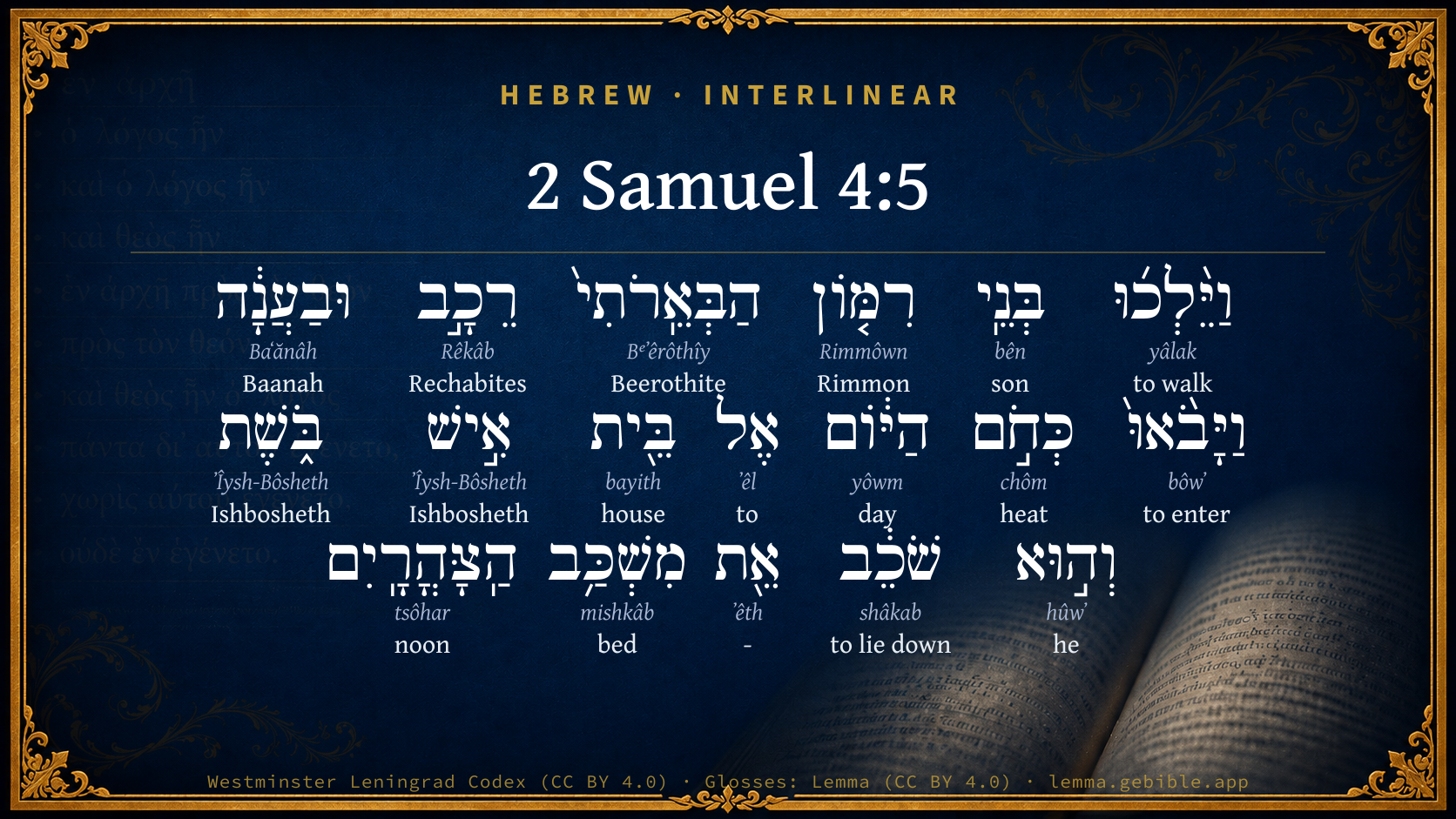
  1. וַיֵּ֨לְכ֜וּ yâlak H3212 “and · to walk” Conjunction + Verb, Qal, Sequential Imperfect, 3rd Person, Masculine, Plural
  2. בְּנֵֽי bên H1121 “sons of” Noun, Common, Masculine, Plural, Construct
  3. רִמּ֤וֹן Rimmôwn H7417 “Rimmon” Noun, Proper
  4. רֵכָ֣ב Rêkâb H7394 “Rechabites” Noun, Proper
  5. וּבַעֲנָ֔ה Baʻănâh H1196 “and · Baanah” Conjunction + Noun, Proper
  6. וַיָּבֹ֨אוּ֙ bôwʼ H935 “and · to enter” Conjunction + Verb, Qal, Sequential Imperfect, 3rd Person, Masculine, Plural
  7. כְּחֹ֣ם chôm H2527 “like/as · heat of” Preposition + Noun, Common, Masculine, Singular, Construct
  8. הַיּ֔וֹם yôwm H3117 “the · day” Particle, Definite Article + Noun, Common, Masculine, Singular, Absolute
  9. אֶל ʼêl H413 “to” Preposition
  10. בֵּ֖ית bayith H1004 “house of” Noun, Common, Masculine, Singular, Construct
  11. אִ֣ישׁ ʼÎysh-Bôsheth H378 “Ishbosheth” Noun, Proper
  12. בֹּ֑שֶׁת ʼÎysh-Bôsheth H378 “Ishbosheth” Noun, Proper
  13. וְה֣וּא hûwʼ H1931 “and · he” Conjunction + Pronoun, Personal, 3rd Person, Masculine, Singular
  14. שֹׁכֵ֔ב shâkab H7901 “lying down” Verb, Qal, Participle Active, Masculine, Singular, Absolute
  15. אֵ֖ת ʼêth H853 “-” Particle, Direct Object
  16. מִשְׁכַּ֥ב mishkâb H4904 “bed of” Noun, Common, Masculine, Singular, Construct
  17. הַֽצָּהֳרָֽיִם tsôhar H6672 “the · noon” Particle, Definite Article + Noun, Common, Masculine, Plural, Absolute

About this verse

These counts appear in no published source. They are computed here, from the morphology-tagged text and Lemma’s own curated glosses. What Lemma adds →

18
words
17
distinct lemmas
Historical
section

Notable vocabulary

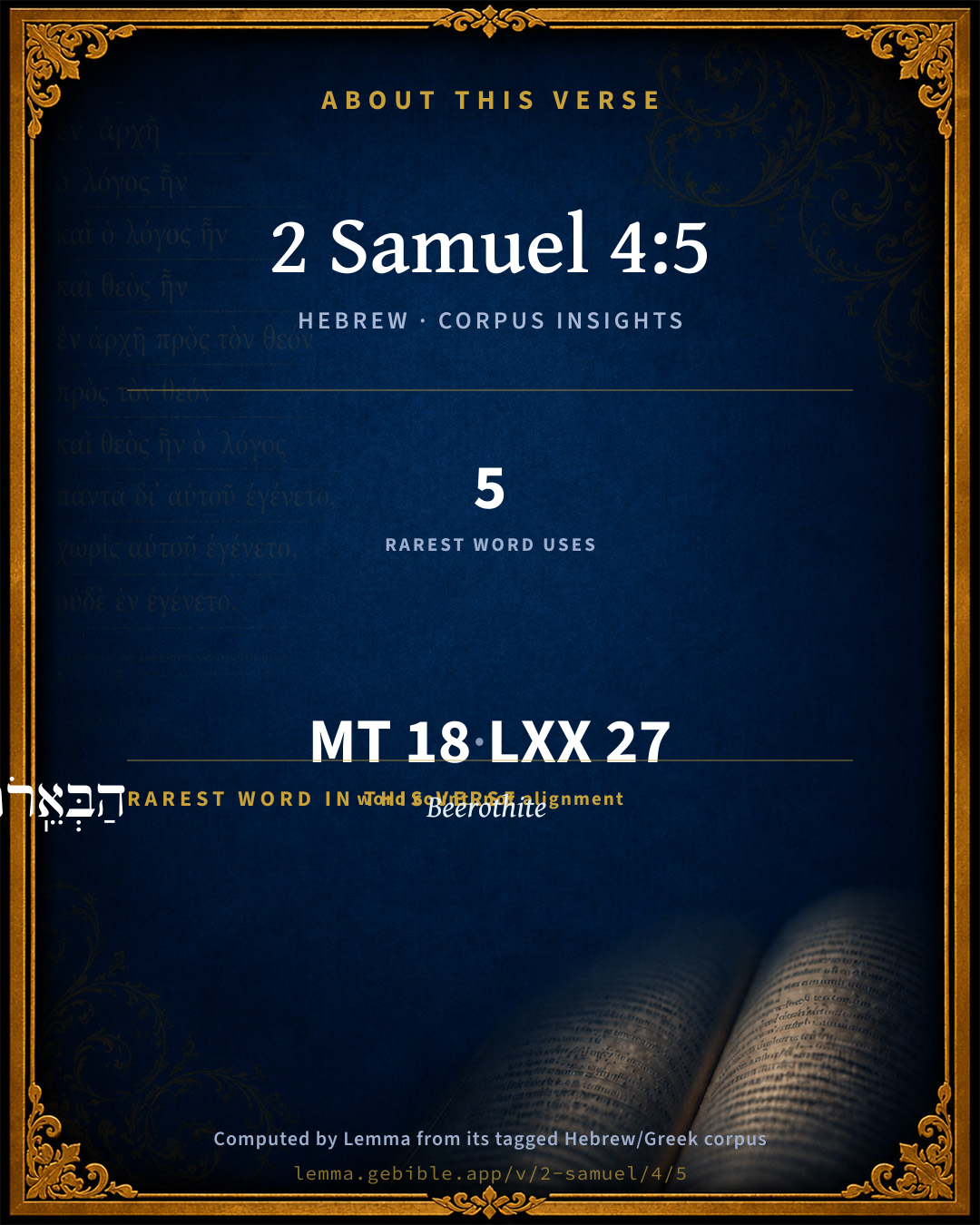
The rarest word here is הַבְּאֵֽרֹתִי֙ Beerothite H886 — appearing just 5 times in the whole Hebrew Bible.

Shared distinctive vocabulary

הַבְּאֵֽרֹתִי֙ Beerothite H886 occurs in 5 verses of the Hebrew Bible. Also found in:

Grammatical profile

  • 3 verbs
  • 12 nouns
  • 1 pronoun
  • 1 preposition
  • 1 particle

Verb forms

  • וַיֵּ֨לְכ֜וּ Qal · Sequential Imperfect
  • וַיָּבֹ֨אוּ֙ Qal · Sequential Imperfect
  • שֹׁכֵ֔ב Qal · Participle Active

Repetition

A word recurs within this verse — often emphatic in Hebrew:

  • אִ֣ישׁ Ishbosheth H378 ×2

Hebrew & Septuagint length

In English translation the verse runs 30 words from the Hebrew and 34 from the Septuagint (LXX English) — closely comparable.

A rough comparison of the two English renderings, which tokenize alike — not a word-level alignment.

Word counts can differ between the Hebrew and the Greek without any difference in meaning — e.g. the Hebrew direct-object marker אֵת has no separate Greek word, and Greek often adds the article ὁ.

In the original languages it is 18 Hebrew tokens and 27 Greek tokens — but the two are counted differently (Hebrew bundles its prefixes and suffixes into one token; the Greek is in lemma form), so that isn’t a like-for-like length.

Cross-references

8

Topical passages linked to 2 Samuel 4:5 in the Treasury of Scripture Knowledge — connected by theme and wording, ordered by reader-vote popularity; previews shown in the World English Bible.

  • Proverbs 24:33–34 A little sleep, a little slumber, A little folding of the hands to sleep;
  • 2 Samuel 2:8 Now Abner the son of Ner, captain of Saul's host, had taken Ish-bosheth the son of Saul, and brought him over to Mahanaim;
  • 2 Samuel 11:2 It happened at evening, that David arose from off his bed, and walked on the roof of the king's house: and from the roof he saw a woman bathing; and the woman was very beautiful to look on.
  • 1 Kings 16:9 His servant Zimri, captain of half his chariots, conspired against him. Now he was in Tirzah, drinking himself drunk in the house of Arza, who was over the household in Tirzah:
  • 2 Chronicles 24:25 When they were departed for him (for they left him very sick), his own servants conspired against him for the blood of the sons of Jehoiada the priest, and killed him on his bed, and he died; and they buried him in the city of David, but they didn't bury him in the tombs of the kings.
  • 2 Chronicles 25:27 Now from the time that Amaziah did turn away from following Yahweh they made a conspiracy against him in Jerusalem; and he fled to Lachish: but they sent after him to Lachish, and killed him there.
  • 1 Thessalonians 5:3–7 For when they are saying, "Peace and safety," then sudden destruction will come on them, like birth pains on a pregnant woman; and they will in no way escape.
  • 2 Chronicles 33:24 His servants conspired against him, and put him to death in his own house.

Cross-references courtesy of OpenBible.info (CC BY 4.0).

Hebrew and Greek witnesses Masoretic Hebrew ↔ Greek Septuagint

The same verse in the two great witnesses to the Old Testament, shown verse-for-verse.

These are two independent witnesses, not word-aligned to each other, and the Septuagint is shown in lemma (dictionary) form.

Hebrew 2 Samuel 4:5 Masoretic · Westminster Leningrad Codex

וַיֵּ֨לְכ֜וּ בְּנֵֽי רִמּ֤וֹן הַבְּאֵֽרֹתִי֙ רֵכָ֣ב וּבַעֲנָ֔ה וַיָּבֹ֨אוּ֙ כְּחֹ֣ם הַיּ֔וֹם אֶל בֵּ֖ית אִ֣ישׁ בֹּ֑שֶׁת וְה֣וּא שֹׁכֵ֔ב אֵ֖ת מִשְׁכַּ֥ב הַֽצָּהֳרָֽיִם

The sons of Rimmon the Beerothite, Rechab and Baanah, went, and came about the heat of the day to the house of Ish-bosheth, as he took his rest at noon.

World English Bible · Public Domain

Greek LXX 2 Samuel 4:5 Septuagint · lemma form

καί πορεύομαι υἱός ρεμμων ὁ βηρωθαίου ρεκχα καί βαανα καί εἰςἔρχομαι ἐν ὁ καῦμα ὁ ἡμέρα εἰς οἶκος μεμφιβοσθε καί αὐτός καταεὕδω ἐν ὁ κοίτη ὁ μεσημβρία

And Rechab and Baana the sons of Remmon the Berothite went, and they came in the heat of the day into the house of Jebosthe; and he was sleeping on a bed at noon.

LXX2012 (modern English Septuagint) · Public Domain

On this verse, The Biblical Illustrator discusses the Septuagint’s reading. Read the note in Commentary ↓

Hebrew: Westminster Leningrad Codex (CC BY 4.0). Greek: Septuagint (public domain); English from LXX2012 (modern English Septuagint) (Public Domain). How the Septuagint differs from the Hebrew →

Targum (Aramaic paraphrase)

1

The Targum is the ancient Jewish Aramaic paraphrase of the Hebrew Scriptures — an interpretive translation, not the Hebrew text itself. Onkelos (literal) and Pseudo-Jonathan (expansive) render the Torah, and Jonathan the Prophets. Coverage is partial: where no permissively-licensed English translation exists for a verse, only the Aramaic is shown. This is verse-level text, not a word-by-word alignment to the Hebrew.

  1. Targum Jonathan Prophets (Joshua–Malachi)
    וַאֲזַלוּ בְּנֵי רִמוֹן דְמִבְּאֵרוֹת רֵכָב וּבַעֲנָה וַאֲתוֹ כְּמֵיחַם יוֹמָא לְבֵית אִישׁ בֹּשֶׁת וְהוּא שָׁכִיב יַת שִׁנַת מַלְכַיָא:

    (no public-domain English translation for this verse)

    Targum Jonathan — Aramaic: “Mikraot Gedolot” (public domain). English: “Sefaria Community Translation” (CC0 1.0 (public-domain dedication)); “London "Chaldee Paraphrase," 1871” (public domain). Text via Sefaria.

Commentary

Notes on 2 Samuel 4:5 from classic Christian and Jewish commentators (each source and its license shown beneath its notes). The classic Christian expositions comment on the surrounding passage and are grouped to its opening verse, so a note may address several verses; the Jewish commentaries on the Tanakh (Rashi and others) are per-verse, so they appear only where the commentator wrote on this verse.

Lemma curates 59 commentaries, every one of them public domain or Creative Commons licensed, each selected and text-cleaned for this edition rather than reprinted as found. About our sources →

Trapp's Complete Commentary

John Trapp

2Sa 4:5 And the sons of Rimmon the Beerothite, Rechab and Baanah, went, and came about the heat of the day to the house of Ishbosheth, who lay on a bed at noon.

Ver. 5. Who lay on a bed at noon.] And on his bed was slain sleeping: so true is that

“ Per quod quis peccat, per idem punitur et ipse. ”

It was much he could sleep at all, having so lately lost his Antipater, his Abner; but to sleep at noon, and without a guard, speaketh him both sluggish and secure. He dieth therefore in his sloth, who had lived slothfully all his days: Qualis vita finis ira. {a} Some hold that these two were captains of Ishbosheth’s guard, and thereby had so easy an access unto his person. Queen Elizabeth complained that in trust she had found treason. And Augustus Caesar was wont to say of his own guard, Metuendum est esse sine custode, sed multo magis a custode metuendum est. {b} It is dangerous to be without a guard, and yet more dangerous to have one.

{a} Salian.

{b} Dion., in August.

John Trapp, A Commentary or Exposition upon All the Books of the Old and New Testament (1647–1656) — public domain. Text from a community e-Sword module.

The Biblical Illustrator

Joseph S. Exell

2Sa_4:5-12

And the sons of Rimmon the Beerothite, Rechab, and Baanah.

The death of Ishbosheth

I. The motives that induced those two traitors to murder Ishbosheth were:

1. Abners death had disabled him for any royal duty.

2. All the tribes were in a confusion to hear their peacemaker was slain; hereupon they now doubted of obtaining Davids favour.

3. None of Sauls house (beside concubine sons incapable of the crown) were alive to revenge Ishbosheths murder, save only Mephibosheth.

4. These two traitors, therefore, thought that by their removing useless Ishbosheth out of Davids way the Crown of the whole kingdom must needs come to him without any contradiction.

II. What reception these two traitors found with David when they presented Ishbosheths head to him.

1. David abhors the villany, and resolves with an oath to execute the villains.

2. Hereupon David justly commanded their execution, and cut off their hands that had done the deed, and their feet that carried them away with this present. (C. Ness.)

Assassination of Ishbosheth

The Septuagint has the following entirely different rendering, which is found also in some MSS. of the Vulgate, in addition to the rendering of the present Hebrews text, but apparently was not retained by Jerome himself. And behold the portress of the house was cleaning wheat, and she slumbered and slept; and the brothers Rechab and Baanah came unobserved into the house. Now Ishbosheth was sleeping on the bed in his chamber: and they smote him, etc. This also explains how the murderers entered unobserved. The female slave who watched the door (Joh_18:16, Act_12:13) had fallen asleep over her task of sifting the wheat, and there was no one to give the alarm. (A. F. Kirkpatrick, M. A.)

The end of weakling

Here lies what was once a bar of iron, but the joint action of air and water has reduced it to a bar of rust. It has now no strength, and consequently no value. To how many varied and useful purposes it might have been put some years ago, and in its work have found its strength, beauty and preservation; but it is too late now; it will soon be blended with the earth upon which it passively lies, a striking emblem of the man who refuses to face the hammer and anvil of active life and honest work; who flies from the purifying fire of lifes adversities, and who will fight no battle for truth and the higher interests of his soul. Gifted only with powers which properly cultivated and employed would have blessed myriads, and opportunities for good which an angel might have envied, be allows the former to run waste and the latter to pass unheeded away, until corroded and worn down by his own inanition he sinks by degrees into that grave of mental and physical imbecility which has swallowed up its myriads, and which is too:frequently but the dark passage to a more terrible death.

The Biblical Illustrator, edited by Joseph S. Exell (c. 1880s–1900s) — public domain. Text from a community e-Sword module.

Joseph Benson's Commentary

2Sa 4:5-6. Who lay on a bed at noon — As the manner was, and still continues to be, in hot countries. As though they would have fetched wheat — Which was laid up in public granaries in the king’s house, and was fetched thence by the captains and commanders of the army for the pay of their soldiers, who, in those ancient times, were not paid in money, but in corn. Upon this pretence they were admitted into the house, and so went from room to room to the place where the king lay.

Joseph Benson's Commentary on the Old and New Testaments (1811–1818) — public domain. Text from a community e-Sword module.

Jamieson, Fausset & Brown

Robert Jamieson, A. R. Fausset & David Brown

Rechab and Baanah went and came about the heat of the day to the house of Ish-bosheth, &c.--It is still a custom in the East to allow their soldiers a certain quantity of corn, together with some pay; and these two captains very naturally went to the palace the day before to fetch wheat, in order to distribute it to the soldiers, that it might be sent to the mill at the accustomed hour in the morning.

Jamieson, Fausset & Brown — Commentary Critical and Explanatory on the Whole Bible (1871) — public domain (CC PDM 1.0). Text via the HelloAO Bible API.

Adam Clarke's Commentary

Verse 5. Lay on a bed at noon.] It is a custom in all hot countries to travel or work very early and very late, and rest at noonday, in which the heat chiefly prevails.

Adam Clarke's Commentary on the Bible (1810–1826) — public domain. Text from a community e-Sword/MySword module.

Ellicott's Commentary for English Readers

(5) Who lay on a bed at noon—according to the custom in hot countries of taking a siesta at midday. Ish-bosheth’s bed was, of course, in the coolest and most retired part of the house.

A Bible Commentary for English Readers, edited by Charles John Ellicott (1878–1897) — public domain. Text from a community e-Sword module.

The Cambridge Bible for Schools and Colleges

gen. ed. J. J. S. Perowne

5. to the house of Ish-bosheth] At Mahanaim (ch. 2Sa_2:8).

who lay on a bed at noon] Or, as he was taking his midday sleep, or siesta, according to the usual custom of hot countries. They chose an hour when Ish-bosheth would be alone and defenceless.

The Cambridge Bible for Schools and Colleges (gen. ed. J. J. S. Perowne; Cambridge University Press, 1878–1918) — public domain. Text from a community e-Sword module.

John Gill's Exposition

And they came thither into the midst of the house,.... They not only came unto it, but entered into it, and went into the inmost part of it; the guards being asleep also perhaps, or not on duty, so that there were none to obstruct them; or if there were, they deceived them, since they went in

as though they would have fetched wheat; out of the king's granaries, for the payment and support of the soldiers under them, who in those days were paid in corn, as were the Roman soldiers (y) in later times; and these granaries might not only be in the king's house, but near his bedchamber; for in those ancient ages of simplicity there was not such grandeur in the courts of princes as now; the Targum is,"as sellers of wheat,''

in the guise and habit of such persons, pretending they came to sell wheat to the king's purveyors, who were at the granaries; or, as others interpret it, they went in along with the wheat merchants as if they belonged to them, and so found their way to the king's bedchamber:

and smote him under the fifth rib; See Gill on Sa2 2:23,

and Rechab and Baanah his brother escaped; they got out of the palace after they had committed the murder undiscovered and unsuspected.

(y) Vid. Valtrinum de re militar. Roman. l. 3. c. 15. p. 236.

John Gill's Exposition of the Whole Bible (1746–1763) — public domain (CC PDM 1.0). Text via the HelloAO Bible API.

Albert Barnes' Notes on the Bible

Lay on a bed at noon - Render, “was taking his midday rest,” according to the custom of hot countries.

Albert Barnes' Notes on the Bible (1834–1885) — public domain. Text from a community e-Sword/MySword module.

Haydock's Catholic Bible Commentary

At noon, "to divide the day," as Varro (iii. 2,) writes. This custom is very prevalent in hot countries. --- And the, &c., is all omitted in Hebrew and in most ancient manuscripts of St. Jerome’s version. It is taken from the Septuagint, (Calmet) who do not notice any farther the taking ears of corn, ver. 6. (Haydock) --- Probably the Hebrew had this sentence formerly. (Du Hamel) --- It was customary to have women to keep the doors; (Matthew xxvi. 69,) and they were often employed in cleansing wheat. Petronius says, in lance argentea pisum purgabat. (Calmet) --- The ears of corn, hardly ripe, were cleansed, and used as a delicious food. (Tirinus) (1 Kings xvii. 17.) (Sanctius)

George Leo Haydock (1774–1849), Haydock's Catholic Family Bible and Commentary, 1859 edition — public domain. Excludes Psalms (Douay-Rheims chapter numbering differs from Protestant) and Deuterocanonical books (Catholic canon only).

Matthew Poole's English Annotations

Either from discontent of mind, as Ahab did, 1Ki 21:4; or from sloth and sensuality, as David seems to have done, 2Sa 11:2.

Matthew Poole's English Annotations on the Holy Bible (1683–1685) — public domain. Text from a community e-Sword/MySword module.

Whedon's Commentary on the Bible

Daniel D. Whedon

5. Lay on a bed at noon — A common custom in the East. “In Arabia it is so hot in July and in August, that, except in a case of pressing necessity, nobody goes out from eleven in the morning till three in the afternoon. The Arabs seldom work during this time; they employ it commonly in sleeping in a vault into which the air is let from above.” — Harmer’s Observations.

Daniel D. Whedon (gen. ed.), Commentary on the Old and New Testaments (1874–1909) — public domain. Text from a community e-Sword module.

The Pulpit Commentary

Vers. 5-8. (MAHANAIM.)

Assassins.

they brought the head of Ishbosheth unto David to Hebron" (ver. 8).

1. What useful purpose can the record of the atrocious deeds of such men serve? To throw light upon the condition of the age in which they occurred. To confirm inspired testimony concerning human depravity. (Ps 14) To exhibit the tendency of the evil principles and passions by which these men were actuated, and incite hatred and abhorrence of them. To show that the wickedness of the wicked is subject to restraint and returns upon their own heads in significant punishment. To make us grateful for our preservation from crime and from calamity; thankful for the improved condition of society, and zealous for its farther advancement.

2. The crime of the two brothers, Baanah and Rechab, which has given them an infamous immortality, was not an ordinary murder. What their former course had been, and whether they were influenced by any other motive besides the love of gain, we know not. But in taking away the life of the head of their tribe, the ruler under whom they held their position, and in their subsequent conduct, they acted disloyally, ungratefully, deceitfully, basely. Notice their

I DELIBERATE TREASON. Having lost the feeling of reverence and obligation, they marked the helplessness of Ishbosheth, and resolved to take advantage of it; consulted together as to the time and means of effecting their design; "went, and came about the heat of the day," etc. (ver. 5); "and behold, the woman who kept the door of the house winnowed wheat, and she slumbered and slept. And the brothers Rechab and Baanah got through unobserved," etc. (LXX).

1. In proportion to the duty of men to do good to others is their guilt indoing them evil.

2. Premeditated sin greatly aggravates its guilt.

3. Those whose hearts are set on crime are lured on by circumstances to itscommission.

II HEARTLESS CRUELTY. "He lay on his bed in his bed chamber," taking his midday siesta, "and they smote him" etc. (ver. 7). Men of violence, with more than the ordinary fierceness of their tribe, they "murdered sleep, the innocent sleep," without pity and without compunction, being "past feeling;" escaped with their ghastly trophy; and "gat them away through the plain of the Jordan all night" to Hebron (a distance of sixty miles), knowing not that they were swiftly pursued by nemesis with unerring aim, and hurrying to their doom. (Act_28:4)

III HYPOCRITICAL MEANNESS. "Behold the head of Ishbosheth thine enemy," etc. (ver. 8). In order to gain the favour of David they hesitated not to blacken the character of their former master by attributing to him feelings of personal revenge; called him their lord the king; and represented their crime as an act of judgment performed by them under the sanction of Jehovah. How often do ungodly men profanely and hypocritically use the name of God when it suits their purpose; and even paint their shameful villainies as praiseworthy virtues! "Hypocrisy is the homage which vice pays to virtue.

IV MERCENARY SELFISHNESS. Like the Amalekite, (2Sa_1:2) they sought, not David"s welfare, but their own interest (ver. 10). Hence "their feet were swift to shed blood" (Isa_59:7; Rom_3:9-18) and "their mouth was fall of deceit". (Psa_10:3-10) "Cursed be he that taketh reward to slay an innocent person". (Deu_27:26) For thirty pieces of silver Judas betrayed the Lord.

V SELF-BLINDED MISJUDGMENT. They were probably acquainted with the manner in which Abner had been treated (2Sa_3:20) and with the impunity of his murderer; and not unnaturally supposed that whatever promoted the interests of David would be pleasing to him. The nature of the wicked is ever to measure others by themselves. Their ruling motive gives its colouring to their views of everything, and leads them to attribute to the same motive actions which are due to one entirely different. Their delusion is sometimes suddenly dispelled, and they fall into the pit which they have digged. (Psa_7:15 Psa_37:15) "Hell is truth discovered too late.

VI JUSTLY DESERVED DOOM. (Ver. 12.) "David acted with strict justice in this case also, not only to prove to the people that he had neither commanded nor approved the murder, but from heartfelt abhorrence of such crimes and to keep his conscience void of offence toward God and toward man" (Keil). "Indeed, in a war of five years" continuance, which followed upon Saul"s death, David never lifted up his sword against a subject; and at the end of it he punished no rebel; he remembered no offence but the murder of his rival." "Though Mephibosheth (the next avenger of blood) was lame and could not overtake them, yet God"s justice followed and punished them when they little expected" (Wordsworth). D.

The Pulpit Commentary (1880–1919), ed. H.D.M. Spence-Jones & Joseph S. Exell — public domain. Text from a community e-Sword module.

unfoldingWord translationNotes

Door43 World Missions Community

General Information:

The story returns to the actions of Rechab and Baanah who were introduced in 2 Samuel 4:2.

the heat of the day

the middle of the day, the part of the day when it is the hottest

sifting wheat

"cleaning chaff from wheat"

translationWords

son

Rimmon

rest

wheat

cut off

Arabah

unfoldingWord translationNotes — © Distant Shores Media and the Door43 World Missions Community, licensed CC BY-SA 4.0. Source: git.door43.org/Door43/en_tn.

Lesson kit

Teaching starters — assembled from the data on this page, not authored interpretation. Every prompt links to the verse data it draws on. Edit before teaching.

2 Samuel, in the Historical, opens this verse with 18 words (17 distinct Hebrew lemmas). Its most distinctive word is Bᵉʼêrôthîy (“Beerothite”). A historical commentator’s framing appears above. Read the whole chapter for the surrounding context.

Discussion questions

  1. The word Bᵉʼêrôthîy carries the sense “Beerothite.” How does it shape the verse?
  2. 2 Samuel 4:2 shares the word «Beerothite» with this verse. How do the two illuminate each other?
  3. “Ishbosheth” occurs 2× in this one verse. What is the effect of the repetition?
  4. These translations render this verse differently. What is at stake in choosing one wording over another?
  5. The verb «וַיֵּ֨לְכ֜וּ» is Qal Sequential Imperfect. How does its form color the action?
  6. Reading how Trapp's Complete Commentary and The Biblical Illustrator read this verse, where do the two commentators agree and where do they part?

Things to notice

Reading settings

Reading text

Shown beneath each verse's original-language words.

Old Testament
Old Testament edition

Read the OT as the Masoretic Hebrew (MT) or the Greek Septuagint (LXX).

English shown for the Greek Septuagint (in the Hebrew ↔ Greek comparison).

Comparing translations? Open the Compare panel on any verse page to stack up to four side by side.