Isaiah 13:16

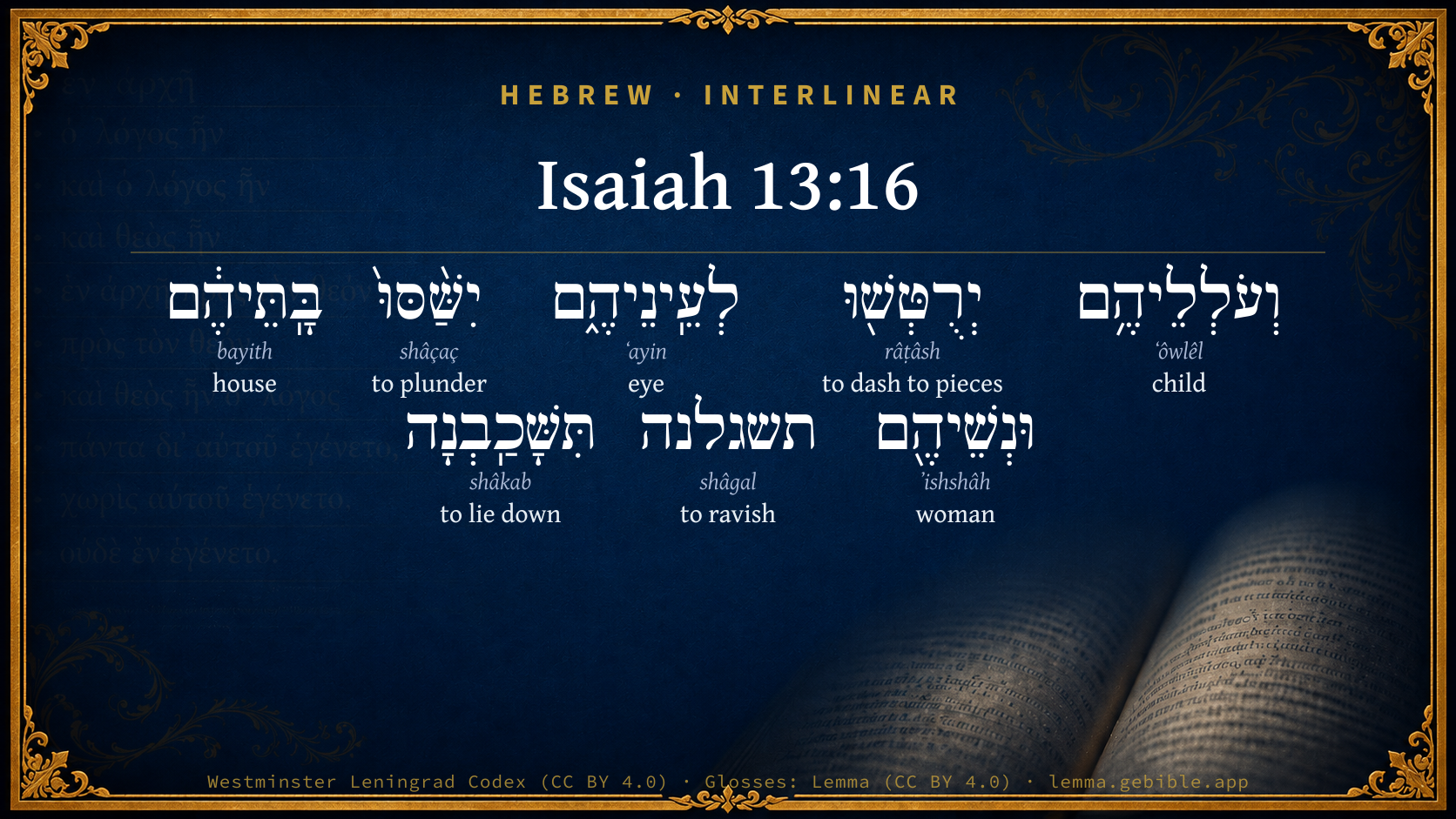
Hebrew (Westminster Leningrad Codex) Isaiah 13:16 appears in the Hebrew Old Testament. The text above is from the Westminster Leningrad Codex. Each word links to its Strong’s number, a concise gloss, and parsing drawn from the Open Scriptures Hebrew Bible morphology. Click any word for its full Brown-Driver-Briggs (BDB) entry.
Download image
Cite this verse

Isaiah 13:16 (World English Bible). Public Domain. Lemma interlinear Bible study tool, https://lemma.gebible.app/v/isaiah/13/16.

Show BibTeX & RIS
BibTeX
RIS
English Translation
Their infants also shall be dashed in pieces before their eyes; their houses shall be rifled, and their wives ravished.
World English Bible · Public Domain
Download a study sheet

One document with this verse’s original text, its word-by-word gloss line, the meaning frame, cross-references with their text, attributed commentary, and full source and license credits — printable, and it pastes into notes with its structure intact.

This verse Autodidact and up

Study sheet (.html) Plain text (.txt)

A passage Seminary Student

Up to 50 verses in one chapter. A passage sheet keeps up to 6 commentary sources and 12 cross-references per verse, in the order this page ranks them, and says so on the sheet whenever that leaves anything out. Ask for a single verse and you get the Autodidact verse sheet above.

Everything on this page stays free to read, with no account — the sheet is a download of what is already on screen, not access to it.

Want to remove ads? Support Godless Engineer
Compare translations 3

The same verse in 3 English versions, stacked beneath the original-language interlinear above. Click any original word for its lexicon entry.

Each is an independent rendering of the whole verse — the interlinear is not word-aligned to these translations.

Highlighted words mark where these versions differ — a whole-verse word diff, not a word-by-word alignment.

  • World English Bible Public Domain
    Their infants also shall be dashed in pieces before their eyes; their houses shall be rifled, and their wives ravished.
  • King James Version Public Domain
    Their children also shall be dashed to pieces before their eyes; their houses shall be spoiled, and their wives ravished.
  • unfoldingWord Literal Text CC BY-SA 4.0
    And their infants will be dashed to their eyes; their houses will be plundered, and their wives will be ravished. q1

unfoldingWord Literal Text — © unfoldingWord, licensed CC BY-SA 4.0. Word-aligned USFM3 via Door43 (git.door43.org/unfoldingWord/en_ult).

Versions to compare (up to 4)

3 of 4 selected

Show all 18 translations

Every available English version of this verse, each an independent rendering of the whole verse.

  • World English Bible Public Domain
    Their infants also shall be dashed in pieces before their eyes; their houses shall be rifled, and their wives ravished.
  • Berean Standard Bible Public Domain
    Their infants will be dashed to pieces before their eyes, their houses will be looted, and their wives will be ravished.
  • Majority Standard Bible Public Domain
    Their infants will be dashed to pieces before their eyes, their houses will be looted, and their wives will be ravished.
  • King James Version Public Domain
    Their children also shall be dashed to pieces before their eyes; their houses shall be spoiled, and their wives ravished.
  • American Standard Version (1901) Public Domain
    Their infants also shall be dashed in pieces before their eyes; their houses shall be rifled, and their wives ravished.
  • Revised Version (1885) Public Domain
    Their infants also shall be dashed in pieces before their eyes; their houses shall be spoiled, and their wives ravished.
  • Geneva Bible (1599) Public Domain
    Their children also shall be broken in pieces before their eyes: their houses shall be spoiled, and their wiues rauished.
  • Douay-Rheims (1899) Public Domain
    Their infants shall be dashed in pieces before their eyes: their houses shall be pillaged, and their wives shall be ravished.
  • Young's Literal Translation Public Domain
    And their sucklings are dashed to pieces before their eyes, Spoiled are their houses, and their wives lain with.
  • Literal Standard Version CC BY-SA 4.0
    And their sucklings are dashed to pieces before their eyes, || Their houses are spoiled, and their wives lain with.
  • Unlocked Literal Bible CC BY-SA 4.0
    Their infants also will be dashed in pieces before their eyes. Their houses will be plundered and their wives raped.
  • unfoldingWord Literal Text CC BY-SA 4.0
    And their infants will be dashed to their eyes; their houses will be plundered, and their wives will be ravished. q1
  • Darby Bible Public Domain
    And their infants shall be dashed in pieces before their eyes, their houses shall be rifled, and their women ravished.
  • World Messianic Bible Public Domain
    Their infants also will be dashed in pieces before their eyes. Their houses will be ransacked, and their wives raped.
  • Webster's Bible Public Domain
    Their children also shall be dashed to pieces before their eyes; their houses shall be plundered, and their wives ravished.
  • Free Bible Version CC BY-SA 4.0
    Their little children will be dashed to pieces as they watch, their houses will be looted, and their wives will be raped.
  • Bible in Basic English Public Domain
    Their young children will be broken up before their eyes; their goods will be taken away, and their wives made the property of others.
  • JPS Tanakh (1917) Public Domain
    Their babes also shall be dashed in pieces before their eyes; their houses shall be spoiled, and their wives ravished.

Literal Standard Version (2020), Covenant Press — licensed CC BY-SA 4.0. Text via the HelloAO Bible API (eBible.org). Unlocked Literal Bible (unfoldingWord) — licensed CC BY-SA 4.0. Text via the HelloAO Bible API (eBible.org). unfoldingWord Literal Text — © unfoldingWord, licensed CC BY-SA 4.0. Word-aligned USFM3 via Door43 (git.door43.org/unfoldingWord/en_ult). Free Bible Version, Dr. Jonathan Gallagher — licensed CC BY-SA 4.0. Text via the HelloAO Bible API (eBible.org).

Word by word

More ways to search: Search by grammar → Find every occurrence → Compare this word →

Practice this passage: Drill this verse → Learn its vocabulary →

תשגלנה
shâgal
H7693
“to ravish”
Verb, Niphal, Imperfect, 3rd Person, Feminine, Plural
Part of Speech
Verb
Stem
Niphal
Form
Imperfect
Person
3rd Person
Gender
Feminine
Number
Plural
Full BDB Definition

Origin: a primitive root

TWOT: 2327

to violate, ravish - (Qal) to violate, ravish - (Niphal) to be ravished - (Pual) to be ravished
  1. וְעֹלְלֵיהֶ֥ם ʻôwlêl H5768 “and · children · their” Conjunction + Noun, Common, Masculine, Plural, Construct + Suffix, Personal, 3rd Person, Masculine, Plural
  2. יְרֻטְּשׁ֖וּ râṭâsh H7376 “to dash to pieces” Verb, Pual, Imperfect, 3rd Person, Masculine, Plural
  3. לְעֵֽינֵיהֶ֑ם ʻayin H5869 “to/for · eyes · their” Preposition + Noun, Common, Both, Dual, Construct + Suffix, Personal, 3rd Person, Masculine, Plural
  4. יִשַּׁ֨סּוּ֙ shâçaç H8155 “to plunder” Verb, Niphal, Imperfect, 3rd Person, Masculine, Plural
  5. בָּֽתֵּיהֶ֔ם bayith H1004 “houses · their” Noun, Common, Masculine, Plural, Construct + Suffix, Personal, 3rd Person, Masculine, Plural
  6. וּנְשֵׁיהֶ֖ם ʼishshâh H802 “and · women · their” Conjunction + Noun, Common, Feminine, Plural, Construct + Suffix, Personal, 3rd Person, Masculine, Plural
  7. תִּשָּׁכַֽבְנָה shâkab H7901 “to lie down” Verb, Niphal, Imperfect, 3rd Person, Feminine, Plural

About this verse

These counts appear in no published source. They are computed here, from the morphology-tagged text and Lemma’s own curated glosses. What Lemma adds →

8
words
8
distinct lemmas
Prophets
section

Notable vocabulary

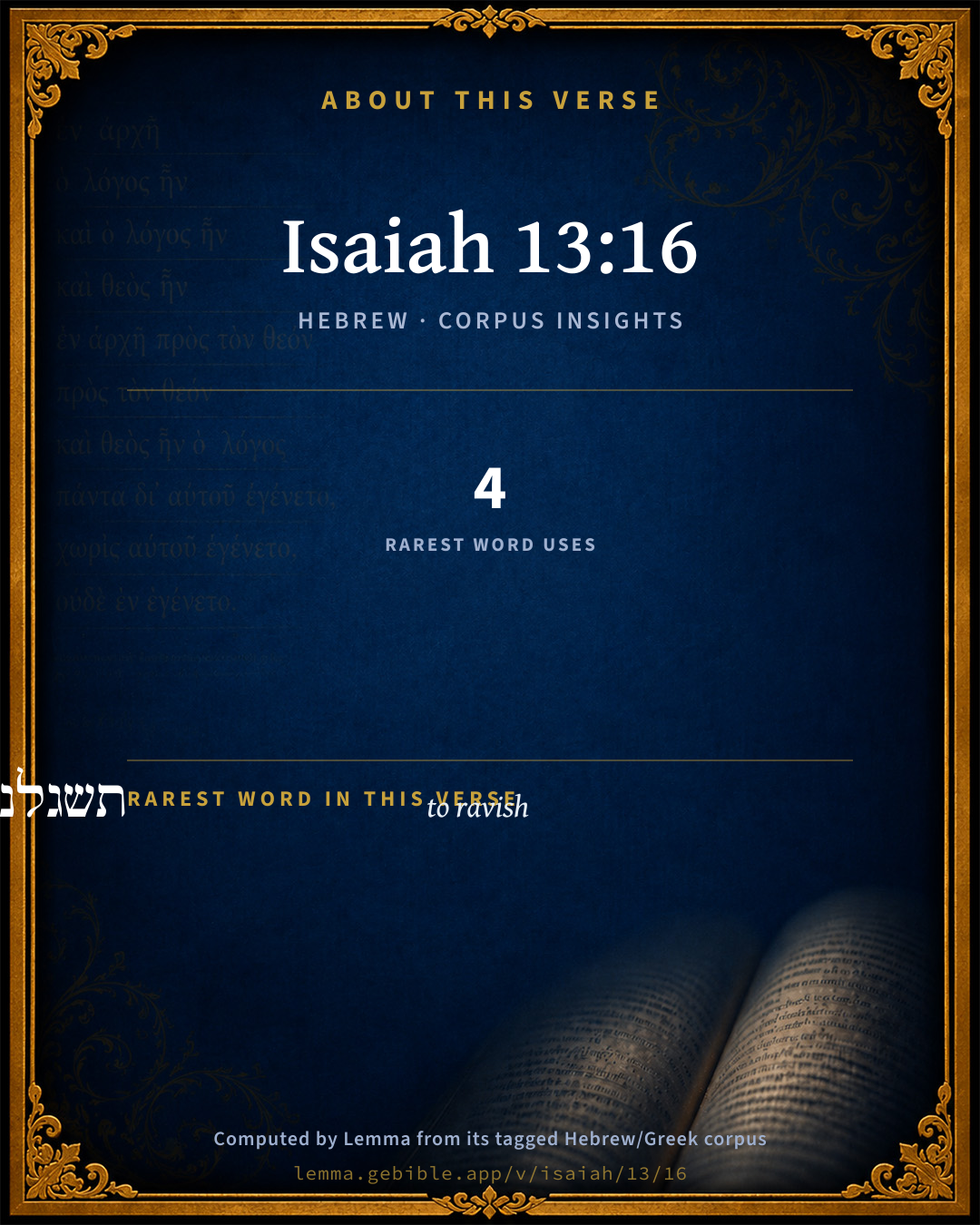
The rarest word here is תשגלנה to ravish H7693 — appearing just 4 times in the whole Hebrew Bible.

Shared distinctive vocabulary

תשגלנה to ravish H7693 occurs in 4 verses of the Hebrew Bible. Also found in:

Grammatical profile

  • 4 verbs
  • 4 nouns

Verb forms

  • יְרֻטְּשׁ֖וּ Pual · Imperfect
  • יִשַּׁ֨סּוּ֙ Niphal · Imperfect
  • תשגלנה Niphal · Imperfect
  • תִּשָּׁכַֽבְנָה Niphal · Imperfect

Hebrew & Septuagint length

In English translation the verse runs 20 words from the Hebrew and 20 from the Septuagint (LXX English) — the same length.

A rough comparison of the two English renderings, which tokenize alike — not a word-level alignment.

Word counts can differ between the Hebrew and the Greek without any difference in meaning — e.g. the Hebrew direct-object marker אֵת has no separate Greek word, and Greek often adds the article ὁ.

Cross-references

6

Topical passages linked to Isaiah 13:16 in the Treasury of Scripture Knowledge — connected by theme and wording, ordered by reader-vote popularity; previews shown in the World English Bible.

  • Hosea 10:14 Therefore a battle roar will arise among your people, And all your fortresses will be destroyed, As Shalman destroyed Beth Arbel in the day of battle. The mother was dashed in pieces with her children.
  • Nahum 3:10 Yet was she carried away. She went into captivity. Her young children also were dashed in pieces at the head of all the streets, and they cast lots for her honorable men, and all her great men were bound in chains.
  • Psalms 137:8–9 Daughter of Babylon, doomed to destruction, He will be happy who rewards you, As you have served us.
  • Isaiah 13:18 [Their] bows shall dash the young men in pieces; and they shall have no pity on the fruit of the womb; their eye shall not spare children.
  • Lamentations 5:11 They ravished the women in Zion, The virgins in the cities of Judah.
  • Zechariah 14:2 For I will gather all nations against Jerusalem to battle; and the city will be taken, the houses rifled, and the women ravished. half of the city will go out into captivity, and the rest of the people will not be cut off from the city.

Cross-references courtesy of OpenBible.info (CC BY 4.0).

Hebrew and Greek witnesses Masoretic Hebrew ↔ Greek Septuagint

The same verse in the two great witnesses to the Old Testament, shown verse-for-verse.

These are two independent witnesses, not word-aligned to each other, and the Septuagint is shown in lemma (dictionary) form.

Hebrew Isaiah 13:16 Masoretic · Westminster Leningrad Codex

וְעֹלְלֵיהֶ֥ם יְרֻטְּשׁ֖וּ לְעֵֽינֵיהֶ֑ם יִשַּׁ֨סּוּ֙ בָּֽתֵּיהֶ֔ם וּנְשֵׁיהֶ֖ם תשגלנה תִּשָּׁכַֽבְנָה

Their infants also shall be dashed in pieces before their eyes; their houses shall be rifled, and their wives ravished.

World English Bible · Public Domain

Greek LXX Isaiah 13:16 Septuagint · lemma form

καί ὁ τέκνον αὐτός ἐνώπιον αὐτός ῥάσσω καί ὁ οἰκία αὐτός προνομεύω καί ὁ γυνή αὐτός ἔχω

And they shall dash their children before their eyes; and they shall spoil their houses, and shall take their wives.

LXX2012 (modern English Septuagint) · Public Domain

Hebrew: Westminster Leningrad Codex (CC BY 4.0). Greek: Septuagint (public domain); English from LXX2012 (modern English Septuagint) (Public Domain). How the Septuagint differs from the Hebrew →

Targum (Aramaic paraphrase)

1

The Targum is the ancient Jewish Aramaic paraphrase of the Hebrew Scriptures — an interpretive translation, not the Hebrew text itself. Onkelos (literal) and Pseudo-Jonathan (expansive) render the Torah, and Jonathan the Prophets. Coverage is partial: where no permissively-licensed English translation exists for a verse, only the Aramaic is shown. This is verse-level text, not a word-by-word alignment to the Hebrew.

  1. Targum Jonathan Prophets (Joshua–Malachi)
    וְעוּלֵימֵיהוֹן יִטְרְפוּן לְעֵינֵיהוֹן יִתְבְּזִיזוּן בָּתֵּיהוֹן וּנְשֵׁיהוֹן יִשְׁתַּכְבָן:

    And their children shall be dashed before their eyes; their houses shall be plundered, and their wives ravished.

    Targum Jonathan — Aramaic: “Mikraot Gedolot” (public domain). English: “Sefaria Community Translation” (CC0 1.0 (public-domain dedication)); “London "Chaldee Paraphrase," 1871” (public domain). Text via Sefaria.

Commentary

Notes on Isaiah 13:16 from classic Christian and Jewish commentators (each source and its license shown beneath its notes). The classic Christian expositions comment on the surrounding passage and are grouped to its opening verse, so a note may address several verses; the Jewish commentaries on the Tanakh (Rashi and others) are per-verse, so they appear only where the commentator wrote on this verse.

Lemma curates 59 commentaries, every one of them public domain or Creative Commons licensed, each selected and text-cleaned for this edition rather than reprinted as found. About our sources →

The Cambridge Bible for Schools and Colleges

gen. ed. J. J. S. Perowne

16. That the capture of Babylon should be marked by the atrocities here spoken of was no doubt to be expected from the character of the Medes (Isa_13:17 f.), but no such crimes appear to have stained the actual victory of Cyrus. According to Babylonian records he took possession of the city peacefully. (Records of the Past, New SeR.V. 144 ff.) Cf. Psa_137:9; Nah_3:10; Hos_13:16; 2Ki_8:12. The last half of the verse is repeated in Zec_14:2.

The Cambridge Bible for Schools and Colleges (gen. ed. J. J. S. Perowne; Cambridge University Press, 1878–1918) — public domain. Text from a community e-Sword module.

Trapp's Complete Commentary

John Trapp

Isa 13:16 Their children also shall be dashed to pieces before their eyes; their houses shall be spoiled, and their wives ravished.

Ver. 16. Their children shall be dashed in pieces, &c.] As had been prayed and prophesied long before {Psa 137:9} and this was but lex talionis. See 2Ch 36:17 Lam 5:11.

Their houses shall be spoiled, and their wives ravished.] As those three commandments, Thou shalt not kill, Thou shalt not commit adultery, Thou shalt not steal, are ranked together in the law, so they are commonly violated together in the lawless violence of war.

John Trapp, A Commentary or Exposition upon All the Books of the Old and New Testament (1647–1656) — public domain. Text from a community e-Sword module.

The Pulpit Commentary

Their children also shall be dashed to pieces. In the barbarous warfare of the time, even children were not spared. (see Psa_137:9 Nah_3:10 Hos_13:16) When a town was taken by assault, they were ruthlessly slaughtered. When spared, it was only to be dragged off as captives, and to become the slaves of their captors in a foreign land. Assyrian sculptures often illustrate this latter practice. Their wives ravished. (comp. Lam_5:11 Zec_14:2)

The Pulpit Commentary (1880–1919), ed. H.D.M. Spence-Jones & Joseph S. Exell — public domain. Text from a community e-Sword module.

The Preacher's Complete Homiletical Commentary

Joseph S. Exell (gen. ed.)

THE DOOM OF THE CHILDREN OF BABYLON

Isa_13:16. Their children also shall be dashed to pieces before their eyes.

Consider this terrible declaration—

I. As it regards man.

1. As a revelation of the degradation of which he is capable. History may be said to be a manifold revelation to this effect; the Bible alone gives hope for man, by disclosing his capabilities of development and exaltation.

2. As a remindal that no earthly empire is in and of itself secure against utter over throw.

3. As a remindal that what are called national disasters, are made up of sufferings endured by a vast number of individuals.

II. As it regards God. So considered, it should be remembered—

1. That His permission of such things is, when viewed comprehensively, only part of the great mystery of the permission of evil.

2. That this is an instance of the working of one of the great natural laws by which God governs the universe—the law of retribution.

3. That in the heart of this terrible prediction there is a bright ray of hope. When you see a surgeon performing a terrible operation on a patient, you are sure that he is confident that the patient will be restored to health. So when we look at the world as it is, we are certified that there is a better world to be. God would never have permitted the world to be, if He did not see how out of this present misery He could educe eternal and triumphant blessedness. Towards that better future God is leading on the world (H. E. I., 3421–3423). The revulsion of feeling with which we read this prediction is one proof of it; there was a time when such incidents in the prosecution of a war would have been regarded as a matter of course. That it should not be so now marks an advance, and is a prophecy of further advances.

The Preacher's Complete Homiletical Commentary (gen. ed. Joseph S. Exell; Funk & Wagnalls, c. 1892) — public domain (pre-1929). A full-Bible homiletical/sermon-outline anthology covering 65 of 66 books (2 John is absent from the source module). Text from a community e-Sword module.

Tyndale Open Study Notes

Tyndale Open Resources

13:16 These terrible acts of war would be perpetrated against Babylon, itself a cruel conquering power (see also Ps 137:8-9; Jer 6:11-12; Nah 3:10).

Tyndale Open Study Notes — © Tyndale Open Resources, licensed CC BY-SA 4.0. Text via the HelloAO Bible API.

Geneva Bible (1599)

Geneva Bible translators

This was not accomplished when Cyrus took Babylon, but after the death of Alexander the great.

Geneva Bible (1599) marginal notes — public domain. Text via Bolls.life.

Jamieson, Fausset & Brown

Robert Jamieson, A. R. Fausset & David Brown

(Psa 137:8-9).

Jamieson, Fausset & Brown — Commentary Critical and Explanatory on the Whole Bible (1871) — public domain (CC PDM 1.0). Text via the HelloAO Bible API.

Ellicott's Commentary for English Readers

(16) Their children also shall be dashed.—Better, their sucklings. The words of the prediction seem to have been in the minds of the exiles in Babylon when they uttered their dread beatitude on those who were to be the ministers of a righteous vengeance (Psa_137:9). Outrages such as these were then, as they have been ever since, the inevitable accompaniments of the capture of a besieged city.

A Bible Commentary for English Readers, edited by Charles John Ellicott (1878–1897) — public domain. Text from a community e-Sword module.

John Gill's Exposition

Their children also shall be dashed to pieces before their eyes,.... Upon the ground, or against the wall, as was foretold should be, Psa 137:8 and in way of retaliation for what they did to the Jews, Ch2 36:17 and this was to be done "before their eyes", in the sight of the inhabitants, which must make it the more distressing and afflicting; and, as Kimchi observes, this phrase is to be applied to the following clauses:

their houses shall be spoiled; plundered of the substance, wealth, and riches in them, by the Persian soldiers:

and their wives ravished; by the same, and both before their eyes, and after that slain, in like manner as they had ravished the women in Zion, Lam 5:11.

John Gill's Exposition of the Whole Bible (1746–1763) — public domain (CC PDM 1.0). Text via the HelloAO Bible API.

Albert Barnes' Notes on the Bible

Their children also shall be dashed to pieces - This is a description of the horrors of the capture of Babylon; and there can be none more frightful and appalling than that which is here presented. That this is done in barbarous nations in the time of war, there can be no doubt. Nothing was more common among American savages, than to dash out the brains of infants against a rock or a tree, and it was often done before the eyes of the afflicted and heartbroken parents. That these horrors were not unknown in Oriental nations of antiquity, is evident. Thus, the Psalmist implies that it would be done in Babylon, in exact accordance with this prediction of Isaiah; Psa 137:8-9 :

O daughter of Babylon, who art to be destroyed:

Happy shall he be who rewardeth these as thou hast served us;

Happy shall he be who taketh and dasheth thy little ones

Against the stones.

Thus, also, it is said of Hazael, that when he came to be king of Syria, he would be guilty of this barbarity in regard to the Jews (2Ki 8:13; compare Nah 3:10). It was an evidence of the barbarous feelings of the times; and a proof that they were far, very far, from the humanity which is now deemed indispensable even in war.

Their houses shall be spoiled - Plundered. It is implied here, says Kimchi, that this was to be done also ‘before their eyes,’ and thus the horrors of the capture would be greatly increased.

Albert Barnes' Notes on the Bible (1834–1885) — public domain. Text from a community e-Sword/MySword module.

Matthew Poole's English Annotations

Their children also shall be dashed to pieces before their eyes, as a just recompence for the like cruelty acted by them upon the Jews, 2Ch 36:17, which also was foretold, Psa 137:9.

Matthew Poole's English Annotations on the Holy Bible (1683–1685) — public domain. Text from a community e-Sword/MySword module.

Whedon's Commentary on the Bible

Daniel D. Whedon

16. Their children — Whose children? Either those of foreigners, or of foreigners and natives, according as slaughter was seen to be restricted or general. It was likely to be general, in which case all children are to be slain, every house despoiled, and every woman ravished.

Daniel D. Whedon (gen. ed.), Commentary on the Old and New Testaments (1874–1909) — public domain. Text from a community e-Sword module.

J. A. Alexander on Isaiah

Joseph Addison Alexander

The horrors of the conquest shall extend not only to the men, but to their wives and children. “And their children shall be dashed to pieces before their eyes, their houses shall be plundered and their wives ravished.” The same thing is threatened against Babylon in Psa 137:9, in retaliation for the barbarities practiced in Jerusalem (2Ch 36:17; Lam 5:11). The horror of the threatening is enhanced by the addition of before their eyes. (Compare Isa 1:7 and Deu 28:31-32).

Joseph Addison Alexander, The Prophecies of Isaiah (1846–1847; New York: Scribner, 1870–1878) — public domain. Text from a community e-Sword module.

Rashi

Rabbi Shlomo Yitzchaki (Rashi)

shall be dashed Heb. יְרֻטָּשׁוּ. Comp. (verse 18) “Shall dash (תְּרַטַּשְׁנָה) youths.”

Rashi on the Tanakh — English translations: “The Judaica Press complete Tanach with Rashi, translated by A. J. Rosenberg” (CC BY 4.0); “Pentateuch with Rashi's commentary by M. Rosenbaum and A.M. Silbermann, 1929-1934” (public domain); “The Metsudah Tanach series, Lakewood, N.J” (CC BY 4.0); and “The Book of Joshua, Metsudah Publications, 1997” (CC BY 4.0). Text via Sefaria.

Ibn Ezra

Rabbi Abraham ibn Ezra

תשגלנה They will be ravished. It is read תשכבנה by euphemism.

Ibn Ezra on the Tanakh — English translations: “Sefaria Community Translation” (CC0 1.0 (public-domain dedication)); “Yalkut, Sifsei Chachomim Chumash, Metsudah Publications, 2009” (CC BY 4.0); and “Commentary of Ibn Ezra on Isaiah - trans. by M. Friedlander, 1873” (public domain). Text via Sefaria.

Lesson kit

Teaching starters — assembled from the data on this page, not authored interpretation. Every prompt links to the verse data it draws on. Edit before teaching.

Isaiah, in the Prophets, opens this verse with 8 words (8 distinct Hebrew lemmas). Its most distinctive word is shâgal (“to ravish”). A historical commentator’s framing appears above. Read the whole chapter for the surrounding context.

Discussion questions

  1. The word shâgal carries the sense “to ravish.” How does it shape the verse?
  2. Deuteronomy 28:30 shares the word «to ravish» with this verse. How do the two illuminate each other?
  3. These translations render this verse differently; the difference is in the English rendering, not the original. What questions does that raise?
  4. The verb «יְרֻטְּשׁ֖וּ» is Pual Imperfect. How does its form color the action?
  5. Reading how The Cambridge Bible for Schools and Colleges and Trapp's Complete Commentary read this verse, where do the two commentators agree and where do they part?

Things to notice

Reading settings

Reading text

Shown beneath each verse's original-language words.

Old Testament
Old Testament edition

Read the OT as the Masoretic Hebrew (MT) or the Greek Septuagint (LXX).

English shown for the Greek Septuagint (in the Hebrew ↔ Greek comparison).

Comparing translations? Open the Compare panel on any verse page to stack up to four side by side.