
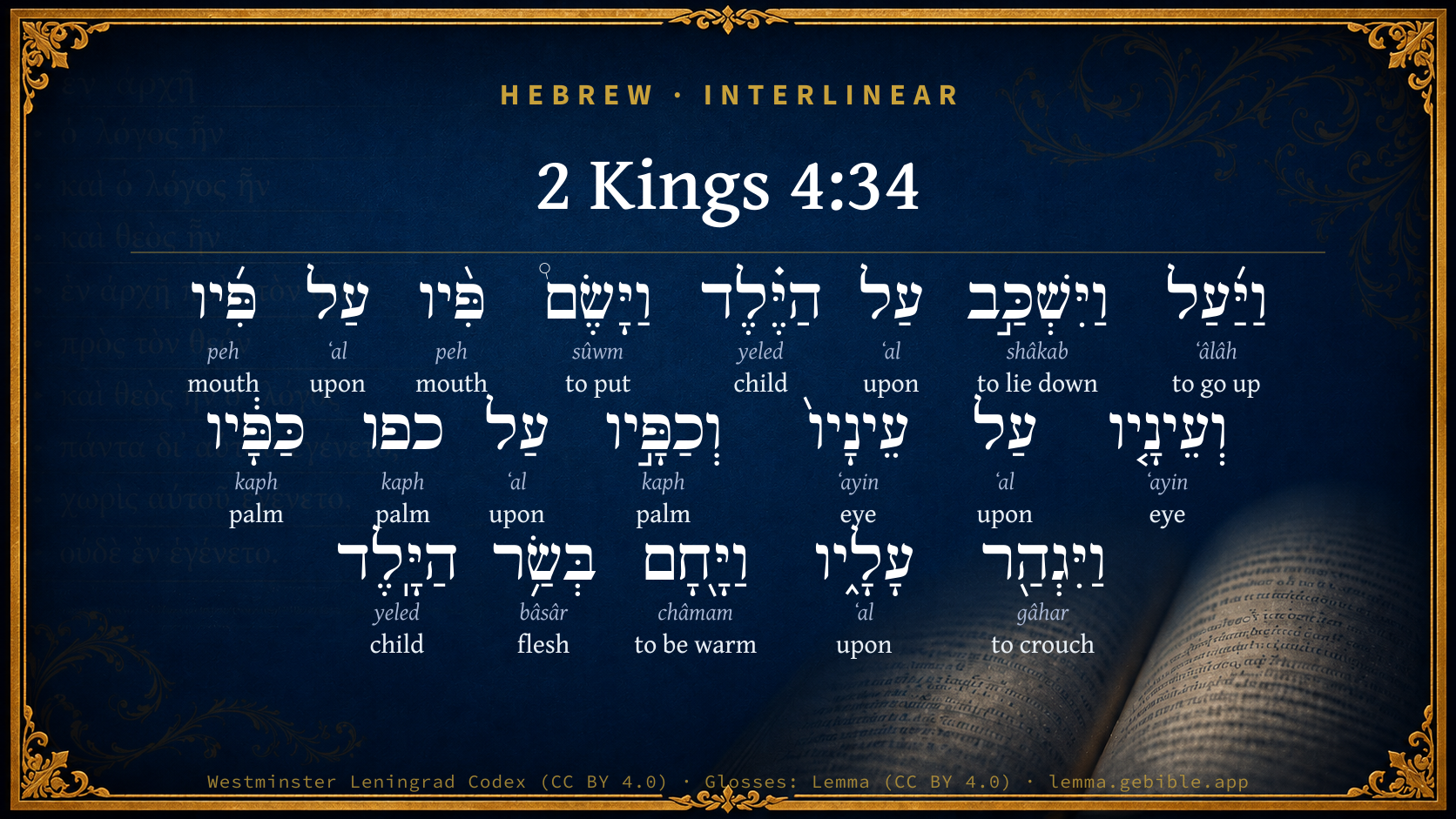
2 Kings 4:34

Hebrew (Westminster Leningrad Codex) 2 Kings 4:34 appears in the Hebrew Old Testament. The text above is from the Westminster Leningrad Codex. Each word links to its Strong’s number, a concise gloss, and parsing drawn from the Open Scriptures Hebrew Bible morphology. Click any word for its full Brown-Driver-Briggs (BDB) entry.
Download image
Cite this verse

2 Kings 4:34 (World English Bible). Public Domain. Lemma interlinear Bible study tool, https://lemma.gebible.app/v/2-kings/4/34.

Show BibTeX & RIS
BibTeX
RIS
English Translation
He went up, and lay on the child, and put his mouth on his mouth, and his eyes on his eyes, and his hands on his hands: and he stretched himself on him; and the flesh of the child grew warm.
World English Bible · Public Domain
Download a study sheet

One document with this verse’s original text, its word-by-word gloss line, the meaning frame, cross-references with their text, attributed commentary, and full source and license credits — printable, and it pastes into notes with its structure intact.

This verse Autodidact and up

Study sheet (.html) Plain text (.txt)

A passage Seminary Student

Up to 50 verses in one chapter. A passage sheet keeps up to 6 commentary sources and 12 cross-references per verse, in the order this page ranks them, and says so on the sheet whenever that leaves anything out. Ask for a single verse and you get the Autodidact verse sheet above.

Everything on this page stays free to read, with no account — the sheet is a download of what is already on screen, not access to it.

Want to remove ads? Support Godless Engineer
Compare translations 3

The same verse in 3 English versions, stacked beneath the original-language interlinear above. Click any original word for its lexicon entry.

Each is an independent rendering of the whole verse — the interlinear is not word-aligned to these translations.

Highlighted words mark where these versions differ — a whole-verse word diff, not a word-by-word alignment.

  • World English Bible Public Domain
    He went up, and lay on the child, and put his mouth on his mouth, and his eyes on his eyes, and his hands on his hands: and he stretched himself on him; and the flesh of the child grew warm.
  • King James Version Public Domain
    And he went up, and lay upon the child, and put his mouth upon his mouth, and his eyes upon his eyes, and his hands upon his hands: and stretched himself upon the child; and the flesh of the child waxed warm.
  • unfoldingWord Literal Text CC BY-SA 4.0
    And he went up, and he lay on the child, and he put his mouth on his mouth, and his eyes on his eyes, and his palms on his palms. And he stretched out upon him, and the flesh of the child became warm.

unfoldingWord Literal Text — © unfoldingWord, licensed CC BY-SA 4.0. Word-aligned USFM3 via Door43 (git.door43.org/unfoldingWord/en_ult).

Versions to compare (up to 4)

3 of 4 selected

Show all 18 translations

Every available English version of this verse, each an independent rendering of the whole verse.

  • World English Bible Public Domain
    He went up, and lay on the child, and put his mouth on his mouth, and his eyes on his eyes, and his hands on his hands: and he stretched himself on him; and the flesh of the child grew warm.
  • Berean Standard Bible Public Domain
    Then Elisha got on the bed and lay on the boy, mouth to mouth, eye to eye, and hand to hand. As he stretched himself out over him, the boy’s body became warm.
  • Majority Standard Bible Public Domain
    Then Elisha got on the bed and lay on the boy, mouth to mouth, eye to eye, and hand to hand. As he stretched himself out over him, the boy’s body became warm.
  • King James Version Public Domain
    And he went up, and lay upon the child, and put his mouth upon his mouth, and his eyes upon his eyes, and his hands upon his hands: and stretched himself upon the child; and the flesh of the child waxed warm.
  • American Standard Version (1901) Public Domain
    And he went up, and lay upon the child, and put his mouth upon his mouth, and his eyes upon his eyes, and his hands upon his hands: and he stretched himself upon him; and the flesh of the child waxed warm.
  • Revised Version (1885) Public Domain
    And he went up, and lay upon the child, and put his mouth upon his mouth, and his eyes upon his eyes, and his hands upon his hands: and he stretched himself upon him; and the flesh of the child waxed warm.
  • Geneva Bible (1599) Public Domain
    After he went vp, and lay vpon the child, and put his mouth on his mouth, and his eyes vpon his eies, and his hands vpon his handes, and stretched himselfe vpon him, and the flesh of the child waxed warme.
  • Douay-Rheims (1899) Public Domain
    And he went up, and lay upon the child: and he put his mouth upon his mouth, and his eyes upon his eyes, and his hands upon his hands: and he bowed himself upon him, and the child's flesh grew warm.
  • Young's Literal Translation Public Domain
    And he goeth up, and lieth down on the lad, and putteth his mouth on his mouth, and his eyes on his eyes, and his hands on his hands, and stretcheth himself upon him, and the flesh of the lad becometh warm;
  • Literal Standard Version CC BY-SA 4.0
    And he goes up, and lies down on the boy, and puts his mouth on his mouth, and his eyes on his eyes, and his hands on his hands, and stretches himself on him, and the flesh of the boy becomes warm;
  • Unlocked Literal Bible CC BY-SA 4.0
    He went up and lay on the child; he put his mouth on his mouth, his eyes on his eyes, and his hands on his hands. He stretched himself out on the boy, and the boy's body grew warm.
  • unfoldingWord Literal Text CC BY-SA 4.0
    And he went up, and he lay on the child, and he put his mouth on his mouth, and his eyes on his eyes, and his palms on his palms. And he stretched out upon him, and the flesh of the child became warm.
  • Darby Bible Public Domain
    And he went up, and lay upon the child, and put his mouth upon his mouth, and his eyes upon his eyes, and his hands upon his hands, and bent over him; and the flesh of the child grew warm.
  • World Messianic Bible Public Domain
    He went up and lay on the child, and put his mouth on his mouth, and his eyes on his eyes, and his hands on his hands. He stretched himself on him; and the child’s flesh grew warm.
  • Webster's Bible Public Domain
    And he went up, and lay upon the child, and put his mouth upon his mouth, and his eyes upon his eyes, and his hands upon his hands: and he stretched himself upon the child; and the flesh of the child became warm.
  • Free Bible Version CC BY-SA 4.0
    Then he got on the bed and lay on top of the boy, and put his mouth on the boy's mouth, his eyes on the boy's eyes, his hands on the boy's hands. As he stretched out on him, the boy's body warmed up.
  • Bible in Basic English Public Domain
    Then he got up on the bed, stretching himself out on the child, and put his mouth on the child's mouth, his eyes on his eyes and his hands on his hands; and the child's body became warm.
  • JPS Tanakh (1917) Public Domain
    And he went up, and lay upon the child, and put his mouth upon his mouth, and his eyes upon his eyes, and his hands upon his hands; and he stretched himself upon him; and the flesh of the child waxed warm.

Literal Standard Version (2020), Covenant Press — licensed CC BY-SA 4.0. Text via the HelloAO Bible API (eBible.org). Unlocked Literal Bible (unfoldingWord) — licensed CC BY-SA 4.0. Text via the HelloAO Bible API (eBible.org). unfoldingWord Literal Text — © unfoldingWord, licensed CC BY-SA 4.0. Word-aligned USFM3 via Door43 (git.door43.org/unfoldingWord/en_ult). Free Bible Version, Dr. Jonathan Gallagher — licensed CC BY-SA 4.0. Text via the HelloAO Bible API (eBible.org).

Word by word

More ways to search: Search by grammar → Find every occurrence → Compare this word →

Practice this passage: Drill this verse → Learn its vocabulary →

וַיִּגְהַ֖ר
gâhar
H1457
“and · to crouch”
Conjunction + Verb, Qal, Sequential Imperfect, 3rd Person, Masculine, Singular
Part of Speech
Conjunction + Verb
Stem
Qal
Form
Sequential Imperfect
Person
3rd Person
Gender
Masculine
Number
Singular
Full BDB Definition

Origin: a primitive root

TWOT: 322

(Qal) to bend, crouch
  1. וַיַּ֜עַל ʻâlâh H5927 “and · to go up” Conjunction + Verb, Qal, Sequential Imperfect, 3rd Person, Masculine, Singular
  2. וַיִּשְׁכַּ֣ב shâkab H7901 “and · to lie down” Conjunction + Verb, Qal, Sequential Imperfect, 3rd Person, Masculine, Singular
  3. עַל ʻal H5921 “upon” Preposition
  4. הַיֶּ֗לֶד yeled H3206 “the · child” Particle, Definite Article + Noun, Common, Masculine, Singular, Absolute
  5. וַיָּשֶׂם֩ sûwm H7760 “and · to put” Conjunction + Verb, Qal, Sequential Imperfect, 3rd Person, Masculine, Singular
  6. פִּ֨יו peh H6310 “mouth · his” Noun, Common, Masculine, Singular, Construct + Suffix, Personal, 3rd Person, Masculine, Singular
  7. עַל ʻal H5921 “upon” Preposition
  8. פִּ֜יו peh H6310 “mouth · his” Noun, Common, Masculine, Singular, Construct + Suffix, Personal, 3rd Person, Masculine, Singular
  9. וְעֵינָ֤יו ʻayin H5869 “and · eyes · his” Conjunction + Noun, Common, Both, Dual, Construct + Suffix, Personal, 3rd Person, Masculine, Singular
  10. עַל ʻal H5921 “upon” Preposition
  11. עֵינָיו֙ ʻayin H5869 “eyes · his” Noun, Common, Both, Dual, Construct + Suffix, Personal, 3rd Person, Masculine, Singular
  12. וְכַפָּ֣יו kaph H3709 “and · palms · his” Conjunction + Noun, Common, Feminine, Dual, Construct + Suffix, Personal, 3rd Person, Masculine, Singular
  13. עַל ʻal H5921 “upon” Preposition
  14. כפו kaph H3709 “palms · his” Noun, Common, Feminine, Dual, Construct + Suffix, Personal, 3rd Person, Masculine, Singular
  15. כַּפָּ֔יו kaph H3709 “palms · his” Noun, Common, Feminine, Dual, Construct + Suffix, Personal, 3rd Person, Masculine, Singular
  16. עָלָ֑יו ʻal H5921 “upon · him” Preposition + Suffix, Personal, 3rd Person, Masculine, Singular
  17. וַיָּ֖חָם châmam H2552 “and · to be warm” Conjunction + Verb, Qal, Sequential Imperfect, 3rd Person, Masculine, Singular
  18. בְּשַׂ֥ר bâsâr H1320 “flesh of” Noun, Common, Masculine, Singular, Construct
  19. הַיָּֽלֶד yeled H3206 “the · child” Particle, Definite Article + Noun, Common, Masculine, Singular, Absolute

About this verse

These counts appear in no published source. They are computed here, from the morphology-tagged text and Lemma’s own curated glosses. What Lemma adds →

20
words
11
distinct lemmas
Historical
section

Notable vocabulary

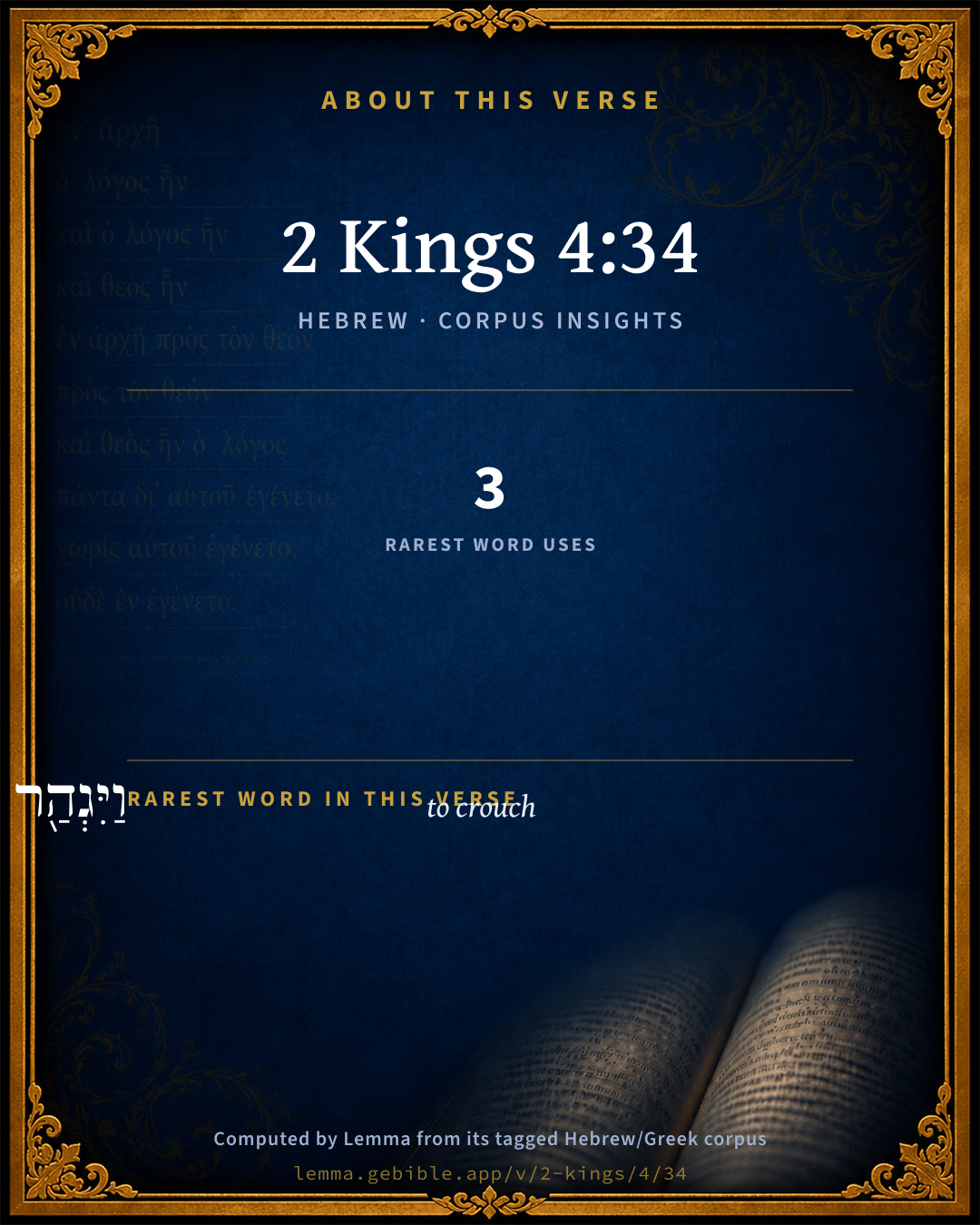
The rarest word here is וַיִּגְהַ֖ר to crouch H1457 — appearing just 3 times in the whole Hebrew Bible.

Shared distinctive vocabulary

וַיִּגְהַ֖ר to crouch H1457 occurs in 3 verses of the Hebrew Bible. Also found in:

Grammatical profile

  • 5 verbs
  • 10 nouns
  • 5 prepositions

Verb forms

  • וַיַּ֜עַל Qal · Sequential Imperfect
  • וַיִּשְׁכַּ֣ב Qal · Sequential Imperfect
  • וַיָּשֶׂם֩ Qal · Sequential Imperfect
  • וַיִּגְהַ֖ר Qal · Sequential Imperfect
  • וַיָּ֖חָם Qal · Sequential Imperfect

Repetition

Words recur within this verse — often emphatic in Hebrew:

  • עַל upon H5921 ×5
  • וְכַפָּ֣יו palm H3709 ×3
  • הַיֶּ֗לֶד child H3206 ×2
  • פִּ֨יו mouth H6310 ×2
  • וְעֵינָ֤יו eye H5869 ×2

Hebrew & Septuagint length

In English translation the verse runs 41 words from the Hebrew and 41 from the Septuagint (LXX English) — the same length.

A rough comparison of the two English renderings, which tokenize alike — not a word-level alignment.

Word counts can differ between the Hebrew and the Greek without any difference in meaning — e.g. the Hebrew direct-object marker אֵת has no separate Greek word, and Greek often adds the article ὁ.

Cross-references

2

Topical passages linked to 2 Kings 4:34 in the Treasury of Scripture Knowledge — connected by theme and wording, ordered by reader-vote popularity; previews shown in the World English Bible.

  • 1 Kings 17:21 He stretched himself on the child three times, and cried to Yahweh, and said, Yahweh my God, please let this child's soul come into him again.
  • Acts 20:10 Paul went down, and fell upon him, and embracing him said, "Don't be troubled, for his life is in him."

Cross-references courtesy of OpenBible.info (CC BY 4.0).

Hebrew and Greek witnesses Masoretic Hebrew ↔ Greek Septuagint

The same verse in the two great witnesses to the Old Testament, shown verse-for-verse.

These are two independent witnesses, not word-aligned to each other, and the Septuagint is shown in lemma (dictionary) form.

Hebrew 2 Kings 4:34 Masoretic · Westminster Leningrad Codex

וַיַּ֜עַל וַיִּשְׁכַּ֣ב עַל הַיֶּ֗לֶד וַיָּשֶׂם֩ פִּ֨יו עַל פִּ֜יו וְעֵינָ֤יו עַל עֵינָיו֙ וְכַפָּ֣יו עַל כפו כַּפָּ֔יו וַיִּגְהַ֖ר עָלָ֑יו וַיָּ֖חָם בְּשַׂ֥ר הַיָּֽלֶד

He went up, and lay on the child, and put his mouth on his mouth, and his eyes on his eyes, and his hands on his hands: and he stretched himself on him; and the flesh of the child grew warm.

World English Bible · Public Domain

Greek LXX 2 Kings 4:34 Septuagint · lemma form

καί ἀναβαίνω καί κοιμάω ἐπί ὁ παιδάριον καί τίθημι ὁ στόμα αὐτός ἐπί ὁ στόμα αὐτός καί ὁ ὀφθαλμός αὐτός ἐπί ὁ ὀφθαλμός αὐτός καί ὁ χείρ αὐτός ἐπί ὁ χείρ αὐτός καί διακάμπτω ἐπί αὐτός καί διαθερμαίνω ὁ σάρξ ὁ παιδάριον

And he went up, and lay upon the child, and put his mouth upon his mouth, and his eyes upon his eyes, and his hands upon his hands; and bowed himself upon him, and the flesh of the child grew warm.

LXX2012 (modern English Septuagint) · Public Domain

On this verse, Trapp's Complete Commentary discusses the Septuagint’s reading. Read the note in Commentary ↓

Hebrew: Westminster Leningrad Codex (CC BY 4.0). Greek: Septuagint (public domain); English from LXX2012 (modern English Septuagint) (Public Domain). How the Septuagint differs from the Hebrew →

Targum (Aramaic paraphrase)

1

The Targum is the ancient Jewish Aramaic paraphrase of the Hebrew Scriptures — an interpretive translation, not the Hebrew text itself. Onkelos (literal) and Pseudo-Jonathan (expansive) render the Torah, and Jonathan the Prophets. Coverage is partial: where no permissively-licensed English translation exists for a verse, only the Aramaic is shown. This is verse-level text, not a word-by-word alignment to the Hebrew.

  1. Targum Jonathan Prophets (Joshua–Malachi)
    וּסְלִיק וּשָׁכִיב עַל רַבְיָא וְשַׁוִי פוּמֵיהּ עַל פוּמֵיהּ וְעֵינוֹהִי עַל עֵינוֹהִי וִידוֹהִי עַל יְדוֹהִי וְאַלְהֵי עֲלוֹהִי וְחַם בִּיסְרֵיהּ דְרַבְיָא:

    (no public-domain English translation for this verse)

    Targum Jonathan — Aramaic: “Mikraot Gedolot” (public domain). English: “Sefaria Community Translation” (CC0 1.0 (public-domain dedication)); “London "Chaldee Paraphrase," 1871” (public domain). Text via Sefaria.

Commentary

Notes on 2 Kings 4:34 from classic Christian and Jewish commentators (each source and its license shown beneath its notes). The classic Christian expositions comment on the surrounding passage and are grouped to its opening verse, so a note may address several verses; the Jewish commentaries on the Tanakh (Rashi and others) are per-verse, so they appear only where the commentator wrote on this verse.

Lemma curates 59 commentaries, every one of them public domain or Creative Commons licensed, each selected and text-cleaned for this edition rather than reprinted as found. About our sources →

Trapp's Complete Commentary

John Trapp

2Ki 4:34 And he went up, and lay upon the child, and put his mouth upon his mouth, and his eyes upon his eyes, and his hands upon his hands: and he stretched himself upon the child; and the flesh of the child waxed warm.

Ver. 34. And put his mouth upon his mouth.] The Septuagint adds, And breathed upon him. See on 1Ki 17:21. Christ risen again thus applied to the dead soul, quickeneth it.

John Trapp, A Commentary or Exposition upon All the Books of the Old and New Testament (1647–1656) — public domain. Text from a community e-Sword module.

The Biblical Illustrator

Joseph S. Exell

2Ki_4:34

And the child sneezed seven times.

The seven sneezes

The child was dead. Although he had been the special gift of Divine promise and was therefore doubly prized by his parents, yet the little lad was not secure from the common hazards of life. The first clear evidence that the child was restored to life was his sneezing. Doubtless, it greatly rejoiced the prophets heart. We too, who are seeking the good of others will greatly exult if we are favoured to see gracious tokens in those for whose good we labour. At all gospel meetings earnest people should be on the look-out for persons convinced of sin, aroused in conscience, or in any other manner made to feel the power of the life-giving Spirit. It will be well if these persons watch with instructed eyes, so that they do not look for what they will never see, nor overlook that which should give them full content. Of natural life we may discern the tokens more readily than those of spiritual life; we need practice and experience in reference to this more mysterious matter, or we may cause great pain to ourselves and to those whom we would befriend. Possibly we may gather instruction from the signs of life which contented the prophet:--the child sneezed seven times.

1. This evidence of life was very simple. Nothing is freer from art than a sneeze. It is so far from being artificial that it is involuntary. As a rule we sneeze, not because we will, but because we must. No instruction, education, talent, or acquirement is necessary to a sneeze, nor even to a series of seven sneezes; it is the act of a child, or of an illiterate peasant, quite as much as of a philosopher or a divine. We ought not to expect too much in enquirers; we ought not to be satisfied without signs of life; but he faintest sign of life ought to encourage us and lead us to encourage them.

2. This evidence of life was in itself unpleasant. To the child it was no pleasure to sneeze. We should most of us prefer to be excused from sneezing seven times. Many of the surest marks of the new life are by no means pleasurable. The regenerate are not at once happy; on the other hand, they are often in great bitterness for their sins, and in Bore anguish because they have pierced their Saviour. The Divine life is not born into the world without pangs. When a man has been nearly drowned, and animation is restored by rubbing, the first movements of the blood within the veins causes tingling and other sensations which are exquisitely painful. Sin causes numbness of soul, and this is attended by an absence of sensation; this is changed when life comes with its look of faith, for the first result is that men look on Him whom they have pierced, and mourn for Him.

3. A sneeze, again, is not very musical to those who hear it, and so the first signs of grace are not in themselves pleasing to those who are watching for souls.

4. The child sneezed seven times, the evidences of life were very monotonous. Again and again there came a sneeze and nothing else. No song, no note of music, not even one soft word, but sneeze, sneeze, sneeze, seven times. Yet the noises wearied not the prophet, who was too glad to hear the sounds of life to be very particular about their musical character. The child lived, and that was enough for him. Much of the talk of enquirers is very wearisome; they tell the same melancholy tale over and over again. Let us not be disappointed because at the first we get so little which is interesting from young converts. We are not examining them for the ministry, we are only looking for evidences of spiritual life; to apply to them the tests which would be proper enough for a doctor of divinity would be both cruel and ridiculous.

5. Yet the sound which entered the prophets ear was a sure token of life, and we must not be content with any doubtful or merely hopeful signs. We want evidences of life, and these we must have. The child might have been washed and dressed in his best clothes, but this would not have fulfilled the prophets desire; the lad might have been decked with a chaplet of flowers, and his young cheeks might have been rouged into the imitation of a ruddy blush, but the holy man would have remained unsatisfied: he must have a sign of life. However simple, it must assuredly be a life-token, or it would be in vain. Nothing could trove been more conclusive than a sneeze. (C. H. Spurgeon.)

.

The Biblical Illustrator, edited by Joseph S. Exell (c. 1880s–1900s) — public domain. Text from a community e-Sword module.

Tyndale Open Study Notes

Tyndale Open Resources

4:34-35 lay down on the child’s body: Elisha’s actions and faith in the Lord were similar to Elijah’s (1 Kgs 17:17-24).

Tyndale Open Study Notes — © Tyndale Open Resources, licensed CC BY-SA 4.0. Text via the HelloAO Bible API.

Geneva Bible (1599)

Geneva Bible translators

The like did Elijah to the widow’s son at Zarephath, 1 Kings 17:21 and St. Paul, Acts 20:10, signifying the care that ought to be in them, that bear the word of God, and are distributors of the spiritual life.

Geneva Bible (1599) marginal notes — public domain. Text via Bolls.life.

Jamieson, Fausset & Brown

Robert Jamieson, A. R. Fausset & David Brown

lay upon the child, &c.--(see Kg1 17:21; Act 20:10). Although this contact with a dead body would communicate ceremonial uncleanness, yet, in performing the great moral duties of piety and benevolence, positive laws were sometimes dispensed with, particularly by the prophets.

Jamieson, Fausset & Brown — Commentary Critical and Explanatory on the Whole Bible (1871) — public domain (CC PDM 1.0). Text via the HelloAO Bible API.

Adam Clarke's Commentary

Verse 34. Lay upon the child] Endeavoured to convey a portion of his own natural warmth to the body of the child; and probably endeavoured, by blowing into the child's mouth, to inflate the lungs, and restore respiration. He uses every natural means in his power to restore life, while praying to the Author of it to exert a miraculous influence. Natural means are in our power; those that are supernatural belong to God. We should always do our own work, and beg of God to do his.

Adam Clarke's Commentary on the Bible (1810–1826) — public domain. Text from a community e-Sword/MySword module.

Ellicott's Commentary for English Readers

(34) He went up.—Upon the bed (2Ki_1:6).

And lay upon the child.—Comp. 1Ki_17:21. What is hinted at there is described here (Thenius).

Stretched himself upon the child.—Bowed himself. So LXX., Syriac, and Vulg. (Comp. 1Ki_18:42.) This expression summarises the preceding details.

The flesh of the child waxed warm.—The life of the Divine Spirit which was in Elisha was miraculously imparted by contact to the lifeless body. (Comp. Gen_2:7.)

A Bible Commentary for English Readers, edited by Charles John Ellicott (1878–1897) — public domain. Text from a community e-Sword module.

The Cambridge Bible for Schools and Colleges

gen. ed. J. J. S. Perowne

34. And he went up] The verb is used in 2Ki_1:4, of getting upon a bed. For some old beds it is very appropriate, for formerly they were much higher from the ground than is now the fashion.

and lay upon the child] (Cf. 1Ki_17:21.) Probably Elisha knew of the acts of Elijah at Zarephath, and followed that example. The answer to his prayer seems to have been less immediate than in Elijah’s case. Throughout the history there is a degree less of fervency in Elisha’s actions and hence the less quickly availing prayer.

Comparing the two prophets, Bp Hall says: ‘How true an heir is Elisha of his master, not in his graces only but in his actions. Both of them divided the waters of Jordan, the one as his last act, the other as his first. Elijah’s curse was the death of the captains and their troops; Elisha’s curse was the death of the children: Elijah rebuked Ahab to his face; Elisha, Jehoram: Elijah supplied the drought of Israel by rain from heaven; Elisha supplied the drought of the three kings by waters gushing out of the earth: Elijah increased the oil of the Sareptan; Elisha increased the oil of the prophet’s widow: Elijah raised from death the Sareptan’s son; Elisha, the Shunammite’s: both of them had one mantle, one spirit; both of them climbed up one Carmel, one heaven’.

stretched himself upon the child] R.V. upon him. So the Hebrew, and there can be no misunderstanding such as to require the noun to be repeated.

the flesh of the child waxed warm] The returning life is slowly given, but the first signs of restoration must have strengthened the zeal, and given fervour to the prayers which no doubt filled every moment of the time of waiting and watching.

The Cambridge Bible for Schools and Colleges (gen. ed. J. J. S. Perowne; Cambridge University Press, 1878–1918) — public domain. Text from a community e-Sword module.

John Gill's Exposition

And he went up,.... To the bed, which was on an ascent in the chamber; see Gill on Kg2 1:4 and lay upon the child; as Elijah did on the widow's son of Zarephath, Kg1 17:21.

and put his mouth upon his mouth, and his eyes upon his eyes, and his hands upon his hands, and stretched himself upon the child; that is, he did each of these one after another, since the disproportion of their bodies would not admit of their being done together:

and the flesh of the child waxed warm; not from any virtue imparted to it by these motions and actions of the prophet, but from life being infused into it by the Lord, which caused an heat in the several parts of the body.

John Gill's Exposition of the Whole Bible (1746–1763) — public domain (CC PDM 1.0). Text via the HelloAO Bible API.

Albert Barnes' Notes on the Bible

Be stretched himself - Or, “prostrated himself.” The word is a different one from that used of Elijah, and expresses closer contact with the body. Warmth may have been actually communicated from the living body to the dead one; and Elisha’s persistence Heb 11:35, may have been a condition of the child’s return to life.

Albert Barnes' Notes on the Bible (1834–1885) — public domain. Text from a community e-Sword/MySword module.

Haydock's Catholic Bible Commentary

Warm. Arabic adds, "by his breath," as when God breathed a soul into Adam. (Theodoret, q. 18.) --- Some Greek interpreters have, "he breathed upon him," &c.

George Leo Haydock (1774–1849), Haydock's Catholic Family Bible and Commentary, 1859 edition — public domain. Excludes Psalms (Douay-Rheims chapter numbering differs from Protestant) and Deuterocanonical books (Catholic canon only).

Matthew Poole's English Annotations

He went up, and lay upon the child; and although some ceremonial uncleanness might seem to be contracted by the touch of this dead body, yet that was justly to give place to a moral duty, and to an action of so great piety and charity as this was, especially when done by a prophet, and by the instinct of God’s Spirit, who can dispense with his own laws.

His mouth upon his mouth, & c; one part upon another successively; for the disproportion of the bodies would not permit it to be done together. Compare 1Ki 17:21; Act 20:10.

The flesh of the child waxed warm; not by any external heat, which could not be transmitted to the child’s body by such slight touches of the prophet’s body; but by a natural heat, proceeding from a principle of life, which was already infused into the child, and by degrees enlivened all the parts of his body.

Matthew Poole's English Annotations on the Holy Bible (1683–1685) — public domain. Text from a community e-Sword/MySword module.

Whedon's Commentary on the Bible

Daniel D. Whedon

34. Lay upon the child — He knew what Elijah had done in a similar case, (1Ki_17:21,) and followed his example; but doubtless both Elijah and Elisha used these natural measures in accordance with some Divine revelation which was given them.

His mouth upon his mouth — This was designed to convey his own animal warmth to the dead child. He would thus use the natural means which God might make instrumental in working that which lay altogether beyond the power of Elisha. This placing of his mouth, eyes, and hands upon those of the child, bore the same relation to this miracle which the spittle and the washing in Siloam did to the miracle by which Jesus gave sight to the man blind from his birth. Joh_9:1-7. Divine Power could have raised this child to life in answer to Elisha’s prayer without any other action on the part of the prophet, but Divine Wisdom decreed otherwise. Christ opened one blind man’s eyes by a single command; but in other cases he adopted peculiar measures to work substantially the same miracle. We cannot tell why, but we accept the facts, and argue from them the depth of the riches both of the wisdom and knowledge of God. Rom_11:33. We do not presume to deny that our God might have adopted a different plan of redemption from the one we have, but we may well question the possibility of a wiser one; and though we cannot fathom all its mystery, we accept with joy the fact of “God manifest in the flesh;” and in the blessed incarnation of our Lord, to use the analogy of this miracle of Elisha, we see with wonder how the Godman stretches himself upon our cold, lifeless humanity, that was dead in trespasses and sins, and even contracts himself to vile narrow span of our infancy, childhood, manhood; his blessed mouth and eyes and hands come into contact with our own. He breathes upon us the Holy Ghost, and we are quickened and warmed into a new and eternal life. We are thus raised from spiritual death, and our ears hear, and our eyes see, and our hands handle, the Word of life. 1Jn_1:1.

The flesh of the child waxed warm — Thus the miracle was wrought, not instantaneously, but by slow degrees.

Daniel D. Whedon (gen. ed.), Commentary on the Old and New Testaments (1874–1909) — public domain. Text from a community e-Sword module.

The Pulpit Commentary

And he went up, and lay upon the child, and put his mouth upon his mouth, and his eyes upon his eyes, and his hands upon his hands; following the example set him by his master and predecessor, Elijah. (1Ki_17:21) The idea may in both cases have been to fit the Body for reinhabitation by the soul (see ver. 22), through the restoration of warmth to it. And he stretched himself upon the child; i.e. brought his flesh as close as he could to the flesh of the child, covering the body and pressing on it, to force his own bodily warmth to pass into it. The word used, rhgyi, is different from that in 1Ki_17:21, which is ddemotyi, and implies a closer contact. And the flesh of the child waxed warm. Elisha"s efforts had an effect; the child"s Body was actually warmed by them.

The Pulpit Commentary (1880–1919), ed. H.D.M. Spence-Jones & Joseph S. Exell — public domain. Text from a community e-Sword module.

John Wesley's Explanatory Notes

And put - One part upon another successively; for the disproportion of the bodies would not permit it to be done together. Grew warm - Not by any external heat, which could not be transmitted to the child's body by such slight touches of the prophet's body; but from a principle of life, which was already infused into the child, and by degrees enlivened all the parts of his body.

John Wesley, Explanatory Notes Upon the Whole Bible (1754–1765) — public domain. Text via the GEBible commentary corpus.

Rashi

Rabbi Shlomo Yitzchaki (Rashi)

And he spread himself upon him. [Targum] Yonoson rendered ‘וְאַלְהֵי עֲלוֹהִי’, an expression of weariness. There is a similar word in the Beraisa of Ha’azinu and in Sifrei. But Menachem rendered ‘וַיִּגְהַר’, an interpretation of the word according to its context, “he prostrated himself upon him.”

Rashi on the Tanakh — English translations: “The Judaica Press complete Tanach with Rashi, translated by A. J. Rosenberg” (CC BY 4.0); “Pentateuch with Rashi's commentary by M. Rosenbaum and A.M. Silbermann, 1929-1934” (public domain); “The Metsudah Tanach series, Lakewood, N.J” (CC BY 4.0); and “The Book of Joshua, Metsudah Publications, 1997” (CC BY 4.0). Text via Sefaria.

Lesson kit

Teaching starters — assembled from the data on this page, not authored interpretation. Every prompt links to the verse data it draws on. Edit before teaching.

2 Kings, in the Historical, opens this verse with 20 words (11 distinct Hebrew lemmas). Its most distinctive word is gâhar (“to crouch”). A historical commentator’s framing appears above. Read the whole chapter for the surrounding context.

Discussion questions

  1. The word gâhar carries the sense “to crouch.” How does it shape the verse?
  2. How does 1 Kings 18:42, which shares the word «to crouch», read alongside this verse?
  3. What does the repetition of “upon” (5× in this one verse) do in this verse?
  4. These translations render this verse differently. What is at stake in choosing one wording over another?
  5. «וַיַּ֜עַל» is a Qal Sequential Imperfect verb. How does that grammatical form shape the action described?
  6. Compare how Trapp's Complete Commentary and The Biblical Illustrator read this verse. Where do they agree or differ?

Things to notice

Reading settings

Reading text

Shown beneath each verse's original-language words.

Old Testament
Old Testament edition

Read the OT as the Masoretic Hebrew (MT) or the Greek Septuagint (LXX).

English shown for the Greek Septuagint (in the Hebrew ↔ Greek comparison).

Comparing translations? Open the Compare panel on any verse page to stack up to four side by side.