Genesis 39:7

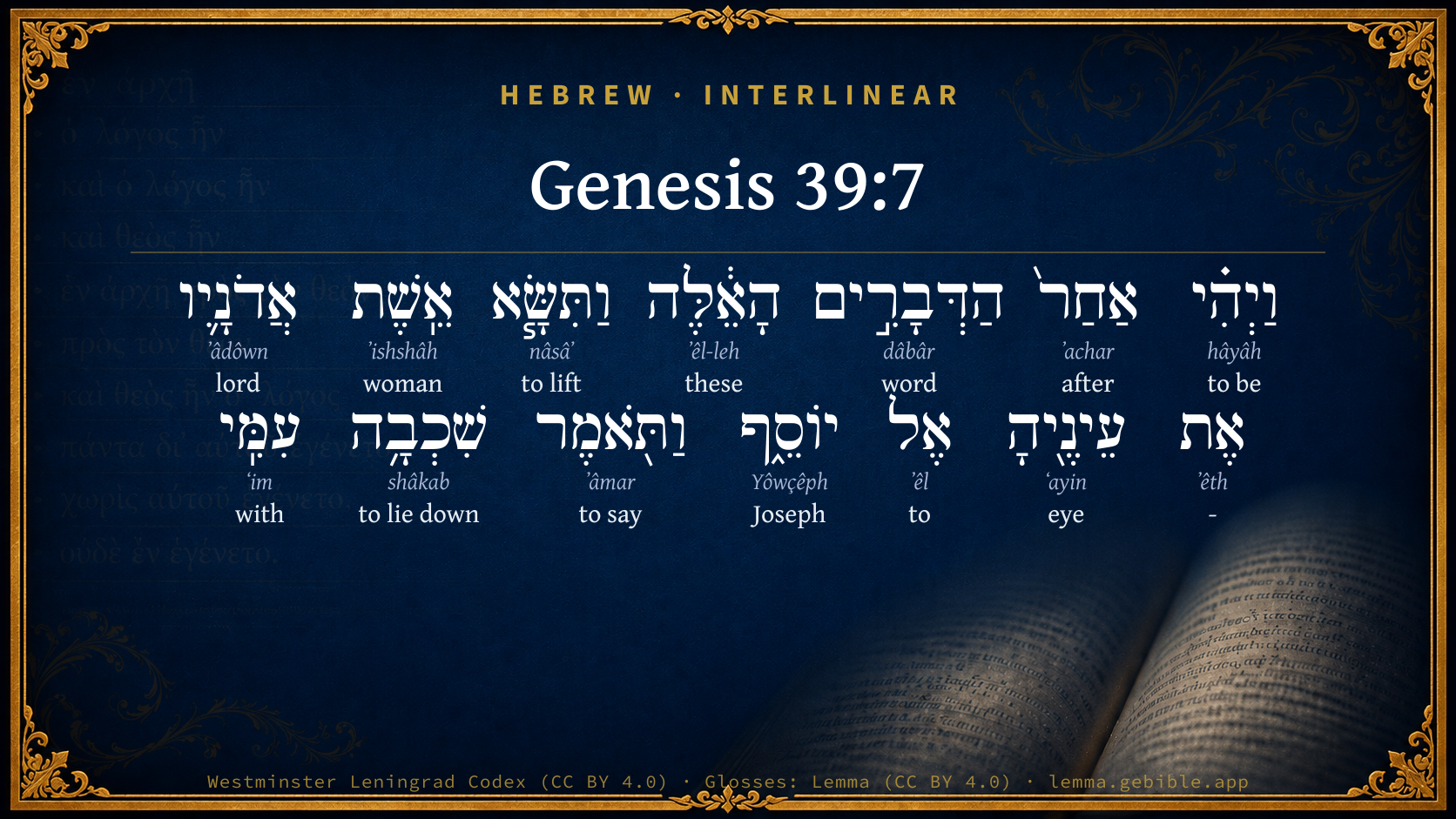
Hebrew (Westminster Leningrad Codex) Genesis 39:7 appears in the Hebrew Old Testament. The text above is from the Westminster Leningrad Codex. Each word links to its Strong’s number, a concise gloss, and parsing drawn from the Open Scriptures Hebrew Bible morphology. Click any word for its full Brown-Driver-Briggs (BDB) entry.
Download image
Cite this verse

Genesis 39:7 (World English Bible). Public Domain. Lemma interlinear Bible study tool, https://lemma.gebible.app/v/genesis/39/7.

Show BibTeX & RIS
BibTeX
RIS
English Translation
It happened after these things, that his master's wife cast her eyes on Joseph; and she said, "Lie with me."
World English Bible · Public Domain
Download a study sheet

One document with this verse’s original text, its word-by-word gloss line, the meaning frame, cross-references with their text, attributed commentary, and full source and license credits — printable, and it pastes into notes with its structure intact.

This verse Autodidact and up

Study sheet (.html) Plain text (.txt)

A passage Seminary Student

Up to 50 verses in one chapter. A passage sheet keeps up to 6 commentary sources and 12 cross-references per verse, in the order this page ranks them, and says so on the sheet whenever that leaves anything out. Ask for a single verse and you get the Autodidact verse sheet above.

Everything on this page stays free to read, with no account — the sheet is a download of what is already on screen, not access to it.

Want to remove ads? Support Godless Engineer
Compare translations 3

The same verse in 3 English versions, stacked beneath the original-language interlinear above. Click any original word for its lexicon entry.

Each is an independent rendering of the whole verse — the interlinear is not word-aligned to these translations.

Highlighted words mark where these versions differ — a whole-verse word diff, not a word-by-word alignment.

  • World English Bible Public Domain
    It happened after these things, that his master's wife cast her eyes on Joseph; and she said, "Lie with me."
  • King James Version Public Domain
    And it came to pass after these things, that his master's wife cast her eyes upon Joseph; and she said, Lie with me.
  • unfoldingWord Literal Text CC BY-SA 4.0
    And it happened after those things, then the wife of his master lifted her eyes toward Joseph and said, “Lie with me!”

unfoldingWord Literal Text — © unfoldingWord, licensed CC BY-SA 4.0. Word-aligned USFM3 via Door43 (git.door43.org/unfoldingWord/en_ult).

Versions to compare (up to 4)

3 of 4 selected

Show all 18 translations

Every available English version of this verse, each an independent rendering of the whole verse.

  • World English Bible Public Domain
    It happened after these things, that his master's wife cast her eyes on Joseph; and she said, "Lie with me."
  • Berean Standard Bible Public Domain
    and after some time his master’s wife cast her eyes upon Joseph and said, “Sleep with me.”
  • Majority Standard Bible Public Domain
    and after some time his master’s wife cast her eyes upon Joseph and said, “Sleep with me.”
  • King James Version Public Domain
    And it came to pass after these things, that his master's wife cast her eyes upon Joseph; and she said, Lie with me.
  • American Standard Version (1901) Public Domain
    And it came to pass after these things, that his master's wife cast her eyes upon Joseph; and she said, Lie with me.
  • Revised Version (1885) Public Domain
    And it came to pass after these things, that his master’s wife cast her eyes upon Joseph; and she said, Lie with me.
  • Geneva Bible (1599) Public Domain
    Nowe therefore after these thinges, his masters wife cast her eyes vpon Ioseph, and saide, Lye with me.
  • Douay-Rheims (1899) Public Domain
    h And after many days his mistress 'cast her eyes on Joseph, and said: Lie with me.
  • Young's Literal Translation Public Domain
    And it cometh to pass after these things, that his lord's wife lifteth up her eyes unto Joseph, and saith, `Lie with me;'
  • Literal Standard Version CC BY-SA 4.0
    And it comes to pass after these things, that his lord’s wife lifts up her eyes to Joseph and says, “Lie with me”;
  • Unlocked Literal Bible CC BY-SA 4.0
    It came about after this that his master's wife lusted for Joseph. She said, “Sleep with me.”
  • unfoldingWord Literal Text CC BY-SA 4.0
    And it happened after those things, then the wife of his master lifted her eyes toward Joseph and said, “Lie with me!”
  • Darby Bible Public Domain
    And it came to pass after these things, that his master's wife cast her eyes on Joseph, and said, Lie with me!
  • World Messianic Bible Public Domain
    After these things, his master’s wife set her eyes on Joseph; and she said, “Lie with me.”
  • Webster's Bible Public Domain
    And it came to pass after these things, that his master's wife cast her eyes upon Joseph: and she said, Lie with me.
  • Free Bible Version CC BY-SA 4.0
    so some time later he caught the eye of his master's wife. She propositioned him, saying, “Come here! Sleep with me!”
  • Bible in Basic English Public Domain
    And after a time, his master's wife, looking on Joseph with desire, said to him, Be my lover.
  • JPS Tanakh (1917) Public Domain
    And it came to pass after these things, that his master's wife cast her eyes upon Joseph; and she said: 'Lie with me.'

Literal Standard Version (2020), Covenant Press — licensed CC BY-SA 4.0. Text via the HelloAO Bible API (eBible.org). Unlocked Literal Bible (unfoldingWord) — licensed CC BY-SA 4.0. Text via the HelloAO Bible API (eBible.org). unfoldingWord Literal Text — © unfoldingWord, licensed CC BY-SA 4.0. Word-aligned USFM3 via Door43 (git.door43.org/unfoldingWord/en_ult). Free Bible Version, Dr. Jonathan Gallagher — licensed CC BY-SA 4.0. Text via the HelloAO Bible API (eBible.org).

Word by word

More ways to search: Search by grammar → Find every occurrence → Compare this word →

Practice this passage: Drill this verse → Learn its vocabulary →

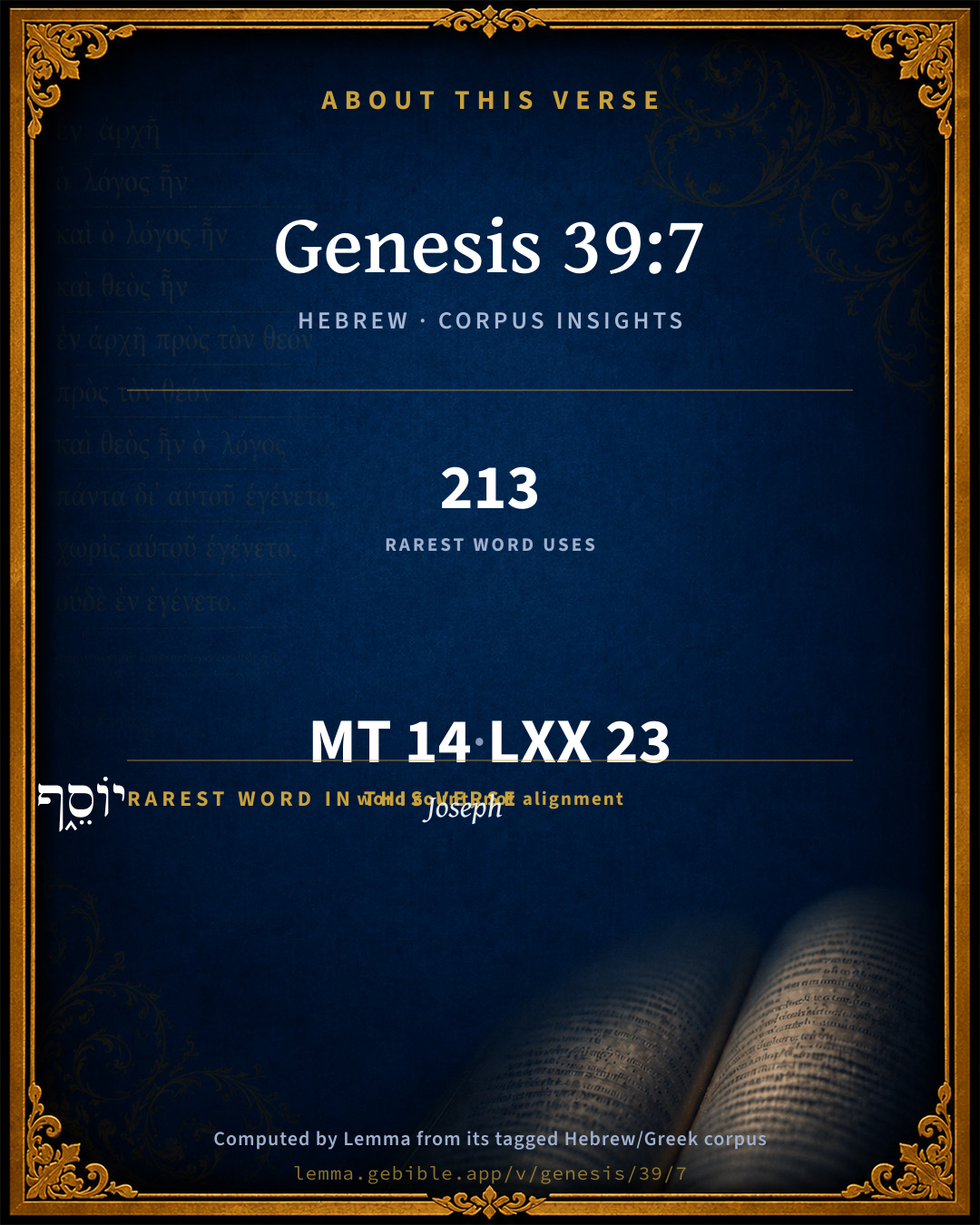
יוֹסֵ֑ף
Yôwçêph
H3130
“Joseph”
Noun, Proper
Part of Speech
Noun
Type
Proper
Full BDB Definition

Origin: future of H3254

TWOT: None

Joseph = "Jehovah has added" - the eldest son of Jacob by Rachel - father of Igal, who represented the tribe of Issachar among the spies - a son of Asaph - a man who took a foreign wife in the time of Ezra - a priest of the family of Shebaniah in the time of Nehemiah
  1. וַיְהִ֗י hâyâh H1961 “and · to be” Conjunction + Verb, Qal, Sequential Imperfect, 3rd Person, Masculine, Singular
  2. אַחַר֙ ʼachar H310 “after” Preposition
  3. הַדְּבָרִ֣ים dâbâr H1697 “the · words” Particle, Definite Article + Noun, Common, Masculine, Plural, Absolute
  4. הָאֵ֔לֶּה ʼêl-leh H428 “the · these” Particle, Definite Article + Pronoun, Demonstrative, Common, Plural
  5. וַתִּשָּׂ֧א nâsâʼ H5375 “and · to lift” Conjunction + Verb, Qal, Sequential Imperfect, 3rd Person, Feminine, Singular
  6. אֵֽשֶׁת ʼishshâh H802 “woman of” Noun, Common, Feminine, Singular, Construct
  7. אֲדֹנָ֛יו ʼâdôwn H113 “lords · his” Noun, Common, Masculine, Plural, Construct + Suffix, Personal, 3rd Person, Masculine, Singular
  8. אֶת ʼêth H853 “-” Particle, Direct Object
  9. עֵינֶ֖יהָ ʻayin H5869 “eyes · her” Noun, Common, Both, Dual, Construct + Suffix, Personal, 3rd Person, Feminine, Singular
  10. אֶל ʼêl H413 “to” Preposition
  11. וַתֹּ֖אמֶר ʼâmar H559 “and · to say” Conjunction + Verb, Qal, Sequential Imperfect, 3rd Person, Feminine, Singular
  12. שִׁכְבָ֥ה shâkab H7901 “lie down” Verb, Qal, Imperative, 2nd Person, Masculine, Singular + Suffix, h
  13. עִמִּֽי ʻim H5973 “with · me” Preposition + Suffix, Personal, 1st Person, Common, Singular

About this verse

These counts appear in no published source. They are computed here, from the morphology-tagged text and Lemma’s own curated glosses. What Lemma adds →

14
words
14
distinct lemmas
Pentateuch
section

Grammatical profile

  • 4 verbs
  • 5 nouns
  • 1 pronoun
  • 3 prepositions
  • 1 particle

Verb forms

  • וַיְהִ֗י Qal · Sequential Imperfect
  • וַתִּשָּׂ֧א Qal · Sequential Imperfect
  • וַתֹּ֖אמֶר Qal · Sequential Imperfect
  • שִׁכְבָ֥ה Qal · Imperative

Hebrew & Septuagint length

In English translation the verse runs 20 words from the Hebrew and 22 from the Septuagint (LXX English) — closely comparable.

A rough comparison of the two English renderings, which tokenize alike — not a word-level alignment.

Word counts can differ between the Hebrew and the Greek without any difference in meaning — e.g. the Hebrew direct-object marker אֵת has no separate Greek word, and Greek often adds the article ὁ.

In the original languages it is 14 Hebrew tokens and 23 Greek tokens — but the two are counted differently (Hebrew bundles its prefixes and suffixes into one token; the Greek is in lemma form), so that isn’t a like-for-like length.

Cross-references

17

Topical passages linked to Genesis 39:7 in the Treasury of Scripture Knowledge — connected by theme and wording, ordered by reader-vote popularity; previews shown in the World English Bible.

  • 2 Samuel 13:11 When she had brought them near to him to eat, he took hold of her, and said to her, Come, lie with me, my sister.
  • Ezekiel 16:34 You are different from [other] women in your prostitution, in that none follows you to play the prostitute; and whereas you give hire, and no hire is given to you, therefore you are different.
  • 2 Peter 2:14 having eyes full of adultery, and who can't cease from sin; enticing unsettled souls; having a heart trained in greed; children of cursing;
  • Job 31:1 "I made a covenant with my eyes, How then should I look lustfully at a young woman?
  • Ezekiel 16:32 A wife who commits adultery! who takes strangers instead of her husband!
  • Ezekiel 23:5–6 Oholah played the prostitute when she was mine; and she doted on her lovers, on the Assyrians [her] neighbors,
  • Ezekiel 23:12–16 She doted on the Assyrians, governors and rulers, [her] neighbors, clothed most gorgeously, horsemen riding on horses, all of them desirable young men.
  • Matthew 5:28 but I tell you that everyone who gazes at a woman to lust after her has committed adultery with her already in his heart.
  • 1 John 2:16 For all that is in the world, the lust of the flesh, the lust of the eyes, and the pride of life, isn't the Father's, but is the world's.
  • Genesis 6:2 that God's sons saw that men's daughters were beautiful, and they took for themselves wives of all that they chose.
  • Psalms 119:37 Turn my eyes away from looking at worthless things. Revive me in your ways.
  • Proverbs 2:16 To deliver you from the strange woman, Even from the foreigner who flatters with her words;
  • Proverbs 5:9 Lest you give your honor to others, And your years to the cruel one;
  • Proverbs 7:13 So she caught him, and kissed him. With an impudent face she said to him:
  • Proverbs 7:15–18 Therefore I came out to meet you, To diligently seek your face, And I have found you.
  • Jeremiah 3:3 Therefore the showers have been withheld, and there has been no latter rain; yet you have a prostitute's forehead, you refused to be ashamed.
  • Ezekiel 16:25 You have built your lofty place at the head of every way, and have made your beauty an abomination, and have opened your feet to everyone who passed by, and multiplied your prostitution.

Cross-references courtesy of OpenBible.info (CC BY 4.0).

Hebrew and Greek witnesses Masoretic Hebrew ↔ Greek Septuagint

The same verse in the two great witnesses to the Old Testament, shown verse-for-verse.

These are two independent witnesses, not word-aligned to each other, and the Septuagint is shown in lemma (dictionary) form.

Hebrew Genesis 39:7 Masoretic · Westminster Leningrad Codex

וַיְהִ֗י אַחַר֙ הַדְּבָרִ֣ים הָאֵ֔לֶּה וַתִּשָּׂ֧א אֵֽשֶׁת אֲדֹנָ֛יו אֶת עֵינֶ֖יהָ אֶל יוֹסֵ֑ף וַתֹּ֖אמֶר שִׁכְבָ֥ה עִמִּֽי

It happened after these things, that his master's wife cast her eyes on Joseph; and she said, "Lie with me."

World English Bible · Public Domain

Greek LXX Genesis 39:7 Septuagint · lemma form

καί γίγνομαι μετά ὁ ῥῆμα οὗτος καί ἐπιβάλλω ὁ γυνή ὁ κύριος αὐτός ὁ ὀφθαλμός αὐτός ἐπί ιωσηφ καί εἶπον κοιμάω μετά ἐγώ

And it came to pass after these things, that his master's wife cast her eyes upon Joseph, and said, Lie with me.

LXX2012 (modern English Septuagint) · Public Domain

Hebrew: Westminster Leningrad Codex (CC BY 4.0). Greek: Septuagint (public domain); English from LXX2012 (modern English Septuagint) (Public Domain). How the Septuagint differs from the Hebrew →

Targum (Aramaic paraphrase)

2

The Targum is the ancient Jewish Aramaic paraphrase of the Hebrew Scriptures — an interpretive translation, not the Hebrew text itself. Onkelos (literal) and Pseudo-Jonathan (expansive) render the Torah, and Jonathan the Prophets. Coverage is partial: where no permissively-licensed English translation exists for a verse, only the Aramaic is shown. This is verse-level text, not a word-by-word alignment to the Hebrew.

  1. Targum Onkelos Torah (Genesis–Deuteronomy)
    וַהֲוָה בָּתַר פִּתְגָּמַיָּא הָאִלֵּין וּזְקָפַת אִתַּת רִבּוֹנֵהּ יָת עֵינָהָא לְיוֹסֵף וַאֲמֶרֶת שְׁכוּב עִמִּי

    (no public-domain English translation for this verse)

    Targum Onkelos — Aramaic: “Onkelos Genesis” (public domain); “Onkelos Exodus” (public domain); “Onkelos Leviticus” (public domain); “Onkelos Numbers” (public domain); “Onkelos Deuteronomy” (public domain). English: “Sefaria Community Translation” (CC0 1.0 (public-domain dedication)); “J.W. Etheridge. The Targums of Onkelos and Jonathan Ben Uzziel on the Pentateuch. London: Longmans, Green, 1862” (public domain). Text via Sefaria.

  2. Targum Pseudo-Jonathan Torah (Genesis–Deuteronomy)
    וַהֲוָה בָּתַר פִּתְגָמַיָא הָאִלֵין וּזְקָפַת אִתַּת רִבּוֹנֵיהּ יַת עֵינָהּ בְּיוֹסֵף וַאֲמָרַת שְׁכוֹב עִמִי

    And it was after these things that the wife of his master lifted up her eyes to Joseph, and said, Lie with me.

    Targum Pseudo-Jonathan — Aramaic: “Targum Jonathan on Genesis” (public domain); “Targum Jonathan on Exodus” (public domain); “Targum Jonathan on Leviticus” (public domain); “Targum Jonathan on Numbers” (public domain); “Targum Jonathan on Deuteronomy” (public domain). English: “The Targum of Jonathan ben Uzziel, trans. J. W. Etheridge, London, 1862” (public domain). Text via Sefaria.

Commentary

Notes on Genesis 39:7 from classic Christian and Jewish commentators (each source and its license shown beneath its notes). The classic Christian expositions comment on the surrounding passage and are grouped to its opening verse, so a note may address several verses; the Jewish commentaries on the Tanakh (Rashi and others) are per-verse, so they appear only where the commentator wrote on this verse.

Lemma curates 59 commentaries, every one of them public domain or Creative Commons licensed, each selected and text-cleaned for this edition rather than reprinted as found. About our sources →

Matthew Henry's Commentary

Here is, I. A most shameful instance of impudence and immodesty in Joseph's mistress, the shame and scandal of her sex, perfectly lost to all virtue and honour, and not to be mentioned, nor thought of, without the utmost indignation. It was well that she was an Egyptian; for we must have shared in the confusion if such folly had been found in Israel. Observe,

I. Her sin began in the eye: She cast her eyes upon Joseph (Gen 39:7), who was a goodly person, and well-favoured, Gen 39:6. Note, (1.) Remarkable beauty, either of men or women, often proves a dangerous snare both to themselves and others, which forbids pride in it and commands constant watchfulness against the temptation that attends it; favour is deceitful - deceiving. (2.) We have great need to make a covenant with our eyes (Job 31:1), lest the eye infect the heart. Joseph's mistress had a husband that ought to have been to her for a covering of the eyes from all others, Gen 20:16.

2. She was daring and shameless in the sin. With an impudent face, and a harlot's forehead, she said, Lie with me, having already, by her wanton looks and unchaste desires, committed adultery with him in her heart. Note, Where the unclean spirit gets possession and dominion in a soul, it is as with the possessed of the devils (Luk 8:27, Luk 8:29), the clothes of modesty are thrown off and the bands and fetters of shame are broken in pieces. When lust has got head, it will stick at nothing, blush at nothing; decency, and reputation, and conscience, are all sacrificed to that Baal-peor. 3. She was urgent and violent in the temptation. Often she had been denied with the strongest reasons, and yet as often renewed her vile solicitations. She spoke to him day by day, Gen 39:10. Now this was, (1.) Great wickedness in her, and showed her heart fully set to do evil. (2.) A great temptation to Joseph. The hand of Satan, no doubt, was in it, who, when he found he could not overcome him with troubles and the frowns of the world (for in them he still held fast his integrity), assaulted him with soft and charming pleasures, which have ruined more than the former, and have slain their ten-thousands.

II. Here is a most illustrious instance of virtue and resolved chastity in Joseph, who, by the grace of God, was enabled to resist and overcome this temptation; and, all things considered, his escape was, for aught I know, as great an instance of the divine power as the deliverance of the three children out of the fiery furnace.

1. The temptation he was assaulted with was very strong. Never was a more violent onset made upon the fort of chastity than this recorded here. (1.) The sin he was tempted to was uncleanness, which considering his youth, his beauty, his single state, and his plentiful living at the table of a ruler, was a sin which, one would think, might most easily beset him and betray him. (2.) The tempter was his mistress, a person of quality, whom it was his place to obey and his interest to oblige, whose favour would contribute more than any thing to his preferment, and by whose means he might arrive at the highest honours of the court. On the other hand, it was at his utmost peril if he slighted her, and made her his enemy. (3.) Opportunity makes a thief, makes an adulterer, and that favoured the temptation. The tempter was in the house with him; his business led him to be, without any suspicion, where she was; none of the family were within (Gen 39:11); there appeared no danger of its being ever discovered, or, if it should be suspected, his mistress would protect him. (4.) To all this was added importunity, frequent constant importunity, to such a degree that, at last, she laid violent hands on him.

2. His resistance of the temptation was very brave, and the victory truly honourable. The almighty grace of God enabled him to overcome this assault of the enemy,

(1.) By strength of reason; and wherever right reason may be heard, religion no doubt will carry the day. He argues from the respect he owed both to God and his master, Gen 39:8, Gen 39:9. [1.] He would not wrong his master, nor do such an irreparable injury to his honour. He considers, and urges, how kind his master had been to him, what a confidence he had reposed in him, in how many instances he had befriended him, for which he abhorred the thought of making such an ungrateful return. Note, We are bound in honour, as well as justice and gratitude, not in any thing to injure those that have a good opinion of us and place a trust in us, how secretly soever it may be done. See how he argues (Gen 39:9): "There is none greater in this house than I, therefore I will not do it." Note, Those that are great, instead of being proud of their greatness, should use it as an argument against sin. "Is none greater than I? Then I will scorn to do a wicked thing; it is below me to serve a base lust; I will not disparage myself so much." [2.] He would not offend his God. This is the chief argument with which he strengthens his aversion to the sin. How can I do this? not only, How shall I? or, How dare I? but, How can I? Id possumus, quod jure possumus - We can do that which we can do lawfully. It is good to shut out sin with the strongest bar, even that of an impossibility. He that is born of God cannot sin, Jo1 3:9. Three arguments Joseph urges upon himself. First, He considers who he was that was tempted. "I; others may perhaps take their liberty, but I cannot. I that am an Israelite in covenant with God, that profess religion, and relation to him: it is next to impossible for me to do so." Secondly, What the sin was to which he was tempted: This great wickedness. Others might look upon it as a small matter, a peccadillo, a trick of youth; but Joseph had another idea of it. In general, when at any time we are tempted to sin, we must consider the great wickedness there is in it, let sin appear sin (Rom 7:13), call it by its own name, and never go about to lessen it. Particularly let the sin of uncleanness always be looked upon as great wickedness, as an exceedingly sinful sin, that wars against the soul as much as any other. Thirdly, Against whom he was tempted to sin - against God; not only, "How shall I do it, and sin against my master, my mistress, myself, my own body and soul; but against God?" Note, Gracious souls look upon this as the worst thing in sin that it is against God, against his nature and his dominion, against his love and his design. Those that love God do for this reason hate sin.

(2.) By stedfastness of resolution. The grace of God enabled him to overcome the temptation by avoiding the tempter. [1.] He hearkened not to her, so much as to be with her, Gen 39:10. Note, Those that would be kept from harm must keep themselves out of harm's way. Avoid it, pass not by it. Nay, [2.] When she laid hold of him, he left his garment in her hand, Gen 39:12. He would not stay so much as to parley with the temptation, but flew out from it with the utmost abhorrence; he left his garment, as one escaping for his life. Note, It is better to lose a good coat than a good conscience.

Matthew Henry's Commentary on the Whole Bible (1708–1710) — public domain (CC PDM 1.0). Text via the HelloAO Bible API.

Trapp's Complete Commentary

John Trapp

Gen 39:7 And it came to pass after these things, that his master’s wife cast her eyes upon Joseph; and she said, Lie with me.

Ver. 7. After these things.] After he had been ten or eleven years in that house. So long he was safe: yet at length set upon. Learn we always to stand upon our guard; to do, as it is reported of the bird Onocrotalus, that she is so well practised to expect the hawk to grapple with her, that even, when she shutteth her eyes, she sleepeth with her beak exalted, as if she would contend with her adversary. {a} A man is to expect, if he live out his days, to be urged to all sins, to the breach of every branch of the ten commandments, and to be put to it in respect of every article of our creed.

His master’s wife cast her eyes upon Joseph.] She looked and lusted. {b} {See Trapp on "Gen 34:2"}

And she said, Lie with me.] An impudent harlotry, that could so barely and basely solicit. Such a frontless propudium was that in the Pro 7:13; Pro 7:18. Such were those insatiate empresses, Messalina, wife to Claudius; and Barbara, wife to Sigismund, emperor of Germany, faemina immensae libidinis et procacitatis inverecundae, quae saepius viros peteret quam peteretur. Vitam omnem censuit inanem, quae non coitu, luxu, ac libidine contereretur. {c} And such were those brazen faced courtezans that Franciscus Junius, that learned man, met with; and for their sakes abhorred the company of all women ever after, as himself recordeth in his own life.

{a} The Divine Cosmographer, p. 94.

{b} Non dicit Moses, "Vidit"; "Aspexit," &c. Hic fuit aspectus impudicus. - Pareus.

{c} Pareus, in Medul. Hist. Profanae, p. 786. Haec stultas vocabat virgines pro Christi nomine passas, quod voluptatum gaudia non gustassent.

John Trapp, A Commentary or Exposition upon All the Books of the Old and New Testament (1647–1656) — public domain. Text from a community e-Sword module.

The Pulpit Commentary

CHAPTER 39:7-23

And it came to pass after these things, Joseph had by this time been nearly ten years in Potiphar"s house (vide Gen_41:46) that his master s wife cast her eyes (lasciviously) upon Joseph; and she said, Lie with me. According to monumental evidence (Wilkinson"s "Ancient Egyptians," vol. 1. p. 392, ed. 1878; Hengstenbergs "Egypt and the Books of Moses," 1:25; Kalisch, p. 631) and historical testimony (Herod., 2:111), Egyptian females, even though married, were distinguished for licentiousness and immorality, and were not condemned to live in seclusion (Bohlen), but were allowed freely to mix in promiscuous society, which facts perfectly account for Joseph s temptation by his mistress.

Vers. 7-23.

Joseph and the wife of Potiphar.

I THE GREAT TEMPTATION.

1. The time of it. Never perhaps had Joseph s prospects been brighter since he left his father"s house than towards the close of that decade of years which he spent in the Egyptian officer"s employ; and yet then it was that, like a thunderbolt shot from a clear sky, a fierce temptation burst upon him.

1. The occasion of it. This was the beauty of Joseph" s person. Things innocent and lovely in themselves may sometimes be a source of danger, and, if not guarded against, a cause of sin, to their possessors. In particular the good looks of men and women are often snares to others as well as fraught with peril to themselves, as the cases Of Sarah, (Gen_12:14) Rebekah, (Gen_26:10) and Dinah (Gen_34:2) testify. Hence beauty of the person should neither be too eagerly coveted nor too proudly worn by either sex, as-by each its charms in the other should be moderately admired, and its allurements earnestly resisted.

2. The form of it. The special trial to which the young man Joseph was now subjected partook of the character of an assault upon his chastity. It is, however, a mistake to suppose that a good man is always assaulted at the point where he is weakest. On the contrary, it is one of the devil"s blunders that, in directing his attacks against saints, he for the most part mistakenly selects the point where they are strongest. Joseph was permitted to be assailed by his lascivious mistress not because his own personal virtue was doubtful, but because in that direction he was best prepared to repel the fiercest onset of temptation.

3. The strength of it. There were elements in this assault upon Joseph"s virtue which were calculated to impart to it a vehemence that in ordinary circumstances, i.e. with persons of less robustness of moral principle than Joseph, must have proved overwhelming. These were

(1) The person by whom it was directed, viz., Joseph"s mistress, the wife of a high officer of state, whose smile might have turned the head and intoxicated the heart of a young man who was only her slave.

(2) The vehement importunity with which it was urged, his mistress speaking to him day by day, and even by act as well as word endeavoring to prevail.

(3) The convenient opportunity which was almost always presented, seeing that Joseph"s master was mostly absent, and the domestics often out of the way.

(4) The danger he might incur by offending one so high in rank as his master"s wife.

(5) The advantages he might expect to reap from complying with her pleasure.

II THE SPLENDID VICTORY.

1. The manner of Joseph"s refusal.

(1) Promptly, without the slightest hesitation or appearance of dallying with the tempting bait. Had Joseph hesitated, he might have been lost; had he trifled with the forbidden fruit, he might have plucked and ate.

(2) Firmly. There was no sound of wavering or indecision about the reply of Joseph. It was not the answer of a man who was only half-hearted in putting away from him a thing which he secretly desired. In Joseph"s "no" there was the clear, full-toned ring of a man who had made up his mind intelligently and finally.

(3) Kindly. Joseph behaved towards his mistress with as much tenderness as his moral indignation and disgust at her behavior would allow; his considerateness shining out conspicuously in this, that he studiously endeavored to be as much as possible out of the unhappy woman"s sight, in the hope, doubtless, that her unholy passion might abate.

(4) Bravely. Joseph was prepared to run any risk rather than accede to the base proposal of his mistress, as was proved by his fleeing from the house without his doublet, when the impudent woman sought by catching hold of him to secure compliance with her request.

2. The reason of Joseph"s refusal.

(1) The greatness of the trust reposed in him by his master. Potiphar had committed everything to his (Joseph"s) care; and how then could he repay with treachery so abominable a confidence so great?

(2) The extent of the power delegated to him. Potiphar had kept back nothing from him except his wife: how then, having privileges so extensive, should he covet the one thing forbidden?

(3) The sacredness of the relationship existing between his mistress and Potiphar. "Thou art his wife;" and by the covenant of marriage thou belongest to him only, and not to me.

(4) The heinousness of the sin of which he would be guilty. "How can I do this great wickedness, and sin against God?

III THE REMARKABLE REWARD.

1. The slander of his mistress. The disappointed strumpet, thirsting for revenge, resolves upon accomplishing the ruin of the fair youth of whom the moment before she affected to be enamored. But indeed all illicit passion, whether gratified or baulked, has a tendency sooner or later to become transformed into hate. Laying up the garment which Joseph had indiscreetly dropped in his haste, she makes use of it to trump up a charge against Joseph of having attempted a violation of her chastity. There is no length to which the fierce resentment of a wicked woman will not proceed against those who have incurred her hate. It will commonly go hard with her if out of a straw her infernal ingenuity cannot manufacture a rope wherewith to strangle her victim.

2. The wrath of his master Potiphar, as was natural, at first felt inclined to believe his wife and to suppose that Joseph had foully betrayed the trust reposed in his honor. In this, of course, he acted hastily, and therefore sinfully. Even from the nearest and the dearest reports affecting injuriously the characters of others should not be accepted without investigation. But that second thoughts prevailed with Potiphar, who, remembering the bad reputation of Egyptian ladies generally, and knowing something possibly of the slenderness of his own wife"s virtue, as well as recalling the previous high character of Joseph, began to doubt the truth of what was alleged against his favorite, and to think it more likely that his wife lied than that Joseph sinned, has been inferred from the circumstance that Joseph was not forthwith remitted to the executioner"s block, but only committed to the tower.

3. The mercy of his God. As before, Jehovah went with Joseph to the prison, and comforted him with gracious thoughts concerning his affliction, with speedy favor in the sight of his keeper, so that the severity of his confinement was considerably mitigated, and with ultimate promotion to a position of trust within the prison, the charge of all the criminals being committed to his care. And finally, the Lord made him prosperous and successful as before in all his undertakings.

The Pulpit Commentary (1880–1919), ed. H.D.M. Spence-Jones & Joseph S. Exell — public domain. Text from a community e-Sword module.

The Preacher's Complete Homiletical Commentary

Joseph S. Exell (gen. ed.)

CRITICAL NOTES.—

Gen_39:9. Sin against God.] Joseph uses the common name for God in addressing this Egyptian.—

Gen_39:11. About this time.] Heb. At this day. The day on which the occurrence now related took place.

MAIN HOMILETICS OF THE PARAGRAPH.—Gen_39:7-12

THE TEMPTATION OF JOSEPH

I. The strength of it. Joseph had been severely tried on the side of endurance of adversity, now he is tried by the more perilous temptation of sensuality. This was a most fierce temptation, when we consider—

1. His youth. Joseph was young and of beautiful form and countenance. In youth endowed with high health and vigour the sensual passions are violent and impetuous. The temptation to gratify them is strong.

2. The force of opportunity. Joseph’s beauty proved a snare to him. His master’s wife “cast her eyes” upon him. (Gen_39:7.) He had not to seek to draw her into temptation. She solicited him.

3. The prospect of advancement which his compliance would secure. “He saw this pleasure would advance him: he knew what it was to be a minion of one of the greatest ladies in Egypt: yet resolves to contemn.”—(Bp. Hall.)

4. The repetition of the temptation. It was renewed day by day. (Gen_39:10.) Many are able to withstand temptation in the first instance who yet fail to hold out to the end. Eve resisted the tempter at the first outset, but was overcome by the second. Samson refused at first to satisfy Delilah’s insidious questions, but was at last conquered by the tears and importunities of that fair woman. The assaults of temptation may prevail even over sturdy virtue by repeated blows.

II. His resistance of it. Mark the grounds upon which he refuses the base proposal. He says nothing about the wickedness of the tempter. He utters no word of reproach for her sensuality and faithlessness; but simply considers his own obligation—what he ought to do.

1. He pleads the law of honour. His master had reposed great trust in him, and he must not abuse that confidence. (Gen_39:8-9.)

2. He pleads the law of chastity. “How then can I do this great wickedness?” It was a moral wrong in itself, an invasion of the rights of another, a crime against society.

3. He pleads the law of piety. It was “a sin against God,” a direct violation of His commandment. He recognises a supreme authority over human conduct. It would be trespass against heaven to break through God’s distinct prohibition. He must be faithful to God as well as to man.

III. His victory over it.

1. It was obtained by flight. (Gen_39:12). He was firm in refusing, and yet he would not imperil his virtue by remaining in the neighbourhood of temptation. He would not expose his strength to too severe and to an unnecessary trial. Therefore he consulted his safety by taking to flight. Such flight is more honourable than the most heroic deeds. He who would avoid being vanquished by temptation must use his own prudence in taking the first way of escape. Divine aid is only for those who are willing to work in harmony with it.

2. It was obtained through loss. He retained a good conscience—the approval of God, but he lost his good name. His real character in the sight of God was preserved pure, but his reputation in the sight of men was gone. He would rather lie humbled in the dust, under the imputation of evil, than rise by sinful means. “How much had he rather leave his cloak than his virtue; and to suffer his mistress to spoil him of his liberty, rather than he should blemish her honour, or his master’s in her, or God’s in either of them?”—(Bp. Hall.)

SUGGESTIVE COMMENTS ON THE VERSES

Gen_39:7. After these things. A man is to expect, if he live out his days, to be urged to all sins, to the breach of every branch of the ten commandments, and to be put to it in respect of every article of our creed.—(Trapp.)

The times of our advance in the world may prove the times of our greatest temptation.

Circe may enchant us, the cockatrice slay us with her sight. “Let her not take thee with her eyelids,” saith Solomon (Pro_6:25); as larks, while they gaze in a glass, are taken in a day-net.—(Trapp.)

All the spite of his brethren was not so great a cross to him as the inordinate affection of his mistress.—(Bp. Hall.)

Gen_39:8. Joseph, as an example of chastity, stands here in the brightest light when compared with the conduct of Judah in the previous chapter.—(Lange.)

He refused, though this wicked woman could easily have taken her revenge upon him for it.

To argue from bounty to duty is but right reason; but to argue, as most do, from God’s liberality to liberty in sin, is the devil’s logic. Joseph will not deal so basely with his master, though an Egyptian. To render good for evil is divine; good for good is human, but evil for good is devilish. The “goodness of God should lead us to repentance,” saith Paul. (Rom_2:4.) And this Peter picks out of Paul’s Epistles, as one of the choicest sentences, and urged it upon those to whom he wrote. (2Pe_3:15.)—(Trapp.)

Verse 9. He considers his obligation as heightened by the generosity and kindness of his master, who withheld nothing else from him. Eve reasoned at first on this principle (Gen_3:2.), and had she kept to it, she had been safe. When we are tempted to covet what God has forbidden, it were well to think of the many things which He has not forbidden, but freely given us.—(Fuller.)

Though the iron entered into Joseph’s soul, sin could not; because it was fraught with God’s fear. He had “set God at his right hand,” and “therefore he was not moved.” (Psa_16:8.) Satan knocked oft at that door, but there was none within to answer or open. He struck fire, but upon wet tinder. Joseph in Egypt, like a pearl in a puddle, keeps his virtue still, wherever he comes.—(Trapp.)

It will not only be treachery to my master on earth, but daring wickedness against my Master in heaven. God is our Maker and our Judge; and if honour required Joseph to be faithful to his master, much more did religion, which is a far stronger principle, oblige him to be faithful to his God; if gratitude bound him not to sin against the former, how much more strong ought that feeling be towards God?—(Bush.)

The fear of God is the keeper of all other virtues.

Gen_39:10. Joseph finds it necessary to shun her company. This showed—

1. His great sincerity: for if we throw ourselves in the way of temptation, or be not careful to shun it when occasions offer, in vain do we talk against sin.

2. Great wisdom: for though he had been kept hitherto, he was not sure that he should be so in future.

3. Great resolution and perseverance: for it is not every one who withstands a temptation in the first instance that holds out to the end. Job endured a series of trials and sinned not; yet afterwards spake things which he ought not.

4. Great grace. “Can a man go upon hot coals, and his feet not be burned?” No; if we voluntarily go into temptation, we shall assuredly be hurt, if not ruined by it; but when God by His providence leads us into it for the trial of our graces, we may hope to be preserved in it, and brought victorious out of it.—(Fuller.)

Gen_39:11-12. We are reminded here of Solomon’s description of an impudent woman. (Pro_7:13-23).

The Church “comes from the wilderness,” that is, through troubles and afflictions, leaning on her beloved. (Son_8:5); choosing rather to suffer than to sin. The good heart goes in a right line to God, and will not fetch a compass, but strikes through all troubles and hazards to get to Him. It will not break the hedge of any commandment, to avoid any piece of foul way.—(Trapp.)

This second time is Joseph stript of his garment; before, in the violence of envy, now of lust; before, of necessity, now of choice; before, to deceive his father, now his master; for, behold the pledge of his fidelity, which he left in those wicked hands, is made an evidence against him, of that which he refused to do; therefore did he leave his cloak, because he would not do that of which he is accused and condemned, because he left it. What safety is there against great adversaries, when even arguments of innocence are used to convince of evil? Lust yielded unto is a pleasant madness, but is desperate madness when it is opposed; no hatred burns so furiously as that which arises from the quenched coals of love.—(Bp. Hall.)

The Preacher's Complete Homiletical Commentary (gen. ed. Joseph S. Exell; Funk & Wagnalls, c. 1892) — public domain (pre-1929). A full-Bible homiletical/sermon-outline anthology covering 65 of 66 books (2 John is absent from the source module). Text from a community e-Sword module.

Geneva Bible (1599)

Geneva Bible translators

In this word he declareth the sum whereunto all her flatteries did tend.

Geneva Bible (1599) marginal notes — public domain. Text via Bolls.life.

Jamieson, Fausset & Brown

Robert Jamieson, A. R. Fausset & David Brown

his master's wife cast her eyes upon Joseph--Egyptian women were not kept in the same secluded manner as females are in most Oriental countries now. They were treated in a manner more worthy of a civilized people--in fact, enjoyed much freedom both at home and abroad. Hence Potiphar's wife had constant opportunity of meeting Joseph. But the ancient women of Egypt were very loose in their morals. Intrigues and intemperance were vices very prevalent among them, as the monuments too plainly attest [WILKINSON]. Potiphar's wife was probably not worse than many of the same rank, and her infamous advances made to Joseph arose from her superiority of station.

Jamieson, Fausset & Brown — Commentary Critical and Explanatory on the Whole Bible (1871) — public domain (CC PDM 1.0). Text via the HelloAO Bible API.

John Calvin's Commentaries

7. Lie with me Moses only briefly touches upon the chief points, and the sum of the things he relates. For there is no doubt that this impure woman endeavored, by various arts, to allure the pious youth, and that she insinuated herself by indirect blandishments, before she broke forth to such a shameless kind of license. But Moses, omitting other things, shows that she had been pushed so far by base lust, as not to shrink from openly soliciting a connection with Joseph. Now as this filthiness is a signal proof that carnal lust acts from blind and furious impulses; so, in the person of Joseph, an admirable example of fidelity and continence is set before us. His fidelity and integrity appear in this, that he acknowledges himself to be the more strictly bound, the greater the power with which he is entrusted. Ingenuous and courageous men have this property, that the more is confided to them, the less they can bear to deceive: but it is a rare virtue for those who have the power of doing injury to cultivate honesty gratuitously. Wherefore Joseph is not undeservedly commended by Moses, for regarding the authority with which he was invested by his master, as a bridle to restrain him from transgressing the bounds of duty. Besides, he gives also a proof of his gratitude, in bringing forward the benefits received from his master, as a reason why he should not subject him to any disgrace. And truly hence arises at this day such confusion everywhere, that men are half brutal, because this sacred bond of mutual society is broken. All, indeed, confess, that if they have received any benefit from another, they are under obligation to him: one even reproaches another for his ingratitude; but there are few who sincerely follow the example of Joseph. Lest, however, he should seem to be restrained only by a regard to man, he also declares that the act would be offensive to God. And, indeed, nothing is more powerful to overcome temptation than the fear of God. But he designedly commends the generosity of his master, in order that the wicked woman may desist from her abandoned purpose. To the same point is the objection which he mentions, Neither hath he kept anything back from me but thee, because thou art his wife. Why does he say this, except that, by recalling the religious obligation of marriage, he may wound the corrupt mind of the woman, and may cure her of her insane passion? Therefore he not only strenuously strives to liberate himself from her wicked allurements; but, lest her lusts should prove indomitable, he proposes to her the best remedy. And we may know that the sanctity of marriage is here commended to us in the history of Joseph, whereby the Lord would declare himself to be the maintainer of matrimonial fidelity, so that none who violate another’s bed should escape his vengeance. For he is a surety between the man and his wife, and requires mutual chastity from each. Whence it follows that, besides the injury inflicted upon man, God himself is grievously wronged.

John Calvin's Commentaries (1540-1563) — public domain. Text from the Calvin Translation Society English edition (1840s-50s) via the Christian Classics Ethereal Library (ccel.org). Calvin's coverage is partial (roughly two-thirds of the Bible); uncommented books and verses are honest gaps, never fabricated. The 19th-century editor's footnotes and remarks are omitted so the notes are faithfully Calvin's own voice.

John Gill's Exposition

And it came to pass after these things,.... After he was the overseer of his house; in which office, after he had been some time, so it was

that his master's wife cast her eyes upon Joseph; he being a handsome young man, caught her eye, and that her heart, and led her on to lust after him, and frequently fed her eyes with amorous glances at him:

and at length being fired with lust, and having an opportunity:

she said, to him, in a bold and impudent manner, in plain words, having given signs and hints, and dropped expressions tending thereto before, as it is probable:

lie with me; now directly, there being both opportunity and convenience, perhaps her chamber was near: this was a very great temptation to a young man in single life and living well, from his mistress, who had it greatly in her power to make him should he consent, or ruin him should he deny.

John Gill's Exposition of the Whole Bible (1746–1763) — public domain (CC PDM 1.0). Text via the HelloAO Bible API.

Haydock's Catholic Bible Commentary

Many days. About 10 years; as Joseph was 30, three years after this. (Calmet)

George Leo Haydock (1774–1849), Haydock's Catholic Family Bible and Commentary, 1859 edition — public domain. Excludes Psalms (Douay-Rheims chapter numbering differs from Protestant) and Deuterocanonical books (Catholic canon only).

Matthew Poole's English Annotations

She

cast her eyes upon Joseph, in a lascivious and unchaste manner. See Job 31:1; Mat 5:28; 2Pe 2:14.

Matthew Poole's English Annotations on the Holy Bible (1683–1685) — public domain. Text from a community e-Sword/MySword module.

Whedon's Commentary on the Bible

Daniel D. Whedon

7. Cast her eyes upon Joseph — Having briefly but impressively explained how Joseph became exalted in the house of his Egyptian master, and now Potiphar trusted every thing to his management; also having, at the close of Gen_39:6, mentioned the great personal beauty of the Hebrew slave, the writer has prepared us to understand the power of the great temptation which came to Joseph. The licentiousness of Egyptian women is evidenced by numerous testimonies. The monuments, as well as ancient writers, show that they did not live the secluded life to which the women of other eastern nations were compelled. See Wilkinson, Ancient Egypt, vol. i, p. 144; vol. ii, p. 224. An Egyptian papyrus in the British Museum relates the story of two brothers, the wife of the elder of whom acts and speaks toward the younger almost in the same words that Potiphar’s wife used with Joseph. See Ebers, Egypten, p. 311.

Daniel D. Whedon (gen. ed.), Commentary on the Old and New Testaments (1874–1909) — public domain. Text from a community e-Sword module.

Kretzmann's Popular Commentary

Paul E. Kretzmann

Joseph Flees from Temptation

v. 6. And Joseph was a goodly person, and well favored. He was a handsome young man, and well proportioned, well built.

v. 7. And it came to pass after these things that his master’s wife cast her eyes upon Joseph; and she said, Lie with me. With lustful persuasions, continued for some time, she tried to lead him to commit fornication.

v. 8. But he refused, and said unto his master’s wife, Behold, my master wotteth (knoweth)not what is with me in the house, and he hath committed all that he hath to my hand;

v. 9. there is none greater in this house than I; neither hath he kept back anything from me but thee, because thou art his wife; how, then, can I do this great wickedness, and sin against God? Joseph gave three reasons why he was obliged to be disobedient to his master’s wife: It would have been a disgraceful abuse of the confidence placed in him by his master; it would have been an outrage upon Potiphar’s rights as a husband; it-would have been adultery, a great crime in the sight of God. It is the thought of God, the fear of the Lord, the consciousness that nothing is hidden from His knowledge, that aids in fighting temptations of every kind.

v. 10. And it came to pass, as she spake to Joseph day by day, that he hearkened not unto her to lie by her or to be with her. He resolutely turned his face from the temptation, he arranged his work so that he was never alone with her, all of which meant a continual battle with his own flesh and blood.

v. 11. And it came to pass about this time that Joseph went in to the house to do his business, a day came when he came to the house to attend to his work; and there was none of the men of the house there within. It was probably by her arrangement that all the servants were absent at that time.

v. 12. And she caught him by his garment, she took a firm hold of his outer garment, saying, Lie with me; she wanted to take by force what she could not obtain by her lustful suggestions. And he left the garment in her hand, and fled, and got him out. He preferred flight with the loss of his dress and of his good name to the loss of his chastity. So far as youthful lusts are concerned, there is only one way of dealing with them properly, namely, by fleeing from them, by fleeing fornication and every form of uncleanness. For it is here that no person dare to put too much confidence in himself.

Paul E. Kretzmann, Popular Commentary of the Bible (1921–1924) — public domain. Text from a community e-Sword module.

unfoldingWord translationNotes

Door43 World Missions Community

It came about after this that

"And so." This phrase is used here to mark a new event. (See: Introduction of a New Event)

Look

"Listen." Joseph uses this word to get Potiphar's wife's attention.

my master does not pay attention to what I do in the house

"my master has no concern about his household with me in charge." This can be written in positive form. AT: "my master trusts me with his household" (See: Double Negatives)

he has put everything that he owns under my care

When something is "put under someone's care," it means that the person is responsible for its care and safe-keeping. AT: "he has put me in charge of everything that belongs to him" (See: Metaphor)

No one is greater in this house than I am

Here the author speaks of authority as if it were greatness. AT: "I have more authority in this house than anyone else" (See: Metaphor)

He has not kept back anything from me but you

This can be stated in positive form. AT: "He has given me everything except you" (See: Litotes)

How then can I do this great wickedness and sin against God?

Joseph uses a question for emphasis. This can be written as a statement. AT: "I certainly cannot do such a wicked thing and sin against God." (See: Rhetorical Question)

translationWords

lust

had relations with

lord

evil

sin

God

unfoldingWord translationNotes — © Distant Shores Media and the Door43 World Missions Community, licensed CC BY-SA 4.0. Source: git.door43.org/Door43/en_tn.

Rashi

Rabbi Shlomo Yitzchaki (Rashi)

ותשא אשת אדניו HIS LORD’S WIFE LIFTED UP HER EYES etc. — wherever אחר is used and not אחרי it means immediately after (Genesis Rabbah 44:5).

Rashi on the Tanakh — English translations: “The Judaica Press complete Tanach with Rashi, translated by A. J. Rosenberg” (CC BY 4.0); “Pentateuch with Rashi's commentary by M. Rosenbaum and A.M. Silbermann, 1929-1934” (public domain); “The Metsudah Tanach series, Lakewood, N.J” (CC BY 4.0); and “The Book of Joshua, Metsudah Publications, 1997” (CC BY 4.0). Text via Sefaria.

Radak

Rabbi David Kimhi (Radak)

ויהי אחר הדברים האלה, after Joseph had been in the house of his Egyptian master for some time and had occupied the highest position in that household, feeling very secure, the invitation of a romantic relationship with Mrs. Potiphar brought tension into his life again. He had, of course, no way of knowing at the time that these developments had as its purpose that he would in due course rise to far higher prominence and that he would become the direct instrument of bringing his family to Egypt where they would reside in comfort and found a nation. Also the sin of the Chief butler and Chief baker respectively, as well as their being held in the same jail as Joseph and his becoming their valet, were all part of G’d’s design to further His plans without interfering with anyone’s free choice. We have to learn from this whole story that when a person suffers a setback in life, one that appears to him undeserved, he must remember how all these setbacks worked in Joseph’s favour at the time although he was not yet aware of it. We must therefore trust that G’d has our best interests at heart at all times, even though we cannot always appreciate this at the time when we are being tested. The incidents were narrated at this point to demonstrate Joseph’s righteousness when on his own without family support, after having in effect been cast out from his family.

Radak on the Tanakh — English translations: “Sefaria Community Translation” (CC0 1.0 (public-domain dedication)); “Eliyahu Munk, HaChut Hameshulash” (CC BY 4.0); “Rabbi Mike Feuer, Jerusalem Anthology” (CC BY 4.0); and “R. David Kimhi on the first book of Psalms, Translated by R.G. Finch, London, 1919” (public domain). Text via Sefaria.

Lesson kit

Teaching starters — assembled from the data on this page, not authored interpretation. Every prompt links to the verse data it draws on. Edit before teaching.

Genesis, in the Pentateuch, opens this verse with 14 words (14 distinct Hebrew lemmas). Its most distinctive word is Yôwçêph (“Joseph”). A historical commentator’s framing appears above. Read the whole chapter for the surrounding context.

Discussion questions

  1. The word Yôwçêph carries the sense “Joseph.” How does it shape the verse?
  2. How does 2 Samuel 13:11, which shares this passage’s theme, read alongside this verse?
  3. The translations on this page render this verse differently — a whole-verse word diff, not a word-by-word alignment. What might account for the different wordings?
  4. «וַיְהִ֗י» is a Qal Sequential Imperfect verb. How does that grammatical form shape the action described?
  5. Compare how Matthew Henry's Commentary and Trapp's Complete Commentary read this verse. Where do they agree or differ?

Things to notice

Reading settings

Reading text

Shown beneath each verse's original-language words.

Old Testament
Old Testament edition

Read the OT as the Masoretic Hebrew (MT) or the Greek Septuagint (LXX).

English shown for the Greek Septuagint (in the Hebrew ↔ Greek comparison).

Comparing translations? Open the Compare panel on any verse page to stack up to four side by side.