
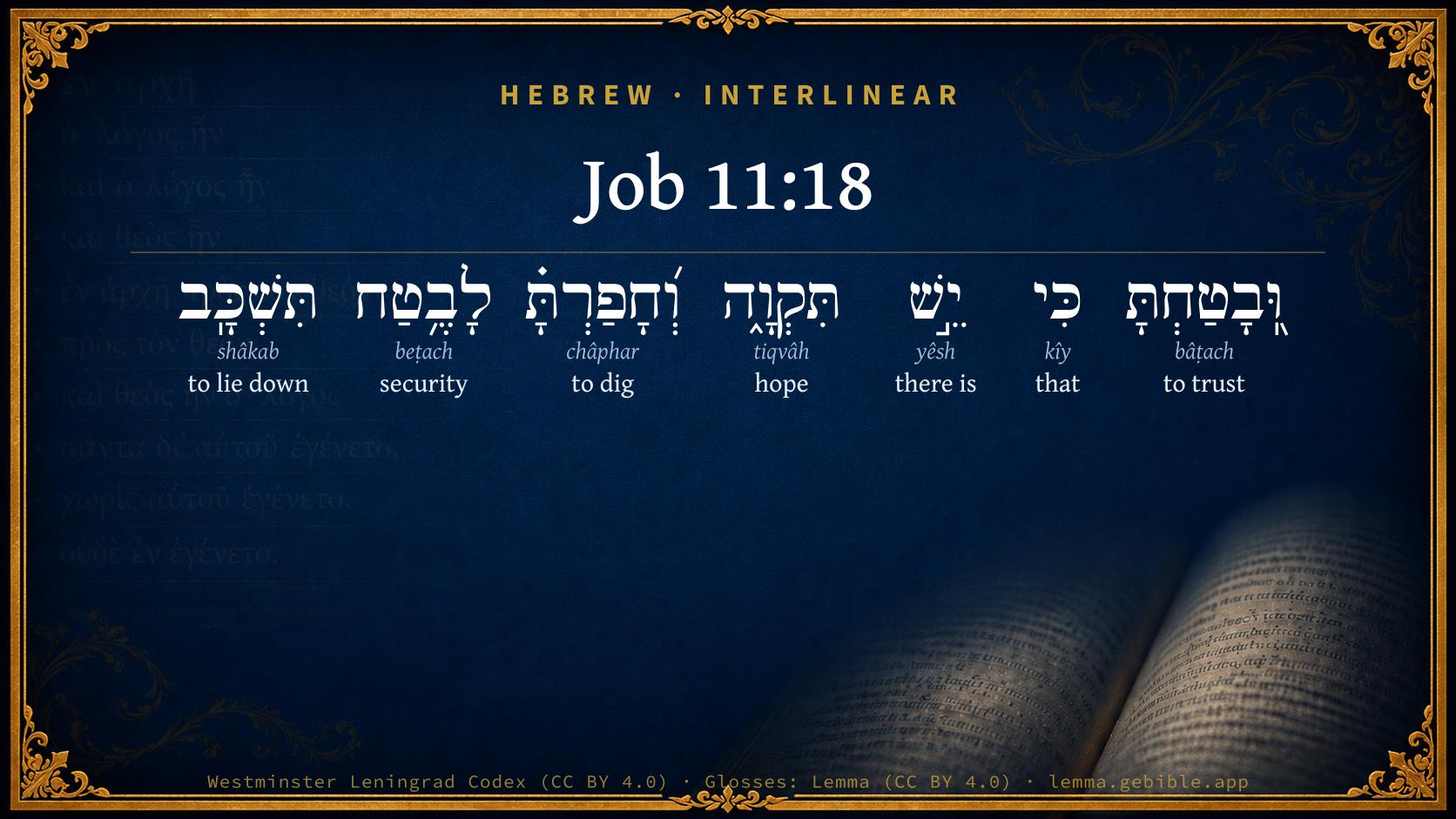
Job 11:18

Hebrew (Westminster Leningrad Codex) Job 11:18 appears in the Hebrew Old Testament. The text above is from the Westminster Leningrad Codex. Each word links to its Strong’s number, a concise gloss, and parsing drawn from the Open Scriptures Hebrew Bible morphology. Click any word for its full Brown-Driver-Briggs (BDB) entry.
Download image
Cite this verse

Job 11:18 (World English Bible). Public Domain. Lemma interlinear Bible study tool, https://lemma.gebible.app/v/job/11/18.

Show BibTeX & RIS
BibTeX
RIS
English Translation
You shall be secure, because there is hope; Yes, you shall search, and shall take your rest in safety.
World English Bible · Public Domain
Download a study sheet

One document with this verse’s original text, its word-by-word gloss line, the meaning frame, cross-references with their text, attributed commentary, and full source and license credits — printable, and it pastes into notes with its structure intact.

This verse Autodidact and up

Study sheet (.html) Plain text (.txt)

A passage Seminary Student

Up to 50 verses in one chapter. A passage sheet keeps up to 6 commentary sources and 12 cross-references per verse, in the order this page ranks them, and says so on the sheet whenever that leaves anything out. Ask for a single verse and you get the Autodidact verse sheet above.

Everything on this page stays free to read, with no account — the sheet is a download of what is already on screen, not access to it.

Want to remove ads? Support Godless Engineer
Compare translations 3

The same verse in 3 English versions, stacked beneath the original-language interlinear above. Click any original word for its lexicon entry.

Each is an independent rendering of the whole verse — the interlinear is not word-aligned to these translations.

Highlighted words mark where these versions differ — a whole-verse word diff, not a word-by-word alignment.

  • World English Bible Public Domain
    You shall be secure, because there is hope; Yes, you shall search, and shall take your rest in safety.
  • King James Version Public Domain
    And thou shalt be secure, because there is hope; yea, thou shalt dig about thee, and thou shalt take thy rest in safety.
  • unfoldingWord Literal Text CC BY-SA 4.0
    You will be confident, because there is hope, and you will look around, you will lie down in safety.

unfoldingWord Literal Text — © unfoldingWord, licensed CC BY-SA 4.0. Word-aligned USFM3 via Door43 (git.door43.org/unfoldingWord/en_ult).

Versions to compare (up to 4)

3 of 4 selected

Show all 18 translations

Every available English version of this verse, each an independent rendering of the whole verse.

  • World English Bible Public Domain
    You shall be secure, because there is hope; Yes, you shall search, and shall take your rest in safety.
  • Berean Standard Bible Public Domain
    You will be secure, because there is hope, and you will look around and lie down in safety.
  • Majority Standard Bible Public Domain
    You will be secure, because there is hope, and you will look around and lie down in safety.
  • King James Version Public Domain
    And thou shalt be secure, because there is hope; yea, thou shalt dig about thee, and thou shalt take thy rest in safety.
  • American Standard Version (1901) Public Domain
    And thou shalt be secure, because there is hope; Yea, thou shalt search `about thee', and shalt take thy rest in safety.
  • Revised Version (1885) Public Domain
    And thou shalt be secure, because there is hope; yea, thou shalt search about thee, and shalt take thy rest in safety.
  • Geneva Bible (1599) Public Domain
    And thou shalt bee bolde, because there is hope: and thou shalt digge pittes, and shalt lye downe safely.
  • Douay-Rheims (1899) Public Domain
    And thou shalt have confidence, hope being set before thee, and being buried thou shalt sleep secure.
  • Young's Literal Translation Public Domain
    And thou hast trusted because their is hope, And searched -- in confidence thou liest down,
  • Literal Standard Version CC BY-SA 4.0
    And you have trusted because there is hope, || And searched—in confidence you lie down,
  • Unlocked Literal Bible CC BY-SA 4.0
    You would be secure because there is hope; indeed, you would find safety about you and would take your rest in safety.
  • unfoldingWord Literal Text CC BY-SA 4.0
    You will be confident, because there is hope, and you will look around, you will lie down in safety.
  • Darby Bible Public Domain
    And thou shalt have confidence, because there shall be hope; and having searched about [thee], thou shalt take rest in safety.
  • World Messianic Bible Public Domain
    You will be secure, because there is hope. Yes, you will search, and will take your rest in safety.
  • Webster's Bible Public Domain
    And thou shalt be secure, because there is hope; yes, thou shalt dig about thee, and thou shalt take thy rest in safety.
  • Free Bible Version CC BY-SA 4.0
    You will have confidence because there is hope; you will be protected and rest in safety.
  • Bible in Basic English Public Domain
    And you will be safe because there is hope; after looking round, you will take your rest in quiet;
  • JPS Tanakh (1917) Public Domain
    And thou shalt be secure, because there is hope; yea, thou shalt look about thee, and shalt take thy rest in safety.

Literal Standard Version (2020), Covenant Press — licensed CC BY-SA 4.0. Text via the HelloAO Bible API (eBible.org). Unlocked Literal Bible (unfoldingWord) — licensed CC BY-SA 4.0. Text via the HelloAO Bible API (eBible.org). unfoldingWord Literal Text — © unfoldingWord, licensed CC BY-SA 4.0. Word-aligned USFM3 via Door43 (git.door43.org/unfoldingWord/en_ult). Free Bible Version, Dr. Jonathan Gallagher — licensed CC BY-SA 4.0. Text via the HelloAO Bible API (eBible.org).

Word by word

More ways to search: Search by grammar → Find every occurrence → Compare this word →

Practice this passage: Drill this verse → Learn its vocabulary →

About this verse

These counts appear in no published source. They are computed here, from the morphology-tagged text and Lemma’s own curated glosses. What Lemma adds →

7
words
7
distinct lemmas
Wisdom
section

Notable vocabulary

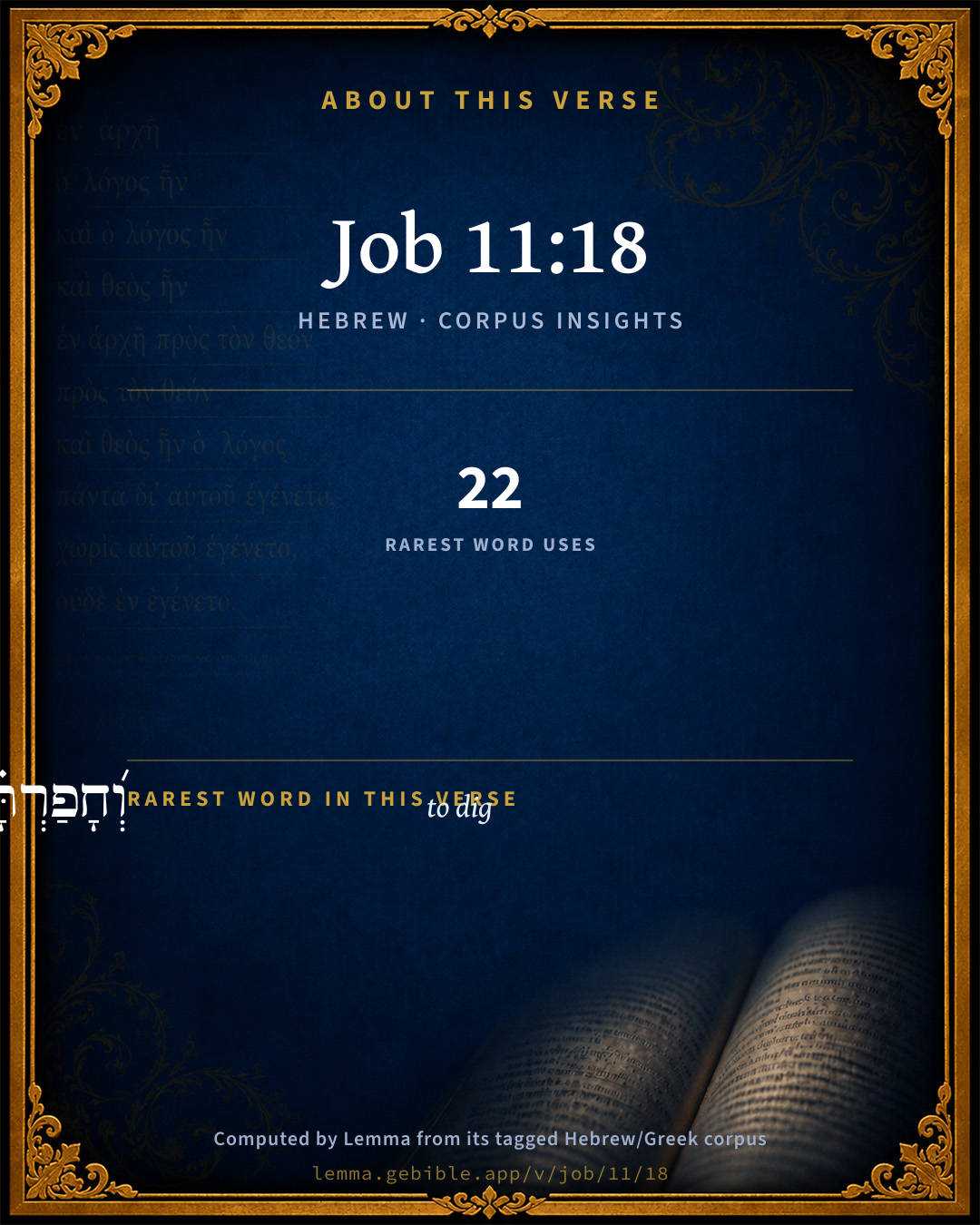
The rarest word here is וְ֝חָפַרְתָּ֗ to dig H2658 — appearing just 22 times in the whole Hebrew Bible.

Shared distinctive vocabulary

וְ֝חָפַרְתָּ֗ to dig H2658 occurs in 21 verses of the Hebrew Bible. Also found in:

Grammatical profile

  • 3 verbs
  • 2 nouns
  • 1 conjunction
  • 1 particle

Verb forms

  • וּֽ֭בָטַחְתָּ Qal · Sequential Perfect
  • וְ֝חָפַרְתָּ֗ Qal · Sequential Perfect
  • תִּשְׁכָּֽב Qal · Imperfect

Hebrew & Septuagint length

In English translation the verse runs 19 words from the Hebrew and 21 from the Septuagint (LXX English) — closely comparable.

A rough comparison of the two English renderings, which tokenize alike — not a word-level alignment.

Word counts can differ between the Hebrew and the Greek without any difference in meaning — e.g. the Hebrew direct-object marker אֵת has no separate Greek word, and Greek often adds the article ὁ.

Cross-references

11

Topical passages linked to Job 11:18 in the Treasury of Scripture Knowledge — connected by theme and wording, ordered by reader-vote popularity; previews shown in the World English Bible.

  • Proverbs 3:24–26 When you lie down, you will not be afraid. Yes, you will lie down, and your sleep will be sweet.
  • Psalms 3:5 I laid myself down and slept. I awakened; for Yahweh sustains me.
  • Psalms 43:5 Why are you in despair, my soul? Why are you disturbed within me? Hope in God! For I shall still praise him: My Savior, my helper, and my God.
  • Psalms 4:8 In peace I will both lay myself down and sleep, For you, Yahweh alone, make me live in safety.
  • Leviticus 26:5–6 Your threshing shall reach to the vintage, and the vintage shall reach to the sowing time; and you shall eat your bread to the full, and dwell in your land safely.
  • Romans 5:3–5 Not only this, but we also rejoice in our sufferings, knowing that suffering works perseverance;
  • Job 7:6 My days are swifter than a weaver's shuttle, And are spent without hope.
  • Proverbs 14:32 The wicked is brought down in his calamity, But in death, the righteous has a refuge.
  • Job 22:27–29 You shall make your prayer to him, and he will hear you. You shall pay your vows.
  • Job 6:11 What is my strength, that I should wait? What is my end, that I should be patient?
  • Colossians 1:27 to whom God was pleased to make known what are the riches of the glory of this mystery among the Gentiles, which is Christ in you, the hope of glory;

Cross-references courtesy of OpenBible.info (CC BY 4.0).

Hebrew and Greek witnesses Masoretic Hebrew ↔ Greek Septuagint

The same verse in the two great witnesses to the Old Testament, shown verse-for-verse.

These are two independent witnesses, not word-aligned to each other, and the Septuagint is shown in lemma (dictionary) form.

Hebrew Job 11:18 Masoretic · Westminster Leningrad Codex

וּֽ֭בָטַחְתָּ כִּי יֵ֣שׁ תִּקְוָ֑ה וְ֝חָפַרְתָּ֗ לָבֶ֥טַח תִּשְׁכָּֽב

You shall be secure, because there is hope; Yes, you shall search, and shall take your rest in safety.

World English Bible · Public Domain

Greek LXX Job 11:18 Septuagint · lemma form

πείθω τε εἰμί ὅτι εἰμί σύ ἐλπίς ἐκ δέ μέριμνα καί φροντίς ἀναφαίνω σύ εἰρήνη

And you shall be confident, because you have hope; and peace shall dawn to you from out of anxiety and care.

LXX2012 (modern English Septuagint) · Public Domain

Hebrew: Westminster Leningrad Codex (CC BY 4.0). Greek: Septuagint (public domain); English from LXX2012 (modern English Septuagint) (Public Domain). How the Septuagint differs from the Hebrew →

Commentary

Notes on Job 11:18 from classic Christian and Jewish commentators (each source and its license shown beneath its notes). The classic Christian expositions comment on the surrounding passage and are grouped to its opening verse, so a note may address several verses; the Jewish commentaries on the Tanakh (Rashi and others) are per-verse, so they appear only where the commentator wrote on this verse.

Lemma curates 59 commentaries, every one of them public domain or Creative Commons licensed, each selected and text-cleaned for this edition rather than reprinted as found. About our sources →

Trapp's Complete Commentary

John Trapp

Job 11:18 And thou shalt be secure, because there is hope; yea, thou shalt dig [about thee, and] thou shalt take thy rest in safety.

Ver. 18. And thou shalt be secure, because there is hope] It is a spiritual security that is here promised, which is a fruit of faith, quelling and killing distracting and distrustful fears; faith, I say, unfeigned, 1Ti 1:5, which produceth hope unfailable, Rom 5:5. Hope is the daughter of faith, but such as is a staff to her aged mother.

Yea, thou shalt dig about thee] That is (saith one interpreter) by searching to find out how to do all things for the best, thou shalt prosper in all. Others sense it thus, Thou shalt be secure as they that lie in trenches (Eugub. Tigur.). Rabbi David, Thou shalt dig only about thy city, and not need to make any walls about it for thy security. Others, Thou shalt labour hard, and sleep soundly thereupon (Lavater). Or thus, God shall so encompass thee with his safe protection, as if thou dost but dig a place to pitch thy tent in, thou shalt enjoy thyself more safely therein than otherwise thou wouldest do in a walled city.

And thou shalt take thy rest] God will keep off those gnats of cares and fears, that might disquiet thee. We read of some great princes that could not sleep, as Ahasuerus, Est 6:1, Richard III of England, and Charles IX of France, after that barbarous massacre at Paris (Daniel Thulin.); but David could, Psa 3:1-8 Psa 4:1-8, because God was his keeper. No marvel that Philip sleepeth soundly when Antipater, his fast friend, watched by him the while. Job and all God’s beloved ones shall sleep on both ears, Psa 127:2, rest securely and comfortably ( In utramvis aurem). What should hinder, when the keeper of Israel, who neither slumbereth nor sleepeth, shall watch over them for good?

John Trapp, A Commentary or Exposition upon All the Books of the Old and New Testament (1647–1656) — public domain. Text from a community e-Sword module.

The Biblical Illustrator

Joseph S. Exell

Job_11:18

And thou shalt be secure.

The practical advantages of religion

These words represent to us the comfortable state of that man who has God for his protector and friend; the security and safety which there is in His favour. He shall be secure, because there is hope; i.e., whatever may be the present portion of his lot, he needs not to be anxious about the future; he may be easy concerning that, because he has such comfortable ground of expectation from it. If he enjoys the blessings of life, he may enjoy them securely; he has great reason to expect their continuance, and that the providence of God will protect him from all pernicious and fatal accidents. Zophar made this mistake in his reasoning; what was with great reason to be expected from the general course of Gods providence, he made an invariable rule of judging and censuring in each single instance. Suppose--

1. That the recompenses of vice and virtue were dubious; that the sanctions of the Gospel were not so ascertained as to exclude all scruple and distrust concerning them: even upon this supposal, religion would be much the safest side of the question. When we are considering the danger or the safety which respectively belongs to vice or virtue, in order to a just representation of the matter, we must take into our account the risks and prospects of both sides what it is which the man of religion and the man of no religion do respectively venture, and what on each side is the propounded recompense. As to: religion, the risks, if any, are small and inconsiderable; and its prospects vast and very promising. The risks are ordinarily small in themselves, and always small on comparison. Godliness has the promise of this life. In comparison with its prospects the risks of religion were always inconsiderable. A very encouraging prospect deserves a proportionable venture. So men think, and so they act in the common commerce and dealings of the world. They do not insist upon downright demonstration for the certainty of their success in what they aim at. If the appearances be fair, there is no man who stands debating for more evidence, or refuses reasonable and promising conditions. We desire no more in the business of religion; nay, we need not so much. If religion promises for the general a pleasant and easy passage through this life, and always a state of infinite and endless bliss and glory beyond it; if it promises this, upon reasons as firm and unexceptionable, as the nature of the case, and of such proofs will admit; if with all this vast encouragement, it requires, for the main, no other sacrifice than of such indulgences as would be injurious either to ourselves or others, what account can be given of that monstrous indifference wherewith the notice of so great a gain is commonly entertained? What are the prospects and risks of vice and irreligion? The prospects are inconsiderable, the risks are dangerous and fatal. The promises of vice fall miserably short in the performance. Vice may promise pleasure, but it will pay in pain. The prospects of sin with regard to this life are dark and gloomy; and with regard to the next they are infinitely worse. The risk of the sinner who resolves to persist in his wicked courses, is no less than to encounter the wrath of God, and to arm Divine justice against his own soul.

2. In the favourable circumstances of life and fortune, the good man is best qualified for enjoying them with the least alloy, the least apprehension of a change for the worse. To the righteous it is no abatement of their present felicities that they must exchange them one day for others which shall be brighter and more perfect. They are sure that when this mortal shall put on immortality, that immortality will be blessed and triumphant. That comfortable hope will balance a good deal against those natural fears of death and dissolution, which otherwise were enough to jar the most harmonious conjunction of the worlds blessings. The wicked, even upon their own principles, are entirely destitute of this cordial preservative. The more pleasing life is, the more melancholy (one would think) should be the thought of parting with it.

3. So great is the difference between the case of the good man and the wicked, that, whereas the latter can scarce bear up amid all the affluences of a prosperous fortune, the former has the support of the brightest hopes. The severest pinches of adversity are improved by a religious disposition into occasions of weaning us from the world, and of turning us to God; of strengthening our faith, and of elevating our hope, and of enlarging our spirits towards the Father of them. He who has all his happiness and all his prospects on this side the grave, is miserably disappointed when these are defeated.

4. What mightily heightens the good mans security, both in the misfortunes and felicities of his present state, is the assurance he has of favour with the great Governor of the world, and the Supreme Disposer of all events. We see, therefore, that whatever circumstance or station of life may be allotted us, religion is necessary to carry us through it with satisfaction and comfort. (N. Marshall, D. D.)

The believers security

Faith is the Christians foundation, and hope his anchor, and death is his harbour, and Christ is his pilot, and heaven is his country; and all the evils of poverty, or affronts of tribunals and evil judges, of fears and sad apprehensions, are but like the loud winds blowing from the night point,--they make a noise, but drive faster to the harbour. And if we do not leave the ship and jump into the sea; quit the interest of religion, and run to the securities of the world; cut our cables and dissolve our hopes; grow impatient; hug a wave and die in its embrace--we are safe at sea, safer in the storm which God sends us, than in a calm when befriended by the world. (Jeremy Taylor.)

The Biblical Illustrator, edited by Joseph S. Exell (c. 1880s–1900s) — public domain. Text from a community e-Sword module.

Joseph Benson's Commentary

Job 11:18-19. Thou shalt be secure, because there is hope — Thy mind shall be quiet and free from terrors, because thou shalt have a firm and well-grounded confidence in God. Thou shalt dig — Either to fix thy tents, which, after the manner of the Arabians, were removed from place to place; or, to plough thy ground, as he had done, Job 1:14, or to make a fence about thy dwelling Thou shalt take thy rest in safety — Free from dangers and the fear of them; because of God’s fatherly providence watching over thee, when thou canst not watch over thyself. And none shall make thee afraid — Thou shalt be in perfect peace, and none shall disquiet thee; yea, many shall make suit unto thee — Desiring thy favour and friendship, because of thy great power and riches, and eminent felicity.

Joseph Benson's Commentary on the Old and New Testaments (1811–1818) — public domain. Text from a community e-Sword module.

Whedon's Commentary on the Bible

Daniel D. Whedon

e. Beneath this noontide glory Job shall dwell with ever-increasing honour, secure against any dark forebodings of ill, Job_11:18-20.

18. Dig about thee — חפר, “search about,” (Ewald, Dillmann, etc.,) to see that all is right — an uncalled-for weakening of the sense. Rosenmuller, etc., give it the sense of “being ashamed;” many others retain its ordinary meaning of dig, (Job_3:21;) for instance, “the fields,” (Furst,) or, “a well,” (Dr. A. Clarke.) Our translators had the true sense of digging for protection. Thus Hengstenberg.

Daniel D. Whedon (gen. ed.), Commentary on the Old and New Testaments (1874–1909) — public domain. Text from a community e-Sword module.

Jamieson, Fausset & Brown

Robert Jamieson, A. R. Fausset & David Brown

The experience of thy life will teach thee there is hope for man in every trial.

dig--namely, wells; the chief necessity in the East. Better, "though now ashamed (Rom 5:5, opposed to the previous 'hope'), thou shalt then rest safely" [GESENIUS];

Jamieson, Fausset & Brown — Commentary Critical and Explanatory on the Whole Bible (1871) — public domain (CC PDM 1.0). Text via the HelloAO Bible API.

Adam Clarke's Commentary

Verse 18. And thou shalt be secure] Thou shalt not fear any farther evils to disturb thy prosperity, for thou shalt have a well-grounded hope and confidence that thou shalt no more be visited by adversity.

Yea, thou shalt dig] I believe this neither refers to digging his grave, nor to curiously investigating surrounding circumstances; but to the custom of digging for water in the places where they pitched their tents. It was a matter of high importance in Asiatic countries to find good wells of wholesome water; and they were frequently causes of contention among neighbouring chiefs, who sometimes stopped them up, and at other times seized them as their own. Through envy of Isaac's prosperity the Philistines stopped up all the wells which Abraham had digged, Ge 26:12-16. And we find the herdsmen of Gerar contending with Isaac's servants about the wells which the latter had digged; so that they were obliged to abandon two of the chief of them, and remove to a distance in order to dig and find quiet possession. See Ge 31:17-22. Zophar, in reference to all these sorts of contentions and petty wars about wells and springs, tells Job that in the state of prosperity to which he shall be brought by the good providence of God, he shall dig-find wells of living water; none shall contend with him; and he shall rest in safety, all the neighbouring chieftains cultivating friendship with him; see on Job 5:23; Job 5:24; and that this is the meaning of the passage the following verse shows: Thou shalt lie down, and none shall make thee afraid; yea, many shall make suit unto thee. Thou shalt be in perfect security; no enemy shall molest thee, and many shall seek thy friendship.

Adam Clarke's Commentary on the Bible (1810–1826) — public domain. Text from a community e-Sword/MySword module.

Ellicott's Commentary for English Readers

(18) Thou shalt dig about thee.—Rather, thou shalt look around or search about thee, and see that thou canst lie down in safety. (Comp. Jos_2:2, and Job_39:29.) The same word means, indeed, to dig and to blush; but both meanings are incongruous and inadmissible here.

A Bible Commentary for English Readers, edited by Charles John Ellicott (1878–1897) — public domain. Text from a community e-Sword module.

The Cambridge Bible for Schools and Colleges

gen. ed. J. J. S. Perowne

18. because there is hope] In opposition to Job’s desponding pictures of his life, ch. Job_7:6 seq., Job_9:25 seq., Job_10:20 seq.

thou shalt dig about thee] Rather, thou shalt look, or search, about thee, cf. ch. Job_39:29; Deu_1:22. Job, as one naturally does before retiring to rest, will look around to see if there be any danger near or cause of disquietude, and seeing none will take his rest in safety.

The Cambridge Bible for Schools and Colleges (gen. ed. J. J. S. Perowne; Cambridge University Press, 1878–1918) — public domain. Text from a community e-Sword module.

John Gill's Exposition

And thou shall be secure,.... From coming into like darkness, difficulties, and distress again, and from every evil and enemy; nothing shall come nigh to disturb and hurt, nothing to be feared from any quarter, all around: or "shalt be confident" (y); have a strong faith and full assurance of it, in the love of God, in the living Redeemer, and in the promises which respect the life that now is, and that which is to come:

because there is hope; of the mercy of God, of salvation by Christ, and of eternal glory and happiness, as well as of a continuance of outward prosperity; faith and hope mutually assist each other; faith is the substance of things hoped for, and hope of better and future things on a good foundation encourages faith and confidence:

yea, thou shalt dig about thee; to let in stakes for the pitching and fixing of tents to dwell in, and for more commodious pasturage; or for wells of water, for the supply both of the family and the flocks; or rather, for ditches and trenches to secure from thieves and robbers, or for drains to carry off floods of water:

and thou shalt take thy rest in safety; lie down on the bed and sleep in the night season in peace and quietness, having nothing to fear; being well entrenched, and secure from depredations and inundations; and, more especially being hedged about and protected by the power and providence of God; see Psa 3:5; the Targum is,

"thou shall prepare a grave, and lie down, and sleep secure.''

(y) "et confides", Mercerus, Piscator, Schmidt; "et habebis fiduciam", V. L.

John Gill's Exposition of the Whole Bible (1746–1763) — public domain (CC PDM 1.0). Text via the HelloAO Bible API.

Albert Barnes' Notes on the Bible

And thou shalt be secure - You will feel confident that your prosperity will be permanent, and you will be free from the distressing anxieties and fears which you now have.

Thou shalt dig about thee - The Chaldee renders this, “thou shalt prepare for thyself a sepulchre, and shalt lie down in safety.” The word used here (חפר châphar) has two significations. It means,

(1) “to dig” - as, e. g. a well, and under this signification to search out, to explore; and,

(2.) to be ashamed, to blush, Isa 1:29.

According to Gesenius, the latter here is the signification. “Now thou art ashamed, then thou shalt dwell in quiet,” Lexicon. So Noyes renders it. Dr. Good translates it, “yea, thou shalt look around;” Rosenmuller, “thou art suffused with shame.” This is, probably, the true sense; and the idea is, that though he was now covered with shame, yet he would lie down in peace and safety if he would return to the Lord.

Albert Barnes' Notes on the Bible (1834–1885) — public domain. Text from a community e-Sword/MySword module.

Haydock's Catholic Bible Commentary

Secure, dying full of hope. (Chaldean) Hebrew, "thou shalt dig," (for water, which was there a great treasure, Genesis xxi. 25., and xxvi. 15.) or to fasten down thy tent, (Calmet) "and rest secure." (Haydock)

George Leo Haydock (1774–1849), Haydock's Catholic Family Bible and Commentary, 1859 edition — public domain. Excludes Psalms (Douay-Rheims chapter numbering differs from Protestant) and Deuterocanonical books (Catholic canon only).

Matthew Poole's English Annotations

i.e. Thy mind shall be quiet and free from terrors, because thou shalt have a firm and well-grounded hope and confidence in God’s merciful and providential care of thee. Or, thou shalt be confident that thou shalt have what thou hopest for, the act, hope, being put for the object, as is very usual, i.e. thou shalt have assurance in and from God, that thy hopes shall not be disappointed, but fulfilled. This is opposed to that fear, Job 11:15.

Thou shalt dig about thee; either to fix thy tents, which after the manner of the Arabians were removed from place to place for conveniency of pasturage for their cattle; or to find out water for thy cattle, as they did, Ge 26; or to plough the ground, as he had done, Job 1:14; or to make a fence about thy dwelling; for both the foregoing and following passages express his secure and safe condition.

In safety; free from dangers and the fear of them, because of God’s fatherly providence watching over thee when thou canst not watch over thyself.

Matthew Poole's English Annotations on the Holy Bible (1683–1685) — public domain. Text from a community e-Sword/MySword module.

The Pulpit Commentary

And thou shalt be secure, because there is hope. Job, entering on this second period of prosperity, would be and feel secure; safe, i.e. "from any return of calamity, because hope would once more animate him and be his predominant feeling. No doubt "hope springs eternal in the human breast;" and when Job"s prosperity was actually restored, (Job_42:12-16) these anticipations had their fulfilment; but, as uttered by Zophar, there is a ring of insincerity about them, and we cannot but feel that his object in expatiating at length on the details of Job"s coming happiness is not to console and encourage his friend, but rather to annoy and exasperate him, since the entire basis on which he builds is the assumption of Job"s heinous guilt (vers. 3, 6, 11, 14), and the prosperity which he promises is to follow upon an acknowledgment of guilt and a putting sway of iniquity (vers. 13, 14), which he knew that Job wholly repudiated . Yea, thou shalt dig about thee. So Schultens, who understands it to mean that Job shall dig a moat around his habitation, to make himself perfectly secure. The verb has, however, two other meanings investigate" or "search out," and "to blush;" and it is taken here ineach of these meanings by some critics. Our Revisers translate, "Yea, thou shalt search about thee;" and so Canon Cook and Professor Stanley Loathes. Rosenmuller, on the other hand, and Professor Lee render the words by "Though thou shouldst blush," or "be ashamed." It is difficult to decide between such high authorities; but the fast that Job uses the verb in the sense of "search," "look after," in Job_39:29, and does not elsewhere use it in either of the other senses, should incline us to accept the rendering of the Revised Version. And thou shalt take thy rest in safety; or, securely; i.e. with a sense of being in perfect security.

The security of hope.

I IT IS OF THE NATURE OF HOPE TO GIVE A SENSE OF SECURITY. If a man thinks himself safe, he will go forward confidently; if he expects he can win, he will throw his energy into what he is doing; if he is sure of victory, he will not shrink from the foe. When hope has faded out of a man"s life, he may still pursue his course with the doggedness of despair; but his step has lost its elasticity and his eye its fire.

II HOPE TENDS TO CREATE REAL SECURITY. The loss of confidence is itself a weakness. When we expect to fail, we prepare failure for ourselves. On the other hand, a calm, fearless progress makes for success. There is a foolish sanguineness which only dreams of the joys that are to drop into one"s lap unsought and unearned. But a true and sensible hope will not be thus blind and indolent. It will be the inspiration of effort. If we have hopes of victory over sin and of a useful Christian life, we are spurred on to attempt to realize them. Hope is necessary in Christian work. A hopeless missionary is not likely to be very fruitful.

III A BASELESS HOPE LEADS TO A FALSE SECURITY, Hope may be a mere snare. Possibly the sanguine man is living in a fool"s paradise. His hope may be altogether without foundation, and if so, in trusting to it he will only sink down to ruin. We need to have a reason for the hope that is in us. (1Pe_3:15) Safety is not proportionate to confidence. Although, as we have just seen, hope simply as a subjective feeling does tend to victory, yet if it is quite groundless, its tendency will not be strong enough to overcome tangible obstacles.

IV CHRIST HAS GIVEN TO US A TRUE AND INSPIRING HOPE.

1. It is true. Christ does not content himself with soothing our fears and instilling a sense of restfulness and confidence. That would be a fatal course, like drugging a patient with morphia instead of curing his disease. But when Christ instills the feeling of hope, he does so by setting before us good reasons for hope. The Christian hope is based on the revelation of God"s love, on the atoning work of our Lord, on his resurrection and triumph. He is our Hope, (Col_1:27) and all that gives worth to him and his work gives weight to the Christian hope.

2. It is inspiring. The great hope of Christ is that sin shall be conquered and the kingdom of heaven come in power.

(1) This is inspiring to the individual. No one of us need be satisfied with a low tone of Christian life. It is open to all to rise to great heights of holiness and fruitful living. The hope is in Christ, not in ourselves; and his resources are unlimited, his riches unsearchable. (Eph_3:8)

(2) This is also inspiring for the Church. The weary battle of the ages is destined to ultimate victory. Christ, not the devil, must triumph at last. Difficulties press upon us and discouragements grow thick around us, yet the cause of God cannot fail The promise of victory should inspire the hope which helps forward the accomplishment. W.F.A.

The Pulpit Commentary (1880–1919), ed. H.D.M. Spence-Jones & Joseph S. Exell — public domain. Text from a community e-Sword module.

John Wesley's Explanatory Notes

Secure - Thy mind shall be quiet and free from terrors, because thou shalt have a firm and well-grounded confidence in God. Dig - Either to fix thy tents, which after the manner of the Arabians were removed from place to place: or to plough the ground, as he had done, chap. i, 14, or to make a fence about thy dwelling.

John Wesley, Explanatory Notes Upon the Whole Bible (1754–1765) — public domain. Text via the GEBible commentary corpus.

unfoldingWord translationNotes

Door43 World Missions Community

You would be secure ... take your rest in safety

Zophar repeats the same idea for emphasis and describes the possibility. (See: Parallelism and Hypothetical Situations)

would take your rest in safety

"Take your rest" here is an idiom for "rest." The phrase "in safety" can be expressed with the word "safely." AT: "would rest safely" (See: Idiom and Abstract Nouns)

Also you would lie down in rest ... your favor.

Zophar repeats the same idea for emphasis and describes the possibility. (See: Parallelism and Hypothetical Situations)

you would lie down in rest

The abstract noun "rest" can be expressed with the verb "rest." AT: "you would lie down and rest" (See: Abstract Nouns)

translationWords

hope

rest

fear

favor

unfoldingWord translationNotes — © Distant Shores Media and the Door43 World Missions Community, licensed CC BY-SA 4.0. Source: git.door43.org/Door43/en_tn.

Lesson kit

Teaching starters — assembled from the data on this page, not authored interpretation. Every prompt links to the verse data it draws on. Edit before teaching.

Job, in the Wisdom, opens this verse with 7 words (7 distinct Hebrew lemmas). Its most distinctive word is châphar (“to dig”). A historical commentator’s framing appears above. Read the whole chapter for the surrounding context.

Discussion questions

  1. What does “to dig” (châphar) contribute to the verse as a whole?
  2. Genesis 21:30 shares the word «to dig» with this verse. How do the two illuminate each other?
  3. These translations render this verse differently; the difference is in the English rendering, not the original. What questions does that raise?
  4. The verb «וּֽ֭בָטַחְתָּ» is Qal Sequential Perfect. How does its form color the action?
  5. Reading how Trapp's Complete Commentary and The Biblical Illustrator read this verse, where do the two commentators agree and where do they part?

Things to notice

Reading settings

Reading text

Shown beneath each verse's original-language words.

Old Testament
Old Testament edition

Read the OT as the Masoretic Hebrew (MT) or the Greek Septuagint (LXX).

English shown for the Greek Septuagint (in the Hebrew ↔ Greek comparison).

Comparing translations? Open the Compare panel on any verse page to stack up to four side by side.