
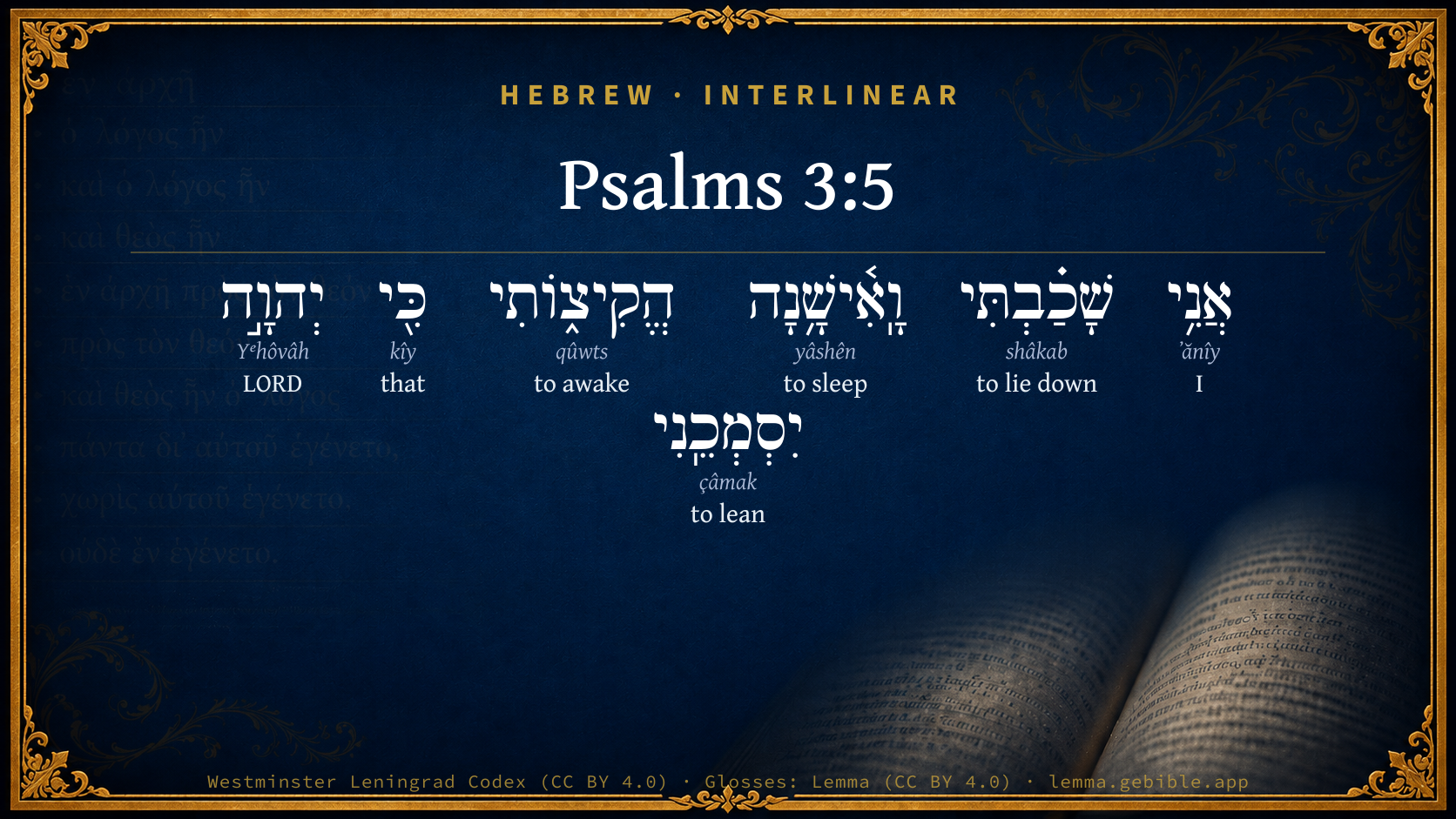
Psalms 3:5

Hebrew (Westminster Leningrad Codex) Psalms 3:5 appears in the Hebrew Old Testament. The text above is from the Westminster Leningrad Codex. Each word links to its Strong’s number, a concise gloss, and parsing drawn from the Open Scriptures Hebrew Bible morphology. Click any word for its full Brown-Driver-Briggs (BDB) entry.
Download image
Cite this verse

Psalms 3:5 (World English Bible). Public Domain. Lemma interlinear Bible study tool, https://lemma.gebible.app/v/psalms/3/5.

Show BibTeX & RIS
BibTeX
RIS
English Translation
I laid myself down and slept. I awakened; for Yahweh sustains me.
World English Bible · Public Domain
Download a study sheet

One document with this verse’s original text, its word-by-word gloss line, the meaning frame, cross-references with their text, attributed commentary, and full source and license credits — printable, and it pastes into notes with its structure intact.

This verse Autodidact and up

Study sheet (.html) Plain text (.txt)

A passage Seminary Student

Up to 50 verses in one chapter. A passage sheet keeps up to 6 commentary sources and 12 cross-references per verse, in the order this page ranks them, and says so on the sheet whenever that leaves anything out. Ask for a single verse and you get the Autodidact verse sheet above.

Everything on this page stays free to read, with no account — the sheet is a download of what is already on screen, not access to it.

Want to remove ads? Support Godless Engineer
Compare translations 3

The same verse in 3 English versions, stacked beneath the original-language interlinear above. Click any original word for its lexicon entry.

Each is an independent rendering of the whole verse — the interlinear is not word-aligned to these translations.

Highlighted words mark where these versions differ — a whole-verse word diff, not a word-by-word alignment.

  • World English Bible Public Domain
    I laid myself down and slept. I awakened; for Yahweh sustains me.
  • King James Version Public Domain
    I laid me down and slept; I awaked; for the LORD sustained me.
  • unfoldingWord Literal Text CC BY-SA 4.0
    I laid myself down and slept. I awoke, for Yahweh protects me.

unfoldingWord Literal Text — © unfoldingWord, licensed CC BY-SA 4.0. Word-aligned USFM3 via Door43 (git.door43.org/unfoldingWord/en_ult).

Versions to compare (up to 4)

3 of 4 selected

Show all 18 translations

Every available English version of this verse, each an independent rendering of the whole verse.

  • World English Bible Public Domain
    I laid myself down and slept. I awakened; for Yahweh sustains me.
  • Berean Standard Bible Public Domain
    I lie down and sleep; I wake again, for the LORD sustains me.
  • Majority Standard Bible Public Domain
    I lie down and sleep; I wake again, for the LORD sustains me.
  • King James Version Public Domain
    I laid me down and slept; I awaked; for the LORD sustained me.
  • American Standard Version (1901) Public Domain
    I laid me down and slept; I awaked; for Jehovah sustaineth me.
  • Revised Version (1885) Public Domain
    I laid me down and slept; I awaked; for the LORD sustaineth me.
  • Geneva Bible (1599) Public Domain
    I layed me downe and slept, and rose vp againe: for the Lord susteined me.
  • Douay-Rheims (1899) Public Domain
    I have cried to the Lord with my voice: and he hath heard me from his holy hill.
  • Young's Literal Translation Public Domain
    I -- I have lain down, and I sleep, I have waked, for Jehovah sustaineth me.
  • Literal Standard Version CC BY-SA 4.0
    I have lain down, and I sleep, || I have awoken, for YHWH sustains me.
  • Unlocked Literal Bible CC BY-SA 4.0
    I lay down and slept; I awoke, for Yahweh protected me.
  • unfoldingWord Literal Text CC BY-SA 4.0
    I laid myself down and slept. I awoke, for Yahweh protects me.
  • Darby Bible Public Domain
    I laid me down and slept; I awaked, for Jehovah sustaineth me.
  • World Messianic Bible Public Domain
    I laid myself down and slept. I awakened, for the LORD sustains me.
  • Webster's Bible Public Domain
    \\3:4\\I cried to the LORD with my voice, and he heard me from his holy hill. Selah.
  • Free Bible Version CC BY-SA 4.0
    I lie down to sleep, and in the morning I wake up because the Lord takes care of me.
  • Bible in Basic English Public Domain
    I took my rest in sleep, and then again I was awake; for the Lord was my support.
  • JPS Tanakh (1917) Public Domain
    (3-6) I lay me down, and I sleep; I awake, for the LORD sustaineth me.

Literal Standard Version (2020), Covenant Press — licensed CC BY-SA 4.0. Text via the HelloAO Bible API (eBible.org). Unlocked Literal Bible (unfoldingWord) — licensed CC BY-SA 4.0. Text via the HelloAO Bible API (eBible.org). unfoldingWord Literal Text — © unfoldingWord, licensed CC BY-SA 4.0. Word-aligned USFM3 via Door43 (git.door43.org/unfoldingWord/en_ult). Free Bible Version, Dr. Jonathan Gallagher — licensed CC BY-SA 4.0. Text via the HelloAO Bible API (eBible.org).

Word by word

More ways to search: Search by grammar → Find every occurrence → Compare this word →

Practice this passage: Drill this verse → Learn its vocabulary →

וָֽאִ֫ישָׁ֥נָה
yâshên
H3462
“and · to sleep”
Conjunction + Verb, Qal, Sequential Imperfect, 1st Person, Common, Singular + Suffix, h
Part of Speech
Conjunction + Verb
Stem
Qal
Form
Sequential Imperfect
Person
1st Person
Gender
Common
Number
Singular
Full BDB Definition

Origin: a primitive root

TWOT: 928

to sleep, be asleep - (Qal) to sleep, go to sleep, be asleep - (Niphal) - to remain a long time, be stored up - to be festering (of leprosy) - (Piel) to cause to sleep, entice to sleep
  1. אֲנִ֥י ʼănîy H589 “I” Pronoun, Personal, 1st Person, Common, Singular
  2. שָׁכַ֗בְתִּי shâkab H7901 “to lie down” Verb, Qal, Perfect, 1st Person, Common, Singular
  3. הֱקִיצ֑וֹתִי qûwts H6974 “to awake” Verb, Hiphil, Perfect, 1st Person, Common, Singular
  4. כִּ֖י kîy H3588 “that” Conjunction
  5. יְהוָ֣ה Yᵉhôvâh H3068 “LORD” Noun, Proper
  6. יִסְמְכֵֽנִי çâmak H5564 “to lean · me” Verb, Qal, Imperfect, 3rd Person, Masculine, Singular + Suffix, Personal, 1st Person, Common, Singular

About this verse

These counts appear in no published source. They are computed here, from the morphology-tagged text and Lemma’s own curated glosses. What Lemma adds →

7
words
7
distinct lemmas
Wisdom
section

Notable vocabulary

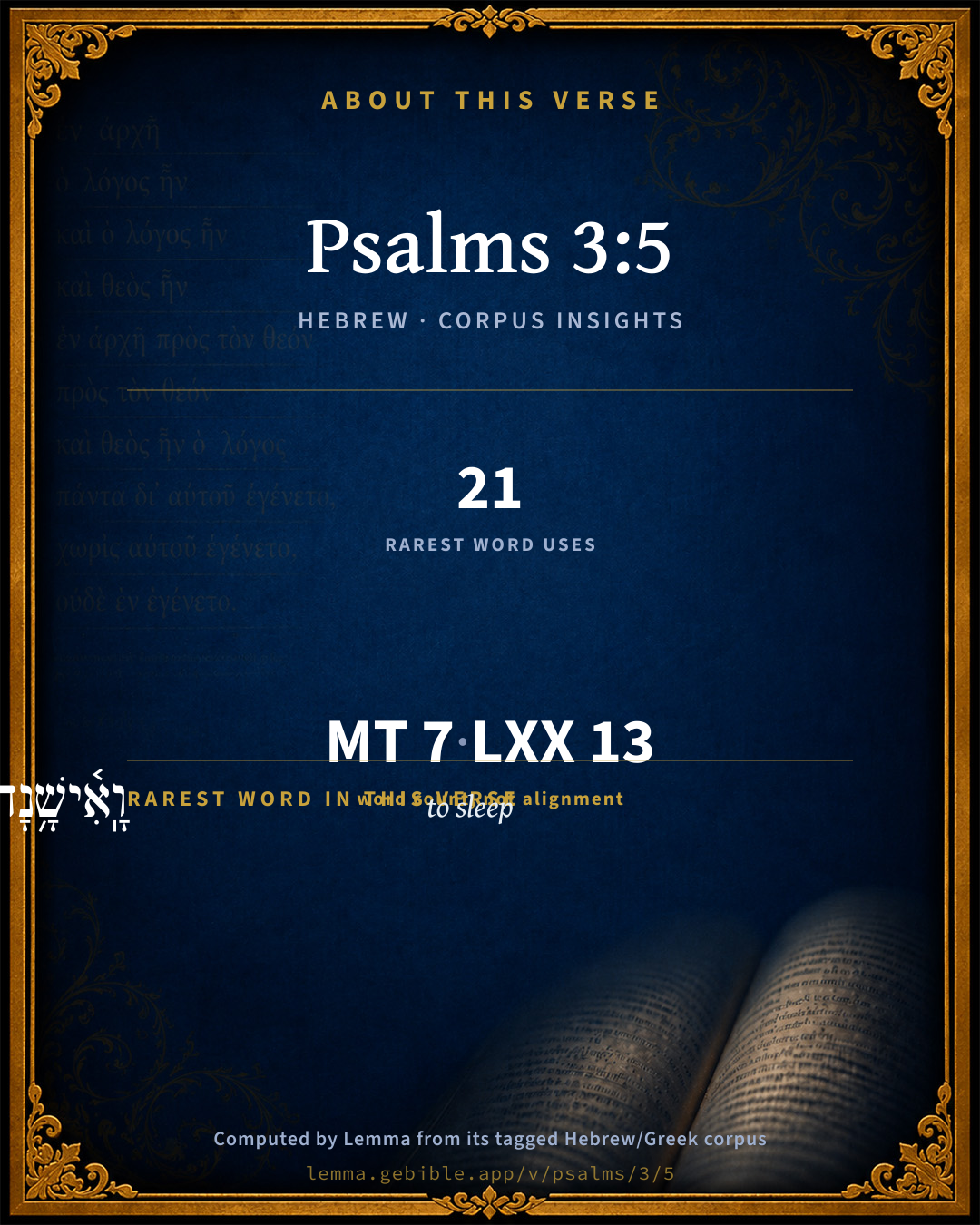
The rarest word here is וָֽאִ֫ישָׁ֥נָה to sleep H3462 — appearing just 21 times in the whole Hebrew Bible.

Shared distinctive vocabulary

וָֽאִ֫ישָׁ֥נָה to sleep H3462 occurs in 21 verses of the Hebrew Bible. Also found in:

Grammatical profile

  • 4 verbs
  • 1 noun
  • 1 pronoun
  • 1 conjunction

Verb forms

  • שָׁכַ֗בְתִּי Qal · Perfect
  • וָֽאִ֫ישָׁ֥נָה Qal · Sequential Imperfect
  • הֱקִיצ֑וֹתִי Hiphil · Perfect
  • יִסְמְכֵֽנִי Qal · Imperfect

Hebrew & Septuagint length

In English translation the verse runs 12 words from the Hebrew and 13 from the Septuagint (LXX English) — closely comparable.

A rough comparison of the two English renderings, which tokenize alike — not a word-level alignment.

Word counts can differ between the Hebrew and the Greek without any difference in meaning — e.g. the Hebrew direct-object marker אֵת has no separate Greek word, and Greek often adds the article ὁ.

In the original languages it is 7 Hebrew tokens and 13 Greek tokens — but the two are counted differently (Hebrew bundles its prefixes and suffixes into one token; the Greek is in lemma form), so that isn’t a like-for-like length.

Cross-references

10

Topical passages linked to Psalms 3:5 in the Treasury of Scripture Knowledge — connected by theme and wording, ordered by reader-vote popularity; previews shown in the World English Bible.

  • Psalms 4:8 In peace I will both lay myself down and sleep, For you, Yahweh alone, make me live in safety.
  • Proverbs 3:24 When you lie down, you will not be afraid. Yes, you will lie down, and your sleep will be sweet.
  • Isaiah 26:3 You will keep [him] in perfect peace, [whose] mind [is] stayed [on you]; because he trusts in you.
  • Leviticus 26:6 "'I will give peace in the land, and you shall lie down, and no one will make you afraid; and I will remove evil animals out of the land, neither shall the sword go through your land.
  • Job 11:18–19 You shall be secure, because there is hope; Yes, you shall search, and shall take your rest in safety.
  • Psalms 127:2 It is vain for you to rise up early, To stay up late, Eating the bread of toil; For he gives sleep to his loved ones.
  • Proverbs 18:10 The name of Yahweh is a strong tower: The righteous run to him, and are safe.
  • Proverbs 14:26 In the fear of Yahweh is a secure fortress, And he will be a refuge for his children.
  • Psalms 66:9 Who preserves our life among the living, And doesn't allow our feet to be moved.
  • Acts 12:6 The same night when Herod was about to bring him out, Peter was sleeping between two soldiers, bound with two chains. Guards in front of the door kept the prison.

Cross-references courtesy of OpenBible.info (CC BY 4.0).

Hebrew and Greek witnesses Masoretic Hebrew ↔ Greek Septuagint

The same verse in the two great witnesses to the Old Testament, shown verse-for-verse.

You’re reading Greek Psalm 3 (Hebrew Psalm 3). The Septuagint counts the superscription, so verse numbers can differ from the Hebrew — chapter-level alignment, not verse-by-verse. Numbering follows Rahlfs.

These are two independent witnesses, not word-aligned to each other, and the Septuagint is shown in lemma (dictionary) form.

Hebrew Psalms 3:5 Masoretic · Westminster Leningrad Codex

אֲנִ֥י שָׁכַ֗בְתִּי וָֽאִ֫ישָׁ֥נָה הֱקִיצ֑וֹתִי כִּ֖י יְהוָ֣ה יִסְמְכֵֽנִי

I laid myself down and slept. I awakened; for Yahweh sustains me.

World English Bible · Public Domain

Greek LXX Greek Psalm 3:5 Septuagint · lemma form

φωνή ἐγώ πρός κύριος κράζω καί ἐπιἀκούω ἐγώ ἐκ ὄρος ἅγιος αὐτός διάψαλμα

I lay down and slept; I awaked; for the Lord will help me.

LXX2012 (modern English Septuagint) · Public Domain

Hebrew: Westminster Leningrad Codex (CC BY 4.0). Greek: Septuagint (public domain); English from LXX2012 (modern English Septuagint) (Public Domain). How the Septuagint differs from the Hebrew →

Commentary

Notes on Psalms 3:5 from classic Christian and Jewish commentators (each source and its license shown beneath its notes). The classic Christian expositions comment on the surrounding passage and are grouped to its opening verse, so a note may address several verses; the Jewish commentaries on the Tanakh (Rashi and others) are per-verse, so they appear only where the commentator wrote on this verse.

Lemma curates 59 commentaries, every one of them public domain or Creative Commons licensed, each selected and text-cleaned for this edition rather than reprinted as found. About our sources →

Trapp's Complete Commentary

John Trapp

Psa 3:5 I laid me down and slept; I awaked; for the LORD sustained me.

Ver. 5. I laid me down and slept] My faith was above my fear; I knew whom I had trusted. No marvel I slept so soundly, seeing Antipater was by, and watched, said Philip of Macedon (Plutarch). We may better say so of Antipater, our gracious Father. Oh the safety of a saint! He ever goes guarded with the peace of God within him and the power of God without him, Php 4:7 1Pe 1:5, and hence his spiritual security. David will never break his sleep for any danger or doubt of success. Peter was found fast asleep the night before he should have been executed, Act 12:6. So was our proto martyr, in Queen Mary’s days, Mr Rogers; insomuch as that, scarce with much shugging, could he be awakened, when he was called for to be burned. Some few years since Mr White, of Dorchester, being a member of the assembly of divines at Westminster, was appointed minister of Lambeth; but for the present could get no convenient house to dwell in, but one that was possessed by the devil. This he took; and not long after, his maid, sitting up late, the devil appeared to her; whereupon in a great fright she ran up to tell her master; he bade her get to bed, saying, she was well served for sitting up so late. Presently after, the devil appeared to Mr White himself, standing at his bed’s feet. To whom Master White said, If thou hast nothing else to do thou mayest stand there still and I will betake myself to my rest. And accordingly composing himself to sleep, the devil vanished (Mirror for Saints, by Mr Clark, 460).

I awaked] A proverbial speech, as Mar 4:27. Tamerlane could not sleep at all through care (though he endeavoured it) the night before the mortal battle between him and Bajazet (Turk. Hist. 218).

For the Lord sustained me] Heb. will sustain me. He hath done it, and I doubt not but he will do it again. Experience breedeth confidence. He hath, he will, is an ordinary Scriptural medium.

John Trapp, A Commentary or Exposition upon All the Books of the Old and New Testament (1647–1656) — public domain. Text from a community e-Sword module.

The Biblical Illustrator

Joseph S. Exell

Psa_3:5

I laid me down and slept; I awaked; for the Lord sustained me.

Gods protection of the helpless

The reason why we sleep in peace and rise up in safety is, the Lord sustained me. This is one of those truths, long familiar and unrealised, which later on m our spiritual life may become to us fresh discoveries. Underneath the beating of every heart, and underneath the whole order of human things, and underneath the world and all worlds, there is forever a present active sustaining power from one generation to another, and that power is the power of God. The same truth is equally true if stated more widely. Whether we take as our measure the short time of the earth turning on itself, or the longer time of the earth travelling round; whether we speak of the day or of the sum of all the year, with its multitude of thoughts, its complexity of circumstances, its frequent risks and incessant occurrence of events;--still there is always abiding over us the same Divine protection, never tired, never slackening. Some people are so situated in life that they have but very little pressure and very few cares. All along the path of life seems smooth to them. That is but a tame life, and unless we have the nerve to make ourselves useful in some way, time so passed is a yoke which soon sits uneasy on the shoulder. Days wasted are a bad investment of life, and a dark account to be laying up. But the many are blessed with the pressure of responsibilities, and obliged to take up the happy burden of usefulness. All Christian burden bearers have laid them down to sleep, and risen again feeling that a benefit has been conferred on them, a sustaining hand has been bearing them up, and their good God has been giving to the human trial the promise He speaks of, As thy days, so shall thy strength be. The Hebrew word translated sustained means to place the open hand under a thing to support it. The Sept. renders by a word meaning to take hold of one another by the hand, the weaker being so supported. How does the kindness of God support the weakness of all Christians? He tells His own secret in Colossians

1. It is done by His Christ and our Christ. There He says how He has qualified us to partake of the portion of the saints in light; how He has rescued us from the power of darkness, and translated us into the kingdom of the Son of His love. It is in Him, He says, we have redemption through His blood, even the remission of sins. Let us count up, discover, and consider these many mercies until our heart warms into some honourable and loving recognition of this care, which is never tired of us and never leaves us. We may feel confident from the past that God will take care of us in the future. (T. F. Crosse, D. C. L.)

Sleeping and waking

One of the mysteries of life of which men hardly think at all is the mystery of sleep. Deaths twin sister, it has been called. Into its secrets the cleverest man cannot pierce, though all men share its blessings. See the tired man worn out after a heavy days work, or burdened with care. He flings himself on his bed, his days work or his days trouble, his foremost, ever-present thought. Kind sleep touches his eyes. His fatigue is forgotten, his cares are gone. What thought strikes us most forcibly as we look on the picture of the sleeper? Surely the thought of helplessness. The strongest man asleep cannot defend himself or help himself. And yet the millions of mankind daily lie down to sleep, and daily rise again, safely and in peace. Why? We know why, though we so often carelessly forget it. Because God is with us always, never leaving us for an instant to ourselves; about our path and about our bed; the Almighty Father, with more than a mothers love and tenderness. Ought we not to have, at least, Davids faith? I say at least because we know so much more of Gods truth than he did, have so much more light upon our path than he had. We know our weakness and helplessness, but we know our Helper. If we will only love and serve God in Christ, and consecrate our lives to Him, we are safe. (Samuel Pascoe.)

A trustful sleeper

Luther noticed one evening a bird quietly settling down for the darkness of the night, and he exclaimed, That little fellow preaches faith to us all! He takes hold of his twig, tucks his head under his wing, and goes to sleep, leaving God to think for him.

Preserved amidst the dangers of the night

In Mongolia we had one rather serious adventure. The south edge of the plain is famed for storms, and the night we camped there, just after dark, began one of the fiercest thunderstorms I can remember having seen. The wind roared, the rain dashed, the tent quivered; the thunder rattled with a metallic ring, like shafts of iron dashing against each other, as it darted along a sheet-iron sky; the water rose in the tent till part of our bed was afloat. It was hardly possible to hear each other speak; but amid and above all the din of the tempest rose one sound not to be mistaken, the roar of rushing water. There was a river to right of us, but the sound came more from the left. Venturing out, I found there was a great swift-flowing river on both sides of us; that we could not move from the little piece of elevated land plain on which we had our tent; and that a few inches more water, or an obstacle getting into the path of the upper river, would send the full force of the current down on our tents. Flocks, herds, men are said to be swept away now and again in Mongolia, and for an hour our case seemed doubtful; but about 11 p.m. the storm ceased and the danger was over, and, though we had hardly anything left, we went to sleep, thanking God for His preserving mercy. (James Gilmour.)

And rose up again.

Christian uprising

The whole world is full of Divine tokens. Everything should put us in mind, more or less directly, of Jesus Christ our Saviour. The sun rising in the east is natures token, to remind us of Christmas Day; and here in the text we find a no less clear token of the mysteries of Easter, our Lord dying and rising again. It is not anything new to have such a verse applied to the death, burial, and resurrection of our Lord. The old fathers and bishops so explained it from the very beginning of the Church. We do well to connect thin mystery with our own lying down and rising up as often as night and morning return. Sleep is an image of death. To a Christian it is an image of the death of Christ. Our daily lying down and rising up is given us for a sacramental sign and pledge of Christs death and resurrection, and of our own. Our falling asleep is a mystery, a thing which takes place we know not how, a thing out of our power, as much so as death itself. What becomes of us during our sleep? That longer sleep which we call death may come on us we know not how, and leave our bodies without power or thought for awhile, our souls in the meantime departing we know not where, and employed we know not how. There is a still higher and more awful depth of mystery in the Psalmists words, spoken as they are in His person, who is both God and man. It is as if we heard Christ Himself, risen from the tomb, and saying, I laid Me down and slept, and rose up again, for the Lord sustained Me. The Lord, the most high and glorious Godhead, still in our Saviours Person, inseparably joined to His human soul and body, even while the one was in the grave and the other in Paradise, or elsewhere in the regions of the dead,--He still continued the same Christ, very God and very man, and by virtue of that Eternal Spirit He raised Himself from the dead when His time was come. Notice what gracious help is afforded to those who are willing so to lift up their hearts, by Christs making so common a matter as our daily sleep and awakening a token and sign of this most awful mystery. Christ, even now abiding in His people, makes them already in this world partakers of a heavenly and Divine life. He sustains them, sleeping and waking, in life and in death, in their beds and in their graves; for in both conditions they are alike members of Him. But all this depends upon our keeping our baptismal vows. One or two rules of recovery and perseverance--

1. Since it is Christ only who sustains us, when in our lying down, or sleeping, or rising up, how dare any of us lie down or rise up without solemnly committing himself to Christ on his knees in devout prayer? Private devotion must be one great help towards saving and recovering the heavenly life which our Lord offers to sustain in us.

2. The Holy Communion of the Body and the Blood. This is the sacrament of perseverance and growth in grace, as baptism is of repentance and regeneration. The heavenly life which Christ has begun in us can be sustained in no other way besides that which He has appointed. Prayer, then, and Holy Communion, are necessary to all. (Plain Sermons by Contributors to Tracts for the Times. )

I will not be afraid of ten thousands of people, that have set themselves against me.--

Faith stronger than fear

It is said that the Romans were accustomed only to inquire where the enemies were and not after their numbers Faith revived and invigorated by prayer and fixed on God alone is a stranger to fear in the worst of times. (Bp. Horne.)

The Biblical Illustrator, edited by Joseph S. Exell (c. 1880s–1900s) — public domain. Text from a community e-Sword module.

Tyndale Open Study Notes

Tyndale Open Resources

3:5 By refocusing on the Lord (3:3-4) in the midst of his crisis, the psalmist can rest, confident of his safety (see study note on 4:8). The Lord cares for his servant; he protects him and keeps his mind and heart from fear (37:17; 54:4; 119:116; 145:14).

Tyndale Open Study Notes — © Tyndale Open Resources, licensed CC BY-SA 4.0. Text via the HelloAO Bible API.

Jamieson, Fausset & Brown

Robert Jamieson, A. R. Fausset & David Brown

the Lord sustained me--literally, "will sustain me," as if his language or thought when he laid down, and the reason of his composure.

Jamieson, Fausset & Brown — Commentary Critical and Explanatory on the Whole Bible (1871) — public domain (CC PDM 1.0). Text via the HelloAO Bible API.

Adam Clarke's Commentary

Verse 5. I laid me down and slept] He who knows that he has God for his Protector may go quietly and confidently to his bed, not fearing the violence of the fire, the edge of the sword, the designs of wicked men, nor the influence of malevolent spirits.

I awaked] Though humanly speaking there was reason to fear I should have been murdered in my bed, as my most confidential servants had been corrupted by my rebellious son; yet God, my shield, protected me. I both slept and awaked; and my life is still whole in me.

Adam Clarke's Commentary on the Bible (1810–1826) — public domain. Text from a community e-Sword/MySword module.

John Calvin's Commentaries

According to the usage of the Hebrews, these words, which are in the past tense, I laid me down and slept, are taken sometimes for the future, I will lie down and sleep. Selon l’usage des Hebrieux, ces mots qui sont en un temps passe, Je suis couche et endormi se prenent ancunesfois pour un temps a-venir, Je me coucheray et dormiray. — Fr.

John Calvin's Commentaries (1540-1563) — public domain. Text from the Calvin Translation Society English edition (1840s-50s) via the Christian Classics Ethereal Library (ccel.org). Calvin's coverage is partial (roughly two-thirds of the Bible); uncommented books and verses are honest gaps, never fabricated. The 19th-century editor's footnotes and remarks are omitted so the notes are faithfully Calvin's own voice.

The Cambridge Bible for Schools and Colleges

gen. ed. J. J. S. Perowne

5. The pronoun is emphatic:—I, pursued by enemies, despaired of by friends:—and the words refer to the actual experience of the past night. The calmness which could thus repose in the face of danger was a practical proof of faith.

sustained] R.V. sustaineth. The tense suggests the unceasing, ever active care by which he is upheld. The same word is used in Psa_37:17; Psa_37:24; Psa_71:6; Psa_145:14. Contrast Psa_27:2.

5, 6. Not only past but present experience justifies this confidence.

The Cambridge Bible for Schools and Colleges (gen. ed. J. J. S. Perowne; Cambridge University Press, 1878–1918) — public domain. Text from a community e-Sword module.

John Gill's Exposition

I laid me down and slept,.... After the battle was over between Absalom's men and his, says Aben Ezra; but rather this was in the midst of his trouble and distress, since he afterwards prays for salvation: and this sleep was either, as Jarchi observes, through his heart being overwhelmed with grief; for there have been instances of persons sleeping through sorrow, as Elijah, Jonah, and the disciples of Christ, Kg1 19:4; or rather this is expressive of the calmness and serenity of his mind amidst his troubles; he laid himself down in peace, and slept quietly and comfortably; he did not lose a night's rest, his sleep was sweet unto him; which was a blessing of life from the Lord that everyone does not enjoy; see Psa 127:2;

I awakened; in the morning, alive and cheerful, Some lay themselves down and never awake more, as Sisera the captain of Jabin's army, and Ishbosheth the son of Saul; and this might have been David's case, considering the circumstances he was in: and others, through perplexing thoughts and cares, or pains of body, or uneasy dreams, rise fatigued and distressed; but David arose in good health of body, and tranquillity of mind, and comfortably refreshed;

for the Lord sustained me; the psalmist committed himself to the care and protection of God; he laid himself down in his arms, and there slept in safety; the Lord preserved him, who is Israel's keeper, that neither slumbers nor sleeps: and he rose in health and cheerfulness in the morning, supported by his right hand. This shows, that lying down to sleep, when in such circumstances, and awaking with cheerfulness, were not owing to rashness, stupidity, and insensibility, but to divine supports. These words may be interpreted, as they are by some of the ancients, of the death of Christ, and of his resurrection from the dead by the power of God; death is often expressed by sleep, and the resurrection of the dead by an awaking out of sleep, Dan 12:2; and Christ's death being signified by lying down and sleeping, may denote both the voluntariness of it, that he laid down his life freely and willingly; and his short continuance under the power of death, it was but like a night's sleep; and his resurrection from the dead, being expressed by an awaking through the Lord's sustaining him, shows that it was by the power of God, even the exceeding greatness of his power: and the whole of this may be applied to the case and state of the saints and people of God, who at times have rest and peace amidst their enemies; though they have tribulation in the world, they have peace in Christ; and notwithstanding the temptations of Satan, and the corruptions of their own hearts, they have joy and comfort through believing in Christ; the Lord sustains them with precious promises, and supports them with the discoveries of his love, and upholds them with the right hand of his righteousness.

John Gill's Exposition of the Whole Bible (1746–1763) — public domain (CC PDM 1.0). Text via the HelloAO Bible API.

Albert Barnes' Notes on the Bible

I laid me down and slept - Notwithstanding these troubles and dangers I had such confidence that God hears prayer, and such calm trust in his protection, that I laid me down gently and slept securely. The psalmist mentions this as a remarkable proof of the divine protection and favor. He was driven from his capital, his throne, and his home. He was compelled to wander as a poor fugitive, accompanied by only a few friends. He was pursued by enemies, who were numbered by thousands. He was made an exile, and persecuted by his own son; and with this son there were men of age and of experience in war. The forces of his enemies might come upon him at any moment. In these circumstances, persecuted as he was, and under all the anxiety and distress which he felt in view of the ungrateful conduct of his own son, he regarded it as a singular proof of the divine favor, and as an illustration of the peace which confidence in God gives to those who put their trust in him, that on such a dreadful night he was permitted to lie calmly down and sleep. As such a proof and illustration it may be regarded here: a proof of the unspeakable value of the divine favor, and an illustration of the effect of confidence in God in giving calmness and peace of mind in time of trouble. Psa 127:2.

I awaked - Still safe and secure. He had not been suddenly attacked by his foes, and made to sleep the sleep of death; he had not been crushed by anguish of spirit. That we are “awaked” in the morning after a night’s refreshing slumber; that we are raised up again to the enjoyments of life; that we are permitted again to greet our friends and to unite with them in the privileges of devotion, should always be regarded as a new proof of the goodness of God, and should lead to acts of praise. We have no power to awake ourselves; and when we remember how many are taken away from our world each night - how many there are who lie down to sleep to wake no more, we should never rise from a bed of repose without giving our first thoughts in gratitude to our Great Preserver.

For the Lord sustained me - He kept me from danger; he preserved me from death. And it is as true now as it was then, that God is the supporter of life when men sleep. He guards us; he causes the action of the heart to be continued as it propels the blood through our frame; he secures the gentle heaving of the lungs, both when we slumber and when we wake.

Albert Barnes' Notes on the Bible (1834–1885) — public domain. Text from a community e-Sword/MySword module.

Matthew Poole's English Annotations

I laid me down and slept, to wit, securely, casting all my cares and fears upon God, and relying upon his help. I awaked in due time and manner, after a sweet and undisturbed sleep.

Sustained me; or, supported me, as it were with his right hand, that I should not fall under my burden. He upheld my spirit, and person, and cause.

Matthew Poole's English Annotations on the Holy Bible (1683–1685) — public domain. Text from a community e-Sword/MySword module.

The Treasury of David

Charles H. Spurgeon

Verse 5. David's faith enabled him to lie down; anxiety would certainly have kept him on tiptoe, watching for an enemy. Yea, he was able to sleep, to sleep in the midst of trouble, surrounded by foes. "So he giveth his beloved sleep." There is a sleep of presumption; God deliver us from it! There is a sleep of holy confidence; God help us so to close our eyes! But David says he awaked also. Some sleep the sleep of death; but he, though exposed to many enemies, reclined his head on the bosom of his God, slept happily beneath the wing of Providence in sweet security, and then awoke in safety. "For the Lord sustained me." The sweet influence of the Pleiades of promise shone upon the sleeper, and he awoke conscious that the Lord had preserved him. An excellent divine has well remarked "This quietude of a man's heart by faith in God, is a higher sort of work than the natural resolution of manly courage, for it is the gracious operation of God's Holy Spirit upholding a man above nature, and therefore the Lord must have all the glory of it."

Verse 5. "I laid me down and slept; I awaked; for the Lord sustained me." The title of the Psalm tells us when David had this sweet night's rest; not when he lay on his bed of down in his stately palace at Jerusalem, but when he fled for his life from his unnatural son Absalom, and possibly was forced to lie in the open field under the canopy of heaven. Truly it must be a soft pillow indeed that could make him forget his danger, who then had such a disloyal army at his back hunting of him; yea, so transcendent is the influence of this peace, that it can make the creature lie down as cheerfully to sleep in the grave, as on the softest bed. You will say that child is willing that calls to be put to bed; some of the saints have desired God to lay them at rest in their beds of dust, and that not in a pet and discontent with their present trouble, as Job did, but from a sweet sense of this peace in their bosoms. "Now let thy servant depart in peace, for mine eyes have seen thy salvation," was the swan-like song of old Simeon. He speaks like a merchant that had got all his goods on ship-board, and now desires the master of the ship to hoist sail, and be gone homewards. Indeed, what should a Christian, that is but a foreigner here, desire to stay any longer for in the world, but to get his full lading in for heaven? And when hath he that, if not when he is assured of his peace with God? This peace of the gospel, and sense of the love of God in the soul, doth so admirably conduce to the enabling of a person in all difficulties, and temptations, and troubles, that ordinarily, before he calls his saints to any hard service, or hot work, he gives them a draught of this cordial wine next their hearts, to cheer them up and embolden them in the conflict.

William Gurnall.

Verse 5. Gurnall, who wrote when there were houses on old London Bridge, has quaintly said, "Do you not think that they sleep as soundly who dwell on London Bridge as they who live at Whitehall or Cheapside? for they know that the waves which rush under them cannot hurt them. Even so may the saints rest quietly over the floods of trouble or death, and fear no ill."

Verse 5. Xerxes, the Persian, when he destroyed all the temples in Greece, caused the temple of Diana to be preserved for its beautiful structure: that soul which hath the beauty of holiness shining in it, shall be preserved for the glory of the structure; God will not suffer his own temple to be destroyed. Would you be secured in evil times? Get grace and fortify this garrison; a good conscience is a Christian's fort-royal. David's enemies lay round about him; yet, saith he, "I laid me down and slept". A good conscience can sleep in the mouth of a cannon; grace is a Christian's coat of mail, which fears not the arrow or bullet. True grace may be shot at, but can never be shot through; grace puts the soul into Christ, and there it is safe, as the bee in the hive, as the dove in the ark. "There is no condemnation to them which are in Christ Jesus," Romans 8:1.

Thomas Watson.

Verse 5. "The Lord sustained me." It would not be unprofitable to consider the sustaining power manifested in us while we lie asleep. In the flowing of the blood, heaving of the lung, etc., in the body, and the continuance of mental faculties while the image of death is upon us. C. H. S.

Verse 5.

(1) Describe sweet sleeping.

(2) Describe happy waking.

(3) Show how both are to be enjoyed, "for the Lord sustained me."

Verse 5. "I laid me down and slept; I awaked; for the Lord sustained me." Christ, by the words of this verse, signifies his death and burial. . . . For it is not to be supposed that he would have spoken so importantly concerning mere natural rest and sleep; especially since that which preceeds, and that which follows, compel us to understand him as speaking of a deep conflict and a glorious victory over his enemies. By all which things he stirs us up and animates us to faith in God, and commends unto us the power and grace of God; that he is able to raise us up from the dead; an example of which he sets before us, and proclaims it unto us as wrought in himself. . . . . . . And this is shown also farther in his using gentle words, and such as tend wonderfully to lessen the terror of death. "I laid me down (saith he), and slept." He does not say, I died, and was buried; for death and the tomb had lost both their name and their power. And now death is not death, but a sleep; and the tomb not a tomb, but a bed and resting place; which was the reason why the words of this prophecy were put somewhat obscurely and doubtfully, that it might by that means render death most lovely in our eyes (or rather most contemptible), as being that state from which, as from the sweet rest of sleep, an undoubted arising and awaking are promised. For who is not most sure of an awaking and arising, who lies down to rest in a sweet sleep (where death does not prevent)? This person, however, does not say that he died, but that he laid him down to sleep, and that therefore he awaked. And moreover, as sleep is useful and necessary for a better renewal of the powers of the body (as Ambrosius says in his hymn), and as sleep relieves the weary limbs, so is death also equally useful, and ordained for the arriving at a better life. And this is what David says in the following Psalm, "I will lay me down in peace, and take my rest, for thou, O Lord, in a singular manner hast formed me in hope." Therefore, in considering death, we are not so much to consider death itself, as that most certain life and resurrection which are sure to those who are in Christ; that those words (John 8:51) might be fulfilled, "If a man keep my sayings, he shall never see death." But how is it that he shall never see it? Shall he not feel it? Shall he not die? No! he shall only see sleep, for, having the eyes of his faith fixed upon the resurrection, he so glides through death, that he does not even see death; for death, as I have said, is to him no death at all. And hence, there is that also of John 11:25, "He that believeth in me, though he were dead, yet shall he live."

Charles H. Spurgeon's The Treasury of David (1869–1885) — public domain. Psalms only. Text from a community e-Sword/MySword module.

Whedon's Commentary on the Bible

Daniel D. Whedon

5. I laid me down and slept—This proves it to be a morning song, probably the day after he had left Jerusalem.

Sustained me—See Psa_37:24

Daniel D. Whedon (gen. ed.), Commentary on the Old and New Testaments (1874–1909) — public domain. Text from a community e-Sword module.

The Pulpit Commentary

I laid me down and slept; literally, as for me, I laid me down, etc. A contrast seems intended between the king and some of his companions. "I, for my part," he says, "confident in God, calmly laid me down and slept; I did not allow the danger which I was in to interfere with my repose at night." Others, probably, were less trustful. I awaked. When morning came, i.e. , I awoke, as usual, from quiet and refreshing slumbers.

For the Lord sustained me; rather, sustaineth me. Now and always I am sustained by the Almighty.

The Pulpit Commentary (1880–1919), ed. H.D.M. Spence-Jones & Joseph S. Exell — public domain. Text from a community e-Sword module.

John Wesley's Explanatory Notes

Slept - Securely, casting all my cares upon God. Awaked - After a sweet and undisturbed sleep.

John Wesley, Explanatory Notes Upon the Whole Bible (1754–1765) — public domain. Text via the GEBible commentary corpus.

Keil & Delitzsch

C. F. Keil & F. Delitzsch

(Heb.: 3:6-7) That this God will protect him, His protection during the past night is now a pledge to him in the early morning. It is a violation of the rules of grammar to translate ואישׁנה: I shall go to sleep, or: I am going to sleep. The 1 pers. fut. consec. which is indicated by the ו, is fond of taking an ah of direction, which gives subjective intensity to the idea of sequence: "and thus I then fell asleep," cf. Psa 7:5; Psa 119:55, and frequently, Gen 32:6, and more especially so in the later style, Ezr 9:3; Neh 13:21, vid., Ges. 49, 2, Bttcher, Neue Aehrenlese, No. 412. It is a retrospective glance at the past night. Awaking in health and safety, he feels grateful to Him to whom he owes it: יהוה יסמכני. It is the result of the fact that Jahve supports him, and that God's hand is his pillow.

(Note: Referred to the other David, Psa 3:6 has become an Easter-morning call, vid., Val. Herberger's Paradies-Blmlein aus dem Lustgarten der Psalmen (Neue Ausg. 1857) S. 25.)

Because this loving, almighty hand is beneath his head (Sol 2:6) he is inaccessible and therefore also devoid of fear. שׁית (שׁוּת) carries its object in itself: to take up one's position, as in Isa 22:7, synon. חנה Psa 28:3 and שׂים Kg1 20:12, cf. ἐπιτιθέναι τινί. David does not put a merely possible case. All Israel, that is to say ten thousands, myriads, were gone over to Absolom. Here, at the close of the third strophe, סלה is wanting because the לא אירא (I will not fear) is not uttered in a tone of triumph, but is only a quiet, meek expression of believing confidence. If the instruments struck up boldly and suddenly here, then a cry for help, urged forth by the difficulties that still continually surrounded him, would not be able to follow.

Keil & Delitzsch — Biblical Commentary on the Old Testament (1861–1891) — public domain (CC PDM 1.0). Text via the HelloAO Bible API. (Old Testament only.)

J. A. Alexander on Psalms

Joseph Addison Alexander

6. I, even I, whose case you regarded as so desperate, have lain down, and slept, (and) awaked, notwithstanding all these dangers, for the Lord, Jehovah, will sustain me, and I therefore have no fears to rob me of my sleep. This last clause is not a reason for the safety he enjoys, which would require the past tense, but for his freedom from anxiety, in reference to which the future is entirely appropriate. This construction, the only one which gives the Hebrew words their strict and full sense, forbids the supposition that the psalm before us was an evening song, composed on the night of David's flight from Jerusalem. If any such distinctions be admis• sible or necessary, it may be regarded as a morning rather than an evening hymn.

Joseph Addison Alexander, The Psalms Translated and Explained (1850) — public domain. Text from a community e-Sword module.

unfoldingWord translationNotes

Door43 World Missions Community

have set themselves against me on every side

"have surrounded me to destroy me"

translationWords

Yahweh

unfoldingWord translationNotes — © Distant Shores Media and the Door43 World Missions Community, licensed CC BY-SA 4.0. Source: git.door43.org/Door43/en_tn.

Radak

Rabbi David Kimhi (Radak)

I cry unto the Lord with my voice: – i.e. unto the Lord with my voice, for I cry to Him by reason of (my) distress.

And He answered me: – a past (tense) in place of a future, equivalent to “and He will answer me”; and there are many similar cases. Or, it may be taken according to its literal sense; for he was confident of this. Or the Holy Spirit made a revelation upon his tongue; and this is the correct view – for we have already interpreted that all the Psalms were uttered in the Holy Spirit. And in the greater part of prophecy this is found, that the speaker uses a past tense in place of a future; for it is as though the thing had already happened when it has been spoken in the Holy Spirit.

out of His holy hill. Selah: – We can interpret (this) of Mount Moriah. And although it was not yet holy, it may be that there was a tradition among them that the Sanctuary would be there. And because of this David, in his flight, ascended the Mount of Olives and from thence worshipped God; for from thence one can see that (holy) place. Or the interpretation of out of His holy hill (may be): from Mount Sion, where the Ark was. Or the interpretation of out of His holy hill (may be) out of heaven, as “Who shall dwell in Thy holy hill?” (Ps. 15:1).

Radak on the Tanakh — English translations: “Sefaria Community Translation” (CC0 1.0 (public-domain dedication)); “Eliyahu Munk, HaChut Hameshulash” (CC BY 4.0); “Rabbi Mike Feuer, Jerusalem Anthology” (CC BY 4.0); and “R. David Kimhi on the first book of Psalms, Translated by R.G. Finch, London, 1919” (public domain). Text via Sefaria.

Ibn Ezra

Rabbi Abraham ibn Ezra

My voice (קוֹלִי - koli): And the meaning is: I will not enter into battle, but rather I will lift up my voice in prayer.

From His holy mountain (מֵהַר קָדְשׁוֹ - me-har kodsho): Because of the Ark that was in Zion [having been brought by David earlier, cf. II Samuel 6], it [Zion] is called the holy mountain. And this [psalm, referencing Zion as the location of the Ark] precedes the incident involving Araunah the Jebusite [i.e., David's purchase of the threshing floor which later became the Temple site, II Samuel 24].

Ibn Ezra on the Tanakh — English translations: “Sefaria Community Translation” (CC0 1.0 (public-domain dedication)); “Yalkut, Sifsei Chachomim Chumash, Metsudah Publications, 2009” (CC BY 4.0); and “Commentary of Ibn Ezra on Isaiah - trans. by M. Friedlander, 1873” (public domain). Text via Sefaria.

Lesson kit

Teaching starters — assembled from the data on this page, not authored interpretation. Every prompt links to the verse data it draws on. Edit before teaching.

Psalms, in the Wisdom, opens this verse with 7 words (7 distinct Hebrew lemmas). Its most distinctive word is yâshên (“to sleep”). A historical commentator’s framing appears above. Read the whole chapter for the surrounding context.

Discussion questions

  1. The word yâshên carries the sense “to sleep.” How does it shape the verse?
  2. Genesis 2:21 shares the word «to sleep» with this verse. How do the two illuminate each other?
  3. These translations render this verse differently; the difference is in the English rendering, not the original. What questions does that raise?
  4. The verb «שָׁכַ֗בְתִּי» is Qal Perfect. How does its form color the action?
  5. Reading how Trapp's Complete Commentary and The Biblical Illustrator read this verse, where do the two commentators agree and where do they part?

Things to notice

Reading settings

Reading text

Shown beneath each verse's original-language words.

Old Testament
Old Testament edition

Read the OT as the Masoretic Hebrew (MT) or the Greek Septuagint (LXX).

English shown for the Greek Septuagint (in the Hebrew ↔ Greek comparison).

Comparing translations? Open the Compare panel on any verse page to stack up to four side by side.