
Isaiah 14:18

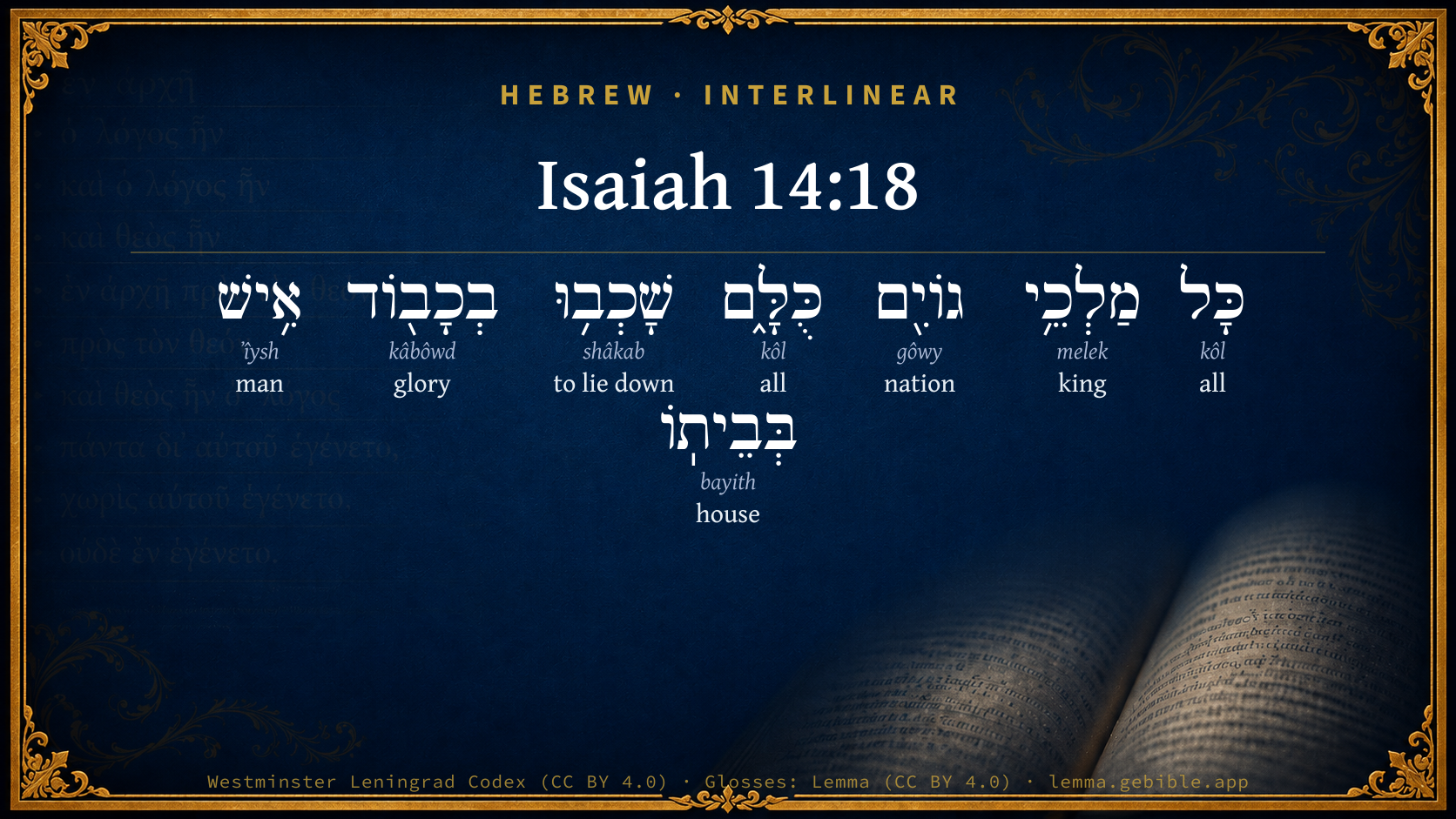
Hebrew (Westminster Leningrad Codex) Isaiah 14:18 appears in the Hebrew Old Testament. The text above is from the Westminster Leningrad Codex. Each word links to its Strong’s number, a concise gloss, and parsing drawn from the Open Scriptures Hebrew Bible morphology. Click any word for its full Brown-Driver-Briggs (BDB) entry.
Download image
Cite this verse

Isaiah 14:18 (World English Bible). Public Domain. Lemma interlinear Bible study tool, https://lemma.gebible.app/v/isaiah/14/18.

Show BibTeX & RIS
BibTeX
RIS
English Translation
All the kings of the nations, all of them, sleep in glory, everyone in his own house.
World English Bible · Public Domain
Download a study sheet

One document with this verse’s original text, its word-by-word gloss line, the meaning frame, cross-references with their text, attributed commentary, and full source and license credits — printable, and it pastes into notes with its structure intact.

This verse Autodidact and up

Study sheet (.html) Plain text (.txt)

A passage Seminary Student

Up to 50 verses in one chapter. A passage sheet keeps up to 6 commentary sources and 12 cross-references per verse, in the order this page ranks them, and says so on the sheet whenever that leaves anything out. Ask for a single verse and you get the Autodidact verse sheet above.

Everything on this page stays free to read, with no account — the sheet is a download of what is already on screen, not access to it.

Want to remove ads? Support Godless Engineer
Compare translations 3

The same verse in 3 English versions, stacked beneath the original-language interlinear above. Click any original word for its lexicon entry.

Each is an independent rendering of the whole verse — the interlinear is not word-aligned to these translations.

Highlighted words mark where these versions differ — a whole-verse word diff, not a word-by-word alignment.

  • World English Bible Public Domain
    All the kings of the nations, all of them, sleep in glory, everyone in his own house.
  • King James Version Public Domain
    All the kings of the nations, even all of them, lie in glory, every one in his own house.
  • unfoldingWord Literal Text CC BY-SA 4.0
    All of the kings of the nations, all of them, lie down in glory, a man in his house.

unfoldingWord Literal Text — © unfoldingWord, licensed CC BY-SA 4.0. Word-aligned USFM3 via Door43 (git.door43.org/unfoldingWord/en_ult).

Versions to compare (up to 4)

3 of 4 selected

Show all 18 translations

Every available English version of this verse, each an independent rendering of the whole verse.

  • World English Bible Public Domain
    All the kings of the nations, all of them, sleep in glory, everyone in his own house.
  • Berean Standard Bible Public Domain
    All the kings of the nations lie in state, each in his own tomb.
  • Majority Standard Bible Public Domain
    All the kings of the nations lie in state, each in his own tomb.
  • King James Version Public Domain
    All the kings of the nations, even all of them, lie in glory, every one in his own house.
  • American Standard Version (1901) Public Domain
    All the kings of the nations, all of them, sleep in glory, every one in his own house.
  • Revised Version (1885) Public Domain
    All the kings of the nations, all of them, sleep in glory, every one in his own house.
  • Geneva Bible (1599) Public Domain
    All the Kings of the nations, euen they all sleepe in glorie, euery one in his owne house.
  • Douay-Rheims (1899) Public Domain
    All the kings of the nations have all of them slept in glory, every one in his own house.
  • Young's Literal Translation Public Domain
    All kings of nations -- all of them, Have lain down in honour, each in his house,
  • Literal Standard Version CC BY-SA 4.0
    All kings of nations—all of them, || Have lain down in glory, each in his house,
  • Unlocked Literal Bible CC BY-SA 4.0
    All the kings of the nations, all of them lie down in honor, each one in his own tomb.
  • unfoldingWord Literal Text CC BY-SA 4.0
    All of the kings of the nations, all of them, lie down in glory, a man in his house.
  • Darby Bible Public Domain
    -- All the kings of the nations, all of them, lie in glory, every one in his own house;
  • World Messianic Bible Public Domain
    All the kings of the nations sleep in glory, everyone in his own house.
  • Webster's Bible Public Domain
    All the kings of the nations, even all of them, lie in glory, every one in his own house.
  • Free Bible Version CC BY-SA 4.0
    All the other kings of the nations lie in splendor in their great mausoleums.
  • Bible in Basic English Public Domain
    All the kings of the earth are at rest in glory, every man in his house,
  • JPS Tanakh (1917) Public Domain
    All the kings of the nations, all of them, sleep in glory, every one in his own house.

Literal Standard Version (2020), Covenant Press — licensed CC BY-SA 4.0. Text via the HelloAO Bible API (eBible.org). Unlocked Literal Bible (unfoldingWord) — licensed CC BY-SA 4.0. Text via the HelloAO Bible API (eBible.org). unfoldingWord Literal Text — © unfoldingWord, licensed CC BY-SA 4.0. Word-aligned USFM3 via Door43 (git.door43.org/unfoldingWord/en_ult). Free Bible Version, Dr. Jonathan Gallagher — licensed CC BY-SA 4.0. Text via the HelloAO Bible API (eBible.org).

Word by word

More ways to search: Search by grammar → Find every occurrence → Compare this word →

Practice this passage: Drill this verse → Learn its vocabulary →

בְכָב֖וֹד
kâbôwd
H3519
“in/at · glory”
Preposition + Noun, Common, Both, Singular, Absolute
Part of Speech
Preposition + Noun
Type
Common
Gender
Both
Number
Singular
State
Absolute
Full BDB Definition

Origin: from H3513

TWOT: 943d , 943e

glory, honour, glorious, abundance - abundance, riches - honour, splendour, glory - honour, dignity - honour, reputation - honour, reverence, glory - glory
  1. כָּל kôl H3605 “all of” Noun, Common, Masculine, Singular, Construct
  2. מַלְכֵ֥י melek H4428 “kings of” Noun, Common, Masculine, Plural, Construct
  3. גוֹיִ֖ם gôwy H1471 “nations” Noun, Common, Masculine, Plural, Absolute
  4. כֻּלָּ֑ם kôl H3605 “all · their” Noun, Common, Masculine, Singular, Construct + Suffix, Personal, 3rd Person, Masculine, Plural
  5. שָׁכְב֥וּ shâkab H7901 “to lie down” Verb, Qal, Perfect, 3rd Person, Common, Plural
  6. אִ֥ישׁ ʼîysh H376 “man” Noun, Common, Masculine, Singular, Absolute
  7. בְּבֵיתֽוֹ bayith H1004 “in/at · house · his” Preposition + Noun, Common, Masculine, Singular, Construct + Suffix, Personal, 3rd Person, Masculine, Singular

About this verse

These counts appear in no published source. They are computed here, from the morphology-tagged text and Lemma’s own curated glosses. What Lemma adds →

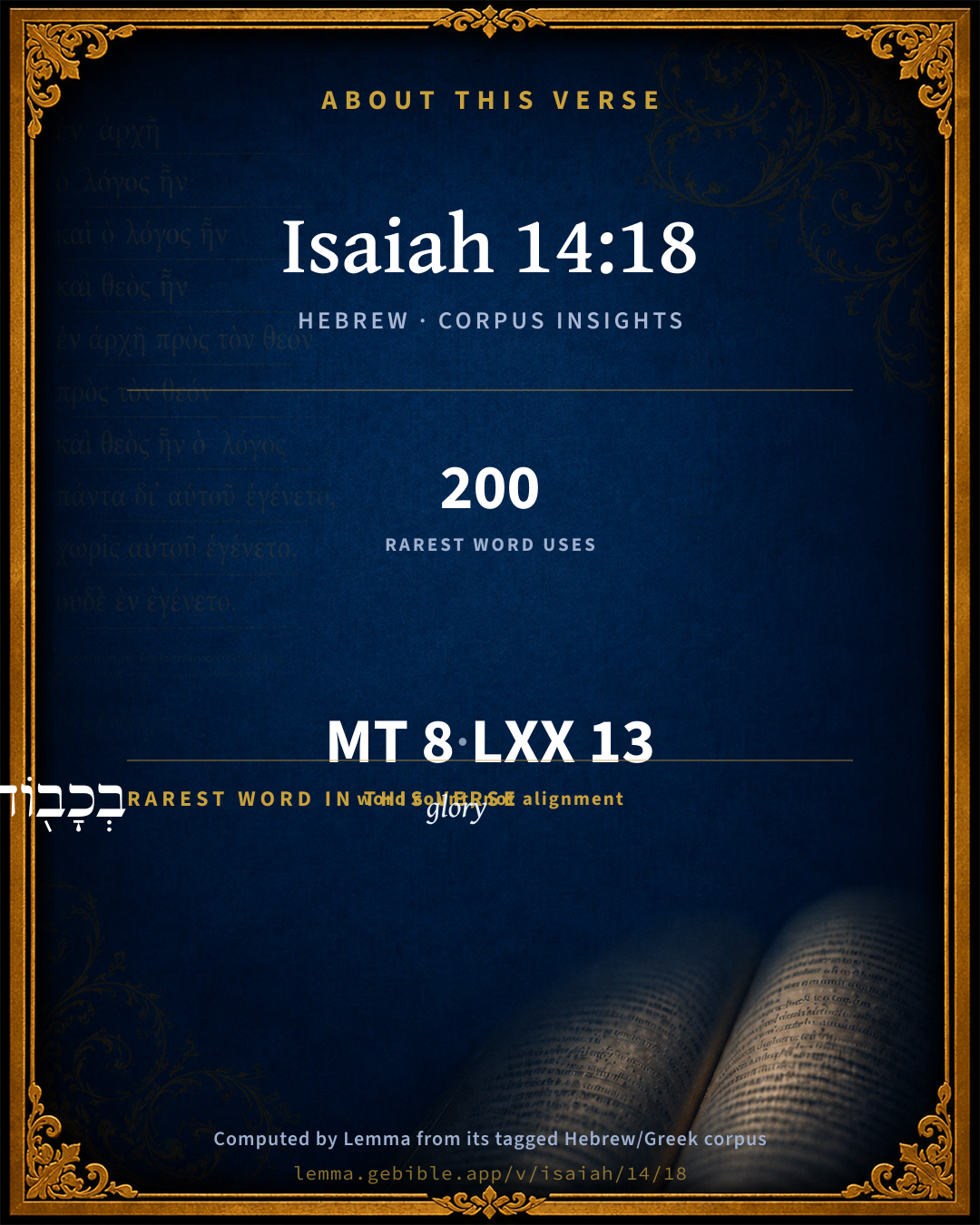
8
words
7
distinct lemmas
Prophets
section

Grammatical profile

  • 1 verb
  • 7 nouns

Verb forms

  • שָׁכְב֥וּ Qal · Perfect

Repetition

A word recurs within this verse — often emphatic in Hebrew:

Hebrew & Septuagint length

In English translation the verse runs 17 words from the Hebrew and 14 from the Septuagint (LXX English) — closely comparable.

A rough comparison of the two English renderings, which tokenize alike — not a word-level alignment.

Word counts can differ between the Hebrew and the Greek without any difference in meaning — e.g. the Hebrew direct-object marker אֵת has no separate Greek word, and Greek often adds the article ὁ.

In the original languages it is 8 Hebrew tokens and 13 Greek tokens — but the two are counted differently (Hebrew bundles its prefixes and suffixes into one token; the Greek is in lemma form), so that isn’t a like-for-like length.

Cross-references

7

Topical passages linked to Isaiah 14:18 in the Treasury of Scripture Knowledge — connected by theme and wording, ordered by reader-vote popularity; previews shown in the World English Bible.

  • 2 Chronicles 24:16 They buried him in the city of David among the kings, because he had done good in Israel, and toward God and his house.
  • 2 Chronicles 24:25 When they were departed for him (for they left him very sick), his own servants conspired against him for the blood of the sons of Jehoiada the priest, and killed him on his bed, and he died; and they buried him in the city of David, but they didn't bury him in the tombs of the kings.
  • Job 30:23 For I know that you will bring me to death, To the house appointed for all living.
  • Isaiah 22:16 "What are you doing here? and who has you here, that you have hewed out a tomb here? Cutting him out a tomb on high, chiseling a habitation for himself in the rock!"
  • Ezekiel 32:18–32 Son of man, wail for the multitude of Egypt, and cast them down, even her, and the daughters of the famous nations, to the lower parts of the earth, with those who go down into the pit.
  • Ecclesiastes 6:3 If a man fathers a hundred children, and lives many years, so that the days of his years are many, but his soul is not filled with good, and moreover he has no burial; I say, that an untimely birth is better than he:
  • Ecclesiastes 12:5 Yes, they shall be afraid of heights, And terrors will be in the way; And the almond tree shall blossom, And the grasshopper shall be a burden, And desire shall fail; Because man goes to his everlasting home, And the mourners go about the streets:

Cross-references courtesy of OpenBible.info (CC BY 4.0).

Hebrew and Greek witnesses Masoretic Hebrew ↔ Greek Septuagint

The same verse in the two great witnesses to the Old Testament, shown verse-for-verse.

These are two independent witnesses, not word-aligned to each other, and the Septuagint is shown in lemma (dictionary) form.

Hebrew Isaiah 14:18 Masoretic · Westminster Leningrad Codex

כָּל מַלְכֵ֥י גוֹיִ֖ם כֻּלָּ֑ם שָׁכְב֥וּ בְכָב֖וֹד אִ֥ישׁ בְּבֵיתֽוֹ

All the kings of the nations, all of them, sleep in glory, everyone in his own house.

World English Bible · Public Domain

Greek LXX Isaiah 14:18 Septuagint · lemma form

πᾶς ὁ βασιλεύς ὁ ἔθνος κοιμάω ἐν τιμή ἄνθρωπος ἐν ὁ οἶκος αὐτός

All the kings of the nations lie in honor, every man in his house.

LXX2012 (modern English Septuagint) · Public Domain

Hebrew: Westminster Leningrad Codex (CC BY 4.0). Greek: Septuagint (public domain); English from LXX2012 (modern English Septuagint) (Public Domain). How the Septuagint differs from the Hebrew →

Targum (Aramaic paraphrase)

1

The Targum is the ancient Jewish Aramaic paraphrase of the Hebrew Scriptures — an interpretive translation, not the Hebrew text itself. Onkelos (literal) and Pseudo-Jonathan (expansive) render the Torah, and Jonathan the Prophets. Coverage is partial: where no permissively-licensed English translation exists for a verse, only the Aramaic is shown. This is verse-level text, not a word-by-word alignment to the Hebrew.

  1. Targum Jonathan Prophets (Joshua–Malachi)
    כָּל מַלְכֵי עַמְמַיָא כּוּלְהוֹן שָׁכְבִין בִּיקָר גְבַר בְּבֵית עַלְמֵיהּ:

    All the kings of the nations, all of them, lie down in glory, each in his eternal abode."

    Targum Jonathan — Aramaic: “Mikraot Gedolot” (public domain). English: “Sefaria Community Translation” (CC0 1.0 (public-domain dedication)); “London "Chaldee Paraphrase," 1871” (public domain). Text via Sefaria.

Commentary

Notes on Isaiah 14:18 from classic Christian and Jewish commentators (each source and its license shown beneath its notes). The classic Christian expositions comment on the surrounding passage and are grouped to its opening verse, so a note may address several verses; the Jewish commentaries on the Tanakh (Rashi and others) are per-verse, so they appear only where the commentator wrote on this verse.

Lemma curates 59 commentaries, every one of them public domain or Creative Commons licensed, each selected and text-cleaned for this edition rather than reprinted as found. About our sources →

Trapp's Complete Commentary

John Trapp

Isa 14:18 All the kings of the nations, [even] all of them, lie in glory, every one in his own house.

Ver. 18. All the kings of the nations,] i.e., Very many of them have their stately pyramids, tombs, mausolean monuments erected, as among us at Westminster Henry VII’s chapel is a curious and costly piece.

John Trapp, A Commentary or Exposition upon All the Books of the Old and New Testament (1647–1656) — public domain. Text from a community e-Sword module.

Joseph Benson's Commentary

Isa 14:18-20. All the kings of the nations — That is, other kings generally; lie in glory, &c. — Are buried in their own sepulchres, having stately monuments erected to their memory. The persons who are represented as uttering these words are supposed to have before their eyes the carcass of the king of Babylon, lying on the bare ground among the common slain, greatly disfigured and covered with blood and wounds. But thou art cast out of thy grave — Deprived of a grave, or burying-place. Which very probably happened to Belshazzar, who, according to Dan 5:30, was slain in the night in which the city was taken by Cyrus, when his people had neither opportunity nor heart to bestow an honourable interment upon him, and the conquerors would not suffer them to do it. Like an abominable branch — Like a rotten twig of a tree, which he that prunes the trees, casts away: and as raiment of those that are slain — Which, being mangled, and besmeared with mire and blood, is cast away with contempt. That go down to the pit — Who, being slain, are cast into some pit. He saith, to the stones of the pit, because when dead bodies are cast in thither, men use to throw a heap of stones upon them. As a carcass trodden under feet — Neglected, like such a carcass. And this might literally happen to Belshazzar’s dead body. Thou shalt not be joined with them in burial — Not buried, as they are. Because thou hast slain thy people — Thou hast exercised great tyranny and cruelty, not only to thine enemies, but even to thine own subjects. The seed of evil-doers — Such as Belshazzar was, being descended from that Nebuchadnezzar who had made such horrid slaughters and devastations in the world, merely to gratify his own insatiable lusts, and who had been so impious toward God and his temple, and so bloody toward his church and people; shall never be renowned — Or, shall not be renowned for ever: although I have long borne with thee and thy family.

Joseph Benson's Commentary on the Old and New Testaments (1811–1818) — public domain. Text from a community e-Sword module.

Tyndale Open Study Notes

Tyndale Open Resources

14:18-20 The absence of a proper burial was a sign of great shame and dishonor. Unlike other kings, the king of Babylon would be disgraced in judgment.

Tyndale Open Study Notes — © Tyndale Open Resources, licensed CC BY-SA 4.0. Text via the HelloAO Bible API.

Jamieson, Fausset & Brown

Robert Jamieson, A. R. Fausset & David Brown

All--that is, This is the usual practice.

in glory--in a grand mausoleum.

house--that is, "sepulchre," as in Ecc 12:5; "grave" (Isa 14:19). To be excluded from the family sepulcher was a mark of infamy (Isa 34:3; Jer 22:19; Kg1 13:22; Ch2 21:20; Ch2 24:25; Ch2 28:27).

Jamieson, Fausset & Brown — Commentary Critical and Explanatory on the Whole Bible (1871) — public domain (CC PDM 1.0). Text via the HelloAO Bible API.

Ellicott's Commentary for English Readers

(18) All the kings of the nations . . .—The “house” in which the monarchs lie is, of course, their sepulchre. Such sepulchres, as in the case of the pyramid graves of the Egyptian kings, the “eternal home” as they themselves called it (comp. Ecc_12:5), were often almost literally the “house,” or palace, of the dead.

A Bible Commentary for English Readers, edited by Charles John Ellicott (1878–1897) — public domain. Text from a community e-Sword module.

The Cambridge Bible for Schools and Colleges

gen. ed. J. J. S. Perowne

18. every one in his own house] This yields a perfectly good sense as it stands, the “house” being the tomb prepared by the king in his lifetime. But it forms a short half-line where a long one is required by the measure; hence the proposal to transfer the words to Isa_14:17 (see on that verse).

18, 19. The contrast here is that between the honourable burial accorded to other kings and the indignity to which the king of Babylon is subjected by being deprived of sepulchral rites.

The Cambridge Bible for Schools and Colleges (gen. ed. J. J. S. Perowne; Cambridge University Press, 1878–1918) — public domain. Text from a community e-Sword module.

John Gill's Exposition

All the kings of the nations,.... Of other nations, besides those he governed, and even of those whom he had subdued, at least their ancestors, the greatest part of them however; for the word "all" does not always signify every individual, though by the repetition of it, it here bids fair for such a sense, there being but very few, or scarce any exceptions to this observation; for, on some account or another, both good and bad kings are interred in great state:

even all of them lie in glory; in rich tombs and stately monuments, erected for the honour of them; and where they "sleep", as the word signifies, with their fathers, their ancestors, and are at rest, in the state of the dead, where they will continue to the resurrection:

everyone in his own house; or grave, see Job 30:23 the same with his long home, Ecc 12:5 or the house of his world: in reference to which, the Targum paraphrases it by the same phrase here; and though their graves were not in their dwelling houses or palaces, yet often near them, and in their own country, and were what had been erected, or caused to be erected by them, in their lifetime.

John Gill's Exposition of the Whole Bible (1746–1763) — public domain (CC PDM 1.0). Text via the HelloAO Bible API.

Albert Barnes' Notes on the Bible

All the kings of the nations - That is, this is the common way in which the kings are buried.

Lie in glory - They lie in a magnificent mausoleum; they are surrounded with splendor even in their tombs. It is well known that vast sums of money were expended to rear magnificent mausoleums as the burial place of kings. With this design, probably, the pyramids of Egypt were reared; and the temple of Bel in Babylon, we are told, was employed for this purpose. Josephus says that vast quantities of money were buried in the sepulchre of David. The kings of Israel were buried in a royal burying place on Mount Zion 2Ch 21:20; 2Ch 35:24; Neh 3:16. For a description of the sepulchre of David, and of sepulchres in general, “see” Calmet’s “Dict.” Art. “Sepulchre” (compare Ezek. 32.)

Every one in his own house - In a sepulchre constructed for himself. It was usual for kings to have a splendid tomb constructed for themselves.

Albert Barnes' Notes on the Bible (1834–1885) — public domain. Text from a community e-Sword/MySword module.

Matthew Poole's English Annotations

All of them; other kings most commonly do, as the word all is frequently used.

Every one in his own house; are buried in their own sepulchres, having stately monuments erected to their honour and memory.

Matthew Poole's English Annotations on the Holy Bible (1683–1685) — public domain. Text from a community e-Sword/MySword module.

Whedon's Commentary on the Bible

Daniel D. Whedon

18. All… kings… lie in glory — This is the ordinary fact; and it is a great mark of dishonour not to be buried, even for a private person, (1Ki_13:22,) and how much more for a sovereign. 2Ch_21:20; 2Ch_34:24. The language is not that of derision, but of astonishment.

Daniel D. Whedon (gen. ed.), Commentary on the Old and New Testaments (1874–1909) — public domain. Text from a community e-Sword module.

The Pulpit Commentary

All the kings of the nations, etc.; i.e. the other kings, speaking generally, died in peace, and had an honorable burial, each one in the sepulcher that he had prepared for himself as his final abode or "house". (Isa_22:16) The care taken to prepare tombs was not confined to Egypt, though there obtaining its greatest development. Among others, the Persian kings certainly prepared their own sepulchers; and probably the practice was general.

The Pulpit Commentary (1880–1919), ed. H.D.M. Spence-Jones & Joseph S. Exell — public domain. Text from a community e-Sword module.

John Wesley's Explanatory Notes

All - That is, other things most commonly do. Lie - Are buried in their own sepulchres, having stately monuments erected to their memory.

John Wesley, Explanatory Notes Upon the Whole Bible (1754–1765) — public domain. Text via the GEBible commentary corpus.

Keil & Delitzsch

C. F. Keil & F. Delitzsch

The prophet, whose own words now follow the words of the spectators, proceeds to describe the state in which the tyrant lies, and which calls for such serious reflections. "All the kings of the nations, they are all interred in honour, every one in his house: but thou art cast away far from thy sepulchre like a shoot hurled away, clothed with slain, with those pierced through with the sword, those that go down to the stones of the pit; like a carcase trodden under feet." Every other king was laid out after his death "in his house" (b'bēthō), i.e. within the limits of his own palace; but the Chaldean lay far away from the sepulchre that was apparently intended for him. The מן in מקברך signifies procul ab, as in Num 15:24; Pro 20:3. He lies there like nētzer nith‛âb, i.e., like a branch torn off from the tree, that has withered and become offensive, or rather (as neetzer does not mean a branch, but a shoot) like a side-shoot that has been cut off the tree and thrown away with disgust as ugly, useless, and only a hindrance to the regular growth of the tree (possibly also an excrescence); nith‛âb (cast away) is a pregnant expression, signifying "cast away with disgust." The place where he lies is the field of battle. A vaticinium post eventum would be expressed differently from this, as Luzzatto has correctly observed. For what Seder 'Olam says - namely, that Nebuchadnezzar's corpse was taken out of the grave by Evilmerodach, or as Abravanel relates it, by the Medo-Persian conquerors - is merely a conclusion drawn from the passage before us, and would lead us to expect הוצת rather than השלכת. It is a matter of indifference, so far as the truth of the prophecy is concerned, whether it was fulfilled in the person of Nebuchadnezzar I, or of that second Nebuchadnezzar who gave himself out as a son of Nabonet, and tried to restore the freedom of Babylon. The scene which passes before the mind of the prophet is the field of battle. To clear this they made a hole and throw stones (abnē-bor, stones of the pit) on the top, without taking the trouble to shovel in the earth; but the king of Babylon is left lying there, like a carcase that is trampled under foot, and deserves nothing better than to be trampled under foot (mūbâs, part. hoph. of būs, conculcare). They do not even think him worth throwing into a hole along with the rest of the corpses.

Keil & Delitzsch — Biblical Commentary on the Old Testament (1861–1891) — public domain (CC PDM 1.0). Text via the HelloAO Bible API. (Old Testament only.)

J. A. Alexander on Isaiah

Joseph Addison Alexander

“All kings of nations, all of them, lie in state (or glory), each in his house.” There is here a special reference to the peculiar oriental feeling with respect to burial. The Egyptians paid far more attention to the dwellings of the dead than of the living. Some of the greatest national works have been intended for this purpose, such as the pyramids, the temple of Belus, and the cemetery at Persepolis. The environs of Jerusalem are full of ancient sepulchres. The want of burial is spoken of in Scripture as disgraceful even to a private person (1Ki 13:22) much more to a sovereign (2Ch 21:20). The ancient oriental practice of burying above ground and in solid structures, often reared by those who were to occupy them (see below, Isa 22:16) will account for the use of house here in the sense of sepulchre, without supposing any reference to the burial of kings within their palaces. To lie in state may seem inappropriate to burial, but is in fact happily descriptive of the oriental method of sepulture.

Joseph Addison Alexander, The Prophecies of Isaiah (1846–1847; New York: Scribner, 1870–1878) — public domain. Text from a community e-Sword module.

unfoldingWord translationNotes

Door43 World Missions Community

Connecting Statement:

This is the end of the taunt song that the Israelites will sing to the king of Babylon.

all of them lie down in honor

This means that their bodies were buried in an honorable way. AT: "all the kings who have died are buried in an honorable way" (See: Assumed Knowledge and Implicit Information)

But you are cast out of your grave

Being thrown out of the grave represents not being buried. AT: "But you are not buried. Your body is left on the ground" (See: Metaphor)

like a branch thrown away

A branch thrown away represents something worthless. AT: "like a worthless branch that is tossed aside" (See: Simile)

The dead cover you like a garment

This represents many dead bodies being on top of his body. AT: "The bodies of dead people completely cover your body" or "The bodies of dead soldiers are piled on top of your body" (See: Simile)

those pierced by the sword

This describes "the dead" spoken of at the beginning of this sentence. Being pierced by the sword represents being killed in battle. AT: "those who were killed in battle" (See: Metonymy)

who go down to the stones of the pit

The pit refers either to hell, or to a large hole in the ground where many dead bodies are simply dumped.

You will not join them in burial

The word "them" refers to the other kings who died and were buried properly. Joining them in burial represents being buried as they were. AT: "you will never be buried as other kings were buried" (See: Metaphor)

The offspring of evildoers will never be mentioned again

This can be stated in active form. AT: "no one will ever speak again about the descendants of evildoers" (See: Active or Passive)

translationWords

king

nation

grave

sword

pit

bury

son

evildoer

unfoldingWord translationNotes — © Distant Shores Media and the Door43 World Missions Community, licensed CC BY-SA 4.0. Source: git.door43.org/Door43/en_tn.

Rashi

Rabbi Shlomo Yitzchaki (Rashi)

each in his house In his grave, and so did Jonathan render: In his eternal house.

Rashi on the Tanakh — English translations: “The Judaica Press complete Tanach with Rashi, translated by A. J. Rosenberg” (CC BY 4.0); “Pentateuch with Rashi's commentary by M. Rosenbaum and A.M. Silbermann, 1929-1934” (public domain); “The Metsudah Tanach series, Lakewood, N.J” (CC BY 4.0); and “The Book of Joshua, Metsudah Publications, 1997” (CC BY 4.0). Text via Sefaria.

Ibn Ezra

Rabbi Abraham ibn Ezra

In his house. Which he had prepared for himself, that is the grave; comp. man goeth to his long home (Eccl. 12:5)

Ibn Ezra on the Tanakh — English translations: “Sefaria Community Translation” (CC0 1.0 (public-domain dedication)); “Yalkut, Sifsei Chachomim Chumash, Metsudah Publications, 2009” (CC BY 4.0); and “Commentary of Ibn Ezra on Isaiah - trans. by M. Friedlander, 1873” (public domain). Text via Sefaria.

Lesson kit

Teaching starters — assembled from the data on this page, not authored interpretation. Every prompt links to the verse data it draws on. Edit before teaching.

Isaiah, in the Prophets, opens this verse with 8 words (7 distinct Hebrew lemmas). Its most distinctive word is kâbôwd (“glory”). A historical commentator’s framing appears above. Read the whole chapter for the surrounding context.

Discussion questions

  1. What does “glory” (kâbôwd) contribute to the verse as a whole?
  2. How does 2 Chronicles 24:16, which shares this passage’s theme, read alongside this verse?
  3. What does the repetition of “all” (2× in this one verse) do in this verse?
  4. The translations on this page render this verse differently — a whole-verse word diff, not a word-by-word alignment. What might account for the different wordings?
  5. «שָׁכְב֥וּ» is a Qal Perfect verb. How does that grammatical form shape the action described?
  6. Compare how Trapp's Complete Commentary and Joseph Benson's Commentary read this verse. Where do they agree or differ?

Things to notice

Reading settings

Reading text

Shown beneath each verse's original-language words.

Old Testament
Old Testament edition

Read the OT as the Masoretic Hebrew (MT) or the Greek Septuagint (LXX).

English shown for the Greek Septuagint (in the Hebrew ↔ Greek comparison).

Comparing translations? Open the Compare panel on any verse page to stack up to four side by side.