
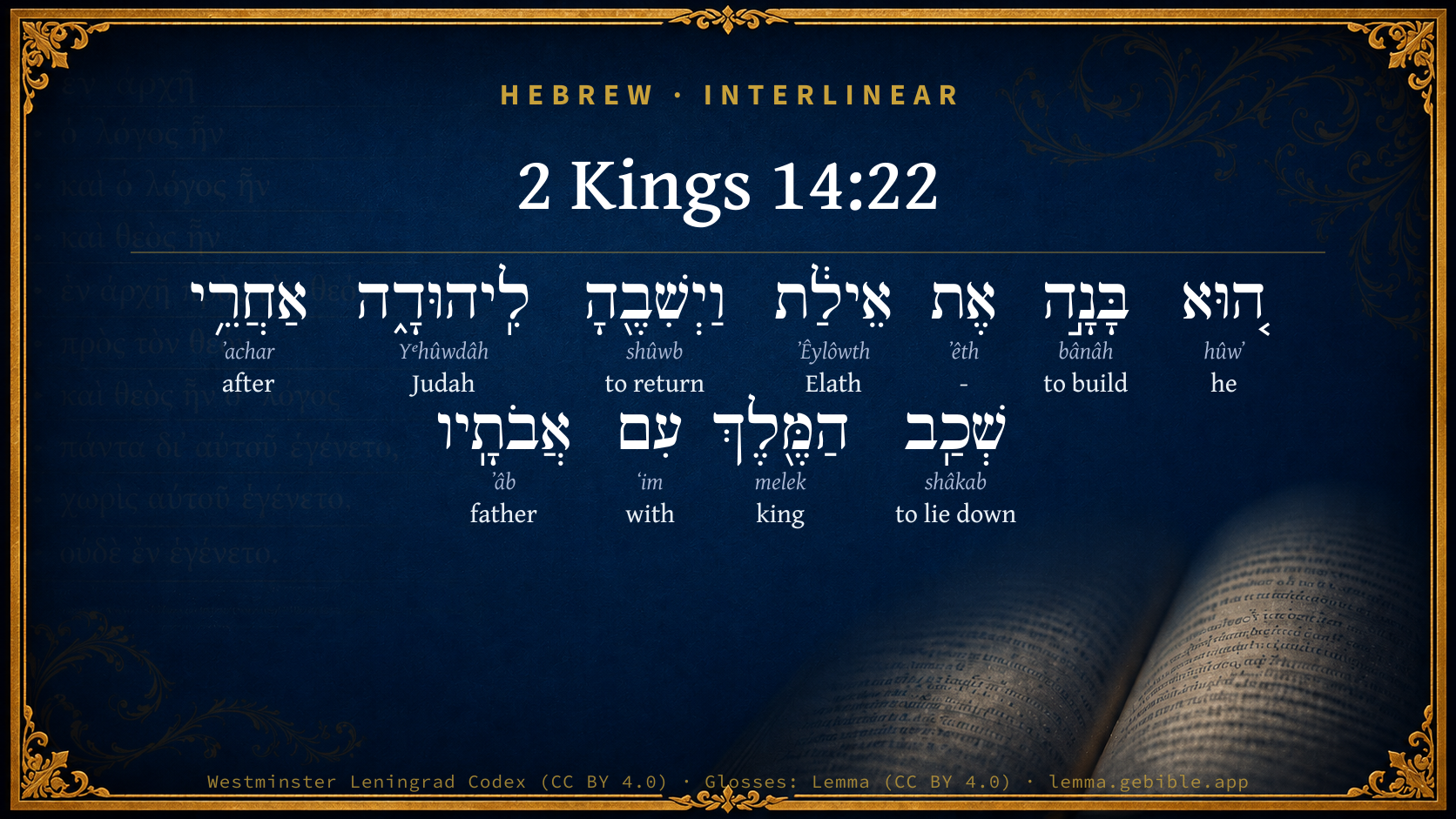
2 Kings 14:22

Hebrew (Westminster Leningrad Codex) 2 Kings 14:22 appears in the Hebrew Old Testament. The text above is from the Westminster Leningrad Codex. Each word links to its Strong’s number, a concise gloss, and parsing drawn from the Open Scriptures Hebrew Bible morphology. Click any word for its full Brown-Driver-Briggs (BDB) entry.
Download image
Cite this verse

2 Kings 14:22 (World English Bible). Public Domain. Lemma interlinear Bible study tool, https://lemma.gebible.app/v/2-kings/14/22.

Show BibTeX & RIS
BibTeX
RIS
English Translation
He built Elath, and restored it to Judah, after that the king slept with his fathers.
World English Bible · Public Domain
Download a study sheet

One document with this verse’s original text, its word-by-word gloss line, the meaning frame, cross-references with their text, attributed commentary, and full source and license credits — printable, and it pastes into notes with its structure intact.

This verse Autodidact and up

Study sheet (.html) Plain text (.txt)

A passage Seminary Student

Up to 50 verses in one chapter. A passage sheet keeps up to 6 commentary sources and 12 cross-references per verse, in the order this page ranks them, and says so on the sheet whenever that leaves anything out. Ask for a single verse and you get the Autodidact verse sheet above.

Everything on this page stays free to read, with no account — the sheet is a download of what is already on screen, not access to it.

Want to remove ads? Support Godless Engineer
Compare translations 3

The same verse in 3 English versions, stacked beneath the original-language interlinear above. Click any original word for its lexicon entry.

Each is an independent rendering of the whole verse — the interlinear is not word-aligned to these translations.

Highlighted words mark where these versions differ — a whole-verse word diff, not a word-by-word alignment.

  • World English Bible Public Domain
    He built Elath, and restored it to Judah, after that the king slept with his fathers.
  • King James Version Public Domain
    He built Elath, and restored it to Judah, after that the king slept with his fathers.
  • unfoldingWord Literal Text CC BY-SA 4.0
    He, he built up Elath, and he returned it to Judah after the king lay down with his fathers.

unfoldingWord Literal Text — © unfoldingWord, licensed CC BY-SA 4.0. Word-aligned USFM3 via Door43 (git.door43.org/unfoldingWord/en_ult).

Versions to compare (up to 4)

3 of 4 selected

Show all 18 translations

Every available English version of this verse, each an independent rendering of the whole verse.

  • World English Bible Public Domain
    He built Elath, and restored it to Judah, after that the king slept with his fathers.
  • Berean Standard Bible Public Domain
    Azariah was the one who rebuilt Elath and restored it to Judah after King Amaziah rested with his fathers.
  • Majority Standard Bible Public Domain
    Azariah was the one who rebuilt Elath and restored it to Judah after King Amaziah rested with his fathers.
  • King James Version Public Domain
    He built Elath, and restored it to Judah, after that the king slept with his fathers.
  • American Standard Version (1901) Public Domain
    He built Elath, and restored it to Judah, after that the king slept with his fathers.
  • Revised Version (1885) Public Domain
    He built Elath, and restored it to Judah, after that the king slept with his fathers.
  • Geneva Bible (1599) Public Domain
    He built Elath, and restored it to Iudah, after that the King slept with his fathers.
  • Douay-Rheims (1899) Public Domain
    He built Elath, and restored it to Juda, after that the king slept with his fathers.
  • Young's Literal Translation Public Domain
    he hath built Elath, and bringeth it back to Judah, after the lying of the king with his fathers.
  • Literal Standard Version CC BY-SA 4.0
    he has built Elath, and brings it back to Judah, after the lying of the king with his fathers.
  • Unlocked Literal Bible CC BY-SA 4.0
    It was Azariah who rebuilt Elath and restored it to Judah, after King Amaziah slept with his ancestors.
  • unfoldingWord Literal Text CC BY-SA 4.0
    He, he built up Elath, and he returned it to Judah after the king lay down with his fathers.
  • Darby Bible Public Domain
    It was he that built Elath, and restored it to Judah, after the king slept with his fathers.
  • World Messianic Bible Public Domain
    He built Elath and restored it to Judah. After that the king slept with his fathers.
  • Webster's Bible Public Domain
    He built Elath, and restored it to Judah, after that the king slept with his fathers.
  • Free Bible Version CC BY-SA 4.0
    Azariah recaptured Elath for Judah and rebuilt it after his father's death.
  • Bible in Basic English Public Domain
    He was the builder of Elath, which he got back for Judah after the death of the king.
  • JPS Tanakh (1917) Public Domain
    He built Elath, and restored it to Judah, after that the king slept with his fathers.

Literal Standard Version (2020), Covenant Press — licensed CC BY-SA 4.0. Text via the HelloAO Bible API (eBible.org). Unlocked Literal Bible (unfoldingWord) — licensed CC BY-SA 4.0. Text via the HelloAO Bible API (eBible.org). unfoldingWord Literal Text — © unfoldingWord, licensed CC BY-SA 4.0. Word-aligned USFM3 via Door43 (git.door43.org/unfoldingWord/en_ult). Free Bible Version, Dr. Jonathan Gallagher — licensed CC BY-SA 4.0. Text via the HelloAO Bible API (eBible.org).

Word by word

More ways to search: Search by grammar → Find every occurrence → Compare this word →

Practice this passage: Drill this verse → Learn its vocabulary →

About this verse

These counts appear in no published source. They are computed here, from the morphology-tagged text and Lemma’s own curated glosses. What Lemma adds →

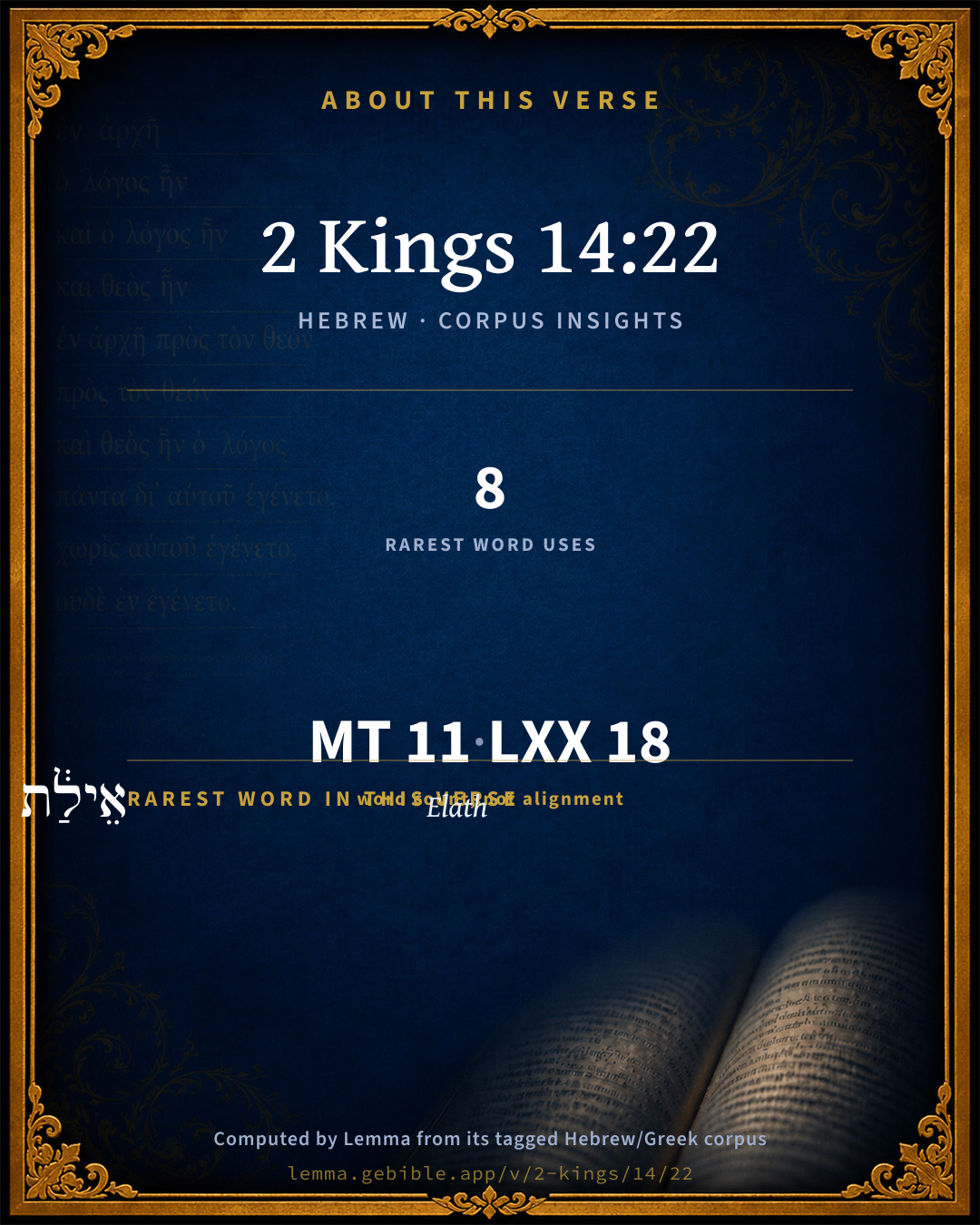
11
words
11
distinct lemmas
Historical
section

Notable vocabulary

The rarest word here is אֵילַ֔ת Elath H359 — appearing just 8 times in the whole Hebrew Bible.

Shared distinctive vocabulary

אֵילַ֔ת Elath H359 occurs in 6 verses of the Hebrew Bible. Also found in:

Grammatical profile

  • 3 verbs
  • 4 nouns
  • 1 pronoun
  • 2 prepositions
  • 1 particle

Verb forms

  • בָּנָ֣ה Qal · Perfect
  • וַיְשִׁבֶ֖הָ Hiphil · Sequential Imperfect
  • שְׁכַֽב Qal · Infinitive Construct

Hebrew & Septuagint length

In English translation the verse runs 16 words from the Hebrew and 15 from the Septuagint (LXX English) — closely comparable.

A rough comparison of the two English renderings, which tokenize alike — not a word-level alignment.

Word counts can differ between the Hebrew and the Greek without any difference in meaning — e.g. the Hebrew direct-object marker אֵת has no separate Greek word, and Greek often adds the article ὁ.

In the original languages it is 11 Hebrew tokens and 18 Greek tokens — but the two are counted differently (Hebrew bundles its prefixes and suffixes into one token; the Greek is in lemma form), so that isn’t a like-for-like length.

Cross-references

5

Topical passages linked to 2 Kings 14:22 in the Treasury of Scripture Knowledge — connected by theme and wording, ordered by reader-vote popularity; previews shown in the World English Bible.

  • 2 Kings 16:6 At that time Rezin king of Syria recovered Elath to Syria, and drove the Jews from Elath; and the Syrians came to Elath, and lived there, to this day.
  • 1 Kings 9:26 King Solomon made a navy of ships in Ezion Geber, which is beside Eloth, on the shore of the Red Sea, in the land of Edom.
  • Deuteronomy 2:8 So we passed by from our brothers the children of Esau, who dwell in Seir, from the way of the Arabah from Elath and from Ezion Geber. We turned and passed by the way of the wilderness of Moab.
  • 2 Chronicles 8:17 Then went Solomon to Ezion Geber, and to Eloth, on the seashore in the land of Edom.
  • 2 Chronicles 26:2 He built Eloth, and restored it to Judah, after that the king slept with his fathers.

Cross-references courtesy of OpenBible.info (CC BY 4.0).

Hebrew and Greek witnesses Masoretic Hebrew ↔ Greek Septuagint

The same verse in the two great witnesses to the Old Testament, shown verse-for-verse.

These are two independent witnesses, not word-aligned to each other, and the Septuagint is shown in lemma (dictionary) form.

Hebrew 2 Kings 14:22 Masoretic · Westminster Leningrad Codex

ה֚וּא בָּנָ֣ה אֶת אֵילַ֔ת וַיְשִׁבֶ֖הָ לִֽיהוּדָ֑ה אַחֲרֵ֥י שְׁכַֽב הַמֶּ֖לֶךְ עִם אֲבֹתָֽיו

He built Elath, and restored it to Judah, after that the king slept with his fathers.

World English Bible · Public Domain

Greek LXX 2 Kings 14:22 Septuagint · lemma form

αὐτός οἰκοδομέω ὁ αιλωθ καί ἐπιστρέφω αὐτός ὁ ιουδα μετά ὁ κοιμάω ὁ βασιλεύς μετά ὁ πατήρ αὐτός

He built Aeloth, and restored it to Juda, after the king slept with his fathers.

LXX2012 (modern English Septuagint) · Public Domain

Hebrew: Westminster Leningrad Codex (CC BY 4.0). Greek: Septuagint (public domain); English from LXX2012 (modern English Septuagint) (Public Domain). How the Septuagint differs from the Hebrew →

Targum (Aramaic paraphrase)

1

The Targum is the ancient Jewish Aramaic paraphrase of the Hebrew Scriptures — an interpretive translation, not the Hebrew text itself. Onkelos (literal) and Pseudo-Jonathan (expansive) render the Torah, and Jonathan the Prophets. Coverage is partial: where no permissively-licensed English translation exists for a verse, only the Aramaic is shown. This is verse-level text, not a word-by-word alignment to the Hebrew.

  1. Targum Jonathan Prophets (Joshua–Malachi)
    הוּא בְנָא יַת אֵילַת וַאֲתִיבָהּ לְבֵית יְהוּדָה בָּתַר דִשְׁכִיב מַלְכָּא עִם אֲבָהָתוֹהִי:

    (no public-domain English translation for this verse)

    Targum Jonathan — Aramaic: “Mikraot Gedolot” (public domain). English: “Sefaria Community Translation” (CC0 1.0 (public-domain dedication)); “London "Chaldee Paraphrase," 1871” (public domain). Text via Sefaria.

Commentary

Notes on 2 Kings 14:22 from classic Christian and Jewish commentators (each source and its license shown beneath its notes). The classic Christian expositions comment on the surrounding passage and are grouped to its opening verse, so a note may address several verses; the Jewish commentaries on the Tanakh (Rashi and others) are per-verse, so they appear only where the commentator wrote on this verse.

Lemma curates 59 commentaries, every one of them public domain or Creative Commons licensed, each selected and text-cleaned for this edition rather than reprinted as found. About our sources →

Trapp's Complete Commentary

John Trapp

2Ki 14:22 He built Elath, and restored it to Judah, after that the king slept with his fathers.

Ver. 22. He built Elath.] A place of great importance, as being a port town, say some, near the Red Sea.

John Trapp, A Commentary or Exposition upon All the Books of the Old and New Testament (1647–1656) — public domain. Text from a community e-Sword module.

Joseph Benson's Commentary

2Ki 14:22. He built Elath — Repaired and fortified it; for it was built before, Deu 2:8. And restored it to Judah — From whom it had revolted with the rest of Edom, in which land it lay, upon the Red sea. After that the king — Namely, his father Amaziah; slept with his fathers — The meaning is, that Amaziah did not perfect his conquest of Edom, but left some work there for his son to do.

Joseph Benson's Commentary on the Old and New Testaments (1811–1818) — public domain. Text from a community e-Sword module.

Tyndale Open Study Notes

Tyndale Open Resources

14:22 Elath, built by Solomon (2 Chr 8:17) on the Gulf of Aqaba, provided an important commercial gateway to the Red Sea.

Tyndale Open Study Notes — © Tyndale Open Resources, licensed CC BY-SA 4.0. Text via the HelloAO Bible API.

Geneva Bible (1599)

Geneva Bible translators

Which is also called Elanon or Eloth.

Geneva Bible (1599) marginal notes — public domain. Text via Bolls.life.

Jamieson, Fausset & Brown

Robert Jamieson, A. R. Fausset & David Brown

He built Elath--fortified that seaport. It had revolted with the rest of Edom, but was now recovered by Uzziah. His father, who did not complete the conquest of Edom, had left him that work to do.

Jamieson, Fausset & Brown — Commentary Critical and Explanatory on the Whole Bible (1871) — public domain (CC PDM 1.0). Text via the HelloAO Bible API.

Adam Clarke's Commentary

Verse 22. He built Elath] This city belonged to the Edomites; and was situated on the eastern branch of the Red Sea, thence called the Elanitic Gulf. It had probably suffered much in the late war; and was now rebuilt by Uzziah, and brought entirely under the dominion of Judah.

Adam Clarke's Commentary on the Bible (1810–1826) — public domain. Text from a community e-Sword/MySword module.

Ellicott's Commentary for English Readers

(22) He built Elath.—The pronoun is emphatic; he, in contrast with his father. “Built,” either rebuilt or fortified. The verse is in close connection with the preceding narrative. Amaziah perhaps had not vigorously prosecuted the conquest of Edom, having been greatly weakened by his defeat in the struggle with Jehoash. He may even have suffered some further losses at the hands of the Edomites; and this, as Thenius supposes may have led to the conspiracy which brought about his death and the accession of his son. The warlike youth Uzziah took the field at once, and pushed his victorious arms to the southern extremity of Edom, the port of Elath (2Ki_9:26), and thus restored the state of things which had existed under Solomon and Jehoshaphat.

After that the king slept—i.e., immediately after the murder of Amaziah. Thenius explains the verse with most success, but this clause is still somewhat surprising.

A Bible Commentary for English Readers, edited by Charles John Ellicott (1878–1897) — public domain. Text from a community e-Sword module.

The Cambridge Bible for Schools and Colleges

gen. ed. J. J. S. Perowne

22. He built Elath] Elath (also written Eloth) was at the northern extremity of the Gulf of Akabah. It is said in 1Ki_9:26 to have belonged to Edom, but at this time Judah was powerful enough to secure a road through Edom for trade purposes, and so extend the sway of their kingdom to the same point southward which they had occupied in the days of Solomon. Between that time and this, Elath had most likely fallen into decay. Hence the mention of ‘building’, which of course means restoration. (See on 2Ki_15:35.)

and restored it to Judah] As it had been in the days of Solomon. We need not suppose that more was done than to secure a passage through Edom between Elath and Jerusalem. Edom was of small use to Judah, but a port on the Red Sea was a great acquisition.

after that the king slept with his fathers] This is another of those vague notices which indicate an unusual state of things in Judah at this period. It would almost seem as though Azariah had been put in authority, if not on the throne, before the death of his father, and that he had been making his plans beforehand, only waiting for his father’s death to carry them out. He was without doubt a popular monarch, for it is said (verse 21) that all Judah agreed on him for king.

The Cambridge Bible for Schools and Colleges (gen. ed. J. J. S. Perowne; Cambridge University Press, 1878–1918) — public domain. Text from a community e-Sword module.

John Gill's Exposition

He restored the coast of Israel,.... The cities upon it, which had been taken away from them by their enemies:

from the entering of Hamath; which was the northern border of the land of Canaan, the entrance into it from Syria, see Num 34:8,

unto the sea of the plain: of Jordan, called sometimes the salt sea and the Dead Sea; the lake Asphaltites, as Josephus (k), where formerly stood Sodom and Gomorrah:

according to the word of the Lord God of Israel, which he spake by the hand of his servant Jonah the son of Amittai; the same with him whose prophecy among the small prophets bears this name; and though his prophecy concerning Jeroboam's success and victories is not there, nor anywhere else, recorded at length, yet needed not to be doubted of; this is the first of the prophets spoken of whose books are extant:

which was of Gathhepher; a city in the tribe of Zebulun, Jos 19:13, which contradicts a notion of the Jews, that no prophet came out of Galilee, when the very first of those that were the penmen of the books of prophecies was from thence, see Joh 7:52.

(k) Ut supra, (Antiqu. l. 9.) c. 10. sect. 1.

John Gill's Exposition of the Whole Bible (1746–1763) — public domain (CC PDM 1.0). Text via the HelloAO Bible API.

Albert Barnes' Notes on the Bible

Elath, or Eloth (marginal reference 1Ki 9:26), was near Ezion-Geber, in the Gulf of Akabah. It had been lost to the Jews on the revolt of Edom from Joram 2Ki 8:22. Uzziah’s re-establishment of the place, rendered possible by his father’s successes 2Ki 14:7, was one of his first acts, and seems to imply a desire to renew the commercial projects which Solomon had successfully carried out, and which Jehoshaphat had vainly attempted 1Ki 22:48.

Albert Barnes' Notes on the Bible (1834–1885) — public domain. Text from a community e-Sword/MySword module.

Haydock's Catholic Bible Commentary

Built, or rebuilt Elath; which gives its name to the eastern branch of the Red Sea. David had possession of all Idumea. Amasias had reconquered a great part, and his son pushed his conquests still further.

George Leo Haydock (1774–1849), Haydock's Catholic Family Bible and Commentary, 1859 edition — public domain. Excludes Psalms (Douay-Rheims chapter numbering differs from Protestant) and Deuterocanonical books (Catholic canon only).

Matthew Poole's English Annotations

He built Elath, i.e. repaired and fortified it; for it was built before, Deu 2:8.

Restored it to Judah; from whom it had revolted with the rest of Edom, in which land this place was upon the Red Sea.

The king, i.e. his father Amaziah; who did not perfect his conquest of Edom, but left some work for his son.

Matthew Poole's English Annotations on the Holy Bible (1683–1685) — public domain. Text from a community e-Sword/MySword module.

Whedon's Commentary on the Bible

Daniel D. Whedon

22. Built Elath, and restored it to Judah — This fragmentary notice of the chief triumph of Judah during Azariah’s reign seems to have been thrown in here to show that the son of Amaziah was chiefly distinguished, like his father, for his work in the territories of Edom. Elath, which Azariah is here said to have built — that is, repaired and fortified — is first mentioned in connexion with the journey of Israel through the desert, (Deu_2:8,) and again at 1Ki_9:26, where see note. It was situated at the head of the eastern arm of the Red Sea, and the ancient site is now marked by extensive mounds of rubbish.

Daniel D. Whedon (gen. ed.), Commentary on the Old and New Testaments (1874–1909) — public domain. Text from a community e-Sword module.

The Pulpit Commentary

He built Elath, and restored it to Judah. On the position of Elath, or Eloth, and its importance, see the comment on 1Ki_9:26. It had been the headquarters of Solomon"s fleet, (1Ki_9:26) and again of Jehoshaphat"s (1Ki_22:48; 2Ch_20:36) but had been, of course, recovered by the Edomites when they revolted. (2Ki_8:22) Azariah"s re-occupation seems to imply an intention on his part of, renewing the old Red Sea trade. By "built" in this passage we must understand "rebuilt" or (as in 2Ch_11:6) "fortified." After that the king slept with his fathers. Keil is probably right in understanding this to mean "immediately after he had ascended the throne," or "as soon as ever his father was dead" (see the comment on ver. 19). His further military successes will be considered in the comment on his reign, as sketched in the next chapter.

The Pulpit Commentary (1880–1919), ed. H.D.M. Spence-Jones & Joseph S. Exell — public domain. Text from a community e-Sword module.

Rashi

Rabbi Shlomo Yitzchaki (Rashi)

After the king lay with his forefathers. After the death of his father Amatzyoh. From here you deduce that Uzziyoh reigned during his father’s lifetime. Nevertheless, Eilas was not delivered into his hand until after his father’s death, for if he did not reign during his father’s lifetime, why was it necessary to state, “after the king lay with his forefathers”? And when you count the days of the Beis [Hamikdosh] according to the years of the kings, if you do not subtract these fifteen years, which are counted for Amatzyoh and Uzziyohu, you will find that it existed four hundred twenty-five years.

Rashi on the Tanakh — English translations: “The Judaica Press complete Tanach with Rashi, translated by A. J. Rosenberg” (CC BY 4.0); “Pentateuch with Rashi's commentary by M. Rosenbaum and A.M. Silbermann, 1929-1934” (public domain); “The Metsudah Tanach series, Lakewood, N.J” (CC BY 4.0); and “The Book of Joshua, Metsudah Publications, 1997” (CC BY 4.0). Text via Sefaria.

Lesson kit

Teaching starters — assembled from the data on this page, not authored interpretation. Every prompt links to the verse data it draws on. Edit before teaching.

2 Kings, in the Historical, opens this verse with 11 words (11 distinct Hebrew lemmas). Its most distinctive word is ʼÊylôwth (“Elath”). A historical commentator’s framing appears above. Read the whole chapter for the surrounding context.

Discussion questions

  1. The word ʼÊylôwth carries the sense “Elath.” How does it shape the verse?
  2. How does Deuteronomy 2:8, which shares the word «Elath», read alongside this verse?
  3. The translations on this page render this verse differently — a whole-verse word diff, not a word-by-word alignment. What might account for the different wordings?
  4. «בָּנָ֣ה» is a Qal Perfect verb. How does that grammatical form shape the action described?
  5. Compare how Trapp's Complete Commentary and Joseph Benson's Commentary read this verse. Where do they agree or differ?

Things to notice

Reading settings

Reading text

Shown beneath each verse's original-language words.

Old Testament
Old Testament edition

Read the OT as the Masoretic Hebrew (MT) or the Greek Septuagint (LXX).

English shown for the Greek Septuagint (in the Hebrew ↔ Greek comparison).

Comparing translations? Open the Compare panel on any verse page to stack up to four side by side.