
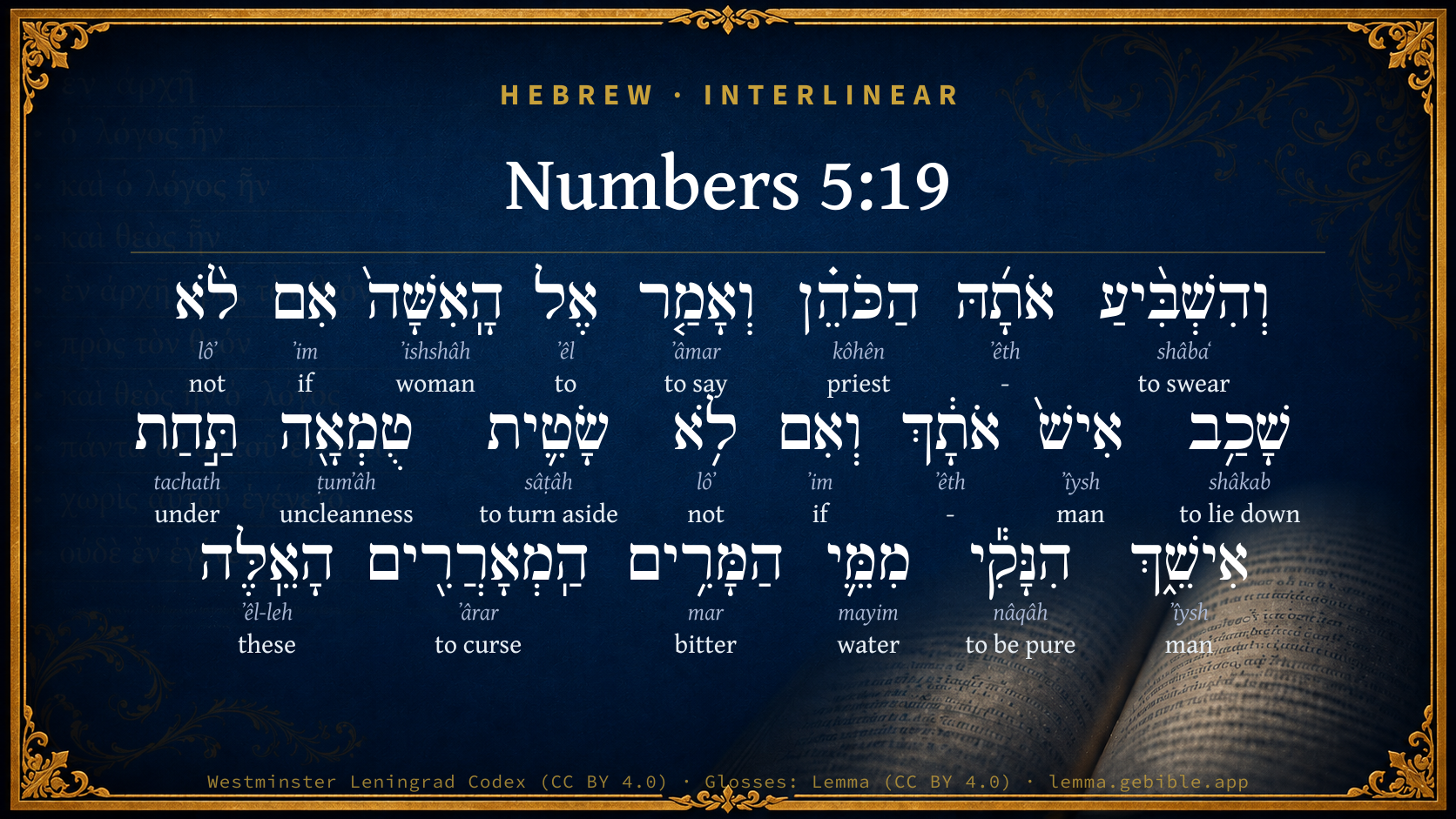
Numbers 5:19

Hebrew (Westminster Leningrad Codex) Numbers 5:19 appears in the Hebrew Old Testament. The text above is from the Westminster Leningrad Codex. Each word links to its Strong’s number, a concise gloss, and parsing drawn from the Open Scriptures Hebrew Bible morphology. Click any word for its full Brown-Driver-Briggs (BDB) entry.
Download image
Cite this verse

Numbers 5:19 (World English Bible). Public Domain. Lemma interlinear Bible study tool, https://lemma.gebible.app/v/numbers/5/19.

Show BibTeX & RIS
BibTeX
RIS
English Translation
The priest shall cause her to swear, and shall tell the woman, 'If no man has lain with you, and if you haven't gone aside to uncleanness, being under your husband, be free from this water of bitterness that brings a curse.
World English Bible · Public Domain
Download a study sheet

One document with this verse’s original text, its word-by-word gloss line, the meaning frame, cross-references with their text, attributed commentary, and full source and license credits — printable, and it pastes into notes with its structure intact.

This verse Autodidact and up

Study sheet (.html) Plain text (.txt)

A passage Seminary Student

Up to 50 verses in one chapter. A passage sheet keeps up to 6 commentary sources and 12 cross-references per verse, in the order this page ranks them, and says so on the sheet whenever that leaves anything out. Ask for a single verse and you get the Autodidact verse sheet above.

Everything on this page stays free to read, with no account — the sheet is a download of what is already on screen, not access to it.

Want to remove ads? Support Godless Engineer
Compare translations 3

The same verse in 3 English versions, stacked beneath the original-language interlinear above. Click any original word for its lexicon entry.

Each is an independent rendering of the whole verse — the interlinear is not word-aligned to these translations.

Highlighted words mark where these versions differ — a whole-verse word diff, not a word-by-word alignment.

  • World English Bible Public Domain
    The priest shall cause her to swear, and shall tell the woman, 'If no man has lain with you, and if you haven't gone aside to uncleanness, being under your husband, be free from this water of bitterness that brings a curse.
  • King James Version Public Domain
    And the priest shall charge her by an oath, and say unto the woman, If no man have lain with thee, and if thou hast not gone aside to uncleanness with another instead of thy husband, be thou free from this bitter water that causeth the curse:
  • unfoldingWord Literal Text CC BY-SA 4.0
    And the priest shall make her swear, and he shall say to the woman, “If a man did not lie with you, and if you did not turn aside to uncleanness under your husband, be free from this water of bitterness that brings a curse.

unfoldingWord Literal Text — © unfoldingWord, licensed CC BY-SA 4.0. Word-aligned USFM3 via Door43 (git.door43.org/unfoldingWord/en_ult).

Versions to compare (up to 4)

3 of 4 selected

Show all 18 translations

Every available English version of this verse, each an independent rendering of the whole verse.

  • World English Bible Public Domain
    The priest shall cause her to swear, and shall tell the woman, 'If no man has lain with you, and if you haven't gone aside to uncleanness, being under your husband, be free from this water of bitterness that brings a curse.
  • Berean Standard Bible Public Domain
    And he is to put the woman under oath and say to her, ‘If no other man has slept with you and you have not gone astray and become defiled while under your husband’s authority, may you be immune to this bitter water that brings a curse.
  • Majority Standard Bible Public Domain
    And he is to put the woman under oath and say to her, ‘If no other man has slept with you and you have not gone astray and become defiled while under your husband’s authority, may you be immune to this bitter water that brings a curse.
  • King James Version Public Domain
    And the priest shall charge her by an oath, and say unto the woman, If no man have lain with thee, and if thou hast not gone aside to uncleanness with another instead of thy husband, be thou free from this bitter water that causeth the curse:
  • American Standard Version (1901) Public Domain
    And the priest shall cause her to swear, and shall say unto the woman, If no man have lain with thee, and if thou have not gone aside to uncleanness, being under thy husband, be thou free from this water of bitterness that causeth the curse.
  • Revised Version (1885) Public Domain
    and the priest shall cause her to swear, and shall say unto the woman, If no man have lain with thee, and if thou hast not gone aside to uncleanness, being under thy husband, be thou free from this water of bitterness that causeth the curse:
  • Geneva Bible (1599) Public Domain
    And the Priest shall charge her by an othe, and say vnto the woman, If no man haue lien with thee, neither thou hast turned to vncleannesse from thine husband, be free from this bitter and cursed water.
  • Douay-Rheims (1899) Public Domain
    And he shall adjure her, and shall say: If another man hath not slept with thee, and if thou be not defiled by forsaking thy husband's bed, these most bitter waters, on which I have heaped curses, shall not hurt thee.
  • Young's Literal Translation Public Domain
    `And the priest hath caused her to swear, and hath said unto the woman, If no man hath lain with thee, and if thou hast not turned aside `to' uncleanness under thy husband, be free from these bitter waters which cause the curse;
  • Literal Standard Version CC BY-SA 4.0
    And the priest has caused her to swear, and has said to the woman, If no man has lain with you, and if you have not turned aside [to] uncleanness under your husband, be free from these bitter waters which cause the curse;
  • Unlocked Literal Bible CC BY-SA 4.0
    The priest will put the woman under an oath and say to her, 'If no other man had sexual relations with you, and if you have not gone astray and committed impurity, then you will be free from this bitter water that can bring a curse.
  • unfoldingWord Literal Text CC BY-SA 4.0
    And the priest shall make her swear, and he shall say to the woman, “If a man did not lie with you, and if you did not turn aside to uncleanness under your husband, be free from this water of bitterness that brings a curse.
  • Darby Bible Public Domain
    And the priest shall adjure her, and say unto the woman, If no man have lain with thee, and if thou hast not gone astray in uncleanness, in being with another instead of thy husband, be free from this bitter water that bringeth the curse.
  • World Messianic Bible Public Domain
    The priest shall cause her to take an oath and shall tell the woman, “If no man has lain with you, and if you haven’t gone aside to uncleanness, being under your husband’s authority, be free from this water of bitterness that brings a curse.
  • Webster's Bible Public Domain
    And the priest shall charge her by an oath, and say to the woman, If no man hath lain with thee, and if thou hast not gone aside to uncleanness with another instead of thy husband, be thou free from this bitter water that causeth the curse:
  • Free Bible Version CC BY-SA 4.0
    He shall place the woman under oath and tell her, ‘If no one else has slept with you and you have not been unfaithful and become unclean while married to your husband, may you not be harmed by this bitter water that curses.
  • Bible in Basic English Public Domain
    And he will make her take an oath, and say to her, If no man has been your lover and you have not been with another in place of your husband, you are free from this bitter water causing the curse;
  • JPS Tanakh (1917) Public Domain
    And the priest shall cause her to swear, and shall say unto the woman: 'If no man have lain with thee, and if thou hast not gone aside to uncleanness, being under thy husband, be thou free from this water of bitterness that causeth the curse;

Literal Standard Version (2020), Covenant Press — licensed CC BY-SA 4.0. Text via the HelloAO Bible API (eBible.org). Unlocked Literal Bible (unfoldingWord) — licensed CC BY-SA 4.0. Text via the HelloAO Bible API (eBible.org). unfoldingWord Literal Text — © unfoldingWord, licensed CC BY-SA 4.0. Word-aligned USFM3 via Door43 (git.door43.org/unfoldingWord/en_ult). Free Bible Version, Dr. Jonathan Gallagher — licensed CC BY-SA 4.0. Text via the HelloAO Bible API (eBible.org).

Word by word

More ways to search: Search by grammar → Find every occurrence → Compare this word →

Practice this passage: Drill this verse → Learn its vocabulary →

שָׂטִ֛ית
sâṭâh
H7847
“to turn aside”
Verb, Qal, Perfect, 2nd Person, Feminine, Singular
Part of Speech
Verb
Stem
Qal
Form
Perfect
Person
2nd Person
Gender
Feminine
Number
Singular
Full BDB Definition

Origin: a primitive root

TWOT: 2250

to turn aside, go aside, turn, decline - (Qal) to turn aside
  1. וְהִשְׁבִּ֨יעַ shâbaʻ H7650 “and · to swear” Conjunction + Verb, Hiphil, Sequential Perfect, 3rd Person, Masculine, Singular
  2. אֹתָ֜הּ ʼêth H853 “- · her” Particle, Direct Object + Suffix, Personal, 3rd Person, Feminine, Singular
  3. הַכֹּהֵ֗ן kôhên H3548 “the · priest” Particle, Definite Article + Noun, Common, Masculine, Singular, Absolute
  4. וְאָמַ֤ר ʼâmar H559 “and · to say” Conjunction + Verb, Qal, Sequential Perfect, 3rd Person, Masculine, Singular
  5. אֶל ʼêl H413 “to” Preposition
  6. הָֽאִשָּׁה֙ ʼishshâh H802 “the · woman” Particle, Definite Article + Noun, Common, Feminine, Singular, Absolute
  7. אִם ʼim H518 “if” Conjunction
  8. לֹ֨א lôʼ H3808 “not” Particle, Negative
  9. שָׁכַ֥ב shâkab H7901 “to lie down” Verb, Qal, Perfect, 3rd Person, Masculine, Singular
  10. אִישׁ֙ ʼîysh H376 “man” Noun, Common, Masculine, Singular, Absolute
  11. אֹתָ֔ךְ ʼêth H853 “- · you” Particle, Direct Object + Suffix, Personal, 2nd Person, Feminine, Singular
  12. וְאִם ʼim H518 “and · if” Conjunction + Conjunction
  13. לֹ֥א lôʼ H3808 “not” Particle, Negative
  14. טֻמְאָ֖ה ṭumʼâh H2932 “uncleanness” Noun, Common, Feminine, Singular, Absolute
  15. תַּ֣חַת tachath H8478 “under” Preposition
  16. אִישֵׁ֑ךְ ʼîysh H376 “man · your” Noun, Common, Masculine, Singular, Construct + Suffix, Personal, 2nd Person, Feminine, Singular
  17. הִנָּקִ֕י nâqâh H5352 “be pure” Verb, Niphal, Imperative, 2nd Person, Feminine, Singular
  18. מִמֵּ֛י mayim H4325 “from · water(s) of” Preposition + Noun, Common, Masculine, Plural, Construct
  19. הַמָּרִ֥ים mar H4751 “the · bitter” Particle, Definite Article + Adjective, Adjective, Masculine, Plural, Absolute
  20. הַֽמְאָרֲרִ֖ים ʼârar H779 “the · cursing” Particle, Definite Article + Verb, Piel, Participle Active, Masculine, Plural, Absolute
  21. הָאֵֽלֶּה ʼêl-leh H428 “the · these” Particle, Definite Article + Pronoun, Demonstrative, Common, Plural

About this verse

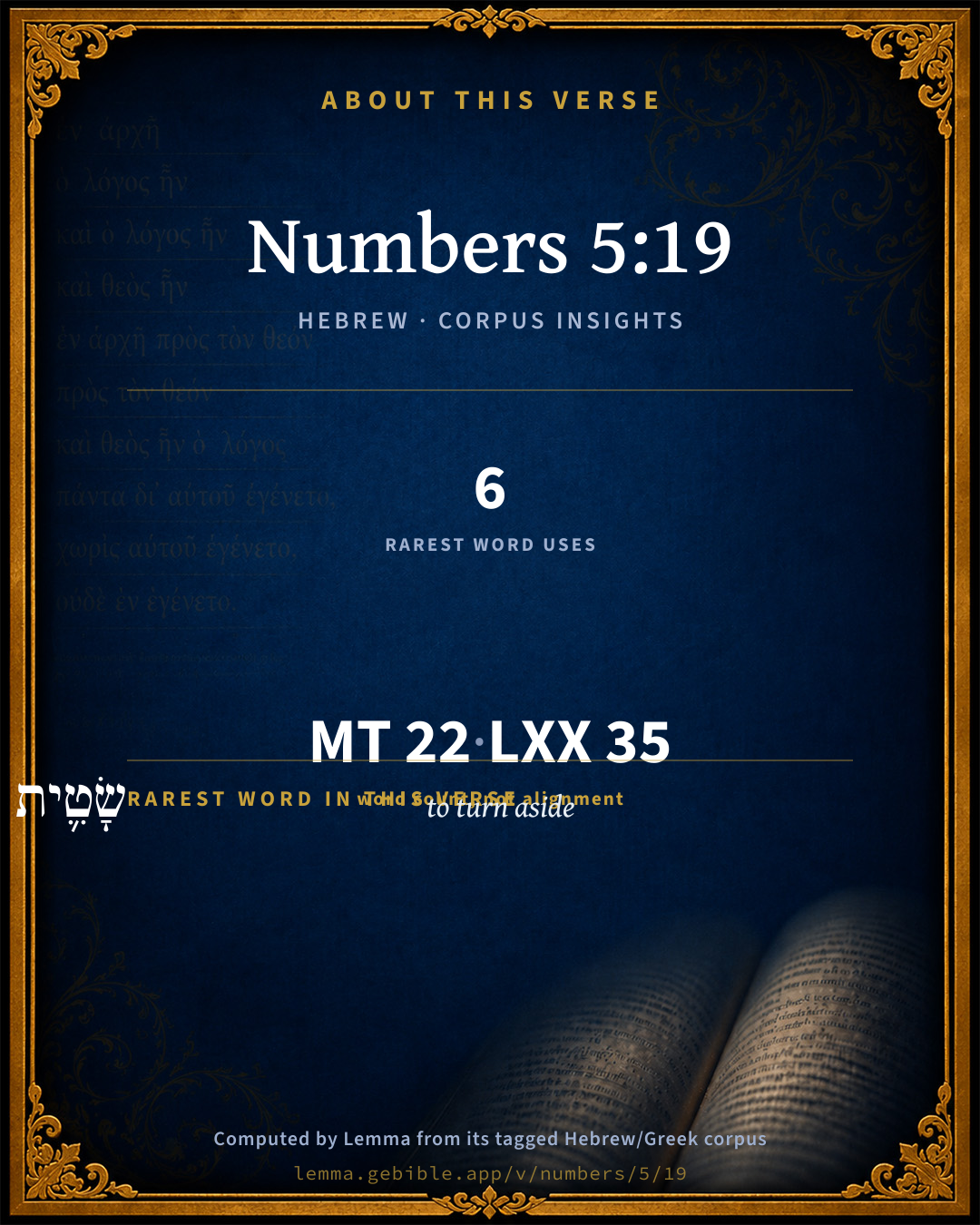
These counts appear in no published source. They are computed here, from the morphology-tagged text and Lemma’s own curated glosses. What Lemma adds →

22
words
18
distinct lemmas
Pentateuch
section

Notable vocabulary

The rarest word here is שָׂטִ֛ית to turn aside H7847 — appearing just 6 times in the whole Hebrew Bible.

Shared distinctive vocabulary

שָׂטִ֛ית to turn aside H7847 occurs in 6 verses of the Hebrew Bible. Also found in:

Grammatical profile

  • 6 verbs
  • 6 nouns
  • 1 adjective
  • 1 pronoun
  • 2 prepositions
  • 2 conjunctions
  • 4 particles

Verb forms

  • וְהִשְׁבִּ֨יעַ Hiphil · Sequential Perfect
  • וְאָמַ֤ר Qal · Sequential Perfect
  • שָׁכַ֥ב Qal · Perfect
  • שָׂטִ֛ית Qal · Perfect
  • הִנָּקִ֕י Niphal · Imperative
  • הַֽמְאָרֲרִ֖ים Piel · Participle Active

Repetition

Words recur within this verse — often emphatic in Hebrew:

  • אִישׁ֙ man H376 ×2
  • אִם if H518 ×2
  • לֹ֨א not H3808 ×2

Hebrew & Septuagint length

In English translation the verse runs 42 words from the Hebrew and 49 from the Septuagint (LXX English) — closely comparable.

A rough comparison of the two English renderings, which tokenize alike — not a word-level alignment.

Word counts can differ between the Hebrew and the Greek without any difference in meaning — e.g. the Hebrew direct-object marker אֵת has no separate Greek word, and Greek often adds the article ὁ.

In the original languages it is 22 Hebrew tokens and 35 Greek tokens — but the two are counted differently (Hebrew bundles its prefixes and suffixes into one token; the Greek is in lemma form), so that isn’t a like-for-like length.

Cross-references

3

Topical passages linked to Numbers 5:19 in the Treasury of Scripture Knowledge — connected by theme and wording, ordered by reader-vote popularity; previews shown in the World English Bible.

  • Numbers 5:12 "Speak to the children of Israel, and tell them: If any man's wife goes astray, and is unfaithful to him,
  • Romans 7:2 For the woman that has a husband is bound by law to the husband while he lives, but if the husband dies, she is discharged from the law of the husband.
  • Matthew 26:63 But Jesus held his peace. The high priest answered him, "I adjure you by the living God, that you tell us whether you are the Christ, the Son of God."

Cross-references courtesy of OpenBible.info (CC BY 4.0).

Hebrew and Greek witnesses Masoretic Hebrew ↔ Greek Septuagint

The same verse in the two great witnesses to the Old Testament, shown verse-for-verse.

These are two independent witnesses, not word-aligned to each other, and the Septuagint is shown in lemma (dictionary) form.

Hebrew Numbers 5:19 Masoretic · Westminster Leningrad Codex

וְהִשְׁבִּ֨יעַ אֹתָ֜הּ הַכֹּהֵ֗ן וְאָמַ֤ר אֶל הָֽאִשָּׁה֙ אִם לֹ֨א שָׁכַ֥ב אִישׁ֙ אֹתָ֔ךְ וְאִם לֹ֥א שָׂטִ֛ית טֻמְאָ֖ה תַּ֣חַת אִישֵׁ֑ךְ הִנָּקִ֕י מִמֵּ֛י הַמָּרִ֥ים הַֽמְאָרֲרִ֖ים הָאֵֽלֶּה

The priest shall cause her to swear, and shall tell the woman, 'If no man has lain with you, and if you haven't gone aside to uncleanness, being under your husband, be free from this water of bitterness that brings a curse.

World English Bible · Public Domain

Greek LXX Numbers 5:19 Septuagint · lemma form

καί ὁρκίζω αὐτός ὁ ἱερεύς καί εἶπον ὁ γυνή εἰ μή κοιμάω τις μετά σύ εἰ μή παραβαίνω μιαίνω ὑπό ὁ ἀνήρ ὁ σεαυτοῦ ἀθῷος εἰμί ἀπό ὁ ὕδωρ ὁ ἐλεγμός ὁ ἐπι καταἀράομαι οὗτος

And the priest shall adjure her, and shall say to the woman, If no one has lain with you, and if you have not transgressed so as to be polluted, being under the power of your husband, be free from this water of the conviction that causes the curse.

LXX2012 (modern English Septuagint) · Public Domain

On this verse, The Pulpit Commentary discusses the Septuagint’s reading. Read the note in Commentary ↓

Hebrew: Westminster Leningrad Codex (CC BY 4.0). Greek: Septuagint (public domain); English from LXX2012 (modern English Septuagint) (Public Domain). How the Septuagint differs from the Hebrew →

Targum (Aramaic paraphrase)

2

The Targum is the ancient Jewish Aramaic paraphrase of the Hebrew Scriptures — an interpretive translation, not the Hebrew text itself. Onkelos (literal) and Pseudo-Jonathan (expansive) render the Torah, and Jonathan the Prophets. Coverage is partial: where no permissively-licensed English translation exists for a verse, only the Aramaic is shown. This is verse-level text, not a word-by-word alignment to the Hebrew.

  1. Targum Onkelos Torah (Genesis–Deuteronomy)
    וְיוֹמֵי יָתַהּ כַּהֲנָא וְיֵימַר לְאִתְּתָא אִם לָא שְׁכִיב גְבַר יָתִיךְ וְאִם לָא סְטִּית לְאִסְתְּאָבָא בַּר מִבַּעֲלִיךְ הֱוֵי זַכָּאָה מִמַיָא מְרִירַיָא מְלַטְטַיָא הָאִלֵין

    (no public-domain English translation for this verse)

    Targum Onkelos — Aramaic: “Onkelos Genesis” (public domain); “Onkelos Exodus” (public domain); “Onkelos Leviticus” (public domain); “Onkelos Numbers” (public domain); “Onkelos Deuteronomy” (public domain). English: “Sefaria Community Translation” (CC0 1.0 (public-domain dedication)); “J.W. Etheridge. The Targums of Onkelos and Jonathan Ben Uzziel on the Pentateuch. London: Longmans, Green, 1862” (public domain). Text via Sefaria.

  2. Targum Pseudo-Jonathan Torah (Genesis–Deuteronomy)
    וְיוֹמֵי יָתָהּ כַּהֲנָא בִּשְׁבוּעַת שְׁמָא רַבָּא וְיַקִירָא וְיֵימַר כַּהֲנָא לְאִתְּתָא אִין לָא סָטִית לְאִסְתְּאָבָא בְּתַּשְׁמִישׁ דְעָרִיס בַּר מִן רְשׁוּתָא דְבַעֲלִיךְ תֶּהֱוֵי זַכָּאָה מִמַיָא מְרִירַיָא בְּדוּקַיָא הָאִלֵין

    And the priest shall adjure her by the adjuration of the Great and Glorious Name, and shall say to the woman: If thou hast not turned aside, to defile thyself by acting against the right of thy husband, be thou unhurt by these bitter waters of trial.

    Targum Pseudo-Jonathan — Aramaic: “Targum Jonathan on Genesis” (public domain); “Targum Jonathan on Exodus” (public domain); “Targum Jonathan on Leviticus” (public domain); “Targum Jonathan on Numbers” (public domain); “Targum Jonathan on Deuteronomy” (public domain). English: “The Targum of Jonathan ben Uzziel, trans. J. W. Etheridge, London, 1862” (public domain). Text via Sefaria.

Commentary

Notes on Numbers 5:19 from classic Christian and Jewish commentators (each source and its license shown beneath its notes). The classic Christian expositions comment on the surrounding passage and are grouped to its opening verse, so a note may address several verses; the Jewish commentaries on the Tanakh (Rashi and others) are per-verse, so they appear only where the commentator wrote on this verse.

Lemma curates 59 commentaries, every one of them public domain or Creative Commons licensed, each selected and text-cleaned for this edition rather than reprinted as found. About our sources →

Trapp's Complete Commentary

John Trapp

Num 5:19 And the priest shall charge her by an oath, and say unto the woman, If no man have lain with thee, and if thou hast not gone aside to uncleanness [with another] instead of thy husband, be thou free from this bitter water that causeth the curse:

Ver. 19. Causeth the curse.] The divine justice caused it; the water discovered it.

John Trapp, A Commentary or Exposition upon All the Books of the Old and New Testament (1647–1656) — public domain. Text from a community e-Sword module.

The Cambridge Bible for Schools and Colleges

gen. ed. J. J. S. Perowne

19. being under thy husband] i.e. under his authority; cf. Eze_23:5 ‘when she was mine’ (R.V. ), lit. ‘under me.’

The Cambridge Bible for Schools and Colleges (gen. ed. J. J. S. Perowne; Cambridge University Press, 1878–1918) — public domain. Text from a community e-Sword module.

John Gill's Exposition

And the priest shall charge her by an oath,.... Or give her her oath:

and say unto the woman, if no man hath lain with thee: besides her husband:

and thou hast not gone aside to uncleanness with another instead of thy husband; which is but another phrase expressive of the same thing, the sin of adultery:

be thou free from this bitter water that causeth the curse; if this is the case, it shall produce no bitter effects, or bring any curse upon thee.

John Gill's Exposition of the Whole Bible (1746–1763) — public domain (CC PDM 1.0). Text via the HelloAO Bible API.

Haydock's Catholic Bible Commentary

Adjure. The woman was put to her oath. (Josephus) (Haydock)

George Leo Haydock (1774–1849), Haydock's Catholic Family Bible and Commentary, 1859 edition — public domain. Excludes Psalms (Douay-Rheims chapter numbering differs from Protestant) and Deuterocanonical books (Catholic canon only).

Matthew Poole's English Annotations

Charge her by an oath, to answer truly to his question, or to declare by oath whether she be guilty or no, and after such oath shall say as follows.

If no man, to wit, except thy husband, as is manifest from the whole context; or no other man, the word another being understood here, as it is thought to be also Gen 14:1; 36:6; Exo 22:20. With another, or, with him, i.e. the man now mentioned. So it is an ellipsis easily supplied out of the text.

Matthew Poole's English Annotations on the Holy Bible (1683–1685) — public domain. Text from a community e-Sword/MySword module.

Whedon's Commentary on the Bible

Daniel D. Whedon

19. Instead of thy husband — Hebrew, under thy husband; that is, being in the power of thy husband. This explains the words, no man.

Daniel D. Whedon (gen. ed.), Commentary on the Old and New Testaments (1874–1909) — public domain. Text from a community e-Sword module.

The Pulpit Commentary

If no man. The oath presupposed her innocence. With another instead of thy husband. Hebrew, "under thy husband, i.e., as a wife subject to a husband. (Eze_23:5 Hos_4:12) Upandrov ousa , Septuagint. It was only as a femme couverte that she could commit this sin.

The Pulpit Commentary (1880–1919), ed. H.D.M. Spence-Jones & Joseph S. Exell — public domain. Text from a community e-Sword module.

John Wesley's Explanatory Notes

By an oath - To answer truly to his question, or to declare whether she be guilty or no, and after such oath shall say as follows.

John Wesley, Explanatory Notes Upon the Whole Bible (1754–1765) — public domain. Text via the GEBible commentary corpus.

Rashi

Rabbi Shlomo Yitzchaki (Rashi)

והשביע אתה וגו׳ AND [THE PRIEST] SHALL ADJURE HER etc. — and wherein does this adjuration consist? In that he says to the woman, “if no man hath lain with thee … הנקי, be thou free”, which implies: “if, however, a man hath lain with thee, חנקי, thou deservest to be suffocated”, because from a negative statement you may deduce its converse, the positive statement. It is true that in an adjuration it would be more appropriate to make this threat of punishment if guilty, and to allow the converse to be derived from it, but here it mentions first what will happen if she has not sinned, since it intends to suggest that it is a duty in capital cases to begin the proceedings with the statement of something that bears upon the innocence of the accused (Sotah 17a; Shevuot 36a; Sanhedrin 33a).

Rashi on the Tanakh — English translations: “The Judaica Press complete Tanach with Rashi, translated by A. J. Rosenberg” (CC BY 4.0); “Pentateuch with Rashi's commentary by M. Rosenbaum and A.M. Silbermann, 1929-1934” (public domain); “The Metsudah Tanach series, Lakewood, N.J” (CC BY 4.0); and “The Book of Joshua, Metsudah Publications, 1997” (CC BY 4.0). Text via Sefaria.

Ramban (Nachmanides)

Rabbi Moshe ben Nachman (Ramban / Nachmanides)

IF NO ‘ISH’ (MAN) HAVE LAIN WITH THEE, AND IF THOU HAST NOT GONE ASIDE TO UNCLEANNESS. These two conditions constitute [in reality] one. Thus the verse is stating: “If no man have lain with thee, and thus thou has not gone aside to uncleanness, be thou free from the water of bitterness; ” [for you cannot say that these are two separate conditions], since her husband lay with her and he is “a man” [thus the priest could not say to her, if no man have lain with thee; therefore both conditions must be one, as explained]. It is possible that the word ish (man) lacks the definite article [making it ha’ish — “the man”], and Scripture is stating: “If ‘the man’ has not lain with thee, and if thou hast not gone aside to uncleanness at all,” and he makes her swear specifically concerning the particular man about whom he [her husband] had warned her, and in general terms about others. And so have the Rabbis said: “And the woman shall say: ‘Amen, Amen. ’ [The double utterance of the word ‘Amen’ signifies:] ‘Amen [that I have not committed adultery] with this man, and Amen [that I have not committed adultery] with any other man.’”

Ramban (Nachmanides) on the Tanakh — English translation: “Commentary on the Torah by Ramban (Nachmanides). Translated and annotated by Charles B. Chavel. New York, Shilo Pub. House, 1971-1976” (CC BY 4.0). Text via Sefaria.

Lesson kit

Teaching starters — assembled from the data on this page, not authored interpretation. Every prompt links to the verse data it draws on. Edit before teaching.

Numbers, in the Pentateuch, opens this verse with 22 words (18 distinct Hebrew lemmas). Its most distinctive word is sâṭâh (“to turn aside”). A historical commentator’s framing appears above. Read the whole chapter for the surrounding context.

Discussion questions

  1. How does “to turn aside” (sâṭâh) shape what this verse is saying?
  2. How does Numbers 5:12, which shares the word «to turn aside», read alongside this verse?
  3. What does the repetition of “man” (2× in this one verse) do in this verse?
  4. These translations render this verse differently; the difference is in the English rendering, not the original. What questions does that raise?
  5. «וְהִשְׁבִּ֨יעַ» is a Hiphil Sequential Perfect verb. How does that grammatical form shape the action described?
  6. Compare how Trapp's Complete Commentary and The Cambridge Bible for Schools and Colleges read this verse. Where do they agree or differ?

Things to notice

Reading settings

Reading text

Shown beneath each verse's original-language words.

Old Testament
Old Testament edition

Read the OT as the Masoretic Hebrew (MT) or the Greek Septuagint (LXX).

English shown for the Greek Septuagint (in the Hebrew ↔ Greek comparison).

Comparing translations? Open the Compare panel on any verse page to stack up to four side by side.