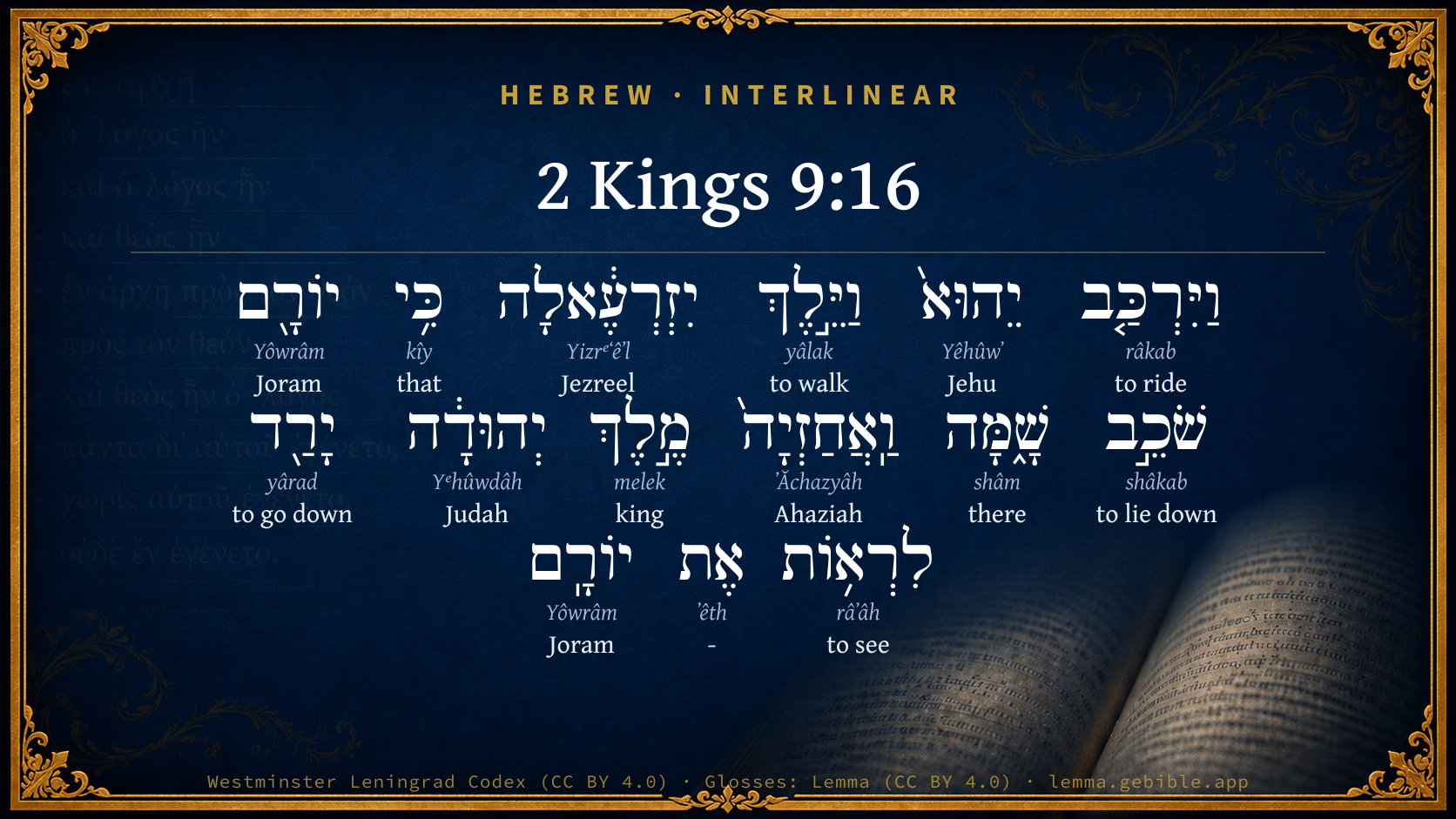
2 Kings 9:16

Hebrew (Westminster Leningrad Codex) 2 Kings 9:16 appears in the Hebrew Old Testament. The text above is from the Westminster Leningrad Codex. Each word links to its Strong’s number, a concise gloss, and parsing drawn from the Open Scriptures Hebrew Bible morphology. Click any word for its full Brown-Driver-Briggs (BDB) entry.
Download image
Cite this verse

2 Kings 9:16 (World English Bible). Public Domain. Lemma interlinear Bible study tool, https://lemma.gebible.app/v/2-kings/9/16.

Show BibTeX & RIS
BibTeX
RIS
English Translation
So Jehu rode in a chariot, and went to Jezreel; for Joram lay there. Ahaziah king of Judah was come down to see Joram.
World English Bible · Public Domain
Download a study sheet

One document with this verse’s original text, its word-by-word gloss line, the meaning frame, cross-references with their text, attributed commentary, and full source and license credits — printable, and it pastes into notes with its structure intact.

This verse Autodidact and up

Study sheet (.html) Plain text (.txt)

A passage Seminary Student

Up to 50 verses in one chapter. A passage sheet keeps up to 6 commentary sources and 12 cross-references per verse, in the order this page ranks them, and says so on the sheet whenever that leaves anything out. Ask for a single verse and you get the Autodidact verse sheet above.

Everything on this page stays free to read, with no account — the sheet is a download of what is already on screen, not access to it.

Want to remove ads? Support Godless Engineer
Compare translations 3

The same verse in 3 English versions, stacked beneath the original-language interlinear above. Click any original word for its lexicon entry.

Each is an independent rendering of the whole verse — the interlinear is not word-aligned to these translations.

Highlighted words mark where these versions differ — a whole-verse word diff, not a word-by-word alignment.

  • World English Bible Public Domain
    So Jehu rode in a chariot, and went to Jezreel; for Joram lay there. Ahaziah king of Judah was come down to see Joram.
  • King James Version Public Domain
    So Jehu rode in a chariot, and went to Jezreel; for Joram lay there. And Ahaziah king of Judah was come down to see Joram.
  • unfoldingWord Literal Text CC BY-SA 4.0
    And Jehu rode and went to Jezreel, because Joram was lying down there. Now Ahaziah, the king of Judah, had gone down to see Joram.

unfoldingWord Literal Text — © unfoldingWord, licensed CC BY-SA 4.0. Word-aligned USFM3 via Door43 (git.door43.org/unfoldingWord/en_ult).

Versions to compare (up to 4)

3 of 4 selected

Show all 18 translations

Every available English version of this verse, each an independent rendering of the whole verse.

  • World English Bible Public Domain
    So Jehu rode in a chariot, and went to Jezreel; for Joram lay there. Ahaziah king of Judah was come down to see Joram.
  • Berean Standard Bible Public Domain
    Then Jehu got into his chariot and went to Jezreel, because Joram was laid up there and Ahaziah king of Judah had gone down to see him.
  • Majority Standard Bible Public Domain
    Then Jehu got into his chariot and went to Jezreel, because Joram was laid up there. And Ahaziah king of Judah had gone down to see him.
  • King James Version Public Domain
    So Jehu rode in a chariot, and went to Jezreel; for Joram lay there. And Ahaziah king of Judah was come down to see Joram.
  • American Standard Version (1901) Public Domain
    So Jehu rode in a chariot, and went to Jezreel; for Joram lay there. And Ahaziah king of Judah was come down to see Joram.
  • Revised Version (1885) Public Domain
    So Jehu rode in a chariot, and went to Jezreel; for Joram lay there. And Ahaziah king of Judah was come down to see Joram.
  • Geneva Bible (1599) Public Domain
    So Iehu gate vp into a charet, and went to Izreel: for Ioram lay there, and Ahaziah King of Iudah was come downe to see Ioram.
  • Douay-Rheims (1899) Public Domain
    And he got up, and went into Jezrahel: for Joram was sick there, and Ochozias king of Juda was come down to visit Joram.
  • Young's Literal Translation Public Domain
    And Jehu rideth, and goeth to Jezreel, for Joram is lying there, and Ahaziah king of Judah hath gone down to see Joram.
  • Literal Standard Version CC BY-SA 4.0
    And Jehu rides, and goes to Jezreel, for Joram is lying there, and Ahaziah king of Judah has gone down to see Joram.
  • Unlocked Literal Bible CC BY-SA 4.0
    So Jehu rode in a chariot to Jezreel; for Joram was resting there. Now Ahaziah king of Judah had come down to see Joram.
  • unfoldingWord Literal Text CC BY-SA 4.0
    And Jehu rode and went to Jezreel, because Joram was lying down there. Now Ahaziah, the king of Judah, had gone down to see Joram.
  • Darby Bible Public Domain
    And Jehu rode in a chariot and went to Jizreel; for Joram lay there. And Ahaziah king of Judah had come down to see Joram.
  • World Messianic Bible Public Domain
    So Jehu rode in a chariot and went to Jezreel, for Joram lay there. Ahaziah king of Judah had come down to see Joram.
  • Webster's Bible Public Domain
    So Jehu rode in a chariot, and went to Jezreel; for Joram lay there. And Ahaziah king of Judah had come down to see Joram.
  • Free Bible Version CC BY-SA 4.0
    Jehu got on his chariot and went to Jezreel, for Joram was recuperating there. Ahaziah, king of Judah, was there too because he had come to visit Joram.
  • Bible in Basic English Public Domain
    So Jehu got into his carriage and went to Jezreel, for Joram was ill in bed there; and Ahaziah, king of Judah, had come down to see Joram.
  • JPS Tanakh (1917) Public Domain
    So Jehu rode in a chariot, and went to Jezreel; for Joram lay there. And Ahaziah king of Judah was come down to see Joram.

Literal Standard Version (2020), Covenant Press — licensed CC BY-SA 4.0. Text via the HelloAO Bible API (eBible.org). Unlocked Literal Bible (unfoldingWord) — licensed CC BY-SA 4.0. Text via the HelloAO Bible API (eBible.org). unfoldingWord Literal Text — © unfoldingWord, licensed CC BY-SA 4.0. Word-aligned USFM3 via Door43 (git.door43.org/unfoldingWord/en_ult). Free Bible Version, Dr. Jonathan Gallagher — licensed CC BY-SA 4.0. Text via the HelloAO Bible API (eBible.org).

Word by word

More ways to search: Search by grammar → Find every occurrence → Compare this word →

Practice this passage: Drill this verse → Learn its vocabulary →

יוֹרָ֖ם
Yôwrâm
H3141
“Joram”
Noun, Proper
Part of Speech
Noun
Type
Proper
Full BDB Definition

Origin: a form of H3088

TWOT: None

Joram = "Jehovah is exalted" - son of king Jehoshaphat of Judah and himself king of Judah for 8 years; his wife was the wicked Athaliah who was probably the instigator for his returning the nation of Judah to the worship of Baal - son of king Ahab of the northern kingdom of Israel and king of Israel himself for 12 years; he was murdered by Jehu on the plot of land for which his father had murdered Naboth thus fulfilling the prophecy of Elijah to the very letter - a Levite in the time of David and an ancestor of Shelomith - son of Toi, king of Hamath
  1. וַיִּרְכַּ֤ב râkab H7392 “and · to ride” Conjunction + Verb, Qal, Sequential Imperfect, 3rd Person, Masculine, Singular
  2. יֵהוּא֙ Yêhûwʼ H3058 “Jehu” Noun, Proper
  3. וַיֵּ֣לֶךְ yâlak H3212 “and · to walk” Conjunction + Verb, Qal, Sequential Imperfect, 3rd Person, Masculine, Singular
  4. יִזְרְעֶ֔אלָה Yizrᵉʻêʼl H3157 “Jezreel · toward” Noun, Proper + Suffix, Demonstrative
  5. כִּ֥י kîy H3588 “that” Conjunction
  6. שֹׁכֵ֣ב shâkab H7901 “lying down” Verb, Qal, Participle Active, Masculine, Singular, Absolute
  7. שָׁ֑מָּה shâm H8033 “there · toward” Adverb + Suffix, Demonstrative
  8. וַֽאֲחַזְיָה֙ ʼĂchazyâh H274 “and · Ahaziah” Conjunction + Noun, Proper
  9. מֶ֣לֶךְ melek H4428 “king of” Noun, Common, Masculine, Singular, Construct
  10. יְהוּדָ֔ה Yᵉhûwdâh H3063 “Judah” Noun, Proper
  11. יָרַ֖ד yârad H3381 “to go down” Verb, Qal, Perfect, 3rd Person, Masculine, Singular
  12. לִרְא֥וֹת râʼâh H7200 “to see” Preposition + Verb, Qal, Infinitive Construct
  13. אֶת ʼêth H853 “-” Particle, Direct Object
  14. יוֹרָֽם Yôwrâm H3141 “Joram” Noun, Proper

About this verse

These counts appear in no published source. They are computed here, from the morphology-tagged text and Lemma’s own curated glosses. What Lemma adds →

15
words
14
distinct lemmas
Historical
section

Notable vocabulary

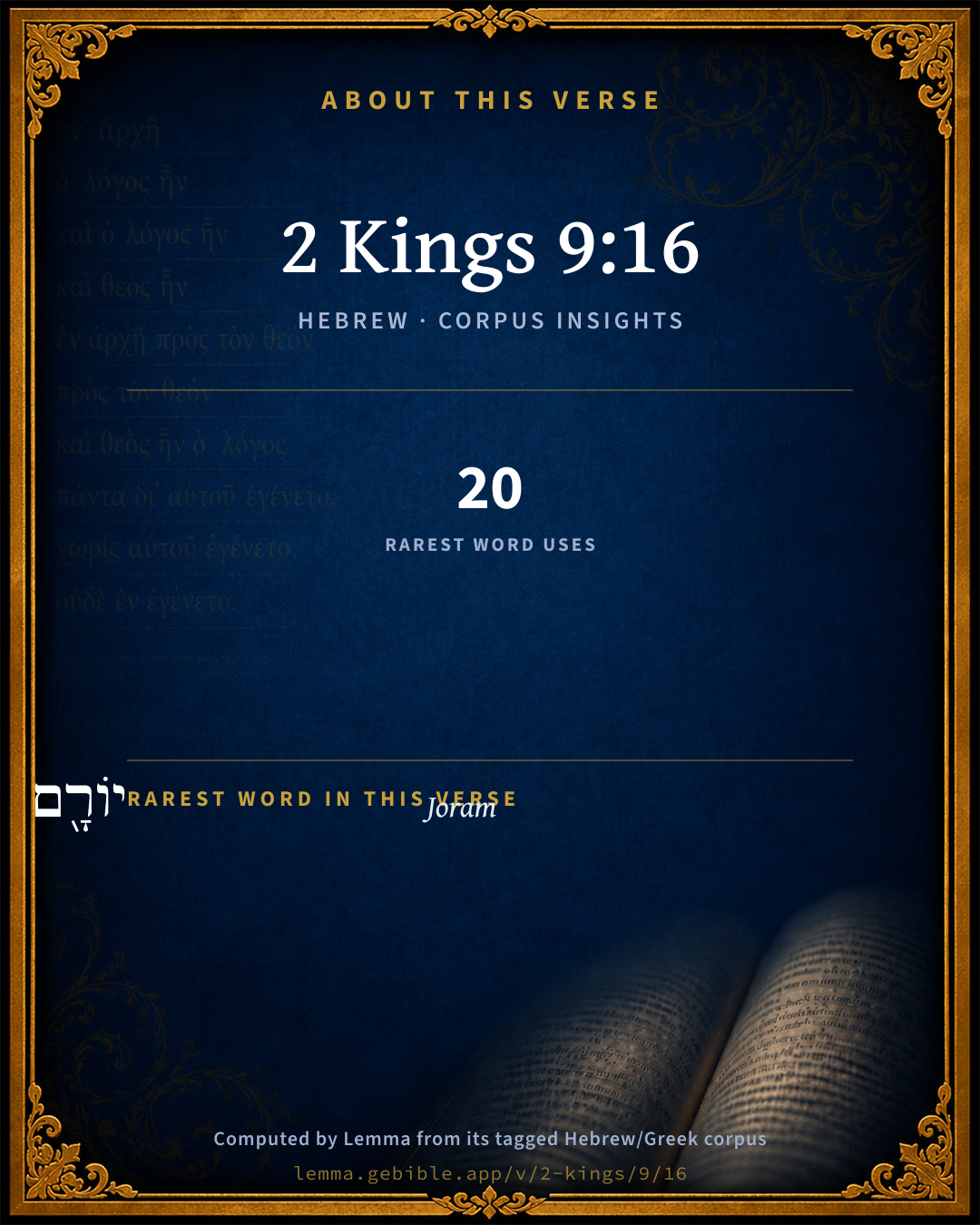
The rarest word here is יוֹרָ֖ם Joram H3141 — appearing just 20 times in the whole Hebrew Bible.

Shared distinctive vocabulary

יוֹרָ֖ם Joram H3141 occurs in 16 verses of the Hebrew Bible. Also found in:

Grammatical profile

  • 5 verbs
  • 7 nouns
  • 1 conjunction
  • 1 adverb
  • 1 particle

Verb forms

  • וַיִּרְכַּ֤ב Qal · Sequential Imperfect
  • וַיֵּ֣לֶךְ Qal · Sequential Imperfect
  • שֹׁכֵ֣ב Qal · Participle Active
  • יָרַ֖ד Qal · Perfect
  • לִרְא֥וֹת Qal · Infinitive Construct

Repetition

A word recurs within this verse — often emphatic in Hebrew:

  • יוֹרָ֖ם Joram H3141 ×2

Hebrew & Septuagint length

In English translation the verse runs 24 words from the Hebrew and 58 from the Septuagint (LXX English) — the Septuagint runs noticeably longer here. See the side-by-side →

A rough comparison of the two English renderings, which tokenize alike — not a word-level alignment.

Word counts can differ between the Hebrew and the Greek without any difference in meaning — e.g. the Hebrew direct-object marker אֵת has no separate Greek word, and Greek often adds the article ὁ.

Cross-references

2

Topical passages linked to 2 Kings 9:16 in the Treasury of Scripture Knowledge — connected by theme and wording, ordered by reader-vote popularity; previews shown in the World English Bible.

  • 2 Kings 8:28–29 He went with Joram the son of Ahab to war against Hazael king of Syria at Ramoth-gilead: and the Syrians wounded Joram.
  • 2 Chronicles 22:6–7 He returned to be healed in Jezreel of the wounds which they had given him at Ramah, when he fought against Hazael king of Syria. Azariah the son of Jehoram king of Judah went down to see Jehoram the son of Ahab in Jezreel, because he was sick.

Cross-references courtesy of OpenBible.info (CC BY 4.0).

Hebrew and Greek witnesses Masoretic Hebrew ↔ Greek Septuagint

The same verse in the two great witnesses to the Old Testament, shown verse-for-verse.

Here the Septuagint runs noticeably longer than the Hebrew — LXX2012 (modern English Septuagint) 58 words vs World English Bible 24. A rough length comparison of the two English translations, not a word-level alignment — read both below.

These are two independent witnesses, not word-aligned to each other, and the Septuagint is shown in lemma (dictionary) form.

Hebrew 2 Kings 9:16 Masoretic · Westminster Leningrad Codex

וַיִּרְכַּ֤ב יֵהוּא֙ וַיֵּ֣לֶךְ יִזְרְעֶ֔אלָה כִּ֥י יוֹרָ֖ם שֹׁכֵ֣ב שָׁ֑מָּה וַֽאֲחַזְיָה֙ מֶ֣לֶךְ יְהוּדָ֔ה יָרַ֖ד לִרְא֥וֹת אֶת יוֹרָֽם

So Jehu rode in a chariot, and went to Jezreel; for Joram lay there. Ahaziah king of Judah was come down to see Joram.

World English Bible · Public Domain

Greek LXX 2 Kings 9:16 Septuagint · lemma form

καί ἱππεύω καί πορεύομαι ιου καί καταβαίνω εἰς ιεζραελ ὅτι ιωραμ βασιλεύς ἰσραήλ θεραπεύω ἐν ιεζραελ ἀπό ὁ τόξευμα ὅς κατατοξεύω αὐτός ὁ αραμιν ἐν ὁ ραμμαθ ἐν ὁ πόλεμος μετά αζαηλ βασιλεύς συρία ὅτι αὐτός δυνατός καί ἀνήρ δύναμις καί οχοζιας βασιλεύς ιουδα καταβαίνω ὁράω ὁ ιωραμ

And Ju rode and advanced, and came down to Jezrael; for Joram king of Israel was getting healed in Jezrael of the arrow-wounds wherewith the Syrians had wounded him in Rammath in the war with Azael king of Syria; for he was strong and a mighty man: and Ochozias king of Juda was come down to see Joram.

LXX2012 (modern English Septuagint) · Public Domain

On this verse, Ellicott's Commentary for English Readers discusses the Septuagint’s reading. Read the note in Commentary ↓

Hebrew: Westminster Leningrad Codex (CC BY 4.0). Greek: Septuagint (public domain); English from LXX2012 (modern English Septuagint) (Public Domain). How the Septuagint differs from the Hebrew →

Targum (Aramaic paraphrase)

1

The Targum is the ancient Jewish Aramaic paraphrase of the Hebrew Scriptures — an interpretive translation, not the Hebrew text itself. Onkelos (literal) and Pseudo-Jonathan (expansive) render the Torah, and Jonathan the Prophets. Coverage is partial: where no permissively-licensed English translation exists for a verse, only the Aramaic is shown. This is verse-level text, not a word-by-word alignment to the Hebrew.

  1. Targum Jonathan Prophets (Joshua–Malachi)
    וּרְכַב יֵהוּא וַאֲזַל לְיִזְרְעֶאל אֲרֵי יוֹרָם שְׁכִיב תַּמָן וַאֲחַזְיָה מַלְכָּא שִׁבְטָא דְבֵית יְהוּדָה נְחַת לְמִסְעַד יַת יוֹרָם:

    (no public-domain English translation for this verse)

    Targum Jonathan — Aramaic: “Mikraot Gedolot” (public domain). English: “Sefaria Community Translation” (CC0 1.0 (public-domain dedication)); “London "Chaldee Paraphrase," 1871” (public domain). Text via Sefaria.

Commentary

Notes on 2 Kings 9:16 from classic Christian and Jewish commentators (each source and its license shown beneath its notes). The classic Christian expositions comment on the surrounding passage and are grouped to its opening verse, so a note may address several verses; the Jewish commentaries on the Tanakh (Rashi and others) are per-verse, so they appear only where the commentator wrote on this verse.

Lemma curates 59 commentaries, every one of them public domain or Creative Commons licensed, each selected and text-cleaned for this edition rather than reprinted as found. About our sources →

Trapp's Complete Commentary

John Trapp

2Ki 9:16 So Jehu rode in a chariot, and went to Jezreel; for Joram lay there. And Ahaziah king of Judah was come down to see Joram.

Ver. 16. And Ahaziah king of Judah was come down.] But to an ill bargain, as we say; to be "taken in an evil net," as Solomon hath it. As he had joined with Joram in sin, so he was to be joined with him in destruction, and all this by the will and appointment of God, as it is in 2Ch 22:7, at a time of great joy and jollity for the recovery of Ramothgilead, and for the entertainment of the king of Judah, and forty princes of his blood, who were expected at court. {2Ki 10:13} Wicked men are taken at the worst.

John Trapp, A Commentary or Exposition upon All the Books of the Old and New Testament (1647–1656) — public domain. Text from a community e-Sword module.

Keil & Delitzsch

C. F. Keil & F. Delitzsch

Slaying of the Two Kings, Joram of Israel and Ahaziah of Judah. - Kg2 9:16. Jehu drove without delay to Jezreel, where Joram was lying sick, and Ahaziah had come upon a visit to him.

Kg2 9:17-21

As the horsemen, who were sent to meet him on the announcement of the watchman upon the tower at Jezreel that a troop was approaching, joined the followers of Jehu, and eventually the watchman, looking down from the tower, thought that he could discover the driving of Jehu in the approaching troop, Joram and Ahaziah mounted their chariots to drive and meet him, and came upon him by the portion of the ground of Naboth the Jezreelite. The second שׁפעת in Kg2 9:17 is a rarer form of the absolute state (see Ges. 80, 2, Anm. 2, and Ewald, 173, d.). - וּלשׁלום מה־לּך: "what hast thou to do with peace?" i.e., to trouble thyself about it. אל־אחרי סב: "turn behind me," sc. to follow me. כם המּנהג: "the driving is like the driving of Jehu; for he drives like a madman." בּשׁגּעון, in insania, i.e., in actual fact in praecipitatione (Vatabl.). "The portion of Naboth" is the vineyard of Naboth mentioned in 1 Kings 21, which formed only one portion of the gardens of the king's palace.

Kg2 9:22

To Joram's inquiry, "Is it peace, Jehu?" the latter replied, "What peace, so long as the whoredoms of thy mother Jezebel and her many witchcrafts continue?" The notion of continuance is implied in עד (see Ewald, 217, e.); זנוּנים is spiritual whoredom, i.e., idolatry. כּשׁפים, incantationes magicae, then witchcrafts generally, which were usually associated with idolatry (cf. Deu 18:10.).

Kg2 9:23

Joram detecting the conspiracy from this reply, turned round (ידיו יהפך as in Kg1 22:34) and fled, calling out to Ahaziah מרמה, "deceit," i.e., we are deceived, in actual fact betrayed.

Kg2 9:24

But Jehu seized the bow (בּקּשׁת ידו מלּא, lit., filled his hand with the bow), and shot Joram "between his arms," i.e., in his back between the shoulders in an oblique direction, so that the arrow came out at his heart, and Joram sank down in his chariot.

Kg2 9:25-26

Jehu then commanded his aide-de-camp (שׁלישׁ, see at Sa2 23:8) Bidkar to cast the slain man into the field of Naboth the Jezreelite, and said, "For remember how we, I and thou, both rode (or drove) behind his father Ahab, and Jehovah pronounced this threat upon him." ואתּה אני are accusatives, written with a looser connection for ואותך אתי, as the apposition רכבים shows: literally, think of me and thee, the riders. The olden translators were misled by אני, and therefore transposed זכר into the first person, and Thenius naturally follows them. צמדים רכבים, riding in pairs. This is the rendering adopted by most of the commentators, although it might be taken, as it is by Kimchi and Bochart, as signifying the two persons who are carried in the same chariot. משּׂא, a burden, then a prophetic utterance of a threatening nature (see the Comm. on Nah 1:1). For the connection of the clauses וגו ויהוה, see Ewald, 338, a. In Kg2 9:26 Jehu quotes the word of God concerning Ahab in Kg1 21:19 so far as the substance is concerned, to show that he is merely the agent employed in executing it. "Truly (אם־לא, a particle used in an oath) the blood of Naboth and the blood of his sons have I seen yesterday, saith the Lord, and upon this field will I requite him." The slaying of the sons of Naboth is not expressly mentioned in Kg1 21:13, "because it was so usual a thing, that the historian might leave it out as a matter of course" (J. D. Mich., Ewald). It necessarily followed, however, from the fact that Naboth's field was confiscated (see at Kg1 21:14).

Kg2 9:27-29

When Ahaziah saw this, he fled by the way to the garden-house, but was smitten, i.e., mortally wounded, by Jehu at the height of Gur near Jibleam, so that as he was flying still farther to Megiddo he died, and was carried as a corpse by his servants to Jerusalem, and buried there. After הכּהוּ, "and him also, smite him," we must supply ויּכּהוּ, "and they smote him," which has probably only dropped out through a copyist's error. The way by which Ahaziah fled, and the place where he was mortally wounded, cannot be exactly determined, as the situation of the localities named has not yet been ascertained. The "garden-house" (הגּן בּית הגּ) cannot have formed a portion of the royal gardens, but must have stood at some distance from the city of Jezreel, as Ahaziah went away by the road thither, and was not wounded till he reached the height of Gur near Jibleam. מעלה־גוּר, the ascent or eminence of Gur, is defined by Jibleam. Now, as Ahaziah fled from Jezreel to Megiddo past Jibleam, Thenius thinks that Jibleam must have been situated between Jezreel and Megiddo. But between Jezreel and Megiddo there is only the plain of Jezreel or Esdrelom, in which we cannot suppose that there was any such eminence as that of Gur. Moreover Jibleam or Bileam (Ch1 6:55, see at Jos 17:11) was probably to the south of Jenin, where the old name בּלעם has been preserved in the well of Arab. bl'mh, Belameh, near Beled Sheik Manssr, which is half an hour's journey off. And it is quite possible to bring this situation of Jibleam into harmony with the account before us. For instance, it is a priori probable that Ahaziah would take the road to Samaria when he fled from Jezreel, not only because his father's brothers were there (Kg2 10:13), but also because it was the most direct road to Jerusalem; and he might easily be pursued by Jehu and his company to the height of Gur near Jibleam before they overtook him, since the distance from Jezreel (Zern) to Jenin is only two hours and a half (Rob. Pal. iii. p. 828), and the height of Gur might very well be an eminence which he would pass on the road to Jibleam. But the wounded king may afterwards have altered the direction of his flight for the purpose of escaping to Megiddo, probably because he thought that he should be in greater safety there than he would be in Samaria.

(Note: In Ch2 22:8-9, the account of the slaying of Ahaziah and his brethren (Kg2 10:12.) is condensed into one brief statement, and then afterwards it is stated with regard to Ahaziah, that "Jehu sought him, and they seized him when he was hiding in Samaria, and brought him to Jehu and slew him, "from which it appears that Ahaziah escaped to Samaria. From the brevity of these accounts it is impossible to reconcile the discrepancy with perfect certainty. On the one hand, our account, which is only limited to the main fact, does not preclude the possibility that Ahaziah really escaped to Samaria, and was there overtaken by Jehu's followers, and then brought back to Jehu, and wounded upon the height of Gur near Jibleam, whence he fled to Megiddo, where he breathed out his life. On the other hand, in the perfectly summary account in the Chronicles, בשׁמרון מתחבּא והוּא may be understood as referring to the attempt to escape to Samaria and hide himself there, and may be reconciled with the assumption that he was seized upon the way to Samaria, and when overtaken by Jehu was mortally wounded.)

- In Kg2 9:29 we are told once more in which year of Joram's reign Ahaziah became king. The discrepancy between "the eleventh year" here and "the twelfth year" in Kg2 8:25 may be most simply explained, on the supposition that there was a difference in the way of reckoning the commencement of the years of Joram's reign.

Keil & Delitzsch — Biblical Commentary on the Old Testament (1861–1891) — public domain (CC PDM 1.0). Text via the HelloAO Bible API. (Old Testament only.)

Tyndale Open Study Notes

Tyndale Open Resources

9:16 While Jehu was receiving the homage of his men as their king, Joram and Ahaziah were still at Jezreel (8:28-29; 9:14-15).

Tyndale Open Study Notes — © Tyndale Open Resources, licensed CC BY-SA 4.0. Text via the HelloAO Bible API.

Geneva Bible (1599)

Geneva Bible translators

God had thus ordained, as is read, 2 Chron. 22:7, that this wicked and idolatrous King, who was more ready to gratify wicked Joram, than to obey the will of God, should perish with him, by whose means he thought to have been stronger.

Geneva Bible (1599) marginal notes — public domain. Text via Bolls.life.

Matthew Henry's Commentary

From Ramoth-Gilead to Jezreel was more than one day's march; about the mid-way between them the river Jordan must be crossed. We may suppose Jehu to have marched with all possible expedition, and to have taken the utmost precaution to prevent the tidings from getting to Jezreel before him; and, at length, we have him within sight first, and then within reach, of the devoted king.

I. Joram's watchman discovers him first at a distance, him and his retinue, and gives notice to the king of the approach of a company, whether of friends or foes he cannot tell. But the king (impatient to know what is the matter, and perhaps jealous that the Syrians, who had wounded him, had traced him by the blood to his own palace, and were coming to seize him) sent first one messenger, and then another, to bring him intelligence, Kg2 9:17-19. He had scarcely recovered from the fright he was put into in the battle, and his guilty conscience put him into a continual terror. Each messenger asked the same question: "Is it peace? are you for us or for our adversaries? Do you bring good tidings or bad?" Each had the same answer: What hast thou to do with peace? Turn thee behind me, Kg2 9:18. 19. As if he had said, "It is not to thee, but to him that sent thee, that I will give answer; for thy part, if thou consult thy own safety, turn thee behind me, and enlist thyself among my followers." The watchman gave notice that the messengers were taken prisoners, and at length observed that the leader of this troop drove like Jehu, who it seems was noted for driving furiously, thereby discovering himself to be a man of a hot eager spirit, intent upon his business, and pushing forward with all his might. A man of such a violent temper was fittest for the service to which Jehu was designated. The wisdom of God is seen in the choice of proper instruments to be employed in his work. But it is not much for any man's reputation to be known by his fury. He that has rule over his own spirit is better than the mighty. The Chaldee paraphrase gives this a contrary sense: The leading is like that of Jehu, for he leads quietly. And, it should seem, he did not come up very fast, for then there would not have been time for all this that passed. And some think he chose to march slowly, that he might give Joram time to come out to him, and so dispatch him before he entered the city.

II. Joram himself goes out to meet him, and takes Ahaziah king of Judah along with him, neither of them equipped for war, as not expecting an enemy, but in haste to have their curiosity satisfied. How strangely has Providence sometimes ordered it, that men have been in haste to meet their ruin when their day has come to fall.

1. The place where Joram met Jehu was ominous: In the portion of Naboth the Jezreelite, Kg2 9:21. The very sight of that ground was enough to make Joram tremble and Jehu triumph; for Joram had the guilt of Naboth's blood fighting against him and Jehu had the force of Elijah's curse fighting for him. The circumstances of events are sometimes so ordered by divine Providence as to make the punishment answer to the sin as face answers to face in a glass.

2. Joram's demand was still the same: "Is it peace, Jehu? Is all well? Dost thou come home thus flying from the Syrians or more than a conqueror over them?" It seems, he looked for peace, and could not entertain any other thought. Note, It is very common for great sinners, even when they are upon the brink of ruin, to flatter themselves with an opinion that all is well with them, and to cry peace to themselves.

3. Jehu's reply was very startling. He answered him with a question: What peace canst thou expect, so long as the whoredoms of thy mother Jezebel (who, though queen dowager, was in effect queen regent) and her witchcrafts are so many? See how plainly Jehu deals with him. Formerly he durst not do so, but now he had another spirit. Note, Sinners will not always be flattered; one time or other, they will have their own given them, Psa 36:2. Observe, (1.) He charges upon him his mother's wickedness, because he had at first learned it and then with his kingly power protected it. She stands impeached for whoredom, corporal and spiritual (serving idols and serving them with the very acts of lewdness), for witchcraft likewise, enchantments and divinations, used in honour of her idols; and these multiplied, the whoredoms and the witchcrafts many; for those that abandon themselves to wicked courses know not where they will stop. One sin begets another. (2.) Upon that account he throws him off from all pretensions to peace: "What peace can come to that house in which there is so much wickedness unrepented of?" Note, The way of sin can never be the way of peace, Isa 57:21. What peace can sinners have with God, what peace with their own consciences, what good, what comfort, can they expect in life, in death, or after death, who go on still in their trespasses? No peace so long as sin is persisted in; but, as soon as it is repented of and forsaken, there is peace.

4. The execution was done immediately. When Joram heard of his mother's crimes his heart failed him; he presently concluded the long-threatened day of reckoning had now come, and cried out, "There is treachery, O Ahaziah! Jehu is our enemy, and it is time for us to shift for our safety." Both fled, and, (1.) Joram king of Israel was slain presently, Kg2 9:24. Jehu dispatched him with his own hands. The bow was not drawn at a venture, as that which sent the fatal arrow through the joints of his father's harness, but Jehu directed the arrow between his shoulders as he fled (it was one of God's arrows which he has ordained against the persecutor, Psa 7:13), and it reached to his heart, so that he died upon the spot. He was now the top branch of Ahab's house, and therefore was first cut off. He died a criminal, under the sentence of the law, which Jehu, the executioner, pursues in the disposal of the dead body. Naboth's vineyard was hard by, which put him in mind of that circumstance of the doom Elijah passed upon Ahab, "I will requite thee in this plat, said the Lord (Kg2 9:25, Kg2 9:26), for the blood of Naboth himself, and for the blood of his sons," who were either put to death with him as partners in his crime, or secretly murdered afterwards, lest they should bring an appeal, or find some way to avenge their father's death, or break their hearts for the loss of him, or (his whole estate being confiscated, as well as his vineyard) lose their livelihoods, which was in effect to lose their lives. For this the house of Ahab must be reckoned with; and that very piece of ground which he, with so much pride and pleasure, had made himself master of at the expense of the guilt of innocent blood, now became the theatre on which his son's dead body lay exposed a spectacle to the world. Thus the Lord is known by the judgment which he executeth. Higgaion. Selah. (2.) Ahaziah king of Judah was pursued, and slain in a little time, and not far off, Kg2 9:27, Kg2 9:28. [1.] Though he was now in Joram's company, he would not have been slain but that he was joined with the house of Ahab both in affinity and in iniquity. He was one of them (so he had made himself by his sins) and therefore he must fare as they fared. Jehu justly construed his commission as extending to them. Yet, [2.] Perhaps he would not at this time have fallen with them if he had not been found in company with them. It is a dangerous thing to associate with evil-doers; we may be entangled both in guilt and misery by it.

Matthew Henry's Commentary on the Whole Bible (1708–1710) — public domain (CC PDM 1.0). Text via the HelloAO Bible API.

Jamieson, Fausset & Brown

Robert Jamieson, A. R. Fausset & David Brown

So Jehu rode in a chariot, and went to Jezreel--Full of ambitious designs, he immediately proceeded to cross the Jordan to execute his commission on the house of Ahab.

Jamieson, Fausset & Brown — Commentary Critical and Explanatory on the Whole Bible (1871) — public domain (CC PDM 1.0). Text via the HelloAO Bible API.

Adam Clarke's Commentary

Verse 16. Jehu - went to Jezreel; for Joram lay there.] From the preceding verse we learn, that Joram had been wounded in his attack on Ramoth-gilead, and had gone to Jezreel to be cured; and neither he nor Ahaziah knew any thing of the conspiracy in Ramoth-gilead, because Jehu and his captains took care to prevent any person from leaving the city; so that the two kings at Jezreel knew nothing of what had taken place.

Adam Clarke's Commentary on the Bible (1810–1826) — public domain. Text from a community e-Sword/MySword module.

Ellicott's Commentary for English Readers

(16) Lay.—Was lying. His wounds were not yet quite healed.

Ahaziah king of Judah was come down.—See 2Ki_8:29. After relating what had meanwhile occurred with the army at Ramoth, the narrative returns to that point. Instead of Joram was lying there, the LXX. has, “Joram king of Israel was being healed in Jezreel of the shots wherewith the Arameans shot him in Ramoth, in the war with Hazael king of Syria, because he was mighty and a man of might.” The first sentence, “Joram king of Israel . . . king of Syria,” was probably a marginal note of a different reading of the first half of 2Ki_9:15. This was inadvertently inserted by some transcriber in connection with Joram in the present verse. The sentence, “Because he was mighty and a man of might,” was originally a marginal note on the words “Hazael king of Syria” (2Ki_9:14), but in like manner came to be erroneously connected with the same words in the various reading of 2Ki_9:15 (Thenius).

A Bible Commentary for English Readers, edited by Charles John Ellicott (1878–1897) — public domain. Text from a community e-Sword module.

The Cambridge Bible for Schools and Colleges

gen. ed. J. J. S. Perowne

16. went to Jezreel] After these words the LXX. has “for Joram king of Israel was being cured in Jezreel of the wounds which the Syrians gave him in Ramoth in the battle with Hazael king of Syria, for he was a mighty man and man of power”.

And Ahaziah king of Judah was come down to see Joram] This visit of Ahaziah to Joram and its fatal result is the only portion of the history alluded to by the Chronicler (2Ch_22:7-9). He tells how the visit was ordained by God for Ahaziah’s destruction. He gives however some variations in reference to the manner of Ahaziah’s death, on which see below, verse 27.

The Cambridge Bible for Schools and Colleges (gen. ed. J. J. S. Perowne; Cambridge University Press, 1878–1918) — public domain. Text from a community e-Sword module.

John Gill's Exposition

So there went one on horseback to meet him, and said, thus saith the king, is it peace?.... Are things well in the army, or any disturbance in the kingdom? are you come as friends or enemies?

and Jehu said, what hast thou to do with peace? or to ask such a question:

turn thee behind me; which he was obliged to do, Jehu having such a company of soldiers with him; and this he did, that he might carry no tidings to Joram, that he might not know as yet who he and his company were:

and the watchman told, saying, the messenger came to them, but he cometh not again; of this he sent word to the king what he had observed.

John Gill's Exposition of the Whole Bible (1746–1763) — public domain (CC PDM 1.0). Text via the HelloAO Bible API.

Matthew Poole's English Annotations

Went to Jezreel, accompanied with the horsemen of his army.

Matthew Poole's English Annotations on the Holy Bible (1683–1685) — public domain. Text from a community e-Sword/MySword module.

The Pulpit Commentary

So Jehu rode in a chariot, and went to Jezreel; for Joram lay there. We must understand that the captains came into Jehu"s views, acknowledged the necessity of secrecy, and took precautions against the departure of any one, openly or secretly, from the city. Jehu, with a moderate troop or company (h,pvi), sets out, perhaps on the very day of his enthronement, and hastens with all speed to Jezreel, bent on arriving there before any suspicion has arisen of revolt or rebellion. His great object was to surprise Joram, and to kill or capture him before he could take any steps to organize a defense. Probably the force which accompanied him was wholly a chariot force. And Ahaziah King of Judah was come down to see Joram . (see 2Ki_8:29, and the comment ad. loc) Ahaziah, it must be remembered, was Joram"s nephew, as well as his ally in the war against Syria. It was natural that he should visit his uncle when he was wounded, even if the wounds were not very serious.

The Pulpit Commentary (1880–1919), ed. H.D.M. Spence-Jones & Joseph S. Exell — public domain. Text from a community e-Sword module.

Lesson kit

Teaching starters — assembled from the data on this page, not authored interpretation. Every prompt links to the verse data it draws on. Edit before teaching.

2 Kings, in the Historical, opens this verse with 15 words (14 distinct Hebrew lemmas). Its most distinctive word is Yôwrâm (“Joram”). The Greek Septuagint runs longer here. A historical commentator’s framing appears above. Read the whole chapter for the surrounding context.

Discussion questions

  1. The word Yôwrâm carries the sense “Joram.” How does it shape the verse?
  2. 2 Samuel 8:10 shares the word «Joram» with this verse. How do the two illuminate each other?
  3. “Joram” occurs 2× in this one verse. What is the effect of the repetition?
  4. Compared with the Hebrew, the Septuagint runs longer here. What questions does that raise?
  5. These translations render this verse differently. What is at stake in choosing one wording over another?
  6. The verb «וַיִּרְכַּ֤ב» is Qal Sequential Imperfect. How does its form color the action?
  7. Reading how Trapp's Complete Commentary and Keil & Delitzsch read this verse, where do the two commentators agree and where do they part?

Things to notice

Reading settings

Reading text

Shown beneath each verse's original-language words.

Old Testament
Old Testament edition

Read the OT as the Masoretic Hebrew (MT) or the Greek Septuagint (LXX).

English shown for the Greek Septuagint (in the Hebrew ↔ Greek comparison).

Comparing translations? Open the Compare panel on any verse page to stack up to four side by side.