

1 Kings 21:27

Hebrew (Westminster Leningrad Codex) 1 Kings 21:27 appears in the Hebrew Old Testament. The text above is from the Westminster Leningrad Codex. Each word links to its Strong’s number, a concise gloss, and parsing drawn from the Open Scriptures Hebrew Bible morphology. Click any word for its full Brown-Driver-Briggs (BDB) entry.
Download image
Cite this verse

1 Kings 21:27 (World English Bible). Public Domain. Lemma interlinear Bible study tool, https://lemma.gebible.app/v/1-kings/21/27.

Show BibTeX & RIS
BibTeX
RIS
English Translation
It happened, when Ahab heard those words, that he tore his clothes, and put sackcloth on his flesh, and fasted, and lay in sackcloth, and went softly.
World English Bible · Public Domain
Download a study sheet

One document with this verse’s original text, its word-by-word gloss line, the meaning frame, cross-references with their text, attributed commentary, and full source and license credits — printable, and it pastes into notes with its structure intact.

This verse Autodidact and up

Study sheet (.html) Plain text (.txt)

A passage Seminary Student

Up to 50 verses in one chapter. A passage sheet keeps up to 6 commentary sources and 12 cross-references per verse, in the order this page ranks them, and says so on the sheet whenever that leaves anything out. Ask for a single verse and you get the Autodidact verse sheet above.

Everything on this page stays free to read, with no account — the sheet is a download of what is already on screen, not access to it.

Want to remove ads? Support Godless Engineer
Compare translations 3

The same verse in 3 English versions, stacked beneath the original-language interlinear above. Click any original word for its lexicon entry.

Each is an independent rendering of the whole verse — the interlinear is not word-aligned to these translations.

Highlighted words mark where these versions differ — a whole-verse word diff, not a word-by-word alignment.

  • World English Bible Public Domain
    It happened, when Ahab heard those words, that he tore his clothes, and put sackcloth on his flesh, and fasted, and lay in sackcloth, and went softly.
  • King James Version Public Domain
    And it came to pass, when Ahab heard those words, that he rent his clothes, and put sackcloth upon his flesh, and fasted, and lay in sackcloth, and went softly.
  • unfoldingWord Literal Text CC BY-SA 4.0
    And it happened, when Ahab heard these words, that he tore his garments and put sackcloth upon his flesh, and he fasted. And he lay down in sackcloth, and he walked softly.

unfoldingWord Literal Text — © unfoldingWord, licensed CC BY-SA 4.0. Word-aligned USFM3 via Door43 (git.door43.org/unfoldingWord/en_ult).

Versions to compare (up to 4)

3 of 4 selected

Show all 18 translations

Every available English version of this verse, each an independent rendering of the whole verse.

  • World English Bible Public Domain
    It happened, when Ahab heard those words, that he tore his clothes, and put sackcloth on his flesh, and fasted, and lay in sackcloth, and went softly.
  • Berean Standard Bible Public Domain
    When Ahab heard these words, he tore his clothes, put on sackcloth, and fasted. He lay down in sackcloth and walked around meekly.
  • Majority Standard Bible Public Domain
    When Ahab heard these words, he tore his clothes, put on sackcloth, and fasted. He lay down in sackcloth and walked around meekly.
  • King James Version Public Domain
    And it came to pass, when Ahab heard those words, that he rent his clothes, and put sackcloth upon his flesh, and fasted, and lay in sackcloth, and went softly.
  • American Standard Version (1901) Public Domain
    And it came to pass, when Ahab heard those words, that he rent his clothes, and put sackcloth upon his flesh, and fasted, and lay in sackcloth, and went softly.
  • Revised Version (1885) Public Domain
    And it came to pass, when Ahab heard those words, that he rent his clothes, and put sackcloth upon his flesh, and fasted, and lay in sackcloth, and went softly.
  • Geneva Bible (1599) Public Domain
    Nowe when Ahab heard those wordes, he rent his clothes, and put sackcloth vpon him and fasted, and lay in sackecloth and went softely.
  • Douay-Rheims (1899) Public Domain
    And when Achab had heard these words, he rent his garments, and put haircloth upon his flesh, and fasted and slept in sackcloth, and walked with his head cast down.
  • Young's Literal Translation Public Domain
    And it cometh to pass, at Ahab's hearing these words, that he rendeth his garments, and putteth sackcloth on his flesh, and fasteth, and lieth in sackcloth, and goeth gently.
  • Literal Standard Version CC BY-SA 4.0
    And it comes to pass, at Ahab’s hearing these words, that he tears his garments, and puts sackcloth on his flesh, and fasts, and lies in sackcloth, and goes gently.
  • Unlocked Literal Bible CC BY-SA 4.0
    When Ahab heard these words, he tore his clothes and put sackcloth on his body and fasted, and lay in sackcloth and became very sad.
  • unfoldingWord Literal Text CC BY-SA 4.0
    And it happened, when Ahab heard these words, that he tore his garments and put sackcloth upon his flesh, and he fasted. And he lay down in sackcloth, and he walked softly.
  • Darby Bible Public Domain
    And it came to pass when Ahab heard these words, that he rent his garments, and put sackcloth upon his flesh, and fasted, and lay in sackcloth, and went softly.
  • World Messianic Bible Public Domain
    When Ahab heard those words, he tore his clothes, put sackcloth on his body, fasted, lay in sackcloth, and went about despondently.
  • Webster's Bible Public Domain
    And it came to pass, when Ahab heard those words, that he rent his clothes, and put sackcloth upon his flesh, and fasted, and lay in sackcloth, and went softly.
  • Free Bible Version CC BY-SA 4.0
    As soon as Ahab heard this message, he tore his clothes, put on sackcloth, and fasted. He even went to bed in sackcloth, and walked around repentantly.
  • Bible in Basic English Public Domain
    Hearing these words, Ahab, in great grief, put haircloth on his flesh and went without food, sleeping in haircloth, and going about quietly.
  • JPS Tanakh (1917) Public Domain
    And it came to pass, when Ahab heard those words, that he rent his clothes, and put sackcloth upon his flesh, and fasted, and lay in sackcloth, and went softy.

Literal Standard Version (2020), Covenant Press — licensed CC BY-SA 4.0. Text via the HelloAO Bible API (eBible.org). Unlocked Literal Bible (unfoldingWord) — licensed CC BY-SA 4.0. Text via the HelloAO Bible API (eBible.org). unfoldingWord Literal Text — © unfoldingWord, licensed CC BY-SA 4.0. Word-aligned USFM3 via Door43 (git.door43.org/unfoldingWord/en_ult). Free Bible Version, Dr. Jonathan Gallagher — licensed CC BY-SA 4.0. Text via the HelloAO Bible API (eBible.org).

Word by word

More ways to search: Search by grammar → Find every occurrence → Compare this word →

Practice this passage: Drill this verse → Learn its vocabulary →

אַֽט
ʼaṭ
H328
“gentleness”
Adverb
Part of Speech
Adverb
Full BDB Definition

Origin: from an unused root perhaps meaning to move softly

TWOT: 72b

gentleness, softness - gently - flowing - softly - enchanter, necromancer (substantive)
  1. וַיְהִי֩ hâyâh H1961 “and · to be” Conjunction + Verb, Qal, Sequential Imperfect, 3rd Person, Masculine, Singular
  2. כִשְׁמֹ֨עַ shâmaʻ H8085 “like/as · to hear” Preposition + Verb, Qal, Infinitive Construct
  3. אַחְאָ֜ב ʼAchʼâb H256 “Ahab” Noun, Proper
  4. אֶת ʼêth H853 “-” Particle, Direct Object
  5. הַדְּבָרִ֤ים dâbâr H1697 “the · words” Particle, Definite Article + Noun, Common, Masculine, Plural, Absolute
  6. הָאֵ֨לֶּה֙ ʼêl-leh H428 “the · these” Particle, Definite Article + Pronoun, Demonstrative, Common, Plural
  7. וַיִּקְרַ֣ע qâraʻ H7167 “and · to tear” Conjunction + Verb, Qal, Sequential Imperfect, 3rd Person, Masculine, Singular
  8. בְּגָדָ֔יו beged H899 “garments · his” Noun, Common, Masculine, Plural, Construct + Suffix, Personal, 3rd Person, Masculine, Singular
  9. וַיָּֽשֶׂם sûwm H7760 “and · to put” Conjunction + Verb, Qal, Sequential Imperfect, 3rd Person, Masculine, Singular
  10. שַׂ֥ק saq H8242 “sackcloth” Noun, Common, Masculine, Singular, Absolute
  11. עַל ʻal H5921 “upon” Preposition
  12. בְּשָׂר֖וֹ bâsâr H1320 “flesh · his” Noun, Common, Masculine, Singular, Construct + Suffix, Personal, 3rd Person, Masculine, Singular
  13. וַיָּצ֑וֹם tsûwm H6684 “and · to fast” Conjunction + Verb, Qal, Sequential Imperfect, 3rd Person, Masculine, Singular
  14. וַיִּשְׁכַּ֣ב shâkab H7901 “and · to lie down” Conjunction + Verb, Qal, Sequential Imperfect, 3rd Person, Masculine, Singular
  15. בַּשָּׂ֔ק saq H8242 “in/at the · sackcloth” Preposition, Determined + Noun, Common, Masculine, Singular, Absolute
  16. וַיְהַלֵּ֖ךְ hâlak H1980 “and · to walk” Conjunction + Verb, Piel, Sequential Imperfect, 3rd Person, Masculine, Singular

About this verse

These counts appear in no published source. They are computed here, from the morphology-tagged text and Lemma’s own curated glosses. What Lemma adds →

17
words
16
distinct lemmas
Historical
section

Notable vocabulary

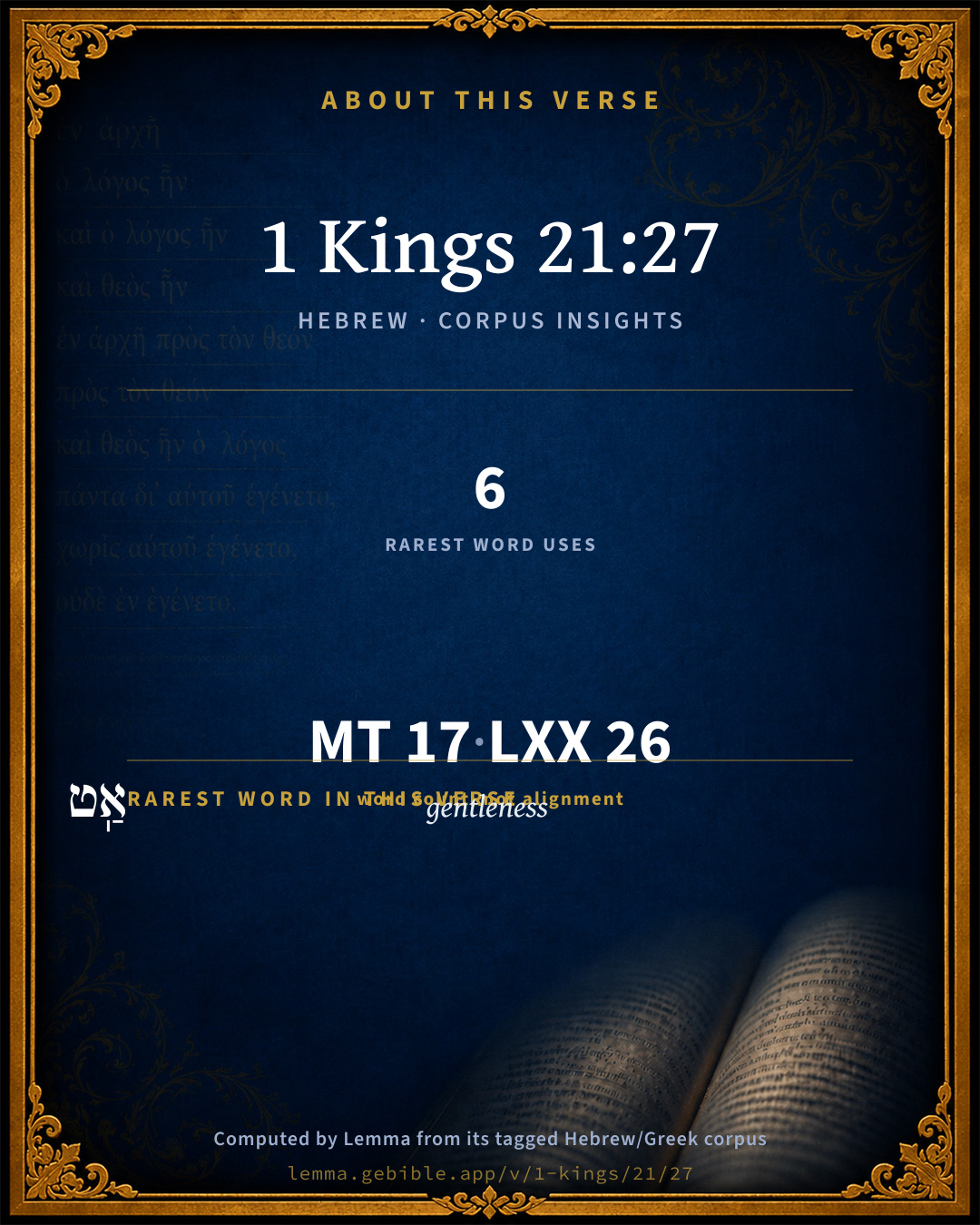
The rarest word here is אַֽט gentleness H328 — appearing just 6 times in the whole Hebrew Bible.

Shared distinctive vocabulary

אַֽט gentleness H328 occurs in 6 verses of the Hebrew Bible. Also found in:

Grammatical profile

  • 7 verbs
  • 6 nouns
  • 1 pronoun
  • 1 preposition
  • 1 adverb
  • 1 particle

Verb forms

  • וַיְהִי֩ Qal · Sequential Imperfect
  • כִשְׁמֹ֨עַ Qal · Infinitive Construct
  • וַיִּקְרַ֣ע Qal · Sequential Imperfect
  • וַיָּֽשֶׂם Qal · Sequential Imperfect
  • וַיָּצ֑וֹם Qal · Sequential Imperfect
  • וַיִּשְׁכַּ֣ב Qal · Sequential Imperfect
  • וַיְהַלֵּ֖ךְ Piel · Sequential Imperfect

Repetition

A word recurs within this verse — often emphatic in Hebrew:

  • שַׂ֥ק sackcloth H8242 ×2

Hebrew & Septuagint length

In English translation the verse runs 27 words from the Hebrew and 28 from the Septuagint (LXX English) — closely comparable.

A rough comparison of the two English renderings, which tokenize alike — not a word-level alignment.

Word counts can differ between the Hebrew and the Greek without any difference in meaning — e.g. the Hebrew direct-object marker אֵת has no separate Greek word, and Greek often adds the article ὁ.

In the original languages it is 17 Hebrew tokens and 26 Greek tokens — but the two are counted differently (Hebrew bundles its prefixes and suffixes into one token; the Greek is in lemma form), so that isn’t a like-for-like length.

Cross-references

11

Topical passages linked to 1 Kings 21:27 in the Treasury of Scripture Knowledge — connected by theme and wording, ordered by reader-vote popularity; previews shown in the World English Bible.

  • 2 Kings 6:30 It happened, when the king heard the words of the woman, that he tore his clothes (now he was passing by on the wall); and the people looked, and, behold, he had sackcloth within on his flesh.
  • Genesis 37:34 Jacob tore his clothes, and put sackcloth on his loins, and mourned for his son many days.
  • 2 Samuel 3:31 David said to Joab, and to all the people who were with him, Tear your clothes, and gird you with sackcloth, and mourn before Abner. King David followed the bier.
  • 2 Samuel 12:16–17 David therefore begged God for the child; and David fasted, and went in, and lay all night on the earth.
  • 2 Kings 18:37 Then came Eliakim the son of Hilkiah, who was over the household, and Shebna the scribe, and Joah the son of Asaph the recorder, to Hezekiah with their clothes torn, and told him the words of Rabshakeh.
  • Job 16:15 I have sewed sackcloth on my skin, And have thrust my horn in the dust.
  • Isaiah 22:12 In that day did the Lord, Yahweh of Hosts, call to weeping, and to mourning, and to baldness, and to girding with sackcloth:
  • Isaiah 38:15 What shall I say? he has both spoken to me, and himself has done it: I shall go softly all my years because of the bitterness of my soul.
  • Isaiah 58:5–8 Is such the fast that I have chosen? the day for a man to afflict his soul? Is it to bow down his head as a rush, and to spread sackcloth and ashes under him? will you call this a fast, and an acceptable day to Yahweh?
  • Joel 1:13 Put on sackcloth and mourn, you priests! Wail, you ministers of the altar. Come, lie all night in sackcloth, you ministers of my God, For the meal offering and the drink offering are withheld from your God's house.
  • Jonah 3:6 The news reached the king of Nineveh, and he arose from his throne, and took off his royal robe, covered himself with sackcloth, and sat in ashes.

Cross-references courtesy of OpenBible.info (CC BY 4.0).

Hebrew and Greek witnesses Masoretic Hebrew ↔ Greek Septuagint

The same verse in the two great witnesses to the Old Testament, shown verse-for-verse.

These are two independent witnesses, not word-aligned to each other, and the Septuagint is shown in lemma (dictionary) form.

Hebrew 1 Kings 21:27 Masoretic · Westminster Leningrad Codex

וַיְהִי֩ כִשְׁמֹ֨עַ אַחְאָ֜ב אֶת הַדְּבָרִ֤ים הָאֵ֨לֶּה֙ וַיִּקְרַ֣ע בְּגָדָ֔יו וַיָּֽשֶׂם שַׂ֥ק עַל בְּשָׂר֖וֹ וַיָּצ֑וֹם וַיִּשְׁכַּ֣ב בַּשָּׂ֔ק וַיְהַלֵּ֖ךְ אַֽט

It happened, when Ahab heard those words, that he tore his clothes, and put sackcloth on his flesh, and fasted, and lay in sackcloth, and went softly.

World English Bible · Public Domain

Greek LXX 1 Kings 21:27 Septuagint · lemma form

καί ὁ υἱός ἰσραήλ ἐπισκέπτομαι καί παραγίγνομαι εἰς ἀπαντή αὐτός καί παρα ἐνβάλλω ἰσραήλ ἐκ ἐναντίος αὐτός ὡσεί δύο ποίμνιον αἴξ καί συρία πίμπλημι ὁ γῆ

And the children of Israel were numbered, and came to meet them: and Israel encamped before them as two little flocks of goats, but Syria filled the land.

LXX2012 (modern English Septuagint) · Public Domain

On this verse, Ellicott's Commentary for English Readers discusses the Septuagint’s reading. Read the note in Commentary ↓

Hebrew: Westminster Leningrad Codex (CC BY 4.0). Greek: Septuagint (public domain); English from LXX2012 (modern English Septuagint) (Public Domain). How the Septuagint differs from the Hebrew →

Targum (Aramaic paraphrase)

1

The Targum is the ancient Jewish Aramaic paraphrase of the Hebrew Scriptures — an interpretive translation, not the Hebrew text itself. Onkelos (literal) and Pseudo-Jonathan (expansive) render the Torah, and Jonathan the Prophets. Coverage is partial: where no permissively-licensed English translation exists for a verse, only the Aramaic is shown. This is verse-level text, not a word-by-word alignment to the Hebrew.

  1. Targum Jonathan Prophets (Joshua–Malachi)
    וַהֲוַה כַד שְׁמַע אַחְאָב יַת פִּתְגָמַיָא הָאִלֵין וּבְזַע יַת לְבוּשׁוֹהִי וַאֲסַר סַקָא עַל בִּסְרֵיהּ וְצָם וּשְׁכִיב בְּסַקָא וְהַלִיךְ יָחֵיף:

    (no public-domain English translation for this verse)

    Targum Jonathan — Aramaic: “Mikraot Gedolot” (public domain). English: “Sefaria Community Translation” (CC0 1.0 (public-domain dedication)); “London "Chaldee Paraphrase," 1871” (public domain). Text via Sefaria.

Commentary

Notes on 1 Kings 21:27 from classic Christian and Jewish commentators (each source and its license shown beneath its notes). The classic Christian expositions comment on the surrounding passage and are grouped to its opening verse, so a note may address several verses; the Jewish commentaries on the Tanakh (Rashi and others) are per-verse, so they appear only where the commentator wrote on this verse.

Lemma curates 59 commentaries, every one of them public domain or Creative Commons licensed, each selected and text-cleaned for this edition rather than reprinted as found. About our sources →

Trapp's Complete Commentary

John Trapp

1Ki 21:27 And it came to pass, when Ahab heard those words, that he rent his clothes, and put sackcloth upon his flesh, and fasted, and lay in sackcloth, and went softly.

Ver. 27. When Ahab heard these words,] viz., Concerning the utter excision of his wife and posterity, {a} this troubled him more than the loss of his own life forethreatened.

And fasted and lay in sackcloth.] So do the Turks still in their greatest fears and distresses. This wicked men do, not out of hatred of sin, as it is offensivum Dei, et aversivum a Deo, but for fear of punishment.

{a} Aυτος ακι παιδες, και παιδων ουκετι παιδες.

John Trapp, A Commentary or Exposition upon All the Books of the Old and New Testament (1647–1656) — public domain. Text from a community e-Sword module.

The Biblical Illustrator

Joseph S. Exell

1Ki_21:27

And it came to pass, when Ahab heard those words, that he rent his clothes.

Ahabs repentance

I. How Ahabs repentance was called forth. A threefold crime is here laid to the charge of the King of Israel: that he had provoked God to anger--that he had made Israel to sin--and that he had sold himself to work wickedness in the sight of the Lord. It was for this cause that the sword of the Almighty had been whetted for the destruction of himself and his house. It is a common proverb that Every man has his price; that there is something for which every one will be found willing to sell himself. These are words of very awful import, and yet they are but too true concerning every natural man. The children of this world, proud as they are of themselves, may always be bought with one temptation or another: honours, profits, pleasures of one class or another, will induce them to debase themselves more and more. The idol to which Ahab sacrificed was his affection for Jezebel. His own will, his honour, his peace of conscience, the salvation of his soul, the favour of God--all that he had or hoped for, was laid at this idols feet. Would that he were singular in such infatuation; or only one of a few! But alas, it is common in every age. Let any one ask himself, why he is an unbeliever; why he despises the people of God; why he serves the world and the devil, and endeavours to stifle every good conviction. What an accursed alliance, though it be under the sacred name of friendship itself, must that be, which is connected with enmity against God!

II. What kind of repentance it was. This mourning of the King of Samaria was real as far as it went. The wretched outward dress in which he appeared was a true expression of his inward temper and state of mind. Still, much was wanting in his repentance to render it a repentance unto life and salvation. It was not a mourning like that of the woman that was a sinner at the feet of Jesus, like that of the thief on the cross, or that of the poor publican. Ahabs repentance was utterly destitute of love; and it is love which hallows all our acts and deeds, and give them a real value. Now, when a sinner has, with heartfelt seriousness, pronounced sentence against himself before the throne of God, he has begun to die to the law. For here is an end of his supposed self-righteousness, and of his own supposed ability. But that true repentance, which the Scripture calls a godly sorrow, and a repentance which needeth not to be repented of, does not, as yet necessarily exist. This is but, as it were, dying before the Divine holiness; as we see was the case of St. Paul, in Rom_7:1-25,: When the commandment came, sin revived, and I died. And the commandment, which was ordained to life, I found to be unto death. Now, this glorious and happy death comes by the law of the Spirit of life in Christ Jesus (Rom_8:2). And this law is no other than the Gospel; whereby alone it is that true, divine, and saving repentance is called forth.

III. What were its consequences. Here was a delay of execution; but no revocation of the sentence. The curse still rested upon Ahab and his house. Yet even this respect shown to a repentance which had so little intrinsic worth, this exemption of Ahab from personally experiencing those storms which impended over his house, was an instance of great condescension and favour. But why, it may be asked, if Ahabs humiliation was so little worth, was any Divine regard shown towards it? This, we answer, was to show by a living example that self-condemnation and abasement before God is the way to escape His anger, and obtain His favour. Just as a novice in any art or trade may be cheered by words of encouragement at the first favourable attempt which he makes, however important it may be; so the exemption which the Lord made in Ahabs favour on repenting, was calculated to encourage him to aim at something better. Self-condemnation, self-abasement, and giving God the glory, are the first steps from spiritual death to spiritual life. (F. W. Krummacher, D. D.)

Repentance of Ahab

I. A person whose heart is unchanged, and who is totally destitute of real piety, may perform many outward religious duties, and have inward sentiments and affections, somewhat resembling the Christian graces.

II. How powerful is the word of God, which can humble the haughtiest oppressors, and make the most hardened of mortals tremble.

III. Sin is always succeeded by sorrow and remorse. (H. Kollock, D. D.)

Ahab

In the context we have three subjects worthy of attention.

1. A fiendishly greedy soul,

2. A truly heroic soul.

3. A morally alarmed soul. In this incident we discover three things.

I. The worthlessness of a partial reformation.

II. The mighty force of Divine truth.

III. The self-frustrating power of sin. (Homilist.)

Ahabs sin and repentance

There is much in this old chronicle of sin and doom which it may profit us to ponder. Let me try to bring out of it some present-day lessons of warning and admonition.

I. Happiness consists, not in having, but in being. How many even to-day are letting their lives be darkened because some Naboth denies them a vineyard, or some Mordecai will not salute them! They forget that, even if they had the things which they so long for, happiness would be as far from them as ever, and some new object would take the place of their old grievance. They do lack one thing. But that one thing is not external to them, but within them. They lack a new heart, and until they get that they can have no abiding satisfaction. Whosoever drinketh of this water shall thirst again.

II. The evil of unhallowed alliances. Dazzled with the glitter of a fortune, or the glare of an exalted position, a young person enters into the sacred alliance of matrimony with one who has no moral stability or Christian excellence, and the issue is certain misery, with the probable addition of crime and disaster.

III. The perversion which an evil heart makes of religious knowledge. The Spaniards have a proverb somewhat to this effect, When the serpent straightens himself, it is that he may go into his hole. So when the unscrupulous suddenly manifest some punctilious regard for legal forms or for religious observances, you may be sure that they are after mischief. Some of the blackest crimes that have ever been committed have been perpetrated through the forms of law, or under the colour of religion. Is it not true that the heart is deceitful above all things, and desperately wicked? and are we forcibly impressed with the fact that no one is so daringly defiant in wickedness as he who knows the truth and disregards it? Mere knowledge never yet saved any one from ruin; for, if the heart be perverted, everything that enters the head is only made subservient to its iniquity. Your educated villains are all the more dangerous because of their education; and among godless men they are the most to be dreaded who have an intelligent acquaintance with the Word of God.

IV. The price which we have to pay for sin. What weighty words are these of Elijah to Ahab, Thou hast sold thyself to work evil in the sight of the Lord! The great German poet has elaborated this thought into that weird production wherein he represents his hero as selling his soul to the mocking Mephistopheles. And it were well that every evil-doer laid to heart the moral of his tragic tale. That which the sinner gives for his unhallowed pleasure or dishonest gain is himself. Consider it well.

V. The curse which attends ill-gotten gains. The gains of ungodliness are weighted with the curse of God; and, sooner or later, that will be made apparent. For the moral government of God to-day is administered on the same principles as those which we find underlying this narrative. True, the dishonest man now pursuing his purposes in secret may have no Elijah sent to him, with the special mission to declare to him the sort of punishment which shall overtake him; but Elijahs God is living yet, and one has only to open his eyes, and mark the progress of events from year to year, to be convinced that sorrow tracketh wrong, as echo follows song--on, on, on.

VI. The tenderness of God toward the penitent. Ahab was filled with bitter regret at what had been done, and God, who will not break the bruised reed or quench the smoking flax, said that the evil should not come in his day. If God were so considerate of Ahab, the idolater, the murderer, the thief, will He not regard thee, O thou tearful one! who art bemoaning the number and aggravation of thy sins? Go, then, to Him; and let this be thine encouragement. (W. M. Taylor, D. D.)

Ahabs repentance, and punishment deferred

I. The repentance of Ahab was awakened by the fearful prediction of coming vengeance, which Elijah delivered at the moment when he had taken possession of Naboths vineyard. Mark the power of the Divine word. Is it not like as a fire, saith the Lord; and like a hammer that breaketh the rock in pieces? In the moment of Ahabs humiliation, his remorse was sincere; i.e., his conscience was roused, his fears excited, his sense of Gods justice real, and his desire for pardon unfeigned.

II. Ahabs punishment was suspended in his own days. Because he humbleth himself before Me, I will not bring the evil in his days. How can this be? It is possible that the God of mercy should show mercy; and that His mercy should rejoice against judgment. The history of our own lives, still spared and still prolonged, notwithstanding our manifold transgressions, is an evidence of this certain truth. And what is the practical result, arising from this combined view of Gods mercy and truth? Assuredly, it will cause the contrite to hope, and the careless to fear. The one will recognise, in the sorest visitations that befall him, the hand of a gracious Father who chastens that He may bless; and whose afflictions are strewed upon the path of life, like the arrows of Jonathan before David, not for destruction, but for warning. The other will as surely perceive, that Gods word shall not return unto him void; and, that, if it work not his conversion, it must be his condemnation. The threatenings which are revealed, that the sinner may repent, will remain, if he do not repent, to proclaim his fall.

III. The threatened evil, which was suspended in the days of Ahab, should, in his sons days, be brought upon his house. And here we cannot but call to mind the fact, that, whatever be the difficulties, connected with the view which is here presented to us, of Gods moral government, or however weakly we may succeed in explaining them; it is, still, the government of God, of Him who is righteous in all His ways, and holy in all His works. The matter of fact, in the history before us, came to pass, as it is here predicted. Evil was brought upon Ahabs house, in his sons days Ahaziah, his first successor, soon perished. The next, Jehoram, fell by the arm of Jehu, in the very portion of Naboths field. The seventy sons in Jezreel, were also slain, in obedience to the commands of Jehu, which he sent to the elders of that city; and, last of all, the same anointed captain, slew all that remained of the house of Ahab in Jezreel, and all his great men, and all his kinsfolk, and his priests, until he left him none remaining. Now, if we examine the sacred narrative which relates these events, we shall find that all these descendants of Ahab walked in his evil ways, and wrought evil in the sight of the Lord. It was not the innocent, then, suffering for the guilty; but the guilty reaping the harvest of his own guilt. And since known unto God are all his works before the beginning of the world, the whole of this train of wickedness was known likewise,--itself, its causes, and its consequences,--that long process stretching out, from year to year, and from generation to generation,--whose separate and disjointed portions, only, can be discerned by moral intellect,--but the whole of which was, alike, and at the same moment, present to the Eternal Mind. It is difficult for us, in forming our estimate of actions, to preserve this distinction between the occasion which leads to an event, and its immediate effective cause; but a distinction there is, and must be remembered. When a criminal is convicted at the tribunal of an earthly judge, the law, and they who administer it, are the instrumental causes of inflicting the sentence; but the crime committed is the immediate cause which deserves it. We do not confound these things, in our estimate of the dealings between man and man: let us not confound them, therefore, when we are contemplating the revealed dispensations of God to man. But may we not be permitted, in some degree, to trace the course of the Divine counsels, in the present instance? The punishment of Ahabs descendants, we know to have been inflicted under a theocracy, which employed temporal rewards, and temporal punishments, as the instruments of its government. Now, what instrument could be more powerful, in such a case, than the prospect of misery, about to fall upon the children of the sinner, as well as upon himself? His own licentious and hardened passions might make a man insensible to the fear of temporal evil befalling himself; but, when he was assured, as he could not fail to be, by the moral law of Moses, that Divine wrath would visit his iniquity, upon his children, unto the third and fourth generation, every instinctive feeling of parental kindness and affection would be enlisted on the side of duty, and act as a restraint upon the unruly will. (J. S. M. Anderson, M. A.)

.

The Biblical Illustrator, edited by Joseph S. Exell (c. 1880s–1900s) — public domain. Text from a community e-Sword module.

Joseph Benson's Commentary

1Ki 21:27. He rent his clothes, and put on sackcloth, &c. — These were expressions of great sorrow and heaviness, and usual in mourning: for, notwithstanding that Ahab was drawn, by the persuasions of his wife, to idolatry and other great crimes; yet he was sensible that many of Elijah’s prophecies had been fulfilled, and therefore he was much disturbed at what he now heard from that prophet. And went softly — Slowly and silently, after the manner of mourners, or those who are under a great consternation.

Joseph Benson's Commentary on the Old and New Testaments (1811–1818) — public domain. Text from a community e-Sword module.

Tyndale Open Study Notes

Tyndale Open Resources

21:27-29 Ahab was a complex character. Although justly condemned for his evil character, here he repented when the Lord’s prophet brought a message of rebuke (21:27). Because of Ahab’s repentance, the Lord sent Elijah to postpone the awful sentence against Ahab and instead impose it on his equally wicked sons (2 Kgs 1:17; 9:24-26; 10:1-11).

Tyndale Open Study Notes — © Tyndale Open Resources, licensed CC BY-SA 4.0. Text via the HelloAO Bible API.

Geneva Bible (1599)

Geneva Bible translators

In token of mourning, or as some read, barefooted.

Hebrew, his flesh.

Geneva Bible (1599) marginal notes — public domain. Text via Bolls.life.

Jamieson, Fausset & Brown

Robert Jamieson, A. R. Fausset & David Brown

Ahab . . . rent his clothes, and put sackcloth upon his flesh, and fasted, and lay in sackcloth, and went softly--He was not obdurate, like Jezebel. This terrible announcement made a deep impression on the king's heart, and led, for a while, to sincere repentance. Going softly, that is, barefoot, and with a pensive manner, within doors. He manifested all the external signs, conventional and natural, of the deepest sorrow. He was wretched, and so great is the mercy of God, that, in consequence of his humiliation, the threatened punishment was deferred.

Next: 1 Kings Chapter 22

Jamieson, Fausset & Brown — Commentary Critical and Explanatory on the Whole Bible (1871) — public domain (CC PDM 1.0). Text via the HelloAO Bible API.

Adam Clarke's Commentary

Verse 27. He rent his clothes] He was penetrated with sorrow, and that evidently unfeigned.

Put sackcloth upon his flesh] He humbled himself before God and man.

And fasted] He afflicted his body for his soul's benefit.

Lay in sackcloth] Gave the fullest proof that his repentance was real.

And went softly.] Walked barefooted; so the Chaldee, Syriac, and Arabic. The Vulgate has demisso capite, "with his head hanging down." Houbigant translates went groaning. Jarchi says that the word אט at, used here, signifies to be unshod. This is its most likely sense. All these things prove that Ahab's repentance was genuine; and God's approbation of it puts it out of doubt. The slow and measured pace which always accompanies deep and reflective sorrow is also alluded to by AEschylus, where the Chorus are thus shortly addressed on the defeat of Xerxes. - AESCH. Pers. 1073.

Γοασθ ' ἁβροβαται

"With light and noiseless step lament."

Adam Clarke's Commentary on the Bible (1810–1826) — public domain. Text from a community e-Sword/MySword module.

Ellicott's Commentary for English Readers

(27) And went softly.—The translation seems correct; the meaning is variously conjectured. The LXX. (in some MSS.) has “bent down” in sorrow; the Vulgate similarly “with head bent down;” the Eastern versions and Josephus, “barefooted,” which seems far the most probable meaning.

A Bible Commentary for English Readers, edited by Charles John Ellicott (1878–1897) — public domain. Text from a community e-Sword module.

The Cambridge Bible for Schools and Colleges

gen. ed. J. J. S. Perowne

27. The LXX. gives for this verse ‘And when Ahab was pricked (in his heart) on account of this word (coming) from the presence of the Lord, he went and wept, and rent his robe, and girded sackcloth upon his body, and fasted. And he put on sackcloth in the day on which he slew Naboth the Jezreelite, and went [softly]’. There is nothing to represent the last word, which is in brackets, and thus the sentence is incomplete. Josephus explains that the king went barefoot. On the mention of the day of Naboth’s murder, see above on 1Ki_21:16.

The Cambridge Bible for Schools and Colleges (gen. ed. J. J. S. Perowne; Cambridge University Press, 1878–1918) — public domain. Text from a community e-Sword module.

Albert Barnes' Notes on the Bible

The repentance of Ahab resembles that of the Ninevites Jon 3:5. It has the same outward signs - fasting and sackcloth - and it has much the same inward character. It springs, not from love, nor from hatred of sin, but from fear of the consequences of sin. It is thus, although sincere and real while it lasts, shallow and exceedingly short-lived. God, however, to mark His readiness to receive the sinner who turns to Him, accepted the imperfect offering (as He likewise accepted the penitence of the Ninevites), and allowed it to delay the execution of the sentence 1Ki 21:29. So the penitence of the Ninevites put off the fall of Nineveh for a century.

And lay in sackcloth - In this particular he seems to have gone beyond the usual practice. We do not read elsewhere of mourners passing the night in sackcloth.

And went softly - “As if he had no heart to go about any business” (Patrick).

Albert Barnes' Notes on the Bible (1834–1885) — public domain. Text from a community e-Sword/MySword module.

Haydock's Catholic Bible Commentary

Down. Hebrew, "uncovered," (Malvenda; 2 Kings xv. 30.) or "barefoot," (Chaldean; Syriac) or "softly," (Vatable; Protestants) or "he walked bent down." (Septuagint) This variety shows that the signification or at (Haydock) is not well known. The repentance of Achab is not more certain. Some believe that it was insincere, and only external: yet God was pleased to reward it iin this life, (Lyranus; Theodoret, &c.) as if might have some influence on the people. (Haydock) --- Others suppose that Achab really repented for what he had done, but presently relapsed at the instigation of Jezabel; so that his reward was equally of a temporal nature; though St. Chrysostom (ad Theod. laps.) seems to be convinced that he "obtained the remission of all his sins, and entirely changed his life." (ser. 68, et hom. 5. ad Antioc.) --- But here lies the difficulty. (Calmet) --- "His groans would have found favour, if the lurking envy had not increased his offence." (St. Ambrose, in Psalm xxxvii., de Naboth. chap. iv.) See ver. 25. --- A relapse renders the sincerity of the former conversions doubtful; and the more so, when no radical change, but only external sorrow, has appeared.

George Leo Haydock (1774–1849), Haydock's Catholic Family Bible and Commentary, 1859 edition — public domain. Excludes Psalms (Douay-Rheims chapter numbering differs from Protestant) and Deuterocanonical books (Catholic canon only).

Matthew Poole's English Annotations

i. e. Slowly and silently, after the manner of mourners, or those who are under a great consternation, and in deep consideration.

Matthew Poole's English Annotations on the Holy Bible (1683–1685) — public domain. Text from a community e-Sword/MySword module.

Whedon's Commentary on the Bible

Daniel D. Whedon

27. Went softly — Walked in the slow and silent manner of a mourner. So he put on every appearance of humiliation and penitence. Many have supposed that Ahab’s repentance was altogether false and hypocritical. But Jehovah considered it as sufficiently genuine to cause him to modify the sentence he had previously passed upon him. For a time, doubtless, his repentance was deep and genuine, but it soon passed away, and, like many previous convictions, was lost by reason of the evils to which he had made himself a slave.

Daniel D. Whedon (gen. ed.), Commentary on the Old and New Testaments (1874–1909) — public domain. Text from a community e-Sword module.

The Pulpit Commentary

And it came to pass, when Ahab heard those Heb. these words vers. 21-24, and others not recorded, that he rent his clothes cf. 2Sa_13:19; Job_1:20 Job_2:12; Jer_36:24, etc. and put sackcloth upon his flesh 1Ki_20:31; 2Ki_6:8; Joel, 1Ki_18:17 1Ki_21:20) In all ages the word of God has been "as a fire," and as a "hammer". (Jer_23:29) Give examples. The Ninevites, the Jews at Pentecost, etc. It has "pleased God, by the foolishness of preaching, to save them that believe.

1. It asserted itself in fasting and tears. These would be natural signs of distress. In themselves they were no evidence of sincerity. It is easier to put on the outward than to experience the inward. There is always danger of letting the visible supersede the invisible, though it is only of value as the honest expression of conviction, Leaves and blossoms may be tied around a dead branch, but that does not make it live. (The perils of Ritualism.) Even under the Old Dispensation this was understood. Samuel said, "To obey is better than sacrifice," etc. David exclaimed, "Thou desirest not sacrifice," etc. (Psa_51:16, Psa_51:17; see also Mic_6:8; Isa_1:11) Compare the words of our Lord, "Moreover when ye fast, be not as the hypocrites, of a sad countenance; for they disfigure their faces, that they may appear unto men to fast.

2. It consisted in terror, not in turning. Ahab was thoroughly alarmed, but imagination rather than conscience was at work within him. He did not forsake his idols, nor give up Naboth"s vineyard, nor abandon his self confidence. See next chapter, which narrates his dealings with Micaiah. Evidently there was no change of heart or of life; nor had his present feeling any abiding influence. He was like those who are alarmed at the thought of hell, not at the thought of sin. They shrink from punishment, but not from guilt. Examples. The drunkard weeping maudlin tears over his poverty; the detected wrong doer thrown out of employment; the sinner who believes himself to be at the point of death, etc. True repentance makes us feel and act differently towards sin and towards God.

II THE DIVINE NOTICE OF AHAB"S HUMILIATION.

1. It did not escape the Divine search. God looks down from heaven to see if there were any that do good. He rejoices to find not the evil that must be punished, but the feeble germs of good that may be encouraged. (Compare Psa_14:2) Even such a sinner as Ahab (ver. 25) was not disregarded when he showed the faintest signs of repentance. God would foster them lovingly, as He fosters the seed sown in the warm earth. The prodigal is seen "when yet a great way off." Even the first beginnings of righteousness were commended by our Lord: "Jesus, beholding him, loved him," etc.

2. It led to the mitigation of the Divine punishment. Ahab"s feeling was real as far as it went. The postponement of punishment was to give opportunity for more genuine repentance. Had that revealed itself, the judgment would have been averted. Compare this with our Lord"s washing the feet of Judas, though He knew he was about to betray Him. "The goodness of God leadeth to repentance." See how ready God is to meet those who may return to Him (Act_2:38; Joe_2:12-14) NOTE. We ought to notice and encourage what is right even in those who arenot what they should be, commending it whenever it is possible.

3. It Jailed to win a reversal of the Divine judgment. A temporary repentance may be followed by a temporary reprieve; but final salvation must be preceded by true repentance. If the heart is not turned from sin, it cannot be turned from hell. "Godly sorrow worketh repentance to salvation, not to be repented of; but the sorrow of this world worketh death." Not only must evil be expelled, but good must enter; for if the heart is left "empty, swept, and garnished" by self-reformation, the evil spirits will return. Good must supersede evil; Christ must supplant sin; the Holy Spirit must conquer the evil spirit. (Compare Act_11:17, Act_11:18)

A partial penitence gained reprieve, and much more will a thorough repentance gain justification. As Trapp says, "If the leaves of repentance be so medicinal, much more the fruit. A.R.

The Pulpit Commentary (1880–1919), ed. H.D.M. Spence-Jones & Joseph S. Exell — public domain. Text from a community e-Sword module.

John Wesley's Explanatory Notes

Softly - Slowly and silently, after the manner of mourners, or those who are under a great consternation.

John Wesley, Explanatory Notes Upon the Whole Bible (1754–1765) — public domain. Text via the GEBible commentary corpus.

Keil & Delitzsch

C. F. Keil & F. Delitzsch

This terrible threat made such an impression upon Ahab, that he felt deep remorse, and for a time at least was sincerely penitent. Rending the clothes, putting on the mourning garment of hair (שׂק), and fasting, are frequently mentioned as external signs of humiliation before God or of deep mourning on account of sin. יהלּך אט, he walked about lightly (slowly), like one in deep trouble. This repentance was neither hypocritical, nor purely external; but it was sincere even if it was not lasting and produced no real conversion. For the Lord Himself acknowledge it to be humiliation before Him (Kg1 21:29), and said to Elijah, that because of it He would not bring the threatened calamity upon Ahab's house in his own lifetime, but only in the days of his son. אבי for אביא, as in Kg1 21:21.

Keil & Delitzsch — Biblical Commentary on the Old Testament (1861–1891) — public domain (CC PDM 1.0). Text via the HelloAO Bible API. (Old Testament only.)

unfoldingWord translationNotes

Door43 World Missions Community

the word of Yahweh came

This idiom means that Yahweh spoke or has sent a message. See how you translated this in 1 Kings 6:11. AT: "Yahweh spoke this message" or "Yahweh spoke" (See: Idiom)

Do you see how Ahab humbles himself before me?

God uses this question to show Elijah that Ahab's sorrow is genuine. AT: "I have seen how Ahab humbles himself before me." or "Look at how Ahab humbles himself before me." (See: Rhetorical Question)

in his days ... in his son's day

"during his lifetime ... during his son's lifetime"

translationWords

word

sackcloth

fast

word of God

Elijah

humble

son

family

unfoldingWord translationNotes — © Distant Shores Media and the Door43 World Missions Community, licensed CC BY-SA 4.0. Source: git.door43.org/Door43/en_tn.

Rashi

Rabbi Shlomo Yitzchaki (Rashi)

And walked barefoot. [He walked] barefoot.

Rashi on the Tanakh — English translations: “The Judaica Press complete Tanach with Rashi, translated by A. J. Rosenberg” (CC BY 4.0); “Pentateuch with Rashi's commentary by M. Rosenbaum and A.M. Silbermann, 1929-1934” (public domain); “The Metsudah Tanach series, Lakewood, N.J” (CC BY 4.0); and “The Book of Joshua, Metsudah Publications, 1997” (CC BY 4.0). Text via Sefaria.

Lesson kit

Teaching starters — assembled from the data on this page, not authored interpretation. Every prompt links to the verse data it draws on. Edit before teaching.

1 Kings, in the Historical, opens this verse with 17 words (16 distinct Hebrew lemmas). Its most distinctive word is ʼaṭ (“gentleness”). A historical commentator’s framing appears above. Read the whole chapter for the surrounding context.

Discussion questions

  1. How does “gentleness” (ʼaṭ) shape what this verse is saying?
  2. How does Genesis 33:14, which shares the word «gentleness», read alongside this verse?
  3. What does the repetition of “sackcloth” (2× in this one verse) do in this verse?
  4. The translations on this page render this verse differently — a whole-verse word diff, not a word-by-word alignment. What might account for the different wordings?
  5. «וַיְהִי֩» is a Qal Sequential Imperfect verb. How does that grammatical form shape the action described?
  6. Compare how Trapp's Complete Commentary and The Biblical Illustrator read this verse. Where do they agree or differ?

Things to notice

Reading settings

Reading text

Shown beneath each verse's original-language words.

Old Testament
Old Testament edition

Read the OT as the Masoretic Hebrew (MT) or the Greek Septuagint (LXX).

English shown for the Greek Septuagint (in the Hebrew ↔ Greek comparison).

Comparing translations? Open the Compare panel on any verse page to stack up to four side by side.