Leviticus 15:33

Hebrew (Westminster Leningrad Codex) Leviticus 15:33 appears in the Hebrew Old Testament. The text above is from the Westminster Leningrad Codex. Each word links to its Strong’s number, a concise gloss, and parsing drawn from the Open Scriptures Hebrew Bible morphology. Click any word for its full Brown-Driver-Briggs (BDB) entry.
Download image
Cite this verse

Leviticus 15:33 (World English Bible). Public Domain. Lemma interlinear Bible study tool, https://lemma.gebible.app/v/leviticus/15/33.

Show BibTeX & RIS
BibTeX
RIS
English Translation
and of her who has her period, and of a man or woman who has a discharge, and of him who lies with her who is unclean.
World English Bible · Public Domain
Highlights Full analysis ↓
Download a study sheet

One document with this verse’s original text, its word-by-word gloss line, the meaning frame, cross-references with their text, attributed commentary, and full source and license credits — printable, and it pastes into notes with its structure intact.

This verse Autodidact and up

Study sheet (.html) Plain text (.txt)

A passage Seminary Student

Up to 50 verses in one chapter. A passage sheet keeps up to 6 commentary sources and 12 cross-references per verse, in the order this page ranks them, and says so on the sheet whenever that leaves anything out. Ask for a single verse and you get the Autodidact verse sheet above.

Everything on this page stays free to read, with no account — the sheet is a download of what is already on screen, not access to it.

Want to remove ads? Support Godless Engineer
Compare translations 3

The same verse in 3 English versions, stacked beneath the original-language interlinear above. Click any original word for its lexicon entry.

Each is an independent rendering of the whole verse — the interlinear is not word-aligned to these translations.

Highlighted words mark where these versions differ — a whole-verse word diff, not a word-by-word alignment.

  • World English Bible Public Domain
    and of her who has her period, and of a man or woman who has a discharge, and of him who lies with her who is unclean.
  • King James Version Public Domain
    And of her that is sick of her flowers, and of him that hath an issue, of the man, and of the woman, and of him that lieth with her that is unclean.
  • unfoldingWord Literal Text CC BY-SA 4.0
    and of who is sick in her menstruation and of the flowing of his flow, whether male or female, and of the man who lies with an unclean.’”

unfoldingWord Literal Text — © unfoldingWord, licensed CC BY-SA 4.0. Word-aligned USFM3 via Door43 (git.door43.org/unfoldingWord/en_ult).

Versions to compare (up to 4)

3 of 4 selected

Show all 18 translations

Every available English version of this verse, each an independent rendering of the whole verse.

  • World English Bible Public Domain
    and of her who has her period, and of a man or woman who has a discharge, and of him who lies with her who is unclean.
  • Berean Standard Bible Public Domain
    of a woman in her menstrual period, of any male or female who has a discharge, and of a man who lies with an unclean woman.’”
  • Majority Standard Bible Public Domain
    of a woman in her menstrual period, of any male or female who has a discharge, and of a man who lies with an unclean woman.’”
  • King James Version Public Domain
    And of her that is sick of her flowers, and of him that hath an issue, of the man, and of the woman, and of him that lieth with her that is unclean.
  • American Standard Version (1901) Public Domain
    and of her that is sick with her impurity, and of him that hath an issue, of the man, and of the woman, and of him that lieth with her that is unclean.
  • Revised Version (1885) Public Domain
    and of her that is sick with her impurity, and of him that hath an issue, of the man, and of the woman, and of him that lieth with her that is unclean.
  • Geneva Bible (1599) Public Domain
    Also of her that is sicke of her floures, and of him that hath a running issue, whether it bee man or woman, and of him that lyeth with her which is vncleane.
  • Douay-Rheims (1899) Public Domain
    And of the woman that is separated in her monthly times, or that hath a continual issue of blood, and of the man that sleepeth with her.
  • Young's Literal Translation Public Domain
    and of her who is sick in her separation, and of him who hath an issue, the issue of a male or of a female, and of a man who lieth with an unclean woman.'
  • Literal Standard Version CC BY-SA 4.0
    and of her who is sick in her separation, and of him who has the discharging (his discharge, of the male or of the female), and of a man who lies with an unclean woman.”
  • Unlocked Literal Bible CC BY-SA 4.0
    for any woman who has a menstrual period, for anyone with a flow of fluid, whether male or female, and for any man who sleeps with an unclean woman.'”
  • unfoldingWord Literal Text CC BY-SA 4.0
    and of who is sick in her menstruation and of the flowing of his flow, whether male or female, and of the man who lies with an unclean.’”
  • Darby Bible Public Domain
    and for a woman who is sick in her separation, and for him that hath his flux; for the man and for the woman, and for him that lieth with her that is unclean.
  • World Messianic Bible Public Domain
    and of her who has her period, and of a man or woman who has a discharge, and of him who lies with her who is unclean.
  • Webster's Bible Public Domain
    And of her that is sick of her flowers, and of him that hath an issue, of the man and of the woman, and of him that lieth with her that is unclean.
  • Free Bible Version CC BY-SA 4.0
    a woman during her period, any male or female who has a discharge, and a man who sleeps with an unclean woman.”
  • Bible in Basic English Public Domain
    And for her who has a flow of blood, and for any man or woman who has an unclean flow, and for him who has sex relations with a woman when she is unclean.
  • JPS Tanakh (1917) Public Domain
    and of her that is sick with her impurity, and of them that have an issue, whether it be a man, or a woman; and of him that lieth with her that is unclean.

Literal Standard Version (2020), Covenant Press — licensed CC BY-SA 4.0. Text via the HelloAO Bible API (eBible.org). Unlocked Literal Bible (unfoldingWord) — licensed CC BY-SA 4.0. Text via the HelloAO Bible API (eBible.org). unfoldingWord Literal Text — © unfoldingWord, licensed CC BY-SA 4.0. Word-aligned USFM3 via Door43 (git.door43.org/unfoldingWord/en_ult). Free Bible Version, Dr. Jonathan Gallagher — licensed CC BY-SA 4.0. Text via the HelloAO Bible API (eBible.org).

Word by word

More ways to search: Search by grammar → Find every occurrence → Compare this word →

Practice this passage: Drill this verse → Learn its vocabulary →

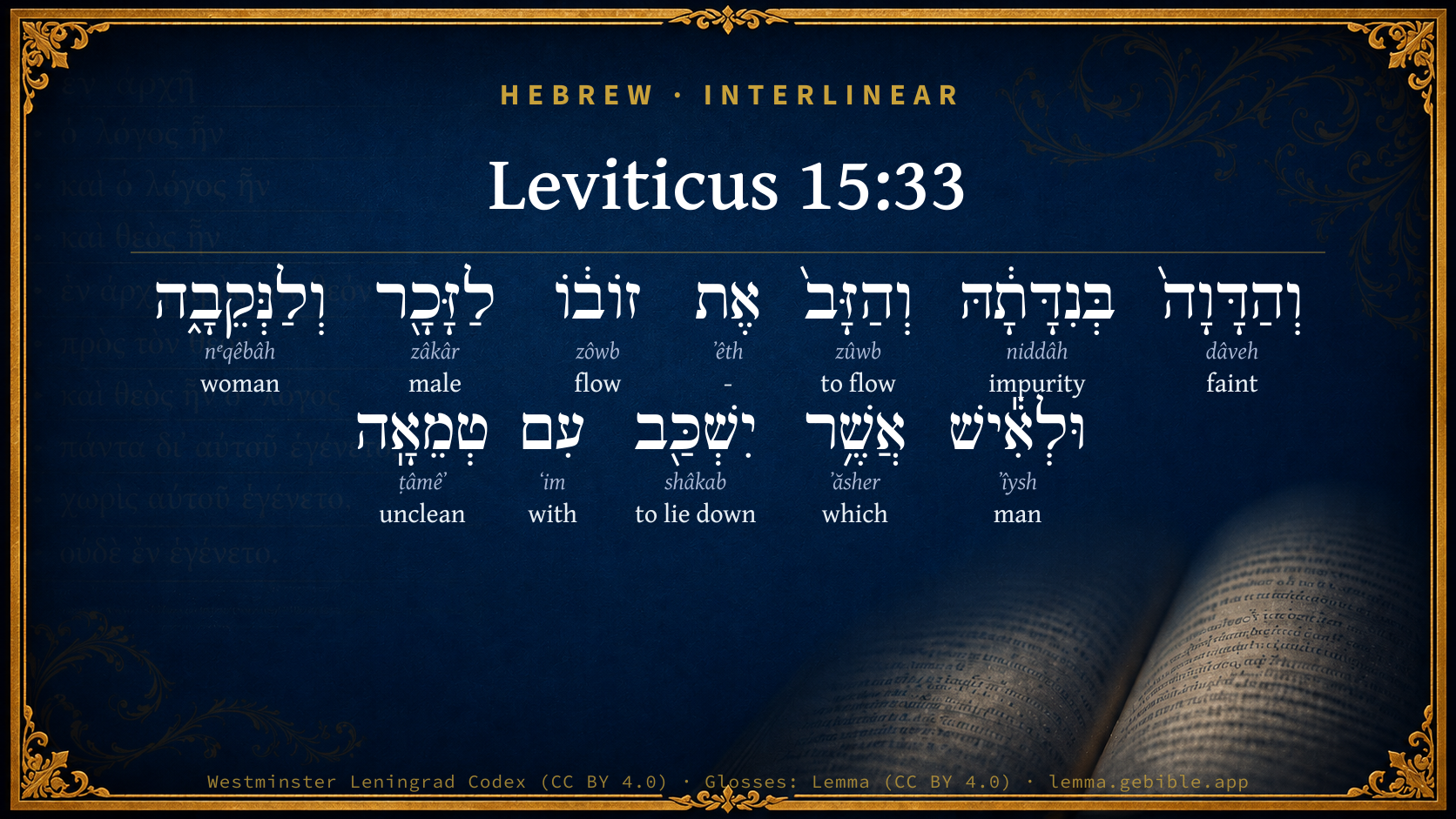
וְהַדָּוָה֙
dâveh
H1739
“and · the · faint”
Conjunction + Particle, Definite Article + Adjective, Adjective, Feminine, Singular, Absolute
Part of Speech
Conjunction + Particle + Adjective
Type
Adjective
Gender
Feminine
Number
Singular
State
Absolute
Full BDB Definition

Origin: from H1738

TWOT: 411b

faint, unwell - faint, weak - unwell, menstruous
  1. בְּנִדָּתָ֔הּ niddâh H5079 “in/at · impurity · her” Preposition + Noun, Common, Feminine, Singular, Construct + Suffix, Personal, 3rd Person, Feminine, Singular
  2. וְהַזָּב֙ zûwb H2100 “and · the · flowing” Conjunction + Particle, Definite Article + Verb, Qal, Participle Active, Masculine, Singular, Absolute
  3. אֶת ʼêth H853 “-” Particle, Direct Object
  4. זוֹב֔וֹ zôwb H2101 “flow · his” Noun, Common, Masculine, Singular, Construct + Suffix, Personal, 3rd Person, Masculine, Singular
  5. לַזָּכָ֖ר zâkâr H2145 “to/for the · male” Preposition, Determined + Noun, Common, Masculine, Singular, Absolute
  6. וְלַנְּקֵבָ֑ה nᵉqêbâh H5347 “and · to/for the · woman” Conjunction + Preposition, Determined + Noun, Common, Feminine, Singular, Absolute
  7. וּלְאִ֕ישׁ ʼîysh H376 “and · to/for · man” Conjunction + Preposition + Noun, Common, Masculine, Singular, Absolute
  8. אֲשֶׁ֥ר ʼăsher H834 “which” Particle, Relative
  9. יִשְׁכַּ֖ב shâkab H7901 “to lie down” Verb, Qal, Imperfect, 3rd Person, Masculine, Singular
  10. עִם ʻim H5973 “with” Preposition
  11. טְמֵאָֽה ṭâmêʼ H2931 “unclean” Adjective, Adjective, Feminine, Singular, Absolute

About this verse

These counts appear in no published source. They are computed here, from the morphology-tagged text and Lemma’s own curated glosses. What Lemma adds →

12
words
12
distinct lemmas
Pentateuch
section

Notable vocabulary

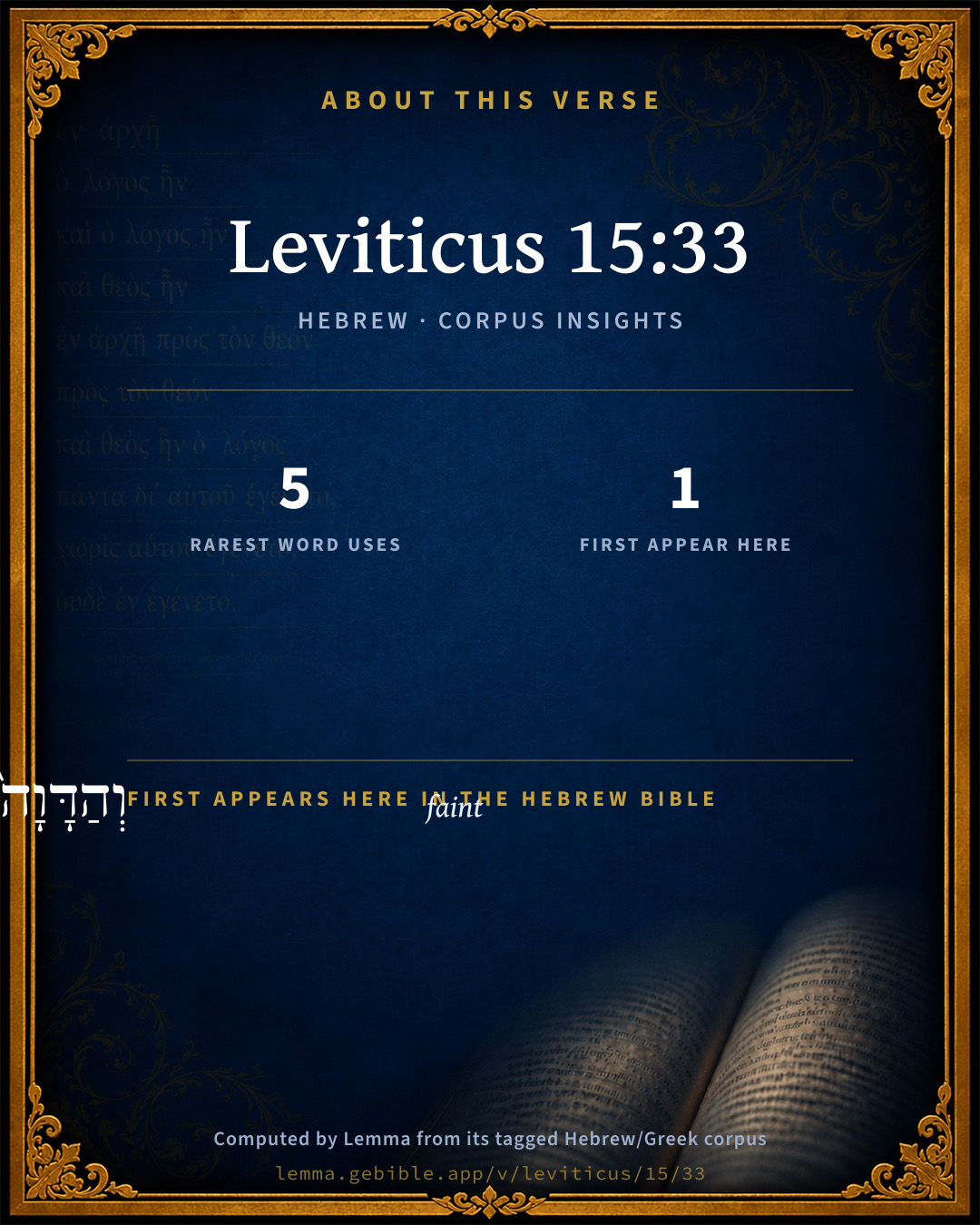
The rarest word here is וְהַדָּוָה֙ faint H1739 — appearing just 5 times in the whole Hebrew Bible.

First appearance in Scripture

This word makes its first canonical appearance in the Hebrew Bible here:

  • וְהַדָּוָה֙ faint H1739

Shared distinctive vocabulary

וְהַדָּוָה֙ faint H1739 occurs in 5 verses of the Hebrew Bible. Also found in:

Grammatical profile

  • 2 verbs
  • 5 nouns
  • 2 adjectives
  • 1 preposition
  • 2 particles

Verb forms

  • וְהַזָּב֙ Qal · Participle Active
  • יִשְׁכַּ֖ב Qal · Imperfect

Hebrew & Septuagint length

In English translation the verse runs 27 words from the Hebrew and 54 from the Septuagint (LXX English) — the Septuagint runs noticeably longer here. See the side-by-side →

A rough comparison of the two English renderings, which tokenize alike — not a word-level alignment.

Word counts can differ between the Hebrew and the Greek without any difference in meaning — e.g. the Hebrew direct-object marker אֵת has no separate Greek word, and Greek often adds the article ὁ.

Cross-references

3

Topical passages linked to Leviticus 15:33 in the Treasury of Scripture Knowledge — connected by theme and wording, ordered by reader-vote popularity; previews shown in the World English Bible.

  • Leviticus 15:19 "'If a woman has a discharge, and her discharge in her flesh is blood, she shall be in her impurity seven days: and whoever touches her shall be unclean until the evening.
  • Leviticus 20:18 "'If a man lies with a woman having her monthly period, and uncovers her nakedness; he has made naked her fountain, and she has uncovered the fountain of her blood: and both of them shall be cut off from among their people.
  • Leviticus 15:24–25 "'If any man lies with her, and her monthly flow is on him, he shall be unclean seven days; and every bed whereon he lies shall be unclean.

Cross-references courtesy of OpenBible.info (CC BY 4.0).

Hebrew and Greek witnesses Masoretic Hebrew ↔ Greek Septuagint

The same verse in the two great witnesses to the Old Testament, shown verse-for-verse.

Here the Septuagint runs noticeably longer than the Hebrew — LXX2012 (modern English Septuagint) 54 words vs World English Bible 27. A rough length comparison of the two English translations, not a word-level alignment — read both below.

These are two independent witnesses, not word-aligned to each other, and the Septuagint is shown in lemma (dictionary) form.

Hebrew Leviticus 15:33 Masoretic · Westminster Leningrad Codex

וְהַדָּוָה֙ בְּנִדָּתָ֔הּ וְהַזָּב֙ אֶת זוֹב֔וֹ לַזָּכָ֖ר וְלַנְּקֵבָ֑ה וּלְאִ֕ישׁ אֲשֶׁ֥ר יִשְׁכַּ֖ב עִם טְמֵאָֽה

and of her who has her period, and of a man or woman who has a discharge, and of him who lies with her who is unclean.

World English Bible · Public Domain

Greek LXX Leviticus 15:33 Septuagint · lemma form

καί ὁ αἱμορροέω ἐν ὁ ἄφεδρος αὐτός καί ὁ γονορρυής ἐν ὁ ῥύσις αὐτός ὁ ἄρσην ἤ ὁ θῆλυς καί ὁ ἀνήρ ὅς ἄν κοιμάω μετά ἀπο καταἧμαι

And this is the law for her that has the issue of blood in her separation, and as to the person who has an issue of seed, in his issue: it is a law for the male and the female, and for the man who shall have lain with her that is set apart.

LXX2012 (modern English Septuagint) · Public Domain

Hebrew: Westminster Leningrad Codex (CC BY 4.0). Greek: Septuagint (public domain); English from LXX2012 (modern English Septuagint) (Public Domain). How the Septuagint differs from the Hebrew →

Targum (Aramaic paraphrase)

2

The Targum is the ancient Jewish Aramaic paraphrase of the Hebrew Scriptures — an interpretive translation, not the Hebrew text itself. Onkelos (literal) and Pseudo-Jonathan (expansive) render the Torah, and Jonathan the Prophets. Coverage is partial: where no permissively-licensed English translation exists for a verse, only the Aramaic is shown. This is verse-level text, not a word-by-word alignment to the Hebrew.

  1. Targum Onkelos Torah (Genesis–Deuteronomy)
    וְלִדְסוֹבְתָה בְּרִחוּקָהּ וְלִדְדָאִיב יָת דוֹבֵהּ לִדְכַר וּלְנֻקְבָא וְלִגְבַר דִי יִשְׁכּוּב עִם מְסָאָבָא

    (no public-domain English translation for this verse)

    Targum Onkelos — Aramaic: “Onkelos Genesis” (public domain); “Onkelos Exodus” (public domain); “Onkelos Leviticus” (public domain); “Onkelos Numbers” (public domain); “Onkelos Deuteronomy” (public domain). English: “Sefaria Community Translation” (CC0 1.0 (public-domain dedication)); “J.W. Etheridge. The Targums of Onkelos and Jonathan Ben Uzziel on the Pentateuch. London: Longmans, Green, 1862” (public domain). Text via Sefaria.

  2. Targum Pseudo-Jonathan Torah (Genesis–Deuteronomy)
    וְלִדְסִיאוֹבְתָּא בְּעִידוּנֵי רִיחוּקָהּ וּלְדִדַיֵיב יַת דִיבֵיהּ לִדְכַר אוֹ לְנוּקְבָא וְלִגְבַר דִי יְשַׁמֵשׁ עִם מְסָאָבְתָּא כָּל אִלֵין יֶהֱוָון זְהִירִין בְּסוֹאֲבַתְהוֹן וְכַד יִדְכּוּן יַיְתוּן יַת קוּרְבָּנֵיהוֹן מְטוֹל לִמְכַפְּרָא עֲלֵיהוֹן

    and for her who is unclean in the time of her separation, and for any one who hath an issue, whether male or female, and for a man who lieth with the unclean. All these shall be advised of their uncleanness, and, when purified, shall bring the oblations that make atonement for them.

    Targum Pseudo-Jonathan — Aramaic: “Targum Jonathan on Genesis” (public domain); “Targum Jonathan on Exodus” (public domain); “Targum Jonathan on Leviticus” (public domain); “Targum Jonathan on Numbers” (public domain); “Targum Jonathan on Deuteronomy” (public domain). English: “The Targum of Jonathan ben Uzziel, trans. J. W. Etheridge, London, 1862” (public domain). Text via Sefaria.

Commentary

Notes on Leviticus 15:33 from classic Christian and Jewish commentators (each source and its license shown beneath its notes). The classic Christian expositions comment on the surrounding passage and are grouped to its opening verse, so a note may address several verses; the Jewish commentaries on the Tanakh (Rashi and others) are per-verse, so they appear only where the commentator wrote on this verse.

Lemma curates 59 commentaries, every one of them public domain or Creative Commons licensed, each selected and text-cleaned for this edition rather than reprinted as found. About our sources →

Rashi

Rabbi Shlomo Yitzchaki (Rashi)

והזב את זובו — This refers to anyone who has two appearances and to anyone who has three appearances, the law regarding whom is set forth above (cf. Rashi on v. 3).

Rashi on the Tanakh — English translations: “The Judaica Press complete Tanach with Rashi, translated by A. J. Rosenberg” (CC BY 4.0); “Pentateuch with Rashi's commentary by M. Rosenbaum and A.M. Silbermann, 1929-1934” (public domain); “The Metsudah Tanach series, Lakewood, N.J” (CC BY 4.0); and “The Book of Joshua, Metsudah Publications, 1997” (CC BY 4.0). Text via Sefaria.

Lesson kit

Teaching starters — assembled from the data on this page, not authored interpretation. Every prompt links to the verse data it draws on. Edit before teaching.

Leviticus, in the Pentateuch, opens this verse with 12 words (12 distinct Hebrew lemmas). Its most distinctive word is dâveh (“faint”). The Greek Septuagint runs longer here. A historical commentator’s framing appears above. Read the whole chapter for the surrounding context.

Discussion questions

  1. The word dâveh carries the sense “faint.” How does it shape the verse?
  2. The word “faint” first appears here in Scripture. What is being introduced at this debut?
  3. Leviticus 20:18 shares the word «faint» with this verse. How do the two illuminate each other?
  4. Compared with the Hebrew, the Septuagint runs longer here. What questions does that raise?
  5. These translations render this verse differently; the difference is in the English rendering, not the original. What questions does that raise?
  6. The verb «וְהַזָּב֙» is Qal Participle Active. How does its form color the action?

Things to notice

Reading settings

Reading text

Shown beneath each verse's original-language words.

Old Testament
Old Testament edition

Read the OT as the Masoretic Hebrew (MT) or the Greek Septuagint (LXX).

English shown for the Greek Septuagint (in the Hebrew ↔ Greek comparison).

Comparing translations? Open the Compare panel on any verse page to stack up to four side by side.